
EXECUTIVE SUMMARY
Consumer Watchdog’s previous report, “Price Spiked”, examined why and how Californians paid substantially more for gasoline than their fellow Americans over the last decade, and the causes of gasoline price spikes in the state. (Read the report at: hJp:// www.consumerwatchdog.org/resources/PriceSpiked.pdf) (opens in new tab) This analysis, “Refining Profits,” looks at how oil refiners in California fared over the last decade in their refining operations and compared the companies’ refining profits during periods of gasoline price spikes. For this report, Consumer Watchdog analyzed public company data filed with the SecuriDes and Exchange Commission (SEC) and Energy InformaDon AdministraDon staDsDcs on the price of California gas over the last decade. Of the four big oil refiners that control 78% of the market, two refiners, Tesoro and Valero, which have 38 percent of California’s refining capacity, report California-‐specific data. Valero provides operating income (refining profits aYer expenses) in California. Tesoro provides California Gross Refining margin per barrel and manufacturing costs per barrel, which are used to calculate operating income per barrel. This analysis looks at these companies’ profits from the last ten years and compares historical profits to periods in which gasoline prices spiked in California.
Chevron, the state’s largest refiner, does not publicly report per barrel operating income or state specific data, but did report that their overall refining profits doubled in the first quarter of 2015 over the first quarter of 2014. On a recent call with investors, Chevron General Manager Jeff Gustavson admitted why the company did so well in the first quarter of 2015, “Margins increased earnings by $435 million driven by unplanned industry downtime and Dght product supply on the US West Coast.” His statements reflect how refiners such as Chevron find it profitable to keep low inventory on hand, and make large sums of money when the state encounters refinery problems. While this report cannot duplicate the California specific research for Chevron, its first quarter results and statement suggest that the pattern of substantial profits following each price spike held true for the state’s largest refiner.
Findings
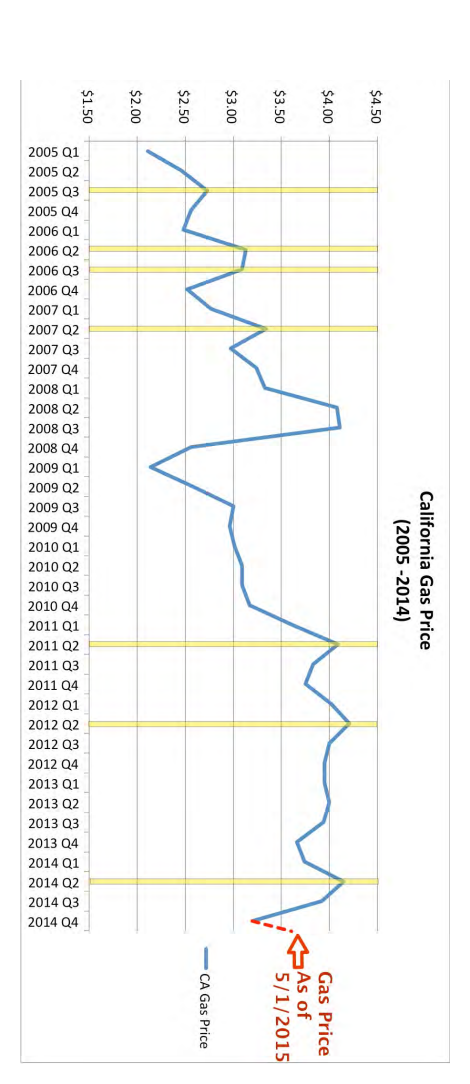
- Over the last ten years, California gasoline price spikes, absent the economic downturn, have corresponded with huge profits for California refiners.
- Over the last decade, Valero has averaged $100 million in profit per quarter. During
seven quarters with spiking gas prices, the refiner averaged $220 million per quarter – an increase of 120%. Price spikes also increased Tesoro’s average quarterly operating income of $142 million per quarter up to an average of $231 million.
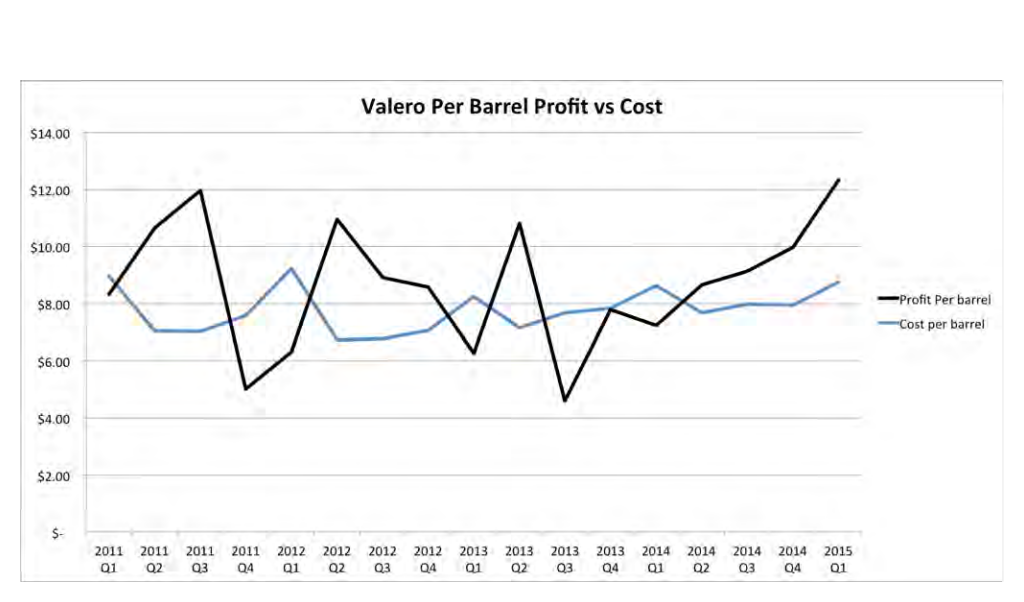
- During the last five years, Valero’s average quarterly refinery profits have not fully recovered since the recession – averaging $25 million per quarter. In the first quarter of 2015, as gasoline prices began to spike in early February, Valero’s California operating income (profit aYer deducting operating costs) per barrel increased by $1.55 per barrel. The company reported $82 million in California refining profit, their best 1 quarter operating income since 2009 and almost triple their average income since then.
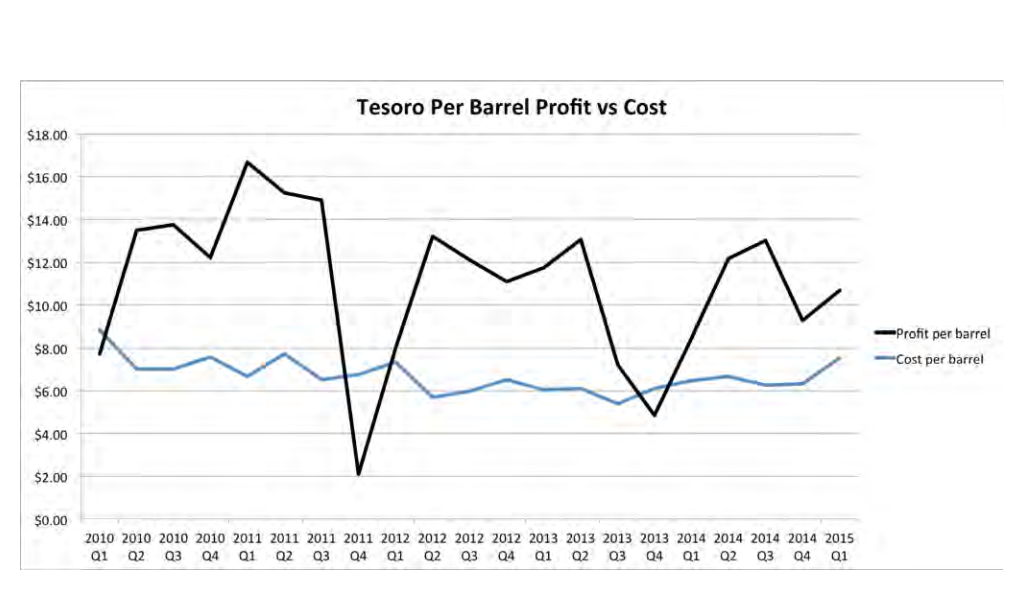
- Tesoro, despite closing a refinery during a labor strike and paying higher prices for gas on the spot market to make up for it, increased its profits per barrel by 20 cents in the first quarter, adding to California’s huge price spikes. Tesoro registered a $119 million profit on its California refineries, which is similar to its five year average of $124 million. (This figure was calculated using public data on their profits per barrel and barrels refined per day, since Tesoro, unlike Valero, reports margins & costs only by the barrel.)
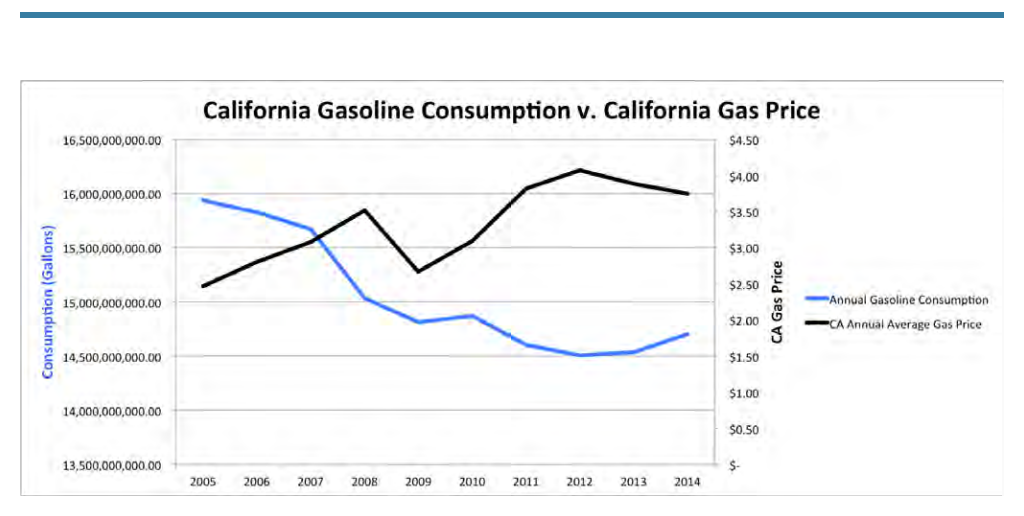
- Though gasoline consumption has dropped by 8 percent since 2005, average gasoline prices in 2014 were 51% higher than in 2005.
1 Quarter Profits & Costs for Valero and Tesoro
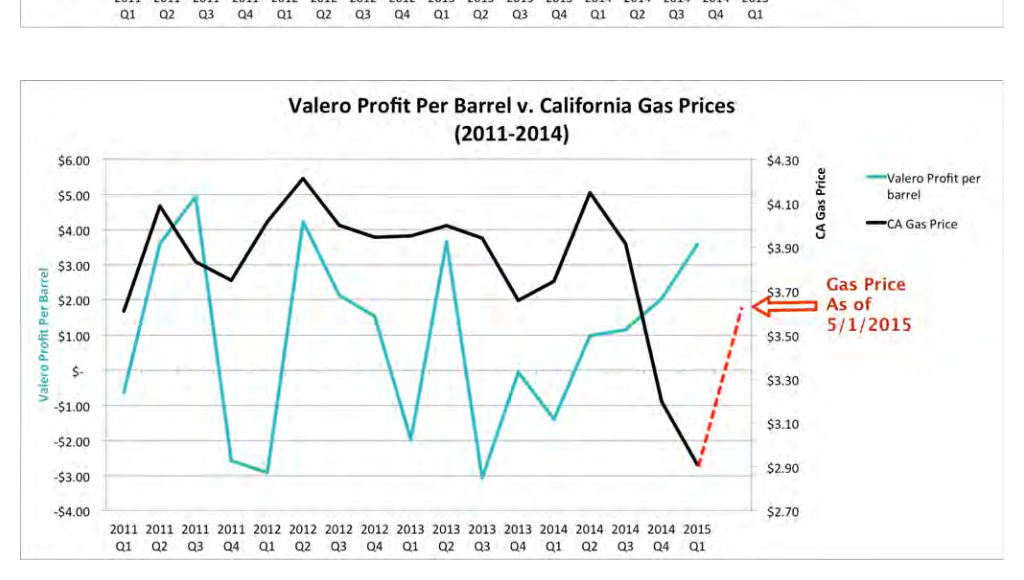
The following two graphs show data from the companies’ own SEC filings and chart per barrel operating income over the last five years, which is refining profits in California aYer expenses, and self-‐reported costs per barrel of refined product. Tesoro, which experienced a strike and shutdown, and Valero, which experienced no problems, scored big California profits during the first quarter of 2015, as gasoline prices spiked. Tesoro’s cost of making refined products rose $1.20 per barrel (since it had to buy gasoline on the spot market to cover for its downed refinery and contract to replace striking workers), but profits per barrel sDll increased by 20 cents over the previous quarter to reach $3.14 per barrel. Tesoro passed through costs and marked the price of gasoline up to more than cover for them. Valero, which experienced no problems, followed Tesoro’s lead marking up the price of products far above any increase in costs because the market could bear it. Historically costs for both companies have remained stable but profits have peaked with gasoline price spikes (see graphs below).
Historical Profits Versus Gas Prices
In the last four years, the pattern shows that as gas prices spiked, so did Tesoro’s and
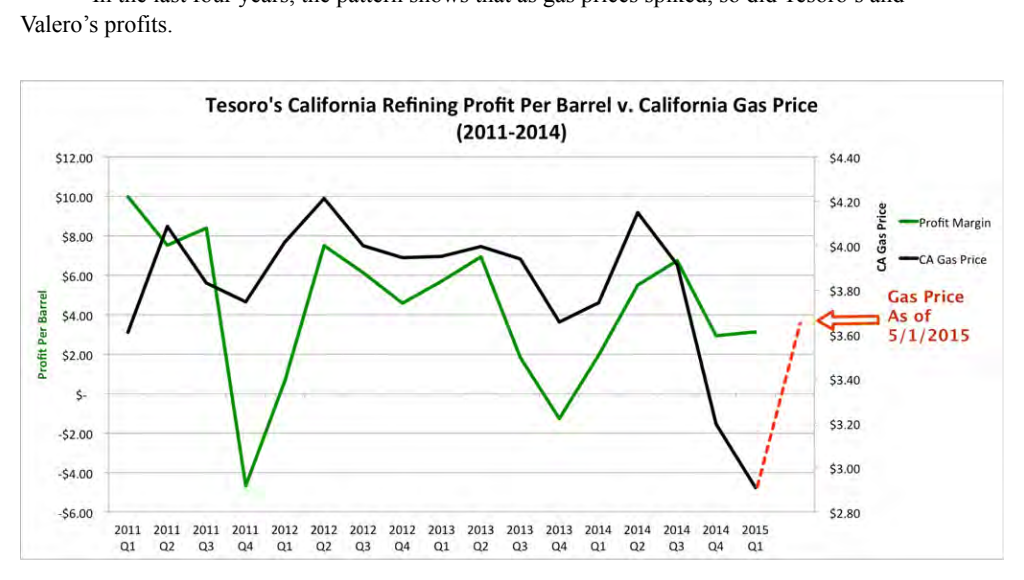
Valero’s profits.
(2011-2014)380 e.:::::::::i “‘ “‘ e I
m w ITT ~ m w ITT ~ m w ITT ~ m w ITT ~ m (2011-2014)370 “‘ e e $- .,
fioeGuu2uaN N ,,. ,,. D rren0 0 0 0 0 g 0 p g s “‘ “‘ “‘ “‘ o reCnyl a,yiee2006 Ql nQ
d nm,y l
gtor-N ~0 c2 a rea…
n1eoi1m-;:;
- tah2010 Q4 “‘ oe…
e RW .◊ t:’.o e: ,,
- 7
California Gasoline Consumption v. California Gas Price ,g 15,500,000,000.00 $3.00 $2.50 -0~.
.g 15,000,000,000.00
Conclusion
The findings of this report bolster the conclusion of our last report, “Price Spiked.” Oil refiners are making huge profits with each gasoline spike. Their incentive is to keep the current system of low inventories, downed refineries and little transparency in place. Governmental intervention is the only hope for changing a system that’s been tilted against drivers for the last decade. On March 24th, 2015 the California State Senate held an oversight hearing into why gas prices in California spiked a dollar over the space of a month after two refineries went offline. Industry CEOs did not appear to answer lawmakers’ questions about why the California market does not function like a typically competitive market should. Consumer Watchdog again recommends that California legislature take the following steps to benefit consumers:
- Create greater transparency and accountability for refiners. California should publish refinery maintenance schedules, outages, and accidents in real time, and ask refiners to publicly disclose weekly supply figures.
- The state should require refiners to keep another week’s worth of gas supply on hand so that it matches national days of supply.
- The state should accelerate the transition to alternative transportation technologies such as electric
vehicles.