Introduction
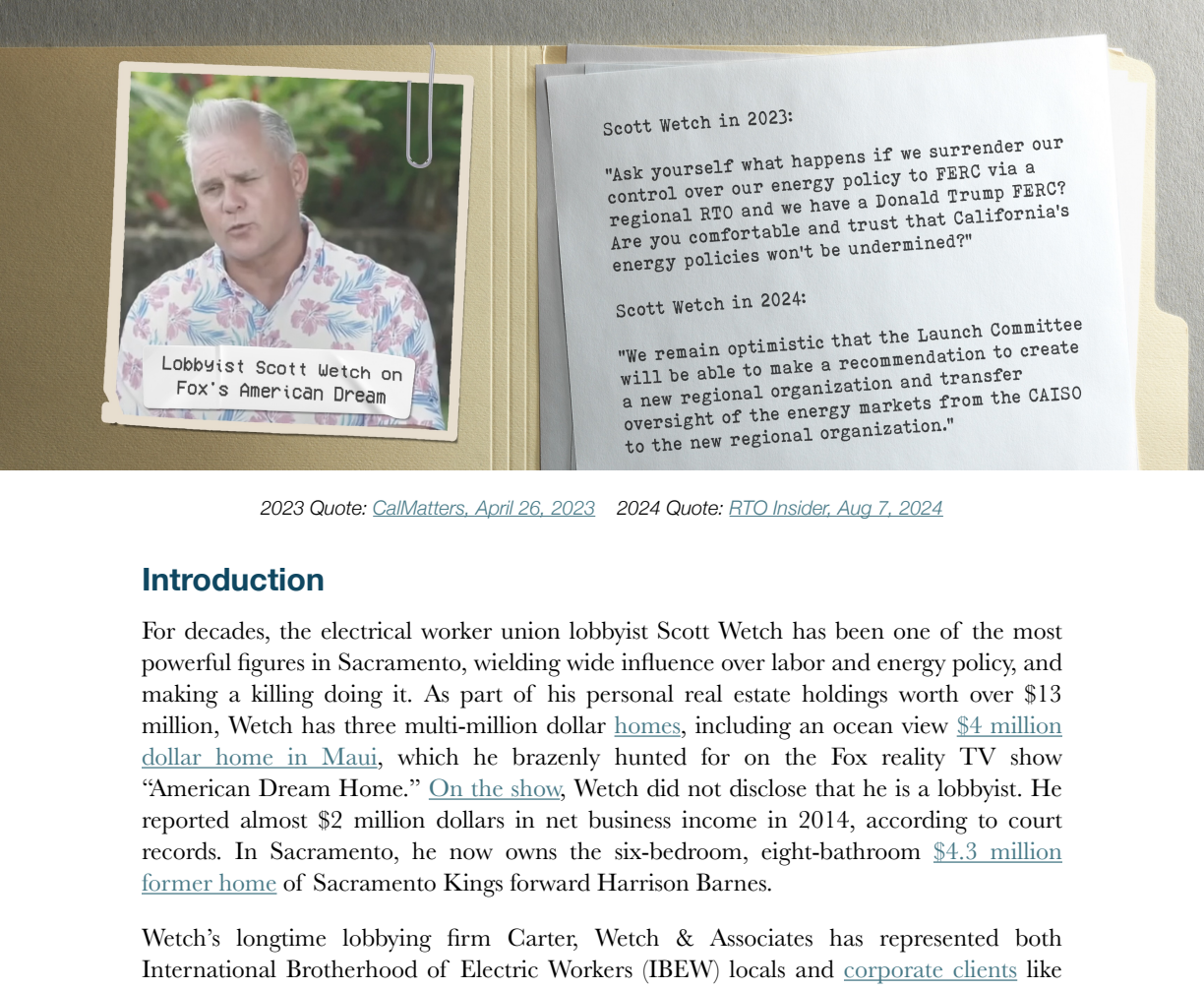
For decades, the electrical worker union lobbyist Scott Wetch has been one of the most powerful figures in Sacramento, wielding wide influence over labor and energy policy, and making a killing doing it. As part of his personal real estate holdings worth over $13 million, Wetch has three multi-million dollar homes (opens in new tab), including an ocean view $4 million dollar home in Maui (opens in new tab), which he brazenly hunted for on the Fox reality TV show “American Dream Home.” On the show, (opens in new tab) Wetch did not disclose that he is a lobbyist. He reported almost $2 million dollars in net business income in 2014, according to court records. In Sacramento, he now owns the six-bedroom, eight-bathroom $4.3 million former home (opens in new tab) of Sacramento Kings forward Harrison Barnes. Wetch’s longtime lobbying firm Carter, Wetch & Associates has represented both International Brotherhood of Electric Workers (IBEW) locals and corporate clients (opens in new tab) like Amazon, BP, UnitedHealthcare, Lyft, and Southern California Gas Company. The firm reported payments (opens in new tab) of $8.5 million for the 2023-24 legislative session, including around $1.4 million from labor, according to Secretary of State lobbying records. On the major issue of California’s energy independence, Wetch has repeatedly opposed regionalization of California’s electricity grid, arguing it would hurt workers and undermine California environmental laws. His political power has repeatedly helped stop the proposal. In 2018, Wetch opposed Assembly Bill 813 (Holden). “The election of Donald Trump and his appointment of a new majority at the Federal Energy Regulatory Commission (FERC) establishes new risks that regional wholesale markets could be used to frustrate California’s energy policy goals, devalue renewable energy resources, and force California customers to subsidize the continued operation of coal-fired generation located in other parts of the West,” said a letter (opens in new tab) signed by Wetch’s labor clients. In 2023, Wetch again sounded the Trump alarm and correctly forecasted the grid problem by opposing AB 538 (Holden), warning that the plan would “eliminate over a million construction jobs” and “surrender control over our energy policy to…a Donald Trump FERC.”
In 2025, Wetch now supports the latest regionalization effort, SB 540 (Becker), which could translate to the political support necessary to pass the new proposal, rebranded as “Pathways.”
But SB 540 is largely the same as its predecessor proposals. As the last section of this report shows, the newly formed Regional Organization (RO) will still have its market rules determined by Trump’s FERC, endangering California’s Renewable Portfolio Standard (RPS), our targets for clean energy goals, and other environmental laws. So what’s changed?
That’s the subject of this investigative report, which traces Wetch’s financial self-interest in pushing SB 540 at the expense of California.
These are the main findings:
- PacifiCorp, a Western utility owned by Warren Buffet that is a main backer of the Pathways proposal, signed a lucrative new contract in 2024 with IBEW Local 659
- cementing the alliance with IBEW, Wetch’s big client.
- Data centers and their need for more energy to power the AI revolution are driving the rush to a Western Regional Organization, and IBEW workers are the principal beneficiaries of the growth of data centers. The data centers are being built by IBEW workers in what has been described as a gold rush for unionized electricity workers. Wetch has pushed for more data centers, and his newfound support for Pathways is consistent with getting more data centers online regardless of the cleanliness of the power that runs them.
- The biggest driver of Pathways is no longer just PacifiCorp, but Amazon, Google and Microsoft, and the rest of the Magnificent Seven stocks that need more and more electricity for their AI operations. Amazon is a Wetch client, and the future synergies for his new lobbying firm Actum are clear. The two biggest shadow backers of Pathways are Wetch and Governor Newsom, whose fealty to AI and Silicon Valley’s goals is clear in his legislative record. SB 540’s author Senator Josh Becker, known as an environmentalist, also represents the Silicon Valley and his financial disclosure forms show he has lucrative investments of up to $3.5 million in an AI-driven stock portfolio and a consulting gig for one AI technology company worth more than $100,000.
- Becker reportedly told multiple people around the Capitol he promised the Governor and Wetch he would get SB 540 done. Becker has thus far refused to take a pledge, proposed by Consumer Watchdog (opens in new tab), to resign from public office if California’s RPS is invalidated by Pathways.
- SoCalGas is a client of Wetch, according to disclosures from a state commission Wetch sits on, and his new firm Actum. SoCalGas and its parent company Sempra will benefit under the Western grid as Sempra owns a company that builds transmission lines and more lines will be needed and financed by ratepayers. The utility previously created an Astroturf front group to fight electrification across California that, according to IRS forms (opens in new tab) obtained by Consumer Watchdog, lists Wetch as a board member.
- Pacific Gas & Electric, the employer of IBEW, will also benefit from the Western grid because of the incentive to build more transmission lines and to charge more for their power under the RO scheme. Wetch has long had an alliance with PG&E in the Capitol, fronting through the IBEW for various PG&E proposals. On legislative issues, he’s aligned labor with PG&E and SoCalGas to fight environmental, consumer rights, and affordable housing bills.
- The investigation also turned up numerous personal transgressions by Wetch. The utility worker union lobbyist has three times had liens filed against him for failing to pay utility bills. In 2013, Wetch was charged with driving under the influence in Sacramento County, to which he pleaded no contest to a reduced charge, and was sentenced to a maximum of nine days in jail and three years’ probation, according to court records on the Lexis system. His divorce revealed how Wetch is willing to wield his wealth and influence as a cudgel to silence those who stand in his way. In one particularly provocative text message attached to the court, Wetch said: “I have the access to capitol [sic] and earnings capacity to litigate you to death. You have fucked with the wrong guy….You want to go to the ground, bring it on bitch!!!!!!!”

New IBEW Contracts from Main Pathways Backer PacifiCorp to Wetch’s Big Client IBEW is the largest labor union in the power sector with about 85,000 members (opens in new tab) at coal and natural gas power plants. IBEW locals who stand behind Pathways also staff corporate utilities in other states, such as NV Energy and PacifiCorp, both of which are owned by the Warren Buffet’s Berkshire Hathaway, a notorious burner of fossil fuels. PacifiCorp is one of the biggest lobbyists (opens in new tab) in Sacramento. PacifiCorp-owned Pacific Power are under two contracts with IBEW unions – Locals 659 (opens in new tab) and 125 (opens in new tab) – who recently signed a letter supporting (opens in new tab) the Pathways plan. IBEW electricity utility worker unions, in turn, paid Carter Wetch & Associates $235,000 just for lobbying, according to financial records from the 2023-24 legislative session. IBEW 1245 is also currently under contract (opens in new tab) with NV Energy-owned Sierra Pacific Power Company. This raises the question: Are Wetch and IBEW for California or for Berkshire Hathaway?
New AI Data Center Jobs For IBEW Between the last time Wetch supported the Pathways initiative in 2023 and his flip in 2025, Wetch helped push for more data centers, which are the servers that store and process information. Using labor as a sword, Wetch supported in 2024 the failed pro-data center bill SB 1298 (opens in new tab), which sought to fast track the data center approval processes in California and expand their capacity. Amidst the arms race to power artificial intelligence, major tech companies are pushing for the development of data centers, which require huge amounts of electricity. Wetch and his labor clients have been behind a drive to streamline data centers, as IBEW has been summoned to work on them all over the country. Microsoft alone said it will need (opens in new tab) 2,300 electricians in the next few years. This is a huge boon for the IBEW—as the electricians in its Washington data centers are all union.
But data centers present a problem. They are projected to grow U.S. electricity demand by 456 percent (opens in new tab) in the next five years. For data centers that Amazon has been approved to build in the state of Washington alone, the amount of electricity required to run them is the equivalent to the power needed to run nearly 6 million homes (opens in new tab), more than the entire country of Chile. And it will be consumers who will have to pay for this, not the data industry, or utilities. Starting this year, the mid-Atlantic region could see an increase in electricity bills by up to 24 percent (opens in new tab) because of the proliferation of data centers in the area.
it will be consumers who will have to pay for this, not the data industry, or utilities. Starting this year, the mid-Atlantic region could see an increase in electricity bills by up to 24 percent because of the proliferation of data centers in the area.
Data centers also raise questions about their environmental sustainability because they cannot run on 100 percent renewable energy. A Siemens executive recently said (opens in new tab) that there isn’t enough clean energy on the planet to power data centers. At an Amazon data center in Oregon, carbon emissions over the last 15 years are up more than 500 percent (opens in new tab). The company is now planning to fuel the data center on natural gas, much like the one it runs in Virginia. In 2023, Amazon fought against a bill (opens in new tab) in Oregon that required data centers to operate on clean energy. Because of data centers, utilities seeking to meet industry demand are proposing new fossil fuel plants and to keep online coal plants that are supposed to be phased out. In a 2023 proposal by Dominion Energy to meet this new energy demand, it recommended (opens in new tab) the possibility of up to seven new natural gas plants and delaying retirement of two coal-fired plants. The need for powering data centers is so great that Exxon (opens in new tab) is building a huge natural gas plant aimed at supplying electricity to data centers.
Meanwhile, AI developers Microsoft, Google (opens in new tab), and Amazon are among the big proponents (opens in new tab)
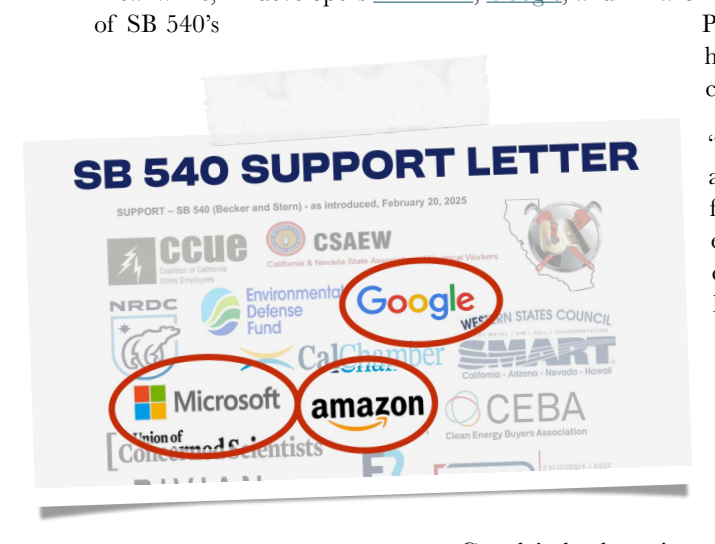
of SB 540’s Pathways plan because it will
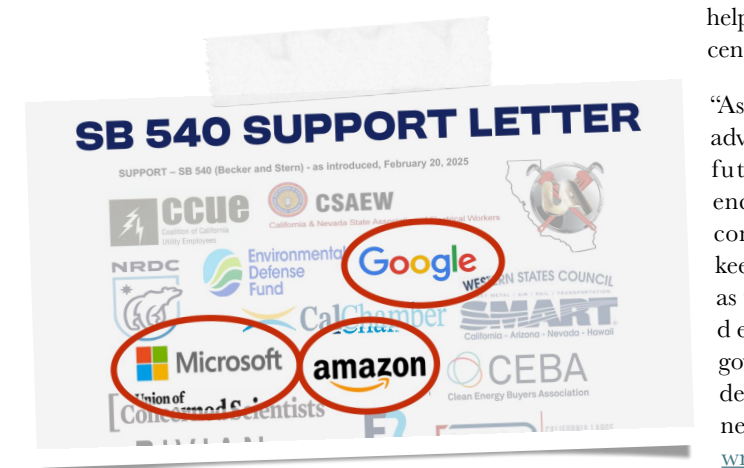
help power their massive data centers.
“As the Pathways Initiative advances and evolves through future phases, Microsoft encourages the stakeholder community to continue to keep a fully integrated RTO as the north star when making decisions regarding governance structure, tariff development and pursuing necessary legislative efforts,” wrote (opens in new tab) Microsoft in 2024. Google’s lead on its energy purchasing (opens in new tab) said, “As a large, focused buyer of renewables, it’s very important for us to be involved in RTO markets. As we expand our footprint with our data centers and our operations and expand our footprint with renewables…I do envision us probably getting involved in more RTOs.”
“We would like to have a Western RTO, but we certainly won’t let things be slowed down by forming the RTO,” said Xing Wang, global leader of grid modernization for Amazon Web Services Inc. energy and utilities.
Data centers also raise questions about their environmental sustainability because they cannot run on 100 percent renewable energy. A Siemens executive recently said that there A Siemens executive recently said that there isn’t enough clean energy on the planet to power data centers.
utilities seeking to meet industry demand are proposing new fossil fuel plants and to keep online coal plants that are supposed to be phased out. In a 2023 proposal by Dominion Energy to meet this new energy demand, it recommended the possibility of up to seven new natural gas plants and delaying retirement of two coal-fired plants. The need for powering data centers is so great that Exxon is building a huge natural gas plant aimed at supplying electricity to data centers.
Satisfying the data center need for electricity and electricians no doubt makes the concerns about Trump’s threat to California sovereignty more palatable for Wetch and Senator Becker. According to his disclosure forms (opens in new tab), Becker has ownership and investments in the range $250,000 to $3.5 million with several companies that invest in AI and quantum computing companies, including Akkadian Holdings (opens in new tab), Akkadian Ventures, J- Ventures Capital Fund II (opens in new tab), and SB Technology, (opens in new tab) the latter of which emerged from Alphabet, the parent company of Google. Among the companies that Akkadian has invested in is Peter Thiel’s Palantir. SB Technology also paid Becker more than $100,000 for his work as an “advisor to the company.”
Corporate Synergy Amazon, a big backer of the Pathways initiative, was a client of Wetch’s lobbying firm. Carter, Wetch & Associates was paid (opens in new tab) by the company in 2024 to lobby a high-profile journalism bill that Amazon opposed (opens in new tab). The bill, which died, would have helped a dying journalism industry by charging a tax on tech giants who took away ad dollars from news organizations. Channeling his role as a Malihini, Wetch professed his love for Bezos:
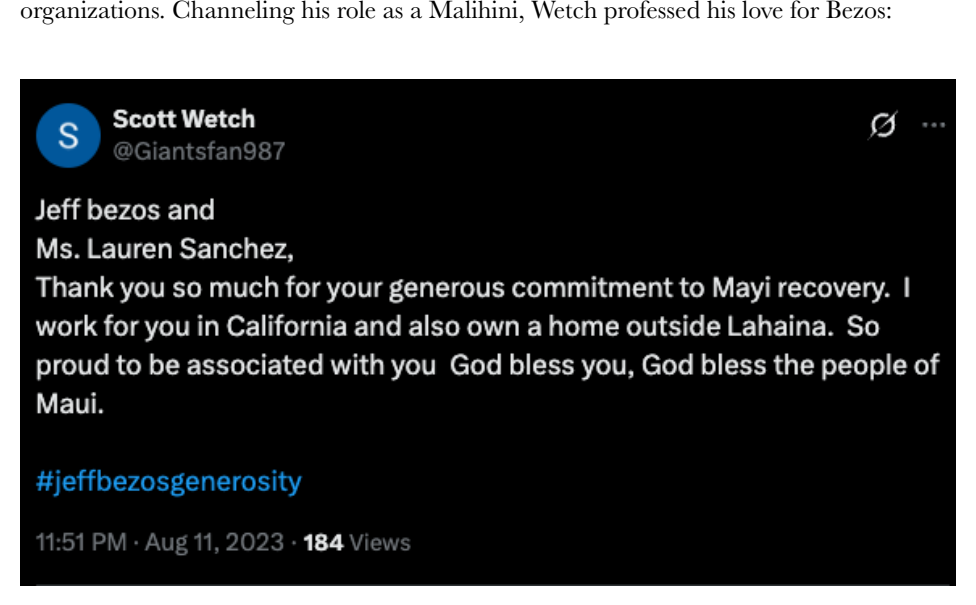
Wetch praising Amazon’s Jeff Bezos.
Although he isn’t officially registered as a lobbyist for SoCalGas, Wetch has been paid by the investor utility, according to financial disclosure forms filed by Wetch for his post on the California Athletic Commission. SoCalGas has also been a client of the lobbying firm Actum, which bought Wetch’s firm in 2024.
SoCalGas has supported California’s entry into the Western grid through multiple front groups. Sempra, SoCalGas’ parent company, is a member of the California Chamber of Commerce (opens in new tab), California Energy Storage Alliance, (opens in new tab) and the Western Power Trading Forum, (opens in new tab) all of whom supported folding California into the Western grid. Sempra has a transmission building company that will profit greatly from the grid expansion, which will allow for building of new transmission lines and justify rate increases. SoCalGas also bankrolled an astro-turf advocacy group called California Balanced Energy Solutions (opens in new tab) (C4BES), which blocked progress toward electrification and pushed for continued investment in natural gas until it was exposed as improperly using ratepayer money. (opens in new tab) The Sierra Club and the California Public Utilities Commission discovered SoCalGas gave the group seed money, and that a SoCalGas employee appeared to recruit members (opens in new tab) for C4BES’s board. According to IRS forms (opens in new tab) obtained by Consumer Watchdog, the front group lists Scott Wetch as a board member. During its brief existence, the front group created the illusion that there was grassroots opposition to electrification in California. It challenged electrification throughout the state in deceptive ways, including on the social media platform Nextdoor, where it tried to sow outrage over a building electrification ordinance.
In a post titled, “Culver City banning gas stoves?” a person named Wilson Truong wrote, “First time I heard about it I thought it was bogus, but I received a newsletter from the city about public hearings to discuss it…Will it pass???!!! I used an electric stove but it never cooked as well as a gas stove so I ended up switching back.”
But according to Mother Jones (opens in new tab), the poster was a fake account created by a C4BES public relations firm.
Another strategy by the front group was exploiting social distancing policies during the Covid pandemic in order to block efforts toward electrification. This time the front group sent the head (opens in new tab) of the Utility Workers Union of America Local 132, which represents thousands of SoCalGas workers, to scare away San Luis Obispo officials from holding the vote on all-electric buildings. And it worked. The city canceled the vote. PG&E will also profit from the Pathways initiative and its payments to it IBEW union members that help pay Wetch’s rent, for which he has long reciprocated in kind with support for anti-environmental PG&E policies. He has supported laws blocking rooftop solar subsidies (opens in new tab), for example, the bane of PG&E, stopped consumer rights (opens in new tab) bills for rate relief that PG&E opposed and he often splits with lawmakers (opens in new tab) on environmental and clean energy issues that the utility dislikes.
Over the past nearly 20 years, PG&E has spent almost $40 million (opens in new tab) in lobbying in the state of California, marshaling Wetch and its union credentials through the years. In 2017, Wetch opposed SB 100, (opens in new tab) which would have transitioned California toward 100 percent renewable energy, but the ramifications were too big on major state utilities such as PG&E who made money off natural gas-fired power plants. The bill passed in 2018, creating a centerpiece of the Renewable Portfolio Standard (RPS) that Pathways now threatens. In 2024, PG&E lobbied against a bill—AB 2666— that would let the public know how much utilities spend on infrastructure after receiving rate hikes. At the same time, Wetch opposed the bill (opens in new tab) on behalf of California Coalition of Utility Employees (CUE), whose workers are employed by PG&E and other utilities. Wetch’s other clients, IBEW 1245, comprised of thousands of PG&E workers, and the California State Pipes Trades Council, also opposed the rate transparency bill. Meanwhile, PG&E posted record profits for 2023—$2.2 billion—but still claimed it wasn’t getting enough rate hikes. (opens in new tab) During the 2023-24 legislative session, Wetch put workers in lock step with PG&E and SoCalGas on several bills. They include:
- AB 2054: The law would have helped address the revolving door between government entities and the corporations whom they regulate, and require wildfire spending by investor-owned utilities to include a cost-benefit analysis. But Wetch, PG&E, SoCalGas and their workers held hands to oppose the bill.
- AB 2292: This bill took away transparency from utility transmission development, an issue that effected farmers especially. Wetch, IBEW 1245, the California State Association of Electrical Workers, and the Coalition of California Utility Employees all supported this bill with PG&E.
- AB 3111: A bill that would have blocked the access to local clean energy and protected the monopoly interests of corporate utilities was supported by both Wetch, PG&E and its workers. The bill faced enormous opposition from virtually everyone else except PG&E and workers, the only entities to oppose it.
“Yes, the advocate for
E U D T S A P
utility workers and utility companies didn’t pay his utility bills”
Personal Contradictions Highlight How Wetch Is Not What He Seems To Be A workers’ lobbyist with a second $4 million home on the Maui coast is just one of the contradictions that undermines the image Wetch portrays in the Capitol. Since Wetch’s relationships and personality are key to his power, Consumer Watchdog dug through his past and found evidence that Wetch is hardly the working man’s representative he portrays himself to be.
- According to Sacramento County public records, officials filed liens against Wetch for delinquent utility service charges at his properties (opens in new tab) three (opens in new tab) times (opens in new tab). Yes, the advocate for utility workers and utility companies didn’t pay his utility bills on time.
- In 2013, Wetch was charged with driving under the influence in Sacramento County, to which he pleaded no contest to a reduced charge, and was sentenced to a maximum of nine days in jail and three years’ probation, according to court records on LexisNexis (opens in new tab). Sacramento County Superior Court Case #13T03058, Filed July 10, 2013.
- Unmasked as a tiki bro on the Fox reality show, Wetch said (opens in new tab) that he wanted to buy a home in Hawaii in order to “calm his life down.” He didn’t disclose his occupation on the show, in fact he disguised it by discussing his investments at an early age as the reason for his good fortunes. “The whole sort of aloha lifestyle is really more of a spiritual sort of way,” explained Wetch.
- His divorce revealed how Wetch is willing to wield his wealth and influence as a cudgel to silence those who stand in his way. According to his divorce records, Wetch texted the following to his former wife:

Text message from Scott Wetch divorce records.
SB 540 Poses the Same Perils as Previous Regionalization Proposals While Wetch’s interests have changed, SB 540 poses the same dangers to the California’s clean energy laws as previous proposals.
Like its predecessor proposals, SB 540 hands the power over California environmental laws to FERC at grave risk to California’s RPS and other clean energy laws. The California Senate Judiciary Committee analysis (opens in new tab) of a similar proposal from 2018 sums up the problems: “This change in governance would place control over California’s energy market in the hands of a Western states RTO heavily dominated by coal interests (the largest coal-producing states in the U.S.) and under the direction of the Trump administration. California’s policies for transitioning to renewable energy—and initiatives to develop distributed or decentralized energy resources—would be subject to review and revision by a market authority that is not interested in either.”
The sovereignty issues that have doomed the Western Regional Transmission Organization (RTO)/Pathways,
“What has happened is
and prevented it from becoming law, have not gone away, in fact they have become more perilous following the
the need for more power
presidential election.
due to the inexhaustible
What has happened is the need for more power due to the inexhaustible hunger of data centers to power AI has
hunger of data centers to
caused some people to conveniently forget the Achilles heel of Pathways.
power AI has caused
Pathways proponents claim that California needs more
some people to
power and more renewable electricity, and that a Delaware corporation operating regional electricity
conveniently forget the
markets will make that happen. The problem is that the
Achilles heel of
Delaware company will be entirely subject to FERC’s rules, a FERC with Donald Trump’s appointees on it, not
Pathways.”
California’s.
Changing California law and statutory requirements to allow a regional market operator that will be a Delaware corporation eliminates all the protections that ISO v. FERC provides California to require the market operator to follow California law and propose market rules that follow California law. ISO v. FERC, 372 F.3d 396 (D.C. Cir. 2004). California is now shielded from any challenge to its authority over the board of CA’s market operator, CAISO, because it is a California corporation. California cannot be forced to violate California’s environmental laws. That protection vanishes if California cedes its authority to a Delaware corporation that runs the regional market. Under Pathways as envisioned in SB 540, the CAISO remains the transmission grid operator, but it will transfer its right to propose tariffs (the rules for how the markets and the transmission grid operate, called Section 205 filing rights) to a Delaware (DE) corporation, called a Regional Operator (RO). The Delaware RO will control all the tariffs dictating how all electricity markets operate and how California runs its grid. California would give up its right to demand that its environmental, consumer and health safety laws be followed.
- California’s laws (P.U.Code §345.5(b)) requiring CAISO to run CA’s electricity markets and California’s grid consistent with the interests of the people of CA and to minimize prices and maximize supply for CA consumers will be made inoperative. The law was created after the Enron crisis to protect Californians. SB 540 eliminates this law.
- Pathways allows the Trump Administration to require CA to buy coal-fired electricity. It will allow Trump to require CA (and the entire regional market) to subsidize the purchase of coal-fired power throughout the West. If Trump requires coal subsidies in regional markets, as he promised and started to do in 2018, California will be required to buy and use electricity made from coal.
- Pathways creates the risk that the DE regional corporation will block the development or expanded use of distributed energy resources in CA. The Delaware RO could file tariff rules that hurt CA’s development of distributed clean power, and instead promote coal, nuclear and fossil resources. The regional operator could require CA help pay for transmission lines in other states in the regional market that support coal and nuclear power plants or are costly and unneeded. In January 2025, PacifiCorp reneged on its promise to shut down its Utah coal plants. California could be required to subsidize their coal power instead of developing its own clean power.
- Pathways risks invalidating CA’s landmark RPS laws. Any market participant or prospective market participant, such as a coal plant owner, can challenge California’s RPS, which sets targets for California’s clean energy goals, as a violation of the Interstate Commerce Law and invalidate the RPS law. Changing our California-only electricity market to a multi-state market makes us vulnerable to lawsuits claiming that our RPS law violates interstate commerce. Even if all the utilities or states joining the regional market operator agreed that California laws, as well as policies, would remain effective, any company could still sue California to invalidate the RPS.
Pathway makes California more vulnerable to the Trump FERC and provides the best opportunity for Trump to hold California over a barrel or hurt our economy and consumers.
The proponents argue that new “guardrails” have been erected under SB 540. They claim keeping the RTO as a California corporation, CAISO, will allow it to withdraw from the Delaware RO if Trump’s FERC or an interstate commerce challenge invalidate the RPS or other clean energy rules. However, FERC and the RO will have to approve that withdrawal and can place rigid conditions on it that could be prohibitive. A Harvard law professor warned (opens in new tab) Connecticut of the dangers: “FERC could block withdrawal and
may be more inclined to do so if ISO-NE or a New England utility protests withdrawal.” The RO has been compared to the Hotel California. You can check out, but you never leave.
“Pathways is not needed to get California more power from the West. California already buys and sells electricity through the West without ceding power to a regional operator.”
Even if CAISO remains the balancing authority, the Delaware corporation will hold all the cards and possess the authority to make the rules for both the markets and the transmission grid, solely subject to FERC’s jurisdiction.
SB 540’s provision that the RO’s statement of corporate governance will respect the right of California and other entities to set policies is not legally binding on the RO, nor will it prevent market participants who want to challenge California’s environmental laws. Similarly, giving CAISO the power to pull the trigger in 2027 is only delaying the inevitable — CAISO and its free market appointees are big backers of Pathways. CAISO’s President and CEO Eliott Mainzer, for example, was once an Enron trader. No exit ramp exists if this experiment goes bad given that the new Regional Operator and the Trump FERC will set the conditions for separation, and the cost, if history is to prove prologue, will be
“No exit
prohibitive.
ramp exists
Moreover, Pathways is not needed to get California more power from the West. California already buys and sells electricity through the West without ceding power to a regional operator.
if this
Many of the same forces that advocated California’s deregulation law are aligned to enact Pathways. The IBEW unions among
experiment
them. NRDC, another principal backer of the deregulation law, has been a driving force for Pathways. Ralph Cavanagh, an
goes bad”
NRDC attorney, was the chief booster of the Western power trading market. He famously said (opens in new tab) in 1997, “Can you trust Enron? On stewardship issues and public benefit issues…the answer is, yes.”
Western power trading and arbitraging comes with its own risks that California has rightly steered away from after its deregulation disaster. Trump poses the ultimate challenge.
The electricity deregulation law passed unanimously under the same conspiracy of silence and self-interest that Pathways seems to be greased with. Consumer Watchdog sponsored a ballot measure in 1998 to do away with the worst parts of the deregulation effort, paying the stranded assets that wound up on our electricity bills for 30 years. Prop 9 failed because of utility opposition, but we were right about the impact of deregulation. Markets that are unfettered will eat the consumer and our environmental laws too. There is another critique of why Pathways is likely to drive up utility rates, by incentivizing the building of transmission lines, and cost California jobs. For the purpose of this report, it is enough to show that the reasons Wetch claimed to oppose regionalization in the past are still a problem. The substance of the proposal has not changed, Wetch’s motivations have.