Executive Summary
Californians have paid $7.5 billion more than they should have for their gasoline since California’s record gasoline price spike began in February of 2015, according to a Consumer Watchdog analysis of state and federal data. That amounts to $314 per California driver. The number takes into account California’s higher taxes.
Those dollars reflect the higher price that Californians pay for gasoline than the rest of the nation, after adjusting for the relative tax difference. At various times throughout the year, Californians were paying over a dollar more per gallon of gasoline than the nationwide average. During July, consumers in Los Angeles paid over $1.50 more than the national average for a gallon of gasoline. California’s gas prices have remained higher throughout 2015 than in the traditionally high cost states of Hawaii & Alaska.
California’s record gas prices, far above the US average, helped bankroll refiners’ increased spending on lobbying in addition to swelling their refining profits. Valero, Tesoro, and their trade association spent more in lobbying during 2015 than ever before. In 2015 they lobbied against a mandate to cut petroleum use by 50% over 15 years, SB 350, that threatened their lifeblood—the sale of petroleum products in the state.
Chevron, Tesoro & Valero, three of California’s four largest refiners that reveal California information had their best first nine months of oil refining profit in the state ever, each at least three times higher than their average first three quarters profit. Other refiners do not reveal such information.
When the California Energy Commission’s Petroleum Market Advisory Committee meets in December, Consumer Watchdog will present the following recommendations: Every California refiner should provide state-specific profit information including per barrel profits, and overall statewide profits. Valero is currently the only refiner that meets this standard. Tesoro provides more information, but not completely. Chevron should be required to disclose California-specific information. The other four major California refiners provide almost no California-specific information.
Consumer Watchdog will also ask that refiners be required to provide to state regulators information about upcoming refinery shutdowns and maintenance in order to prepare the market for decreased capacity. Currently law requires no such thing, so when major refineries schedule overlapping maintenance, prices spike.
California’s major oil refiners made record profits in the 3 quarter of 2015. Tesoro, the state’s second largest refiner, made roughly $770 million off of California refining in the 3 quarter of 2015, according to a Consumer Watchdog analysis of its financial data, which excludes amortization expenses and depreciation. This is its best quarter ever and more than four times the company’s average California profit.
Fourth largest oil refiner Valero made $342 million on California refining in the 3 quarter of 2015. That is its best quarter ever, reflecting more than six times the company’s average2 quarterly profit. Chevron, the largest refiner in California, refines the lion’s share of its petroleum products here–54%. The company made $1.2 billion on refining in the United States, its best refining quarter ever. The amount is more than three times its average quarterly refining profit.
A cratering of crude oil prices to about $46 a barrel made these leaps in California refining profits possible. While major media have focused on declining profits due to the steep fall in the price of crude, refining profits have helped offset losses in oil companies’ upstream crude oil exploration and drilling businesses. Meanwhile, companies that do not produce crude oil, but only refine it, have enjoyed profits beyond their wildest dreams.
The low price of crude oil allows for what are called ‘crack spreads’ or margins in the oil industry – the total possible profit from refining one barrel of crude oil. Because it is so cheap to purchase crude, and gas prices are still relatively high – there is a lot of profit to be captured. In a functioning market, competition would lead to lower profits.
The high profits have dovetailed with the oil industry’s big boost in political spending during the same third quarter. Often, companies’ spending on lobbying increased proportionally to their profits. Combined, the oil industry spent $11 million lobbying the California legislature in the 3 quarter of 2015. Valero’s lobbying expenses jumped to $582,000 – twelve times more than its average spending. Tesoro spent $130,046 – almost four times its usual spending. Chevron expended over $1.8 million – three and a half times the usual amount.
Golden State Gouge Gap
Californians have paid an average of 80 cents more than the national average for each gallon of gasoline since California’s price spike began in February of 2015. The number is especially jarring because before this year, California gas prices only reached the 80-cent premium once in history – for a brief weeklong period. Historically, the average gap has been 30 cents since the year 2000.
United States & California Gas Prices1 Analysis of Tesoro quarterly earnings data – http://phx.corporate-ir.net/phoenix.zhtml?c=79122&p=irol- newsArticle&ID=2103753 – their profits do not take into account amortization expenses or depreciation2
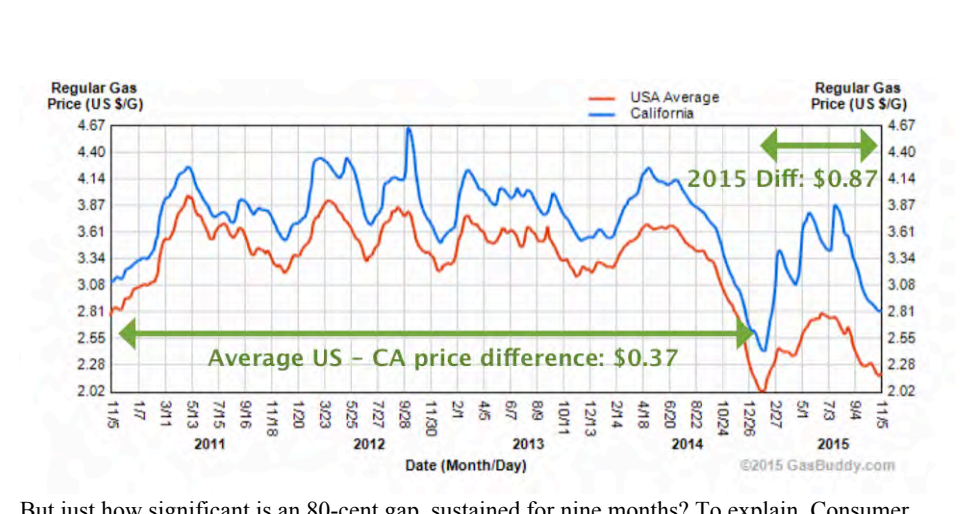
::: 2015 Diff: $0.87 .14 Average US -CA price difference: $0.3 7 ~ ~ ~ ~ ~ ~
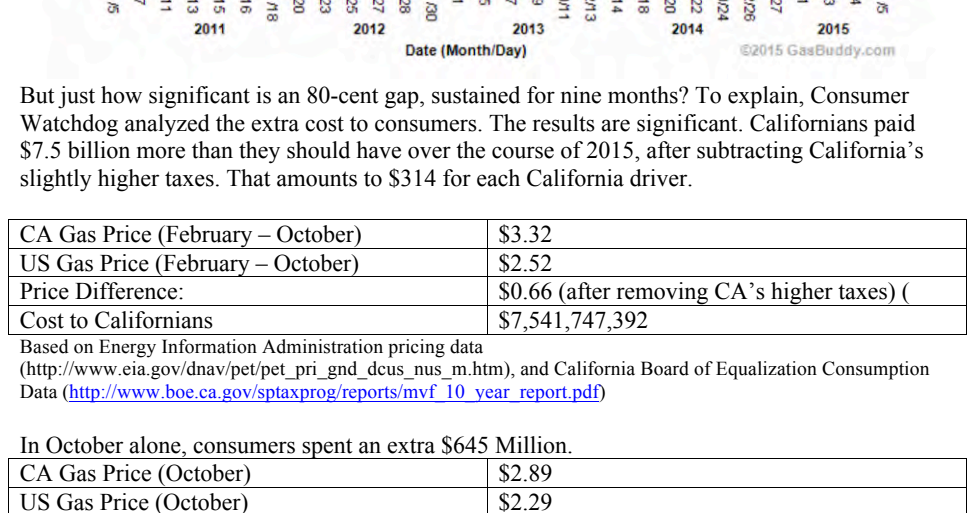
But just how significant is an 80-cent gap, sustained for nine months? To explain, Consumer Watchdog analyzed the extra cost to consumers. The results are significant. Californians paid $7.5 billion more than they should have over the course of 2015, after subtracting California’s slightly higher taxes. That amounts to $314 for each California driver. CA Gas Price (February – October) $3.32 US Gas Price (February – October) $2.52 Price Difference: $0.66 (after removing CA’s higher taxes) ( Cost to Californians $7,541,747,392 In October alone, consumers spent an extra $645 Million.
CA Gas Price (October) $2.89 US Gas Price (October) $2.29 Price Difference: $0.51 (after removing CA’s higher taxes) Cost to Californians $645,335,677
rd 3 Quarter Profits
Valero Valero is California’s fourth largest oil refiner, and is one of only two companies in the state that releases California-specific information. The company, which only refines oil, but does not drill for it, is riding the wave of low crude prices. In the 3 quarter, its most profitable California
| CA Gas Price (February – October) | $3.32 |
|---|---|
| US Gas Price (February – October) | $2.52 |
| Price Difference: | $0.66 (after removing CA’s higher taxes) ( |
| Cost to Californians | $7,541,747,392 |
| CA Gas Price (October) | $2.89 |
|---|---|
| US Gas Price (October) | $2.29 |
| Price Difference: | $0.51 (after removing CA’s higher taxes) |
| Cost to Californians | $645,335,677 |
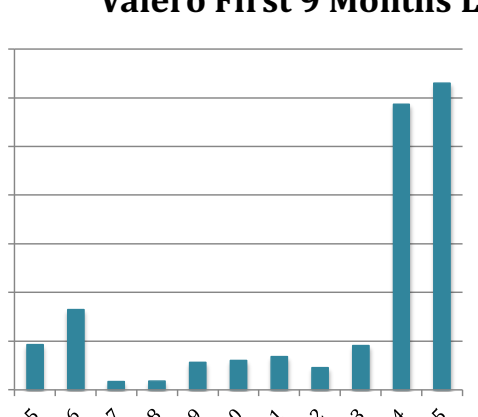
quarter ever, Valero made $342 million. Year-to-date, the company has made $718 Million, their best first three quarters in California since they started using this metric in 2010. To put the $718 Million in context – it’s almost double the sum of all their California profits since 2010 – $447 million.
The quarterly profits of $342 Million are six and a half times more than its average California profit since 2010, and twelve times more than the company made in the same quarter last year.
Valero California Operating Income (millions)
Usually, Valero’s margin per barrel is only slightly higher than the cost per barrel. Valero refines hundreds of thousands of barrels per day so even a small per barrel profit means millions of dollars. The margin is the amount of money a refiner can potentially make from a barrel of oil. In 2015, margins went up sharply, deviating from the norm, while costs stayed stable. The margin can be thought of as what the company sells a barrel of refined product for. If you subtract the costs of running a refinery and the cost of the crude oil, you find the profit per barrel. In the chart below, the company’s margin was $21 per barrel – meaning that’s how much they sold that product for. Costs were roughly $8. Thus, the company received $13.54 per barrel of crude oil they processed in California. Its average per barrel profit since 2005 has been $4. In the same quarter of 2014 they made $1.16 per barrel.3 In the chart below, when the cost bar is above the margin bar, the company made a loss on those barrels.
Valero California Per Barrel Costs & Profit
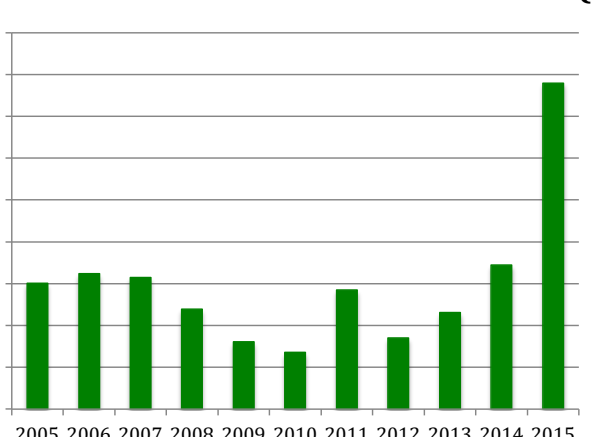
] $20.00- $13.54 $15.00per barrel profit Tesoro Tesoro is California’s second largest oil refiner, controlling 27% of the state’s refining capacity. So far, the company has had their best year ever in California – making an outrageous $1.5 billion in the first three quarters – This is twice as much as they’ve ever made in the first three months of a year – ever. The company saw its best quarter in California ever, making $770 million, based on a Consumer Watchdog analysis of its earnings, which does not account for amortization expenses or depreciation – variables not provided by Tesoro. The amount is more than four times its average quarterly profit since 2010.
Tesoro California Profit (millions)
Like its counterpart Valero, Tesoro’s per barrel costs have stayed relatively steady, in fact slightly dipping throughout 2015. Despite this, the margin per barrel has skyrocketed. In the third quarter of 2015, the company made $16.03 per barrel of refined oil, based on an analysis of the data provided. Average per barrel profit since 2010 has been just $5.24 per barrel.
Tesoro California Per Barrel Costs & Profit
] $16.03 per barrel profit
Tesoro First 9 Months CA Profit (Millions)
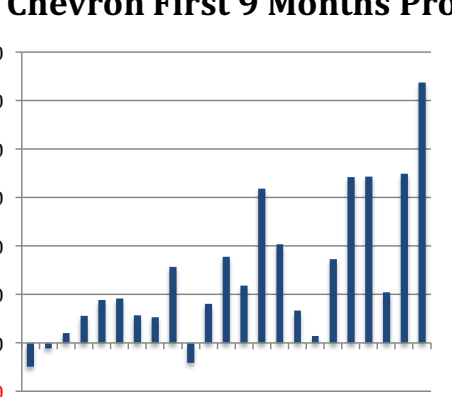
Chevron Chevron is California’s largest oil refiner, with 28% of the state’s refining capacity. While Chevron does not provide state-specific profits, a majority of its refining takes place in California (54%) and thus its US refining profits are based heavily on the California market. It is no surprise then that the third quarter of 2015 was Chevron’s best refining quarter ever, and in fact has been its best refining year thus far, ever.
Its third quarter profits of $1.2 billion are more than triple its usual refining profits.
Chevron US Refining Profits12002
Chevron had its best first three quarters of a year ever in US refining.
Chevron First 9 Months Profit (millions)
LOBBYING
The 3 quarter of 2015 not only saw record increases in profits, it also saw equally high increases in California lobbying expenditures by the very same companies. In total, the oil industry spent a whopping $11 million in the third quarter, dwarfing many of the other major corporate influencers. The Western States Petroleum Association, which represents California’s oil refiners, producers, and marketers as that industry’s top lobbyist, spent $6.7 million. The next highest spender was Chevron, which spent $1.8 million.
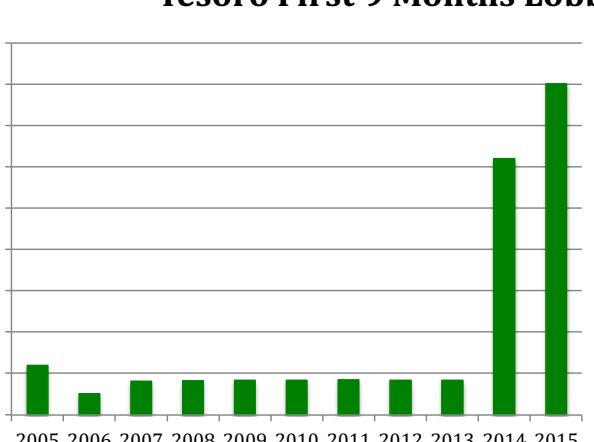
For Chevron, Tesoro & Valero, 2015 represented the most lobbying spending in the first 3 quarters of a year ever.
The legislature was a major target for oil companies in 2015 due to legislation targeting the use of petroleum fuels. Chief among these bills was SB 350. That bill, if it had passed intact, would have mandated a cut in petroleum use by 50% by 2030. Due to the intense lobbying efforts of the4 oil industry, that language was dropped from the final legislation. But the oil industry influenced Sacramento throughout the year, from the Governor’s firing of the head of the Department of5 Conservation for stating that fracking would imperil groundwater, to the watering down of toxic protection bills, to the avoidance of legislation regulating oil refining operations The major oil companies have increased spending over the last few years, culminating in record spending in the 3 quarter of 2015. Valero spent $582,587 in the quarter, the most it ever has, and more than a dozen times the average they’ve spent since 2005: $46,000.
Valero California Lobbying Spending45 Valero First 9 Months Lobbying
While Tesoro consistently spent $13,000 per quarter through most of the late 2000s, mid-2013 saw a large increase in spending to influence legislators. In the third quarter of 2015, the company spent $130,046, which is nearly four times its average spending since 2005.
Tesoro California Lobbying Spending
~ {
I
Tesoro First 9 Months Lobbying
Chevron has historically spent more than other California oil refiners, but in the third quarter of 2015, it spent the second most ever: $1.8 million. That dwarfs the average amount spent since the year 2000: $507,000
Chevron California Lobbying Spending
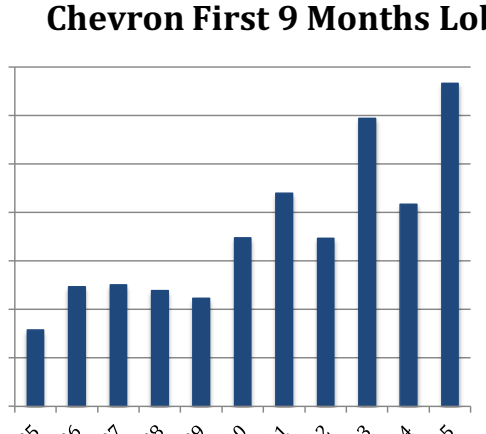
Chevron First 9 Months Lobbying
Though most of California’s oil refiners are not active every year in the legislature, their trade association, the Western States Petroleum Association (WSPA), is notorious for its high lobbying spending every year, averaging $1.14 million per quarter since 2000. In the third quarter of 2015 alone, WSPA spent $6.7 Million, by far the most it’s ever spent.
WSPA California Lobbying Spending WSPA First 9 Months Lobbying Conclusion
While the oil industry spent a record $11 million trying to convince lawmakers and the public that environmental regulations and taxes were the cause of high gas prices, the company’s profit reports show that oil refiners made a killing off gasoline price spikes and pocketed the money.. The people of California have suffered at the whim of these refiners, but the public is still in the dark about how these companies really operate. While Tesoro & Valero provide California-specific information, Chevron only provides US-wide profits, and California’s four other refiners provide information that provides no insight into their California dealings. If the oil industry plans to spend huge sums to dupe the public, the public should at least be aware of the profits these companies are making – facts that diminish the oil industry’s lies about the hardships of environmental regulation and taxes.
In the coming months, the Petroleum Market Advisory Committee, a California Energy Commission committee created to oversee the gasoline market will meet. Consumer Watchdog will urge them to require that all of California’s oil companies provide the public with detailed information about their California profits and operations.
Californians pay big money to refiners. And refiners in California make big money. The more they make, the more they spend on lobbying. The third quarter increases in spending mirrored these companies’ profit increases.
Tesoro’s profits of $770 million were more than four times its average profit since 2010. The amount it spent on lobbying in the quarter was nearly four times its average spending. Valero’s profits were six and a half times its average, and its lobbying expenses were more than a dozen times its norm. Chevron’s $1.2 billion profits were more than three times its average profit. Chevron’s lobbying was a concomitant three and a half times the usual amount. 2015 has emerged as a new era in California refining –record prices, record profits, and record lobbying spending.
While Tesoro & Valero provide California-specific profit information, it brings light to the dearth of information regarding California’s other refiners. Ensuring this data becomes public is critical to Californians and regulators who want to understand the petroleum market. In Los Angeles, one of the largest gasoline markets in the world, prices reached $1.50 more than the national average in July. As of mid-November, prices remain 75 cents above the national average – more than twice the usual gap with US average gas prices. It’s time that Californians could see why.