information, products and services as well as with providing them with targeted advertisements.”
- A system for recommending products based on furnishings observed by a smart home
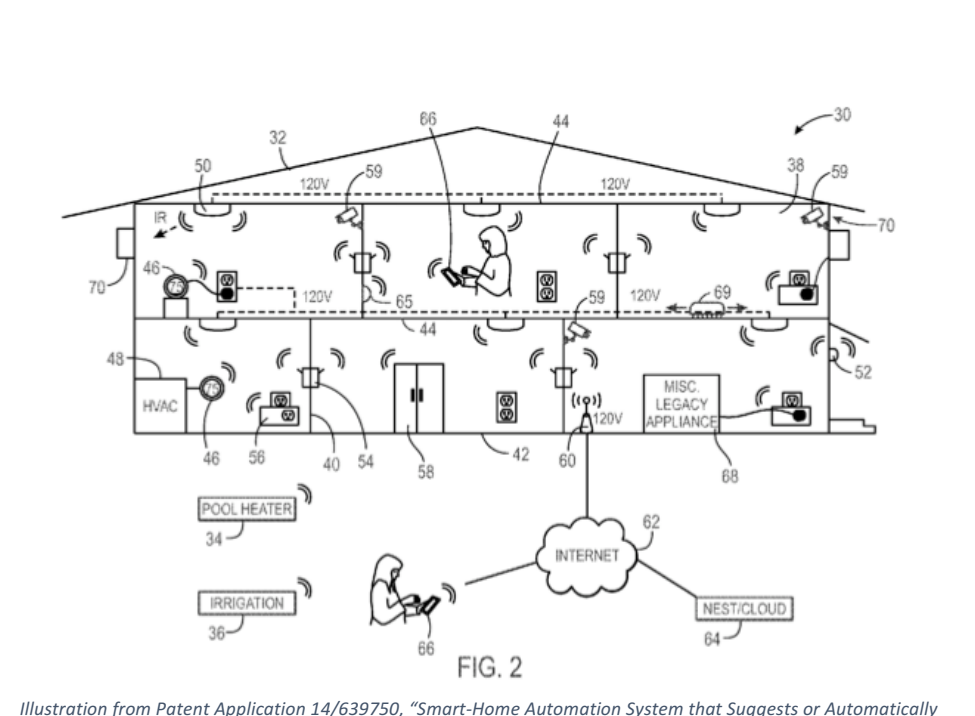
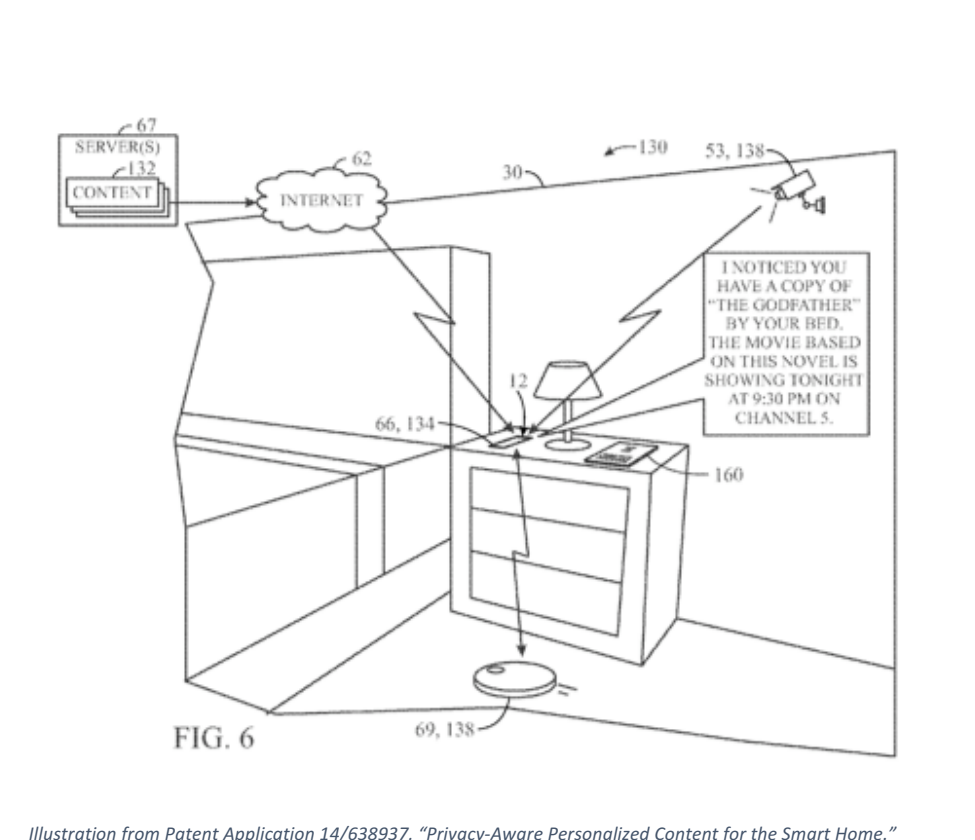
security camera. A particularly troubling patent application describes how Google could use video feeds from smart devices to determine users’ behaviors and characteristics, including “gender, age, fashion-taste, style, mood, known languages, preferred5 activities, and so forth.” The patent application describes smart devices that target advertisements based on the title of the book by a user’s bedside, the presence of a guitar or basketball in the room, and the face of a famous actor on a user’s t-shirt.
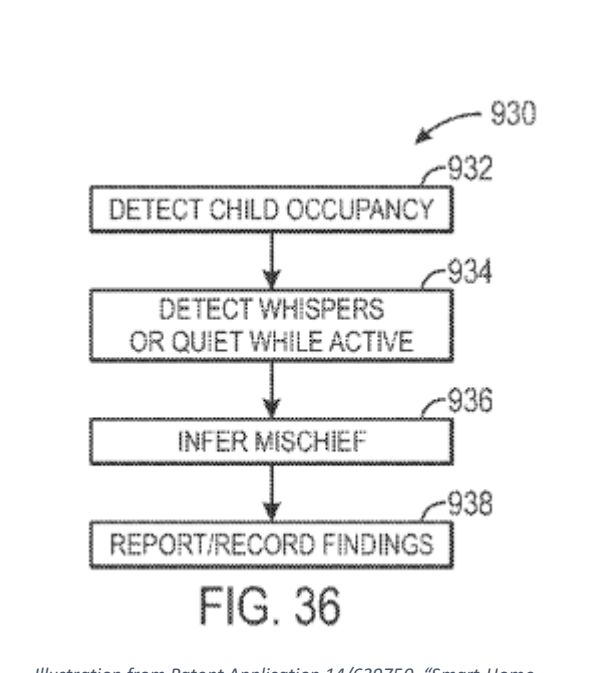
- A methodology for “inferring child mischief” using audio and movement sensors.
Another Google patent describes a smart home system that monitors the activity of6 every member of a household and reports back to a designated “policy holder.” One application uses voice fingerprinting to identify the presence of children and motion sensors to detect activity, and reports inferred mischief when children are both active and quiet. This patent also mentions advertising applications.
- Systems for inserting paid content into the responses provided by digital assistants. Both Amazon and Google have patented methods for serving ads to users through their smart devices. An Amazon discusses a system of “intelligent sponsorship based on knowledge generated by reference to the human being entity using the system.” A Google patent shows how advertisers could bid to have the company’s digital assistant7 feature their products in its voice-based search results.
While Amazon and Google may be focused on the commercial implications of their inventions, these technologies also have troubling legal and ethical implications. Smart devices with cameras and microphones inevitably capture video or audio of people who did not consent to8 being recorded. Third parties can also access data from smart devices; a recent study found9 that hackers could easily access insecure wifi-enabled “smart” toys and talk to children. Law10 enforcement has also begin to subpoena data from smart devices in criminal investigations. These patent applications show the potentially staggering cost of a futuristic “smart home.” To anticipate and meet consumers’ needs in new ways, digital assistants make increasingly5678910 invasive forays into users’ private lives. As users accept these intrusions, they give up their personal data, and with it, their privacy and security.
Background Smart speakers with voice-activated digital assistants, like the Amazon Echo and Google Home, promise to bring a personal Star Trek computer into users’ homes. The devices allow users to11 search the web, play music, order pizza, and make phone calls via a voice command. When connected with other “smart” devices, the Echo and Google Home can also dim the lights,12 control the thermostat, turn on the sprinkler, and check the baby monitor. While these devices offer convenience, they also offer tech companies unprecedented insight into users’ private lives. With the smaller-sized Echo Dot and the Google Home Mini, Amazon13 and Google have begun to foray beyond the living room and into the bedroom. There, they can infer from your interactions with the device when you wake up – and maybe even who you14 wake up with. Both companies’ eventual goal is to have a device in every room of your home. This study asks what user data Amazon and Google derive from these devices and what the companies intend to do with that data. This research draws from patent applications, which reflect the ambitious thinking of companies’ research and development teams. To be sure, the fact that a company has applied to patent a concept does not mean that they will ever implement it. Patents do, however, reflect a company’s ambitions. Patent applications for the Google Glass and Amazon Kindle seemed outlandish when they were filed, but they led to the15 advent of very real products for the applicants. The patent applications detailed in this memo provide insight into the surveillance that is possible via smart home devices. Amazon Echo Amazon’s digital assistant, the Echo, was the first major entry into the home assistant market. The voice-activated smart speaker can make phone calls, control smart home and other internet-enabled devices, retrieve search results, and – of course – order products from16 Amazon.com. Despite initial criticism about its Orwellian implications, the Echo has achieved111213141516 widespread commercial success. Recent estimates suggest that more than 20 million units18 have been sold.
The Echo works by listening for a “wakeword” (usually “Alexa,” the name of the personal19 assistant software that runs on the Echo). Once the wakeword is spoken, the Echo transitions20 from what Amazon calls a “passive listening state” to a “responsive state.” In passive listening state, the Echo captures and analyzes all speech that happens nearby, but it does not21 permanently record this speech or transmit it back to its servers. Once the Echo detects that someone said its wakeword, it enters a responsive state, in which records the audio that22 follows and sends it to Amazon’s servers for processing. It is there that Amazon’s powerful
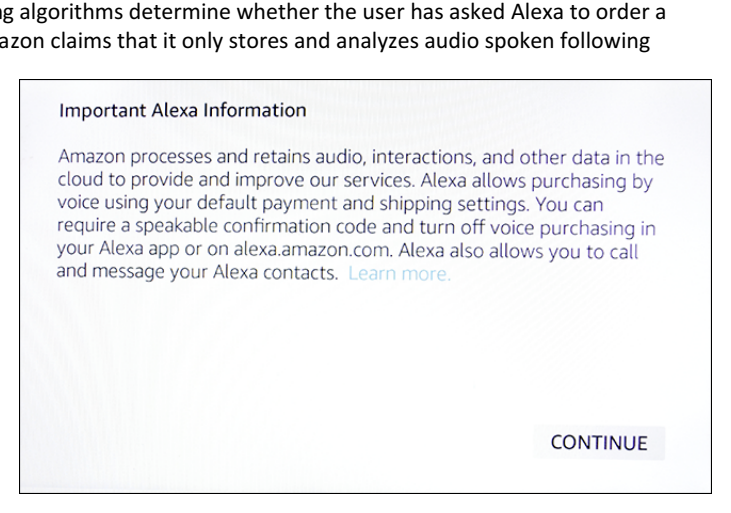
natural language processing algorithms determine whether the user has asked Alexa to order a pizza or dim the lights. Amazon claims that it only stores and analyzes audio spoken following23 an Echo’s wakeword.
When users set up a new Echo, they must click through a screen that functions as consent to data collection. Amazon’s privacy policy states that the company retains acoustic voice signatures, voice queries, music played through the speaker, and Alexa to-do24 and shopping lists.
Users can visit a page on Amazon’s site where the company keeps a complete history of the user’s queries. These queries can add up to valuable information for Amazon. The same sophisticated algorithms that Amazon uses to parse queries from unstructured data (like speech) can also be used for what the company calls “intelligent advertising:”1718192021222324 “An additional way that more relevant advertising can be delivered on systems powered by embodiments of the present invention is via intelligent sponsorship based on knowledge generated by reference to the human being entity using the system. […] For example, a user with a young child whose birthday was coming up in the next few days could be presented with a highly-tailored intelligent message directing him to a local25 bakery which sells birthday cakes.”
Although Amazon claims that it only saves audio of speech immediately following the Echo’s wakeword, a 2014 patent application suggests that it could also log a list of keywords spoken while the Echo is in a passive listening state. The patent application for “Keyword Determinations from Voice Data” describes a system that listens for not just for wakewords but26 also for a list of words that indicate statements of preference. Algorithms described in the patent translates the following statements into keywords, and transmits keywords back to a27 remote data center. By only transmitting keywords stripped of context, Amazon could collect marketing data from the Echo while it is in passive listening mode without breaking its promise to only collect and store audio following the device’s wakeword.252627
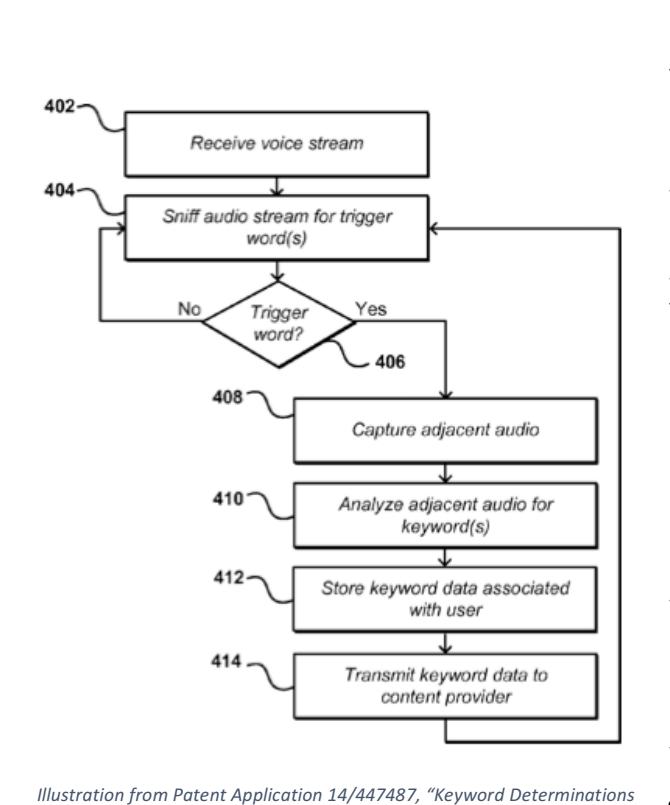
The patent describes a “sniffer algorithm” that listens for “trigger words.” In the patent application, Amazon describes trigger words as “a verb indicating some level of desire or interest in a noun that follows28 the trigger word in a sentence.”
Trigger words can be positive (“love,” “enjoy,” “bought,” etc.)
or negative (“hate,” “dislike, “returned,” etc.). Once the sniffer algorithm detects that a trigger word has been spoken, the device can record the trigger word and the audio that follows.
Unlike wakewords, which prompt the Echo to immediately send recorded audio to Amazon’s29 server for processing, trigger words can prompt the system to process the phrase following a trigger word locally on the30 device. The patent describes an “audio processing algorithm” that parses the captured speech. The algorithm translates the audio to text, analyzes “close words” for context, removes words that are not informative, and assigns a positive or negative value to the keyword. The audio processing algorithm can also associate keywords with specific individuals: “In embodiments where processes can attempt to determine keywords for multiple users, and where data before trigger words are analyzed as well, a process might also identify the word “I” as an indicator of the user that should be associated with that keyword. For example, if the sentence had instead been “Jenny loves to ski” then that process might associate the keyword “ski” with user Jenny (if known, identified, etc.)31 instead of the user speaking that sentence.”28293031
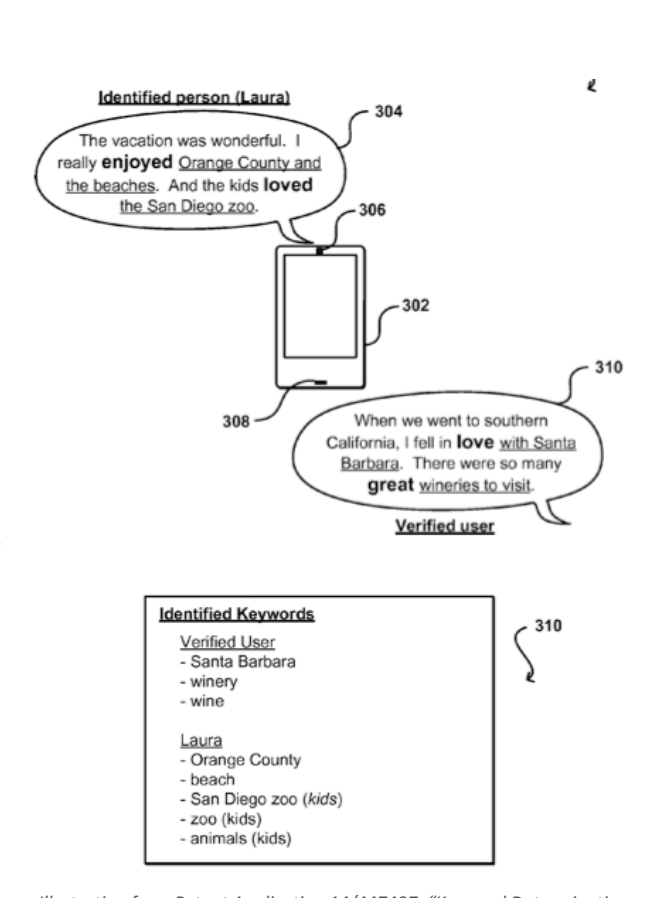
In the examples above, the audio processing algorithm identifies the subject of a sentence spoken by a single individual. The patent makes clear that it could also parse a conversation between two speakers and associate keywords with each. If a person conducts a phone call through her Echo or another device using this technology, the audio processing algorithm could analyze both sides of the call and record keywords for both users.
While the patent for keyword determinations allows for the possibility of sending audio back to remote servers, the most thoroughly discussed implementations of the technology would only transmit keywords, sentiment, and their Illustration from Patent Application 14/447487, “Keyword Determinations associated users back to from Voice Data” remote servers. The device could transmit keyword data in near real-time, at periodic intervals, or when the device transfers data for another purpose. The patent also notes that the device could transmit location data alongside keywords in order to further tailor product recommendations.
Amazon does not obscure the fact that the purpose of this technology is advertising and product recommendations: “Once keyword data is stored for a user, that keyword data can be used to determine and/or target content that might be of interest to that user. […] In this example, the advertising entity located the keyword “wine” associated with the user and, based on any appropriate criteria known or used for such purposes, selected an ad relating to wine to display to the user. Similarly, a provider of an electronic marketplace which the user is accessing has selected a number of different product recommendations.”
“Once keyword data is stored for a user, that keyword data can be used to determine and/or target content that might be of interest to that user. […] In this example, the advertising entity located the keyword “wine” associated with the user and, based on any appropriate criteria known or used for such purposes, selected an ad relating to wine to display to the user. Similarly, a provider of an electronic marketplace which the user is accessing has selected a number of different product recommendations.”
If the advertiser or online marketplace (Amazon) has access to information about a user’s friends, it can use the keyword data that it has derived from two-way conversations to market to people who do not own devices equipped with keyword determination technology. If you know someone with an Amazon Echo, they may be able to use your conversations with that person to tailor ads to you.
Amazon has also developed technology to identify different users in one home. Another patent application describes using voice signatures and behavior to distinguish between members of a32 household. The application describes a “master association table” stored on Amazon’s servers that “may include information associated with individual users, households, accounts, etc. that33 interact with the system.” This could help Amazon determine whether to advertise birthday cake to your spouse or to your six-year-old.
Google Home and Associated Products34 Google debuted its Echo competitor, the Google Home, in 2016. As the name suggests, Google intends for the smart speaker to act as a hub for a variety of other smart home35 products. The Google Home currently works with Google’s Nest line of smart thermostats, cameras, and hazard alarms, as well as products from Samsung’s SmartThings line and Phillips’36 smart lightbulbs. Google’s patent filing history shows that the Google Home is a step toward the company’s eventual goal of collecting data from every room of the home.3233343536
The Google Home works in much the same way as the Amazon Echo. The voice-activated speaker is always listening for its wakeword (which Google calls a “hotword”), but it allegedly37 only records and transmits voice data following an utterance of that word. However, a recently disclosed bug in the Google Home Mini caused a number of devices to randomly38 activate and record conversations even when users did not intend to activate the device. Google claims that it has fixed the bug, but the incident shows just how easy it is to transmit far more data than intended.
Like the Echo, the Google Home is equipped with a proprietary digital assistant software. Google’s digital assistant is called “Google Assistant” and users activate it by saying, “Ok39 Google. Like Alexa, Google assistant can order pizza and perform web searches, but it also performs an array of functions based on “knowledge” drawn from users’ activity on other40 Google platforms.37383940 The Google Assistant makes inferences based users’ web browsing histories, email contents,41
and location data from Google’s mobile apps. A patent application for Google’s voice recognition system says that it draws from “data including a user’s geographic location, a user’s search history, user’s interests, or a user’s activity” to determine the appropriate answer to a spoken42 query. Google uses past voice queries to target ads and train its system to provide more tailored answers43 in the future.
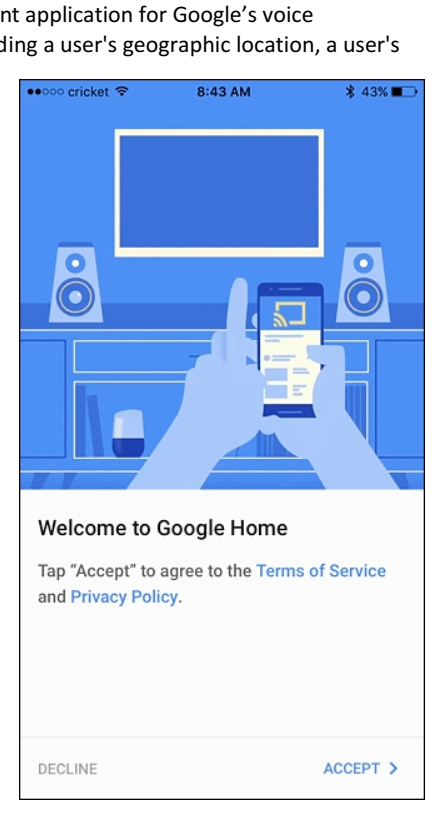
When users set up a new Google Home, they must click a button to accept Google’s Terms of Service and Privacy Policy. Those documents give Google broad license to use any data that passes through its system44 to profile and target ads to users. The set-up screen for Nest devices contains a similar screen that will not let users proceed until they accept the company’s Terms of Service and Privacy Statement. Nest, an Alphabet subsidiary, has a separate Privacy Statement that purports to grant users more control of the data45 that the company collects and shares with others.
The Privacy Statement does not, however, indicate whether Google constitutes a third party for information sharing purposes, nor does it clarify whether the policy also applies to internal processing46 of user data for ad targeting purposes.
The Google Home and connected smart home devices allow Google to gather new types of information about its users. Like Amazon, Google has filed patent applications for its method of identifying and profiling different speakers based on captured47 audio. Google can supplement these profiles with data that it gathers from the sensors and microphones on its smart home products. These products can capture noise signatures, moisture levels, subtle temperature changes, light levels, and other data that indicate what is happening inside the home. Dozens of patent applications for Google products cheerfully announce that the company’s smart home devices may be used to draw “inferences” about their users:41424344454647
The Google Assistant makes inferences based users’ web browsing histories, email contents, and location data from Google’s mobile apps.41 A patent application for Google’s voice recognition system says that it draws from “data including a user’s geographic location, a user’s search history, user’s interests, or a user’s activity” to determine the appropriate answer to a spoken
“[S]uch inferences may include when are occupants home, when are they sleeping, when are they cooking, when are they in the den watching television, and when do they shower. The answers to these questions may help third-parties benefit consumers by providing them with interesting information, products and services as well as with48 providing them with targeted advertisements.”
Many other patents for Google’s smart home products contain boilerplate describing an “advertising/communication paradigm […] that estimates characteristics (e.g., demographic49 information), desires and/or products of interest of a user based on device usage.” One patent application, ironically named “Privacy-Aware Personalized Content for the Smart Home,” goes even further: “In some embodiments, the robot 69 may use its sensors to measure sounds and appearance of people and/or objects in the room and send audio and/or visual features that can be used to assess properties of the objects and/or people. For example, for people, the audio and/or visual features may be used to ascertain gender, age, fashion-50 taste, style, mood, known languages, preferred activities, and so forth.” The application goes on to describe marketing sports camp to a 15-year-old boy holding a basketball in the living room, combining browser search history with an image on a user’s t- shirt to infer an interest in the actor Will Smith, and recommending a TV program based on the51 book on a user’s bedside table.48495051
Many other patents for Google’s smart home products contain boilerplate describing an “ advertising /communication paradigm […] that estimates characteristics (e.g., demographic information), desires and/or products of interest of a user based on device usage.”49
If that were not Orwellian enough, another patent application describes using a smart home system to monitor and control screen time, hygiene habits, meal and travel schedules, and other activity. The system even purports to “infer mischief” based on audio and motion sensor52 readings from rooms where children are present. Even this patent application, which describes a system with near-total insight into every activity in users’ homes, contains a proviso that device usage data may be used for advertising.52
Google’s smart home patent applications also describe the company’s interest in users’ health data. Several applications describe creating an audio signature for the master bathroom that will record the number of times that a toilet is53 flushed. Another application describes monitoring a user’s nighttime breathing patterns to detect a sleep disorder, and storing the information in a user’s “sleep54 profile.” While these patent applications do not describe systems for advertising to users based on this information, Google has demonstrated a willingness to advertise to users based on health data derived from other products.
For example, a 2015 patent describes a scheme to advertise vacations to individuals whose heart rates55 indicate that they are under stress.
Google’s vast repository of information about its users has made the company the single-56 biggest recipient of digital advertising revenues. True to form, Google has applied for a patent57 to bring its ubiquitous display ad auction model to its voice-controlled assistant. The patent describes a system by which advertisers can bid to have their customized voice actions inserted into responses to Google Home users’ queries: “In one example, the voice input of “find restaurant near Mountain View, Calif.” may cause Little Italy to appear at the top of the list of restaurants presented on user device 104. In another example, the voice input of “find restaurant near Mountain View, Calif.” may cause a message to be presented to the user suggesting that the user try Little Italy58 before the list of restaurants is presented. “535455565758 This makes the Home a moneymaking prospect for Google in two respects: It not only gathers data to serve more targeted ads on users’ phones and computers, but it also creates another platform on which to serve paid content.
Implications The digital advertising of the last two decades targeted ads primarily on the basis of demographic information and interests supplied by the user through search queries, email contents, and account information. Modern digital advertising focuses on inferred behaviors,59 contexts, and emotions as better indicators of what consumers are likely to buy. When consumers are at their computers, companies like Google and Amazon observe their behavior60 and emotions through browser cookies that track the websites that they visit. When consumers are on their mobile phones, Google and Amazon can observe their behavior and61 surroundings through location data.
Digital assistants and smart home devices allow companies like Google and Amazon access to the one place where users are likely to spend time disconnected from their devices: home. These patents show that smart devices target moments in between screen time to monitor sleep habits, listen in on dinner conversations, and track when users shower. Access to this data can flesh out Google and Amazon’s profiles of their users in order to help them more accurately server targeted ads. Smart devices also offer a new advertising platform in themselves – a 2013 letter from Google to the Securities and Exchange Commission predicted that in a few years,62 the company could serve ads to refrigerators, thermostats, and other everyday devices. While tech companies are primarily interested in commercial uses for home data, creating a repository of information about users’ private lives raises the near-certainty that others will attempt to access it. Home insurers and utility companies have already made deals with Nest to63 put smart devices in their customers’ homes. Other businesses that would benefit from home data, like lenders and health insurers, could be next.
Law enforcement has already found a use for smart devices. An Amazon Echo made headlines last year when police investigating a murder sought to subpoena recordings made by the64 device. Investigators in the same case also managed to obtain data from a smart water meter596061626364 that suggested that the crime scene had been hosed down before police arrived. In 2015, Popular Mechanics reported that police had requested data from Nest cameras on multiple66 occasions, though it is unclear whether Google has complied with the requests. Hackers or other malicious actors could also access to user data through their smart devices. Google Home’s FAQ contains the following disclaimer: “Anyone who is near your Google Home device can request information from it, and if you have given Google Home access to your calendars, Gmail or other personal information, people can ask your Google Home device about that information. Google Home also gets information about you from your other interactions with Google67 services.”
A recently-disclosed Bluetooth vulnerability could allow hackers to completely take over both the Echo and the Google Home, allowing access to all private information that passes through68 the device. Another recent study showed that some smart devices are so insecure that69 hackers can use them like intercoms to talk to children.
Digital assistants and other smart devices also raise thorny issues surrounding the constitutionally-guaranteed reasonable expectation of privacy. Guests to Echo- or Google Home-enabled homes may not necessarily consent to being recorded. Legal scholars argue that owners of a smart home device should have a duty to disclose the presence of the device to70 guests. Nest’s terms of service explicitly place liability for failure to obtain consent before71 recording on the users of its devices. In practice, however, smart device owners are unlikely to explicitly warn their dinner guests or trick-or-treaters that they might be recorded. Digital assistants like the Amazon Echo and the Google Home greatly expand the collection of personal data, magnifying the risk that someone will learn something about you that you would rather keep private.6566676869 https://www.theguardian.com/technology/2017/nov/14/retailers-urged-to-withdraw-toys-that-allow-hackers- to-talk-to-children70 _EXPECTATION_OF_PRIVACY_FINAL.pdf71 https://nest.com/legal/terms-of-service/