EXECUTIVE SUMMARY
Uber is simultaneously trying to weaken legal accountability while expanding autonomous vehicle deployment, despite unresolved safety and transparency concerns. This report highlights how Uber’s attack on legal protections that hold drivers and auto manufacturers accountable in California and other states threatens public safety.
Bad Background Checks Cause Death And Injury: Uber has a history of performing shoddy background checks that have resulted in dangerous drivers hurting and killing innocent pedestrians, passengers and drivers. Many of these cases are hidden behind the curtain of mandatory arbitration, but those that have made it to court show a pattern of a company working to put as many drivers on the road as possible regardless of whether they are safe. This report highlights five high-profile examples of tragic accidents caused by dangerous Uber drivers who had prior traffic and criminal records but were approved by Uber’s background check system (Pg. 8). If Uber’s attempt to limit its liability succeeds, the company will have even less incentive to do better background checks. Multi-state Legal Attack: Uber’s unprecedented push for limited motor vehicle liability laws in California and other states shows the company is trying to avoid legal accountability under the law at the same time as it’s expanding its robotaxis, which are sub-standard for industry norms. The company has partnered with (opens in new tab) over 20 companies and wants to offer rides in 15 cities by the end of 2026, including in San Francisco and Los Angeles. In California, Uber is pushing a ballot measure that will protect negligent drivers and defective car manufacturers in all motor vehicle accident cases. The proposed law limits victims’ medical recovery and access to an attorney. Consumer Watchdog found that Uber in the past few months has also been pushing pro-corporate, anti-consumer tort reform in New York, Indiana, Florida, and Nevada. The tort reform plan is different in every state—showing it is not really billboard lawyers that Uber has a problem with, but accountability for it and its drivers’ actions. Uber Will Prevent Seriously Injured Accident Victims From Finding Attorneys: Uber’s proposed law says victims must keep 75% of the “total recovery,” which seems like 25% goes to pay their attorneys, but that’s not the whole story. When accident victims need treatment, providers treat them with the understanding they will be paid when the case is over. However, these medical bills are not recoverable costs (opens in new tab) under the Uber initiative’s definition of “total recovery” and would come out of the 25% that would fund attorney costs. A $1 million serious injury settlement, for example, could result in medical liens and bills exceeding $250,000, which would leave nothing for the contingency fee attorney. Seriously injured victims would be unable to find contingency fee attorneys to represent them.

Tying Reimbursement To Medicare Rates Will Prevent Accident Victims From Receiving Medical Care: By limiting recoverable medical costs to a fraction of real-world prices, just more than Medicare rates, the Uber measure will effectively shift the financial burden of accident injuries onto victims themselves, the health care system, and taxpayer funded programs. Many medical providers will decline to treat patients on a lien basis if the capped recovery cannot cover their services, leaving victims with fewer treatment options. In cases where insurance refuses to pay or coverage is incomplete, the initiative could prevent injured individuals from recovering the very expenses they incurred to diagnose and treat their injuries, which were not their fault. The proposal makes it financially unworkable for many providers to treat accident victims.
Eviscerating Product Liability Cases: Uber’s California initiative would apply to product defect cases stemming from motor vehicle crashes as well. Common auto product liability cases involving airbag defects, braking failure, steering issues, battery failure, and electronic control system and software defects would be judicially handicapped. By capping recoverable damages and preventing the seriously injured from getting attorneys, the initiative would make it significantly more difficult for injured passengers, pedestrians, or other motorists to pursue claims for product defects, including that an autonomous driving system itself was defective. These cases deter dangerous manufacturing practices.
Limited Liability Will Abet The Premature Rollout of Uber’s Untested and Dangerous Robocars: Uber says it will have 20,000 Uber-Nuro robotaxis over the next six years. Nuro has an abysmal record testing robotaxis. “Uber is running a prototype that it started testing last month,” said Bryant Walker- Smith, an associate professor in the School of Law and the College of Engineering and Computing at the University of South Carolina in January. “We don’t know what safety standards, if any, Uber is adhering to. We don’t know the specs of the car. We don’t know about their internal testing. We don’t know cost of production.” We do know that
“We don’t know
Nuro tested less than 160,000 miles in California in 2025, compared to over 3 million miles driven by
what safety
Waymo. Nuro’s disengagement rate, or when a human has to take over the autonomous system due to a technical failure or other concerns, was under standards, 700 miles, meaning it couldn’t drive 700 miles
if any, Uber is
without human intervention. By comparison, Waymo robocars could go nearly 20,000 miles
adhering to.”
before the computer disengaged. Uber’s car is reportedly less than (opens in new tab) half the price of Waymo’s and uses weaker Lidar sensors. In addition, recent revelations at U.S. Senate hearings show robocars —BRYANT WALKER-SMITH, ASSOCIATE PROFESSOR IN are monitored by remote international workers who THE SCHOOL OF LAW AND exist outside any regulatory framework. As Sen. Ed C Markey said at a recent AV Senate subcommittee ENGINEERING AND hearing, these remote agents are nothing more than COMPUTING AT THE “trans-Atlantic backseat drivers.” If Uber’s initiative UNIVERSITY OF SOUTH passes, Uber will be able to more quickly rollout its C robotaxis without fear of liability for their negligence or that of their trans-Atlantic agents.
Uber Tried To Hide Its Safety Record: For years the California Public Utilities Commission withheld rideshare safety data due to rideshare company lobbying, and accident reporting remains incomplete with 2021–2024 data suspended. Available figures show roughly 27,000 rideshare crashes from Sep 2019–Aug 2020, with Uber reporting more collisions than Lyft. City-wide traffic enforcement data from San Francisco shows ride-hailing vehicles responsible for most of several violations: 80% of bike-lane obstructions, about 75% of illegal U- turn citations, nearly 70% of bus-lane violations, over 50% of miscellaneous flow and pedestrian yield violations. With the new PUC Chair, John Reynolds, previously working as a lawyer for robocar company Cruise, the public cannot expect better transparency in the future.
INTRODUCTION
“And a world in which, 10 years from now, every single new car sold comes with Level 4, Level 5 AV, we think is a terrific outcome in terms of safety for the streets and also our platform, which will allow any player, any owner of those vehicles, whether it’s financial institutions, to monetize those vehicles at the highest utilizations, so that they’ve got the lowest cost of capital.”
- Dara Khosrowshahi, Uber CEO
Uber envisions a future where everyone will have or use robotaxis, and Uber will be the main facilitator of those rides. The company has partnered with (opens in new tab) over 20 companies and wants to offer rides in 15 cities by the end of 2026, including in San Francisco and Los Angeles.
But to get to that future, Uber is right now reshaping the legal landscape in its favor and against anyone involved in a motor vehicle accident. Uber’s California ballot initiative, as well as similar tort reform measures in Nevada, New York, and Indiana, weakens access to the civil justice system as Uber scales its AV deployment. This will result in fewer lawsuits, and less justice for victims against a company that pushes personal profit over public safety. Its game plan is ensuring less liability during its big robocar rollout.
Uber’s terms of service (opens in new tab) alone are about 50 pages, not counting another 50 from its AV partners (opens in new tab). Under Uber’s terms of service, Uber riders give up their right to a jury trial, any content made inside a ride, and consent to being recorded. The terms also state that whatever happens while a person is in an Uber ride, the rider is responsible for it.
Uber’s terms state: “UBER DOES NOT GUARANTEE THE QUALITY, SUITABILITY, SAFETY OR ABILITY OF THIRD-PARTY PROVIDERS. YOU AGREE THAT THE ENTIRE RISK ARISING OUT OF YOUR USE OF THE SERVICES, AND ANY SERVICE OR GOOD REQUESTED OR OBTAINED FROM THIRD-PARTY PROVIDERS IN CONNECTION THEREWITH, REMAINS SOLELY WITH YOU, TO THE MAXIMUM EXTENT PERMITTED UNDER APPLICABLE LAW.”

An Uber autonomous vehicle. (Nuro) Caveat Emptor. It appears that if anything happens, the rider is on the hook, not Uber or its third-party providers. But rides are hailed in minutes, so it is almost impossible to understand what Uber is forcing riders to do before getting inside one.
Uber has already benefited from major pro-corporate legal rulings, such as the 2011 Supreme Court decision in AT&T Mobility v. Concepcion (opens in new tab), which steered many passenger disputes out of public court and behind the cloak of arbitration. And by enshrining rideshare drivers as independent contractors, California’s Prop 22 law also tilted the legal system in favor of Uber by allowing it to say it’s not liable for its drivers because they are independent contractors. Together, these laws reduced the number of cases that reach juries, limit collective lawsuits, and ultimately benefit Uber. This report will explore the dangerous drivers Uber put on the road in California, its multi-state attack on the civil justice system, and how its incoming fleet of robotaxis is the company’s scariest bet yet. Uber’s legal strategy is unfolding alongside its push to deploy autonomous vehicles at scale. The company’s existing safety record, with both rideshare drivers and AV testing, raises questions about the real reasons it is seeking changes to make drivers and manufacturers less accountable.
The question now is not whether autonomous vehicles will arrive on American roads, because they already are. The real question is whether the legal protections that hold powerful companies like Uber accountable will still exist when they do.
HOW UBER’S CALIFORNIA AND NATIONWIDE TORT REFORM

WEAKENS CIVIL ACCOUNTABILITY

The title and heading of Uber’s proposed measure. (CA AG Office) If Uber’s California ballot measure (opens in new tab) becomes law, injured accident victims will pay the price: Tying Reimbursement To Medicare Will Reduce Medical Providers Who Treat Accident Victims: Uber’s ballot proposal would limit the medical costs that injury victims can recover after a car crash, by tying reimbursement to Medicare reimbursement rates rather than the actual price of medical care. Medicare rates are set by the federal government and are typically much lower than what hospitals, imaging centers, and specialists charge in the private market. If medical recovery is capped at just above the Medicare rate, as the initiative proposes, doctors will be unable to treat injured victims, who will be reimbursed far below the real cost of treatment. Those without good insurance will be unable to get care and even those with good insurance could be denied speedy and specialty care that accident victims need.
Victims Will Have To Pay Out Of Pocket Or Skip Care: Payment for services needed early in an injury case are not always covered by insurance and require upfront payment. Diagnostic imaging such as MRIs, for example, often must be obtained quickly to diagnose spinal injuries or internal damage and show causation. Many patients involved in accidents do not have immediate insurance coverage for these services or must rely on medical providers willing to front the cost and wait for reimbursement through a legal claim. But if reimbursement is limited to 125% or 170% of Medicare rates, as the initiative proposes, providers will be unwilling to provide that care because the capped payment will not cover the cost of the scan. As a result, injured people will find themselves forced to pay out of pocket for critical diagnostics, delay treatment, or go without care entirely. Seriously Injured Accident Victims Will Be Unable To Get Contingency Fee Attorneys to Represent Them: Most injury victims and families cannot afford a lawyer who bills by the hour. Contingency fee lawyers only get paid if they win and often invest years of work and hundreds of thousands of dollars of their own money into a case.
Uber’s proposed law says victims must keep 75% of the “total recovery,” which seems like 25% goes to pay their contingency attorneys, but that’s not accurate. When accident victims need treatment and rehabilitation, providers treat them with the understanding they will be paid when the case is over. However, these medical bills are not recoverable costs (opens in new tab) under the Uber initiative’s definition of “total recovery” and would come out of the 25% that would also fund attorney costs.
That means in many serious injury cases, the more lawyers do to help clients get care, the less they’ll get paid. A $1 million serious injury settlement, for instance, could result in medical liens and bills exceeding $250,000, and the lawyers would get nothing. Uber’s law also makes it nearly impossible to find reputable doctors to provide treatment on a lien.
Injured plaintiffs will struggle to secure counsel, and weakening attorney access weakens public scrutiny and accountability.
Uber’s goal to weaken legal accountability is part of a multi-state strategy. In Nevada, Uber is running a similar playbook to the one in California. The company funneled $5 million to back the proposed “Nevadans for Fair Recovery” ballot initiative, which sought to limit attorney fees to 20% of settlements or verdicts. But the Nevada Supreme Court blocked it from advancing, ruling that its language was “ misleading and confusing.” (opens in new tab) Indiana’s HB 1417 was aimed at capping non-economic damages and protecting businesses from certain liability claims. In addition, it contained a shield protecting ride-sharing companies like Uber (opens in new tab) from lawsuits brought forth by riders for injuries caused by a driver or occurring during a ride.
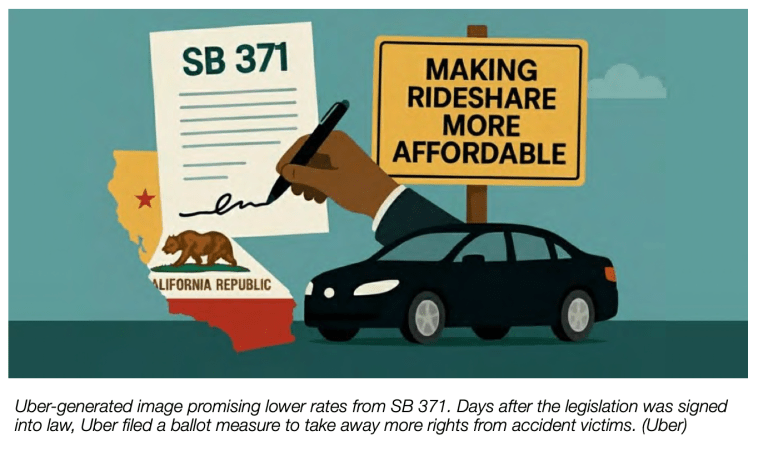
Framed as an “affordability” issue, an Uber-backed plan (opens in new tab) in New York to reduce crash victim payouts was proposed in the governor’s 2027 budget. The plan narrows what constitutes a “serious injury,” a definition that allows victims to money beyond medical expenses and lost wages. New York’s no-fault system already limits recovery unless a “serious injury” threshold is met. By tightening reimbursement rules and claim procedures, the reforms further constrain damages exposure for commercial auto insurers and, by extension, large transportation platforms operating within the state. As reported by StreetBlogNYC, Uber forwarded talking points about the law from one of its front groups to the governor’s office. That group, Citizens for Affordable rates, has lobbied the governor’s office.
Florida lawmakers this year advanced legislation (opens in new tab) reducing insurance requirements during certain rideshare phases, particularly the period after a ride is accepted but before a passenger enters the vehicle. The proposal would lower mandatory coverage thresholds compared to previous requirements. For Uber, reduced coverage levels translate directly into lower potential payout exposure in crash scenarios occurring during these intermediate ride phases. The change narrows the compensation available to injured passengers and third parties. Florida’s proposal mirrors similar efforts in California (SB 371), where rideshare insurance minimums were reduced (opens in new tab) as part of a broader compromise package. Like Nevada and Indiana, the Florida effort reflects a strategy of addressing liability through insurance structure rather than explicit immunity.
UBER’S PROPOSED LAW WILL PREVENT PRODUCT LIABILITY

LAWSUITS
A 2013 Tesla Model S car battery explosion. (Flickr) Product liability cases are critical for auto safety because they expose cars with design, manufacturing or failure to warn issues and hold the car manufacturers accountable. These cases will be harder to bring to court because of Uber’s proposed ballot initiative. Injuries in product liability cases related to crashes fall under the definition of an automobile accident, which the initiative defines as “an accident associated with the ownership, operation, maintenance, or use of an automobile resulting in bodily injury, death, property damage, or other loss. The term does not include incidents of sexual assault or sexual harassment.” That means common auto product liability cases involving airbag defects, braking failure, steering issues, battery failure, and electronic control system and software defects would be judicially handicapped. Product-liability lawsuits have long been one of the primary ways courts hold automakers accountable for defective vehicle technology, but they won’t be if Uber gets its way.
As advanced driver-assistance and autonomous driving systems enter the market, similar claims are beginning to appear involving automated driving software and sensors. Although the number of cases remains relatively small, several high-profile crashes illustrate how plaintiffs are using traditional product-liability theories, such as defective design, failure to warn, and negligent software development, to challenge robocar driving systems.
A couple of Tesla cases highlight the dangers of partially autonomous driving. In Florida, a Tesla Model S operating with Autopilot engaged ran through an intersection and struck another vehicle, killing a pedestrian. In 2025, a jury found Tesla partially responsible and awarded roughly $243 million in damages, including punitive damages. A federal judge recently upheld the verdict (opens in new tab). The bellwether case is widely considered the first jury verdict holding an automated driving system liable for a fatal crash, marking a turning point in litigation over autonomous vehicle technology.
Other lawsuits illustrate similar legal theories. In California, the family of Walter Huang, who died in a 2018 Tesla Model X crash in Mountain View, sued Tesla alleging Autopilot’s lane-keeping system steered the vehicle into a highway barrier and that the company failed to adequately warn drivers about the system’s limitations. The case settled in 2024 (opens in new tab) before trial but became a major test of whether automated driving software could be treated as a defective product. Another California case stems from a 2019 double fatal crash in Gardena, where a Tesla operating with Autopilot allegedly failed to detect a motorcycle before striking it from behind. Plaintiffs claim Tesla’s perception system was defectively designed and incapable of reliably identifying certain road users. The case ultimately settled confidentially. (opens in new tab) Beyond Tesla, litigation has also arisen from testing programs for fully autonomous vehicles. The 2018 Uber self-driving crash in Tempe, Arizona, in which a robotaxi struck and killed pedestrian Elaine Herzberg, led to claims that Uber’s autonomous software improperly disabled emergency braking and failed to classify the pedestrian in time to avoid the collision. Uber ultimately reached a settlement with the victim’s family (opens in new tab). Although the case did not produce a court

In 2018, a self-driving Uber car killed a pedestrian in Tempe, AZ.
ruling on product liability, it demonstrated how AV developers may face legal exposure when automated systems fail.
These early cases illustrate how courts are beginning to treat autonomous driving systems similarly to other automotive safety components, like airbags, fuel systems, or brakes, when they malfunction. However, Uber’s proposed California ballot initiative could dramatically change this legal landscape and pave the way for shielding AVs from legal accountability as robocars become normalized. The measure would restructure how lawsuits arising from automobile accidents are litigated and limit the damages that plaintiffs can recover. Because the definition of covered accidents includes incidents related to the “ownership, operation, maintenance, or use of an automobile,” the measure would effectively restrict product-liability claims involving autonomous vehicle technology. By capping recoverable damages and reshaping the litigation process, the initiative would make it significantly more difficult for injured passengers, pedestrians, or other motorists to pursue claims that an autonomous driving system itself was defective.
If enacted, the measure would arrive at a moment when the first AV-related product-liability verdicts are beginning to emerge. The Tesla Autopilot verdict demonstrates that juries may be willing to assign liability to automated driving systems when plaintiffs can show design flaws or misleading representations about the technology. Limiting the ability to bring such cases could therefore shield companies deploying robotaxis from the same kinds of legal scrutiny that historically exposed safety defects in conventional vehicles.

UBER TRIED TO HIDE ITS SAFETY RECORD
For years, rideshare companies like Uber and Lyft did not have to publicly disclose safety reports to the California Public Utilities Commission (CPUC) due to the CPUC’s own regulatory loophole. When the CPUC reversed course and started releasing limited data, Uber and Lyft resisted, telling the commission that it contained trade secrets and personal information. What data we do have shows that Uber drivers were in more collisions than Lyft.
For example, between September 2019 and August 2020 (opens in new tab), there were nearly 27,000 rideshare accidents, with more 14,800 reported by Uber and 11,200 reported by Lyft. Currently, data detailing rideshare accidents for 2021-2024 are suspended by the CPUC after granting a request from the ride sharing companies.
The commission, despite its stated mission of ensuring public safety, has remained helpless (opens in new tab) as it green-lit robotaxis in California despite incomplete safety records. Unsurprisingly, one of the commissioners who has voted in favor of expansion is a former lawyer for Cruise, which had its AV license in California pulled after it deceived regulators about an accident involving a pedestrian. John Reynolds, the Commissioner, has since been elevated to CPUC President.
But what we do know from other agencies raises questions about the safety of rideshare drivers like Uber. For example, traffic enforcement data released by the city of San Francisco (opens in new tab) showed ride-hailing cars in 2017 accounted for:
- Almost 80% of bike lane obstruction citations
- About 75% of illegal U-turn citations
- Nearly 70% of bus-lane violations
- Over 50% of miscellaneous flow and pedestrian yield violations If that pattern carries into AV deployment, that’s concerning.
The CA DMV has also been a toothless regulatory body (opens in new tab) when it comes to robotaxi testing because manufacturers do not have to prove safety or adhere to any testing standards. The most consumer-forward move the DMV has made with regard to robotaxis was when it pulled Cruise’s driverless permit, but that was not because a pedestrian was struck by a Cruise robotaxi, but because it misled investigators.
After a high-profile legal clash with state regulators, Uber pulled (opens in new tab) its self-driving car testing program out of California in 2016. The company had launched autonomous vehicle trials in San Francisco without obtaining the required permit from the DMV, prompting the agency to file suit to halt the program. Within days, Uber suspended testing in the state and relocated its fleet to Arizona under a lighter regulatory framework. Uber continued testing until 2018, when the Tempe, AZ fatal accident happened. It was the first—and so far only—fatal crash involving a fully autonomous vehicle. The Uber AV did not recognize a jaywalking pedestrian, and its braking system wasn’t designed to avoid an imminent collision, according to federal investigators. (opens in new tab)
UBER’S FAILED BACKGROUND CHECKS CAUSE INJURIES AND DEATHS
This report highlights 5 incidents in which Uber missed red flags in a background check such as a false driver’s license, previous DUIs, suspensions, and reckless driving citations. The pattern shows what happens when a large company doesn’t spend the money on thorough background checks so it can put as many drivers on the roads as possible at the expense of the public. These are just a sliver of cases that would be put in jeopardy under Uber’s proposed new California law— cases that were not shielded by Uber’s mandatory arbitration clause, as is

typically the case.
Uber Driver With Two DUIs Goes On Drunken Rampage And Kills Two: An Uber driver was allegedly speeding as fast as 120 mph in a 40 mph zone and registered a blood alcohol level over twice the legal limit when he killed two people—Gilberto Arteaga-Gutierrez and Silvia Velasco—on October 26, 2021 in Santa Barbara. (opens in new tab) Used nitrous containers were found inside the driver’s car, according to a civil suit. At the time the driver was on probation for his second DUI conviction (opens in new tab), but Uber still hired the driver despite conducting a background check. The Uber driver was sentenced to 15 years to life in prison.
Uber Driver With Fraudulent License Kills Pedestrian: On March 10, 2023, an Uber driver fatally struck a pedestrian in Los Angeles. Despite conducting a background check that requires a valid U.S. driver’s license, Uber did not flag the fraudulent license. The driver was making a left turn at a stop sign when he hit the man, a physician who left behind a wife and four kids. Uber Driver With Record Of Complaints Causes Injury: An Uber driver rear-ended another car, injuring his two passengers and the driver of the vehicle he hit. But the passengers did not know (opens in new tab) the driver had over two dozen customer complaints when they hailed the ride. Further, Uber should have known that driver had less than the required one year of driving experience in the United States when they cleared him to drive, according to a lawsuit. Uber also should have known, but allegedly didn’t, that only seven months earlier the driver was cited for tailgating, and that the next day was in a collision.
Uber Driver (opens in new tab) With Reckless Driving Record Kills 6-year-old Girl: An Uber driver in San Francisco fatally struck a 6-year-old girl (opens in new tab) on New Year’s Eve 2013. The girl, Sofia Liu, was walking with her mother and brother in the crosswalk. Sofia’s mother suffered a major injury to her head, and Sofia’s three-year-old brother was also injured. Uber’s background check missed 10-year-old reckless driving incident because background checks at the time only went back 7 years. A jury found the driver guilty of misdemeanor vehicular manslaughter. Drunk Uber Driver With Suspended License Crashes Into Bus: An Uber driver ran a red light in San Diego and slammed into a parked bus (opens in new tab). The driver was charged with DUI. His driver’s license was previously suspended twice—once for five months in 2013 for a failure to appear in court, and once for three weeks in 2015 for the same reason—according to the state Department of Motor Vehicles. Uber still hired him despite this record.
UBER’S ROBOCARS ARE DANGEROUS
“There are no self-driving or driverless cars. The companies that develop and deploy AVs are the drivers. An AV is only as safe as the companies responsible for it.”
- Bryant Walker-Smith, AV expert
“It is very, very early in terms of the development of AV.”
- Dara Khosrowshahi, Uber CEO, 2025
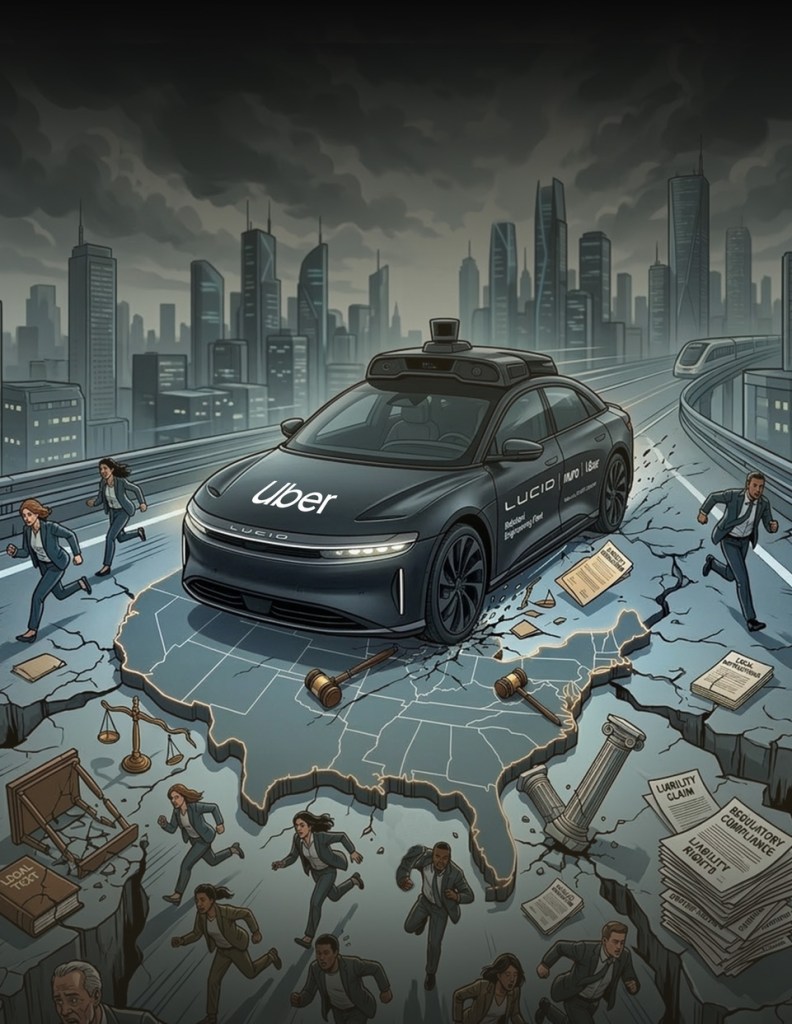
One of the most dangerous aspects of Uber’s push for limited liability is that it gives the robocar industry an opportunity to grow faster than safety standards warrant. It will allow for Uber to bypass the growing pains that come with emerging technologies and shift them to consumers. As Uber expands into more cities, it is the public that ends up as the real-world testing ground while companies such as Uber face fewer legal incentives to address safety issues. Uber has already partnered with over 20 car companies and self-driving companies and wants to offer rides in 15 cities by the end of 2026. By the end of the decade, it wants to be the main facilitator of rides. In Los Angeles, Uber plans to debut later this year its robocar with Volkswagen, which will run on autonomous technology from the Volkswagen-owned MOIA. The new Uber- Lucid-Nuro robotaxi is being tested on public roads right now, with the goal of offering rides by the end of the year. Uber plans on buying 20,000 cars. But we virtually know nothing about the new robotaxi.
“There are a lot of unknowns,” said Bryant Walker-Smith, an associate professor in the School of Law and the College of Engineering and Computing at the University of South Carolina, in January.
“Uber is running a prototype that it started testing last month. We don’t know what safety standards, if any, Uber is adhering to. We don’t know the specs of the car. We don’t know about their internal testing. We don’t know cost of production.”
But what little we do know is frightening.
2025 CA DMV disengagement reports December 2024-December 2025 WaymoNuro Miles Driven3,346,709157,561 Disengagements Disengage Rates (miles/ 19,234646 disengagement) Nuro’s self-driving hardware costs an “order of magnitude less” than what Waymo uses on its Jaguars, Nuro’s COO told InsideEVs. (opens in new tab) This is concerning because Nuro has tested its own AV very little. Nuro tested less than 160,000 miles in California in 2025, compared to over 3 million miles driven by Waymo. Nuro’s disengagement rate, or when a human has to take over the autonomous system due to a technical failure or other concerns, was under 700 miles, meaning it couldn’t drive 700 miles without human intervention. By comparison, Waymo robocars could go nearly 20,000 miles before the computer disengaged. Nuro averaged 646 miles per disengagement in 2025, a sharp decline from 2,044 miles per disengagement in 2024, according to DMV data. (opens in new tab) It’s going to take years before we know the truth about Uber and robotaxis. An influential RAND report (opens in new tab) on robocars states: “Fully autonomous vehicles would have to be driven hundreds of millions of miles and sometimes hundreds of billions of miles to demonstrate their safety in terms of fatalities and injuries.”
General Motors, for example, collaborated with the University of Michigan on a study (opens in new tab) that explored the potential safety benefits of Super Cruise but concluded that there was not enough data to understand whether the AV system reduced crashes. Even the most advanced autonomous vehicle companies have not accumulated enough driving miles to statistically prove they are safer than human drivers, but Uber is pushing to rapidly deploy robotaxis in cities across the country.
| Waymo | Nuro | |
|---|---|---|
| Miles Driven | 3,346,709 | 157,561 |
| Disengagements | 174 | 244 |
| Disengage Rates (miles/ disengagement) | 19,234 | 646 |
But there have been independent safety doubts about other robotaxis too. Independent NHTSA data analysis (opens in new tab) of Tesla robotaxis in Austin suggested crash rates may have been worse than human drivers. Tesla’s own car safety report says the average U.S. driver is in a collision every 229,000 miles. By that metric, the Tesla robotaxi fleet was crashing 4 times more than human drivers (opens in new tab), even though there were trained safety drivers in each car. And a study (opens in new tab) from the Insurance Institute for Highway Safety found “no convincing evidence” that partial automation reduces crash rates.
Studies (opens in new tab) have shown (opens in new tab) that less than 1 degree camera misalignment, and even as little as a few tenths of a degree, can degrade the perception of accuracy in autonomous vehicle systems. These small errors compound into significant errors at longer distances, potentially affecting collision avoidance performance. If the tech world likes to say, “Move fast and break things,” then that is— unfortunately—exactly what Uber has already done and is at-risk to continue to do in the future with robocars. Uber CEO Dara Khosrowshahi said during a 2025 earnings call (opens in new tab) that, “The focus now is how do we bring this product to market as quickly as possible because it looks like from a consumer standpoint and from a safety standpoint, it’s a real hit.”
However, its partner, Lucid, said in a 2025 SEC filing that, “We cannot guarantee that our vehicles will achieve our targeted assisted or autonomous driving functionality within our projected timeframe, if ever.”
Lucid said the bad part quietly. It might never achieve actual AV capability. But regardless, Uber said it needs to bring it to market as quickly as possible. Uber and robocar companies employ teleoperators, who monitor, advise, and occasionally take control of an AV. Aside from the fact that some work remotely in call centers as far away as the Philippines, that’s pretty much all we know about these phantom co-pilots. Massachusetts Senator Ed Markey said during a recent AV Senate subcommittee hearing that these remote agents are nothing more than “trans-Atlantic backseat drivers.”
No one knows what kinds of jobs these are, and there is no regulatory framework in place to govern them and protect the public. It’s unclear how many AVs each remote agent is responsible for, how often they intervene, what the qualifications for the job are, or what happens if communication lines fail. We don’t even know how many remote agents a company like Waymo or Nuro employs.
These are very important questions to answer because remote agents are like emergency dispatchers or air traffic controllers. Imagine if we knew nothing about the qualifications of an air traffic controller. Now imagine there were no laws governing them.
For example, what if an overseas remote agent doesn’t understand the rules of the road in San Francisco? Experts have hypothesized that remote agents might have played a part in the mass AV stoppage that happened in San Francisco (opens in new tab) last year in which hundreds of AVs froze, blocked intersections, and got in the way of emergency responders.
“The whole point of having remote operations is for humans to be there when the system is not responsive in the way it should be,” Missy Cummings, director of the George Mason University Autonomy and Robotics Center, told Reuters (opens in new tab). “The federal government needs to regulate remote operations. They need to make sure that there’s backup remote operations when there’s some kind of catastrophic failure.”
In a letter to AV manufacturers, Markey noted that latency as low as 300 milliseconds can reduce driving performance. That’s pretty low. Latency is the delay between a command and a response, whether between a human and software or a sensor and software. But there are no minimum latency standards, and because of this, companies haven’t disclosed anything about them.
“When latency interrupts a zoom call or streaming service, it may frustrate the user,” wrote Markey. “When it slows down a remote assistance operator’s ability to direct an AV, it could have much more serious consequences.”
And even though Waymo said fleet agents must hold a driver’s license and go through a background check and drug screening, most states, including California, do not require remote agents to hold a driver’s license or be located in the United States. They also don’t require sobriety tests.
Further, there are no laws governing data retention, privacy, encryption, or authentication safeguards.
And the number of AVs on the road is growing. Over a roughly six-month period in 2025, Waymo’s fleet grew by 1,000 AVs, up to 2,500 (opens in new tab). It says it completes 250,000 paid rides per week. Recently, it expanded services in Atlanta with Uber. For more than a century, the civil justice system has been one of the primary ways the public holds corporations accountable when new technologies cause harm. Weakening those protections at the very moment autonomous vehicles are expanding onto public roads risks removing one of the few safeguards that ensures safety comes before speed. Robotaxis may represent the future of transportation. But if companies are allowed to rewrite the rules of liability before that future arrives, the public will be left paying the price for innovation.