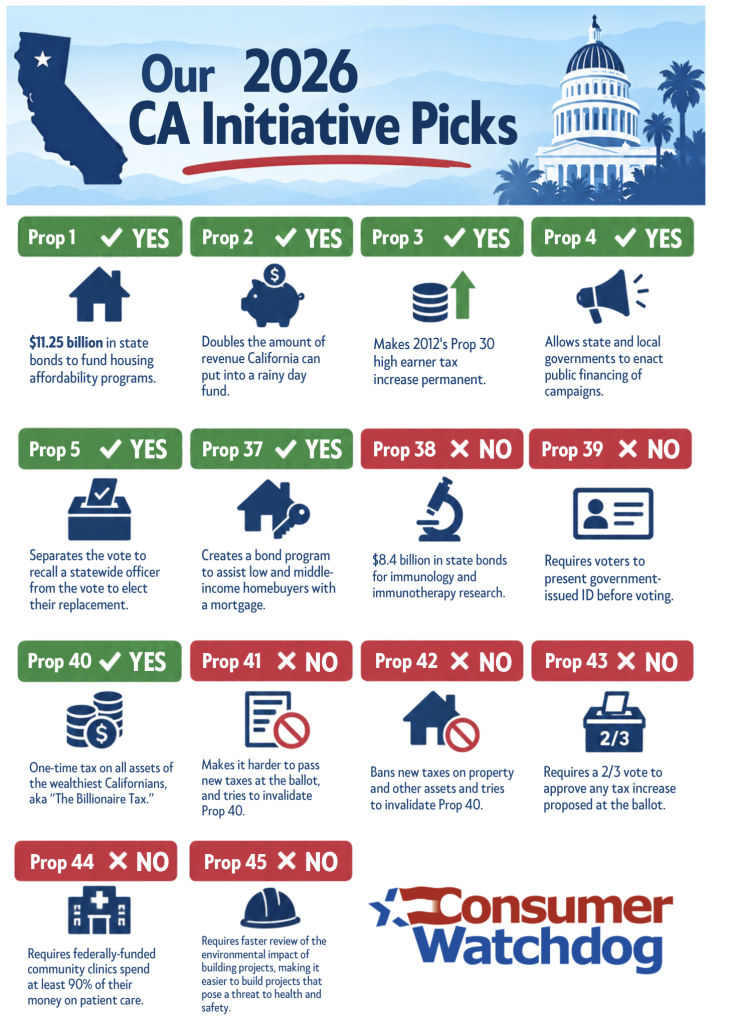
Every election we hear from a lot of people asking for our endorsements on the year’s crop of ballot measures. While Consumer Watchdog hasn’t taken an official position on all of the initiatives, here’s the consensus among our staff on how we’ll vote when we fill out our ballots. Get your black and blue pens ready to vote on a whopping 14 propositions this year.
Proposition 1 – YES
$11.25 billion in state bonds to fund housing affordability programs
The measure’s $11.25 billion in bonds would be split into five main buckets: $5.1B to build and rehab multifamily rentals; $2.1B to preserve existing affordable housing and supportive housing for the homeless; $1.25B for state funded mortgages for California veterans; $1.1B for homeowner mortgage down-payment assistance; and $1B for farmworker, student and tribal housing.
Placed on the ballot by the legislature.
Wide support including: Housing, veteran, senior, teacher and labor organizations.
No organized opposition. Republican lawmakers opposed in legislature.
Proposition 2 – YES
Doubles the amount of revenue California can put into a rainy day fund.
Right now lawmakers are required to put money into a rainy day fund in years California has a budget surplus, to be used as a cushion in lean years. Prop 2 would increase the amount from 10% to 20% of tax revenue. Supporters say this creates a cushion for those frequent years when tax income falls and the state faces a deficit, so the state doesn’t have to cut spending on public priorities. Opponents say Prop 2 lets lawmakers set aside more tax revenue without triggering requirements that the state refund individual taxpayers when the state exceeds a voter-approved spending cap. While the latter is true, proponents have it right that we need to set by more money to handle the frequent and drastic swings in the state budget that frequently finds the state with a $50 billion surplus in one year then a $50 billion deficit the next.
Placed on the ballot by the legislature.
Supported by numerous groups, including business interests and labor unions, tech companies and developers, and the CA Democratic Party.
Opposed by Republican lawmakers.
Proposition 3 – YES
Makes 2012’s Prop 30 high earner tax increase permanent.
In 2012 voters approved a higher tax rate for high income Californians. It ranged from 10.3% to 12.3%, starting at $371,000 in income for individuals and $742,000 for couples in 2025. That’s the wealthiest 2% of Californians. The higher rate is set to expire in 2031, reducing the state’s highest tax rate to 9.3% and costing the state an estimated $5 – 15 billion a year. Prop 3 would make the higher tax rate permanent. Income tax is the largest part of state revenues, and income taxes place the highest tax burden on those most able to pay.
Placed on the ballot by the California Teachers Association.
Healthcare, education and state worker unions support.
Anti-tax groups oppose.
Proposition 4 – YES
Allows state and local governments to enact public financing of candidate campaigns.
Monied interests have undue influence over elections.
Voters approved a law five decades ago that sought to rein in money in politics by limiting how much money politicians can take in campaign contributions and gifts. It also banned the use of public funds for campaigns. Prop 4 would allow public financing again as one way to limit the need for large dollar fundraising by candidates. The idea is to give those without access to wealthy donors, or personal wealth, a chance to be competitive in elections. Every other state allows this, and fourteen states and 26 local governments have enacted it.
Prop 4 doesn’t create a public financing system now. It just gives local governments, or the state, the ability to enact public financing in the future if they choose.
Placed on the ballot by the legislature.
Sponsored by the California Clean Money Campaign and supported by good government groups.
Opposed by anti-tax organizations.
Proposition 5 – YES
Separates the vote to recall a statewide officer from the vote to elect their replacement.
This measure was placed on the ballot by lawmakers as a response to the failed attempt to recall Gov. Newsom in 2021. At that election, voters had to decide both whether the governor should be recalled and who should replace him if he was. 135 candidates were on the ballot. With that many candidates splitting the vote, if the governor had been recalled his replacement would likely have been elected with a very small percentage of the vote, in a low turnout election. The new governor could have been elected with less votes than were cast against the recall. Prop 5 changes this to say the lieutenant governor replaces a recalled governor, and the new governor is chosen at the next statewide election. For other recalled statewide officials, the governor would appoint a replacement until the next election. Recalled members of the legislature would be elected at a special election as they are today.
Placed on the ballot by the legislature.
Supported by good government groups and Democratic politicians.
Opposed by Republican politicians.
Proposition 37 – YES
Creates a bond program to assist low- and middle-income homebuyers with a mortgage.
The state would be authorized to sell up to $25 million in bonds to offer mortgage down-payment assistance to homebuyers. The bonds would be sold on the private market and repaid by homeowners holding the mortgage, with no taxpayer obligation to pay. Homes would have to be new construction, or a home newly converted from nonresidential property. Loans could be up to 17% of purchase price, and buyers would have to put down at least 3%. Buyers would have to meet income and residency requirements and live in the home.
This measure was placed on the ballot through signatures paid for by construction labor unions and builders.
Supporters include a wide range of interests.
There is no filed opposition, likely because there is zero cost to the state.
Proposition 38 – NO
$8.4 billion in state bonds for immunology and immunotherapy research
Half of the $8.4 billion would go to research grants, and half to a University of California affiliated medical research institute. At least half the funds would have to be spent on research into cancer, Alzheimer’s and heart disease. The proponents say massive federal funding cuts necessitate this state investment in immunology so scientific progress towards cures doesn’t stall. Opponents argue that state funding should not be locked in to specific fields when medical needs may change over time. Indeed, basic health care funding like Medi-Cal has also been cut drastically by the current federal administration.
However, even supporters of allocating state funds for specific medical research should question how this measure does it. Its language excludes all but one research institute from qualifying to receive half the funds, an institute that is not yet functional but was co-founded by the two billionaire philanthropists who qualified the measure for the ballot. Something stinks about two billionaires getting taxpayers to pay for their pet project, especially when the measure doesn’t disclose that. Their institute would also sit on the council that chooses where to allocate the rest of the funds, and recipients would be required to work closely with the institute.
Placed on the ballot by signatures paid for by Dr. Gary Michelson and Meyer Luskin.
Supported by Michelson and Luskin, along with disease research and health care related nonprofits.
Lead opponents include a former director at the National Institutes of Health and the League of Women Voters.
https://calmatters.org/politics/elections/2026/07/proposition-38-california/
Proposition 39 – NO
Requires voters to present government-issued ID before voting
This measure creates new hurdles to voting by requiring a government-issued ID, such as social security number or drivers’ license, be presented when submitting a ballot in person or by mail. It invalidates mail-in ballots if the voter ID number provided is from a different ID than the one provided during voter registration, making it more likely that mail-in ballots will be rejected. Californians already prove their citizenship in order to register to vote. Repeating the process makes it harder to vote. Voter ID requirements and claims of voter fraud are a standard tactic to suppress voter turnout, an impact that hits lower income communities and communities of color hardest. Given Prop 39’s campaign is funded with millions from national Republican donors, one reporter suggests they are using the measure as a test case for national support of the President’s larger agenda to tighten voter restrictions.
Placed on the ballot through petition signatures.
Supported by the Republican Party and conservative organizations.
Opposed by the Democratic Party and left-leaning organizations.
https://laist.com/news/politics/why-are-out-of-state-billionaires-funding-a-california-voter-id-measure
Proposition 40 – YES
One-time tax on all assets of the wealthiest Californians, aka “The Billionaire Tax.”
Prop 40 seeks to replace some of the tens of billions in health care and other funding that the current administration and politicians in Washington DC took from California to pay for a tax cut for the wealthy. It would impose a one-time 5% tax on the wealth of California’s richest residents (the same people who benefited from the federal tax cuts). It would also direct funds to education and food assistance.
The law would apply to approximately 250 people in California worth more than $1 billion, according to proponents, and tax wealth they normally don’t have to pay taxes on. For example, the wealthy invest in property that appreciates in value – such as art collections – thus increasing the net worth of these individuals, but this increased wealth is never taxed. Similarly, much business wealth is never taxed, leaving the wealthiest Californians paying a lower overall tax rate than middle class residents. Proponents say the law is necessary to avoid the catastrophic cuts in public health care that could close clinics and hospitals, depriving the most vulnerable of care. Opponents say the law won’t stand up in court because it retroactively taxes wealth, and that a one-time tax is no solution to a long-term problem. They also suggest it will cost the state money for years to come because it will spur impacted billionaires to leave the state. If they do, we’ll lose the income tax revenue they already pay that forms the bulk of California’s annual tax base. However, since the measure applies to wealth as of Jan 1 2026, the chance to avoid the tax by leaving is now past.
Then there’s the politics behind the measure. It was placed on the ballot by SEIU-UHW, a health care union. UHW’s President Dave Regan has long been a controversial figure in state initiative politics, accused of filing ballot measures as leverage points targeting corporations the union is trying to organize. In the past, we’ve evaluated those proposals on their merits, and left aside the politics. Now Regan is accused not just of being a bully in the political process but of being abusive with his colleagues and employees. I find the accusations credible and am loath to support any measure he’s championing. But at the end of the day the needs of millions of Californians who may lose what is already tenuous access to health care should come before the failings of one individual.
A final note. The No campaign is swamping the airwaves with ads. The ads’ most salient claim – that the measure will tax everyone’s retirement accounts – is false.
Placed on the ballot by SEIU-UHW.
Supported by SEIU-UHW, the Democratic Party, health care and other labor unions and Bernie Sanders.
Opposed by billionaires funding the No campaign, business and anti-tax organizations, other labor unions and health care providers.
Proposition 41 – NO
Makes it harder to pass new taxes at the ballot, and could invalidate Prop 40.
This measure requires an audit of any state department or program benefiting from new taxes proposed at the ballot, including whether the program is wasteful or spending money wisely. Likely reduces other state tax revenue by applying the state cap on spending to these new taxes. This measure was placed on the ballot as one of two counter-initiatives (also Prop 42) seeking to either: gain more votes than and therefore invalidate Prop 40, or sow enough confusion about tax measures on the ballot that voters get confused and say no to all three (Props 40, 41 & 42).
Placed on the ballot by opponents of Prop 40.
Major donors include 20 ultra-wealthy Californians with Google co-founder Sergey Brin leading the pack at $102 million given to pass this measure and Prop 42.
Opposition primarily from the proponents of Prop 40, the SEIU-UHW healthcare workers’ union, and the California Democratic Party.
Proposition 42 – NO
Bans new taxes on property and other assets and tries to invalidate Prop 40.
This measure would prevent the state from enacting any new taxes on held assets like property, investment accounts or business interests, and bans taxing activity retroactively. This is the second of two counter-initiatives placed on the ballot with the intent of nullifying Prop 40, the billionaires’ tax. It could do so by either gaining more votes than Prop 40 to directly override it, or by sowing enough confusion about tax measures on the ballot that voters say No to all three (Props 40, 41 & 42).
Placed on the ballot by the same 20 billionaires who funded Prop 41.
Supporters include labor unions representing building trades, police and firefighters.
Opposition primarily from the proponents of Prop 40, the SEIU-UHW health care workers’ union, and the California Democratic Party.
Proposition 43 – NO
Requires a 2/3 vote to approve any tax increase proposed at the ballot.
This measure seeks to make it harder for the public to propose tax increases at the ballot by requiring 2/3 of voters’ approval, instead of 50% plus one. Currently government-proposed taxes need a 2/3 vote, but not voter-proposed taxes. Because Prop 13 slashed local governments’ ability to tax property decades ago, city and county programs for public works like parks, emergency response like wildfire prevention, and even basic services like police, can be highly dependent on the kind of special taxes this measure targets. If a majority of voters can elect a public official, a majority of voters should be enough to pass a tax.
This measure was placed on the ballot by the legislature in a deal made to keep a more restrictive anti-tax measure off the ballot.
Supporters include anti-tax and business organizations.
Opponents include unions representing healthcare, education, and public service workers, housing and environmental organizations.
Proposition 44 – NO
Requires federally-funded community clinics spend at least 90% of their money on patient care.
While spending more money on patient care sounds good, opponents point out that clinics could be barred from investing in capital projects, buying new equipment or technology, or even putting some revenue in budget reserves. Proponents say they’re targeting excessive executive pay, which undoubtedly has been a problem at some clinics. However, painting with such a broad brush could prevent clinics from investing in programs and property that are critical to their patients’ health.
Signatures for this measure were gathered by the SEIU-UHW healthcare workers union, also proponents of Prop 40.
Opponents include organizations representing doctors and hospitals, and the CA Democratic Party.
Proposition 45 – NO
Requires faster review of the environmental impact of building projects, making it easier to build projects that pose a threat to health and safety.
The California Environmental Quality Act (CEQA) was meant to require developers to study the environmental impact of their projects before building, and mitigate harm. Local governments and the public were empowered to challenge them if they got it wrong and a project posed too great a risk to our air, water and communities. By speeding up surveys of a project’s environmental impact, and fast-tracking legal challenges to the findings, Prop 45 would mean some projects get built faster without thorough environmental review. The measure limits current requirements that governments consider alternatives for a harmful project, limits public input into projects, and limits evidence and remedies courts may consider. This would reduce protections against negative environmental impact. It applies to projects it deems ‘essential,’ including housing, schools, roads, and energy. Supporters say Prop 45 is needed to speed up environmental reviews and litigation that can drag on and delay a project for years. Opponents counter that it creates a massive loophole in environmental protections that keep our communities safe.
As one writer put it, “It seeks explicitly to turn a process meant to determine environmental impact into one that prioritizes project completion.” When a question is in doubt, Prop 45 directs the courts to side with getting the project done fast. That’s enough to tell us that Prop 45 pushes the balance too far, giving the benefit of the doubt to polluters, instead of making them show their projects are safe.
Placed on the ballot by the California Chamber of Commerce.
Supporters include local governments, building and business interests.
Opposed by environmental groups and worker unions.
https://www.golden-state.org/california-needs-ceqa-reform-prop-45/