Google-Funded Campaign to Defend Internet Law Also Protects Hub of Child Sex Trafficking Executive Summary
For years, one company—Backpage.com—has dominated online trafficking in minors for sex. The advertising giant’s reach is vast, with sites catering to 437 locations in the U.S. and 506 overseas. So is its impact: By one count, 73% of all suspected child1 trafficking reports in the U.S. involve Backpage.
Details of Backpage’s victims have filled multiple lawsuits, legal actions and government investigations: A 13-year-old girl in Miami whose pimp tattooed his name on her eyelids; a 15-year-old in Seattle who was sold for sex more than 150 times. A new documentary film, I Am Jane Doe, chronicles the struggles of child sex victims to hold Backpage2 responsible for its role in the abuse they suffered.
Despite widespread revulsion at its business model, however, Backpage has managed to elude a series of legal challenges and beat back legislative efforts to stop it from advertising children for sex. In its successful efforts, Backpage has benefitted from the help of an all-star cast of lawyers and legal scholars, as well as significant political and lobbying muscle that it could not assemble itself.
The common factor behind nearly all those forces: Alphabet Inc.’s Internet giant, Google.
An analysis of public records, tax documents and legal filings and other publicly-available documents shows Google has financed and supported a broad array of groups and individuals who have fought aggressively to thwart legal challenges to Backpage’s business model. Legal scholars and groups supported by Google have written letters and amicus briefs in support of Backpage. More than half of the 42 signatories of a letter opposing a bill to tackle online child trafficking—22 in all—were either directly funded by Google, or worked at institutions that were funded by the3 company. (See Appendix C)123 At least four of Google’s lobbying firms have also worked to block efforts by the U.S. Congress to strengthen laws to prevent child sex-trafficking under the Stop Advertising Victims of Exploitation (SAVE Act) of 2014 that would have targeted Backpage and held it accountable. Google’s lobbying firms also appear to have successfully lobbied to remove a key provision from the law that would have held Backpage liable for recklessly disregarding the child sex trafficking occurring on its site. (See page 22).
Lobbyists for Google reportedly helped kill a version of a bill that would have required firms hosting adult ads to determine the age of people appearing in their online4 victim’s advocate credited with helping shut ads.
Google even poached one of the leading campaigners for shutting down Backpage’s child-trafficking ads, who, after being hired, then changed her stance on the issue to crusade against Craigslist, Backpage must also align with her new employer. She now argues that it isn’t possible to shut down sites like Backpage and that laws should target buyers rather than websites that advertise children for sex. (See box, left).
By 2014, Ms. Saada Saar had changed her Why would Google be interested in defending such a company? In short: business. The groups’ defense of Backpage centers around Section 230 of the Communications Decency Act, a 1996 law that Google says provides it with almost unlimited immunity from liability for crimes committed using its services. That includes the posting of pirated movies and music to its YouTube service, fraudulent advertisements posted through its AdWords service or Google suggesting trademarked terms as advertising keywords.
CDA 230 has been described as an implicit subsidy for a then-nascent industry, allowing it to avoid the regulation affecting5 other sectors. Proponents have argued45 that it protects and promotes free speech on the Internet. They have, however, ignored the devastating impact the law can have in its current form. Section 230 has been central to Google’s stratospheric success over the past two decades. Partly as a result of the provision, a Harvard professor reported in 2011 that Google earned over $1 billion in revenue annually from Google advertisers posting unlawful material related to child6 trafficking, illegal drugs, and counterfeit goods.
Google has sought to extend its broad interpretation of CDA 230 around the country, while beating back anything that threatens to narrow its scope in the U.S. even when the law has had devastating consequences for victims of such crimes as child sex trafficking. Google’s efforts have apparently included placing its unrivaled resources and lobbying prowess at the service of Backpage, while concealing its own efforts to direct its defense. “The Googles of the world are in a tough spot,” congressional aides told The Daily Beast. “They’re not going to speak out publicly against a human trafficking7 measure. But they also are opposed to it.”
As the key unit of publicly-traded Alphabet Inc., Google with a “Don’t be Evil” ethos, has so far remained publicly silent on the issue of Backpage. Nevertheless, the company’s position can be traced through the activities of its network of paid academics, advocates and third-parties, which it often deploys to promote and defend its public policy interests.
The company’s senior executives—as well as law firms and academics with close financial ties to Google—sit on the boards of numerous nonprofits defending Backpage. And the company has deployed its own contract lobbyists to water down congressional efforts to tackle Backpage and strengthen child sex-trafficking laws.
At the center of the effort to defend Backpage from legal threats are two nonprofit groups that between them have received millions of dollars in financial support from Google—the Center for Democracy and Technology (CDT) and the Electronic Frontier Foundation (EFF). In addition to their heavy funding from Google, both groups have dozens of top advisors with close ties to the company. Both groups—but especially CDT —have a history of supporting Google’s public policy objectives and defending the company in court, often acting as unofficial lobbying arms of the company. Those groups have rallied to Backpage’s defense, filing numerous amicus briefs to defeat lawsuits filed by the child-trafficking victims. They have even filed briefs on Backpage’s behalf to thwart legal subpoenas issued to the company by state law8 enforcement officials and Congress. Supporting the campaign, which advocates say is678 to protect Section 230, is a network of more than two-dozen legal scholars, special-interest groups and trade associations that Google also supports financially from its public policy operation.
The full extent to which Google is directing Backpage’s defense remains unclear and it has yet to publicly clarify its position. Other tech companies, who also benefit from CDA Section 230, support some of these organizations as well.
However, Google is far and away the largest financial backer of these groups, providing millions of dollars to the organizations leading Backpage’s defense. Its efforts also extend to Google’s own contract lobbyists and network of consultants and academics. Google’s financial support of EFF, CDT and dozens of other groups, has contributed to a string of legal successes by Backpage and complicated the quest for justice among its underage victims. Since 2011, the nonprofits have helped Backpage defeat several cases related to child sex trafficking by filing Section 230 briefs on Backpage’s behalf. Among the initiatives the groups have helped defeat:
- A legal case brought by three underage sex-trafficking victims who were advertised on Backpage and sold for sex in Massachusetts and Rhode Island more than 1,9009 times over three years.
- Proposed state laws aimed at curbing Backpage’s child sex advertisements in Washington, New Jersey, and Tennessee.
- Efforts by law enforcement in Cook County, Illinois, to prevent the use of credit card payments to purchase ads offering children for sex. (Pages 23 and 24)
- Efforts by 49 state attorneys general to amend Section 230 to give state and local law enforcement officials the authority to criminally investigate and prosecute13 companies like Backpage for promoting child sex trafficking.
- The “reckless” standard in early versions of Congressional legislation such as the SAVE Act, which strengthened child sex trafficking laws by making it illegal for online14 advertisers to recklessly disregard child sex trafficking occurring on their websites.91011121314 The support of Google-funded groups has also served to confer legitimacy on Backpage, which critics say has become a “boiler room” operation for commercial sex. A U.S. Senate investigation of child trafficking suggests that Backpage’s sole purpose appears to be advertising commercial sex with only a veneer of other, legitimate classified ads.
In recent years, Google has also started to fund several anti-child trafficking organizations, though it appears that it has yet to persuade them, as it has with Ms. Saada Saar, that they should redirect their efforts away from supporting victims’ lawsuits against the company. Several have filed amicus briefs in support of plaintiffs’ arguments that Backpage should not benefit from CDA Section 230 protections because it “materially contributes” to the illegality of content posted on its site. As Backpage’s legal challenges have continued to mount since 2011, the company and its founders have remained defiant, aggressively defending against lawsuits, fighting state and federal subpoenas, and filing their own lawsuits against state laws seeking to regulate online child sex trafficking. In case after case, claiming to be motivated by defending Section 230, Backpage’s active supporters have included EFF, CDT and more than two dozen legal experts, lobbying firms and interest groups—all quietly supported behind the scenes by Alphabet Inc.’s key unit, Google.
Backpage.com’s History
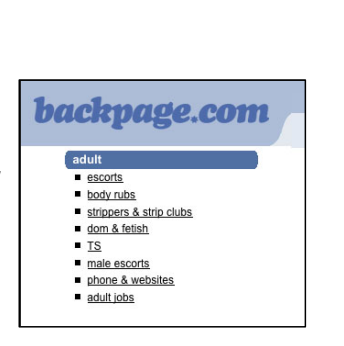
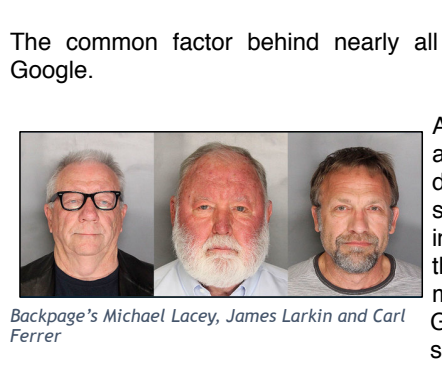
Carl Ferrer, a classified advertising executive who had served as The Dallas Observer’s director of classified advertising since 1996, created Backpage.com in 2003.
It’s mission: “to counter the loss of print classified advertising” from upstart online advertisers. The new online advertising company was named after the classified advertisements, many including adult subject matter, which appeared on the “back page” of the Village Voice and other free weeklies distributed throughout the15 United States.
In 2006, the Village Voice was purchased by New Times Media, an alternative newspaper conglomerate founded in 1970 by James Larkin and Michael Lacey that quickly grew into one of the largest owners of free weeklies in the United States. The merged company, renamed Village Voice Media Holdings, retained the online Backpage classified service, which also included ads soliciting prostitution. When Craigslist, which was the market leader in adult ads, closed its site in 2010, Backpage, a distant second in terms of market share, then filled the vacuum. The company’s gross revenues grew by almost 600% in only two years, from $5.3 million in 2008 to $29 million in 2010. By 2014, Backpage’s gross revenue, and that of its affiliated companies, was estimated to16 be $135 million.
As Backpage’s revenues increased, so did scrutiny of the company over allegations that it turned a blind eye, and in many cases even facilitated, child sex trafficking through its adult personals section. Dozens of news reports since 2010 have highlighted the heartbreaking and horrific stories of young girls trafficked for sex online, including:
- A case in Atlanta, GA of a 12-year-old girl whose pimp regularly tasered her and17 even forced her to work while pregnant with his child.
- A New York City case of a 13-year-old girl who was regularly beaten and even18 kicked down a stairwell for trying to escape her pimp.
- A Miami case of a 13-year-old girl whose pimp had tattooed his name on the girl’s19 eyelids.1516171819
- A Seattle case in which a 15-year-old girl was sold for sex more than 150 times.
- A Chicago case in which a 16 year old, suffering from depression, left home. Three weeks later, she was advertised for sex on Backpage and murdered at the hands of21 her Backpage buyer.
In each of the examples, the girls were sold through Backpage.
In August 2011, 45 state attorneys general sent a letter to Backpage’s legal counsel seeking information on what steps the advertising site was taking to eradicate advertisements for child prostitution. The letter, sent in lieu of an official subpoena, described Backpage as a hub of “human trafficking, especially the trafficking of minors” and pointed to more than 50 cases they had identified since 2008 involving individuals trafficking or attempting to traffic minors through Backpage’s classified advertising22 service. (The National Center for Missing and Exploited Children reports that 73% of23 all child sex trafficking reports it receives are related to Backpage advertisements.) The same month, Backpage was found not guilty in a Missouri case in which a victim sold through Backpage’s adult advertising section alleged that the company knew that child sex victims were regularly being advertised on the site. The court’s decision cited Section 230 of the Communications Decency Act, noting that the provision provided the company immunity from the victim’s claims, whether Backpage knew child sex24 trafficking was occurring on the site or not.
Interestingly, a 2012 article suggested that Backpage’s co-owner, Mr. Larkin, was well-aware of his company’s role in child sex trafficking. The article reported that he kept a photo of himself with Chris Hansen, the former host of Dateline NBC’s To Catch a Predator prominently displayed in his Phoenix mansion. The NBC show centered around hidden camera investigations of men soliciting underage girls for sex. Mr. Hansen had autographed the photo with the words: “To Jimbo, thanks for keeping me in25 business.”
Two months after the August 2011 Missouri decision, Mr. Larkin was interviewed in a New York Times story, “Fighting over Online Sex Ads”, insisting the company was not legally responsible for child sex trafficking ads posted on the site and expressing defiance against efforts by law enforcement to investigate the company. “I am beginning202122232425 to like our odds. We have all these politicians and concerned clergy after us. We must26 be doing something right,” he said.
By September 2012, public pressure and negative attention over Backpage’s facilitation of child sex trafficking ultimately prompted Village Voice Media to spin off the company. Under the spinoff plan, Village Voice Media’s controlling shareholders, Mr. Lacey and Mr. Larkin, continued to operate Backpage independently as a separate entity set up through a complicated legal structure that included several U.S. and, reportedly, Amsterdam-based holding companies. Mr. Ferrer, the founder and creator of Backpage, remained CEO of the new company.
As the company’s legal challenges mounted beginning in 2012, two activist groups with close ties to Google—the Electronic Frontier Foundation and the Center for Democracy and Technology—stepped in to help with Backpage’s legal defense across a widening front of legislative and prosecutorial challenges.
From 2012 to 2015, Backpage faced legislative threats in Washington, Tennessee and New Jersey aimed at finding a way to hold Backpage accountable for its conduct. With legal support of EFF, CDT and others, Backpage beat back the threats in each case.
In October 2016, Mr. Ferrer was arrested in Houston on a California warrant charging the CEO with pimping a minor,29 pimping and conspiracy to commit pimping. Backpage’s controlling shareholders, Mr. Lacey and Mr. Larkin, were also charged with conspiracy to commit pimping.
“Raking in millions of dollars from the trafficking and exploitation of vulnerable victims is outrageous, despicable and illegal,” said California Attorney General Kamala Harris commenting on the arrest. “Backpage and its executives purposefully and unlawfully designed Backpage to be the world’s top online brothel,” Harris noted. A California judge later dismissed the pimping charges citing Section 230. But in January 2017, the Homeland Security Permanent Subcommittee on Investigations wrapped up a lengthy investigation of Backpage’s practices with a scathing 53-page26272829 report alleging Backpage knew it was facilitating child sex trafficking and had knowingly “sanitized” ads for sex with minors by editing out words like “teen” or “Lolita,” but then30 posting the sanitized ads anyway.
The same day as the Senate report, Backpage announced that it had shut down its adult “escorts” section, noting that “years of effort by government at various levels to31 exert pressure on Backpage.com” have made it “too costly to continue.” Until last week, just before the film was available on iTunes, Google Play and Amazon, the site’s escort section included a “censored” message and invited visitors to visit EFF, CDT and the Cato Institute for more information. All three are funded by Google. The escort link has now been removed.
However, many advocates have noted that the shutdown is little more than window dressing, as the child sex trafficking ads have simply migrated to other Backpage sections or to other websites operated by Backpage-owned entities. In March of 2017, The New York Times reported that many of the ads for children were now appearing32 on Backpage’s dating section using suggestive language such as “100% young.”303132
effort by government at various levels to exert pressure on Backpage.com” have made it “too costly to continue.”31 Until last week, just before the film was available on iTunes, Google Play and Amazon, the site’s escort section included a “censored” message and invited visitors to visit EFF, CDT and the Cato Institute for more information. All three are funded by Google. The escort link has now been removed.
And while the company may have shuttered its adult services in the U.S., Backpage’s adult section continues to thrive in cities and countries around the world. As in the U.S., many of the ads have language suggesting underage victims are being sold.
Google and CDA 230
Any change in CDA 230 to allow victims of child sex-trafficking to sue Backpage could expose Alphabet Inc.’s Google to similar legal challenges in state and federal courts. Victims and law-enforcement officials have argued in court filings that Backpage employees knowingly “sanitized” ads suggesting child sex trafficking, by filtering out incriminating keywords such as “Lolita”, “little girl” and “amber alert.” Backpage then allegedly posted the filtered ads nonetheless, as well as coaching its advertisers on how33 to create “clean” ads for illegal transactions.
Google faced a similar legal threat in 2011, when it was forced to pay $500 million to avoid criminal prosecution on charges that it had knowingly accepted illegal34 advertisements from rogue online pharmacies based abroad. Prosecutors alleged that Google willfully turned a blind-eye to the illegal sale of prescription drugs, and at times actively worked with advertisers to prevent their ads from being disqualified by35 suggesting keywords to get around Google’s advertising filters.
Google itself has come under increasing scrutiny for facilitating online sex trafficking in recent years. In March 2012, the National Association of Human Trafficking and Victim Advocates and 37 anti-trafficking organizations sent a letter to state attorneys general calling on law enforcement officials to investigate Google for profiting from sex36 trafficking advertisements in violation of Google’s own AdWords policies. More recently, a 2013 investigation by California-based Consumer Watchdog alleged that Google+ had become an online playground for child sex predators, allowing registered sex offenders and child pornography suspects to open Google+ accounts37 and upload pornographic images aimed at children through the social network. In July 2013, Google raised the ire of child safety advocates in the UK by rejecting a warning system that would flash a cautionary message when people were searching for child abuse content online. Google’s rejection of the system came after news stories revealed that the murderer of a five-year-old girl had collected a “library” of child abuse images by searching for the content on Google and Bing. Both Yahoo and Bing agreed38 to implement the warning system.333435363738 The company has also come under increased scrutiny recently for its alleged failure to accurately monitor other illegal or objectionable activity on its web properties. In March 2017, several advertisers pulled their ads from the video-sharing platform after their brands appeared next to videos that promoted extremist views, hate speech or sexually39 suggestive content. In December of 2016, families of victims murdered in a terrorist shooting at an Orlando nightclub sued Google, Twitter and Facebook, alleging that the40 companies provided “material support” to terrorists.
In each case, Google has publicly made claims that it is doing more to combat illegality on its sites. The question by many remains whether it is doing enough.3940
Google and CDT’s Special Relationship
Google has a long and close relationship with the Center for Democracy and Technology (CDT), which has received millions of dollars in funding from the company and regularly promotes its policy interests. The company has given the nonprofit more41 than $4.75 million since 2011, according to tax filings posted on CDT’s website. Google’s financial support is likely substantially more than that, as the group redacted its contributors in its public Form 990 tax disclosures prior to 2011. The connection between CDT and Google goes beyond the financial. The two have a symbiotic relationship, with several people moving between one and the other in both directions, or even belonging to both organizations simultaneously.
Alan Davidson, Google’s Director of Public Policy Americas from 2005 to 2012, was42 hired directly from CDT, where he served as the organization’s associate director. CDT’s Advisory Council currently includes Google policy executive Adam Kovacevich, several of Google’s top outside law firms, and numerous other special interest groups43 and academics that Google supports financially.
Mr. Kovacevich, who manages the company’s portfolio of relationships with policy groups in Washington, works behind the scenes to push Google’s policy views while keeping the company in the background. In 2014, a Washington Post story highlighted how Mr. Kovacevich worked behind the scenes with officials at George Mason University’s Law & Economic Center to put on Google-funded academic conferences that took a dim view of antitrust regulations aimed at the tech sector. At the time, Google was in the midst of an 18-month antitrust investigation by the Federal Trade44 Commission.
CDT’s advisory council also features several members of Google’s outside legal team, including Todd Hinnen with Perkins Coie, Lydia Parnes with Wilson Sonsini Goodrich and Rosati, and Durie Tangri’s Joseph Gratz.
Mr. Hinnen has represented Google on legal matters related to privacy, including a 2016 case in which the company sought to skirt federal search warrants for data stored45 overseas. (Backpage’s current general counsel, Elizabeth McDougall, was also4142434445 formerly with Perkins Coie). Perkins Coie also represented Google in the FTC’s 18- month antitrust investigation of the company and in the 2010 Google Buzz settlement47 with the FTC.
Wilson Sonsini’s Mr. Parnes represented Google in a separate case brought by the FTC alleging Google overrode the default settings of Safari browsers to place tracking cookies on the computers of Safari users visiting Google’s DoubleClick advertising network. Google settled the case for $22.5 million in 2012.
Mr. Gratz has represented Google in several Google Book Search copyright cases and in the Rescuecom v. Google and Vulcan Golf v. Google trademark cases. He has also authored copyright amicus briefs on behalf of Google in cases such as Flava Works v.50 Gunter. Notably, Professor Mark Lemley, a partner of Mr. Gratz and founder of the Durie Tangri firm has also served as outside legal counsel, and as a paid consultant to Google.
Mr. Lemley signed a letter to members of Congress, spearheaded by EFF and CDT that51 opposed child sex-trafficking legislation in July 2013. Google was required to disclose52 its financial relationship with Mr. Lemley in a 2012 filing in the Oracle v. Google case. Other current and past CDT Advisory Council members with close ties to Google include:
- Rebecca Mackinnon (New America Foundation): Google is the largest corporate contributor to New America and is listed as a $1million+ donor. Google’s former chairman and now Alphabet’s chairman, Eric Schmidt, has contributed more than $1 million to New America through his family foundation and served as New America’s53 Chairman of the Board until 2016.
- Bob Boorstin (Albright Stonebridge Group): Mr. Boorstin served from 2006-2013 as54 Google’s Director of Public Policy.464748495051525354
- Nick Feamster (Princeton University): Mr. Feamster, a professor of computer science at Princeton University, has received $1.6 million in Google research funding,55 according to his CV.
- Maura Corbett (Glenn Echo Group): Ms. Corbett’s Glen Echo Group counts Google as a client and has managed several policy coalitions Google helped create,56 including the NetCoalition, Wireless Innovation Alliance, and Save the Internet. Google and CDT work together closely in other ways as well: Since 2008, CDT has been a host organization for Google’s Policy Fellowship program in which undergraduate, graduate and law students are deployed to special interest57 organizations to work on policy issues important to the company.
Additionally, several former CDT employees now hold senior positions in Google’s policy operation: Erik Stallman, who served as CDT’s general counsel from 2014 to58 2016, joined Google as Public Policy Counsel in June of 2016. Heather West, who served as a CDT policy analyst from 2007 to 2010, worked in Google’s Federal Public59 Policy division until 2015. Andrew McDiarmid who served as a Senior Policy Analyst at CDT from 2012 to 2014 joined Google in late 2014 as a policy specialist.55565758596061
Google’s Special Relationship with EFF
The Electronic Frontier Foundation (EFF) also has a long and lucrative history with Google. The extent of the relationship became clear during the Oracle v. Google patent case in 2012, during which the company was required to disclose its relationships with organizations commenting on the case. Google stated in its filing that it “has contributed to the EFF for years” and listed several articles by EFF writers supporting Google’s62 position in the case.
EFF does not disclose the names of its donors. However, the organization’s revenues more than tripled from $5.3 million in 2011 to over $17 million in 2015. Google is one likely source of EFF’s surging revenues. In 2011, EFF received $1 million from Google in a settlement over the Google Buzz class action suit. The Google
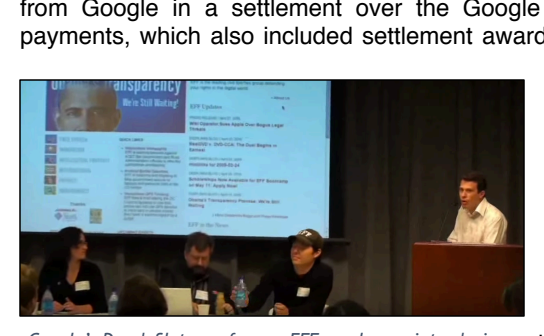
payments, which also included settlement awards to several other groups Google has funded in the past (including CDT), were made through what is known as a cy pres award, in which the class received nothing, but the settling parties agreed to pay the settlement sum to advocacy groups Google helped select under the theory that those groups would promote the interests of the class members in some indirect fashion related to the lawsuit.
EPIC, a privacy group that was originally denied settlement funds at the time, filed an objection contending that they were excluded from the final list of cy pres applicants because of counsel’s “bias towards distribution of cy pres funds to ‘organizations that are currently paid by [Google] to lobby or consult for the company.’” EFF’s Board has long been dominated by members who have close personal,64 institutional, professional, and financial ties to Google, including:
- Pamela Samuelson (UC Berkeley Center for Law and Technology): Google is listed65 as a “corporate benefactor” of UC Berkeley’s Law School. Ms. Samuelson is also on the faculty of UC Berkeley’s School of Information where four of the seven board62636465 members are current or former Google executives: Hal Varian, Elizabeth Churchill,66 Betsy Masiello, and Nicole Wong. Ms. Samuelson and her husband Robert Glushko are also the founders of UC Berkeley’s Samuelson Law, Technology and Public Policy Clinic. The Berkeley Center for Law & Technology and Samuelson Law, Technology & Public Policy Clinic also received $700,000 as part of the Google Buzz67 cy pres settlement.
- Lorrie Cranor (Carnegie Mellon): Ms. Cranor, who served as an EFF board member until her appointment as the FTC’s chief technologist in 2015, has received nearly68 $850,000 in Google research awards, according to her CV. The money included nearly $350,000 in personal research awards and $400,000 shared with two other Carnegie Mellon researchers. She also received $178,920 as part of the cy pres settlement in the Google Buzz case.
- Jonathan Zittrain & Brad Schneier (Harvard Berkman Klein Center): Google is one of only two corporate sponsors (the other is Facebook) of the Berkman Klein Center69 and has a long history with the institution and Mr. Zittrain. In 2010, Emily Brill wrote a profile of Google’s relationship with the Berkman Center, reporting that Google was Berkman’s top corporate backer and its fourth-largest donor. Mr. Zittrain is also personally close to Google co-founder Sergey Brin, according to Ms. Brill’s article. Neither Google nor the Berkman Klein Center discloses the amount of Google’s annual financial support, although Ms. Brill reported that Google had contributed70 “roughly $500,000 over the last two years.” Mr. Schneier is also a fellow at the Berkman Klein Center and a program fellow at New America’s Open Technology Institute. As highlighted above, Google is the largest corporate contributor to New America.
- Brad Templeton (EFF Chairman Emeritus): Mr. Templeton, who served as EFF’s chairman until 2010, has disclosed his close relationship with Google and its founders, noting on his personal website, “One, I’m a fan of Google, and have been friends with Google’s management since they started the company. I’ve also done71 work for Google advising on software design.”
- Joe Kraus (EFF Board Member, Google Director of Product Management): Mr. Kraus served simultaneously as an EFF Board Member and as a Google executive666768697071 from 2005 to 2012 – first as Google’s Director of Product Management and later as a72 partner at Google’s VC firm, Google Ventures.
EFF and Google also count several “revolving door” moves from amongst their ranks:
- Fred von Lohmann, an EFF senior staff attorney until 2010, Mr. Lohmann joined Google first as senior copyright council and currently serves as Google’s legal73 director for copyright.
- Erika Portnoy, a Google software engineer from 2005 to 2016. Today Ms. Portnoy is74 EFF’s “staff technologist”.
- Chris Palmer, As Google’s senior software engineer, Mr. Palmer took a leave of absence in 2010 to serve as EFF’s technology director, before rejoining Google a75 year later in 2011.
- Dan Auerbach, a Google software engineer, left Google in 2010 to join EFF as its76 technology director.
- Derek Slater, EFF’s “activism coordinator” until 2007, Mr. Slater joined Google as its senior public policy manager leading the company’s grassroots strategy in the SOPA-PIPA copyright fight in 2012.
Like CDT, EFF is also a host organization for Google’s Policy Fellowship program and has awarded fellowships to graduate students to work at EFF every year since at least77 2008.727374757677
Google-funded groups’ support of Backpage: A Timeline
After Backpage’s legal troubles gathered steam from 2008 to 2011, EFF and CDT, citing concerns about protecting Section 230, first emerged to defend the company in mid-2012. Supported by dozens of other Google-funded groups, the two non-profits aggressively filed amicus briefs on Backpage’s behalf; recruited signers to coalition letters opposing bills targeting Backpage; wrote blog posts and op-eds defending the company; and, in at least one case, filed directly as an “intervener” in opposition to a lawsuit in which Backpage was a defendant.
EFF and CDT’s frequent use of amicus briefs to defend Backpage in its numerous court cases is not without controversy. Defined as “friend of the court” legal filings by impartial observers, amicus briefs have increasingly been used by the groups to support the legal positions of their funders.
In an unrelated 2015 case known as BMG Rights Management v. Cox Enterprises, the Court denied EFF’s motion to appear as amicus on behalf of Cox, citing the fact that Cox’s counsel in the case also served on EFF’s advisory board and collaborated with78 the non-profit on the drafting of the brief. The judge in the case chastised Cox and EFF for their failure to disclose the relationship, saying: The problem isn’t that you went to EFF and solicited their input… It’s that you didn’t disclose it. And you are close enough to this action as lead counsel where there is absolutely no question that you should have encouraged Public Knowledge or Electronic Frontier Foundation from identifying – Just a footnote… And that is, in my belief, disappointing and deceptive. Amicus are obviously friends of the court. And I think with that, there comes an obligation to tell the Court of relationships they have with a party to an action. You chose not to do it.79 And I think it’s really unfortunate.
In almost every circumstance, the Google-funded groups based their legal challenges on Section 230 of the Communications Decency Act, a key provision that provides Backpage and Google immunity from liability for user-generated content posted to their sites. And in none of the amicus filings did EFF or CDT disclose Google’s substantial financial support of their organizations.
The following timeline highlights key events from 2012 to 2017 in which EFF, CDT and other Google-funded groups weighed-in to support Backpage:
- June 15, 2012: EFF files as an “intervener” on behalf of Backpage in the company’s lawsuit (Backpage v. McKenna) to block enforcement of a Washington State law7879 rescinding Section 230 immunity for companies like Backpage that knowingly publish ads for prostitution depicting minors unless age-identification requirements80 are met. EFF’s Matt Zimmerman claims in a blog post that the bill will create a “speech-chilling ‘race to the bottom’ undermining the protection of Internet intermediaries.”
Six months later, in December of 2012, a U.S. District Court grants a permanent injunction against enforcement of the law and awards Backpage $200,000 in81 attorney’s fees from the Washington Attorney General.
- December 7, 2012: Reporter Timothy B. Lee, writing for Ars Technica, highlights EFF’s efforts to block enforcement of the Washington law and quotes Mr. Zimmerman. “Threatening to throw service providers in jail for what their users say or do is misguided, incredibly harmful to free expression generally, and violates82 federal law,” Zimmerman said.
Google disclosed in the 2012 Oracle v. Google patent case that Lee was a former intern of the company, and Lee himself has disclosed that as a graduate student he83 had received Google money.
• June 24, 2013: EFF and CDT file an amicus brief supporting Backpage in a 2012 lawsuit (J.S., S.L., and L.C., v. Village Voice Media Holdings, dba Backpage) filed by three underage “Jane Does” who were sold repeatedly for sex through the84 advertising site. The girls’ lawsuit alleged that Backpage knowingly aided and abetted their sexual abuse by instructing pimps how to post child sex trafficking ads in ways that evaded law enforcement.
The EFF/CDT brief, filed with the Washington Court of Appeals, argued that Section 230 of the CDA granted Backpage full immunity and urged that the case be dismissed.8081828384
- June 26, 2013: EFF’s Mr. Zimmerman and the Internet Archive file a complaint on behalf of Backpage in New Jersey District Court (Internet Archive v. John Jay Hoffman) seeking an injunction against enforcement of the state’s “Human85 Trafficking, Prevention, Protection, and Treatment Act”. The Act provides for 10 to 20 year jail terms and up to $200,000 fines for anyone advertising the commercial sexual abuse of a minor unless age identification requirements are met. EFF’s complaint notes that enforcement of the law “would impose an intolerable burden on free speech in violation of Section 230.” Two days later, on June 28, U.S. District Judge Dennis Cavanaugh grants EFF’s petition for a temporary stay,86 preventing New Jersey from enforcing the human trafficking law.
- July 23, 2013: Forty-nine state attorneys general send a letter to members of the House and Senate Commerce Committee urging Congress to amend Section 230 of the Communications Decency Act to give state and local governments authority to criminally investigate and prosecute online classified advertising sites like Backpage87 for promoting child sex trafficking.
- July 24, 2013: The next day, Mr. Zimmerman publishes a blog post attacking the state AG’s effort as “dangerously wrong” and argues that if they “want a debate about how state criminal laws fit into the regulation of the Internet, they owe the88 public a more honest discussion.” Zimmerman’s “honest discussion” didn’t include any disclosure of Google’s substantial funding of and relationships with his employer.
- July 30, 2013: Forty-two advocacy groups and legal academics led by EFF and CDT respond to the July 23 AG letter with their own letter to House and Senate Commerce Committee members opposing Congressional amendments to Section89 230. The letter notes that amending Section 230 “would jeopardize the continued growth of the entire Internet industry.” Of the 42 signers, more than half (at least 22), are recipients of Google financial support (some of it substantial), yet none disclose90 the company’s support of their organizations or academic research.
- August 9, 2013: Now writing for The Washington Post, Mr. Lee publishes an article titled, “Here’s how an anti-prostitution campaign could threaten free speech online.”858687888990 The article highlights EFF and CDT efforts to kill regulation of sites such as Backpage, arguing that efforts to “censor the sites will undermine freedom of speech92 more broadly.” Mr. Lee did not disclose his prior receipt of Google funding.
- May 20, 2014: The House of Representatives passes H.R. 4225, the “Stop Advertising Victims of Exploitation Act (SAVE Act), which amends the federal criminal code to criminalize the advertisement of innocent victims forced into sex93 slavery.
The same day, CDT’s Emma Llanso blogs that the legislation “sets a dangerous94 precedent that would jeopardize the hosting of lawful content online.” The ACLU’s Gabe Rottman weighs in the same day as well, arguing that while child sex trafficking is “about as evil as it gets”, Backpage has its own procedures in place to filter out ads featuring underage or coerced subjects. “Hopefully, the bill can be95 fixed. If not, you’ll be hearing a lot more from us,” Mr. Rottman concludes. Mr. Rottman failed to disclose that the ACLU had received $7 million in the same controversial Google Buzz class action lawsuit that also provided funds to EFF and96 CDT. Rottman’s career has intersected with Google in other ways as well: In 2006 and 2007, Mr. Rottman served as a consultant at Criterion Economics, a consultancy founded by antitrust expert and Tilburg University professor Greg Sidak. Sidak has written or co-written at least three academic studies commissioned by Google on97 policy issues important to the company.
Mr. Rottman left the ACLU in April 2016. Today he serves as CDT’s new deputy98 director of its Freedom, Security and Technology Project.9192939495969798
- June 27, 2014: CDT publishes a blog post criticizing child sex trafficking legislation introduced by former Sen. Mark Kirk (R-IL) and Sen. Diane Feinstein (D-CA). Arguing that the Senate version of the SAVE Act would “chill online speech and innovation”, the post blasts provisions in the bill aimed at Backpage that would make sites liable for recklessly disregarding child sex trafficking occurring on online99 advertising sites.
- July 2014: Lobby disclosure records reveal that between July 17, 2014 and January 20, 2015, several of Google’s outside lobbying firms mobilize to meet with Congress about legislation targeting Backpage. The lobbyists include The Ingram Group, the100 Podesta Group, Prime Policy Group, and Dutko Worldwide among others. Overall, the groups reported at least $2.63 million lobbying on behalf of Google on child trafficking bills and other legislation.
- September 5, 2014: EFF and CDT file another amicus brief defending Backpage in the 2012 J.S., S.L., and L.C., v Village Voice Media Holdings Washington state case,101 this time with the Washington State Supreme Court. The new brief argues that Section 230 categorically shields Backpage from any liability from its advertisers actions, and may only be subject to suit if the company “actively developed actionable content”, a point that that the three victims had in fact alleged. On the same day as EFF and CDT’s joint amicus filing, two other Google-funded academics filed a similar amicus brief defending Backpage. UCLA professor Eugene102 Volokh, who received Google funding to write papers, and Summit Law Group’s Jessica Goldman argued in their brief that Backpage’s knowledge of child sex trafficking occurring on its site did not make the company liable because of Section 230’s protections. The brief also argued that imposing liability on Backpage wasn’t necessary to fight child sex trafficking.
Eugene Volokh, a popular blogger at the Volokh Conspiracy blog, has written Google103 commissioned white papers previously. His firm, Mayer Brown, has represented Google in several legal matters including Parallel Iron v. Google and Brilliant Optical104 Solutions v. Google among other cases.99100101102103104 Jessica Goldman with the Summit Law Group represented Google in a patent dispute over whether Google’s Android system infringed Microsoft’s mobile105 patents.
- October 6, 2014: The Daily Beast publishes an article titled, “Congress, Big Tech106 Fight Over Child Prostitution Bill.” The article reports that aides to Rep. Ann Wagner (R-MO) believe that technology companies like Google are “quietly lobbying in private” to kill child sex trafficking legislation: “The Googles of the world are in a tough spot. They’re not going to speak out publicly against a human trafficking measure. But they are also opposed to it,” one of the aides remarks.
The article also quotes Malika Saada Saar, who praised tech companies for their
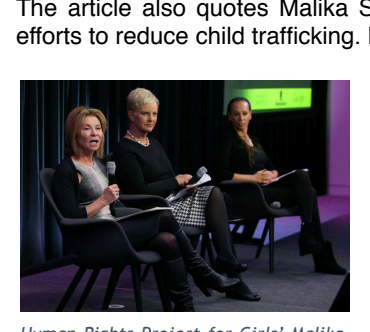
efforts to reduce child trafficking. Ms. Saada Saar joined Google a year later. “We live in an era where it’s just not going to be possible to shut down these websites,” Ms. Saada Saar is quoted as saying. “I understand why people want to go after the websites. I’m more interested in going after a culture which allows people to purchase children with impunity… my belief has been that the way to change that is to go after demand.”
Ms. Saada Saar failed to disclose her relationship with Google’s outside lobbying firm, The Raben Group, and that she was also an employee of the107 traffickinglobbying firm. The Raben Group reported $270,000 in lobbying income from Google in 2014108 according to lobby disclosure records.
In December 2015, Ms. Saada Saar left the Human Rights Project for Girls and apparently is no longer affiliated with the organization. Today she is employed at109 Google as senior counsel for human rights.
- November 12, 2014: CDT and several other Google-funded groups send a letter to U.S. senators urging opposition to Senate S.2536, a companion bill to the House SAVE Act. The Senate bill includes provisions making it unlawful for online105106107108109 advertisers like Backpage to recklessly disregard or facilitate the posting of ads offering children for commercial sex acts.
Of the nine advocacy groups signing the letter opposing the bill, five (the ACLU, EFF, CDT, Internet Commerce Coalition, and the New America Foundation) have received110 Google financial support.
- January 29, 2015: After the SAVE Act is reintroduced and passed in the House of Representatives in early January 2015, Sophia Cope, an EFF staff attorney and former CDT staffer, publishes a blog post warning that the bill is moving “one step111 closer to unnecessarily chilling online speech.”
The same day, several Google-funded groups, academics and trade associations led by EFF and CDT release a coalition statement condemning the legislation as “overbroad, counterproductive, and [placing] unconstitutional burdens on the free112 speech and privacy rights of millions of Americans.” Of the 22 groups signing the letter, more than half (14) either receive Google financial support or work at113 institutions receiving Google funding.
- February 24, 2015: The Senate Judiciary Committee holds a hearing titled “Human Trafficking in the United States: Protecting the Victims.” Ms. Saada Saar is invited114 to testify.
A day later, CDT’s Ms. Llanso blogs about the hearing and Ms. Saada Saar’s testimony, remarking that it’s important to remain focused on “victim-centered115 reforms,” not on online platforms like Backpage that facilitate the child trafficking.
- March 10, 2015: EFF, CDT, and Santa Clara University Professor Eric Goldman file an amicus brief in a Massachusetts civil lawsuit against Backpage (Jane Doe et al v. Backpage) by three underage victims accusing the company of assisting in the116 sexual abuse of minors. The civil complaint asserts that the three victims110111112113114115116 appeared in some 300 Backpage classified ads and were sold for sex more than117 1,900 times between 2010 and 2013.
EFF and CDT’s amicus brief supports Backpage’s counterargument that Section 230 shielded the company from liability, and urged the court to dismiss the case. On May 15, 2015, the U.S. District Court for Massachusetts dismissed the victims’118 lawsuit. A year later, the U.S. Court of Appeals for the First Circuit dismissed the119 victims’ appeal of the District Court decision as well. The Court found that even if Backpage had participated in the crime of child sex trafficking in violation of the Trafficking Victims Protections Reauthorization Act (TVPRA) – a federal criminal offense – Congress intended Section 230 to be the controlling statue and the court dismissed the lawsuit, stating that the children needed to seek a legislative remedy.
- April 10, 2015: Google sponsors an event with Sen. John Cornyn at the company’s Austin, TX Google Fiber office to discuss his comprehensive domestic anti-trafficking120
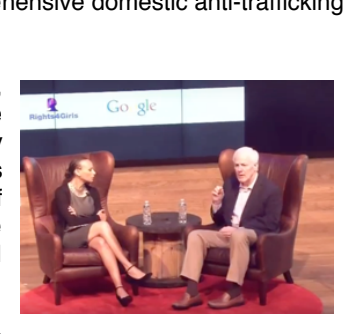
legislation.
Ms. Saada Saar interviews Mr. Cornyn about his bill, the Justice for Victims of Trafficking Act. While Senator Cornyn’s legislation was widely lauded by the anti-trafficking community, Ms. Saada Saar’s interview of the Senator appears to steer clear of any discussion about the culpability of sites like Backpage in facilitating child sex trafficking, instead focusing almost entirely on the “demand”.
Moreover, Ms. Saada Saar guides the conversation Sen. John Cornyn and Malika Saada towards how the Internet can also be used to create opportunities for protection and intervention. “Clearly the Internet has been used to exploit and hurt children… And the Internet has also been used to be able to create opportunities for protection and intervention and services for children who are vulnerable. How can we use the Internet for good and the examples that I know you have been witness to and part of in being able to harness technology to protect our children?117118119120
- May 16, 2015: A day after the U.S. District Court for Massachusetts decision, Mr. Goldman publishes an op-ed at Forbes titled, “Big Win for Free Speech Online in Backpage Lawsuit”. The op-ed notes that despite the victims being the subject of a “heinous crime” and being supported by a “stellar cast of amici, including the Massachusetts attorney general, seven city attorneys, and several sex trafficking121 victims’ advocacy groups”, Backpage’s Section 230 defense once again prevailed. The Markkula Center where Goldman serves as a faculty member received $500,000 from Google in 2011 as part of its Google Buzz settlement. Mr. Goldman has also written several amicus briefs on Google’s behalf in other cases and serves122 as the director of Santa Clara University’s High Tech Law Institute. While neither Goldman nor the Institute discloses the Institute’s funding, several faculty members affiliated with Google’s outside counsel Wilson Sonsini Goodrich & Rosati serve as123 faculty and the law firm is said to have helped finance the Institute’s founding.124
- May 29, 2015: The Justice for Victims of Trafficking Act is signed into law. While provisions of the SAVE Act are added as an amendment (Section 118), in a victory for Google and Backpage, the final law removes the critical “reckless disregard” language—a tougher standard that would have made sites like Backpage culpable for recklessly disregarding the fact that child sex trafficking was occurring on their125 sites.
A week later, on June 4, 2015, Ms. Saada Saar publishes an op-ed in Politico championing the new law: “The Truth About Sex Trafficking: And why the Justice for126 Victims of Trafficking Act deserves our support.” However, Ms. Saada Saar and her co-authors wrote that “even many within the anti-trafficking community did not support [the SAVE Act portions] due to its broad scope.”
- June 29, 2015: Cook County Sheriff Tom Dart sends a letter to Visa and MasterCard requesting that the credit card processors cease allowing Backpage sex advertisers to process their ad payments through the company’s services. Backpage files a lawsuit in federal court known as Backpage v. Dart on July 21 alleging that Dart’s actions were a violation of Section 230 of the CDA.121122123124125126
- September 8, 2015: The Washington State Supreme Court allows the 2012 J.S., S.L., and L.C., v Village Voice Media Holdings lawsuit against Backpage to proceed, agreeing that the plaintiffs argument — that Backpage did more than simply maintain neutral policies regarding content, but instead had policies that were “specifically designed… so that pimps can continue to use Backpage.com to traffic in sex” –127 deserved a hearing in court EFF expresses disappointment in the decision. “Unfortunately, the Washington Supreme Court found for the plaintiffs, holding that Backpage cannot benefit from the broad legal protections of Section 230 because the plaintiffs alleged that Backpage’s policies defining the kinds of ads it would host ‘essentially provide pimps with128 guidelines to have their minor escort ads accepted for posting.’” Santa Clara University’s Mr. Goldman calls the decision a “bummer,” criticizing the judges for being “weak-kneed” and not dismissing the suit on Section 230 grounds. Goldman also expresses his “conflicting feelings” about legal efforts to eliminate online sex advertising. “I’m aware of the critical role that online advertising can play in human sex trafficking… However, it’s less clear to me whether shutting down online prostitution advertising has a net positive effect on human trafficking129 victims.”
- October 23, 2015: The libertarian Cato Institute files an amicus brief on behalf of130 Backpage in the Backpage v. Dart lawsuit. In announcing the brief, Cato’s Ilya Shapiro and Trevor Burrus argue that “Sheriff Dart, along with a new-age Baptist-and-bootleggers coalition matching the religious right and radical feminists, have raised the human-trafficking bugaboo to rally against prostitution – mimicking the131 drug war and all of its worst legal mechanisms.”
Cato failed to disclose in the amicus that, since at least 2012, it has been a recipient132 of “substantial” Google funding. In 2014, Cato said it received $480,000 a year in133 free advertising from Google.
- November 4, 2015: The CDT’s Ms. Llanso and EFF’s David Greene, along with the Association of Alternative News Media file an amicus brief supporting Backpage in127128129130131132133
, holding that Backpage cannot benefit from the broad legal protections of Section 230 because the plaintiffs alleged that Backpage’s policies defining the kinds of ads it would host ‘essentially provide pimps with guidelines to have their minor escort ads accepted for posting.’”128
the Backpage v. Dart case. The brief argues that Dart had violated Backpage’s First Amendment rights by using his government position to “coerce the credit card134 companies into a course of action ultimately aimed at censoring Backpage.com.” Neither Ms. Llanso nor Mr. Greene disclosed Google’s financial support of their organizations in the required amicus interest statement required by the courts. Three weeks later on November 30, the Seventh U.S. Circuit Court of Appeals issues its decision, barring Sheriff Dart from discouraging credit card companies135 from doing business with Backpage.
- December 15, 2015: Backpage sues the Department of Justice and Attorney General Loretta Lynch seeking an injunction preventing enforcement of the SAVE136 Act. The company argues that the law breaches the First and Fifth Amendments. A year later in October of 2016, the DC Circuit Court dismissed the lawsuit arguing that Backpage lacked standing because it hadn’t demonstrated that it intended to engage in the conduct prohibited by the legislation nor demonstrated a credible137 threat of prosecution under the law.
- March 17, 2016: After almost a year of failing to comply with interview requests and a subpoena from the Senate Homeland Security Permanent Subcommittee, Backpage is cited for contempt of Congress in a 96-0 vote – the first time in two138 decades that the Senate uses its contempt powers.
The Subcommittee also applies for a federal court order to enforce Backpage’s production of documents and on August 2016, the U.S District Court in Washington, DC grants the order requiring Backpage’s production of documents requested by the139 Committee.
- October 10, 2016: Backpage’s Carl Ferrer is arrested in Houston on a California warrant charging the CEO with pimping a minor, pimping and conspiracy to commit134135136137138139 pimping. Backpage’s controlling shareholders, Mr. Lacey and Mr. Larkin, are also charged with conspiracy to commit pimping.
“Backpage and its executives purposefully and unlawfully designed Backpage to be the world’s top online brothel,” says California Attorney General Kamala Harris commenting on the arrest.
- November 29, 2016: EFF and CDT file an amicus brief with the D.C. Circuit Court of Appeals in support of Backpage’s emergency stay petition to prevent its production of documents as part of the Homeland Security Committee’s investigation (Ferrer v. Permanent Subcommittee on Investigations).
- December 9, 2016: A California judge dismisses pimping charges against143 Backpage’s CEO and shareholders. Santa Clara’s Mr. Goldman praises the decision, noting, “The definition of pimping as interpreted by this attorney general might apply to… a laundromat or hairdresser. The services [Backpage] provided144 were the dissemination of speech.”
- January 9, 2017: The Homeland Security Permanent Subcommittee releases a scathing 53-page report alleging that Backpage knew it was facilitating child sex trafficking and had knowingly “sanitized” ads for sex with minors by editing out words145 like “teen” or “Lolita,” but then posting the sanitized ads anyway.
In a small and possibly empty victory for child sex trafficking victims, Backpage shuts down its adult advertising section the same day, noting that “years of effort by government at various levels to exert pressure on Backpage.com” have made it “too146 costly to continue.” Backpage quickly retrenches and migrates the adult content advertising to other sections of its website.140141142143144145146
effort by government at various levels to exert pressure on Backpage.com” have made it “too costly to continue.”146 Backpage quickly retrenches and migrates the adult content advertising to other sections of its website.
The CDT’s Ms. Llanso slams the Senate report saying, “The tactics used against sites like Backpage and Craigslist threaten speech far beyond what’s posted on147 online classified sites.”
The EFF’s Ms. Cope writes that “[W]hile Backpage’s announcement suggests that the company’s opponents have at least temporarily won the battle against the adult148 services section of the website, EFF will continue to try to win the war…” Within days, most of Backpage’s adult advertising simply moves to the “seeking relationships” section of the site.
- February 10, 2017: A documentary titled I Am Jane Doe, chronicling the epic legal battle waged by several American mothers and their under-age daughters who were repeatedly bought and sold for sex on Backpage.com, opens in theaters in New149 York, Los Angeles, Washington, DC and other cities around the U.S.
The film follows the heartbreaking journey of child sex trafficking victims, their families, and law enforcement officials, as they navigate a byzantine legal process and are denied justice as their lawsuits are repeatedly dismissed. The film also points out that the EFF and the CDT, funded by the tech industry, are actively intervening in the Backpage cases filed by children and that the largest donors include… Google. A day after the film screens in Washington DC, Shared Hope International and ECPAT, two anti-trafficking NGOs, convene a Congressional briefing on the issues raised in the film. Representative Ann Wagner (D-Missouri) appears and announces that she will begin working on an amendment to Section Advocates at the Congressional briefing acknowledge that the EFF and CDT are likely to once again mount a vigorous assault on any such legislation.147148149
Google’s Support of Anti Child-Trafficking Campaigns: Serious or a Self- Serving Effort to Change the Subject?
While Google claims to be an aggressive advocate in the fight against child sex trafficking, an examination of its actual activities suggest they are similar in many respects to “Greenwashing” campaigns pushed by corporate polluters in order to present a responsible public image but that often have little real world impact. To be sure, Google has contributed several million dollars to anti-trafficking organizations over the years. Its sudden interest in the issue however appears to closely correspond to increased scrutiny on the company for profiting from illicit activities on its own network, including illegal drug sales, prostitution and child trafficking.
It’s worth noting as well that Rights4Girls, The National Center for Missing and Exploited Children, and several other anti-trafficking organizations – many of whom have also received financial support from Google – have filed their own amicus briefs opposing Backpage’s Section 230 defense. Their opposition to Backpage, especially in light of sometimes-substantial Google support, suggests the strong commitment to their core mission despite the contrary position of their funders.
Following the company’s $500 million federal fine to avoid criminal prosecution for advertising illegal pharmaceuticals in August of 2011, Google contributed $11.5 million150 to anti-slavery and anti-trafficking groups only three months later in December. Months later in April of 2012, dozens of human rights groups urged state law enforcement officials to investigate Google for also facilitating child sex trafficking. “Search Google and you will find online ads for exotic services, sex tourism, adult web cams and other sex industry offerings… The sites linked to these advertisements show151 the tell tale signs of trafficked victims,” the letter noted.
The letter prompted Congresswomen Marsha Blackburn and Carolyn Maloney to skeptically ask what Google was doing to combat human trafficking besides contributing to anti-trafficking groups. “Apart from Google’s donations to large human rights organizations, what is your company doing internally to ensure that sexually exploitative152 advertisements do not appear?”
The Digital Citizens Alliance reported in 2013 that Google was continuing to allow prostitution ads to be uploaded to YouTube and in many cases, was profiting from the150151152 content by serving ads around the videos — even when search terms such as “find underage prostitute” were entered.
Moreover, while Google has faced increased allegations for facilitating illicit activities such as sex trafficking, its own anti-trafficking advocacy appears to be less focused on effective measures to combat online trafficking, and more focused on what can be described as superficial PR campaigns that simply change the subject.
Again, the evolution of Ms. Saada Saar’s advocacy efforts in this regard provides an interesting case study: As highlighted above, Ms. Saada Saar, an early advocate for banning adult advertisements on Craigslist and Backpage, appears to have altered her position once hired by The Raben Group, one of Google’s lobbying firms. After joining the firm in 2014, Ms. Saada Saar changed her tune – praising tech companies for their efforts to reduce child trafficking and suggesting that focusing on ad sites like Backpage was ineffective.
It’s significant as well that the Human Rights Project for Girls has been a vocal critic of Backpage and a supporter of tougher laws for online traffickers since Ms. Saada Saar’s departure to join Google in 2015. Senator Rob Portman highlighted the group in press releases dedicated to the Senate Permanent Subcommittee on Investigations155 investigation of Backpage in 2016. The group also joined several other anti-trafficking groups to file an amicus brief supporting the victim in Washington’s 2016 Jane Doe v.156 Backpage Supreme Court case.
According to documents released by the Homeland Security Permanent Subcommittee on Investigations, Google also worked directly with Backpage to develop filtering technology to block child trafficking ads, although the effectiveness of the effort appeared to be questionable.
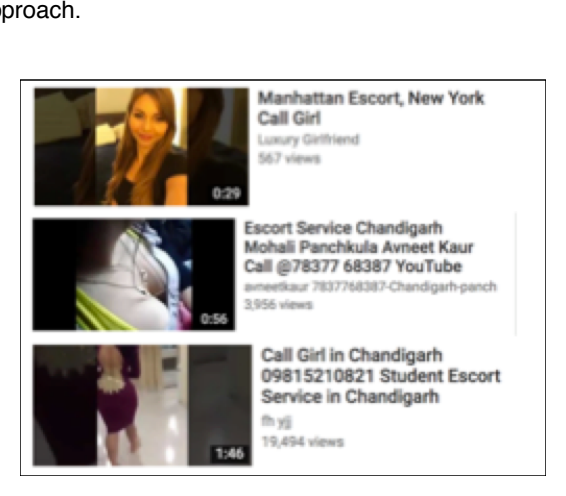
Internal Backpage documents show that the company had requested Google’s help in 2011 to develop filtering technology to flag ad text that suggested child trafficking. Backpage CEO Carl Ferrer noted however that the proposed solution would be largely ineffective, but might provide good optics that it was taking the problem seriously. “I feel this solution is political (meaning good results are minimal but it sounds good…),” Ferrer157 wrote in an email to employees.153154155156157 In fact, Google and many tech companies have often championed a self-regulatory approach to deal with child trafficking. And while the company has taken steps to ban graphic sex ads and images in AdWords or graphic nudity on its Blogger property, the fact that one can still find hundreds of video ads on YouTube offering prostitution, call girl and escort services raises the question as to the effectiveness of its commitment to a self-regulatory approach.
Appendix A – Google, Center for Democracy & Technology Policy Relationships
Google, CDT Revolving Door158 CDT Advisory Council Relationships with Google158
Name Title CDT Relationship Source Adam Kovacevich Google, Sr. Director Public Policy (2007-Present) CDT Advisory Council (2016- Present) LinkedIn Alan Davidson Google, Director Public Policy, Americas (2005-2012) CDT Associate Director (1995-2005) LinkedIn Andrew McDiarmid Google, Policy Specialist (2014- Present) CDT Policy Analyst (2008-2011) LinkedIn Erik Stallman Google, Public Policy Counsel (2016- Present) CDT General Counsel (2014-2016) LinkedIn Hal Abelson Google Visiting Faculty member, part of “App Inventor for Android Team” CDT Director (2009-2011) CDT 990s: Sourcewatch Heather West Google, Federal Public Policy (2010-2015) CDT Policy Analyst (2007-2010) LinkedIn Sheri B. Pan Google, Legal Assistant (2012-2013) CDT Intern (2014) LinkedIn Rena Coen Google, Privacy Research Assistant (2016) CDT Policy Intern (2015) LinkedIn Jason Gerson Google, Student Ambassador (2012-2013) CDT Communications Intern (2013) LinkedIn Ian Tang Google, Student Ambassador (2014-2015) CDT Communications Intern (2016) LinkedIn
Name Google Relationship Source Bennett Freeman – Global Network Initiative Google is a member of the Global Network Initiative and is one of only five companies that sits on the non-profit’s board of directors. GNI website Bob Boorstin – Albright Stonebridge Group Google Director of Public Policy (2006-2013). LinkedIn Chip Pickering – INCOMPAS Google Fiber is an INCOMPAS member. INCOMPAS member list Deirdre Mulligan- Berkeley Center for Law & Technology; EFF Google Buzz settlement provided $500,000 to Berkeley Center for Law & Technology in 2011. Google Buzz settlement
Google/CDT Policy Fellows
Fred Cate – Hunton & Williams Centre for Information Policy Leadership (CIPL) Google is a corporate member of CIPL. CIPL Members Jim Dempsey – Berkeley Center for Law & Technology Google Buzz settlement provided $500,000 to Berkeley Center for Law & Technology in 2011. Google Buzz settlement Joe Gratz – Durie Tangri Represented Google in Google Book Search copyright cases; Rescuecom v. Google and Vulcan Golf v. Google trademark cases. Authored amicus briefs on behalf of Google in Flava Works v. Gunter. Durie Tangri website Lydia Parnes – Wilson Sonsini Goodrich Rosati Represented Google in case brought by the FTC alleging Google overrode the default settings of Safari browsers to place tracking cookies on the computers of Safari users visiting Google’s DoubleClick advertising network. Wilson Sonsini considered Google’s pre-eminent outside counsel. Law 360 Maura Corbett – Glen Echo Group Google is a client of Glen Echo Group, and Corbett has managed several Google policy coalitions. Glen Echo Website Nick Feamster – Princeton University Google research grants totaling $1.6 million. Feamster CV Pablo Chavez – LinkedIn Google Senior Director of Public Policy (2006-2014). LinkedIn Rebecca Mackinnon – New America Foundation Google is New America’s largest corporate member, contributing more than $1 million in 2016. Eric Schmidt’s family foundation is also a $1 million contributor and Schmidt was New America’s Chairman until 2016. New America “Our funders” page Sergio Carrera – Centre for European Policy Studies (CEPS) Google is a corporate member of CEPS. 2016 CEPS Members Stephen Balkam – Family Online Safety Institute (FOSI) Google funds FOSI through U.S. Public Policy/Government Affairs Team. Digital privacy research funded by Google. Google Transparenc y Page; FOSI Disclosure Todd Hinnen – Perkins Coie Has represented Google on privacy matters, including a 2016 case in which the company sought to skirt federal search warrants for data stored overseas. Perkins Coie represented Google in the FTC’s 18-month antitrust investigation of the company and in the 2010 Google Buzz settlement with the FTC. Law 360; Google Buzz settlement
Name Fellowship/Year Source Apratim Vidyarthi Google Policy Fellow, CDT (2016) LinkedIn BJ Ard Google Policy Fellow, CDT (2009) LinkedIn Jonathan Miller Google Policy Fellow, CDT (2012) LinkedIn
CDT Academic Fellows159
Josephine Wolff Google Policy Fellow, CDT (2011) LinkedIn Joshua Gruenspecht Google Policy Fellow, CDT (2010) Google Policy Fellowship Page Natalie Ofoche Google Policy Fellow, CDT (2014) LinkedIn Paul Otto Google Policy Fellow, CDT (2008) Google Policy Fellowship Page Vera Ranieri Google Policy Fellow, CDT (2008) Google Policy Fellowship Page Zack Lerner Google Legal Fellow, CDT (2013) LinkedIn Elizabeth Allen Google Policy Fellow, Future of Music Coalition (2011) CDT Legal Intern (2010) LinkedIn Meredith Whipple Google Policy Fellow, Personal Democracy Forum (2012) CDT Policy Analyst (2012-2013) LinkedIn Taylor Moore Google Policy Fellow, Future of Music Coalition (2015-Present) CDT Free Expression Fellow (2016- Present) LinkedIn
CDT Academic Fellows Alessandro Acquisti $400,000 in Google research awards Carnegie Mellon University The Tartan Margot Kaminski Google Policy Fellow, EFF (2008) Ohio State University Kaminski CV
Appendix B – Google, Electronic Frontier Foundation Policy Relationships
Google, EFF Revolving Door EFF, Google Board Relationships160161
Name Title EFF Relationship Source Chris Palmer Google, Sr. Software Engineer (2010- Present) EFF, Technology Director (2010-2011) LinkedIn Dan Auerbach Google, Software Engineer (2006-2010)) EFF, Staff Technologist (2010-2013) LinkedIn Derek Slater Google, Sr. Public Policy Manager (2007-Present) EFF, Activism Coordinator (2006-2007) LinkedIn Erica Portnoy Google, Software Engineer (2015-2016) EFF, Staff Technologist (2016- Present) LinkedIn James Kasten Google, Software Engineer (2015- Present) EFF, Technology Fellow (2014-2015) LinkedIn Jakub Warmuz Google, Site Reliability Engineer (2015-Present) EFF, Consultant (2015) LinkedIn Joseph Bonneau Google, Software Engineer (2012-2014) EFF, Technology Fellow (2015- Present) LinkedIn Marcel Leonardi Google, Senior Public Policy Counsel (2011-2017) EFF, Google Policy Fellow (2009) LinkedIn Morgan Marquis Boire Google, Sr. Security Engineer (2008-2014) EFF, Special Advisor (2014-Present) LinkedIn Michael Barclay Wilson Sonsini Goodrich Rosati EFF, Special Counsel EFF Staff page; Google disclosure Kurt B. Opsahl Perkins Coie EFF, General Counsel LinkedIn
Name Google Relationship Company/Organization Source Brad Templeton Google Software Design Consultant (2010-2013) Google LinkedIn Bruce Schneier Google is one of only two corporate sponsors of the Berkman Klein Center. Harvard Berkman Klein Center Berkman Klein Center “Support” Page
Deirdre Mulligan Google Buzz settlement provided $500,000 to Berkeley Center for Law & Technology in 2011 Berkeley Center for Law & Technology; Center for Democracy & Technology Google Buzz settlement Ethan Zuckerman Google is one of only two corporate “sponsors” of Global Voices. (The other is Yahoo). Global Voices was founded by the Berkman Klein Center, which also receives substantial Google support. Global Voices Global Voices “Special thanks” page Gwen Hinze Google Buzz settlement provided $200,000 to Berkeley Samuelson Law & Technology Clinic. Berkeley Samuelson Law & Technology Clinic Google Buzz settlement Joe Gratz Represented Google in Google Book Search copyright cases; Rescuecom v. Google and Vulcan Golf v. Google trademark cases. Authored amicus briefs on behalf of Google in Flava Works v. Gunter. Durie Tangri Durie Tangri website Joe Kraus (2012) Google, Director of Product Mgmt.; Google Ventures Partner Google LinkedIn Joe McNamee European Digital European Digital Rights Association Jonathan Zittrain Google is one of only two corporate sponsors of the Berkman Klein Center. Harvard Berkman Klein Center Berkman Klein Center “Support” Page Mark Lemley Lemley has served as outside counsel to Google and was disclosed as a consultant to Google in the Oracle v. Google case. His wife was also a Google employee. Durie Tangri, a firm co-founded by Lemley, has handled several high profile Google legal cases including the Google Books settlement. Lemley has also written several academic studies funded by Google in the past. Durie Tangri Oracle v. Google disclosure Michael Page Page has served as counsel of record for Google in legal cases including Vulcan Golf v. Google. He is a co- founder of the firm, which has represented Google in several high- profile legal cases such as the Google Books settlement. Durie Tangri Page declaration; American Lawyer article Lorrie Cranor (2015) Received nearly $850,000 in Google research funding, including $178,920 as part of the cy pres settlement in the Google Buzz case. Carnegie Mellon University, FTC Chief Technologist Cranor CV
Google/EFF Policy Fellows Google/EFF Other
Pamela Samuelson Google is as a “corporate benefactor” of UC Berkeley’s Law School. Samuelson is a co-founder of UC Berkeley’s Samuelson Law, Technology and Public Policy Clinic. The Berkeley Center for Law & Technology and Samuelson Law, Technology & Public Policy Clinic also received $700,000 as part of the Google Buzz cy pres settlement. UC Berkeley Law School; UC Berkeley Samuelson Law, Technology and Public Policy Clinic. UC Berkeley Law School: Google Cy Pres settlement Ryan Calo Google Research Grant recipient in 2010 University of Washington Google Research Awards blog
Name Year Source Endalkachew Chala Google Policy Fellow (2014) LinkedIn Heather Ford Google Policy Fellow (2010) Google Policy Fellow Page Floris Kreiken Google Policy Fellow (2013) Google Policy Fellow Page Margot Kaminski Google Policy Fellow (2008) Google Policy Fellow Page Oscar Montezuma Google Policy Fellow (2011) Google Policy Fellow Page Ren Bucholz Google Policy Fellow (2008) Google Policy Fellow Page Yana Welander Google Policy Fellow (2012) LinkedIn
Name Title EFF Relationship Source Charles Crain Google, Contractor EFF Legal Intern EFF Staff page Erica Fisher Google, Legal Admin. Asst. (2011-2014) EFF Legal Intern (2015) LinkedIn Erin Simon Google, Associate Product Counsel (2013-Present) EFF Intern (2007) LinkedIn Henry Lien Google, Product Counsel (2011-2015) EFF Intern (2006) LinkedIn
Michael Beamer Google EFF Legal Intern (2017) EFF Staff page Natasha Chu Google, Legal Asst. (2010-2012); Wilson Sonsini Associate (2014- Present) EFF Intern (2014) LinkedIn Tara Whalen Google, Staff Privacy Analyst (2014- Present) EFF Intern (2012) LinkedIn Thaddeus Houston Google, Legal Asst. Transparency (2012-2013) EFF Legal Intern (2014) LinkedIn
Appendix C – July 30, 2013 letter from Google-funded groups opposing Congressional legislation to strengthen child sex trafficking laws
Letter Signers receiving Google financial support Notes Source American Civil Liberties Union Received $7 million in Google Buzz cy pres settlement. Google Buzz settlement American Library Association Financial support provided through Google U.S. Public Policy and Government Affairs Team. Google Transparency Page Association of American Publishers Reached settlement with Google in 2012 that provided AAP members’ content to Google for its Google Library Project. Other details of the settlement are confidential. Association of American Publishers Center for Democracy & Technology According to CDT’s 990 tax filings, Google has contributed more than $4.76 million to the organization since 2011. CDT Financials Competitive Enterprise Institute Financial support provided through Google U.S. Public Policy and Government Affairs Team. Google Transparency Page Computer & Communications Industry Association Financial support provided through Google U.S. Public Policy and Government Affairs Team. Google Transparency Page Electronic Frontier Foundation Received $1 million in Google Buzz cy pres settlement. Google is also an annual funder of EFF. Google Buzz settlement: Google Transparency Page Internet Association Trade association founded by Google, Amazon, eBay and Facebook in 2012. Internet Association Wikipedia page Internet Infrastructure Coalition (I2 Coalition) Google joined the coalition in 2012. I2 Coalition Members page Net Choice Google listed as a dues paying member. Net Choice “About” Page Public Knowledge Google listed as a “platinum” financial supporter. Public Knowledge “About” page Tech Freedom Financial support provided through Google U.S. Public Policy and Government Affairs Team. Google Transparency Page Derek E. Bambauer (University of Arizona) Bambauer’s wife, Jane Bambauer was a 2014 Google fellow. Jane Bambauer CV Jane Bambauer (University of Arizona) 2014 Google fellow Jane Bambauer CV Annemarie Bridy (University of Idaho) Affiliate Scholar at Google-funded Stanford Center for the Internet & Society; Visiting senior fellow at Public Knowledge. Stanford CIS “About” page: Public Knowledge “About” page
Michael A. Carrier (Rutgers Law School) 2011 Google research award recipient Rutgers Today Anupam Chander (UC Davis) Recipient of several Google Faculty Research awards. Research at Google web page Jennifer Granick (Stanford Center for the Internet & Society) Stanford CIS receives “generous support” from Google Inc. Stanford CIS “About” page Mark A. Lemley (Stanford Law School) Outside counsel to Google in Google Book Search settlement. Co-founder of Durie Tangri, which does substantial legal work for Google. Wife was a Google employee. Lemley white paper disclosure Deirdre K. Mulligan (UC Berkeley) Chair, Center for Democracy & Technology, which has received at least $4.75 million from Google. CDT “Board” page Jason Schultz (NYU School of Law) Formerly with Fish & Richardson (counts Google as a major legal client); Electronic Frontier Foundation; Director, Samuelson Law & Technology Clinic. All receive substantial Google funding. Jason Schultz academic page Eugene Volokh (UCLA School of Law) Has written academic white papers commissioned by Google. First Amendment Protection for Search Engine Results
Appendix D – Google lobbying firms reporting meetings on Congressional child sex trafficking legislation
| Google registered lobbyist | Legislation | Amount reported | Year | Quarter |
|---|---|---|---|---|
| Crossroads Strategies | S. 1738, “Justice for Victims of Trafficking Act” | $160,000 | 2014 | Q1, Q3 |
| S. 2564, “End Trafficking Act of 2014” | 2014 | Q1, Q4 | ||
| S. 178, “Justice for Victims of Trafficking Act” | $80,000 | 2015 | Q1 | |
| Dutko Worldwide dba Grayling | S. 2536, “Stop Advertising Victims of Exploitation Act” (SAVE Act) | $100,000 | 2014 | 3,4 |
| Google, Inc. | “Online advertising and sex trafficking” | 2014 | Q1-Q4 | |
| “Online advertising and sex trafficking” | 2015 | Q1-Q4 | ||
| The Ingram Group | “Issues related to human trafficking” | $160,000 | 2013 | Q1, Q4 |
| H.R. 4225, “Stop Advertising Victims of Exploitation Act” (SAVE Act) | $160,000 | 2014 | Q2-Q4 | |
| S. 178, “Justice for Victims of Trafficking Act” | $100,000 | 2015 | Q1, Q2 | |
| Podesta Group | H.R. 4225, “Stop Advertising Victims of Exploitation Act” (SAVE Act) | 270,000 | 2014 | Q2-Q4 |
| S.178, “Justice for Victims of Trafficking Act” | 160,000 | 2015 | Q1, Q2 | |
| Prime Policy Group | S. 2536, “Stop Advertising Victims of Exploitation Act” (SAVE Act) | $210,000 | 2014 | Q2-Q4 |
| S. 2536, “Stop Advertising Victims of Trafficking Act of 2014” | 2014 | Q2-Q4 | ||
| S. 1738, “Justice for Victims of Trafficking Act” | 2014 | Q2, Q3 | ||
| S. 178, “Justice for Victims of Trafficking Act” | $210,000 | 2015 | Q1-Q3 | |
| Lugar Hellman Group | S. 178, “Justice for Victims of Trafficking Act” | $180,000 | 2015 | Q1-Q3 |
| H.R. 4225, “Stop Advertising Victims of Trafficking Act” (SAVE Act) | $60,000 | 2014 | Q4 | |
| S. 2599, “Stop Exploitation Through Trafficking Act of 2014” | 2014 | Q4 | ||
| S-3 Group | S. 1738, “Justice for Victims of Trafficking Act” | $260,000 | 2015 | Q1-Q4 |
| S. 2564, “End Trafficking Act of 2014” | 2015 | Q1-Q4 | ||
| S. 2564 “End Trafficking Act” | $320,000 | 2016 | Q1-Q4 |
Simmons Russell Group S. 1738, “Justice for Victims of Trafficking Act” $150,000 2014 Q2-Q4 S. 178, “Justice for Victims of Trafficking Act” $50,000 2015 Q1
Appendix E – January 29, 2015 coalition statement opposing the SAVE Act: Google funded signers
Letter Signers receiving Google financial support Notes Source Access Google is Access’ largest corporate donor having contributed more than $1.75 million since 2010. Access Now financials American Civil Liberties Union Received $7 million in Google Buzz cy pres settlement Google Buzz settlement Center for Democracy & Technology According to CDT’s 990 tax filings, Google has contributed more than $4.76 million to the organization since 2011. CDT Financials Computer & Communications Industry Association Financial support provided through Google U.S. Public Policy and Government Affairs Team. Google Transparency Page Electronic Frontier Foundation Received $1 million in Google Buzz cy pres settlement. Google is also an annual funder of EFF Google Buzz settlement; Google Transparency Page Interactive Advertising Bureau Google is an IAB member. In 2014, Google and Yahoo purchased the IAB.com name for $75,000 and donated it to the trade association. Google’s Sridhar Ramaswamay is on the IAB Board of Directors Press release IAB Board of Directors Internet Commerce Coalition Financial support provided through Google U.S. Public Policy and Government Affairs Team. Google Transparency Page Internet Infrastructure Coalition (I2 Coalition) Google joined the coalition in 2012. I2 Coalition Members page New American Open Technology Institute Google is New America’s largest corporate funder, contributing more than $2 million in 2016 through the company and Eric Schmidt’s family foundation. Eric Schmidt served as New America’s Chairman until 2016. New America funding page Tech Freedom Financial support provided through Google U.S. Public Policy and Government Affairs Team. Google Transparency Page Derek E. Bambauer (University of Arizona) Bambauer’s wife, Jane Bambauer was a 2014 Google fellow. Jane Bambauer CV David S. Levine (Princeton University) Levine is also an affiliate scholar at Stanford’s Center for the Internet & Society, which receives “generous support” from Google, Inc. Stanford CIS “About” page