EXECUTIVE SUMMARY Governor Gavin Newsom has called for a circular economy that slashes waste while extracting maximum value by reusing or remanufacturing as much of it as possible. A circular economy cuts greenhouse gases and toxic emissions. It helps companies meet new mandates on recycled content and reduces demand for products made from scratch. It also supports recycling and manufacturing jobs in state.
California’s once-vaunted recycling program—passed into law in 1986—is its Bottle Bill. That bill established a recycling system for billions of soda, water, juice and beer containers that today carry a California Redemption Value (CRV) of a nickel or a dime that is supposed to be refundable. Today, the program is collapsing because of a deck that waste haulers and supermarkets stacked against it.
This investigative report examines the role of waste haulers and their surrogates in knocking California from its leadership position among ten bottle deposit states into third-to-last place when it comes to consumer redemption rates. Waste haulers and their lobbyists are the square peg dirtying up Newsom’s circular vision. They do this via contamination of the empties they collect to recycle and contamination of the political process.
When the Bottle Bill passed, environmental groups and lawmakers envisioned a network of redemption centers in supermarket parking lots to redeem containers. But lawmakers and environmentalists also wanted to encourage nascent curbside recycling. Operators of curbside and rural drop off recycling programs won the right to bill the state for the CRV stamped on the labels of empties that consumers tossed into curbside recycling bins—but without offering1 consumers refunds. The CRV began at 1 cent and rose over the decades to the nickel or dime it is today, based on container size. The more it rose, the more haulers collected.
The state also reimburses redemption centers for CRV—but unlike waste haulers they also refund consumer deposits and keep materials up to 98% clean. Today these centers are severely underfunded by the state and shuttering, while haulers are paid more than dying redemption centers for recycling far fewer bottles and cans. About 1,200 redemption centers exist today to serve the state’s 40 million people— half the number that the state had in 2013. Out of 58 counties, 31 have five or fewer redemption centers still open.
In the last decade, waste haulers have worked the legislature to reduce convenient redemption opportunities for the public in order to capture more and more CRV containers and greater state payments. There have been 75 amendments to the Bottle Bill since 1986.
The waste haulers have consistently opposed all attempts to remodel the bottle deposit program along the lines of every other successful program in the United States and across the world. They oppose the idea that the beverage industry should be responsible for recycling its bottles and cans–the Extended Producer Responsibility system–because it would deny them subsidies that they now receive totaling $180 million per year. Waste haulers are the main obstacle to a working bottle deposit system in California. They oppose SB 38–which would create a system of beverage industry stewardship– in the hope of continuing to keep their unjustified subsidies, consumers and the environment be damned.
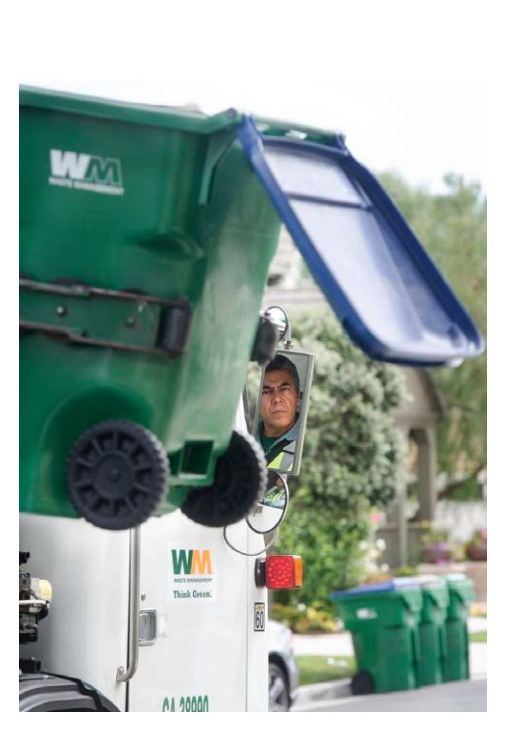
This report finds:
- Waste hauler recycling methods lead to the
contamination of one quarter to one third of all materials tossed into recycling bins, dumped into trash trucks, and further sifted at giant materials recovery facilities (MRFs) operated by haulers. Contamination leads to increased landfilling rather than recycling.
- Waste haulers, including municipal haulers,
were paid $146 million in 2020 for consumer CRV “donated” to their recycling bins at2 curbside and rural drop off locations. That is money for CRV deposits that consumers are never repaid. California is the only bottle deposit state to allow waste haulers to bill it for CRV deposits paid by consumers for containers collected in curbside recycling bins.
- Waste haulers are paid more than $50
million a year in additional subsidies and giveaways that virtually no other bottle deposit state pays and that have never been shown to improve the quality of the materials they collect or to be financially necessary.
- Waste haulers are paid 20 times what it costs them to sort CRV containers at MRFs, according
to the results of a Public Records Act (PRA) request by Consumer Watchdog to the state’s3 recycling regulator, CalRecycle.
- Leading waste haulers have been indicted or paid settlements for corrupt practices and bribery
charges, including a recent settlement of more than $100 million by Recology with the San Francisco City Attorney’s Office for ratepayer overcharges. Recology is the sponsor of a proposed ballot measure to set new mandates to reduce single use plastic packaging and tax manufacturers to raise several billion dollars a year to benefit, among others, themselves.
- Leading waste haulers donated more than $1.3 million to state legislators between 2017 and
2020 and employ heavy hitter lobbyists that have used the revolving door between positions in the Administration and/or Legislature and represent multiple clients, including haulers’ corporate bedfellows—the beverage industry—against reform of the bottle deposit system.
- The trash and beverage industries have funded Californians Against Waste, a group with roots
in the environmental movement that is the only advocacy organization to join the industry coalition opposing legislation to reform the bottle deposit system. Donors to the group include4 the biggest for-profit waste haulers in the state and major beverage makers and distributors. The former director of CalRecycle was a lobbyist for the group, as was a special advisor to the director. Under that director, meaningful reform of the deposit system was stymied. HAULER CONTAMINATION OF EMPTY BOTTLES AND CANS California’s 35-year-old bottle deposit system was created to divert billions of clean aluminum, glass and plastic containers annually away from the overall waste stream and recycle them to slash litter, reuse materials, and preserve the environment. A refundable deposit was meant to incentivize consumers to bring empties back to a network of redemption centers. At the time the law passed, there were very few curbside recycling programs and those that existed were predominantly operated by municipalities and nonprofit community recycling centers. The bottle law meant to preserve these programs and encourage new curbside recycling services. The state allowed haulers to bill their regulator, initially the Department of Conservation, and today CalRecycle, for what began as a 1-cent CRV on empties that consumers tossed into curbside recycling bins. In the 1990s, corporate waste haulers emerged as dominant in a privatization wave. Their recycling methods would lead to high contamination rates that today send too many empties to landfills instead.
Today, redemption centers are dying from state underpayments and scrap market challenges. The system is on the verge of collapse without major, fundamental reform. Waste haulers want to divert more bottles and cans into curbside bins, further reducing the flow of clean materials to redemption centers.
Corporate waste haulers introduced “single stream” recycling in the 1990s as a way to protect garbage hauling and landfilling profits. The single stream method abandoned separating materials into individual bins, instead jumbling glass, plastic, metal, paper and cardboard items into one bin. Empty CRV containers got tossed in with dirty pizza boxes and sticky peanut butter containers. One fourth of the materials thrown into single stream recycling bins are either contaminated with food and other waste or are otherwise unrecyclable, according to haulers. Waste haulers blame consumers for contamination. But that is disingenuous. The very method of eliminating the separation of materials and combining these materials into a single stream increases contamination rates. From there, loading materials into trash trucks and transporting them shatters and breaks materials, resulting in filthy shards and dirty, wet bits of paper lacing loads. Upon arrival at giant Materials Recovery Facilities (MRFs), these loads are further5
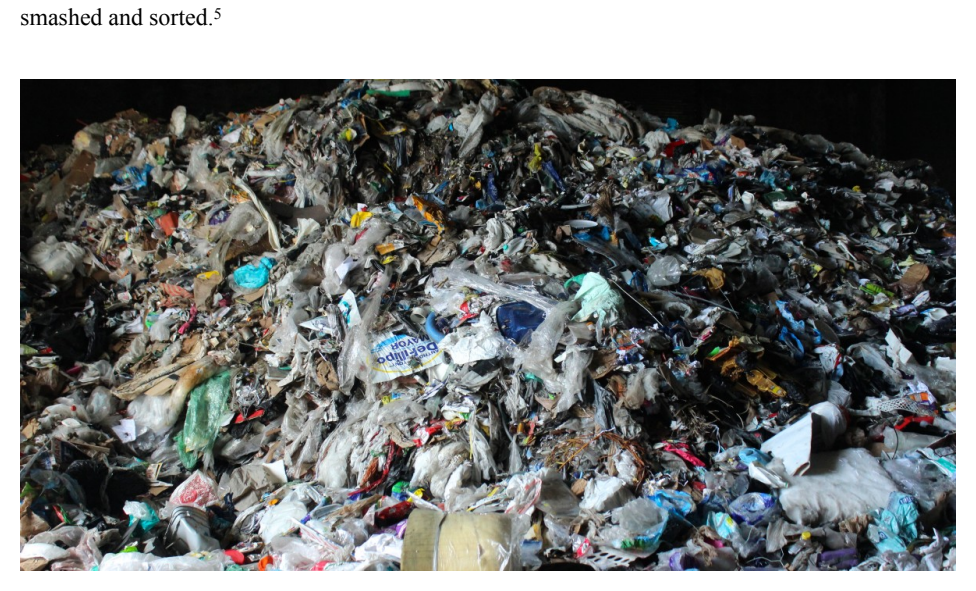
smashed and sorted.
Around 30% of recycled material brought into Reuters Recycling Facility in Pembroke Pines, FL, is contaminated and not recyclable.
Haulers invented single stream recycling to maximize revenue by cutting labor and equipment expenses while betting that any contamination would be offset by sheer recycling volumes. But it didn’t work out that way.
The nonprofit Container Recycling Institute (CRI) estimated nearly a decade ago that out of every ton of curbside recyclables between 22% and 27% are landfilled. These averages include contamination in metal, glass and plastic containers coming through MRFs and also contamination reported by companies who purchase the materials from haulers, and then prep and resell them. These processors reported between 24% and 32% losses in HDPE and PET plastic bottles they purchased from haulers, according to CRI. They reported that only 60% of the glass containers coming from MRFs could be made into comparable products, whereas 98%6 of glass from deposit systems was recyclable.
The variation in contamination depends on types of materials collected, demographics, waste hauler rate structures, and consumer education. Even the cleanest materials have some built in contaminants such as metal caps on glass bottles or polypropylene caps on PET plastic bottles. In
2019, Cass Information Systems, an expense management and business intelligence firm, said that the typical MRF would see contamination rates from 20% to 35% on a regular basis through 2024 as Americans generate more waste, landfill approvals slow, and China continues its ban on US scrap exports (an action that U.S. waste haulers brought upon themselves for selling trash instead of recyclable material to China). This suggests that contamination rates are growing. Contamination also raises costs at MRFs where workers are threatened with flying debris and unrecyclable plastic bags jam machinery, shutting operations down sometimes multiple times a day. Between 2009 and 2018, those costs—including installation of more advanced sorting7 equipment—more than doubled.
In the U.S., the number of MRFs using single stream recycling has grown by more than 82% in the last decade, according to Governmental Advisory Associates, a solid waste and8 environmental consultancy. But no amount of new sorting technologies and fancy recycling9 campaigns have improved recycling rates in the US in the last 20 years. That’s because single stream facilities take scrambled materials and try to unscramble them—a task as impossible as unscrambling an egg, no matter how much money is invested in new sorting technology. P M Waste haulers have excellent reason to defeat the circular economy. They have lobbied their way into lavish state overpayment for recycling. Waste haulers bill the state for CRV from empties consumers throw into curbside bins—and the more CRV containers tossed into their recycling bins the better. They do not redeem consumer deposits, they capture them. They don’t care if containers are soiled and landfilled because they are also paid by cities and ratepayers for exactly that service. Their interest in recycling is getting paid for it while filling landfills, a source of major climate changing emissions, is their main service. Republic
Republic Services, Waste
Services, Waste Connections, and Waste Management landfills, are among California’s leading methane
Connections, and Waste
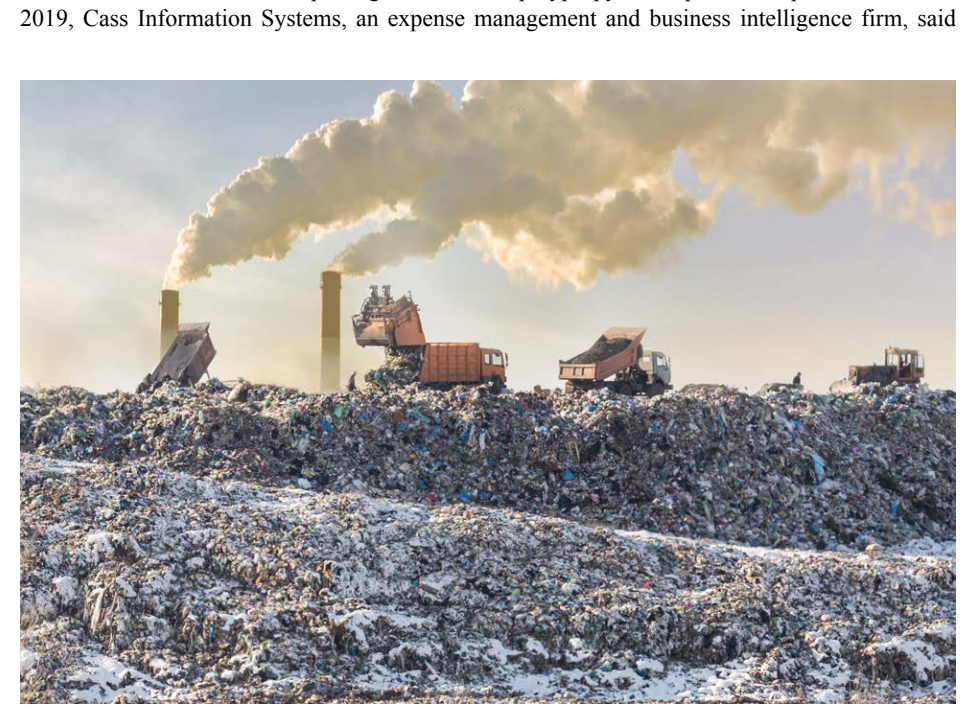
“super-emitters,” according to a report for the California Air Resources Board based on NASA’s Jet Management landfills, are Propulsion Laboratory data. Landfills are the biggest
among California’s leading
source of stationary methane gas emissions in California, making up 41%. Dairies and the oil and methane “super-emitters,” gas sectors follow at 26% each.
according to a report for the California Air Resources Board
These haulers don’t want a functioning bottle deposit system that uses deposits to motivate consumers to
based on NASA’s Jet Propulsion
bring clean containers in for redemption. They just
Laboratory data. Landfills are
want the consumer deposits while shoring up landfilling and incineration revenue.
the biggest source of stationary methane gas emissions in
As it is, consumers are getting back little more than half of the $1.4 billion they pay in nickel and dime
California, making up 41%.
deposits every year. A shrinking number of
Dairies and the oil and gas
redemption centers cause them to leave hundreds of millions in state coffers while operators of curbside
sectors follow at 26% each.
and rural drop off programs captured $146 million in CRV last year and would like an even bigger slice of11 the pie.
A network of lobbyists undermines California’s deposit system, promoting legislation to protect the status quo and killing legislation that threatens their bottom line. In other bottle deposit states, haulers’ curbside programs rarely get payments from bottle deposit12 programs, according to CRI. Rather than rewarding redemption centers that form the backbone of our now broken bottle deposit system, the state recycling regulator CalRecycle winds up paying waste haulers more than half of all state payments for recycling only 12% of all CRV empties through curbside and drop-off programs. Redemption centers get less than half those payments for recycling virtually all of the rest based on a flawed payment formula set by a prescriptive bottle law.
As redemption centers are starved of state payments and shutter—and grocery stores required by law to step up to the plate largely refuse to do so—consumers find fewer places to redeem containers. That encourages consumers to throw their deposit empties into curbside bins instead. This has led to sinking rates of direct consumer redemption and increased landfilling of CRV containers. Today, California’s redemption rate stands at 57%, third to last among ten bottle
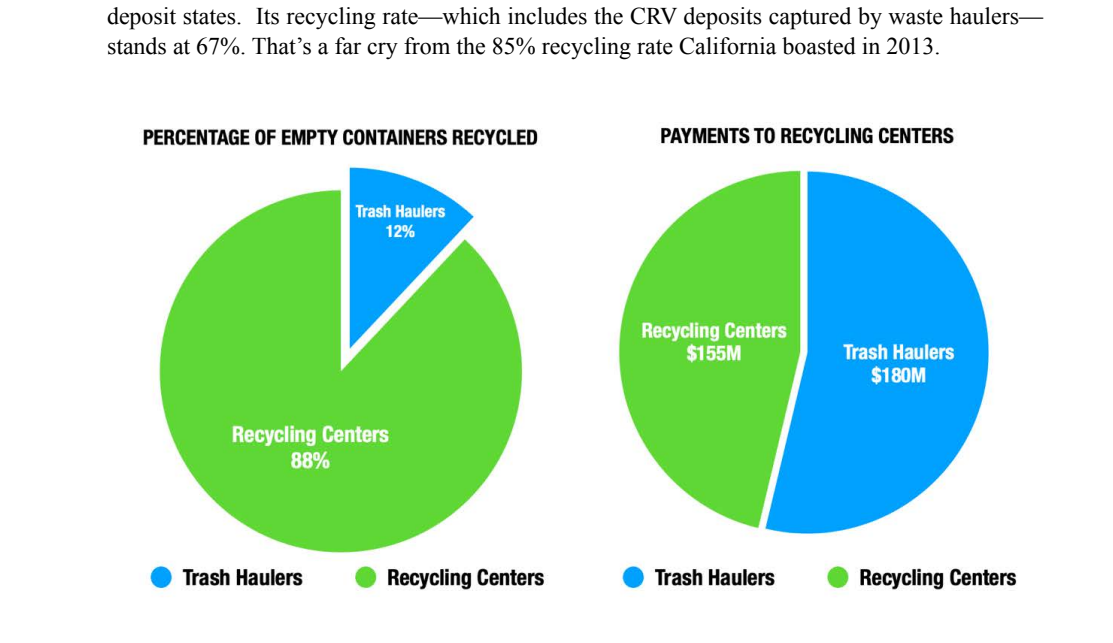
deposit states. Its recycling rate—which includes the CRV deposits captured by waste haulers— stands at 67%. That’s a far cry from the 85% recycling rate California boasted in 2013. Haulers themselves would like to speed up the dying process. Waste haulers once controlled about 100 redemption centers at waste transfer stations, MRFs or landfills, according to industry sources. They closed many of these sites in the face of the pandemic and a plunge in scrap prices. Big scrap metal recyclers also closed their CRV redemption sites. This eliminated still more consumer deposit refund options and forced consumers to throw more CRV containers into recycling bins. Haulers would rather collect the containers for free than run a redemption center. That is bad news for the circular economy. Redemption center materials can be sold for remanufacture into comparable products such as bottles, cans, and fiberglass. As redemption centers die off, only dirtier material is available for remanufacturing in California. Buyers have to spend more money cleaning the materials, pay to landfill more of them, sell them at very low cost for one-time uses such as roadbed, or forgo buying them. That means fewer recycling and manufacturing jobs, more litter, and higher energy use and greenhouse gas and toxic emissions to make containers from scratch.
SB 38: BEVERAGE INDUSTRY RESPONSIBILITY AS ANTIDOTE The antidote is a bottle deposit system run on an Extended Producer Responsibility (EPR) model. These systems put the responsibility onto the beverage industry for recycling, which leads to widespread consumer access to convenient redemption options via modern technology. In such states, beverage retailers must also refund deposits. In Michigan, supermarkets are the only refund option. There are no loophole off-ramps as there are in California for retailers to pay their way out of recycling or to win exemptions from it. The most successful of these systems in eight other bottle deposit states, such as Michigan, Oregon and Maine, deliver redemption rates of between 84% and 89%. Senator Bob Wieckowski (D-Fremont) introduced a bill this session—13 SB 38—that uses this model.
All leading bottle deposit systems in eight other bottle deposit states and abroad use this model of beverage industry responsibility for taking care of the wrappers encasing their profitable beverages. The best bottle deposit programs set deposits high enough to incentivize redemption, ensure wide access to convenient return options at or near retailers, and broadly educate14 consumers on their return options.
SB 38 calls for a consortium of beverage distributors that already have a network of trucks and warehouses to deliver beverages to retailers, using their well-oiled distribution system in reverse. They can collect empties from big supermarkets and deliver them to warehouses where processors can buy the materials directly. This consortium would be in charge of crafting and running the program in exchange for keeping a portion of left-over deposits. The state would set an enforceable redemption goal of 85% and oversee the system. If redemption rates don’t rise sufficiently to meet the goal, the CRV would rise to stimulate returns. S I M I O T D S Giving the beverage industry responsibility for creating a bottle deposit system in California is not a new idea. Four decades ago, in 1982, Proposition 11 would have put a nickel deposit on every beverage container sold in California. The initiative required retail stores selling beverages to refund those deposits and required those retailers or redemption centers returning empties to15 beverage wholesalers or bottlers to be repaid the refund plus additional money. The initiative was defeated at the ballot box. At that time, California had a Republican governor —George Deukmejian, and the country had Ronald Reagan for president. Getting any legislation through without industry support was a non-starter and grocers, beverage makers and distributors wanted no recycling responsibilities. Talk of another ballot initiative helped a coalition of major environmental groups get industry to the negotiating table. This led to a compromise deal that environmentalists asked then-Assembly Member Burt Margolin to carry.
The bill created a system of certified redemption centers near supermarkets where consumers could get deposit refunds and also supported waste haulers to expand curbside recycling service. The objective at the time was first and foremost to slash litter at parks and on beaches. The way to do that was to incentivize consumers to bring back containers and get deposit refunds while also getting waste haulers and cities to do more to recycle independent of whether consumers got their money back. The bill’s compromise focused more on creating a recycling system than a consumer deposit redemption system.
Margolin strengthened the bill with provisions requiring grocers to redeem in-store if redemption centers throughout state-designated consumer “convenience zones” failed to materialize or folded. Overall, the bottle law reflected a deal with industry to create a program that lawmakers
and environmentalists knew would need to be improved.
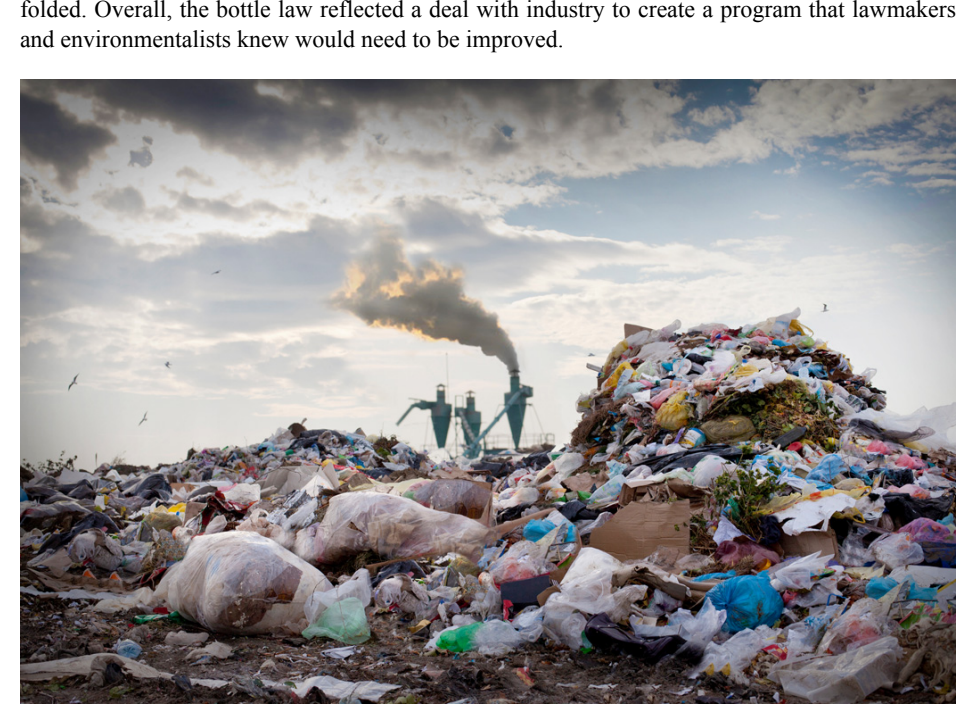
Recyclables being landfilled.
As a starting place it worked. Recycling rates hit a high of 85% in 2013. But over the last decade, retailers’ use of the law’s loopholes, successful hauler lobbying to raise payments to the detriment of redemption centers, poor CalRecycle enforcement of the bottle law against retailers, and paroxysms in world scrap markets has caused the system to steadily crumble. The law allowed grocery stores that did not want to be recyclers of last resort to opt out of recycling beverage containers by buying their way out, unlike any other state. Those grocers must pay $100 a day, or $36,500 a year to forgo recycling. The fee, which is taxi fare for the biggest billion-dollar grocery and big box chains in America, has never been adjusted for inflation. By now, that fee should have risen to $242 a day, or $88,330 a year. The law also allowed beverage distributors to hold back a fraction of the CRV they charge retailers in the wholesale price of deposit beverages to cover “administrative fees.” The percentage of CRV they are allowed to hold back was increased over time, totaling $25 million a year today. Beverage distributors have never been required to provide evidence of the true cost of administering the deposit.
Beverage makers are required to pay state fees to close the gap between the cost of recycling and the value of the recycled material but lobbying limited those fees to about 12% of what is necessary. Unredeemed deposits from consumers make up the difference. CalRecycle estimated that in fiscal year 2019-2020, unredeemed deposits were used to cover $125 million in processing fees that beverage makers would otherwise have had to pay, according to its May16 2020 fact sheet on the program. These fees are paid out as subsidies to redemption centers and processors.
Waste haulers too benefitted from the creation of exemptions from the program for grocers in convenience zones where curbside service was offered, redemption centers were not economic, or another recycling center was near enough. Haulers also got the CRV that consumers tossed into curbside bins together with their cans and bottles.
In fact, the Department of Conservation, in charge of the program in 1986, had drawn up a chart to show who got paid what. Curbside haulers would get the 1-cent CRV plus a “bonus” payment17 yet to be specified—but would never redeem consumer deposits. The legislature would keep adjusting the CRV value up over time to a nickel and a dime, depending on the size of a deposit containers, while a tsunami of redemption center closures in recent years gave haulers more and more CRV containers thrown into curbside bins, too many of which went to landfills. WHAT WASTE HAULERS WON Now the special interests all work together. California’s bottle deposit system has devolved into an alliance between waste haulers, supermarkets, and beverage distributors against redemption centers. Supermarkets and beverage distributors want no real part in the bottle deposit system. The beverage industry plays a minor role, cutting small checks to the state on one hand to subsidize redemption centers, but collecting an “administrative fee” from CalRecycle that essentially zeroes out their contribution to the system.
Haulers, too, won big in the 1986 Bottle Bill with the right to collect CRV from containers thrown into their recycling bins. By 2017, they were paid about $180 million a year, on top of their scrap sales, to recycle just 12% of the empty containers generated in state every year. Tweaks to the Bottle Bill over the years resulted in the following advantages today for waste haulers:
- No other bottle deposit state allows waste haulers to bill directly for the deposit money
consumers throw away in recycling bins. Instead, they are expected to sell containers on the scrap market for revenue. According to CRI, in 2017, haulers mopped up nearly $128 million in18 CRV deposit revenue from five and ten-cent refunds. That includes about $10 million in overpayments for contaminated CRV containers, according to CalRecycle estimates.
- No other state pays waste haulers’ administrative costs. In California, waste haulers that also
process recyclable materials are paid three quarters of one percent on top of the total amount of CRV they collect for costs that have never been quantified. In 2017, that amounted to about $1 million. Other bottle deposit states don’t even have a category of expenditures called “administrative costs.”
- No other state makes payments to operators of curbside and drop-off programs to make up the
difference between the cost of recycling and the scrap value on the market on top of paying them the CRV contained in bins. Redemption centers that have no sources of revenue besides scrap sales receive these processing payments out of unredeemed deposits. But haulers already charge cities and ratepayers a fee for service for their curbside recycling in addition to trash hauling contracts. Processing payments to these operators amounted to $26 million in 2017, according to CRI. This is in addition to the $13 million that haulers made off of scrap sales.
- No other state awards $15 million a year in “supplemental payments” to operators of curbside
programs. These payments were initially created as an incentive to start and support curbside collection programs. Now that most cities have curbside collection programs supported by ratepayers, the supplemental payments have become gravy. Grants are available for curbside programs in other bottle deposit states, but direct state payments are the minority.
- No other state awards “Quality Incentive Payments” of $10 million a year to processors in
order to charge curbside haulers less for taking worthless contaminated single stream glass off their hands.
No other U.S. bottle deposit program is as generous to waste haulers, grocers, and beverage makers and distributors as the California program. But redemption centers get shortchanged. CalRecycle uses a prescriptive method set by law to survey redemption centers on their operating costs. CalRecycle then determines how much all of the redemption centers will get paid based on
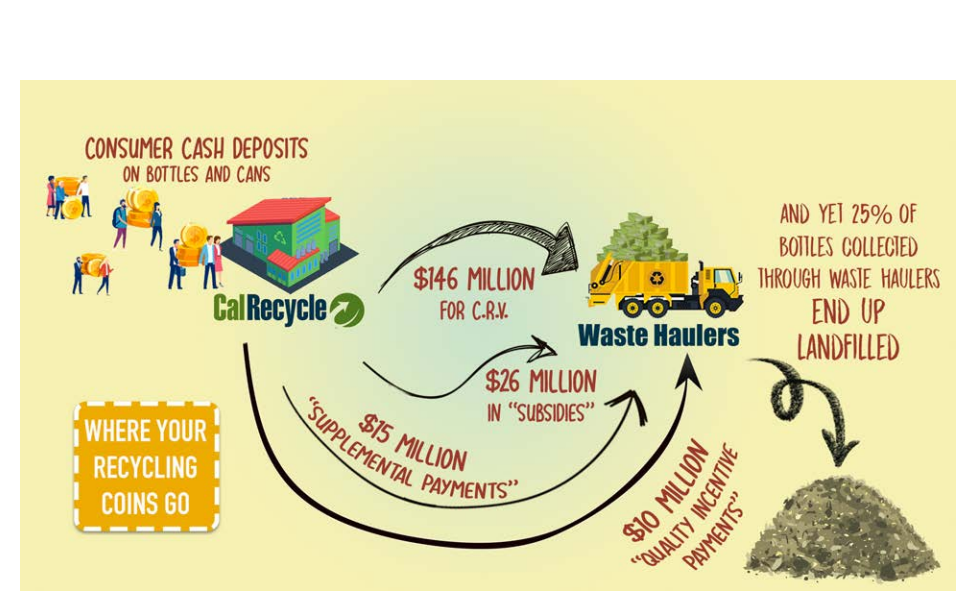
Visualization of Flow of Payments to Waste Haulers average costs, meaning that low-cost sites get paid well, and high-cost sites don’t get paid enough to survive. Because redemption center costs vary by location, rent, labor costs, and transportation distances to market, the surveys’ results end up forcing some sites out of business. Every two years, this cycle is repeated and more centers fold. Waste hauler and grocery store lobbyists and advocates have never suggested reform of the formula.
Prior to 2019, CalRecycle had never surveyed waste hauler operating costs. But the agency did commission an independent and unpublished study on what it costs waste haulers to sort materials at their MRFs. The 2019 study, uncovered in a Public Records Act request (PRA) by Consumer Watchdog, showed that the state overpays haulers by 20 times just for sorting CRV19 containers at MRFs.
CRI calculated that haulers made a profit of 326% from a total of $183 million in revenue from CalRecycle in 2017 (including $13 million in hauler scrap sales). The estimated cost for handling the containers was $43 million, leading to a calculation of $140 million in gross profits. Redemption centers are to be paid enough to make a reasonable return by law. Nothing in the law prescribes what haulers are to be paid.
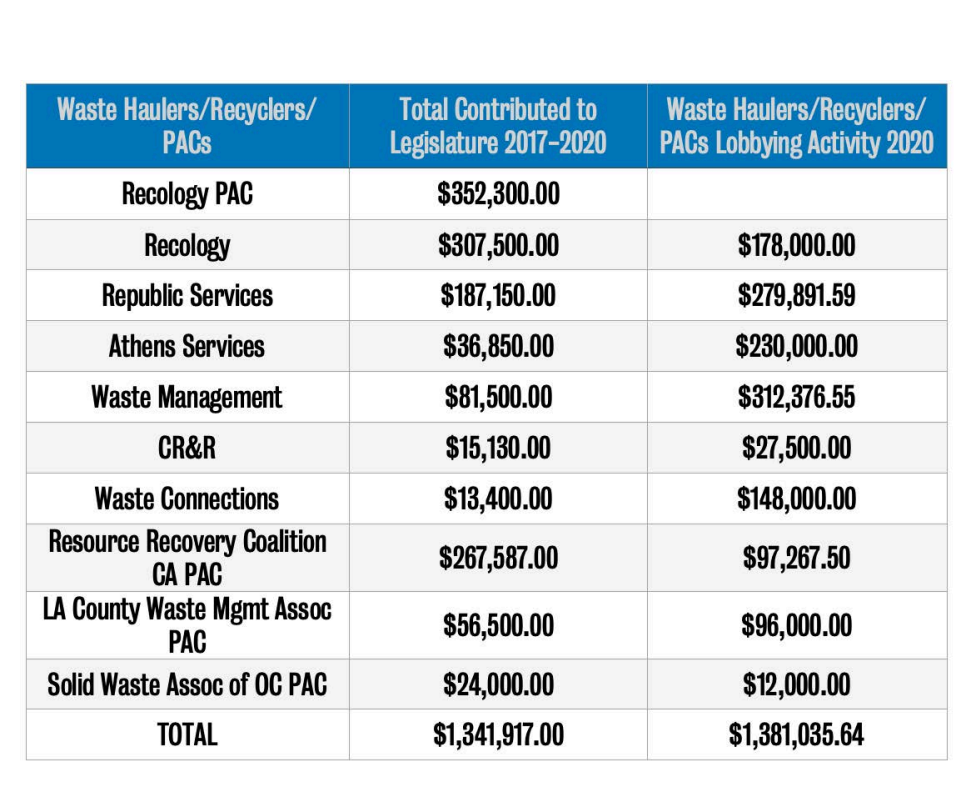
Ever since the Bottle Bill first passed, waste hauler and beverage industry advocates and their lobbyists have fought to preserve the status quo or gain additional advantage. In 2020 alone, waste haulers spent more than $1.3 million on lobbying the legislature, governor’s office and state recycling regulator CalRecycle. They spent the same amount between 2017 and 2020 in donations to lawmakers’ political campaigns.
HAULER DONATIONS
“Ever since the Bottle Bill
The total amount of direct campaign donations contributed
first passed, waste hauler
to the California legislature by waste haulers from 2017 through 2020 was more than $1.3 million—with $420,000
and beverage industry
going to state Senators and $911,000 going to Assembly
advocates and their lobbyists
lawmakers. Waste haulers, like all big corporations, know where the buck stops. Their biggest donations go to top
have fought to preserve the
leaders in the Senate and Assembly and to lawmakers who
status quo or gain
control the most powerful committees in charge of their fortunes, from environmental committees to appropriations
additional advantage. In
committees.
2020 alone, waste haulers
The biggest donors among individual waste management
spent more than $1.3
companies and their PACs were Recology and its PAC, Republic Services, Waste Management, and the Resource
million on lobbying the
Recovery Coalition of California PAC. That trade group legislature, governor’s office represents Northern and Southern California refuse companies.
and state recycling regulator CalRecycle. They spent the
Major corporations, including waste haulers, also make
same amount between 2017
behested payments to the favorite causes of politicians. For example, in 2019 waste hauler Republic Services,
and 2020 in donations to
Safeway, beer makers and distributors Anheuser Busch and
lawmakers’ political
Southern Glazer’s Wine & Spirits donated a total of $170,000 in the name of Governor Newsom for the
campaigns.”
purposes of his inauguration, a benefit concert for CA firefighters, and to other causes helping the disabled or victims of power outages and wild fires, according to the California Fair Political Practices Commission. No behested donations were made in 2020.
There are still other ways to make contributions to garner favor. Take Anthony Rendon, the current California Assembly Speaker. In the Assembly, Speaker Anthony Rendon received the most direct campaign contributions from haulers–a total of $57,700 since 2017. He represents cities in Los Angeles County where haulers do major business and have tried to enact monopolies.
But waste haulers have also contributed to nonprofits tied to his wife Annie Lam. Since, 2016, when Rendon became speaker of the California Assembly, five nonprofits where his wife Annie Lam is employed have taken donations or received sponsorships from more than 50 entities,
according to The Sacramento Bee. At the same time, Rendon was overseeing votes on legislation that some of the companies were fighting. More than half of the sponsors and donors were corporations that regularly lobby on bills before the legislature that can affect their bottom lines. Among the donors or sponsors were waste haulers California Waste Solutions, Recology, Republic Services and Athens Services. Two of the four have had California pay-to-play scandals associated with them. Major haulers have often been accused of and settled cases involving bribery and corruption to achieve their ends.
W H P D In 2014, Euractiv, an independent media network, published a special report on the waste21 management business that it deemed one of the sectors “most prone to corruption.” “Most of the cases have concerned charges or allegations of illegal party funding, personal illicit enrichment, diversion of national or EU funds, favouritism and conflicts of interest,” the report said. “In a few Member States, there were cases in which some organized crime leaders at municipality level establish their own political parties or infiltrated municipal councils to exert influence over local law enforcement or judiciary, and to rig public tenders.” The United States, including California, is no less vulnerable to such corruption—with waste haulers fighting viciously to create, hold onto, or expand trash monopolies just as they want to retain and expand their inroads into bottle and can recycling.
This year, San Francisco’s monopoly garbage and recycling company, Recology, settled with the
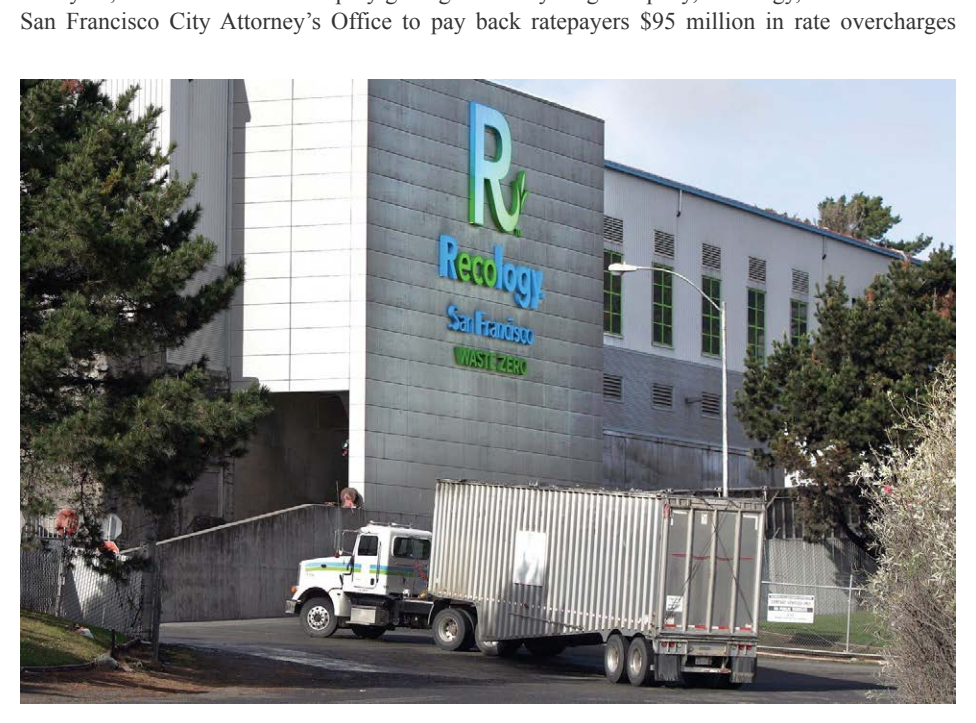
San Francisco City Attorney’s Office to pay back ratepayers $95 million in rate overcharges Two Recology employees were federally charged with bribery and money laundering. since 2017. It will also pay the city $7 million, bumping the tab to over $100 million. The company also lowered garbage rates by 6.8%. The City Attorney alleged that Recology and its affiliated companies regularly gifted money, meals and accommodations to city employees to sway decisions.
Two Recology employees, the former Recology San Francisco group government and community relations manager and the former vice president of Recology San Francisco were federally charged with bribery and money laundering, including paying the former Public Works22 Director to benefit Recology. The company’s rates went up in 2017 under the former Public Works Director that federal authorities alleged accepted bribes from Recology at about the same time the rates spiked.
Federal authorities arrested the former Public Works Director on a corruption charge, accusing him of accepting bribes from Recology through a baseball charity. Federal authorities ultimately charged Recology executives with laundering $1 million in bribes to nonprofits at the behest of the former Public Works Director. Bribes the former Public Works Director is accused of accepting from city contractors include the construction of his vacation home and a $36,000 gold Rolex in exchange for help in getting city contracts. Under the settlement, Recology will also be barred from making any gifts to city employees or contributions to nonprofits if directed by a city employee.
In 2018, Inglewood’s mayor’s role in awarding a $100 million waste collection contract came under scrutiny. The job went to a bidder with fees about $10 million higher than a competitor. Three months after the contract was awarded to the higher bidder, Consolidated Disposal Services, it hired the mayor’s unemployed brother. The L.A. County District Attorney didn’t think it was a coincidence. The complaint alleged, according to the L.A. Times, that the mayor asked bidders to hire his unemployed brother “as a condition for his support.” Both the DA and23 the FBI investigated the garbage contract, but no charges were filed.
In 2006, the mayor of San Jose, his chief budget aide and Norcal Waste Systems (in 2009, Norcal changed its name to Recology) were indicted on bribery, conspiracy, and public-funds misuse charges. Prosecutors alleged that in 2000, the mayor guaranteed one of Norcal’s subcontractors—California Waste Solutions—the hiring of workers represented by the International Brotherhood of Teamsters Local 350. But there was a catch. A Longshoremen’s local was willing to work for a lot less. So, allegedly, the city agreed to cover Norcal’s extra labor costs of more than $11 million. Prosecutors charged that the mayor held a 2000 meeting, before the awarding of the contract, where he allegedly expressed his wish that the Teamsters do the work. The Teamsters got the contract and the mayor got $10,000 in contributions from Norcal and the24 Teamsters.
San Jose Mayor Ron GonzalesIn 2002, the Mayor of Carson was indicted by a federal grand jury along with two former waste management executives and a fourth man in a bribery case involving the city’s award of a $60 million trash-hauling contract, according to The New York Times. Authorities said that municipal officials got $55,000 in bribes before the 10-year contract with a subsidiary of a big waste hauler,25 Allied Waste Industries, was overturned.
HAULERS AND THEIR LOBBYISTS Waste hauler lobbyists have made sure that California does not adopt cutting edge EPR bottle deposit models that keep materials clean and divert them away from the waste stream. The money that haulers spend on lobbying bests their direct contributions to politicians. In 2020 alone, the biggest haulers—Recology, Republic Services, Athens Services, Waste Management, CR&R, Waste Connections, and their associations and coalitions spent more than $1.3 million on lobbying. Their lobbying firms represent major interests in the State Capitol—from energy and insurance companies to banks, from truckers to oil companies, from cities and counties to universities, from CalPERs and unions to massage therapists, from gambling to tobacco and alcohol. They represent every vice and every special interest whose donations matter. Their lobbying firms are studded with former gubernatorial deputies, staff directors of powerful legislative committees, legislative advocates for leading business associations such as the California Chamber of Commerce, and former political campaign directors for both Democrats and Republicans. Their political connections and corporate expertise are so broad that waste haulers can employ lobbying firms representing their allies—big soda maker and beverage distributors that want no responsibility for recycling the containers encasing their profitable products—in a twofer. The beverage industry is a natural waste hauler ally—that sector would just as soon hand over all CRV empties to waste haulers.
For example, Sloat Higgins Jensen & Associates represents Recology plus Anheuser-Busch and the California Bottled Water Association that are opposed to an EPR bottle deposit system. Recology, for one, is a sponsor of a 2022 ballot initiative meant to reduce or eliminate certain single use plastic, such as polystyrene clamshell containers, a laudable goal. The measure would authorize CalRecycle to require makers of single use plastic packaging and food ware to make their products reusable, recyclable, refillable or compostable by 2030. Producers would have to slash by 25% the amount of single-use packaging and food ware by that date. The initiative would also impose a one cent “plastic pollution reduction fee” onto makers of select products to raise up to a few billion dollars annually for waste reduction and recycling programs—including for haulers. Among the fiscal impacts: “There would likely be increased costs for waste collecting and sorting which might be partially or fully offset by new tax26 revenue,” according to the Legislative Analyst’s Office. More money to unscramble eggs that27 cannot be unscrambled.
This initiative has brought together waste haulers and environmental advocacy groups into an alliance where interests coincide in a rare display. Led by Plastics Free California and funded largely by Recology with a $3.7 million donation out of more than $4 million raised, haulers’ interests in the initiative include raising hundreds of millions of dollars for their MRFs and banning single-use plastic that destroys their MRF sorting machinery and their landfill bulldozers.
There would likely be increased costs for waste collecting and sorting which might be partially or fully offset by new tax revenue,” according to the Legislative Analyst’s Office.26 More money to unscramble eggs that cannot be unscrambled.27
Environmental advocacy organizations urgently want to reduce plastic waste. These groups, together with other stakeholders, also stand to get hundreds of millions of dollars in grants from the ballot initiative’s prescriptive methodology on how the revenues will be allocated. According to the initiative, a Circular Economy Grant Program will award grants to stakeholders from industry to “organizations that undertake research, create educational and policy programs, or develop innovative solutions aimed at reducing disposal of single-use plastic packaging or mitigating the impacts of single-use plastic packaging waste on the state’s natural environment….” The initiative will do some good by reducing single use plastic but will only marginally increase recycling, particularly given the huge subsidies to waste haulers, because no28 amount of new technology can eliminate contamination from single stream recycling. The Flanigan Firm represents waste haulers’ corporate bedfellows against Bottle Bill reform— Southern Glazer’s Wine & Spirits, Wine & Spirits Wholesalers of California, and the West Coast chapter of the Institute of Scrap Recycling Industries (ISRI). ISRI includes waste haulers such as Allan Company and giant scrap metal recyclers that have fought California regulators in court to prevent disclosure of data about their tonnage of materials processed. CalRecycle had wanted the information to better track material flows in the state’s recycling infrastructure to improve total29 recycling estimates. California never met its 2020 goal of reducing landfill disposal by 75% from 1989 levels.
ISRI opposes SB 38, the bill introduced this year by Senator Bob Wieckowski to transform the30 bottle deposit system into one run by the beverage industry. This scrapyard association hates the Bottle Bill because it created a government agency that got involved in the trade of scrap, aluminum, plastic and glass. Scrapyards buy materials by the pound but those that also offered redemption services have shut down their CRV sites, according to industry sources. These free traders have been opposed to major reform of the Bottle Bill and would like to kill it. C A W In their campaign to preserve industry’s advantages under the Bottle Bill, increase unjustified subsidies to haulers and exemptions from recycling for grocery stores, and prevent major change to the status quo, the waste haulers and the beverage industry have an ally in Californians Against Waste (CAW). Californians Against Waste is the only advocacy group to be part of the waste industry coalition opposing SB 38’s EPR model.
In a letter opposing SB 38 to the Chair of the Senate Appropriations Committee, Anthony Portantino, CAW joined with Waste Management, Republic Services and other affiliated31 associations.
CAW calls itself a “non-profit environmental research and advocacy organization” devoted to solving pollution and conservation problems posing a threat to public health and the
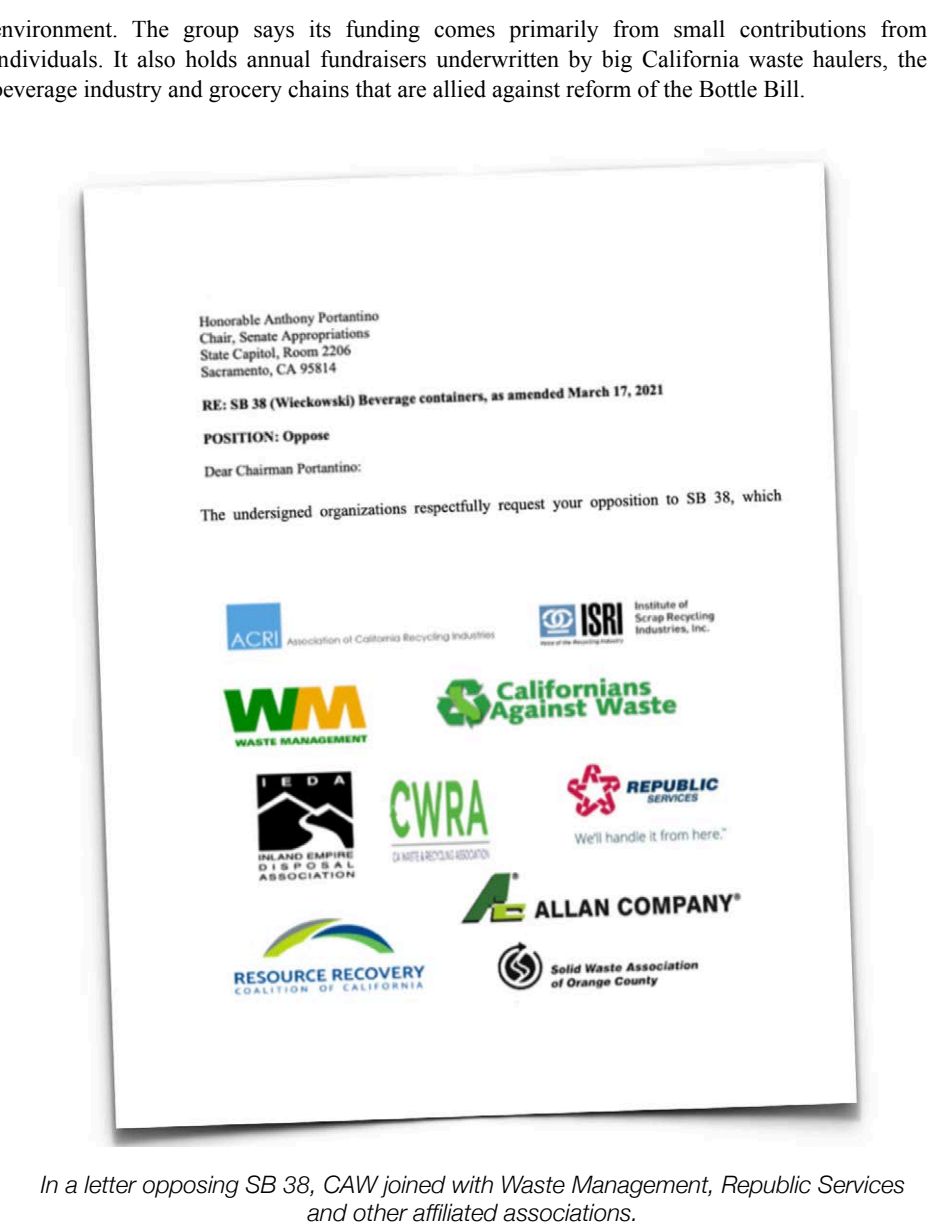
environment. The group says its funding comes primarily from small contributions from individuals. It also holds annual fundraisers underwritten by big California waste haulers, the beverage industry and grocery chains that are allied against reform of the Bottle Bill. In a letter opposing SB 38, CAW joined with Waste Management, Republic Services and other affiliated associations.
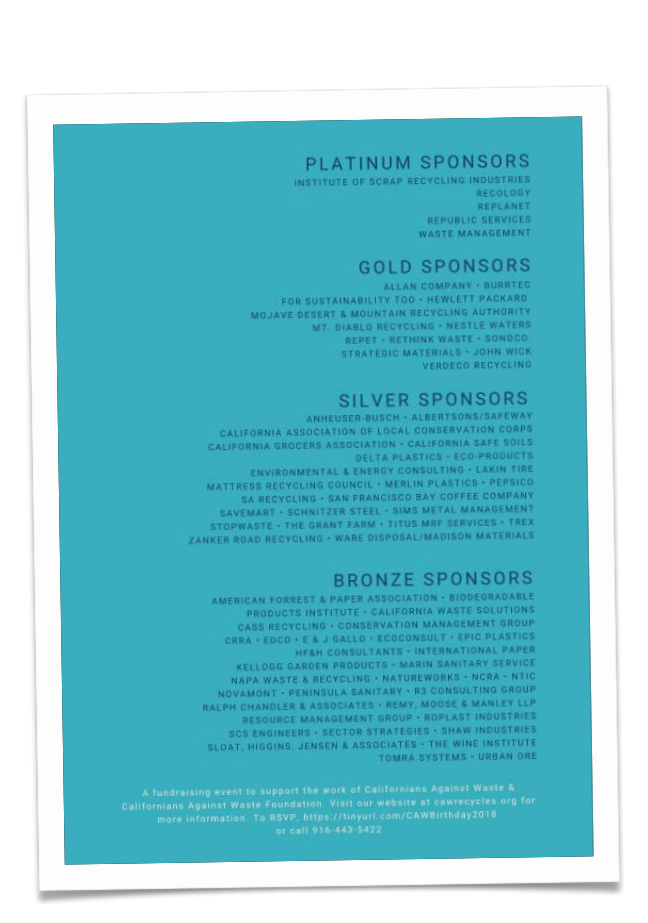
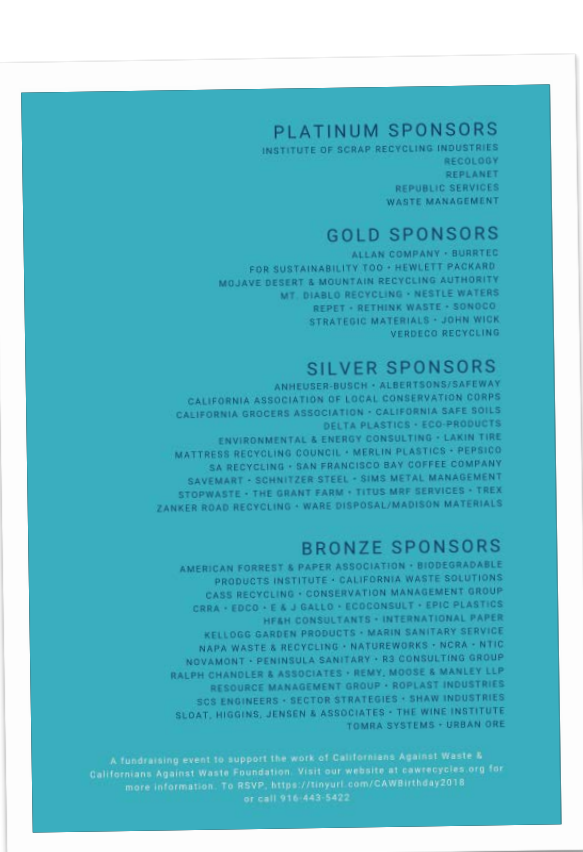
In 2018, CAW threw a 41 birthday bash/fundraiser. The top level “platinum” sponsors included Recology, Republic Services, Waste Management, and the Institute of Scrap Recycling Industries. “Gold” level sponsors included the large regional waste hauler Burrtec, Allan Company, Ware Disposal and Nestle Waters. CAW’s “silver” sponsors included the California Grocers Association, Anheuser-Busch, Albertsons/ Safeway, SaveMart, 7-Eleven, PepsiCo, and big metal shredders SA Recycling, Schnitzer Steel, Sims Metal Management. California haulers EDCO and California Waste Solutions, the lobbying firm of Sloat, Higgins, Jensen & Associates—representing Recology and Anheuser Busch— the Wine Institute, and EJ Gallo Winery, were “bronze” level.
Scores of companies and associations sponsored the event.
A 2018 CAW Fundraiser included numerous waste hauler Central to CAW’s work is: sponsors.
“Lobbying policymakers to implement and extend producer responsibility for the environmental impacts of their products and processes” in order to spur the32 use of recycled materials in manufacturing, according to its website. The group states that the “concept of Producer Responsibility lies at the root of virtually every legislative policy that CAW has pursued for the last 42 years.”
Except when it comes to California’s Bottle Bill.
Prior to the Bottle Bill’s passage in 1986, CAW supported a nickel deposit system with beverage industry responsibility. But the group became instrumental in an environmental alliance that compromised with industry—letting it avoid responsibility for recycling its wrappers—to get the Bottle Bill passed. The lead negotiator between the environmental community and industry who forged the bottle bill compromise in 1986 was CAW’s then-executive director, Bill Shireman. While CAW’s roots were in the environmental movement, Shireman opened the door to industry interests.
Bill Shireman now sits on CAW’s board and his philosophy has left its imprint. His bio on CAW’s website describes Shireman as a “master of environmental entrepreneurism” with two decades of experience in aligning the interests of major corporations and their stakeholders. The bio goes on to say, “He develops profitable business strategies that drive pollution down and33 profits up.” Shireman’s bio at the consulting firm he runs, Future 500, describes him as: A walking contradiction and trend bucker. He’s a life-long Republican and an environmental activist, a social progressive and a free-market enthusiast. Bill believes that our economics and our ecosystems don’t have to be at odds and34 that the left and right both have ample room to learn from each other. F R Over the last decade, CAW has worked to preserve the status quo and prevent fundamental reform of the bottle deposit system. They have sponsored or supported legislation that rewards waste haulers and shields beverage retailers, makers and distributors from the responsibilities and costs of making the California bottle deposit system best in class. Over time, CAW’s positions have increasingly aligned with the interests of curbside haulers, grocers, beverage manufacturers and distributors, and less and less with the public interest, except when industry and consumer interests converge. For example, CAW was instrumental in banning single use plastic bags in California and has supported legislation mandating minimum recycled content in manufactured products. These laws help waste haulers protect their sorting and landfilling equipment from jamming and reduce the amount of unmarketable plastic they collect.
But the public and the environment come last when bills threaten industry interests. For example, CAW played an instrumental role in a ploy to exempt grocers from the requirements of the bottle deposit program altogether. SB 452 (Glazer), a 2017 bill, was supported by CAW, Recology, Republic Services, Waste Management, and the California Grocers Association, among others. At that time, 1,000 redemption centers had closed in just two years. In exchange for temporary financial assistance through 2021 for redemption centers, the bill would have allowed grocers out of their obligations to redeem containers in-store.
It also froze any CalRecycle increases in processing fees charged to beverage makers to support the bottle deposit program until 2019. The centerpiece was to excuse thousands more beverage dealers from participation in the program altogether. The Senate analysis pointed out that “SB
walking contradiction and trend bucker. He’s a life-long Republican and an environmental activist, a social progressive and a free-market enthusiast. Bill believes that our economics and our ecosystems don’t have to be at odds and that the left and right both have ample room to learn from each other.34
452 makes it harder for those consumers to access redemption opportunities by making those opportunities further away.”
The intent was to expand the financial haul for waste management companies by getting more grocery stores off the hook for container redemption. That would have dramatically shrunk the number of stores that had to refund deposits and pushed more CRV containers into curbside
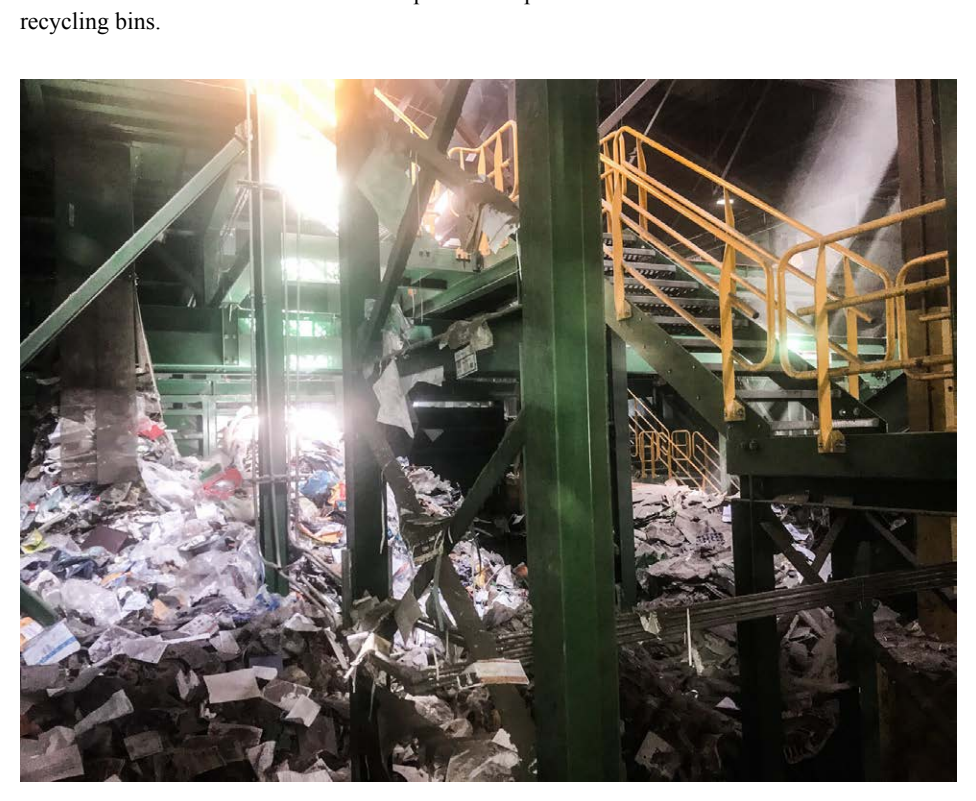
recycling bins.
Rejected Recyclables Tellingly, the bill did nothing to change the flawed payment formula for redemption centers that is a main cause of many centers’ collapse. If the payment formula had been scrapped, perhaps the closure of rePlanet in 2019 could have been avoided. RePlanet ran the biggest network of redemption centers in California. That year it closed all 284 of its locations and laid off hundreds35 of employees. The CalRecycle payment formula shorted the network, helping to ensure its failure, while increasing the amount of empties thrown into curbside bins. SB 452 was vetoed by Jerry Brown for providing carveouts, giveaways, and meaningless temporary financial relief. “SB 452 is inconsistent with the Administration’s principles for reforming and modernizing this program, which was created in 1986,” Brown’s veto message said. “Any legislation to update these statutes should balance three different components: fiscal sustainability, improved collection and incentives for innovative recycling. This bill does not accomplish any of these goals.”
HAULERS VS. REFORM: TWO COMPETING LEGISLATIVE VISIONS In 2020, Wieckowski introduced legislation, SB 372, with the same EPR concept as this year’s SB 38. At the time, CAW supported the bill once it contained some key amendments protecting waste hauler revenue from the program. One amendment promised “payments to curbside programs in an amount sufficient to avoid any adverse impacts on consumers, curbside programs, or local governments.” Another amendment promised “funding for the recycling of36 empty beverage containers pursuant to a curbside collection program.”
But this year, as important details have been fleshed out—such as the requirement that supermarkets take containers back in-store and not buy their way out of the program—CAW is leading the opposition.
CAW sponsored legislation to create an EPR mattress recycling program in California and37 supported legislation creating an EPR system for carpet recycling. But in his letter opposing SB 38, CAW’s Mark Murray speciously argues that an EPR system for beverage containers is doomed to failure based on the results of these very programs. The comparison is apples to oranges. Carpet and mattresses are very cumbersome and hard to recycle. The products have little re-usable content compared to the cost of recycling, while deposit beverage containers are clean and recyclable. Instead, Murray insists that the current system is only “urgently in need of a small number of specific, well understood updates to allow CalRecycle to increase payments and targeted incentives to an otherwise resilient public, private and non-profit recycling infrastructure.”38 This session, CAW is sponsoring AB 1454 (Bloom and O’Donnell). The bill is yet another giveaway to the interest groups that keep the system broken at the expense of consumers and39 redemption centers.
The bill recreates the sorts of “fixes” that would have hurt consumer redemption in SB 452 and shortchanges redemption centers yet again. The bill states that “it is the intent of the legislature” to appropriate $25 million from CalRecycle’s recycling fund to increase incentives to haulers and to provide “startup loans” of $25,000 to open redemption centers in unserved or underserved areas. Yet there are no guarantees that the money will be appropriated at all, and $25,000 to open a new center is nowhere near enough to open centers in places where they are sorely lacking. Those locations are urban areas where operating costs are high, including the Bay Area, Bloom’s Los Angeles district, and rural Northern California where transportation costs for materials are high.
Right now, two thirds, or seven out of ten of the state’s convenience zones lack a redemption center. Instead of enforcing the bottle law so that beverage retailers redeem containers in those convenience zones at their stores, Bloom’s bill, AB 1454, would exempt more grocery stores
from having “take-back” obligations– a give-a-way to the grocers at the expense of consumer convenience. Bloom’s entire district has just one redemption center.
AB 1454 would also hand millions more dollars to haulers to improve the quality of plastic, thickening the gravy of subsidies that haulers already receive. The plastic that haulers collect is extremely contaminated as opposed to clean plastic bottles returned through the deposit program. Curbside haulers already get big payments for contaminated bales of materials via CRV deposit revenue, curbside supplemental payments, and administrative fees that no other bottle deposit states pay. The bill would fatten their wallets instead of telling haulers they won’t get paid for contaminated bales. The bill also reduces the processing fees that beverage makers pay, further starving the program of funds to adequately support recycling.
The bill sets up an advisory board that will give power to regulated entities, waste haulers and beverage makers, to advise CalRecycle, which will deepen its regulatory capture. It does nothing to end the statutory right of grocers to pay their way out of the program and misallocates funds to waste haulers to collect CRV containers, which no other deposit system in the world allows or would even consider.
Nor does the legislation propose to reform the flawed formula the state uses to pay redemption centers. The Assembly Appropriations Committee is particularly critical of this aspect of AB 1454. “The methods to determine processing payments do not accurately reflect the cost of40 recycling or provide a reasonable return.”
If the Bottle Bill was designed to require all grocers without exception to redeem containers, if the responsibility for their recycling were shifted to beverage makers and distributors, if unnecessary resources were not directed to the waste haulers, and redemption centers were fairly paid, the redemption network could be revived and rebuilt. Instead, AB 1454 sets up exactly the system that the waste haulers want—giving consumers no choice but to throw away their CRV containers while paying waste haulers to contaminate them to the point where there is no market for the materials.
CONCLUSION As the state suffers a recycling crisis with consumer redemption at a low of 57%, waste haulers are leading a coalition to prevent fundamental reform of the Bottle Bill. True reform would put the responsibility of running the program where it belongs—onto the beverage industry that makes, distributes, sells, and profits off of deposit beverages whose wrappers pollute the environment.
Such a system would significantly raise California’s redemption rate by making the beverage industry responsible for hitting an 85% redemption goal last reached in 2013. The beverage industry already has a massive beverage distribution system that could just as easily be used to gather and transport empties back to warehouses where existing processing companies could come and buy clean materials for resale to manufacturers here in California. The beverage industry would be allowed to keep unredeemed deposits, with limits, and use that money to modernize the system so that consumers could find redemption points everywhere—from supermarkets to recycling centers, from airports to sports stadiums and malls. Consumers who prefer throwing their CRV containers into recycling bins will be able to continue to do so. But Governor Newsom’s call for a circular economy in recycling depends on his ability to force corporate waste haulers—and the beverage industry—to accept a redrawn system that provides the haulers fewer subsidies and makes the system so convenient that consumers can easily get their deposits back. The job of leadership is not to make all stakeholders happy, lest underrepresented consumers be left out of the bargain. What it takes is the right action to build the circular economy that the Governor claims to want.
CITATIONS1 California also has a number of municipal waste recycling programs in cities such as Los Angeles, Berkeley. Santa Monica, Beverly Hills, Culver City, Long Beach, San Diego, and Pasadena. A few nonprofits also operate redemption centers and MRFs. Some offer “dual stream” services that separate fiber such as paper and cardboard from containers. These programs are not the subject of this report.2 In 2020, haulers were paid $118 million for the CRV in curbside bins and $28 million for the CRV at rural, drop off locations, according to the CalRecycle data analyzed by Container Recycling Institute. Corporate waste haulers operate a majority of these programs, However, municipalities operate at least ten percent of these programs statewide.3 For more on haulers and why consumers do not get back deposits, see: https:// www.consumerwatchdog.org/news-story/opinion-why-californians-dont-get-their-bottle-and-can-deposits-back4 See page 17 of this report for a list of Californians Against Waste’s industry supporters.5 Though some haulers still offer “dual stream” service where cardboard and paper are separated from containers—keeping the containers clean–the majority of programs are single stream. Some haulers that do not offer curbside service use MRFs to separate CRV containers from regular trash—producing very high contamination rates.6 For more on contamination, see: https://www.container-recycling.org/assets/pdfs/ACommonTheme.pdf and https://www.cassinfo.com/waste-expense-management/waste-and-recycling-blog/predictions-for-waste-expenses-2019-costs-on-the-rise7 For more on MRF costs, see: https://resource-recycling.com/recycling/2020/01/12/data-corner-the-expanding-cost-revenue-gap-that-is-plaguing-mrfs/8 For more on contamination facts, see: https://www.rubicon.com/blog/recycling-contamination-facts/9 For more on contamination facts, see: https://www.rubicon.com/blog/recycling-contamination-facts/10 For more on waste haulers and methane emissions, see: https://www.wastedive.com/news/ super-emitters-methane-landfills-nasa-republic-california-waste-management/570850/ and https://truvaluelabs.com/news/press-release/truvalue-labs-report-details-californias-top-methane-super-emitting-companies For other Consumer Watchdog reports on California’s broken bottle deposit system, see: https://www.consumerwatchdog.org/report/half-nickel-how-california-consumers-get-ripped-every-bottle-deposit-they-pay And https://www.consumerwatchdog.org/report/trashed-how-california-recycling-failed-and-how-fix-it12 For more on curbside hauler payments, see: https://www.container-recycling.org/images/ stories/PDF/CACurbsideandDropoffProfitsFINAL.pdf13 For more on SB 38, see: https://www.consumerwatchdog.org/energy/75-whole-foods-markets-abandon-bottle-and-can-recycling-redemption-rate-sinks-58-and-groups And https:// www.consumerwatchdog.org/sites/default/files/2021-04/ CoalitionSupportSB38LetterWLogos.pdf14 For more on the characteristics of the best bottle deposit systems, see: https:// www.consumerwatchdog.org/report/trashed-how-california-recycling-failed-and-how-fix-it15 For more on the 1982 initiative, see: https://ballotpedia.org/ California_Proposition_11,_Beverage_Container_Reuse_and_Recycling_Act_(1982)16 For CalRecycle’s May 2020 fact sheet on the bottle deposit program, see: https:// www.consumerwatchdog.org/sites/default/files/2021-05/ California’s%20Beverage%20Container%20Recycling%20and%20Litter%20Reduction%20Prog ram%20Fact%20Sheet%20%282020%29.pdf17 For details more details on the money trail and the law as originally implemented, see: Money Trail AB 2020, Attachment A, Page 6a :https://digitalcommons.law.ggu.edu/cgi/viewcontent.cgi? referer=https://www.google.com/&httpsredir=1&article=1275&context=caldocs_assembly18 For a detailed CRI analysis of curbside hauler profits, see: https://www.container-recycling.org/images/stories/PDF/CACurbsideandDropoffProfitsFINAL.pdf19 For more on haulers and why consumers do not get back deposits, see: https:// www.consumerwatchdog.org/news-story/opinion-why-californians-dont-get-their-bottle-and-can-deposits-back20 For more on waste hauler contributions to nonprofits, see: https://www.sacbee.com/news/ politics-government/capitol-alert/article249343790.html and https://revealnews.org/article/since-california-speaker-rose-to-power-corporate-donations-flowed-to-nonprofits-tied-to-his-wife/21 For more on haulers and corruption, see: https://www.euractiv.com/section/sustainable-dev/ news/waste-business-very-vulnerable-to-corruption/ For more on Recology and corruption, see: https://www.wastetodaymagazine.com/article/ fraud-california-bribery/ and https://www.kqed.org/news/11863022/sf-corruption-saga-under- nurus-oversight-garbage-company-recology-overcharged-ratepayers-95-million https://www.kqed.org/news/11863022/sf-corruption-saga-under-nurus-oversight-garbage-company-recology-overcharged-ratepayers-95-million and https://www.kqed.org/news/ 11839531/report-corrupt-sf-official-directed-nonprofit-to-pay-60k-to-organizations-under-fbi-investigation23 For more on Inglewood and corruption, see: https://www.latimes.com/local/lanow/la-me-ln- butts-garbage-contract-20180201-story.html24 For more on San Jose and corruption, see: https://nlpc.org/2006/07/17/san-jose-mayor-aide-contractor-indicted-trash-haul-probe/25 For more on Carson and corruption, see: https://www.nytimes.com/2002/11/22/us/mayor-and-trash-hauling-operators-indicted-in-bribery-case.html26 For the plastics initiative’s fiscal effects, see: https://lao.ca.gov/BallotAnalysis/Initiative/ 2019-02827 For the plastics initiative, see: https://ballotpedia.org/ California_Plastic_Waste_Reduction_Regulations_Initiative_(2022)28 For more on the initiative, see: https://news.ballotpedia.org/2020/08/14/signatures-filed-for-california-ballot-initiative-to-reduce-and-tax-single-use-plastic-packaging/ and https:// news.ballotpedia.org/2020/08/14/signatures-filed-for-california-ballot-initiative-to-reduce-and-tax-single-use-plastic-packaging/29 For more on ISRI’s fight against California reporting requirements, see: https://resource-recycling.com/recycling/2019/07/16/isri-wins-injunction-against-california-reporting-regulations/30 For ISRI’s positions on bills, see: https://www.resourcecoalition.org/BillPositions.aspx31 For CAW’s letter of opposition on behalf of haulers to SB 38, see: https:// www.consumerwatchdog.org/sites/default/files/2021-04/ SB%2038%20%28Wieckowski%29%20Beverage%20containers%20-%20OPPOSE_.pdf32 See CAW’s website, here: https://www.cawrecycles.org/about-us33 For more on Shireman, see: https://www.cawrecycles.org/bill-shireman34 For more on Shireman, see: https://www.future500.org/bill-shireman35 For more on rePlanet’s closure, see: https://www.consumerwatchdog.org/news-story/ californias-largest-recycling-center-closes-0 For amendments to SB 372, see: https://leginfo.legislature.ca.gov/faces/billNavClient.xhtml? bill_id=201920200SB37237 For more on CAW’s support for mattress and carpet recycling, see: https:// www.cawrecycles.org/recycling-news/mattress-program-launch and https:// www.cawrecycles.org/ab-2398-john-a-prez38 For CAW’s current list of legislative priorities, see: https://www.cawrecycles.org/legislation39 For Consumer Watchdog’s letter of opposition to AB 1454, see: https:// www.consumerwatchdog.org/sites/default/files/2021-04/OPPOSEAB1454FINAL3-24-21_0.pdf40 For the Assembly Appropriations Committee analysis of AB 1454, See: https:// www.consumerwatchdog.org/sites/default/files/ 2021-05/202120220AB1454_Assembly%20Appropriations.pdf