EXECUTIVE SUMMARY
Internal documents obtained from the oil industry’s lobbying arm, the Western States Petroleum Associa8on, show that the companies have made stopping California’s landmark climate change laws their top priority and will stop at nothing to achieve their ends. This includes the use of a platoon of phony front groups to shield the hidden hand of the unpopular oil industry in the aGacks against the environmental protection laws.
This report by Consumer Watchdog chronicles the tactics that the companies are likely to use to thwart implementation and strengthening of California’s climate change laws, including California’s Global Warming Solu8ons Act (AB 32). In addition to unprecedented lobbying and campaign contribution expenditures in recent years, California’s oil companies are likely to use their extraordinary power over the gasoline market to artificially inflate gasoline prices as a way of driving political pressure against the new legal obligations refiners will face beginning in January 2015. For the last decade and one half, Consumer Watchdog has chronicled through a series of reports how California’s oil companies, much like Enron and other energy companies, have cut back on production to drive up prices at critical moments. This report first outlines the political and public opinion apparatus of the oil companies, then explains the way oil companies have artificially inflated gasoline prices at critical moments for pecuniary and political gain. The main finding of this review of oil companies’ tactics and strategies is that California’s state officials must be on high alert for such price manipulations and warn the oil companies that they will be immediately investigated and prosecuted for cut-‐backs in gasoline production that drive up price.
Influence-Peddling & Cash Register Politics
California’s oil industry has invested heavily in lobbyists, campaign contributions, and astroturf front groups in its war on clean air and clean energy laws that have taken shape in California over the last decade. Two of the industry’s perennial top targets are California’s landmark climate change law AB 32, and preventing passage of an oil extraction tax in the state to mirror that of Texas and Alaska. The Na8onal Ins8tute on Money in State Poli8cs reports that California’s oil and gas industry spent $175 million on campaign contributions from 2004 to 2014. The expenditure, matched only by pharmaceutical and insurance industries, makes these industries the biggest corporate campaign spenders during the last decade.
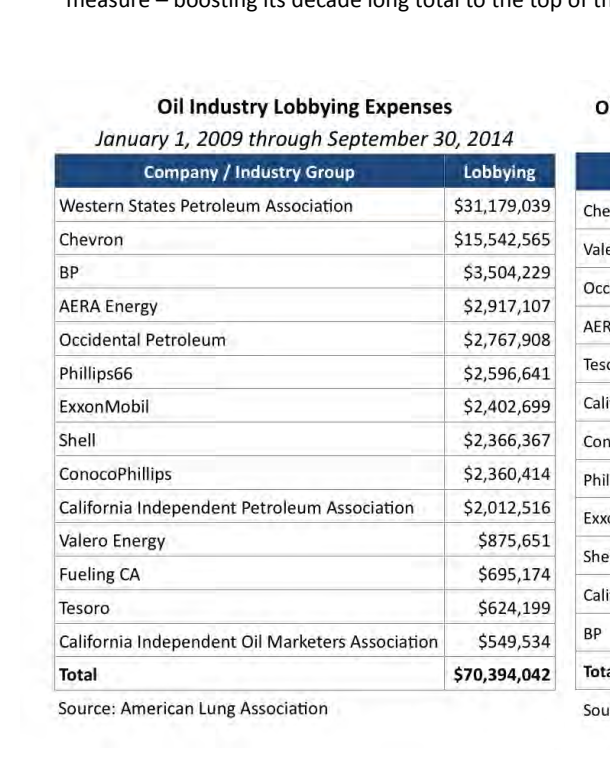
During the last six years, as the climate change movement began to intensify in California, the oil industry spent $106 million between January 2009 and September 2014 on lobbying and campaign contributions to politicians and ballot measures in California.
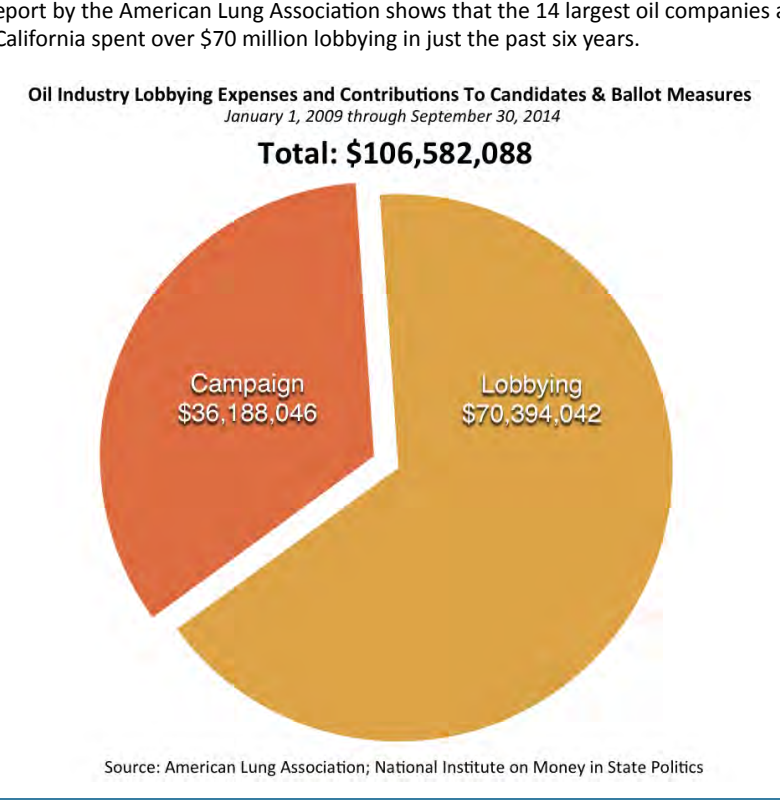
A recent report by the American Lung Associa8on shows that the 14 largest oil companies and trade groups in California spent over $70 million lobbying in just the past six years.
Total: $106,582,088
The report further shows huge increases in spending on lobbying in 2014 over previous years. The oil companies spent $7.1 million during the third quarter of 2014 — $1 every second. During this period, the oil companies were working to exempt themselves from California’s cap and trade requirement (AB 69).
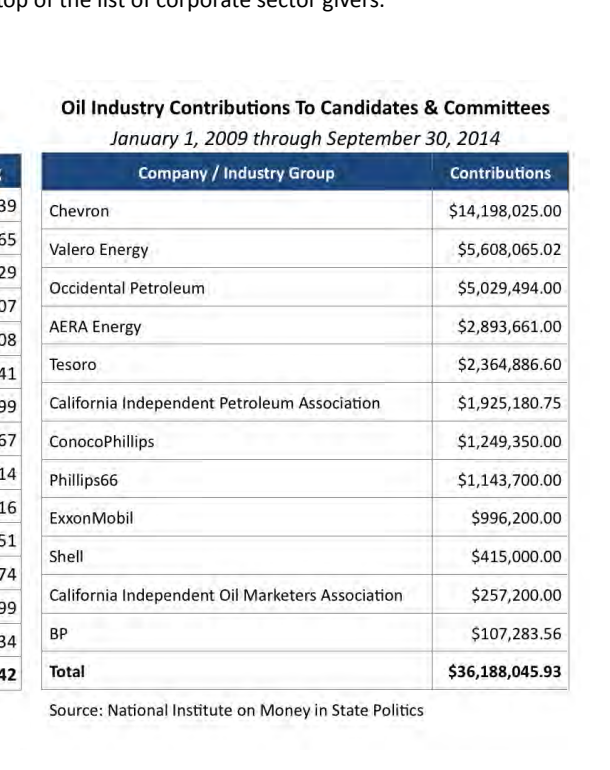
From 2009 through September of 2014, Big Oil interests have spent over $36 million on political campaigns in California. This includes direct and indirect contributions to candidates who “carry oil” for the industry in the legislature, and spending on ballot measures before the voters. This profligate spending has helped ensure that California remains the only major oil producing state that does not have an oil extraction tax. From 2010 to 2014, the industry quashed four bills that would have enacted an extraction tax.
In 2006 clean energy advocates placed Prop 87 on the ballot to enact an oil extraction tax, with the revenues dedicated to alternative energy programs. Big Oil spent a record $93,818,722 to defeat the measure – boosting its decade long total to the top of the list of corporate sector givers.
Phony Front Groups Hide Big Oil’s Hands
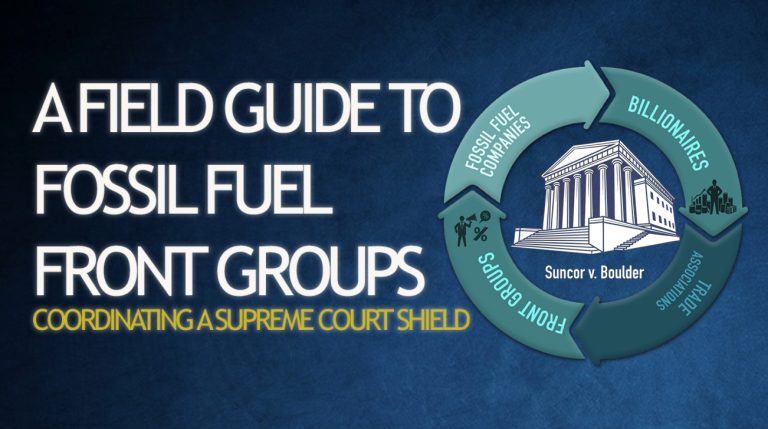
On November 11, 2014, the Western States Petroleum Associa8on (WSPA) gave a presentation to the Washington Research Council that, according to Bloomberg Businessweek (opens in new tab), shows WSPA is leading “a highly coordinated, mul8-‐state coalition that does not want California to succeed at moving off fossil fuels.” The presentation details the aggressive campaign to mislead the public through phony reports, front groups pretending to be consumer advocacy groups, and threatening increased gas prices under California’s landmark climate change law, AB 32. Oil companies know that they are not a credible messenger to advocate for exempting the oil industry from AB 32 implementation, so they have created a collection of fake “consumer advocacy” groups and astroturf campaigns with misleading names like California Drivers Alliance. While the actual amount of money spent on these groups is not publicly available (by WSPA’s design), the campaigns detailed in the presentation are clearly well funded and meant to deceive the public about the financial interests behind them. State officials should monitor the ac8vi8es of these groups and require disclosure about where, when and how they are spending money on their
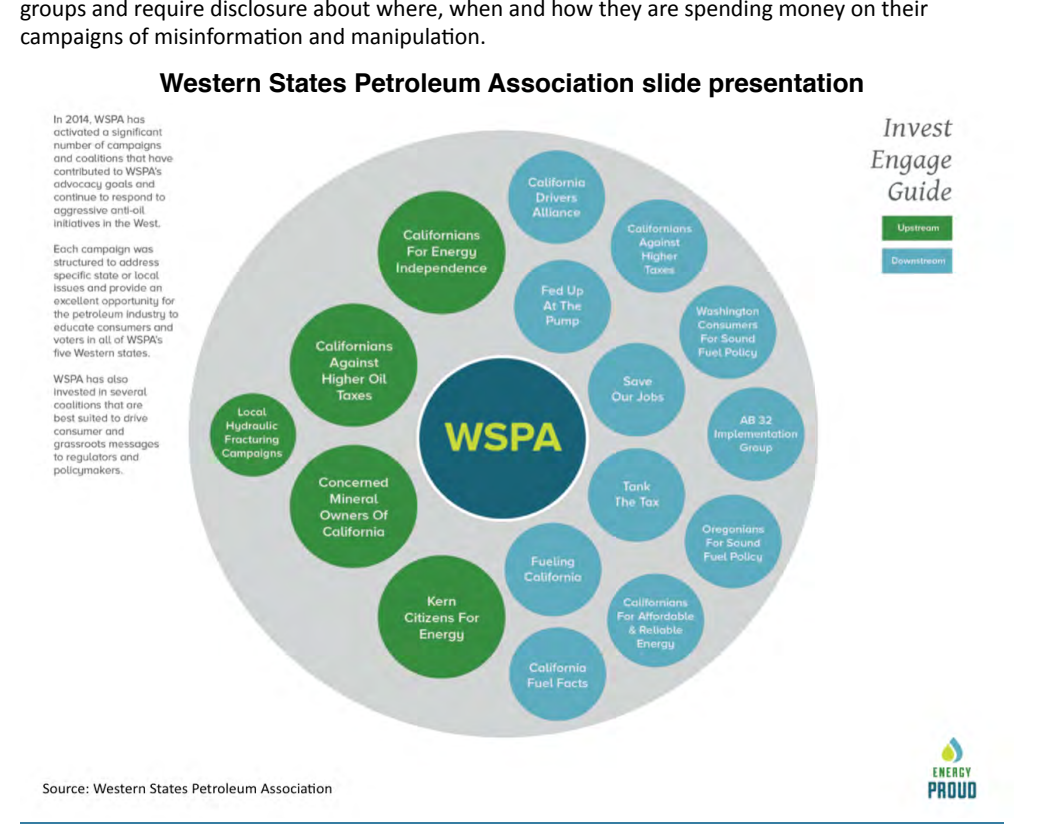
campaigns of misinformation and manipulation.
Western States Petroleum Association slide presentation Invest Engage Guide
~
PROUD Gas Price Manipulation : Gouging Consumers at the Pump
Consumer Watchdog research over the last decade and a half shows that oil companies have manipulated gasoline supplies to artificially drive up gasoline prices and company profits. Significant market consolidation in the hands of a few refiners and historically low inventories of gasoline have given oil companies the power to artificially increase or decrease gas prices at critical moments. The results have been record profits and inflated gasoline prices in California. The companies are likely to try to manipulate gasoline prices in California in order to undermine new state obligations to avert climate change.
Consumer Watchdog warns state officials to be on full alert and inform oil companies that unwarranted refinery outages and other production “slow downs” will be met with swii inves8ga8on and prosecution.
Manipulation of Refined Supply Allows Oil Companies To Drive Price Spikes
How can a power outage at a refinery spark $5-‐a-‐gallon gasoline at some L.A. stations? Why would the fact that California had to switch to the winter-‐blend fuel at the end of October -‐-‐ a switch that happens every year -‐-‐ raise gasoline prices to record levels? Such recurring price spikes in California over the course of the last decade and a half are not a freak phenomenon or the result of a convergence of refinery problems, as the oil industry would have the public believe. Various observers have demonstrated that radical swings in California gasoline prices are the result of a market controlled by a handful of oil companies who make more money when they make less gasoline.
California’s under-‐regulated gasoline market resembles our briefly deregulated electricity grid during 2000-‐01, when energy pirates such as Enron manipulated prices. The California gasoline market is structured to create shortages and scarcity. When an inevitable problem occurs to shock the system, such as a refinery outage or pipeline problem, gasoline prices and company profits go through the roof in tandem.
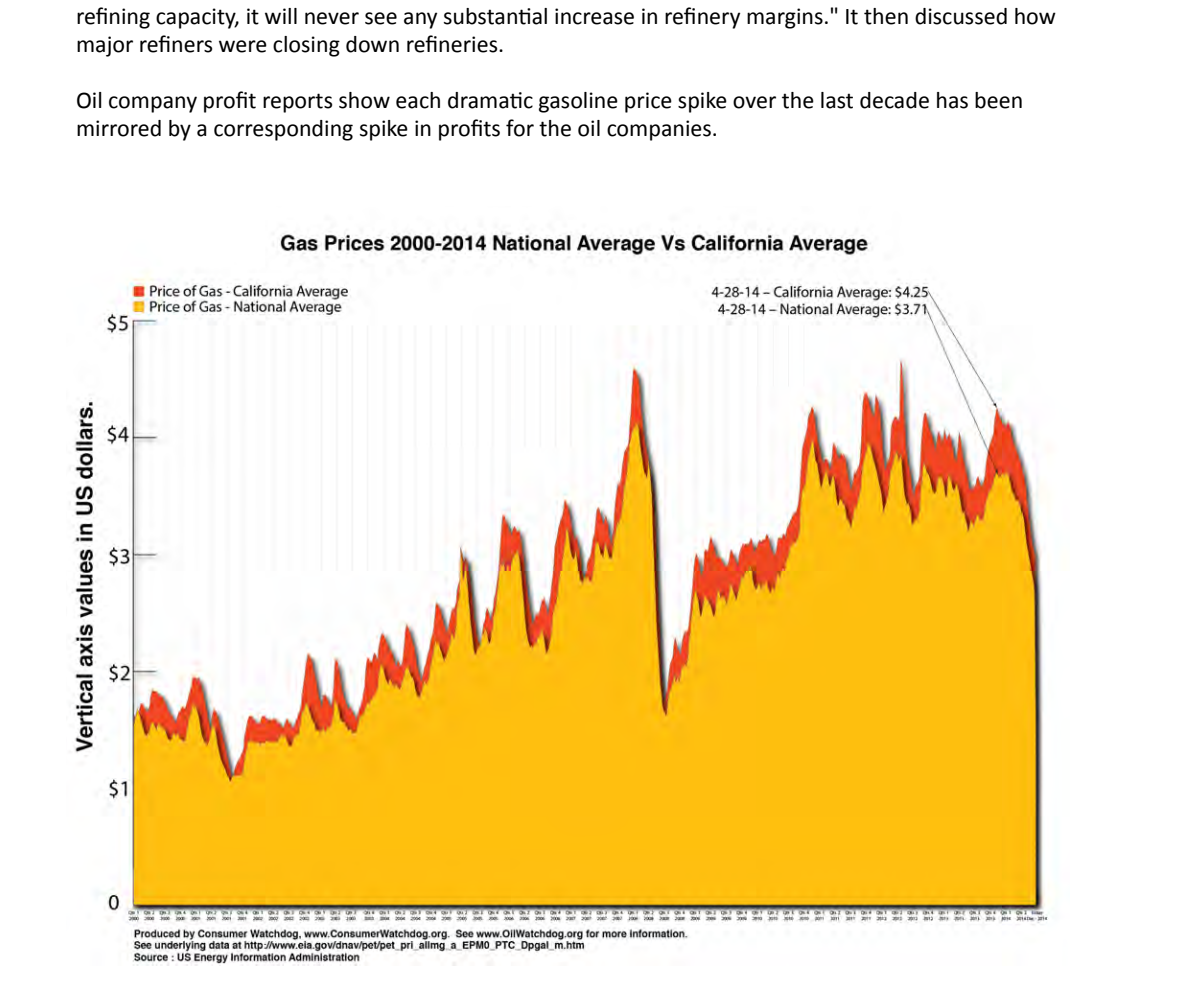
Gasoline is priced in an under-‐regulated commodities market controlled by a handful of companies. Over the last decade, Californians have consistently paid prices that are 10 to 20 cents a gallon higher than the rest of the nation, and we have lower inventories. The rest of the continental U.S. has about 24 days of gasoline on hand; California’s average is 10 to 13 days. Not surprisingly, over the last 10 years, refineries on the West Coast have consistently been among the most profitable in the continental U.S.
Memos from West Coast oil refiners from the 1990s and released in 2011 by Sen. Ron Wyden (D-‐ Ore.) suggest that this is a deliberate business strategy. An internal Chevron memo, for example, stated: “A senior energy analyst at the recent API [American Petroleum Ins8tute] convention warned that if the U.S. petroleum industry doesn’t reduce its
refining capacity, it will never see any substantial increase in refinery margins.” It then discussed how major refiners were closing down refineries.
Oil company profit reports show each drama8c gasoline price spike over the last decade has been mirrored by a corresponding spike in profits for the oil companies. $5
en
ca $40 $3
m
> -~ >< ca $2 ca u > $1 ———————————————————– This situation is well known to policymakers in California. About fiieen years ago, aier some sharp, unexpected price hikes, then-‐AGorney General Bill Lockyer formed a gas pricing task force that included industry experts and Consumer Watchdog. The task force viewed industry documents and cross-‐examined industry representatives.
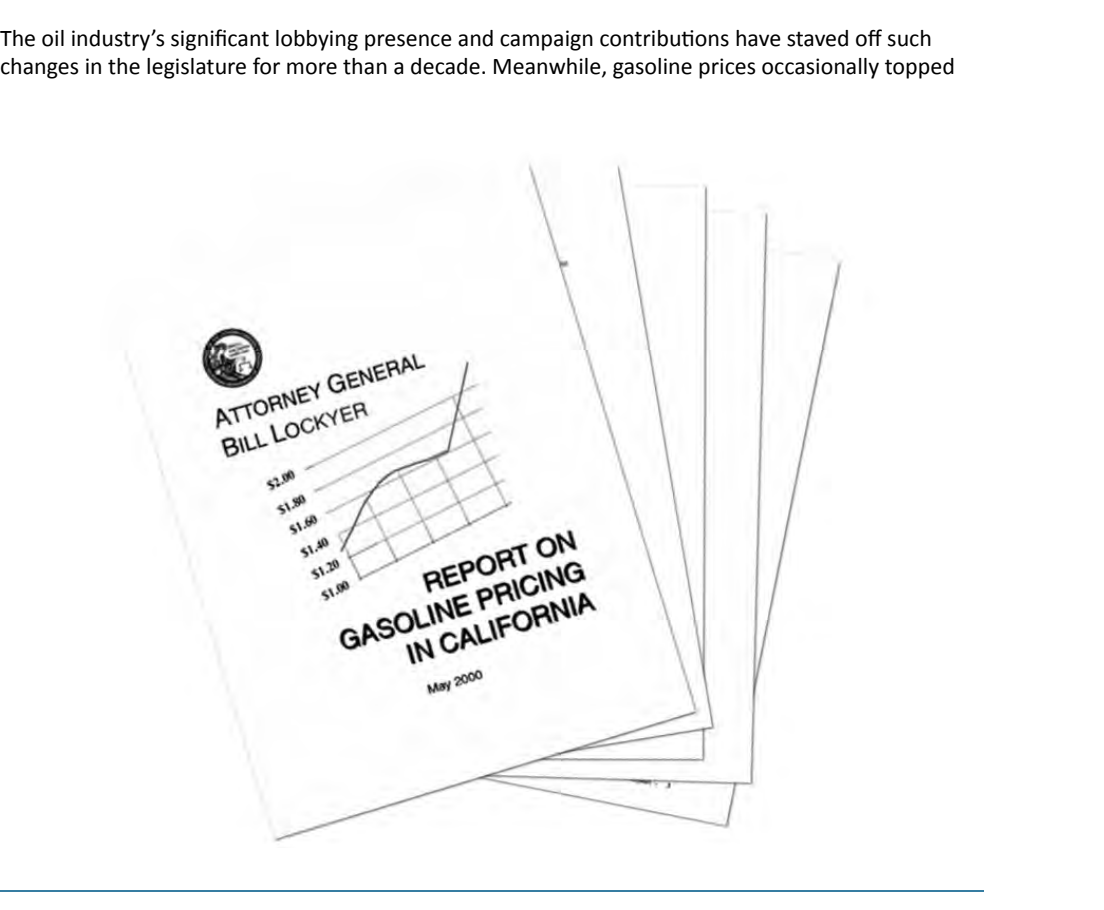
Among the conclusions of the California AGorney General’s Taskforce in 2000: “Supply disruptions that contributed to major price spikes of 1999 are likely to continue … because (1) California refiners have little spare capacity to cover outages; (2) California refiners maintain relatively low inventory levels.” The report noted: “Refiners have significant market control.” The task force recommended a series of measures, including building a strategic gasoline reserve that could flood the market when supply is most scarce.
The oil industry’s significant lobbying presence and campaign contributions have staved off such changes in the legislature for more than a decade. Meanwhile, gasoline prices occasionally topped o”‘ -~ “‘-~~0¢
~i~~~r,..
~s(j,.'”‘~ ,~ c~.-l”” out around $5 per gallon at 8mes of refinery failures -‐-‐ driven by the perception of supply shortages in a touchy commodities market and producing extraordinary profits for the companies. Rapid oil company consolidation has also been a driver of high gas prices. Four companies control 70% of the state’s refineries.
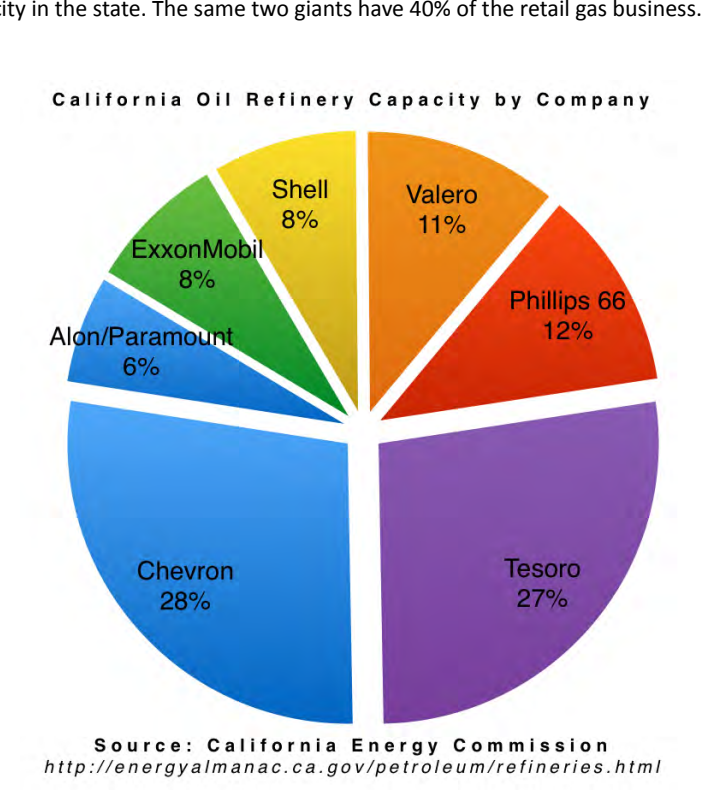
The absurd consequence of such an uncompe88ve, consolidated market was on full display in 2005. Consumer Watchdog worked with Sen. Barbara Boxer (D-‐Calif.) and AGorney General Lockyer and succeeded in geung Shell Oil to reverse its decision to bulldoze its Bakersfield refinery, and to instead sell it. Internal documents showed that the refinery was making among the highest profits of all Shell refineries. Shell’s aGempt to sell an otherwise profitable refinery indicated the company wanted to make supplies even 8ghter, driving prices artificially higher. The industry has significantly consolidated since then. In 2013, Tesoro bought low-‐cost Arco brand and its California assets from BP. Two refiners -‐-‐ Chevron and Tesoro -‐-‐ now control 54% of the refining capacity in the state. The same two giants have 40% of the retail gas business.
Fiieen refineries now power the world’s ninth-‐largest economy. Like the deregulated California electricity market around the turn of this century, oil companies possess the power and the motive, economic and political, to keep their plants running at reduced speed and not produce enough inventory to fuel the state at fair prices.
Consumer Watchdog has recommended a simple policy fix to the gasoline woes in California: supply regulation. If the state doesn’t have the wherewithal to build a strategic gasoline reserve, a simple requirement that refiners keep at least three weeks of inventory on hand could prevent artificial manipulation.
While the oil lobby has staved off such legislative change, the companies are subject to a litany of laws that prevent unfair compe88on and business practices, such as supply manipulation, as well as antitrust laws. AGorney General Lockyer used these laws and his inves8ga8ve power to keep Shell from dismantling its Bakersfield refinery in 2005.
State officials in 2015 need to be prepared for oil company price manipulation aimed at weakening support for climate change laws. The governor, AGorney General, legislators and regulatory agencies need to inform California’s oil companies that all refinery outages and production shutdowns leading to higher gasoline prices will be thoroughly investigated, including the use of subpoena powers. California’s deregulated gasoline market going into 2015 is much like the California electricity market of 2001 – rigged for the profits of the energy companies that control it. History has shown California energy companies will pull the switch for their economic and political interests, as companies like Enron did following electricity deregula8on. State officials today need to learn from the errors of the turn of the century and be prepared to counter any artificial price manipulation by the oil companies with a rapid response.
Manipulating Energy Prices To Influence Elections
Have oil companies used their market power to influence political outcomes before? An analysis of oil company prices and profits in the run-‐up to the 2006 election by Consumer Watchdog found an interesting “October Surprise.”
Na8onally, 80% of all oil company campaign contributions have traditionally gone to Republicans. High gasoline prices can weaken support for GOP candidates by highlighting this connection and aid Democra8c candidates, who are more credible opponents of oil companies. This was particularly true during the presidency of oilman George W. Bush. In the run-‐up to the 2006 mid-‐term election, Consumer Watchdog looked at oil companies’ profit-‐taking to see if the companies pulled back on gasoline prices in order to neutralize gas prices as an issue during elections. Consumer Watchdog found a pattern of refiners reducing their traditional profit-‐taking in order to move or keep the retail price of gasoline lower than usual as elections approached in the autumns of 2006, 2004 and 2002.
Independent oil analyst Tim Hamilton analyzed the gap between pump prices and the spot price of crude oil in election years, compared to the non-‐election previous years. He found that in 2002, 2004 and 2006 there was a moderate to substantial shrinking of that gap, meaning less profit potential for the oil companies, in measurements taken the first week in October. Hamilton found that though gasoline prices did not necessarily fall in election years, the difference between the spot cost of crude oil per gallon and the price of gasoline narrowed. A rise to record high gasoline prices in the Spring of 2006 unleashed a wave of jus8fied criticism at bloated oil company profits. A sharp 70 cents-‐a-‐gallon drop in October 2006 gasoline prices from record highs earlier in the year was steeper than the drop in the price of crude oil. Though gas prices oien drop in Fall, the drop was unusual for its size and due to the fact that the price drop occurred even aier a pipeline accident caused the loss of half of the oil shipped by BP from Alaska and put a dent in steadily rising gasoline production, which exerts downward pressure on retail prices. The situation was the opposite of the Spring and Summer of 2006, when gasoline production and inventory, particularly in the Western states, kept falling from the previous year. Ordinarily an event like the BP shutdown in August would have been an excuse to cut production and raise prices for at least a couple of months.
The companies’ most profitable scenario is to sell less product for steadily higher prices, even though they have tens of billions in spare cash that could be going to development of clean fuels and protecting the planet through compliance with climate change laws. The potential for the oil industry to manipulate gasoline prices to aGain political ends is very real. The election-‐8me price swings between 2002 and 2006 suggest oil companies are likely to engage in such strategies again if they believe they are not going to be accountable for them. Sources A0orney General’s Report on Gasoline Pricing In California. Rep. Office of the AGorney General, 8 May 2000. Web. h0p://oag.ca.gov/an>trust/publica>ons/gasstudy (opens in new tab) “CalAccess -‐ Lobbying and Campaign Contribu8ons.” California Secretary of State -‐ CalAccess. California Secretary of State, n.d. Web. h0p://cal-‐access.ss.ca.gov/ “Data.” Follow the Money. The Na8onal Ins8tute on Money in State Poli8cs, n.d. Web. 2014. h0p:// www.followthemoney.org Dugan, Judy, and Doug Heller. Valero Energy and Its California Profit Pipeline. Rep. Consumer Watchdog, 12 Oct. 2010. Web. h0p://bit.ly/valeroprofits Dugan, Judy, and Tim Hamilton. The Causes and Effects of the Record Breaking Price of Diesel. Rep. Consumer Watchdog, 1 July 2008. Web. h0p://www.oilwatchdog.org/wp-‐content/uploads/2010/09/ Diesel0608pricereport.pdf Dugan, Judy, and Tim Hamilton. Keystone XL: Oil Industry Cash Machine. Rep. Consumer Watchdog, 16 July 2013. Web. h0p://www.consumerwatchdog.org/sites/default/files/resources/ keystonexl_cwd.pdf Dugan, Judy. The Road to Cleaner & Cheaper. Rep. Consumer Watchdog, 19 May 2009. Web. h0p:// www.oilwatchdog.org/wp-‐content/uploads/2010/09/CleanerCheaper.pdf Hamilton, Tim. The Changing Rela>onship Between the Price of Crude Oil and the Price At the Pump. Rep. Consumer Watchdog, 3 May 2007. Web. h0p://www.oilwatchdog.org/wp-‐content/uploads/ 2010/09/CrudevPumpPrices.pdf Hamilton, Tim. The “Katrina Syndrome” Rep. Consumer Watchdog, 23 July 2007. Web. h0p:// www.oilwatchdog.org/wp-‐content/uploads/2010/09/KatrinaLessons2007.pdf Hamilton, Tim. October Surprise. Rep. Consumer Watchdog, 31 Oct. 2006. Web. h0p:// www.oilwatchdog.org/2006/10/big-‐oils-‐october-‐surprises/ Hamilton, Tim. The Causes and Effects of the Price Spike in the Midwest during 2000. Rep. Consumer Watchdog, 17 Sept. 2000. Web. h0p://www.consumerwatchdog.org/feature/causes-‐and-‐effects-‐ price-‐spike-‐midwest-‐during-‐2000 Hamilton, Tim. 2002 FTCR Gas Pricing Study. Rep. Consumer Watchdog, 26 Aug. 2002. Web. h0p:// www.consumerwatchdog.org/feature/2002-‐^cr-‐gas-‐pricing-‐study Hamilton, Tim. Data Showing How CA Oil Companies’ Profits Rise With Price At Pump. Rep. Consumer Watchdog, 26 Apr. 2004. Web. h0p://www.consumerwatchdog.org/feature/data-‐showing-‐how-‐ca-‐ oil-‐companies-‐profits-‐rise-‐price-‐pump Hamilton, Tim. Graph -‐ Increase in Pump Price 2002 to 2003. Rep. Consumer Watchdog, 26 Apr. 2004. Web. h0p://www.consumerwatchdog.org/feature/graph-‐increase-‐pump-‐price-‐2002-‐2003 Hamilton, Tim. Difference in Post-‐Katrina Gas Price Drop vs. Pre-‐Elec>on Gas Price Drop. Rep. Consumer Watchdog, 18 Oct. 2006. Web. h0p://www.consumerwatchdog.org/feature/difference-‐ post-‐katrina-‐gas-‐price-‐drop-‐vs-‐pre-‐elec>on-‐gas-‐price-‐drop OIL INDUSTRY LOBBYING IN CALIFORNIA. Rep. American Lung Association, 4 Nov. 2014. Web. www.lung.org/associations/states/california/advocacy/climate-‐change/oil-‐industy-‐lobbying-‐ report.pdf “PROPOSITION 87 -‐ FollowTheMoney.org.” Follow the Money. The Na8onal Ins8tute on Money in State Poli8cs, n.d. Web. h0p://www.followthemoney.org/en>ty-‐details?eid=10246182 Wieners, Brad. “Leaked: The Oil Lobby’s Conspiracy to Kill Off California’s Climate Law.” Bloomberg Business Week. Bloomberg, 25 Nov. 2014. Web. h0p://www.businessweek.com/ar>cles/2014-‐11-‐25/ revealed-‐the-‐oil-‐lobbys-‐playbook-‐against-‐californias-‐climate-‐law http:// WSPA Priority Issues. Rep. Western States Petroleum Associa8on, 11 Nov. 2014. Web. www.businessweek.com/pdfs/western-‐states-‐petroleum-‐association-‐powerpoint.pdf (opens in new tab) Internal oil company memos released by Senator Ron Wyden in June 2001 -‐ Chevron Document: h0p://cbsnews.com/htdocs/pdf/chevron.pdf -‐ Texaco Memo: h0p://cbsnews.com/htdocs/pdf/texaco.pdf -‐ Mobil e-‐mail: h0p://cbsnews.com/htdocs/pdf/mobil.pdf About Consumer Watchdog: Consumer Watchdog is a nonprofit, nonpartisan public interest group that has fought corporate and government corruption since 1985. The nationally recognized consumer group is based in Santa Monica and has offices in Washington, DC. Consumer Watchdog’s president Jamie Court sat on AGorney General Lockyer’s Gasoline Pricing Taskforce in 1999 as a representative for the California Assembly. The author of this report, Court has studied California’s gasoline market for the last decade and half, and founded Oilwatchdog.org. He is a frequent national media commentator on gasoline prices and has written about gasoline price manipulation in his last two books; Corporateering: How Corporate Power Steals Your Freedom and What You Can Do About It (Tarcher Putnam, 2003) and The Progressive’s Guide To Raising Hell (Chelsea Green, 2012). Learn more at www.consumerwatchdog.org (opens in new tab)