Executive Summary
California’s investor-owned, for-profit utilities are pursuing one of the largest corporate bailouts in California history — one that would shift billions of dollars in wildfire liability away from themselves for causing catastrophic fires on to wildfire survivors, homeowners, insurance policyholders, taxpayers, and local governments. To make that bailout politically possible, utilities have spent years building an extensive political influence network across Sacramento.
As Governor Gavin Newsom and legislative leaders negotiate an end-of-session utility bailout behind closed doors, the proposals under discussion would further reduce utility accountability, limit wildfire survivors’ legal rights, and transfer even more of the financial burden of catastrophic wildfires to the public.
This report documents the utilities’ political influence network — the disinformation echo chamber built over years through campaign contributions, lobbying, charitable giving, nonprofit funding, and political relationships to manufacture support for that bailout. The campaign has reached unprecedented levels during the current legislative session. California’s three largest investor-owned utilities — Pacific Gas & Electric (PG&E), Southern California Edison (Edison), and Sempra Energy (Sempra) — have spent years and millions of dollars building political influence in Sacramento, and that effort is now peaking. Through the first six reporting quarters of the 2025–2026 session, these utilities reported spending a record $16.7 million lobbying state lawmakers — the highest lobbying total of the Newsom administration and of all time, with PG&E leading the pack with over $10 million spent and two reporting quarters still remaining. PG&E, Edison and Sempra spent more than $127.6 million influencing California government during Governor Newsom’s administration, including $66.8 million in campaign contributions and political committees and $60.8 million lobbying the state government. They directed $238.9 million in charitable donations to non-governmental organizations between 2023-2025, many of which now echo utility talking points while presenting themselves as independent voices.
The public face of that campaign is Wildfire Victims First, a coalition that portrays itself as a grassroots movement for wildfire survivors. Our investigation found the opposite. The coalition is 100% financed by utility-connected organizations and functions as a utility-backed front group spreading disinformation and lobbying for legislation that would bailout utilities when they cause wildfires by reducing utility liability while attacking the legal rights of the very wildfire victims it claims to represent. Sixty-six percent of Wildfire Victims First members receive direct utility funding, while dozens maintain governance ties through utility executives and government affairs officials serving in leadership positions. The coalition’s spokesman and director (opens in new tab) is former Newsom Communications Director Nathan Click, while its television advertising is placed by Polaris Campaign Media, the affiliated media-buying firm of Bearstar Strategies, Governor Newsom’s longtime political consulting firm.
This influence campaign has produced significant policy victories in the 2025-2026 legislative session alone. In 2025, utilities secured SB 254, legislation the Los Angeles Times described as ” effectively a bailout (opens in new tab).” The same year, Newsom-appointed California Public Utilities Commission commissioners approved more than $2 billion in new revenue (opens in new tab) and retroactive cost recovery (opens in new tab) for Southern California Edison. Two months later, Edison increased its shareholder dividend for the twenty-second consecutive year. By year’s end, the company reported $4.5 billion (opens in new tab) in profits — more than triple the previous year’s earnings — while CEO Pedro Pizarro credited California regulatory decisions as a key driver of the company’s financial performance. In 2026, legislation sponsored by Consumer Watchdog and the Every Fire Survivors Network requiring independent audits of utility wildfire mitigation spending (AB 1774) failed to advance despite a previous audit finding utilities could not account for $2.5 billion of $6 billion (opens in new tab) collected from ratepayers for wildfire mitigation.
The current bailout proposal also rests heavily on the SB 254 Study, commissioned by the California Earthquake Authority to guide the next generation of wildfire policy. The Authority selected RAND and Aon to prepare the study even though both firms had performed work (opens in new tab) for Edison arising from the Eaton Fire, calculating how much victims should receive in compensation, raising concerns about the independence of recommendations now being used to justify further limits on utility liability. This utility disinformation echo-chamber operates as California’s investor-owned utilities report huge profits, pay billions of dollars in shareholder dividends, and award executives compensation packages worth tens of millions of dollars — proving the utilities don’t need a bailout. Meanwhile, homeowners face soaring insurance premiums, repeated utility rate hikes, and the devastating consequences of utility-caused wildfires. The current legislative proposal did not emerge organically. It is the culmination of years of coordinated political spending, lobbying, charitable giving, nonprofit funding, and relationship-building designed to create the appearance of broad public support for policies that primarily protect utility shareholders from the financial consequences of the disasters their companies cause.
Before California asks the public to finance another multibillion-dollar utility bailout disguised as wildfire liability reform, Californians deserve to know who built this political machine, how it operates, and who stands to benefit if it succeeds.
Key Findings
Since Governor Gavin Newsom took office in 2019: Political Influence
- California’s three largest for-profit utilities spent more than $127.6 million influencing California government during Governor Gavin Newsom’s administration, including $66.8 million in campaign contributions and political committees and $60.8 million lobbying the Legislature, Governor’s Office, California Public Utilities Commission (CPUC), and other state agencies. ○Lobbying spending totals by PG&E, Edison and Sempra already broke all-time records in the latest 2025-2026 session at $16.7 million with two reporting quarters remaining.
○PG&E leads in lobbying spending across both timeframes: 2019-2026 with over $27.7 million and 2025-2026 with over $10 million.
- Utility contributions are strategically concentrated among California’s legislative leadership and lawmakers shaping utility and wildfire insurance policy, either through direct campaign contributions ($1,764,861) or contributions through candidate-controlled ballot committees ($224,650). ○Assembly Speaker Robert Rivas received $148,700 in combined utility contributions through his campaign and lawmaker-controlled ballot committee — more than three times the $48,200 received by Senate President Pro Tempore Monique Limón.
○Assembly Utilities & Energy Committee Chair Cottie Petrie-Norris ($145,400), Assembly Insurance Committee Chair Lisa Calderon ($97,000), Senator Josh Becker ($66,750), Senator Henry Stern ($24,500) and other legislative leaders central to the current bailout negotiations.
- Top Recipients of Combined Utility Contributions (Campaign + Ballot Measure Committees) ○Heath Flora (Assembly Republican Leader): $191,500 ○Robert Rivas (Assembly Speaker): $148,700 ○Cottie Petrie-Norris (Chair, Assembly Utilities & Energy Committee): $145,400 ○Brian Jones (Senate Minority Leader): $100,800 ○Lisa Calderon (Chair, Assembly Insurance): $97,000 ○Blanca Pacheco (Chair, Assembly Rules Committee): $94,600
- Utilities invested more than $5 million in legislative leadership committees and PACs ($3.6 million) and caucus foundations ($1.4 million), strengthening the political infrastructure surrounding California’s legislative leadership rather than focusing solely on individual election campaigns.
Governor Newsom
- Governor Gavin Newsom has been at the center of California’s wildfire and insurance policy reforms since taking office in 2019 — and a central recipient of utility political support. Since taking office, utilities contributed $962,500 to his political campaigns and causes.
- Utilities contributed approximately $162,000 to his campaign committees, $22,500 to committees opposing the 2021 recall election, and $455,000 in support of Proposition 1, his signature 2024 statewide ballot initiative.
- Between 2023 and 2025, PG&E, Edison, and SoCalGas, a Sempra subsidiary utility, contributed a combined $293,000 to the Governor’s Cup Foundation, which hosts the Governor’s annual policy and fundraising event.
- Governor Newsom also requested utility-funded behested payments totaling $30,000, including a $5,000 contribution from PG&E and a $25,000 contribution from SoCalGas.
- While this review found no utility behested payments directed to The Representation Project, investigative reporting documented approximately $290,000 in PG&E contributions to First Partner Jennifer Siebel Newsom’s nonprofit between 2016 and 2018, along with additional institutional ties between the utility and the organization.
Wildfire Victims First
- The Wildfire Victims First coalition — the primary face for California’s latest wildfire utility bailout — is a 100% utility-financed front group. The coalition’s own website identifies Southern California Edison initiatives, PG&E-

After utilities were found responsible for the Eaton Fire, this mailer from the utilities-funded Wildfire Victims First blames attorneys for the problems of wildfire survivors.
funded political organizations, the California Electric Utility Industry Labor- Management Cooperation Committee, and utility shareholders as financing the campaign.
- The coalition itself was built from organizations with longstanding relationships with the utilities seeking a bailout. Of the coalition’s 254 members, 214 were non-governmental organizations (excluding 40 local elected officials). Among those organizations, 142 (66%) received a combined $7.3 million in direct financial support from one or more California investor-owned utilities between 2023 and 2025.
- Beyond financial support, the report also documents 88 coalition organizations with 155 governance, institutional, and financial relationships involving utility executives, government affairs officials, board members, corporate partnerships, and longstanding organizational affiliations.
Building Third-Party Influence
- PG&E, Southern California Edison, SDG&E, and SoCalGas are required to file annual 77-M reports disclosing their charitable contributions. A review of those filings found that the four utilities reported $238.9 million in charitable donations between 2023 and 2025, including $119.3 million from Southern California Edison, $93.1 million from PG&E, $14.7 million from SoCalGas, and $11.9 million from SDG&E.
Building Political Influence Through Campaign Contributions
Since Governor Gavin Newsom took office in 2019, California has undergone the most significant transformation of wildfire, utility, and homeowner insurance policy in state history. During Newsom’s tenure, lawmakers created the $21 billion Wildfire Fund through Assembly Bill 1054, repeatedly restructured the FAIR Plan and insurance market, approved billions of dollars in wildfire mitigation spending and utility cost recovery, and are now considering another sweeping overhaul of California’s wildfire insurance system. Throughout that period, Pacific Gas & Electric (PG&E), Southern California Edison (Edison), and Sempra Energy (Sempra) have directed tens of millions of dollars into California’s political system through candidate committees, political parties, ballot measure committees, legislative leadership organizations, and other political committees. Together, these contributions reveal a long-term strategy of maintaining relationships with the policymakers responsible for regulating the utilities and determining how billions of dollars in wildfire costs and liabilities are allocated.
Political Spending Since Governor Newsom Took Office
Between 2019 and 2026, California’s three for-profit utilities reported contributing $66.8 million to California political committees. While each category of political spending serves a different purpose, the combined totals illustrate the extraordinary scale of utility investment during one of the most consequential periods of utility policymaking in California history.
Ballot Other Political Total Political UtilityCandidatesMeasure CommitteesContributions Committees PG&E$1,323,375.00$1,611,500.00$29,346,243.78$32,281,118.78 Southern California $2,667,712.07$2,244,375.00$15,314,592.75$20,226,679.82 Edison Sempra $2,820,348.69$250,000.00$11,248,255.30$14,318,603.99 Energy Total$6,811,435.76$4,105,875.00$55,909,091.83$66,826,402.59
| Utility | Candidates | Ballot Measure Committees | Other Political Committees | Total Political Contributions |
|---|---|---|---|---|
| PG&E | $1,323,375.00 | $1,611,500.00 | $29,346,243.78 | $32,281,118.78 |
| Southern California Edison | $2,667,712.07 | $2,244,375.00 | $15,314,592.75 | $20,226,679.82 |
| Sempra Energy | $2,820,348.69 | $250,000.00 | $11,248,255.30 | $14,318,603.99 |
| Total | $6,811,435.76 | $4,105,875.00 | $55,909,091.83 | $66,826,402.59 |
While campaign contributions to individual candidates often receive the greatest public attention, they account for only a small share of utility political spending. Almost $56 million — or almost 84 percent of all reported political contributions since 2019 — flowed to political parties, legislative leadership committees, caucus organizations, ballot measure committees, and other political committees. Those entities play an outsized role in shaping California’s political infrastructure by supporting legislative leaders, financing ballot campaigns, strengthening party operations, and influencing the policy agenda extending well beyond any single election cycle.
Utility Lobbying Since Governor Newsom Took Office
Governor Newsom’s administration has overseen nearly every major wildfire, utility, and insurance policy debate in California since 2019. Those decisions have involved not only the Legislature, but also the Governor’s Office, the California Public Utilities Commission (CPUC), the Department of Insurance, and numerous other state agencies responsible for regulating California’s for-profit utilities. As a result, utilities have maintained one of the largest and most sustained lobbying operations in California government.
Lobbying expenditures reported under California law provide another measure of the resources utilities devote to influencing public policy. Unlike campaign contributions, which help build long-term political relationships, lobbying expenditures fund the day-today work of professional advocates who monitor legislation, meet with policymakers, negotiate bill language, and participate in regulatory proceedings. They create the echo chamber in which decisions are made based on information and disinformation. Between Governor Newsom’s inauguration in 2019 and the sixth quarter of the 2025–2026 legislative session, PG&E, Southern California Edison, and Sempra reported spending more than $60.8 million lobbying California government. Utilities spent almost as much on lobbying ($60.8M) as they did on political contributions ($66.8M). Together, utilities spent more than $127.6 million on campaign contributions and lobbying during Governor Newsom’s tenure, illustrating the scale of resources devoted to influencing the political and regulatory institutions shaping California’s wildfire and utility policies.
Lobbying Expenditures by Utility (2019–2026)
UtilityGeneral LobbyingCPUC LobbyingTotal Lobbying PG&E$24,383,139.06$3,372,182.13$27,755,321.19 Southern California Edison$17,810,878.63$946,120.63$18,756,999.26 Sempra$13,953,336.64$389,922.04$14,343,258.68 Total$56,147,354.33$4,708,224.80$60,855,579.13 PG&E reported the largest lobbying operation during the period examined, accounting for nearly $27.8 million in lobbying expenditures. Edison reported more than $18.7 million, while Sempra reported nearly $14.3 million.
Although most reported spending involved lobbying the Legislature and executive agencies, utilities also devoted more than $4.7 million specifically to lobbying proceedings before the California Public Utilities Commission, the agency responsible for regulating for-profit utilities.
Total Lobbying Expenditures by Legislative Session (General + CPUC Lobbying)
SessionPG&EEdisonSempraCombined Total 2019–2020$4,838,924.75$5,095,737.17$3,025,581.20$12,960,243.12 2021–2022$6,110,117.31$4,157,411.24$4,755,266.19$15,022,794.74 2023–2024$6,740,407.95$6,179,722.79$3,214,900.15$16,135,030.89 2025–2026*$10,065,871.18$3,324,128.06$3,347,511.14$16,737,510.38
| Utility | General Lobbying | CPUC Lobbying | Total Lobbying |
|---|---|---|---|
| PG&E | $24,383,139.06 | $3,372,182.13 | $27,755,321.19 |
| Southern California Edison | $17,810,878.63 | $946,120.63 | $18,756,999.26 |
| Sempra | $13,953,336.64 | $389,922.04 | $14,343,258.68 |
| Total | $56,147,354.33 | $4,708,224.80 | $60,855,579.13 |
| Session | PG&E | Edison | Sempra | Combined Total |
|---|---|---|---|---|
| 2019–2020 | $4,838,924.75 | $5,095,737.17 | $3,025,581.20 | $12,960,243.12 |
| 2021–2022 | $6,110,117.31 | $4,157,411.24 | $4,755,266.19 | $15,022,794.74 |
| 2023–2024 | $6,740,407.95 | $6,179,722.79 | $3,214,900.15 | $16,135,030.89 |
| 2025–2026* | $10,065,871.18 | $3,324,128.06 | $3,347,511.14 | $16,737,510.38 |
Lobbying expenditures remained consistently high throughout Governor Newsom’s administration, increasing during legislative sessions involving major utility, wildfire, and insurance legislation. Even though the 2025–2026 session includes only six reporting quarters, utilities had already reported more than $16.7 million in lobbying, surpassing the previous record in utility lobbying expenditures, while negotiations continued over California’s next major wildfire insurance proposal.
CPUC Lobbying by Utility 2019-2026
UtilityCPUC LobbyingPercent of Total Lobbying PG&E$3,372,182.1312.1% Southern California Edison$946,120.635.0% Sempra$389,922.042.7% Total$4,708,224.80 The California Public Utilities Commission occupies a unique position in California government because it regulates utility rates, approves wildfire mitigation plans, oversees utility safety, and authorizes billions of dollars in utility cost recovery. While CPUC lobbying represents a smaller share of overall lobbying expenditures, it reflects sustained engagement with one of the most influential regulatory agencies affecting for-profit utilities.
Building Relationships Across Both Political Parties
Utilities have historically supported both Democratic and Republican political organizations, reflecting a strategy of maintaining relationships regardless of which party controls the Legislature or Governor’s Office.
Although the California Democratic Party adopted (opens in new tab) a 2022 policy prohibiting donations from utilities that provide natural gas service, Edison has continued to be a major donor while PG&E and Sempra ended their contributions after 2018 and 2020, respectively. At the same time, all three companies have continued contributing to the California Republican Party.
| Utility | CPUC Lobbying | Percent of Total Lobbying |
|---|---|---|
| PG&E | $3,372,182.13 | 12.1% |
| Southern California Edison | $946,120.63 | 5.0% |
| Sempra | $389,922.04 | 2.7% |
| Total | $4,708,224.80 |
California State Party Contributions Since 2019
California California Utility Total Democratic PartyRepublican Party PG&E*$0$725,000$725,000 Southern California $1,780,000$1,090,000 $2,870,000 Edison Sempra Energy**$490,000$1,204,500$1,694,500 These contributions demonstrate that utilities do not exclusively invest in one political

party. Instead, they seek to maintain working relationships with lawmakers across the political spectrum, ensuring continued access regardless of electoral outcomes.
Investing in Legislative Leadership
Beyond political parties, utilities devote significant resources to leadership committees and caucus-affiliated political action committees. These organizations are often controlled by legislative leaders or affiliated with influential caucuses and provide an important mechanism for supporting legislative priorities, helping fellow candidates, and strengthening political influence throughout the Capitol. From 2019-2026, “Utilities do not exclusively invest in one PG&E, Edison and Sempra contributed political party.”
over $3.5 million to Leadership PACs.
| Utility | California Democratic Party | California Republican Party | Total |
|---|---|---|---|
| PG&E | *$0 | $725,000 | $725,000 |
| Southern California Edison | $1,780,000 | $1,090,000 | $2,870,000 |
| Sempra Energy | **$490,000 | $1,204,500 | $1,694,500 |
Contributions to Selected Legislative Leadership and Caucus Committees (2019–2026)
CommitteePG&EEdisonSempraTotals Legislative Action PAC, sponsored $0$300,000$300,000$600,000 by Legislative Action California LGBT Caucus Leadership Fund$132,504$260,000$140,000$532,504 Asian Pacific Islander Leadership $322,500$125,000$30,000$477,500 PAC Golden State Leadership Fund $435,000$15,000$0$450,000 PAC LCCC PAC, A Bi-Partisan Coalition of Municipal, County, $3,000$0$433,887$436,887 Latino Appointed and Elected Leaders PAC California African American PAC$152,500$110,000$110,000$372,500 California Latino PAC$187,500$100,000$47,000$334,500 Bay Area Legislative Leaders PAC$266,527$0$0$266,527 North Bay Leadership Council $37,500$0$0$37,500 PAC California Women’s Leadership $0$25,000$0$25,000 Association PAC California Jewish PAC$0$25,000$0$25,000 Total$3,557,918 These committees occupy an important place in Sacramento’s political ecosystem. Unlike candidate committees, leadership PACs help legislative leaders support colleagues, strengthen caucus operations, and build influence across the Capitol. Contributions to these organizations therefore expand a company’s political relationships beyond individual lawmakers and into the broader leadership structure that shapes legislative priorities.
Campaign contributions alone cannot establish that any elected official acted because of a donation. Influence is rarely that direct. Rather, these contributions represent long-term investments in relationships, access, credibility, and participation in California’s political process. As the following sections demonstrate, campaign contributions are
| Committee | PG&E | Edison | Sempra | Totals |
|---|---|---|---|---|
| Legislative Action PAC, sponsored by Legislative Action California | $0 | $300,000 | $300,000 | $600,000 |
| LGBT Caucus Leadership Fund | $132,504 | $260,000 | $140,000 | $532,504 |
| Asian Pacific Islander Leadership PAC | $322,500 | $125,000 | $30,000 | $477,500 |
| Golden State Leadership Fund PAC | $435,000 | $15,000 | $0 | $450,000 |
| LCCC PAC, A Bi-Partisan Coalition of Municipal, County, Latino Appointed and Elected Leaders PAC | $3,000 | $0 | $433,887 | $436,887 |
| California African American PAC | $152,500 | $110,000 | $110,000 | $372,500 |
| California Latino PAC | $187,500 | $100,000 | $47,000 | $334,500 |
| Bay Area Legislative Leaders PAC | $266,527 | $0 | $0 | $266,527 |
| North Bay Leadership Council PAC | $37,500 | $0 | $0 | $37,500 |
| California Women’s Leadership Association PAC | $0 | $25,000 | $0 | $25,000 |
| California Jewish PAC | $0 | $25,000 | $0 | $25,000 |
| Total | $3,557,918 |
only one component of a much broader influence strategy that also includes legislative leadership committees, behested payments, nonprofit partnerships, and extensive charitable giving.
Utility Campaign Contributions to Executive, Legislative Leadership and Key Committee Chairs
While the Democratic Party has stopped taking direct contributions from PG&E and Sempra, campaign finance data shows that these utilities are still giving in large quantities to Democratic leaders to maintain influence. The contribution data shows that PG&E, Edison, and Sempra consistently direct campaign contributions to lawmakers who hold the greatest institutional power in the Legislature. Utilities heavily fund legislative leaders, budget writers, rules committee members, appropriations chairs, and lawmakers responsible for overseeing energy and utility policy.
Legislative leaders determine committee assignments, control the flow of legislation, influence negotiations, and help shape the state’s policy agenda. Committee chairs — particularly those overseeing Utilities & Energy, Budget, Rules, and Appropriations — have significant authority over whether utility-related legislation advances, is amended, or stalls.
One notable feature of the data is the frequent use of candidate-controlled ballot measure committees alongside traditional campaign committees. Unlike candidate committees, these committees can often accept much larger contributions, making them attractive vehicles for corporate donors seeking to support influential lawmakers. California has tightened rules governing how these funds may ultimately be spent, but campaign finance experts and journalists have repeatedly described these committees as providing lawmakers with substantially greater fundraising flexibility and opportunities to cultivate relationships with major donors. Recent reporting by The Sacramento Bee (opens in new tab) found that some candidate-controlled ballot measure committees have raised large sums from special interests while spending little on actual ballot measures, instead functioning primarily as fundraising vehicles.
Key findings:
- Utilities strategically concentrated campaign contributions among the legislative leaders and lawmakers shaping California’s utility, wildfire and insurance policy, either through direct campaign contributions ($1,764,861) or contributions through candidate-controlled ballot committees ($224,650).
○Assembly Speaker Robert Rivas received $148,700 in combined utility contributions through his campaign and lawmaker-controlled ballot committee — more than three times the $48,200 received by Senate President Pro Tempore Monique Limón.
○Assembly Utilities & Energy Committee Chair Cottie Petrie-Norris ($145,400), Assembly Insurance Committee Chair Lisa Calderon ($97,000), Senator Josh Becker ($66,750), Senator Henry Stern ($24,500) and other legislative leaders central to the current bailout negotiations.
- Committee leadership is heavily funded regardless of party. Utilities contributed to Democratic and Republican leaders alike, including majority and minority leaders, committee vice chairs, and budget committee leadership. This bipartisan giving strategy helps utilities maintain relationships with lawmakers regardless of which party controls the Legislature.
- Utilities frequently contribute the maximum allowable amount to candidate committees while also making larger contributions to ballot measure committees where available.
- PG&E appears particularly willing to use candidate-controlled ballot measure committees, making large contributions to committees controlled by Robert Rivas, Heath Flora, Blanca Pacheco, and especially Cottie Petrie-Norris.
- Edison was the most consistent donor across nearly every leadership office, while Sempra frequently matched or exceeded Edison for committee chairs and Republican lawmakers.
California Senate Leadership (Career Contributions)
LawmakerPositionPG&EEdisonSempraTotal President pro Tempore; Monique Limón$10,700$29,900$7,600$48,200 Chair, Rules Committee Angelique Majority Floor Leader$10,500$11,000$10,400$31,900 Ashby Brian W. JonesMinority Leader$8,500$30,700$39,100$78,300 John S. LairdChair, Budget Committee$2,511$11,000$19,500$33,011 Chair, Insurance Steve Padilla$6,500$14,300$15,900$36,700 Committee Vice Chair, Budget Roger NielloCommittee; Vice Chair, $39,300$17,300$23,200$79,800 Insurance Committee Sabrina Chair, Appropriations $20,400$28,000$15,400$63,800 CervantesCommittee Vice Chair, Kelly SeyartoAppropriations $14,800$18,000$22,500$55,300 Committee Shannon Vice Chair, Rules $13,200$20,500$31,200$64,900 GroveCommittee Chair, Energy, Utilities & Benjamin AllenCommunications $5,000$14,800$2,550$22,350 Committee Vice Chair, Energy, Rosilicie Utilities & $4,000$22,400$19,900$46,300 Ochoa BoghCommunications Committee Member of Wildfire Josh Becker Working Group$0 $15,200$8,500$23,700 Member of Wildfire Henry Stern$3,000$20,000$1,500$24,500 Working Group
| Lawmaker | Position | PG&E | Edison | Sempra | Total |
|---|---|---|---|---|---|
| Monique Limón | President pro Tempore; Chair, Rules Committee | $10,700 | $29,900 | $7,600 | $48,200 |
| Angelique Ashby | Majority Floor Leader | $10,500 | $11,000 | $10,400 | $31,900 |
| Brian W. Jones | Minority Leader | $8,500 | $30,700 | $39,100 | $78,300 |
| John S. Laird | Chair, Budget Committee | $2,511 | $11,000 | $19,500 | $33,011 |
| Steve Padilla | Chair, Insurance Committee | $6,500 | $14,300 | $15,900 | $36,700 |
| Roger Niello | Vice Chair, Budget Committee; Vice Chair, Insurance Committee | $39,300 | $17,300 | $23,200 | $79,800 |
| Sabrina Cervantes | Chair, Appropriations Committee | $20,400 | $28,000 | $15,400 | $63,800 |
| Kelly Seyarto | Vice Chair, Appropriations Committee | $14,800 | $18,000 | $22,500 | $55,300 |
| Shannon Grove | Vice Chair, Rules Committee | $13,200 | $20,500 | $31,200 | $64,900 |
| Benjamin Allen | Chair, Energy, Utilities & Communications Committee | $5,000 | $14,800 | $2,550 | $22,350 |
| Rosilicie Ochoa Bogh | Vice Chair, Energy, Utilities & Communications Committee | $4,000 | $22,400 | $19,900 | $46,300 |
| Josh Becker | Member of Wildfire Working Group | $0 | $15,200 | $8,500 | $23,700 |
| Henry Stern | Member of Wildfire Working Group | $3,000 | $20,000 | $1,500 | $24,500 |
California Assembly Leadership (Career Contributions)
LawmakerPositionPG&EEdisonSempraTotal Robert RivasSpeaker$32,600$40,500$35,600$108,700 Josh LowenthalSpeaker pro Tempore$8,400$26,700$13,800$48,900 Cecilia Aguiar- Majority Leader$16,200$39,600$44,800$100,600 Curry Mark GonzálezMajority Whip$5,000$13,900$13,400$32,300 Rick Chavez Democratic Caucus $18,300$26,700$32,600$77,600 ZburChair Heath FloraRepublican Leader$48,300$44,900$50,800$144,000 Cottie Petrie-Chair, Utilities & Energy $28,800$36,100$31,000$95,900 NorrisCommittee Vice Chair, Utilities & Joe Patterson$20,400$21,800$21,300$63,500 Energy Committee Chair, Budget Jesse Gabriel$6,400$30,100$0$36,500 Committee Vice Chair, Budget David Tangipa$2,000$13,900$18,000$33,900 Committee Blanca PachecoChair, Rules Committee$21,800$26,700$32,600$81,100 Vice Chair, Rules Tom Lackey$32,500$37,800$39,000$109,300 Committee Vice Chair, Josh HooverAppropriations $11,000$18,900$24,800$54,700 Committee Chair, Appropriations Buffy Wicks$0$13,400$11,400$24,800 Committee Chair, Insurance Lisa Calderon$26,700$42,000$29,200$97,900 Committee Vice Chair, Insurance Greg Wallis$22,800$22,800$25,300$70,900 Committee
| Lawmaker | Position | PG&E | Edison | Sempra | Total |
|---|---|---|---|---|---|
| Robert Rivas | Speaker | $32,600 | $40,500 | $35,600 | $108,700 |
| Josh Lowenthal | Speaker pro Tempore | $8,400 | $26,700 | $13,800 | $48,900 |
| Cecilia Aguiar- Curry | Majority Leader | $16,200 | $39,600 | $44,800 | $100,600 |
| Mark González | Majority Whip | $5,000 | $13,900 | $13,400 | $32,300 |
| Rick Chavez Zbur | Democratic Caucus Chair | $18,300 | $26,700 | $32,600 | $77,600 |
| Heath Flora | Republican Leader | $48,300 | $44,900 | $50,800 | $144,000 |
| Cottie Petrie- Norris | Chair, Utilities & Energy Committee | $28,800 | $36,100 | $31,000 | $95,900 |
| Joe Patterson | Vice Chair, Utilities & Energy Committee | $20,400 | $21,800 | $21,300 | $63,500 |
| Jesse Gabriel | Chair, Budget Committee | $6,400 | $30,100 | $0 | $36,500 |
| David Tangipa | Vice Chair, Budget Committee | $2,000 | $13,900 | $18,000 | $33,900 |
| Blanca Pacheco | Chair, Rules Committee | $21,800 | $26,700 | $32,600 | $81,100 |
| Tom Lackey | Vice Chair, Rules Committee | $32,500 | $37,800 | $39,000 | $109,300 |
| Josh Hoover | Vice Chair, Appropriations Committee | $11,000 | $18,900 | $24,800 | $54,700 |
| Buffy Wicks | Chair, Appropriations Committee | $0 | $13,400 | $11,400 | $24,800 |
| Lisa Calderon | Chair, Insurance Committee | $26,700 | $42,000 | $29,200 | $97,900 |
| Greg Wallis | Vice Chair, Insurance Committee | $22,800 | $22,800 | $25,300 | $70,900 |


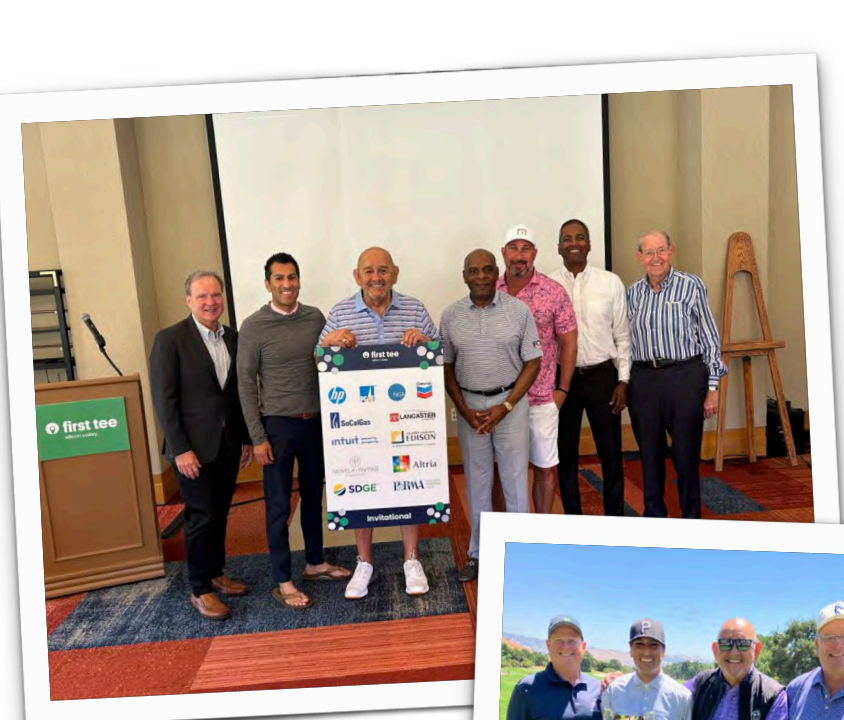
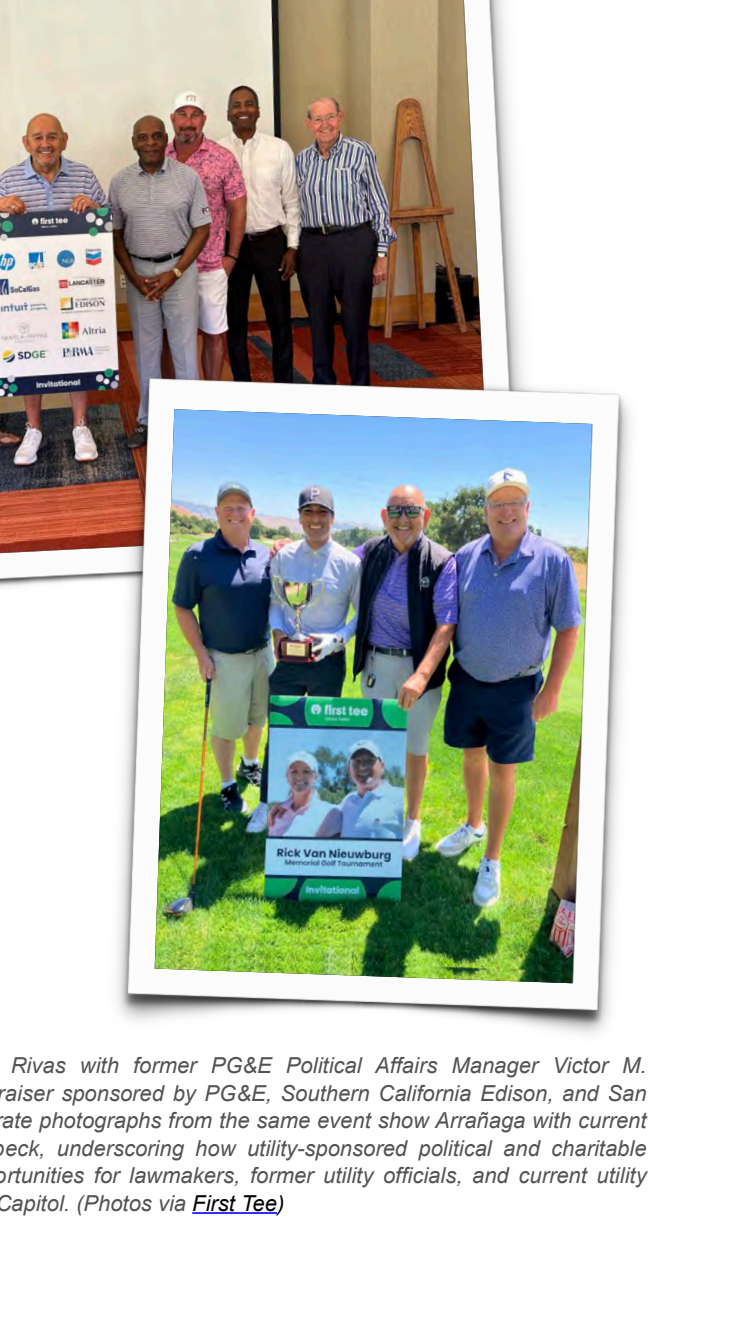


Assembly Speaker Robert Rivas with former PG&E Political Affairs Manager Victor M. Arrañaga, Jr. at a golf fundraiser sponsored by PG&E, Southern California Edison, and San Diego Gas & Electric. Separate photographs from the same event show Arrañaga with current PG&E lobbyist Brandon Ebeck, underscoring how utility-sponsored political and charitable events create informal opportunities for lawmakers, former utility officials, and current utility lobbyists to mix outside the Capitol. (Photos via First Tee (opens in new tab)) Below is a breakdown of utility funding to lawmaker controlled ballot measure committees versus candidate committees where applicable.
California Senate and Assembly Leadership Utility Contributions (Career Totals): Candidate Committees vs. Lawmaker-Controlled Ballot Measure Committees
Lawmaker- Candidate Controlled Ballot LawmakerPositionTotal CommitteesMeasure Committees Republican Heath FloraLeader, $191,500 Assembly Robert Speaker, – PG&E: $32,600 – PG&E: $20,000 $148,700 RivasAssembly Chair, Assembly Cottie Utilities & $145,400 Petrie- Energy Norris- Sempra: $31,000- Sempra: $6,500 Committee Brian Senate Minority $100,800 JonesLeader Chair, Assembly Blanca – PG&E: $21,800 – PG&E: $3,500 Rules $94,600 Pacheco Committee- Sempra: $32,600- Sempra: $10,000
| Lawmaker | Position | Candidate Committees | Lawmaker- Controlled Ballot Measure Committees | Total |
|---|---|---|---|---|
| Heath Flora | Republican Leader, Assembly | $144,000 – PG&E: $48,300 – Edison: $44,900 – Sempra: $50,800 | $47,500 – PG&E: $37,500 – Edison: $0 – Sempra: $10,000 | $191,500 |
| Robert Rivas | Speaker, Assembly | $108,700 – PG&E: $32,600 – Edison: $40,500 – Sempra: $35,600 | $40,000 – PG&E: $20,000 – Edison: $20,000 – Sempra: $0 | $148,700 |
| Cottie Petrie- Norris | Chair, Assembly Utilities & Energy Committee | $95,900 – PG&E: $28,800 – Edison: $36,100 – Sempra: $31,000 | $49,500 – PG&E: $18,500 – Edison: $24,500 – Sempra: $6,500 | $145,400 |
| Brian Jones | Senate Minority Leader | $78,300 – PG&E: $8,500 – Edison: $30,700 – Sempra: $39,100 | $22,500 – PG&E: $7,500 – Edison: $12,000 – Sempra: $3,000 | $100,800 |
| Blanca Pacheco | Chair, Assembly Rules Committee | $81,100 – PG&E: $21,800 – Edison: $26,700 – Sempra: $32,600 | $13,500 – PG&E: $3,500 – Edison: $0 – Sempra: $10,000 | $94,600 |
Vice Chair, Greg Wallis – PG&E: $22,800 – PG&E: $3,600 Insurance $74,500 Committee Member of Josh BeckerWildfire Working $66,750 Group Chair, Assembly Buffy – PG&E: $0 – PG&E: $0 Appropriations $36,800 Wicks Committee- Sempra: $16,400- Sempra: $5,000
Governor Gavin Newsom: At the Center of California’s Wildfire Policy
No elected official has shaped California’s wildfire, utility, and insurance policies more than Governor Gavin Newsom. Since taking office in 2019, Newsom has overseen nearly every major decision affecting California’s investor-owned utilities—from signing legislation that expanded financial protections for utilities, to appointing every member of the California Public Utilities Commission (CPUC), to directing the state’s response to the wildfire insurance crisis.
The Governor’s office has become the center of California’s wildfire policymaking. Under Newsom, major utility legislation has repeatedly been negotiated behind closed doors during the final weeks of the legislative session, limiting public scrutiny before lawmakers are asked to vote on proposals involving billions of dollars and the legal rights of wildfire survivors.
That pattern began with AB 1054 in 2019, which created the $21 billion California Wildfire Fund after PG&E’s bankruptcy and shifted significant wildfire risk away from utility shareholders. It continued with SB 254 in 2025, legislation the Los Angeles Times described as “effectively a bailout,” followed by an Executive Order launching the SB 254 Study that now serves as the foundation for another proposal to further reduce utility liability. As this report was prepared, Governor Newsom was again leading negotiations over another end-of-session wildfire package that could further shift the financial consequences of catastrophic wildfires away from the companies that caused them.
Greg Wallis Vice Chair, Insurance Committee $70,900 – PG&E: $22,800 – Edison: $22,800 – Sempra: $25,300 $3,600 – PG&E: $3,600 – Edison: $0 – Sempra: $0 $74,500 Josh Becker Member of Wildfire Working Group $23,700 – PG&E: $0 – Edison: $15,200 – Sempra: $8,500 $43,050 – PG&E: $43,050 – Edison: $0 – Sempra: $0 $66,750 Buffy Wicks Chair, Assembly Appropriations Committee $31,800 – PG&E: $0 – Edison: $15,400 – Sempra: $16,400 $5,000 – PG&E: $0 – Edison: $0 – Sempra: $5,000 $36,800
Because Governor Newsom sits at the center of these decisions, California’s investor-owned utilities have devoted substantial resources to cultivating relationships with his administration, contributing $962,500 to his political campaigns and causes since running for statewide office. The campaign contributions, recall spending, Proposition 1 support, Governor’s Cup contributions, behested payments, and other financial relationships documented in this section illustrate the many avenues through which utilities have sought to build political influence with the state’s most powerful decision-maker while pursuing policies worth billions of dollars to their industry. Political Contributions Career campaign finance records show that PG&E, Southern California Edison, and Sempra have collectively contributed approximately $162,000 to Governor Newsom’s campaign committees since running for statewide office, both as Lieutenant Governor and Governor. This is more than any other elected official reviewed in this report.
Utility Contributions to Governor Gavin Newsom
RecipientPG&EEdisonSempraTotal Governor Gavin Newsom$58,400$73,400$30,200$162,000 These contributions reflect longstanding political relationships with California’s governor. Like legislative contributions discussed elsewhere in this report, these donations represent one component of a broader strategy of maintaining access and engagement with policymakers responsible for decisions affecting the utility industry. Utility Support During the 2021 Recall Election Utility political spending also extended beyond Governor Newsom’s campaign committees during California’s 2021 gubernatorial recall election. Rather than contributing directly to the governor’s campaign, utilities supported independent committees organized to oppose the recall effort and keep Newsom in office. PG&E contributed $17,500 to Unity PAC, a sponsored committee of the Alameda Labor Council, AFL-CIO, which opposed the gubernatorial recall. Sempra contributed $5,000 to Californians Against Extremism, another committee organized to oppose the recall.
Recipient PG&E Edison Sempra Total Governor Gavin Newsom $58,400 $73,400 $30,200 $162,000
Utility Contributions Opposing the 2021 Recall of Gov. Newsom
UtilityRecipient CommitteeContribution PG&EUnity PAC (Alameda Labor Council, AFL-CIO)$17,500 SempraCalifornians Against Extremism$5,000 Total$22,500 Utility Support for Proposition 1 Utility spending also extended to Proposition 1 (2024), Governor Newsom’s signature ballot initiative and the most significant statewide measure he has personally championed since taking office. Proposition 1 restructured California’s mental health funding system and authorized a $6.4 billion bond to expand behavioral health treatment facilities and housing for people experiencing serious mental illness, substance use disorders, and veterans.
Governor Newsom made Proposition 1 a personal political priority (opens in new tab), placing himself at the center of the campaign. He appeared in television advertisements, headlined campaign events across California, and personally led an aggressive statewide get-out-the-vote effort. Despite beginning with broad public support and facing relatively little organized opposition, Proposition 1 ultimately passed by fewer than 30,000 votes statewide—an unexpectedly narrow margin that political observers widely viewed as one of the biggest political tests of Newsom’s governorship.
While the utility contributions identified in this review were not made directly to Governor Newsom’s own ballot measure committee, they were directed to the Yes on Proposition 1: Expanding Access to Mental Health Services and Veterans’ Care committee, sponsored by the California Medical Association. That committee received contributions from just 22 donors, with California’s three largest for-profit utilities ranking among its largest contributors. PG&E provided $250,000, Sempra contributed $105,000, and Edison gave $100,000, for a combined total of $455,000.
Utility Recipient Committee Contribution PG&E Unity PAC (Alameda Labor Council, AFL-CIO) $17,500 Sempra Californians Against Extremism $5,000 Total $22,500
Contributions by Utilities to Governor Newsom’s Proposition 1 Campaign (2024)
UtilityAmount PG&E$250,000 Sempra$105,000
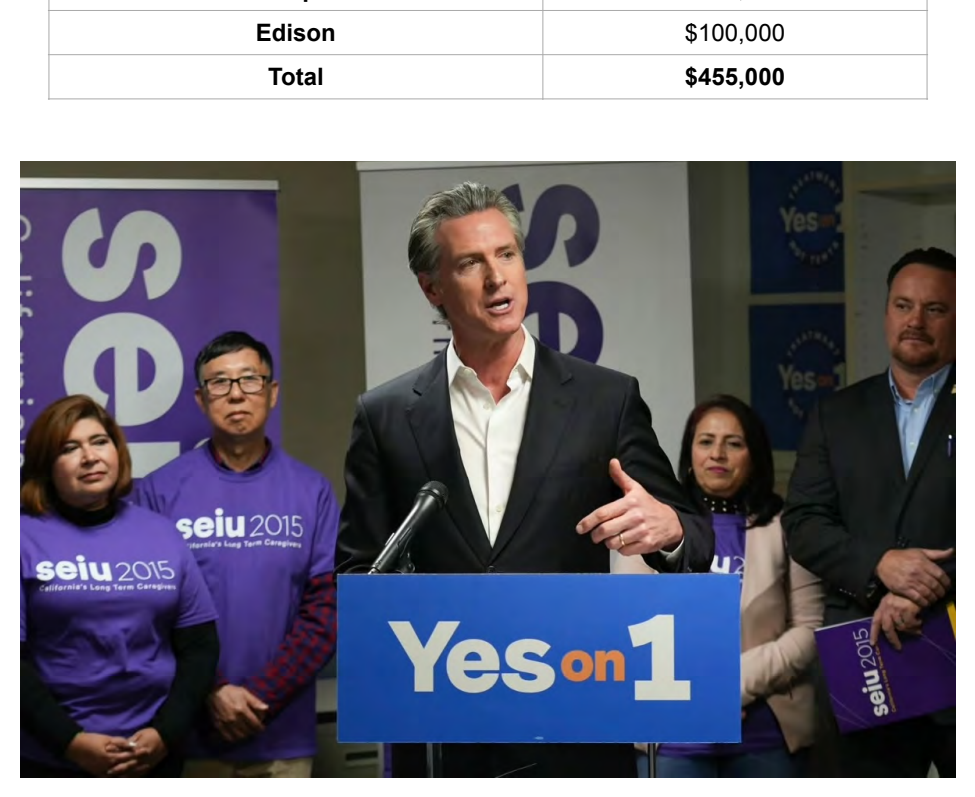
Edison$100,000 Total$455,000 Gov. Gavin Newsom speaks at a Proposition 1 campaign event at the Service Employees International Union office in San Francisco, Monday, March 4, 2024. ( Terry Chea/AP Photo (opens in new tab))
Utility Amount PG&E $250,000 Sempra $105,000 Edison $100,000 Total $455,000
Behested Payments California law requires elected officials to publicly disclose “behested payments”— payments made by a third party at the request, suggestion, or solicitation of a public official to a charitable organization, governmental entity, or other qualifying organization. Although these payments are not campaign contributions and cannot legally be used for an official’s personal benefit, disclosure is required because they can create the appearance of influence by allowing donors to support organizations or causes championed by elected officials.
A review of California behested payment disclosures identified two utility-related payments requested by Governor Newsom totaling $30,000. In 2011, while serving as Lieutenant Governor, Newsom requested a $5,000 contribution from PG&E to the Lieutenant Governor Host Committee, the nonprofit organization that hosted his inaugural events. In 2019, shortly after becoming governor, Newsom requested a $25,000 charitable contribution from Southern California Gas Company to Asian Americans Advancing Justice, a Los Angeles-based civil rights nonprofit.
Utility Behested Payments Requested by Governor Gavin Newsom
Amoun DateUtilityRecipientPurpose t March 15, Lieutenant Governor PG&EGovernmental$5,000 2011Host Committee Southern California Asian Americans July 24, 2019Charitable$25,000 Gas CompanyAdvancing Justice Total$30,000 This review did not identify any utility behested payments directed to The Representation Project, the nonprofit founded by First Partner Jennifer Siebel Newsom. However, investigative reporting has documented broader financial relationships between PG&E and the organization. According to The Sacramento Bee (opens in new tab), PG&E donated approximately $290,000 to The Representation Project between 2016 and 2018. The utility also received producer credits on films produced by the organization, and PG&E’s senior government affairs executive served on its board during that period. Those relationships existed alongside PG&E’s longstanding political support for Governor Newsom before he became governor and illustrate why nonprofit funding and political relationships continue to receive heightened public scrutiny.
Date Utility Recipient Purpose Amoun t March 15, 2011 PG&E Lieutenant Governor Host Committee Governmental $5,000 July 24, 2019 Southern California Gas Company Asian Americans Advancing Justice Charitable $25,000 Total $30,000
Governor Newsom has also faced scrutiny over California’s behested payment disclosure requirements. In June 2026, the California Fair Political Practices Commission fined (opens in new tab) the governor for filing dozens of behested payment reports after the statutory deadline. While the violations involved late disclosure rather than undisclosed payments, the enforcement action reinforced the importance California places on timely transparency so that the public can evaluate financial relationships between elected

officials, donors, and recipient organizations.
Utility Support for the Governor’s Cup Foundation California’s for-profit utilities also regularly support the Governor’s Cup Foundation, the nonprofit that hosts the annual Governor’s Cup Invitational Golf Tournament, which was hosted this year at Pebble Beach. The Foundation describes the event as bringing together government officials, business leaders, and other invited participants to discuss public policy while raising money for charitable causes. Between 2023 and 2025, PG&E, Southern California Edison, and SoCalGas contributed a combined $293,000 to the Foundation, illustrating another avenue through which utilities cultivate relationships with California’s political leadership outside of traditional campaign contributions and lobbying.
UtilityTotal (2023–2025) PG&E$150,000 Southern California Edison$72,000 SoCalGas$71,000 Total$293,000
| Utility | Total (2023–2025) |
|---|---|
| PG&E | $150,000 |
| Southern California Edison | $72,000 |
| SoCalGas | $71,000 |
| Total | $293,000 |
Behested Payments by California’s For-Profit Utilities Requested by California Leadership
Behested payments are contributions made by a third party at the request, suggestion, or solicitation of a public official to a nonprofit, charitable organization, governmental entity, or other organization. Unlike campaign contributions, the money does not go directly to the elected official or their campaign. Instead, the official uses the influence of their office to encourage a donor to support a recipient of the official’s choosing. California law requires public disclosure of behested payments because they present a unique avenue for influence. Although legal, they allow corporations and other interested parties to provide substantial financial support to organizations associated with, supported by, or selected by elected officials outside the campaign finance system. We only examined lawmakers in leadership positions as previously identified — we did not look at total behested payments from utilities.
Key findings
- Utilities made at least 11 disclosed behested payments benefiting organizations selected by legislative leaders.
- PG&E accounted for the largest single behested payment identified, providing $250,000 at the request of Assembly Republican Leader Heath Flora for Legislative Action California.
- Behested payments benefited a wide range of organizations, including charitable nonprofits, leadership organizations, inaugural funds, legislative caucus foundations, and issue advocacy organizations.
- Legislative leaders who also received campaign contributions from utilities — including Robert Rivas, Cecilia Aguiar-Curry, Heath Flora, Blanca Pacheco, Angelique Ashby, Buffy Wicks, and Governor Gavin Newsom — also requested behested payments from those same utilities.
UtilityRecipient OrganizationDateAmount Heath Flora (Assembly Republican Leader – Total: $265,000) SoCalGasCalifornia Problem Solvers Foundation10/21/2025$15,000 PG&ELegislative Action California9/15/2025$250,000 Robert Rivas (Assembly Speaker – Total: $75,000) EdisonSpeaker 2023 Inaugural Fund7/25/2023$25,000 PG&ESpeaker 2023 Inaugural Fund6/27/2023$50,000 Cecilia Aguiar-Curry (Assembly Majority Leader – Total: $35,000) EdisonWomen in California Leadership8/8/2025$35,000 Ben Allen (State Senator – Total: $15,000) California Jewish Legislative Caucus PG&E12/9/2020$5,000 Leadership Foundation California Jewish Legislative Caucus PG&E10/21/2019$5,000 Leadership Foundation California Jewish Legislative Caucus Edison12/19/2019$5,000 Leadership Foundation Angelique Ashby (Senate Majority Floor Leader – Total: $10,000) PG&EEquality California9/19/2024$10,000 Buffy Wicks (Assembly Appropriations Chair – Total: $10,000) Giffords Law Center to Prevent Gun PG&E7/23/2024$10,000 Violence Blanca Pacheco (Assembly Rules Chair – Total: $5,000) SoCalGasRancho Foundation11/20/2025$5,000
| Utility | Recipient Organization | Date | Amount |
|---|---|---|---|
| Heath Flora (Assembly Republican Leader – Total: $265,000) | |||
| SoCalGas | California Problem Solvers Foundation | 10/21/2025 | $15,000 |
| PG&E | Legislative Action California | 9/15/2025 | $250,000 |
| Robert Rivas (Assembly Speaker – Total: $75,000) | |||
| Edison | Speaker 2023 Inaugural Fund | 7/25/2023 | $25,000 |
| PG&E | Speaker 2023 Inaugural Fund | 6/27/2023 | $50,000 |
| Cecilia Aguiar-Curry (Assembly Majority Leader – Total: $35,000) | |||
| Edison | Women in California Leadership | 8/8/2025 | $35,000 |
| Ben Allen (State Senator – Total: $15,000) | |||
| PG&E | California Jewish Legislative Caucus Leadership Foundation | 12/9/2020 | $5,000 |
| PG&E | California Jewish Legislative Caucus Leadership Foundation | 10/21/2019 | $5,000 |
| Edison | California Jewish Legislative Caucus Leadership Foundation | 12/19/2019 | $5,000 |
| Angelique Ashby (Senate Majority Floor Leader – Total: $10,000) | |||
| PG&E | Equality California | 9/19/2024 | $10,000 |
| Buffy Wicks (Assembly Appropriations Chair – Total: $10,000) | |||
| PG&E | Giffords Law Center to Prevent Gun Violence | 7/23/2024 | $10,000 |
| Blanca Pacheco (Assembly Rules Chair – Total: $5,000) | |||
| SoCalGas | Rancho Foundation | 11/20/2025 | $5,000 |
The Wildfire Victims First Coalition: Utility- Funded Front Group
Wildfire Victims First emerged during the 2026 legislative session as the principal public advocate for sweeping changes to California’s wildfire insurance and liability system. The coalition consists of more than 254 organizations (opens in new tab), including nonprofit organizations, chambers of commerce, business associations, labor organizations, local governments, and elected officials.
Rather than advocating directly, California’s investor-owned utilities have increasingly relied on Wildfire Victims First to serve as the public face of their legislative agenda. The coalition has coordinated a statewide communications campaign through its website, policy briefs, coalition letters, television advertising, digital advertising, mail pieces, and grassroots lobbying efforts designed to generate public pressure on lawmakers during closed-door negotiations over the legislation.
The campaign has also become the utilities’ primary public communications vehicle. Utilities have increasingly declined to answer reporters’ questions directly, instead referring media inquiries to Wildfire Victims First. The coalition’s spokesman is Nathan Click, Governor Gavin Newsom’s former communications director and chief spokesman, while its television advertising is placed by Polaris Campaign Media, the affiliated media-buying firm of Bearstar Strategies, Governor Newsom’s longtime political consulting firm.
Despite presenting itself as an independent coalition of wildfire survivors and community organizations, Wildfire Victims First is 100% financed by utility-connected organizations. As the following sections demonstrate, the coalition is built upon an extensive network of organizations receiving utility funding and maintaining governance ties to California’s investor-owned utilities, creating the appearance of broad grassroots support for legislation that would reduce utility accountability for catastrophic wildfires.
Who Funds Wildfire Victims First?
Wildfire Victims First presents itself as a broad coalition advocating on behalf of wildfire survivors. Its own website disclosures show that the campaign is 100% financed by organizations directly connected to California’s for-profit utilities. The website identifies the campaign’s funders as: 1.Powering Progress 2.Building Resilient Infrastructure for a Decarbonized Green Economy (BRIDGE) 3.California Electric Utility Industry Labor-Management Cooperation Committee

4.PG&E, SDG&E, and Southern California Edison shareholders.
Screenshot of Wildfire Victims First website.
Other than the obvious utility shareholders, our review found that these funding sources are directly tied to the for-profit utilities involved.
- Powering Progress is a Southern California Edison initiative.
- BRIDGE has two PACs (opens in new tab) associated with its name: ○The Building Resilient Infrastructure for a Decarbonized Green Economy (BRIDGE) PAC, Funded by PG&E Corporation ○The Building Resilient Infrastructure for a Decarbonized Green Economy Issues PAC (BRIDGE Issues) PAC, Funded by PG&E Corporation
- The California Electric Utility Industry Labor-Management Cooperation Committee is a formal partnership between California’s investor-owned utilities and organized labor in the utility industry.
○In 2026, its joint political committee with PG&E and the International Brotherhood of Electrical Workers (IBEW) Local 1245 was renamed after initially opposing Tom Steyer’s gubernatorial campaign in the June 2026 primary. The committee was previously registered (opens in new tab) as Californians for Resilient and Affordable Energy, No on Steyer for Governor 2026.
It is now registered as Californians for Resilient and Affordable Energy, Sponsored by the California Electric Utility Industry Labor- Management Cooperation Committee, PG&E Corporation, and the International Brotherhood of Electrical Workers Local 1245, reflecting its sponsorship by PG&E, the Labor-Management Cooperation Committee, and IBEW Local 1245.
- The coalition’s own disclosure also identifies PG&E, SDG&E, and Southern California Edison shareholders as supporting the campaign.
Targeting California Lawmakers
The coalition launched an extensive digital advertising (opens in new tab), TV (opens in new tab) and mail campaign urging Californians to contact lawmakers directly involved in negotiating the wildfire package. The campaign focused on legislators occupying leadership positions or serving on committees responsible for shaping wildfire, insurance, utility, and budget policy.


Digital Advertisement Targeting Lawmakers on the FAIR Plan Lawmakers Targeted by Wildfire Victims First Advertising Campaign
- Speaker Robert Rivas — Speaker of the California State Assembly.
- Senator Josh Becker — Chair, Senate Working Group on Wildfire Insurance and author of SB 254.
- Assemblymember Cottie Petrie-Norris — Chair, Assembly Utilities and Energy Committee.
- Senator Ben Allen — Chair, Senate Energy, Utilities and Communications Committee.
- Senator Sasha Renée Pérez — Chair, Senate Select Committee on Wildfire Recovery and member, Senate Insurance Committee
- Senator Henry Stern — Chair, Senate Natural Resources and Water Committee
- Assemblymember Jacqui Irwin — Member, Assembly Appropriations Committee
- Assemblymember John Harabedian — Member, Assembly Insurance Committee
- Assemblymember Pilar Schiavo — Member, Assembly Insurance Committee
- Senator Angelique Ashby — Member, Senate Energy, Utilities and Communications Committee
- Senator Christopher Cabaldon — Member, Senate Energy, Utilities and Communications Committee
- Senator Steve Padilla — Member, Senate Energy, Utilities and Communications Committee Collectively, these lawmakers occupy many of the most influential positions in the Legislature for shaping wildfire policy, utility regulation, insurance legislation, and the state budget. They also include several of the policymakers identified elsewhere in this report as recipients of significant utility campaign contributions and political support, underscoring how the coalition’s advocacy campaign was strategically directed toward legislators with the greatest ability to shape the final legislative package.

FAIR Plan Advertisements – Digital Ads and Video Ads
Utility Funding of Coalition Members
The coalition’s own funding sources tell only part of the story. After removing elected officials from the coalition member list, our review of Public Utilities Commission 77-M reports between 2023-2025 found that 142 of the coalition’s 214 non-governmental organizations (66%) received a combined $7.3 million from one or more California for-profit utilities. During that three-year period, utilities directed funds through coalition organizations through charitable contributions, sponsorships, grants, memberships, and other organizational support.
Utility Funding of Wildfire Victims First Coalition Members (2023-2025)
FindingResult Coalition organizations analyzed*214 Organizations receiving utility funding142 Percent receiving utility funding66% Total identified utility payments$7,303,249
Utility Payments to Wildfire Victims First Coalition Members by Company
UtilityTotal Payments Edison $3,385,416 PG&E$2,546,187 SoCalGas$1,085,312 SDG&E$286,334 The breadth of this funding demonstrates that Wildfire Victims First did not emerge from an entirely new network of organizations assembled around the current legislative proposal. Instead, the coalition is built largely upon existing organizations that have maintained longstanding financial relationships with California’s for-profit utilities, especially Southern California Edison who stands out as a contributor.
Finding Result Coalition organizations analyzed *214 Organizations receiving utility funding 142 Percent receiving utility funding 66% Total identified utility payments $7,303,249
Utility Total Payments Edison $3,385,416 PG&E $2,546,187 SoCalGas $1,085,312 SDG&E $286,334
Top 20 Utility-Funded Organizations in Wildlife Victims First (2023-2025)
SoCalGTotal utility Coalition organizationPG&EEdisonSDG&E aspayments California Hispanic $305,500$233,275$17,500$0$556,275 Chambers of Commerce Fresno Area Hispanic $534,200$0$2,500$0$536,700 Foundation Silicon Valley $455,000$0$0$0$455,000 Leadership Group Orange County $0$273,000$82,545$16,800$372,345 Business Council Bay Area Council$365,000$0$0$0$365,000 American Indian $0$249,000$38,000$0$287,000 Chamber of Commerce American Association of Blacks in Energy, $116,250$60,800$54,000$40,000$271,050 California Chapter Greater Los Angeles African American $0$197,500$15,000$0$212,500 Chamber of Commerce (GLAAACC) Village Solutions $0$159,500$0$0$159,500 Foundation CalAsian Chamber of $0$157,500$0$0$157,500 Commerce $150,00 Central Valley BizFed$7,500$0$0$157,500 California African American Chamber of $0$155,000$1,500$0$156,500 Commerce National Minority Supplier Development $128,776$0$0$0$128,776 Council San Gabriel Valley $0$99,500$24,162$0$123,662 Economic Partnership
| Coalition organization | PG&E | Edison | SoCalG as | SDG&E | Total utility payments |
|---|---|---|---|---|---|
| California Hispanic Chambers of Commerce | $305,500 | $233,275 | $17,500 | $0 | $556,275 |
| Fresno Area Hispanic Foundation | $534,200 | $0 | $2,500 | $0 | $536,700 |
| Silicon Valley Leadership Group | $455,000 | $0 | $0 | $0 | $455,000 |
| Orange County Business Council | $0 | $273,000 | $82,545 | $16,800 | $372,345 |
| Bay Area Council | $365,000 | $0 | $0 | $0 | $365,000 |
| American Indian Chamber of Commerce | $0 | $249,000 | $38,000 | $0 | $287,000 |
| American Association of Blacks in Energy, California Chapter | $116,250 | $60,800 | $54,000 | $40,000 | $271,050 |
| Greater Los Angeles African American Chamber of Commerce (GLAAACC) | $0 | $197,500 | $15,000 | $0 | $212,500 |
| Village Solutions Foundation | $0 | $159,500 | $0 | $0 | $159,500 |
| CalAsian Chamber of Commerce | $0 | $157,500 | $0 | $0 | $157,500 |
| Central Valley BizFed | $7,500 | $0 | $150,00 0 | $0 | $157,500 |
| California African American Chamber of Commerce | $0 | $155,000 | $1,500 | $0 | $156,500 |
| National Minority Supplier Development Council | $128,776 | $0 | $0 | $0 | $128,776 |
| San Gabriel Valley Economic Partnership | $0 | $99,500 | $24,162 | $0 | $123,662 |
California Contact Cities $0$62,500$57,500$0$120,000 Association (CCA) Valley Industry & Commerce Association $0$37,000$80,000$0$117,000 (VICA) California Manufacturers & $0$82,200$17,325$17,325$116,850 Technology Association Butte Environmental $100,000$0$0$0$100,000 Council Burn Institute of San $0$0$0$97,500$97,500 Diego Multi-Cultural Women Executive Leadership $0$96,000$0$0$96,000 Foundation
Governance, Partnerships, and the Utility Coalition
Wildfire Victims First presented itself as a coalition of wildfire survivors, local governments, chambers of commerce, labor organizations, nonprofits, business associations, and community groups advocating for legislation to reduce the wildfire liability of California’s for-profit utilities. Consumer Watchdog’s review found that many coalition members already maintained governance, institutional, or financial relationships with the utilities that stood to benefit from the legislation. Consumer Watchdog reviewed all 254 coalition members and identified 155 documented relationships involving 88 organizations. These relationships included utility executives serving on boards and executive committees, corporate memberships, organizational partnerships, program collaborations, grants, sponsorships, and other longstanding institutional ties.
To distinguish the relative strength of these relationships, they are classified into three categories.
| California Contact Cities Association (CCA) | $0 | $62,500 | $57,500 | $0 | $120,000 |
|---|---|---|---|---|---|
| Valley Industry & Commerce Association (VICA) | $0 | $37,000 | $80,000 | $0 | $117,000 |
| California Manufacturers & Technology Association | $0 | $82,200 | $17,325 | $17,325 | $116,850 |
| Butte Environmental Council | $100,000 | $0 | $0 | $0 | $100,000 |
| Burn Institute of San Diego | $0 | $0 | $0 | $97,500 | $97,500 |
| Multi-Cultural Women Executive Leadership Foundation | $0 | $96,000 | $0 | $0 | $96,000 |
Utility Relationships Within the Wildfire Victims First Coalition
Relationship Documented TierDescription TypeRelationships Utility executives or employees serve in governance or leadership positions, Leadership & 1including boards of directors, executive 54 Governance committees, officers, committee leadership, or advisory boards.
Utilities maintain ongoing organizational relationships through corporate memberships, partnerships, program Institutional 2delivery agreements, business 71 Relationships memberships, committees, contractors, labor relationships, or similar formal affiliations.
Utilities provide grants, sponsorships, Financial donations, or other financial support where Relationshipsno stronger governance or institutional relationship was identified.
Institutional Influence by Utility Family
Examining these relationships at the corporate-family level reveals the breadth of the institutional networks maintained by California’s investor-owned utilities. Southern California Edison operates as a subsidiary of Edison International, while SoCalGas and SDG&E are subsidiaries of Sempra. Evaluating these relationships by corporate family provides a more complete picture of corporate influence, while the subsidiary breakdown illustrates how those relationships are distributed across California’s regions.
Tier Relationship Type Description Documented Relationships 1 Leadership & Governance Utility executives or employees serve in governance or leadership positions, including boards of directors, executive committees, officers, committee leadership, or advisory boards. 54 2 Institutional Relationships Utilities maintain ongoing organizational relationships through corporate memberships, partnerships, program delivery agreements, business memberships, committees, contractors, labor relationships, or similar formal affiliations. 71 3 Financial Relationships Utilities provide grants, sponsorships, donations, or other financial support where no stronger governance or institutional relationship was identified. 30
Institutional Influence Within the Wildfire Victims First Coalition, by Utility
Coalition Tier 1 Utility Tier 2 Tier 3 Total Orgs Board & FamilyInstitutionalFinancialRelationships ConnectedLeadership Sempra 411328950 Family 281118332 ↳ SoCalGas ↳ SDG&E1328515 ↳ Sempra (Corporate) Edison International 361623847 Family ↳ Southern 341522744 California Edison ↳ Edison International PG&E 201210123 Corporation The analysis found that California’s three investor-owned utility families had built extensive institutional networks across organizations that ultimately became part of the Wildfire Victims First coalition.
The Sempra family—including SoCalGas, SDG&E, and Sempra—built the broadest documented institutional network within the coalition, with relationships involving 41 coalition organizations. These included 13 governance and leadership positions, 28 institutional relationships, and 9 financial relationships, spanning chambers of commerce, economic development organizations, business associations, fire safe councils, nonprofit organizations, and other regional institutions throughout Southern
| Utility Family | Coalition Orgs Connected | Tier 1 Board & Leadership | Tier 2 Institutional | Tier 3 Financial | Total Relationships |
|---|---|---|---|---|---|
| Sempra Family | 41 | 13 | 28 | 9 | 50 |
| ↳ SoCalGas | 28 | 11 | 18 | 3 | 32 |
| ↳ SDG&E | 13 | 2 | 8 | 5 | 15 |
| ↳ Sempra (Corporate) | 3 | 0 | 2 | 1 | 3 |
| Edison International Family | 36 | 16 | 23 | 8 | 47 |
| ↳ Southern California Edison | 34 | 15 | 22 | 7 | 44 |
| ↳ Edison International | 2 | 1 | 1 | 1 | 3 |
| PG&E Corporation | 20 | 12 | 10 | 1 | 23 |
California. Together, these relationships illustrate how Sempra cultivated an extensive network of organizations long before the coalition was formed.
The Edison International family, including Southern California Edison, similarly cultivated extensive institutional relationships with 36 coalition organizations, including 16 governance and leadership roles, 23 institutional relationships, and 8 financial relationships. These ties included board memberships, executive leadership positions, chamber of commerce memberships, nonprofit partnerships, sponsorships, and other longstanding relationships that embedded Edison throughout Southern California’s business and civic community.
PG&E Corporation exhibited a different profile. Although its network involved fewer coalition organizations overall (20), it built a comparatively high concentration of Tier 1 governance relationships, including 12 board or executive leadership positions. Many of these leadership roles were concentrated within influential statewide business organizations, chambers of commerce, Latino business organizations, and regional economic development organizations, reflecting a strategy of cultivating influence through leadership within institutions that help shape California’s business and public policy landscape.
The subsidiary breakdown also illustrates the regional nature of these networks. Southern California Edison and SoCalGas accounted for the majority of documented relationships across coalition organizations in Southern California, while SDG&E cultivated its own institutional network centered on San Diego County. PG&E’s relationships were concentrated across Northern and Central California. Viewed together, these regional networks formed an extensive statewide infrastructure of organizations that predated—and ultimately became the foundation of—the Wildfire Victims First coalition.
One finding stood out across the review: Chambers of Commerce and business organizations formed the backbone of the coalition’s institutional network. Dozens of chambers, business associations, and economic development organizations maintained governance, membership, sponsorship, partnership, or financial relationships with one or more investor-owned utilities. In many cases, utility executives served on governing boards or executive committees. In others, the utilities were corporate members, sponsors, or long-term institutional partners. Rather than representing a collection of unrelated local organizations, many coalition members were already connected to the utilities through institutional relationships that had been built over many years before joining the coalition.
Taken together, these findings show that Wildfire Victims First was built upon far more than campaign contributions or charitable giving. The coalition drew heavily from organizations with longstanding governance, institutional, and financial relationships with California’s investor-owned utilities.
The following sections examine these relationships in greater detail, illustrating how the utilities built and maintained influence through governance and leadership positions (Tier 1), institutional partnerships and memberships (Tier 2), and financial support (Tier 3). Together, these examples demonstrate the breadth and depth of the institutional network that ultimately became the foundation of the Wildfire Victims First coalition.
Leadership and Governance
Some of the coalition’s most influential organizations include utility executives in leadership positions. The South Orange County Economic Coalition (opens in new tab) illustrates the depth of these relationships. Kelley Lee of Southern California Edison serves as Chair of the Executive Committee, while Erik Weigand of SDG&E serves as Treasurer, and Juan Gonzalez of SoCalGas serves as an at-large board member. At the same time, SDG&E, Southern California Edison, and SoCalGas all maintain corporate memberships with the organization, creating overlapping governance and institutional ties.
The pattern extends well beyond a single organization. The Bay Area Council (opens in new tab), one of California’s most influential business organizations, includes Carla Peterman, President of PG&E Corporation and Executive Vice President of Corporate Affairs, on both its Board of Directors and Executive Committee. The Ventura County Economic Development Association (opens in new tab) similarly includes Ian Anderson of Southern California Edison and Elisabeth Paniagua of SoCalGas on its Board of Directors with each utility listed as member organizations, while the Building Industry Association of San Diego (opens in new tab) includes Kevin Geraghty of SDG&E on its board. These are not merely charitable relationships. They place utility representatives directly within the governing bodies of organizations that later joined a coalition advocating for legislation benefiting those same utilities.
Institutional Relationships
Many additional coalition organizations maintain ongoing institutional relationships with utilities without utility representatives serving in formal governance roles. The Valley Clean Air Network (opens in new tab), for example, works with PG&E and Southern California Edison to implement the utilities’ pre-owned electric vehicle rebate programs, illustrating how nonprofit organizations can become partners in delivering utility-funded public programs. The Agoura Hills Fire Safe Council (opens in new tab) identifies Southern California Edison as an organizational partner, while the Palomar Mountain Fire Safe Council (opens in new tab) lists SDG&E as a partner.
A particularly notable finding was the prevalence of Chambers of Commerce throughout the coalition. Consumer Watchdog identified numerous chambers that maintained corporate memberships, board representation, sponsorships, or other institutional relationships with utilities. In some cases, utility executives served on chamber boards; in others, utilities were listed as corporate members or major partners. These longstanding relationships provided an existing network of business organizations that later appeared together under the Wildfire Victims First banner.
Financial Relationships
Financial support represents a third layer of institutional influence. Utilities have provided grants, sponsorships, and other financial support to coalition organizations over many years, establishing relationships that often predated the Wildfire Victims First campaign itself.
For example, Sustainable Works (opens in new tab) lists Southern California Edison as their sole corporate sponsor on their website, with additional event sponsorships Edison for its 2019 Eco Star Awards (opens in new tab) and 2020 Eco Star Awards (opens in new tab) and at the 2023 Sustainable Quality Awards (opens in new tab), Edison was featured as a sustainable business exhibitor.. While these historical sponsorships do not represent current governance or institutional partnerships, they illustrate how utilities have cultivated relationships with nonprofit organizations over time through financial support.
Taken together, these governance, institutional, and financial relationships show that Wildfire Victims First was not simply a coalition of independent organizations that happened to support the utilities’ legislative agenda. Many coalition members already maintained longstanding relationships with the utilities through shared leadership, corporate partnerships, program collaborations, memberships, or financial support. Those relationships do not, by themselves, explain an organization’s policy position, but they provide important context for understanding how the coalition was assembled and the network of institutional relationships that underpinned a campaign presented to lawmakers and the public as a grassroots movement.
Building Third Party Support Charitable Donations By Utility (77-M Reports) 2023-2025
California’s investor-owned utilities are required to file annual 77-M reports disclosing their charitable contributions and certain other expenditures. This analysis reviewed charitable donations reported by PG&E, Southern California Edison, SDG&E, and SoCalGas for the three-year period from 2023 through 2025. Together, the four utilities reported $238.9 million in charitable donations during that period, with the following breakdown: UtilityCharitable Donations (2023–2025) PG&E$93,054,748 Edison$119,299,526 SDG&E$11,892,561 SoCalGas$14,694,483 Total$238,941,318 Unlike campaign finance reports, which document direct political giving, these filings provide a window into another avenue through which utilities build influence and relationships. Many donations support legitimate charitable work, but they also reveal how utilities invest in organizations that provide access to policymakers, strengthen relationships with influential institutions, improve public reputation, and shape conversations around California’s energy future. Examining the largest charitable contributions from 2023 through 2025 reveals distinct priorities for each utility, while also highlighting broader strategies shared across the industry.
| Utility | Charitable Donations (2023–2025) |
|---|---|
| PG&E | $93,054,748 |
| Edison | $119,299,526 |
| SDG&E | $11,892,561 |
| SoCalGas | $14,694,483 |
| Total | $238,941,318 |
Charitable Contributions to Legislative Caucus Foundations and Related Organizations (77-M Reports)
Across the utilities reviewed, several consistent patterns emerge:
- California’s legislative and congressional caucus organizations received at least $1.44 million in charitable contributions from investor-owned utilities between 2023 and 2025. PG&E reported $640,000, Southern California Edison $580,000, and Sempra’s utilities (SoCalGas and SDG&E) $222,500, for a combined total of $1,442,500.
- The California Legislative Black Caucus Policy Institute was the largest single recipient, receiving $457,500 from PG&E, Southern California Edison, SoCalGas, and SDG&E during the three-year period—more than any other caucus-affiliated organization reviewed.
- Latino-serving organizations were another major focus, including the Latino Legislative Caucus Foundation, Congressional Hispanic Caucus Institute, Congressional Hispanic Leadership Institute, and California Latino Legislative Caucus.
- Utilities also supported organizations affiliated with the Asian Pacific Islander Legislative Caucus, the Congressional Black Caucus Foundation, and several smaller legislative caucus organizations.
Top 20 77-M Reported Contributions by California’s For-Profit Utilities (2023–2025)
PG&E Top 20 Charitable Donations between 2023 and 2025 PG&E’s charitable giving reflects the company’s continuing effort to rebuild trust following years of catastrophic wildfire disasters. Its largest donation — more than $6.6 million to the California Fire Foundation — far exceeded any other recipient during the three-year period. The utility also contributed $2.6 million to the Dollar Energy Fund, $1.1 million to the California Association of Food Banks, and more than $1.1 million each to the Bay Area Council Foundation and Three Valleys Community Foundation, directing substantial resources toward organizations serving communities across its service territory.
P. 43 Utility 77-M Charitable Contributions to Legislative Caucus Organizations (2023–2025)
| Caucus Organization | PG&E | Edison | SoCalGas | SDG&E | Total |
|---|---|---|---|---|---|
| California Legislative Black Caucus Policy Institute | $70,000 | $195,000 | $182,500 | $10,000 | $457,500 |
| Congressional Hispanic Caucus Institute | $225,000 | $0 | $0 | $0 | $225,000 |
| Congressional Black Caucus Foundation | $96,500 | $100,000 | $0 | $0 | $196,500 |
| Congressional Hispanic Caucus | $0 | $140,000 | $0 | $0 | $140,000 |
| Congressional Hispanic Leadership Institute | $125,000 | $0 | $0 | $0 | $125,000 |
| California Latino Legislative Caucus | $40,000 | $80,000 | $15,000 | $0 | $135,000 |
| Asian Pacific Islander Legislative Caucus Foundation | $49,500 | $0 | $0 | $0 | $49,500 |
| California Legislative Irish Caucus | $0 | $30,000 | $0 | $0 | $30,000 |
| Western Caucus Foundation | $27,000 | $0 | $0 | $0 | $27,000 |
| San Diego County & Communities of Interest Legislative Caucus | $0 | $25,000 | $0 | $0 | $25,000 |
| Latino Caucus of California Counties | $0 | $0 | $0 | $15,000 | $15,000 |
| California Armenian Legislative Caucus | $7,000 | $7,500 | $0 | $0 | $14,500 |
| Total by Utility | $640,000 | $580,000 | $197,500 | $25,000 | $1,442,500 |
Many of these donations support communities that have experienced the devastating consequences of utility-caused wildfires. They also illustrate how philanthropy can help restore public confidence after years of criminal convictions, bankruptcy, and billions of dollars in wildfire liabilities. Several fire-related organizations receiving utility support also maintain close relationships with utility representatives or former executives, underscoring how charitable giving can strengthen institutional ties even while supporting worthwhile public programs.
Beyond disaster recovery, PG&E invested in organizations that help shape civic and business leadership, including $576,000 to UC Berkeley’s Center for Executive Education, $472,500 to the California Asian Pacific Chamber of Commerce Foundation, and $300,000 to the National Energy Education Development Project, demonstrating an interest in influencing future business, educational, and workforce development conversations.
PG&E Top 20 77-M Contributions (2023-2025)
2023 2024 2025 Total OrganizationDonation Donation Donation Donation AmountAmountAmount Amount California Fire Foundation$600,000$5,500,000$557,500$6,657,500 Dollar Energy Fund$775,100$1,868,550$0$2,643,650 Three Valleys Community $103,050$453,200$583,000$1,139,250 Foundation California Association of Food $25,000$0$1,100,000$1,125,000 Banks Bay Area Council Foundation$450,000$377,500$285,000$1,112,500 Capital For Good Usa$0$0$1,000,000$1,000,000 Central Valley Community $4,000$317,000$573,000$894,000 Foundation Corpsgiving Foundation$0$350,000$465,000$815,000 Uc Berkeley Center For $192,000$192,000$192,000$576,000 Executive Education Fresno Area Hispanic $32,500$274,200$227,500$534,200 Foundation Habitat For Humanity Of $0$500,000$25,000$525,000 California, Inc.
City Of Fresno$4,500$510,000$0$514,500 California Asian Pacific Chamber $112,500$250,000$110,000$472,500 of Commerce Foundation Bay Area Video Coalition Inc$120,000$60,000$290,000$470,000 Young Community Developers$25,000$175,000$175,000$375,000 We Care Solar$0$110,000$250,000$360,000 American National Red Cross$303,000$3,000$0$306,000 California Academy of Sciences$150,000$75,500$75,500$301,000 National Energy Education $0$50,000$250,000$300,000 Development Project Inc Oakland Fund For Public $0$0$300,000$300,000 Innovation
| Organization | 2023 Donation Amount | 2024 Donation Amount | 2025 Donation Amount | Total Donation Amount |
|---|---|---|---|---|
| California Fire Foundation | $600,000 | $5,500,000 | $557,500 | $6,657,500 |
| Dollar Energy Fund | $775,100 | $1,868,550 | $0 | $2,643,650 |
| Three Valleys Community Foundation | $103,050 | $453,200 | $583,000 | $1,139,250 |
| California Association of Food Banks | $25,000 | $0 | $1,100,000 | $1,125,000 |
| Bay Area Council Foundation | $450,000 | $377,500 | $285,000 | $1,112,500 |
| Capital For Good Usa | $0 | $0 | $1,000,000 | $1,000,000 |
| Central Valley Community Foundation | $4,000 | $317,000 | $573,000 | $894,000 |
| Corpsgiving Foundation | $0 | $350,000 | $465,000 | $815,000 |
| Uc Berkeley Center For Executive Education | $192,000 | $192,000 | $192,000 | $576,000 |
| Fresno Area Hispanic Foundation | $32,500 | $274,200 | $227,500 | $534,200 |
| Habitat For Humanity Of California, Inc. | $0 | $500,000 | $25,000 | $525,000 |
| City Of Fresno | $4,500 | $510,000 | $0 | $514,500 |
| California Asian Pacific Chamber of Commerce Foundation | $112,500 | $250,000 | $110,000 | $472,500 |
| Bay Area Video Coalition Inc | $120,000 | $60,000 | $290,000 | $470,000 |
| Young Community Developers | $25,000 | $175,000 | $175,000 | $375,000 |
| We Care Solar | $0 | $110,000 | $250,000 | $360,000 |
| American National Red Cross | $303,000 | $3,000 | $0 | $306,000 |
| California Academy of Sciences | $150,000 | $75,500 | $75,500 | $301,000 |
| National Energy Education Development Project Inc | $0 | $50,000 | $250,000 | $300,000 |
| Oakland Fund For Public Innovation | $0 | $0 | $300,000 | $300,000 |
Edison Top 20 Charitable Donations between 2023 and 2025 Southern California Edison devoted some of its largest charitable investments to organizations that advance utility industry priorities. Between 2023 and 2025, Edison contributed more than $7.5 million to the Electric Power Research Institute (EPRI) and nearly $7 million to the Edison Electric Institute (EEI), the electric utility industry’s powerful national trade association. EEI has been widely criticized (opens in new tab) for funding public relations campaigns opposing rooftop solar, promoting utility-friendly legislation, and financing advocacy organizations across the country. These contributions dwarf many of Edison’s traditional charitable gifts and demonstrate the company’s investment in organizations that shape the industry’s policy agenda.
Edison also directed $2 million to the Committee to Build an Affordable California, the campaign behind the controversial Proposition 45 ballot measure to reform the California Environmental Quality Act (CEQA), a major priority of the California Chamber of Commerce and local chambers of commerce statewide. The utility also contributed $1.77 million to the California Chamber of Commerce and $894,000 to the Business Roundtable, a national association of chief executives whose membership includes Edison President and CEO Pedro Pizarro, as well as the CEOs of PG&E, Duke Energy, AES, ExxonMobil, Freeport-McMoRan, General Motors, Meta, Phillips 66, and many other major corporations. Together, these contributions illustrate how a significant share of Edison’s charitable spending flowed to organizations that play influential roles in shaping California’s business climate and public policy, in addition to supporting traditional nonprofit organizations.
At the same time, the utility invested heavily in education and workforce programs, including nearly $916,000 to the California State University Foundation, more than $700,000 to UC Davis, and $4.3 million to Scholarship America.
Wildfire-related giving also features prominently. Edison provided more than $750,000 to the California Fire Foundation and $1 million to the California Conservation Corps Foundation, while maintaining close institutional relationships with wildfire organizations. For example, Southern California Edison wildfire program manager Troy Whitman serves on the board of the California Fire Safe Council, one of the organizations working on wildfire resilience throughout the state. He’s been involved with the organization since 1993 and is an original board member. Edison donated $500,000 to the California Fire Safe Council. The California Fire Safe Council plays a critical coordination role with local Fire Safe Councils. It awards grants for wildfire mitigation and community preparedness, administers wildfire prevention funding, and provides technical assistance and education on defensible space and home hardening. Whitman is also a past president and current director of the Southern California Association of Foresters and Fire Wardens and is a board member. The Association received two small donations from Edison totalling $11,122. These contributions are gestures of goodwill and support important public safety work, but they also reinforce relationships with organizations central to California’s wildfire response as Edison continues to face scrutiny over utility-caused fires.
Edison also invested more than $1.3 million in respected clean energy and climate organizations, including GRID Alternatives ($688,185) and Climate Resolve ($628,750). These organizations perform important work expanding clean energy access and advancing climate resilience, but the donations also help reinforce Edison’s public image as a climate leader while building relationships across California’s environmental community.
Edison Top 20 77-M Contributions (2023-2025)
Organization2023 2024 Total $2,705,755 Electric Power Research Institute$2,499,461$2,372,269$7,577,485 $2,221,527$2,372,489$2,299,812$6,893,828 Edison Electric Institute United Way$2,505,227$1,899,207$1,762,116$6,166,550 Habitat For Humanity$136,199$109,104$5,536,040$5,781,343 Scholarship America, Inc.$1,366,127$1,363,020$1,538,667$4,267,814 Committee To Build An Affordable $0$0$2,000,000$2,000,000 California American National Red Cross$601,151$539,191$672,158$1,812,500 California Chamber Of Commerce$70,600$68,250$1,592,050$1,730,900 Powering California’s Future$0$1,300,000$0$1,300,000 National Forest Foundation$350,200$350,000$350,498$1,050,698 California Conservation Corps $350,000$325,000$325,000$1,000,000 Foundation Veloz$349,174$349,314$250,199$948,687 California State University $370,000$265,000$280,904$915,904 Foundation Business Roundtable$297,941$297,943$298,086$893,970 Community Partners$248,275$293,000$245,408$786,683 California Fire Foundation$250,000$250,000$252,550$752,550 University Of California, Davis$151,324$201,160$351,222$703,706 Grid Alternatives$235,000$227,360$225,825$688,185 $185,263$286,013$686,381 Bloomberg$215,105 Climate Resolve$128,250$250,250$250,250$628,750
| Organization | 2023 | 2024 | 2025 | Total |
|---|---|---|---|---|
| Electric Power Research Institute | $2,499,461 | $2,372,269 | $2,705,755 | $7,577,485 |
| Edison Electric Institute | $2,221,527 | $2,372,489 | $2,299,812 | $6,893,828 |
| United Way | $2,505,227 | $1,899,207 | $1,762,116 | $6,166,550 |
| Habitat For Humanity | $136,199 | $109,104 | $5,536,040 | $5,781,343 |
| Scholarship America, Inc. | $1,366,127 | $1,363,020 | $1,538,667 | $4,267,814 |
| Committee To Build An Affordable California | $0 | $0 | $2,000,000 | $2,000,000 |
| American National Red Cross | $601,151 | $539,191 | $672,158 | $1,812,500 |
| California Chamber Of Commerce | $70,600 | $68,250 | $1,592,050 | $1,730,900 |
| Powering California’s Future | $0 | $1,300,000 | $0 | $1,300,000 |
| National Forest Foundation | $350,200 | $350,000 | $350,498 | $1,050,698 |
| California Conservation Corps Foundation | $350,000 | $325,000 | $325,000 | $1,000,000 |
| Veloz | $349,174 | $349,314 | $250,199 | $948,687 |
| California State University Foundation | $370,000 | $265,000 | $280,904 | $915,904 |
| Business Roundtable | $297,941 | $297,943 | $298,086 | $893,970 |
| Community Partners | $248,275 | $293,000 | $245,408 | $786,683 |
| California Fire Foundation | $250,000 | $250,000 | $252,550 | $752,550 |
| University Of California, Davis | $151,324 | $201,160 | $351,222 | $703,706 |
| Grid Alternatives | $235,000 | $227,360 | $225,825 | $688,185 |
| Bloomberg | $185,263 | $286,013 | $215,105 | $686,381 |
| Climate Resolve | $128,250 | $250,250 | $250,250 | $628,750 |
SoCalGas: Charitable Donations between 2023 and 2025 Unlike PG&E, SoCalGas’ largest charitable recipients reveal a stronger emphasis on policy development, advocacy, and strategic partnerships. The company contributed $200,000 to the Bipartisan Policy Center, $182,500 to the California Legislative Black Caucus Policy Institute, and $150,000 to the Green Hydrogen Coalition, an organization that has promoted hydrogen infrastructure as California debates the future of its natural gas system. Critics have argued the coalition serves as a vehicle for preserving gas infrastructure under the banner of clean energy.
The company also invested in organizations providing access to California’s political leadership. SoCalGas (like all utilities, but those contributions did not make the Top 20 List) contributed to the Governor’s Cup Foundation, one of Sacramento’s premier networking opportunities for elected officials, lobbyists, and special interests. While the proceeds support charitable causes, the event also offers regulated industries valuable access to policymakers outside the Capitol.
Like the other utilities, SoCalGas also directed funding toward wildfire and emergency response organizations, including the Los Angeles Fire Department Foundation, whose board includes former SoCalGas executive Wallace Rawls (opens in new tab) who held director roles at SoCalGas that included safety and emergency management. These relationships illustrate how charitable giving often extends beyond financial support into long-term institutional partnerships.
SoCalGas Top 20 77-M Contributions (2023-2025)
2023 2024 2025 Total OrganizationDonation Donation Donation Donation AmountAmountAmount Amount United Way of Los Angeles, Gas $6,000,000$400,000$0$6,400,000 Assistance Fund California Community Foundation$0$3,000,000$0$3,000,000 United Way$613,725$0$550,000$1,163,725 Bipartisan Policy Center, Inc.$100,000$100,000$0$200,000 California Legislative Black $42,500$91,000$49,000$182,500 Caucus Policy Institute Green Hydrogen Coalition$150,000$0$0$150,000 State of California$0$87,500$0$87,500 Regents of The University of $25,000$25,000$25,000$75,000 California Governors Cup Foundation, Inc.$11,000$35,000$25,000$71,000 Community Partners$0$25,000$40,000$65,000 Los Angeles Economic $42,000$22,000$0$64,000 Development Corporation Scholarship America$30,215$28,525$0$58,740 California Foundation on the $19,000$19,000$19,000$57,000 Environment & the Economy Los Angeles Conservation Corps, $2,500$50,000$0$52,500 Administrative Office American Association of Blacks In $50,000$47,000$0$97,000 Energy (AABE) University of California, Irvine$0$50,000$0$50,000 California Science Center $25,000$25,000$0$50,000 Foundation Los Angeles Fire Department $35,500$11,000$0$46,500 Foundation Korean Health Education $0$0$46,000$46,000 Information And Research Center USC Latino Alumni Association $36,000$0$0$36,000
| Organization | 2023 Donation Amount | 2024 Donation Amount | 2025 Donation Amount | Total Donation Amount |
|---|---|---|---|---|
| United Way of Los Angeles, Gas Assistance Fund | $6,000,000 | $400,000 | $0 | $6,400,000 |
| California Community Foundation | $0 | $3,000,000 | $0 | $3,000,000 |
| United Way | $613,725 | $0 | $550,000 | $1,163,725 |
| Bipartisan Policy Center, Inc. | $100,000 | $100,000 | $0 | $200,000 |
| California Legislative Black Caucus Policy Institute | $42,500 | $91,000 | $49,000 | $182,500 |
| Green Hydrogen Coalition | $150,000 | $0 | $0 | $150,000 |
| State of California | $0 | $87,500 | $0 | $87,500 |
| Regents of The University of California | $25,000 | $25,000 | $25,000 | $75,000 |
| Governors Cup Foundation, Inc. | $11,000 | $35,000 | $25,000 | $71,000 |
| Community Partners | $0 | $25,000 | $40,000 | $65,000 |
| Los Angeles Economic Development Corporation | $42,000 | $22,000 | $0 | $64,000 |
| Scholarship America | $30,215 | $28,525 | $0 | $58,740 |
| California Foundation on the Environment & the Economy | $19,000 | $19,000 | $19,000 | $57,000 |
| Los Angeles Conservation Corps, Administrative Office | $2,500 | $50,000 | $0 | $52,500 |
| American Association of Blacks In Energy (AABE) | $50,000 | $47,000 | $0 | $97,000 |
| University of California, Irvine | $0 | $50,000 | $0 | $50,000 |
| California Science Center Foundation | $25,000 | $25,000 | $0 | $50,000 |
| Los Angeles Fire Department Foundation | $35,500 | $11,000 | $0 | $46,500 |
| Korean Health Education Information And Research Center | $0 | $0 | $46,000 | $46,000 |
| USC Latino Alumni Association | $36,000 | $0 | $0 | $36,000 |
SDG&E: Charitable Donations between 2023 and 2025 SDG&E’s charitable giving combines traditional community philanthropy with substantial investments in organizations that shape business and energy policy. The utility contributed $5 million to United Way of San Diego County, $700,000 to Neighbor to Neighbor, and $600,000 to the California Center for the Arts, Escondido, making community investment a central feature of its giving.
At the same time, SDG&E donated nearly $386,000 to the Edison Electric Institute, $282,000 to the California Chamber of Commerce, and $200,000 to the San Diego Regional Chamber of Commerce, aligning its charitable giving with organizations that play influential roles in California’s policy and business environment. The utility also invested heavily in wildfire response organizations, including $100,000 to the San Diego Regional Fire and Emergency Services Foundation, whose board is chaired by Frank Ault (opens in new tab), retired Senior Vice President & Controller of Sempra Energy. These overlapping governance relationships illustrate how charitable giving can reinforce longstanding institutional connections between utilities and organizations responsible for emergency preparedness and public safety.
SDG&E Top 20 77-M Contributions (2023-2025)
2023 2024 2025 Total OrganizationDonation Donation Donation Donation AmountAmountAmount Amount United Way of San Diego County$5,000,000$0$0$5,000,000 Neighbor to Neighbor$0$0$700,000$700,000 City of Escondido California $200,000$200,000$200,000$600,000 Center For The Arts Edison Electric Institute$195,385$0$190,275$385,660 California Chamber of Commerce$0$0$281,929$281,929 San Diego Regional Chamber of $0$100,000$100,000$200,000 Commerce Padres Foundation$0$75,000$85,000$160,000 Economic Development $10,000$92,500$50,000$152,500 Corporation- San Diego County American Federation of Labor & $3,000$60,000$60,000$123,000 Congress of Industrial Orgs Southwestern College $0$0$120,000$120,000 Foundation San Diego Regional Fire And $0$0$100,000$100,000 Emergency Services Foundation Burn Institute$4,500$0$93,000$97,500 University of San Diego$7,500$15,000$74,000$96,500 San Diego Fire Rescue $2,500$0$70,000$72,500 Foundation YMCA of San Diego County$4,800$16,650$44,500$65,950 Regents of The University of $10,000$0$55,000$65,000 California at Berkeley Mission Edge San Diego$25,000$0$40,000$65,000 Downtown San Diego $0$41,000$22,000$63,000 Partnership California Restaurant $0$41,500$19,500$61,000 Association San Diego Convention and $0$32,500$27,500$60,000 Tourist Bureau
| Organization | 2023 Donation Amount | 2024 Donation Amount | 2025 Donation Amount | Total Donation Amount |
|---|---|---|---|---|
| United Way of San Diego County | $5,000,000 | $0 | $0 | $5,000,000 |
| Neighbor to Neighbor | $0 | $0 | $700,000 | $700,000 |
| City of Escondido California Center For The Arts | $200,000 | $200,000 | $200,000 | $600,000 |
| Edison Electric Institute | $195,385 | $0 | $190,275 | $385,660 |
| California Chamber of Commerce | $0 | $0 | $281,929 | $281,929 |
| San Diego Regional Chamber of Commerce | $0 | $100,000 | $100,000 | $200,000 |
| Padres Foundation | $0 | $75,000 | $85,000 | $160,000 |
| Economic Development Corporation- San Diego County | $10,000 | $92,500 | $50,000 | $152,500 |
| American Federation of Labor & Congress of Industrial Orgs | $3,000 | $60,000 | $60,000 | $123,000 |
| Southwestern College Foundation | $0 | $0 | $120,000 | $120,000 |
| San Diego Regional Fire And Emergency Services Foundation | $0 | $0 | $100,000 | $100,000 |
| Burn Institute | $4,500 | $0 | $93,000 | $97,500 |
| University of San Diego | $7,500 | $15,000 | $74,000 | $96,500 |
| San Diego Fire Rescue Foundation | $2,500 | $0 | $70,000 | $72,500 |
| YMCA of San Diego County | $4,800 | $16,650 | $44,500 | $65,950 |
| Regents of The University of California at Berkeley | $10,000 | $0 | $55,000 | $65,000 |
| Mission Edge San Diego | $25,000 | $0 | $40,000 | $65,000 |
| Downtown San Diego Partnership | $0 | $41,000 | $22,000 | $63,000 |
| California Restaurant Association | $0 | $41,500 | $19,500 | $61,000 |
| San Diego Convention and Tourist Bureau | $0 | $32,500 | $27,500 | $60,000 |
Other Notable Donations and Utility Connections Example: All three major IOUs contributed a total of $310,000 between 2023-2025 to Women in California Leadership Inc. and $32,500 to Foundation for Leadership California. Women in California Leadership (Leadership California for short) is a nonprofit that provides college scholarships for women. The Foundation for Leadership California raises funds to support the programs while providing education and career networking opportunities. Mary King (opens in new tab), a longtime senior executive at PG&E and current vice president of PG&E HR, was previously on the board of Leadership California. Qiana Charles (opens in new tab), CEO of the organization, is currently a banker, but previously served as government relations principal manager at SCE.
Methodology
This report is based on a review of publicly available campaign finance, lobbying, charitable giving, governance, and ethics disclosures from California state agencies and other public sources. Unless otherwise noted, campaign finance data reflect disclosures available as of August 2, 2026.
Campaign Finance Analysis Campaign finance data were compiled using Power Search Software, maintained by MapLight in partnership with the California Secretary of State, utilizing the Advanced Search database. The database was used to identify campaign contributions made by Sempra, Southern California Edison, and Pacific Gas & Electric, including contributions made through affiliated political committees where applicable.
Legislative leadership was identified using official leadership rosters published by the California Senate and California Assembly. Those officials were cross-referenced with campaign finance disclosures to identify utility contributions. The analysis includes Governor Gavin Newsom, legislative leaders, and the chairs and vice chairs of committees with significant authority over the legislative process, including the Senate and Assembly Rules Committees, Senate and Assembly Appropriations Committees, the Senate Energy, Utilities & Communications Committee, and the Assembly Utilities & Energy Committee.
Because the Assembly maintains a substantially larger leadership structure than the Senate, the analysis was limited to the Assembly’s principal leadership positions: Speaker, Speaker pro Tempore, Majority Leader, Majority Whip, Republican Leader, and Democratic Caucus Chair. Assistant leadership positions were excluded. Legislative caucuses and caucus-controlled political committees were identified through targeted database searches using terms including “caucus,” “leadership,” “legislative,” “Latino,” “African American,” “Black,” “LGBT,” “Jewish,” and “Asian Pacific Islander,” as well as searches for the names of known legislative caucuses.
Campaign contributions to individual elected officials reflect each official’s California state career totals, including contributions received while running for or serving in the California Legislature or statewide office. For Governor Gavin Newsom, this includes contributions to campaigns for Lieutenant Governor and Governor. Contributions to political parties, political committees, ballot measure committees, legislative caucuses, and other organizations reflect contributions reported between January 1, 2019, and August 2, 2026, corresponding with Governor Newsom’s tenure in office. Power Search Software was also used to identify campaign finance activity related to Governor Newsom’s 2021 recall election and statewide ballot measures he publicly supported or opposed during his administration.
Lobbying Disclosure Analysis Lobbying expenditures were compiled from California Secretary of State CAL-ACCESS lobbying disclosure filings for Sempra, Southern California Edison, and Pacific Gas & Electric. The analysis includes reported lobbying expenditures from 2019 through the Sixth Quarter of the 2025–2026 legislative session, including both general lobbying expenditures and California Public Utilities Commission (CPUC) lobbying expenditures. Behested Payments Behested payment data were compiled from the California Fair Political Practices Commission (FPPC) Form 803 database. Form 803 requires elected state officers and members of the California Public Utilities Commission to disclose payments made at their behest for legislative, governmental, or charitable purposes when payments from a single source total $5,000 or more during a calendar year. All Form 803 filings available through August 2, 2026, were reviewed for this analysis.
Utility Charitable Giving Utility charitable giving was analyzed using Form 77-M reports filed with the California Public Utilities Commission for 2023, 2024, and 2025. PG&E and Sempra report charitable contributions in dedicated charitable giving schedules, which were used directly for this analysis. Southern California Edison reports dues, donations, subscriptions, and contributions in a combined schedule. Each Edison entry was individually reviewed using the accompanying expense codes, and only expenditures classified as charitable contributions were included. Payments categorized as dues, subscriptions, office expenses, or other non-charitable expenditures were excluded from the charitable giving totals.
Wildfire Victims First Analysis The analysis of Wildfire Victims First was based on publicly available information, including the organization’s website, public statements, Meta’s Ad Library, the organization’s Facebook page, and campaign finance disclosures available through Power Search Software and CAL-ACCESS. Because Wildfire Victims First is not registered as a California political committee, major donor, or lobbying employer, comprehensive financial disclosure is not publicly available.
Organizations identified as coalition members, financial supporters, or affiliated entities were cross-referenced against campaign finance records and utility charitable giving reported in Form 77-M filings to identify financial relationships with California for-profit utilities.
Governance Analysis The governance analysis examined nonprofit organizations, trade associations, coalitions, civic organizations, and other institutions identified through utility charitable giving disclosures. Businesses, government agencies, and individual elected officials were excluded from this portion of the analysis.
Each organization was reviewed to identify documented relationships with California for-profit utilities and classified according to the highest level of demonstrated utility involvement.
TierDescription Utility executives or employees serve in leadership or Tier 1 – governance roles, including boards of directors, executive Leadership & committees, officer positions, advisory boards, or other decision- Governance making bodies.
The utility maintains a formal institutional relationship with the Tier 2 – organization, such as corporate membership, partnership, Institutional coalition participation, or another ongoing organizational Relationship affiliation, without serving in a governance role.
The utility provides financial support through grants, Tier 3 – Financial sponsorships, charitable contributions, or similar funding, with no Support identified governance or institutional leadership role.
Appendix
- Wildfire Victims Fund Governance and Funding Matrix. (opens in new tab) A full breakdown of each coalition member.
Tier Description Tier 1 – Leadership & Governance Utility executives or employees serve in leadership or governance roles, including boards of directors, executive committees, officer positions, advisory boards, or other decision- making bodies. Tier 2 – Institutional Relationship The utility maintains a formal institutional relationship with the organization, such as corporate membership, partnership, coalition participation, or another ongoing organizational affiliation, without serving in a governance role. Tier 3 – Financial Support The utility provides financial support through grants, sponsorships, charitable contributions, or similar funding, with no identified governance or institutional leadership role.