
“A few months before the fire, I told him that I wanted the house to be insured to the max because I wanted to be able to sleep at night. All I got was a declarations page saying that the mid-800s would adequately cover me in case of total loss. So we just believed him.”
- Barbara Holub, Marshal fire survivor
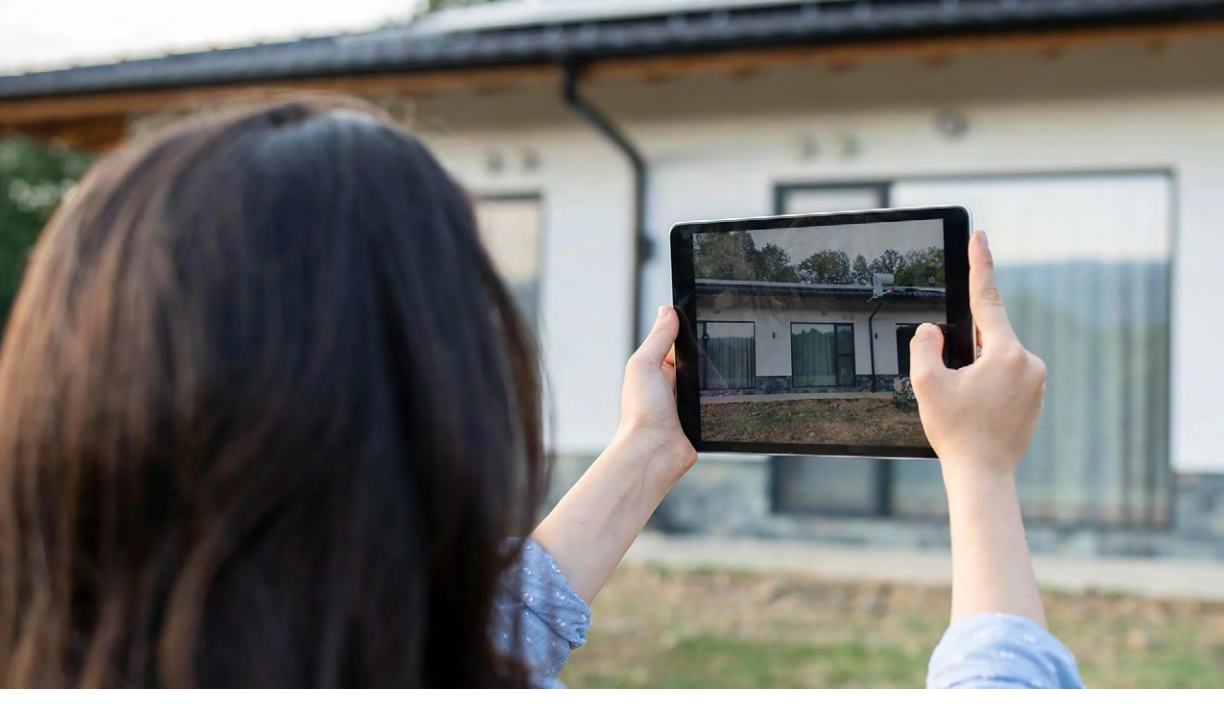
An insurance adjuster taking photos on a tablet with XactAI. (Verisk)
Introduction
Technology has increasingly taken over every aspect of property insurance. There’s the algorithm that decides how much insurance we need when we sign up, the one that determines what it’ll cost to rebuild after a disaster, as well as ones that set your fire risk score and decide how much companies get to charge for future disasters. Worse, the data that feeds this technology is often incorrect and always hidden from public view. This report will examine how there is one large technology company that does all these things: Verisk.
This is part 3 of a series about how large insurance companies have been mistreating wildfire survivors. You can read part one here (opens in new tab) and part two here (opens in new tab).
Are You Underinsured?
In 2021, Colorado resident Barbara Holub wanted to make sure she had adequate insurance coverage for her home. She asked her adjuster at State Farm about it, who said she was properly insured, according to Holub.
But when Barbara and her husband lost their home due to the Marshall Fire, they discovered that they were actually underinsured. State Farm and other insurance companies use a program called 360Value, which scrapes data of property records and construction costs to determine policy limits. Many consumers, including the Holubs, are underinsured because of this software. When it was time to determine rebuild costs, she was given a report by a company called Xactimate that shorted her by roughly $1 million dollars, according to Holub. Instead of getting traditional construction bids, insurance companies use programs like Xactimate that utilize data, algorithms and artificial intelligence to determine rebuild costs. State Farm wouldn’t pay her more than her policy’s coverage limit.
Worse, trying to understand her Xactimate report was like trying to decode a language no one uses. It was hundreds of pages of numbers and words.
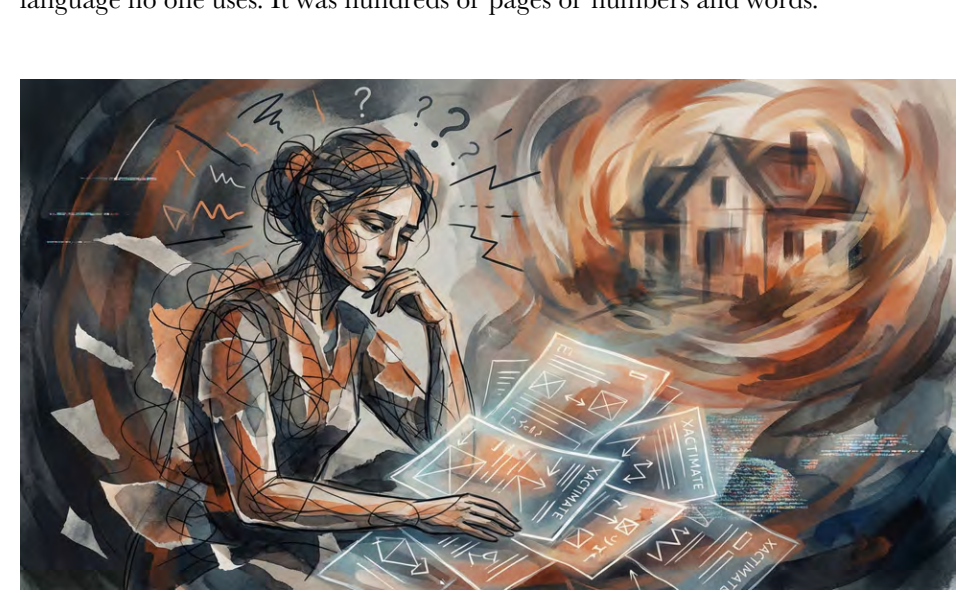
“Trying to understand her Xactimate report was like trying to decode a language no one uses.” (AI/Google Gemini) “My husband and I have done a lot of DIY projects, so we’re familiar with construction,” said Holub. “We had no idea what this Xactimate was telling us, and so I would say to the adjuster, ‘Well, where are the electrical outlets? Oh, they’re included in the square footage. Where are these cabinets and light fixtures? Oh, they’re included in the fixtures. And where are the labor rates? How do I know the labor rates are for our area? Oh, we just choose something that’s appropriate for
the area,’” recalled Holub.
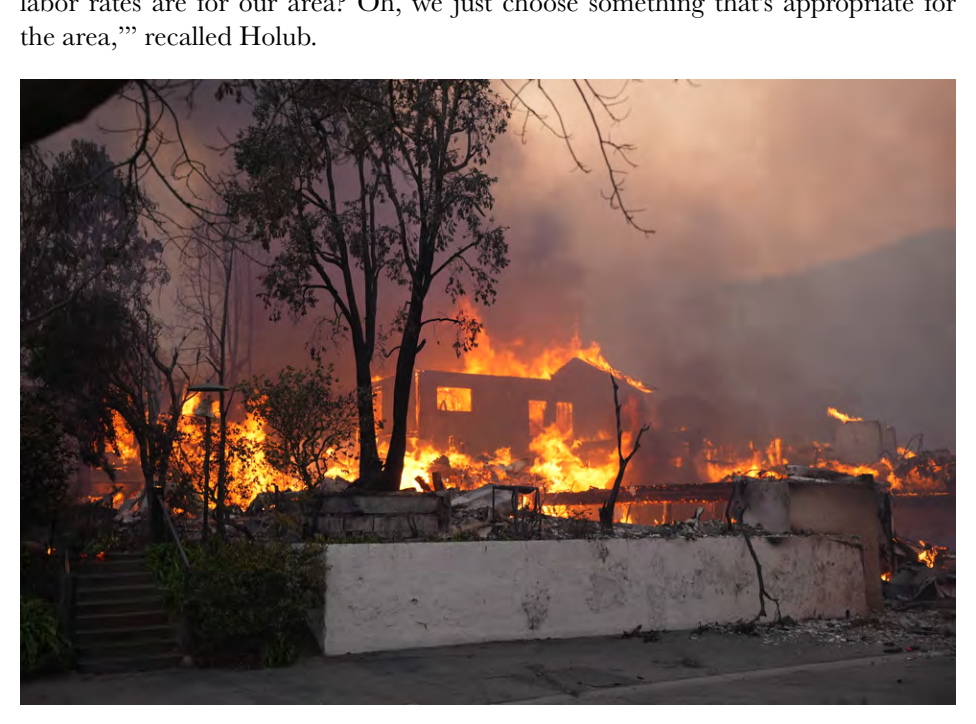
A house burning in the 2025 Palisades Fire. (Adobe Stock) “But they don’t tell you that in an easy way. They spend 5 minutes telling you so that when they’re done with the explanation, you’re like, what did they just say?” Through one-size-fits-all methods of determining coverage limits and rebuild costs, Holub was underinsured and didn’t get enough money back to rebuild her home. William May, a resident of the Pacific Palisades in California, was also quoted far less than it will cost him to rebuild his home. After he lost his home in the Palisades Fire, a State Farm adjuster said the insurance giant would pay out around $1.7 million. That was the amount they insured the home for in 2018. His coverage limit for the dwelling is now $3.4 million.
“And I said, ‘It’s gotta be worth more now…I didn’t realize what a pot of you-know-what I was stepping into, because sometime later, he got overruled,” said May. “It got knocked down to $1.35, which is $250 a square foot for a 4,300 square foot, two-story house with all the niceties of houses in our area now. So, that was very disappointing.”
“I told them a million times that this is ridiculous for it to be worth less now than it was when it was new. And how can it be worth less now when you haven’t even seen the property?”
Turns out State Farm used Xactimate for Bill May’s home as well. But the actual cost to rebuild his home is also about a million more than what State Farm wants to pay for. May isn’t waiting around for insurance. He’s on his way to rebuilding, but so far is out of pocket around $500,000.
Both the software that shapes policy Homeowner Rebuilding Costs After the limits—360Value—and the software 2021 Marshall Fire that determines rebuild costs— Xactimate—are owned by Verisk.
Barbara Holub and Bill May aren’t the only ones, according to studies
Underinsured
conducted on underinsurance. It’s a
39%
pattern.
Nearly 75 percent of people who filed a claim following the Marshall Fire were underinsured, according to a research paper (opens in new tab) done by the
Severely Underinsured
University of Colorado at Boulder
37%
and University of Wisconsin- Madison. The study compared the actual cost to rebuild versus the coverage policyholders had. The homeowners in the study weren’t SOURCE: “Coverage Neglect in Homeowners Insurance,” February 24, underinsured because they couldn’t 2025, U. of Colorado Boulder.
afford enough insurance, where they lived, or even because of rising rebuilding costs, according to Philip Mulder.“Higher-income people tend to have more coverage, but even these relatively affluent people were still mostly underinsured,” said Mulder.
“We kind of think that—and this is sort of based on a lot of other evidence—is that people are given these replacement cost estimates when they get their policy quotes, and that very often customers more or less trust those quotes,” explained Mulder.
The biggest driver of how underinsured you were was which insurer you chose, according to Mulder. And it doesn’t seem like this is related to anything about the policyholders.
“If you were with an insurer who tends to write less coverage, you were slower to rebuild, you were more likely to move away instead of rebuilding,” said Mulder. Even when homeowners shopped around, it often didn’t matter, because most people focused on the so-called “headline premium.” The study looked at 14 insurers, making up about 85% of the market.
And in California, it’s the same thing. A California Western School of Law professor analyzed 60,000 California claims from the past 4 years, and he found 9,000 lost their homes. About two-thirds of those who lost their homes were underinsured.
The History of Insurance and Data Collecting
The insurance industry’s data origin story begins in the 1970s. Insurance companies wanted statistical data, so they created a nonprofit to collect it. This was pre-Internet, so data wasn’t easy to get.
“And the leader of that effort was the Insurance Services Office. It was a non-profit organization at the time,” said Harvey Rosenfield, founder of Consumer Watchdog who spearheaded Proposition 103, a law that leveled the playing field against
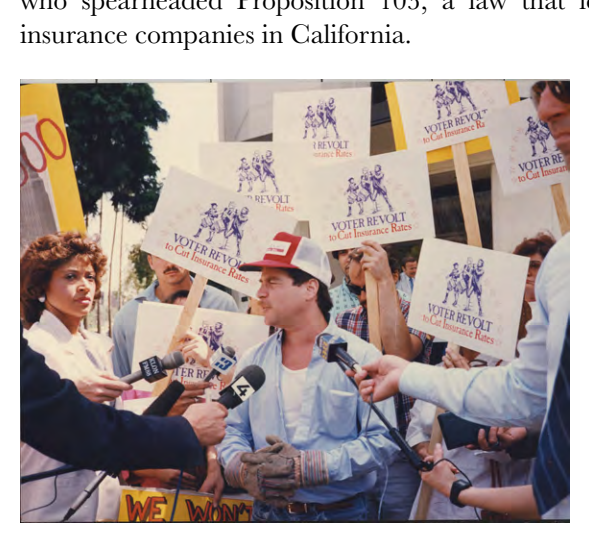
insurance companies in California.
“And it specialized in collecting information about motorists and homeowners. It circulated proposed premiums to all the insurance companies across the country.”
ISO came up with standardized policy forms, ratings, loss data, modeling and risk analytics.
This organization would become elemental to the rise and success of the insurance industry. It made insurance companies, bigger, better, faster, Harvey Rosenfield in 1988 campaigning for Prop stronger. More policies were 103, which regulated insurance in California.
sold, and companies took over (Consumer Watchdog) more market share.
In the 90s, Allstate, Farmers, State Farm, Liberty Mutual worked with the major corporate consultant McKinsey to imagine a new way to approach claims, and what McKinsey advised was to incorporate new technology to lower risk and increase profits.
Perhaps in part to avoid antitrust scrutiny of price fixing, ISO re-organized as a corporation. In the early 2000s it then acquired Xactaware and created 360Value, then officially became Verisk, the global analytics powerhouse it’s known as today. In an SEC filing, its stated goals include: “We enable risk-bearing businesses to better understand and manage their risks.” “Our decision analytics solutions facilitate the profitable underwriting of policies.” “We encourage our customers to share more data with us to enhance the power of our analytics so that our customers can profit from improved risk management decisions.”
“They claim they want to be able to price better, but it just happens to work out that the insurance industry finds a way to charge people too much money,” said Rosenfield.
In its quest to dominate the market, Verisk ran into legal troubles. A jury in New Jersey ordered Verisk to pay $125 million (opens in new tab) to a smaller competitor over allegations Verisk stole patented rooftop imagery. The companies eventually settled the case. An antitrust lawsuit filed against State Farm and Verisk argued that through predatory pricing meant to undercut competition, Verisk allows insurance companies to shave a few dollars off how much each home is insured for in order to monopolize the market. And at the same time homeowners lose hundreds of thousands of dollars. A judge dismissed (opens in new tab) that case, ruling that it wasn’t an antitrust claim, but instead a matter of how the technology was used.
And so what kind of data does Verisk collect, and where does the data come from? “A company like Verisk gets data from many other places, including buying it from online data brokers whose origin they may or may not know,” said Thomas Loeser, a former federal cyber tech prosecutor who now works in private practice at the civil litigation firm Cotchett Pitre & McCarthy. He’s sued Verisk in connection with the car industry.
“There are terabytes of data about individuals out there on both the commercial market and in a gray market, or even on the dark web. And there are many data consolidators who will buy that data from all of those sources and repackage it,” said Loeser.
But it’s not just the data–it’s also the stuff that is missing in the data that is a problem. Data often is incorrect. That’s because Verisk auto-compiles what it finds on the internet, from municipal property records, for example. When data is missing, Verisk’s software automatically substitutes what it determines to be a comparable value. So a lot of its data about homes is wrong or outdated.
An antitrust lawsuit filed against State Farm and Verisk argued that through predatory pricing meant to undercut competition, Verisk allows insurance companies to shave a few dollars off how much each home is insured for in order to monopolize the market. And at the same time homeowners lose hundreds of thousands of dollars. A judge dismissed that case, ruling that it an antitrust claim, but instead a matter of how the technology was used.
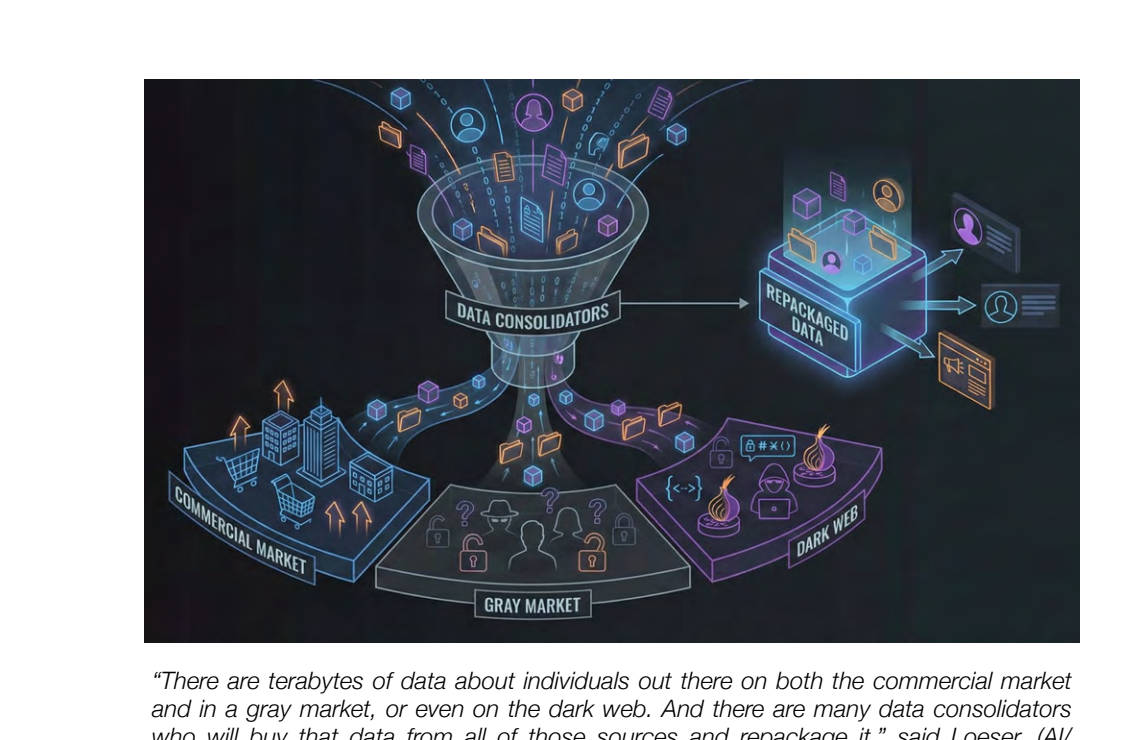
“There are terabytes of data about individuals out there on both the commercial market and in a gray market, or even on the dark web. And there are many data consolidators who will buy that data from all of those sources and repackage it,” said Loeser. (AI/ Google Gemini) “What you hear in statements from the company and around investigations that have happened before is that the makers of these softwares are clear that these are not plug-and-play tools,” said Mulder. “You need to account for very detailed characteristics of the home, and if you don’t, you’re likely to underinsure.” 360Value and Xactimate are both black box data-based tools. So first, people become underinsured, and then they get underpaid.
According to reams of court and government documents in lawsuits (opens in new tab) against Farmers, State Farm, and USAA, 360Value’s dataset was often incomplete or outdated, and often never verified by agents. But insurance companies still used it to establish policy limits for people. With Farmers, for example, this pre-filled data included the size of homes, quality, the age, foundation shape. According to court filings the company went even further: agents manipulated the program to lower homes grades, maybe in order to offer a price that was too low.
Mulder thinks this may have something to do with how agents selling policies are trained: to move fast, and quote customers low prices. If they quote higher, more realistic policies, it might risk losing customers. Bottom line: It doesn’t make money. “If you’re an agent trying to make a sale, you can take more time—meaning you have less time to do more business—to quote people higher prices,” said Mulder. “Which means you’re less likely to make the sale. Or, you can quote them a low, attractive price quickly, which increases your chances of making a sale, lets you
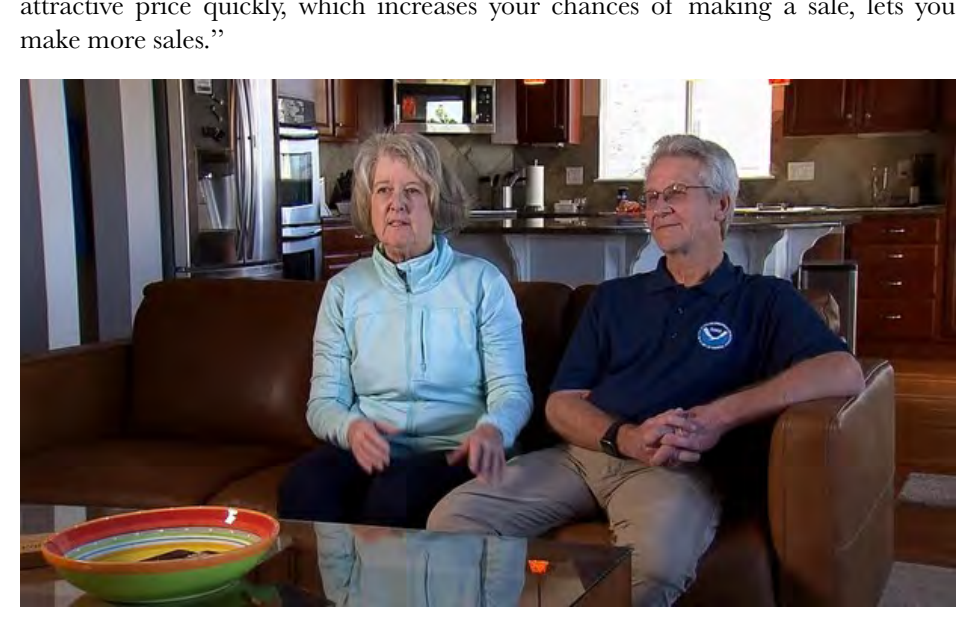
make more sales.’’ Barbara and Kirk Holub lost their home in the 2021 Marshall Fire in Colorado. (CBS) That could help shed some light on why Barbara Holub and Bill May are where they are today. And even though construction costs may be higher, that’s also not the reason homeowners are underinsured, according to the study.
“Another really important detail to understand with these policies is this whole practice of extended replacement cost coverage and inflation guard,” said Mulder. “Going into the paper, I think we had a strong belief that part of the problem here was gonna be that folks were not updating their coverage year to year. That you get some coverage limit, and then you stick with it. What’s really cool about this data is we can see the coverage the first year you got your contract, and what it is today. They’ve all gone up. And so, the average extended replacement cost policy sort of covered that. The problem is that the coverage A limits were too low in the first place.”
Coverage A is the main part of the insurance policy—the amount that insures the home. It shows how both Verisk programs work in tandem to underinsure. Barbara Holub’s policy also had an inflation guard.
What’s interesting on the rebuild side is that policyholders are using Xactimate as well, and getting wildly different results compared to insurance companies. Holub summed it up this way: “Garbage in, garbage out.”
After State Farm delayed Holub’s payment by almost a year, the couple retained a lawyer, who told her to use her own Xactimate. She couldn’t make heads or tails of the technology. The program is so hard to use and understand that they had to pay $6,000 out of pocket just to hire someone who knew how to use it. They used it twice, one time valuing their home at $2.1 million and the other at $1.9 million. Both estimates were twice as much as what State Farm valued it at. It appears to be an insurance company problem.
“We’d say, ‘Well, we had this kind of countertop. Well, we don’t have that kind of countertop in our database, so we have to substitute something,’” said Holub. “So it feels like you have to choose something that’s of lesser value than what you had, or you’re lying by saying it’s of greater value than what we had. So nothing really matched.”
To give you a sense of how un-exact Xactimate is, the Holubs installed a 5 by 7 steam room shower with nice radiant bench heating with parts from Germany. “It was finished a couple days before the fire,” said Holub. “We never got to use it even once. All the stuff that we had in that steam room shower was not in their database. And he could not substitute anything else.”
Catastrophic Modeling
Verisk has control of another part of the insurance galaxy, and that’s something called catastrophic risk modeling, or CAT modeling. Before the current insurance commissioner in California, Ricardo Lara, insurers in the state could use models only to sort or group customers, but not to calculate the rates themselves. New regulations approved by Lara in 2024 allow these models to be used to estimate the portion of rates related to disaster risks like wildfires. This isn’t necessarily bad, but there’s a big concern: they’re completely secret. The Department of Insurance process to review these models keeps all the inner workings secret. No one can
really know how accurate they’ll be at predicting future losses.
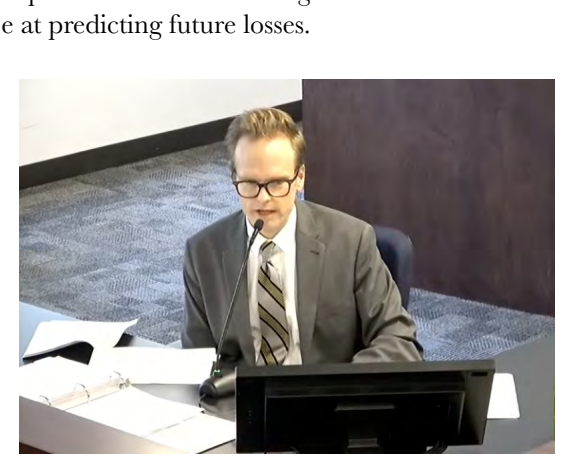
That includes a former insurance actuary named Ben Armstrong, now staff actuary for Consumer Watchdog. Part of his job at Consumer Watchdog is to look under the hood of an insurance company’s rate filing. Ben reviewed a 6.9% rate increase proposed by Mercury in the summer of 2025. Why 6.9%?
Because at 7% consumers are allowed to demand a public hearing before it’s approved by Ben Armstrong, Consumer Watchdog actuary, the CA Department of testifying in a hearing over State Farm proposed rate increases, April 9, 2025.
Insurance. Mercury is the first company to file a homeowner’s rate increase under the new California regulations, which enable insurers to use models for catastrophes that impact rate making for the first time.
“You just gotta ask the question, how do we know which one of these is correct, and how can we be confident that insurers using these models are not overcharging their customers?” said Armstrong.
Ben analyzed Mercury’s proposed rate increase, which used Verisk’s catastrophic model. But he couldn’t verify the portion of the rate that Verisk’s model was used for. In fact, the process set up to review models was intentionally made secret. Ben can’t tell—no actuary can— just from Mercury’s application, whether the output from the model is fair and equitable and results in rates that are not excessive, inadequate, or unfairly discriminatory—a key tenet of actuarial rate making. “Now, if we just want to talk strictly about the Mercury filing, I can tell you that if they had to use the catastrophe framework that was in place prior to these new regulations, they would not qualify for a rate increase at all,” said Armstrong. To recap, homeowners rate filings under the new regulations may appear to support rate increases that are significantly higher, due solely to the use of catastrophe models.
“And it’s not clear to anyone outside of the organizations that develop these models how accurate that is,” said Armstrong. “Compounding the issue is that it’s a well-known facet of catastrophe models that you can line up three different reviewed, well-respected catastrophe models, feed them the same data, and get wildly different results.”
Insurance companies have seized on the fires in California as a perfect excuse to dump disclosure rules.
So if insurance commissioner Lara’s rules stand we will never see inside the black box to tell how accurate these models are. And that means policyholders in higher risk areas who will pay considerably higher premiums because of these models will never know if their rates are fair.
“Since it has now become a component of California homeowners’ insurance premiums, we take issue with the fact that there’s no real way to tell how accurate these are going to be,” said Armstrong. “Meanwhile, consumers in higher risk areas are paying considerably higher premiums due to the introduction of these models, or they would, if these rate filings using models are approved. That’s the primary concern. There’s really no way to see inside the black box.”
“The thing that is terrifying for me as an actuary and consumer advocate is reliance on a single model, and just saying, ‘Well, we put our data in, and it spit out this result, and everybody’s rates are going up.’”
rate filings under the new regulations may appear to support rate increases that are significantly higher, due solely to the use of catastrophe models.
This lack of transparency brings the discussion back to Proposition 103, the law Consumer Watchdog’s founder helped pass with the help of California voters more than 35 years ago.
“One of the things that Prop 103 required was that insurance companies in California had to open their books and justify their rates and premiums,” said Rosenfield. “Proposition 103 says anything that has to do with the creation or establishment of a rate or a premium has to be publicly justified, has to be transparent, so that independent people—consumers, lawmakers, policy makers, scientists, government officials—can assess for themselves whether these models are accurate, reliable, non-discriminatory, and not biased.”
Insurance companies have seized on the fires in California—and increasing weather disasters across the country—as a perfect excuse to dump these disclosure rules.
“The advent of computers, and the advent of the internet in the late 1990s, greatly
exacerbated this problem,” said Rosenfield. “Because it allowed insurance companies to engage in old-fashioned discrimination in the guise of technology and progress, and the infallible computer, which of course we know computers and insurance, programmed by humans for human profit-making purposes, are not infallible.”
Unfortunately, government regulators like the CA Department of Insurance aren’t doing their jobs in protecting policyholders from these black box rate hikes.
“Basically, the insurance companies said to Californians, ‘We’re going to hold you hostage.’ And the ransom is higher insurance rates and deregulation.
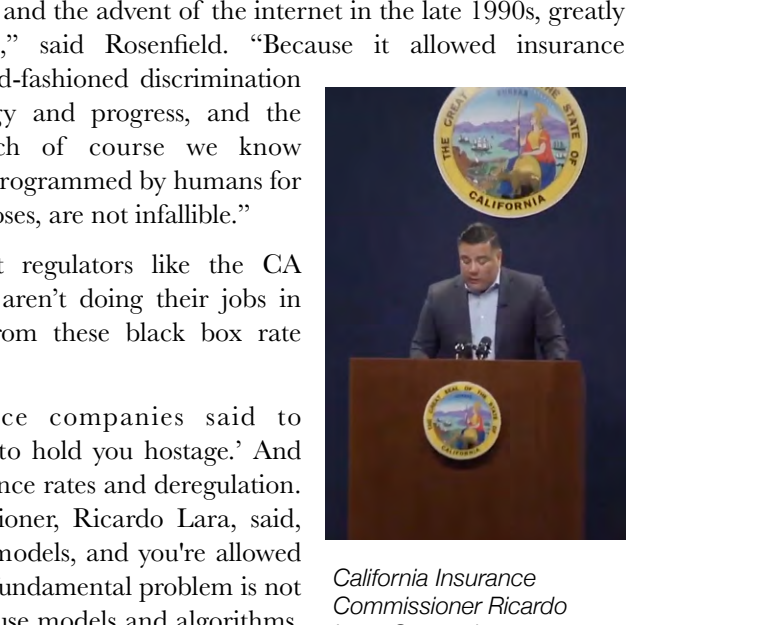
So the insurance commissioner, Ricardo Lara, said, ‘Okay. Go ahead and use models, and you’re allowed California Insurance to do it in secret.’ And the fundamental problem is not Commissioner Ricardo so much that they want to use models and algorithms, Lara, September 21, 2023.
but they want to use them and keep them secret.”
Risk Scores
Verisk also sells insurance companies its risk model—FireLine—that assigns your individual wildfire risk score. Insurers use that to decide who and who not to cover, and who pays more because of fire risk. Those scores—other than the number— also are not explained to policyholders. But like your credit score they have an outsize impact on financial stability—in this case your ability to buy and afford insurance.
Northern California resident Mark Burton saw his AAA premium skyrocket to almost $15,000. The reason? The Verisk-owned FireLine risk score determined it was due to his “fuel load, slope and road access to the property,” according to a letter AAA sent him. This is despite his home being built on a flat spot with oak trees and grass but no underbrush. Mark keeps plenty of room between the house and any vegetation and keeps lower tree branches trimmed to prevent grass fires from catching on trees.
A letter from AAA to Burton said: “As previously explained, both the FireLine Score and PPC are obtained from the Insurance Service Office (ISO) Verisk, a leading provider and source of reliable information regarding property and casualty insurance risk. ISO Verisk’s FireLine score is one rating factor which determines a dwelling’s susceptibility to loss by wildfire based on the fuel load, slope, and road access of a property. ISO Verisk’s PPC is a numerical classification based on the analysis of the structural fire suppression delivery system provided in a community. The Company does not have any part in the calculation of either of these two scores. However, the Company’s use of the scores to measure risk, is an industry standard and not prohibited by the Department nor California law.”
“This is a strong arm by AAA,” said Burton. “They created a $1,500 monthly mortgage for me.”
Burton finally threw in the towel on AAA and no other home insurers would write him a policy. As a result, he ended up on the bare bones FAIR Plan, California’s insurer-run coverage of last resort.
Across the insurance industry companies are doubling down on tech. In September of this year, Verisk launched XactAI, integrating artificial intelligence to, “streamline property claims management and reduce processing costs by up to 70%.”
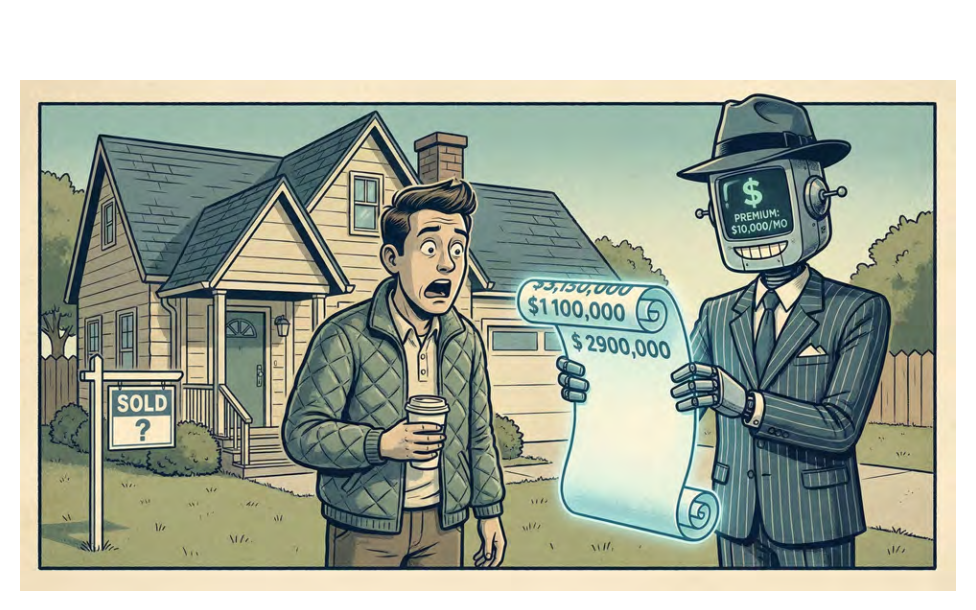
“Forget adjusters not coming to your home, now they won’t even be looking at pictures of your home. That’s up to the robots.” (AI/Google Gemini) Verisk also said the platform, “automates tasks like photo labeling and ALE receipt categorization (when companies have to pay you for temp housing and meals), cutting per-claim costs from $12-$25, to $3-$8, and accelerating resolution times. The tech will take humans out of the loop for the claims process. Forget adjusters not coming to your home, now they won’t even be looking at pictures of your home. That’s up to the robots.
Policyholders aren’t told about programs like 360Value and Xactimate.
“I didn’t sign a contract for Xactimate, I didn’t sign a contract for getting, paid out too little,” said May. “I signed a contract for reasonable and necessary expenses to rebuild. Even if they’re more. They want to have this closed system, this proprietary business of trying to magically figure out what the house was worth.” After the 2025 LA fires, many people are still not rebuilding.
“They’re sitting there and still playing the estimate game with State Farm, or Farmers,” said May.
A Public Model
Bad guesses, incomplete data, and faulty conclusions by the algorithms and AI behind programs like 360 Value and Xactimate are being ignored by Verisk and the insurance companies that use it. The result is stories like Barbara and Will’s that keep repeating: homeowners not getting what they paid for after a disaster. Companies continue using Verisk’s black box risk models to deny coverage or price people out of the regular market, pushing them into the FAIR Plan.
A year after the Eaton and Palisades fires, survivors are still stuck in limbo (opens in new tab), and many others can’t get the insurance they need.
Insurance companies are built on data – they can’t do business without it. But what Verisk’s start-to-finish stranglehold on our insurance policies has made painfully clear is we won’t get a fair deal on that insurance until the data that shapes the whole policy is transparent. Barbara used data in her Xactimate report as leverage to get paid more. It’s how policyholders can fight back.
Consumer Watchdog fought for a public wildfire model in California so people don’t have to take their word for it. Governor Newsom just signed a law—SB 429 —to take the first step.
“For the average person, your fire risk score should be something that you can check against SB 429 data in the future,” said the bill’s co-sponsor, Sen. Dave Cortese.
The bill will create a state fire risk model that is public and transparent. It will simulate wildfire damage and reflect risk scores for properties in California so policyholders, legislators, academic–everyone—can be empowered with
information. The goal is to shed light on why a fire risk has increased. “If you want to know the answer to why, we’re going to try to give you that,” said Cortese. “And we’re going to send you down this sort of parallel path of getting some numbers from the SB429 model. And maybe that helps to make an argument at some point with their own insurance company.”
Transparency isn’t all consumers are asking for, but it’s the first line of defense to make sure insurance companies treat policyholders fairly.