

Table of Contents 1. Executive Summary 2. Google Profits From Fraudulent Advertising 3. Google’s Market in Deceptive Ad Words 4. The Debt Settlement and Credit Repair Industry 5. In Depth: We’re from the Government and We’re Here to Help (Not Really) 6. In Depth: Harvesting Your Personal Financial Data 7. In Depth: USMortgageBailout 8. Lead Generators Pose as Loan Modification Advertisers 9. Google’s Responsibility 10. Conclusions and Recommendations 1. Executive Summary Google has been a prominent beneficiary of the national home loan and foreclosure crisis of the past two years. The giant search engine company has profited by accepting deceptive advertising from fraudulent operators who falsely promise unwary consumers that they can solve their mortgage and credit problems.
Fraud is widespread in the mortgage modification industry, according to the Federal Trade Commission and investigations by the attorneys general of New York and other states. Yet many of these companies pay thousands of dollars for prime advertising space on Google searches. While Google has a policy prohibiting deceptive advertising, that has not kept Google from accepting misleading ads. Indeed, Google has become one of the nation’s largest outlets for deceptive advertising.
So far, Google and other search engines are getting a pass from the FTC, which has opted not to use its legal authority to seek injunctions against search providers who run deceptive ads. Instead, the agency has adopted a whack‐a‐ mole strategy of pursuing scurrilous foreclosure and credit relief firms on an individual basis. As detailed in the conclusions and recommendations in this report, the FTC needs to adopt a more effective approach targeting Google and other search engines that supply the oxygen to these deplorable fly‐by‐night outfits.
In a detailed review of Google’s advertising practices, Consumer Watchdog found that Google typically drops questionable advertisers only after these companies are sued by federal regulators. Even then, Google allows other companies to continue making similar deceptive claims in their advertising. The home loan modification business is an offshoot of the credit repair industry, which also preys on consumers facing financial difficulty. Federal and state regulators have found that the credit repair industry also is riddled with fraudulent practices. Nevertheless, these firms are another profitable source of advertising revenue for Google.
Some loan modification ads on Google falsely imply that the companies’ financial products are endorsed by President Obama and the federal government or by news outlets such as CNN and USA Today. Other ads seek to collect homeowners’ financial information and steer them to companies with questionable lending practices.
Google prides itself on its motto, “Don’t be evil.” But its advertising practices call into question whether misleading ads are such a profitable source of revenue for Google that the company has adopted lower standards and relaxed its oversight for its advertising business.
As the market leader, Google sets the standard for Internet search companies. Its laxity in preventing fraudulent advertising has created an environment in which other search engine companies can feel safe in adopting the same questionable practices.
Consumer Watchdog calls on Google to halt all misleading advertising and to make amends by donating revenue from these ads to assist consumers who have been victimized by fraudulent mortgage modification and credit repair companies.
2. Google Profits From Fraudulent Advertising For millions of Americans who are facing foreclosure, these are hard times. For Google, such financial misery is an opportunity to sell ads.
On Google’s search engine, type in ’stop foreclosure’, ’loan modification,’ or any one of a dozen other housing‐distress related terms and up pops a slew of ads from companies promising to help you modify your mortgage, often for an up‐ front fee that is not initially disclosed.
This is an industry plagued by fraud. More than 25 foreclosure rescue marketers have been sued for deception by the Federal Trade Commission, which is conducting a major investigation of the industry called Operation Stolen Hope.
“Many so‐called foreclosure rescue companies or foreclosure assistance firms claim they can help you save your home. Some are brazen enough to offer a money‐back guarantee,” the FTC warns. ”Unfortunately, once most of these1 foreclosure fraudsters take your money, you lose your home, too.”
During the primary study period of September 10 to September 30, 2010, at least 20 companies selling foreclosure rescue or ”mortgage modification” were paying Google to run their advertisements next to its search results. Every time someone clicks on an ad, Google gets a fee, from a few cents to a few dollars. Consumer Watchdog researched each of these advertisers and made these findings.
- Ten advertisers imply they are affiliated with the U.S. government or
engage in other practices the FTC has labeled deceptive, such as claiming to be nonprofit.1 At least seven have been accused by consumers of fraud in Internet
- postings.
Three of the sites require consumers to buy Experian credit reports
- 2 before receiving advice or help.
One site is affiliated with a lawyer who settled prior fraud charges with
- the FTC, while another is run by a man with a civil judgment record for spamming.
At least five sites collect personal financial information and then refer
- homeowners elsewhere, a practice known as ”lead generation” that raises privacy and deception concerns.
Five sites falsely claim to assess the eligibility of consumers for foreclosure
- relief by analyzing their finances.3 Two carry fake VeriSign security logos.
- In addition, two mortgage modification firms that were identified by Consumer Watchdog earlier in 2010 as Google advertisers were recently put out of business by the FTC.
Many of these firms are based in California, one of the states hardest hit by the mortgage crisis. The epidemic of fraud in this industry led California in 2009 to enact the Mortgage Foreclosure Consultant Act, which prohibits taking advance fees and requires marketers to register with the state.
Despite numerous public warnings by the FTC about deceptive foreclosure rescue advertisers, this study found that Google typically drops such advertisers only after they are sued by the FTC. Other Google advertisers making claims virtually identical to the claims that the FTC says are fraudulent are still advertising on Google as of the release of this report (examples below). The mortgage crisis generates substantial advertising for Google.23 According to Google’s own analytical data, there are more than 74,000 searches per month for the term ”stop foreclosure” and the current ”cost per click” to buy that search term is $8.29. In other words, advertisers must pay that amount to Google every time a Google searcher clicks on their ad aimed at desperate homeowners.
Google peddles it wares via a website, https://adwords.google.com, which contains both a Keyword Tool to check spot prices on the keyword market and s Traffic Estimator so that ad buyers can gauge what results they might get. These figures show that Google routinely sells a variety of “foreclosure relief” search terms, because the high price Google quotes is a market rate based on supply and demand: Advertising keywords are auctioned to the highest bidder. At the current average of 31 clicks per day, Google’s data also shows, the estimated cost of buying this search term and receiving a premium position near the search results would be $266 a day.
If just three loan modification companies advertise with Google at $266 a day for the term ”stop foreclosure,” Google grosses over $5,500 a week. While that may seem like a modest haul for a giant ad firm, advertisers buy multiple keywords and there are at least 20 mortgage modification advertisers at any given time.
In addition, a review of various mortgage modification sites shows that Google also sells ads to the industry through its AdSense division, including one called the Fair Home Loan Bureau, ”ESTABLISHED TO PROTECT & DEFEND THE AMERICAN PEOPLE from UNFAIR MORTGAGES” (www.fairhomeloan.org).
The site is a typical example of how mortgage modifiers try to foster the impression they are some sort of official or nonprofit body created to assist consumers as opposed to profiting from their woes.
Google does not disclose how much it makes from individual advertisers and it is difficult to reliably estimate its revenues from any particular set of keywords without access to internal company data.
Google’s practice is troubling because the Federal Trade Commission has repeatedly warned that many mortgage modification services are nothing more4 than ”insidious fraud,” as Chairman Jon Leibowitz put it in 2009.
Under the federal Lanham Act, newspapers, television networks and other communications mediums ‐‐ including Internet advertising firms – are responsible for the content of ads they publish or air. Federal law also prohibits advertisers from engaging in ”unfair or deceptive acts and practices.” Google says it does not knowingly permit false claims by its advertisers, including companies that help with debt settlement. “Our AdWords Content Policy does not permit ads for sites that make false claims, and we investigate and remove any ads that violate our policies,” Google spokesman Aaron Stein5 said recently.
This is not a new position.
“When we become aware of deceptive ads, we take them down,” a company6 spokesman declared in 2006.
Yet Google has also tacitly acknowledged continuing problems by making more policy changes, such as this announcement: Miracle Cures The AdWords policy relating to miracle cures and false health claims will be updated around the middle of July. The policy is changing to prohibit false medical claims and require advertisers to more clearly distinguish herbal supplements from prescription drugs. The change will affect all countries. After the new policy goes into effect, the relevant456 policy description will be updated to reflect this change.7 (Posted on July 9) While such policy statements are clearly well intentioned, they beg the question of how much effort Google really has put into screening its advertisers. “Read Google’s voluminous Adwords Content Policy, and you’d think Google is awfully tough on bad ads,” wrote Ben Edelman, a professor at Harvard Business School, in a 2006 study. ”If your company sells illegal drugs, makes fake documents, or helps customers cheat drug tests, you can’t advertise at Google. Google also prohibits ads for fireworks, gambling, miracle cures, prostitution, radar detectors, and weapons. What kind of scam could get through rules like these?”
Yet Edelman went on to identify a large number of Google advertisers who don’t meet these standards: “As it turns out, lots of pay‐per‐click advertisers push and exceed the limits of ethical and legal advertising ‐‐ like selling products that are actually free, or promising their services are ‘completely free’ when they actually carry8 substantial recurring charges.”
As Edelman notes, the Lanham Act specifically provides for injunctive relief against publishers such as Google for distributing false advertising.
A review of Google’s own databases shows that advertisers who buy dubious keywords searches are some of Google’s best customers. As detailed below, the high prices for various keywords and the substantial cost estimates provided by Google are indicative that certain dubious ad terms are in high demand. As Edelman first noted, this reveals an unsettling fact: Google has quietly become one of the country’s biggest purveyors of obviously questionable78 advertising, from fake Viagra to “free” software that isn’t actually free. Once, such merchants peddled their wares in the backs of offbeat magazines, on late night local TV, and in other marginal mediums. Now the process is much simpler. The Federal Trade Commission, which regulates advertising, requires that all ads be truthful, that advertisers have evidence to back up their claims and that9 ads are not unfair, according to the FTC’s Bureau of Consumer Protection. An advertisement is considered deceptive if it contains information that is likely to mislead consumers who are acting reasonably. An ad can also be deemed deceptive if it omits information that would be important to a consumer in making a decision to buy a product. An ad is considered to be unfair if it causes or is likely to cause substantial consumer injury that is not outweighed by the benefit to consumers.
Importantly, ads can be deceptive based solely on ”implied” claims rather than explicit ones. So if an advertiser implies that it is somehow affiliated with the government, that can constitute deception under a 1952 Appeals Court ruling against a credit collection firm calling itself the National Service Bureau. The FTC cited the case last year in litigation against the website MakingHomeAffordable.gov, which allegedly ”enticed consumers into providing financial information which defendant then sold as customer leads to marketers of mortgage relief services.”
“The FTC looks at the ad from the point of view of the ‘reasonable consumer’ ‐ the typical person looking at the ad,” according to the Bureau of Consumer Protection. “Rather than focusing on certain words, the FTC looks at the ad in context ‐ words, phrases, and pictures ‐ to determine what it conveys to consumers.”
The FTC also looks at whether material information is omitted from the ad. An advertiser is required to have proof of its claims before running an ad. “Before a9 company runs an ad, it has to have a ”reasonable basis” for the claims,” the bureau says. “A ‘reasonable basis’ means objective evidence that supports the claim. The kind of evidence depends on the claim. At a minimum, an advertiser must have the level of evidence that it says it has.”
3. Google’s Market in Deceptive Ad Words Google’s practice of selling prime advertising space to dubious loan‐ modification marketers is extensive. Through dozens of searches from various geographic locations over a period of months, Consumer Watchdog identified more than 20 paid advertisers of such services operating through hundreds of individual websites. We then analyzed a few of the sites and figured out who is behind a few of them ‐‐ though many of the sponsors go to considerable lengths to hide their identities, even as they delve into yours.
Google operates a thriving market for search terms related to loan modification through its AdWords service, which generates more than 90% of the company’s10 revenues. According to Google’s own AdWords Traffic Estimator, the term “loan modification” is currently getting an average of 301,000 searches per month on Google.
Another system, the Search‐based Keyword Tool, shows the top searches using “loan modification.”
This data (see next page) reveals the enormous demand from homeowners caught up in the mortgage crisis, who go on the Internet seeking a way out of their agonizing predicaments.10 16 Popular Loan Modification Search Keywords Auctioned By Google Global Monthly Keyword Searches modification loan modifications 368000 loan modification 301000 loan modification loan 301000 modification loan 301000 modification of loan 301000 modification of a loan 301000 bad credit loan mortgage 74000 bad credit refinance 74000 mortgage modification 60500 modification mortgage 60500 mortgage foreclosure 60500 home modification 49500 mortgage advice 49500 mortgage help 49500 loan help 40500 The frequency of such searches is an indicator of the high demand for these services, which of course is in keeping with the economic climate.
One of the most popular search terms is “stop foreclosure,” which gets an estimated 74,000 searches per month. During early October 2010, the search result for “stop foreclosure” looked like this (see next page):
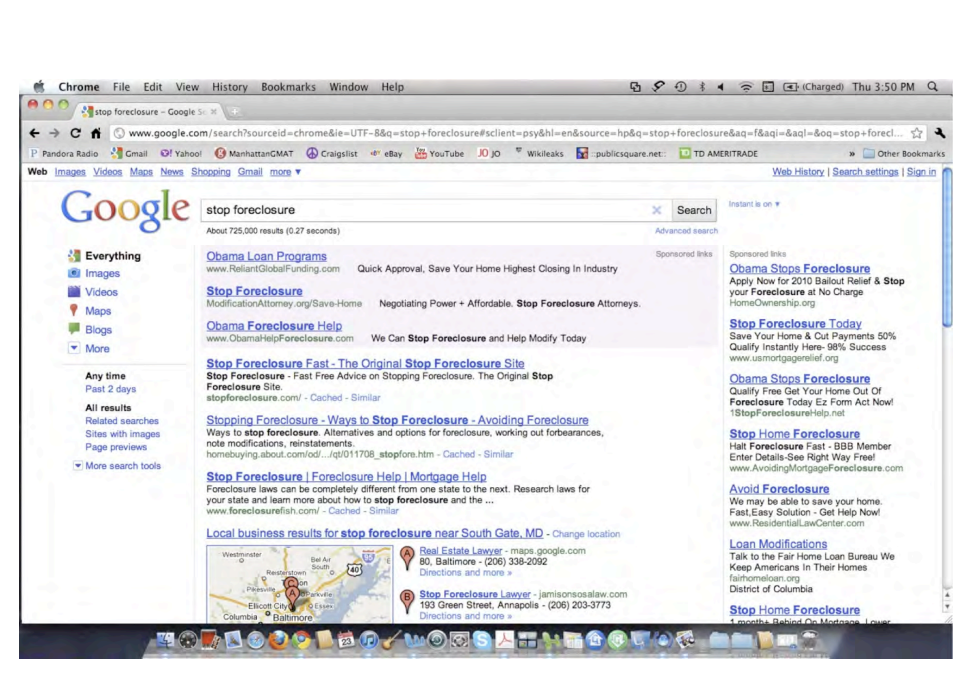
* ” _ Google Everything ….S por,sored lk’lks The most prominent results here (third beneath the search box) include a site called “ObamaHelpForeclosure.com,” which solicits calls to a toll‐free number, (877) 909‐7144. That number is used by a Los Angeles lawyer named Alan Jurick, who in 2000 entered into a $500,000 settlement in federal court with the Federal Trade Commission regarding allegations of telemarketing fraud. When we called the number, we identified ourselves as a consumer group and asked for more information about “Obama Foreclosure Help.” A person identifying himself as a “HUD Counselor” named “Bill Gimbel” conceded that Obama Foreclosure Help isn’t actually affiliated with President Obama or any other part of the U.S. government. But the group will “lead you in the right direction,” promised Gimbel.
Another major Google advertiser who was buying keywords such as “mortgage modification” during the initial months of this study in spring 2010 was www.fedmortgageloans.com, which was created by a California businessman named James Rambadt. In June 2010, the FTC sued Rambadt in federal court for fraud, alleging that he illegally “represented, directly or indirectly, expressly or by implication, that [his companies] are the United States Government.” Rambadt, Consumer Watchdog’s investigation found, is actually a sophisticated harvester of consumer personal financial information, which he then sells to third parties. A detailed account of our investigation into Rambadt’s activities is in Section 5.
Another Google advertiser is www.stopforeclosurequick.org, which claims to be a nonprofit associated with ”one of the largest non‐profit organizations in the United States,” an outfit called the National Hope Foundation. However, IRS records do not show a registered 501 C3 charity by that name. A company spokesman, Mike Lucas, insisted the group is registered with the IRS but declined to provide any proof such as a registration number.
stopforeclosurequick.org also says it is affiliated with a firm called Home Solutions of North America, which in turn says it is part of a nonprofit called Financial Hope for America. According to a consumer blogger named Steve Rhode, ”it appears that Financial Hope for America is a front for Certified Financial Protection Group, a for‐profit company, and the web site for Financial11 Hope for America is under the control of 3M Marketing and Mike Wayman,” a California businessman. Last year, Wayman was the subject of a $7,000 court judgment for defrauding a California consumer seeking a mortgage12 modification.11 really12
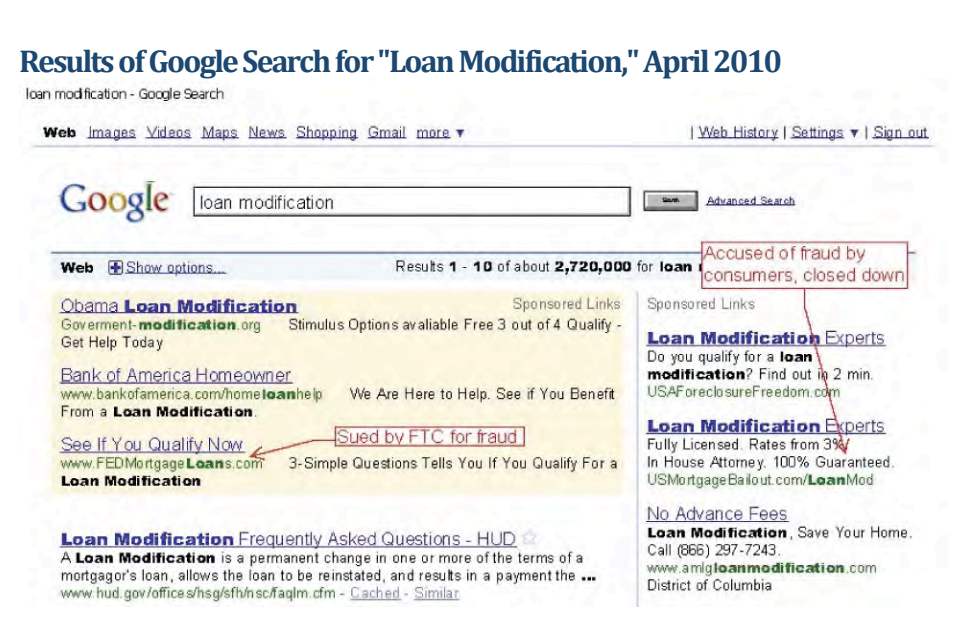
Results of Google Search for ”Loan Modification,” April 2010
Go gf
Consumer Watchdog has not been able to locate any evidence to back up the claim that Financial Hope for America is a legitimate nonprofit.
Another dubious Google advertiser is www.freeloanmodinfo.net, which promises ”Guaranteed Affordable Payments!” According to the FTC, it is impossible for a loan modification company to guarantee a more affordable loan payment. The site also claims that ”The Government is Practically Paying the Bank to Keep You in Your Home,” another statement that is either a wild exaggeration or an outright lie. Yet another whopper: “ in many cases, principal will be reduced.” The site invites troubled homeowners to provide personal financial information.
Copyright notices state that the site was created by Custom Internet Lead Solutions Inc., a Florida firm that designs various marketing ploys targeting consumers in financial distress.
As seen on the following page, Custom Internet Lead Solutions promises internet marketing firms that it will help them make big money targeting consumers.

- ~u~Ionmte~ ran~ leotl utIinocn.1 ,
I Home I Services I Contact I About I FAQ I ._LEJIRTNH EB ENEITFS OFW ORHINWGIT HC USTOMIN TERNEleTf tDSO LUIOTNS~ FRECEU STOM.DIZ E Your Marketing Efforts – CONSISTENT + LEAGDE NERATION
QUALIWTYlE k•
SYSTEM IFTERWEEIM ~indO uWt haQt thre! ead~ ompieasn~ o}n WanYt o!uo Know_ !
e e Are You using a CRM Provided By Your Lei!dC ompany?B EWARE!
The firm’s other sites include FreeDebtSettlement.org, which promises ”Settle your debts with just one click of the mouse.” According to corporate records in Florida, CILS was incorporated by Justin B. Michaels of Tampa, Fl., a major spammer who was sued for fraud by Microsoft Corp. in 2003. According to federal court filings, Michaels and his company Neoburst illegally harvested email addresses from Hotmail ”to send unauthorized and unsolicited bulk e‐ mail advertisements.” In August 2004, Microsoft obtained a permanent injunction and default judgment against Michaels, who never bothered to mount a defense.
So who is Michaels selling his hot mortgage modification leads to?
A small notice inside the freeloanmodinfo.net ”privacy policy” discloses that the information ”will be used to evaluate your mortgage for a loan modification by the Mortgage Mitigation Law Group only.” The MMLG was originally based just across town from Michaels in St. Petersburg, and has now moved to Maricopa, Ariz. Its original incorporators include former Illinois businessman Patrick Drury, who in 2006 was named in a regulatory order by state banking officials for improper mortgage marketing. Consumers have posted complaints alleging that MMLG collected thousands of dollars in fees from them but and failed to modify their mortgages.
4. The Debt Settlement and Credit Repair Industry Mortgage modification is an outgrowth of the larger credit repair sector, which sells hope to consumers in financial distress. Many companies that sell mortgage modification also offer to help consumers repair their bad credit records. In years of investigations and lawsuits, the FTC and state regulators have shown that the credit repair industry is riddled with fraudulent practices including false promises to fix bad records.
Credit repair ads are another one of Google’s product lines, with an estimated 368,000 searches for ”credit repair” per month and a relatively steep $6.60 cost‐ per‐click for the best advertising position. An advertiser who wants the full number of daily clicks, estimated at 211, will get a daily bill from Google of $1,429. Even more staggering is the value of the search term ”bad credit,” which gets an amazing 1.83 million searches a month. An advertiser who wants a premium spot to harvest all of the estimated 2,114 clicks a day would have to pay Google a mind‐boggling $16,259 ‐‐ daily.
The FTC warns consumers away from credit repair services that claim they can fix bad credit scores. ”Don’t believe these claims: they’re very likely signs of a scam,” the FTC states. Agency attorneys have ”never seen a legitimate credit repair operation making those claims.”
And yet a sampling of Google advertisers shows companies promising: ”Get a 720 Credit Score,” and ”100% Guaranteed Permanent Results.”
While it’s tempting to make light of such dubious advertisers as a byproduct of Google’s size, a recent report underscores that Google’s customer base is surprisingly short on big branded advertisers and appears to rely on smaller firms selling individually‐targeted products. According to a recent article in Advertising Age based on a leaked internal Google document, the company gets comparatively little of its revenue from large well‐known companies like Apple or Ford Motor Co. The company’s top ten advertisers ”collectively accounted for just 5% of Google’s U.S. revenue” in June 2010, AdAge reported on Sept. 6. 5. In Depth: We’re from the Government (Not really) and We’re Here to Help (Not really) Many of the advertisements on Google lead to sites that display logos and/or text designed to lead a consumer to believe that government agencies and media endorsements were connected to the advertisement, sometimes with disclaimers in tiny print denying such connections.
One occupant of the prime spot at the top of the Google search results page has been ObamaFederalLoanModification.org, a blatantly deceptive site that went a step further by using the ”.org” address suffix to trick consumers into thinking it’s a nonprofit.
In another blatant deception, ObamaFed’s site boasted that ”as seen on” CNN,
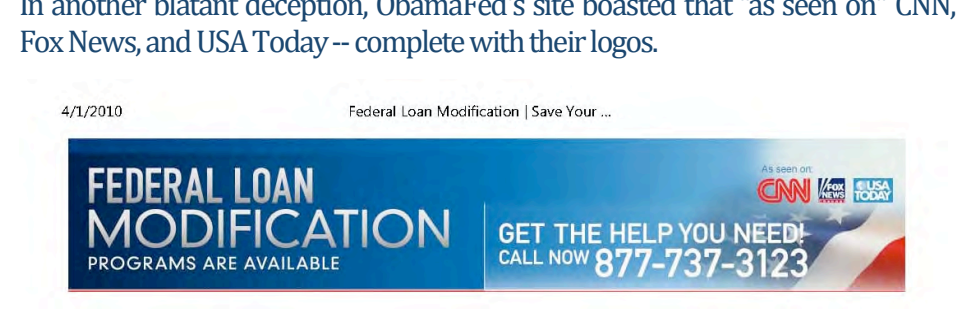
Fox News, and USA Today ‐‐ complete with their logos.
FEDERLAOLA N MODI FlC ATION 8]~-‘Z32-3l2 3
Only if you happened to pull up ObamaFed’s privacy policy would you get this disclaimer in six‐point type at the very bottom: “ * ‘As Seen On’ refers only to government and/or federal loan modification information discussed on the various news channels. The trademarks included on this page are property of13 their respective owners, who have offered no endorsement of this website.”13 While ObamaFed is no longer a live site, Google’s top advertisers now include

the very similar www.LoanModificationDepartment.US, which looks like this: Fl11 fl n- -Cl- 7~] Recent News -lo
- ~-
- The FTC term for marketing like this is “deceptive advertising.” In a case filed last year in federal court in California, the FTC sued an outfit called the Federal Loan Modification Law Center LLP and its owners partly on the grounds that they ”have represented to consumers, expressly or by implication, that Defendants are part of, affiliated with, or endorsed by the United States government or one or more federal government programs.” Making such claims is ”false and misleading and constitutes a deceptive act or practice.” (See http://www.ftc.gov/os/caselist/0923070/090626fedloancmpt.pdf) As pictured, President Obama, CNN and CNBC all appear to approve of www.2010obamaloanmodification.com, and the copy screams, “We can save your home! Call today!” But in the smaller print, this attorney‐created site backs off, stating: “This website is attorney advertising and basic descriptions of the services we provide. It is designed to provide you with general and introductory information only.”
The Oceanside, California firm behind the ad, 1st American Law Center, has attracted complaints on Ripoff Report and pissedconsumer.com. The San Diego Better Business Bureau gave 1 American a D rating for 14 complaints (resolved) and 3 complaints (unresolved) since the business incorporated in14 April 2009.
A complaint on Ripoff Report may not be proof that a company is truly at fault. But you can protect yourself by starting out with the US government sponsored services that are available. MakingHomeAffordable.gov http://makinghomeaffordable.gov/ a US government site, warns “Beware of Foreclosure Rescue Scams ‐ Help Is Free!” and points consumers to a database of HUD‐approved housing counseling agencies at http://www.hud.gov/offices/hsg/sfh/hcc/fc/ where local help can be found. Assistance is also available at Hope Now https://www.hopenow.com/ http://www.995.hope.org, which warns “Beware of scams. Counseling is always free through this site. Call 888‐995‐HOPE.”14 6. In Depth: Harvesting Your Personal Financial Data Google also makes money off another group of companies that prey upon distressed homeowners. These firms operate in the grey market for personal information about distressed homeowners, running websites that specialize in procuring such data.
Until recently, one of Google’s bigger mortgage‐modification advertisers was a vast group of companies and websites affiliated with a Simi Valley businessman named James Rambadt. One of Rambadt’s vehicles, called 123 Creator, has registered hundreds of credit‐distress counseling websites, while Rambadt himself has incorporated scads of companies from Notarize 2 U to Sex See Lingerie. Rambadt is also the administrative contact for a site called www.fedmortgageloans.com, which paid top dollar to advertise on Google
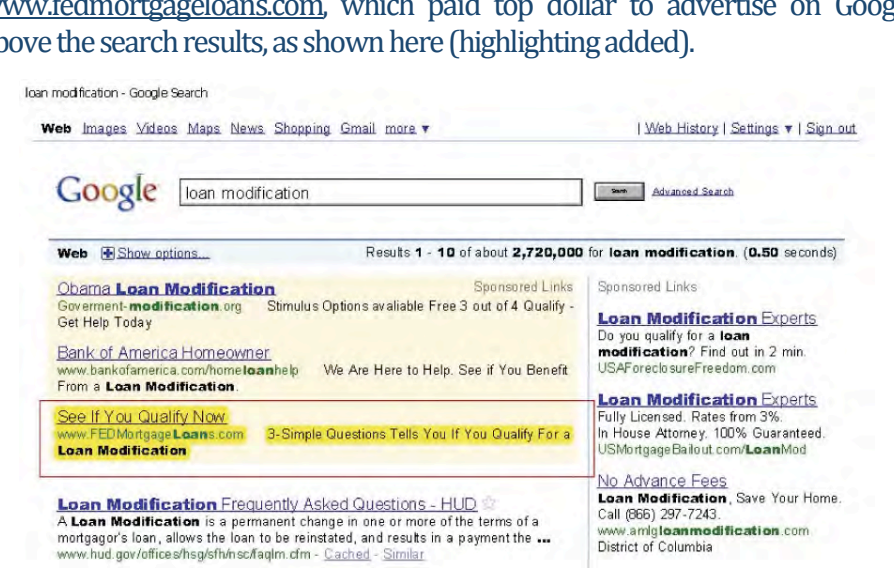
above the search results, as shown here (highlighting added).
- Go gf I The site, which is draped in references to the federal government, was used to collect personal financial information and then direct callers to a company in Utah selling loan modifications.
Internet registration records show that www.fedmortgageloans.com runs on two 123 Creator nameservers. Other sites on the 123 Creator nameservers include www.fedcreditrelief.com, which is very similar to fedmortgage loans, and www.modifyhomedebt.com.
At www.FEDMortgageLoans.com, homeowners were instructed to “Fill out the Form to the Right and answer the Three Questions, and find out instantaneously if your Mortgage is Eligible for the Obama Federal Loan Modification Program.”
Underneath the instructions is an official‐looking graphic of 1600 Pennsylvania Avenue reading: THE WHITE HOUSE WASHINGTON There are also small logos for the Department of Housing and Urban Development and the Treasury Department at the bottom of the page.
When you put in your current mortgage payment, your loan amount, and the name of your bank, the site gives you a hearty congratulation, as seen on the next page.
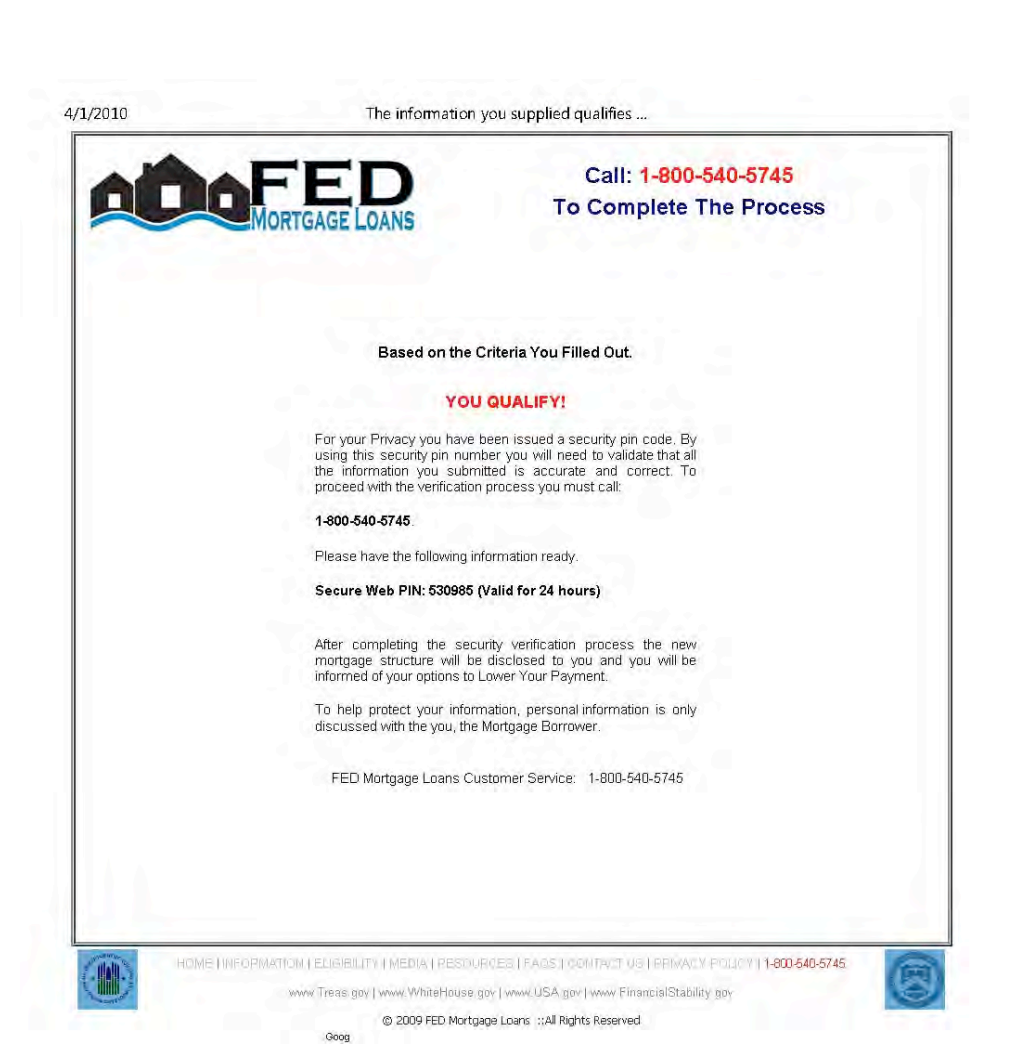
Note the fake government logos at the bottom corners. When the homeowner calls the 800 number and provides the PIN number, the call is transferred to an entirely different company based on the information that was provided. When Consumer Watchdog tried it, a salesman came on the line and identified himself as an employee of Fortified Financial, a small company in Utah that was incorporated in 2004 (see http://www.fortifiedfinancial.com/about.i).
The salesman said Fortified doesn’t own the FEDMortgageLoans website, which is actually owned by “an advertising company,” he said. “There are quite a few sites out there,” he observed.
Rambadt has some familiarity with financial distress, having filed for bankruptcy in 2002. There’s also a long, depressing tale featuring Rambadt that was posted on the web a few years ago by a small businessman who bought some used equipment from a company where Rambadt was vice president (see http://www.ts‐aligner.com/universal.htm).
It’s important to understand that Google advertisers such as 123 Creator do not hide out deep in the behemoth’s paid search results. Rather, 123 Creator has paid top dollar to perch in the upper left part of the Google search page, directly above the topmost search results. This positioning, which Google highlights with an off‐white background, is auctioned off by Google to the highest bidder. Corporate records show that Mr. Rambadt is an officer of a company called Dominant Leads, which is based in the Simi Valley neighborhood of Agoura Hills. The web site for Dominant Leads boasts that it has “the newest and most innovative leads on the market.”
Among the many “products” offered by Dominant Leads is to “Have real‐time Internet debt settlement leads calling you!”
The site explains: “How it Works: We use marketing campaigns that target people inquiring online to relieve their debt. The consumer then fills out the form online and we capture and qualify their information. If the information matches your required filters, the consumer is called immediately. The call prompts the consumer to opt‐in if interested by pressing “1”. Then the consumer is transferred directly to you.”
In June, the FTC sued Rambadt in federal court in Washington, DC., alleging that his mortgage websites falsely presented themselves as affiliated with the U.S. government, that the sites tricked consumers into handing over information by falsely telling them they were eligible for a government program, and lying about the existence of government debt relief programs.
What the FTC complaint does not show is that Rambadt was a kingpin in the market for exploiting consumer financial woe, Internet records show, with at least 236 websites related to credit repair, debt relief, and mortgage modification. The FTC complaint and supporting documents also do not make clear the extent of Google’s role in facilitating this alleged fraud. Without Google’s cooperation, it’s not possible to know how many of Rambadt’s sites were Google customers.
The relationship between Google and the loan lead‐generation industry raises serious legal and policy issues. Such activities could qualify as illegal “pretexting”
- gathering personal financial information under false pretenses. Various state
and federal statutes prohibit this practice. As a policy matter, the relationship between the search engine companies and lead‐generating firms results in large‐scale exchanges of personal financial data in completely unregulated conditions. This exchange could easily evolve into a new black market for personal data used to commit financial crimes against individuals and financial institutions.
7. In Depth: USMortgageBailout Among the sites which surfaced in the CW investigation was www.usmortgagebailout.com, which appeared near the top of the page on Google search results as a paid advertiser in a search performed on March 9 of
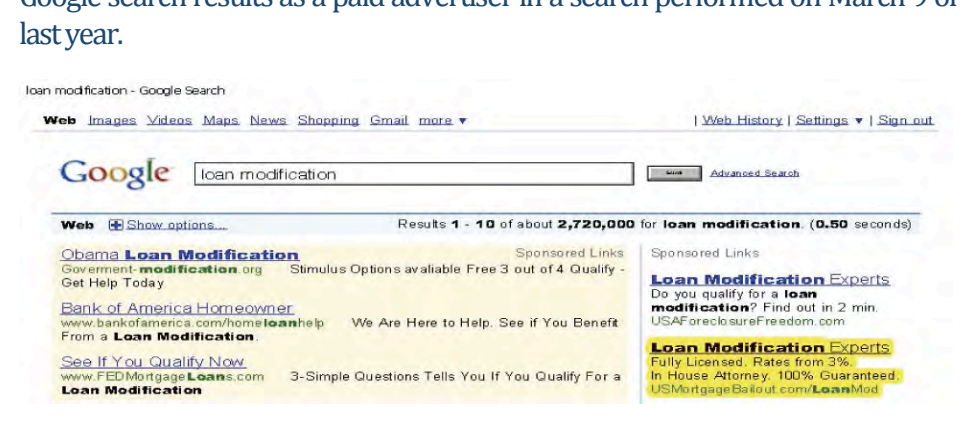
last year.
G USMortgageBailout engaged in several misleading practices, including claiming to be “fully licensed” in its Google ad. But the company which sponsored the site, K2 Capital Management Inc. of La Jolla, was cited by the California Attorney General in August 2009, for failing to register with the state as a loan15 modification company.
USMortgageBailout was one of several sites that displayed a logo for the National Loan Modification Association of America http://www.nlmaa.org/ While the association is designed to look like a nonprofit, Consumer Reports16 revealed that it was actually affiliated with subprime lenders.1516
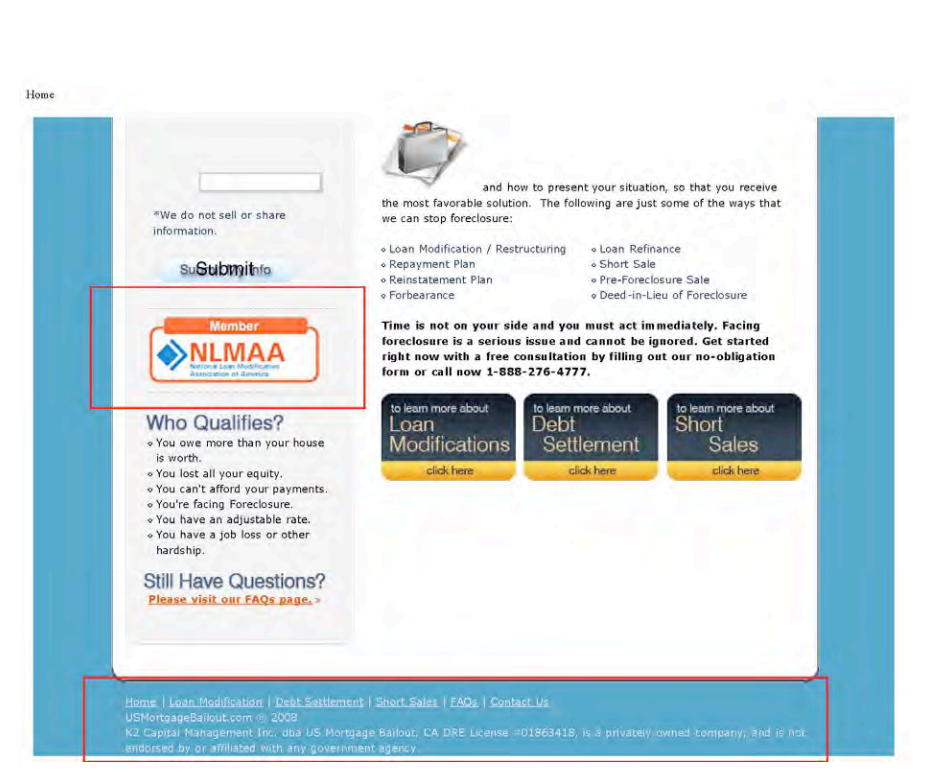
Around that time it was cited by the California AG, USMortgageBailout abruptly closed shop and posted a notice on its website saying it had ceased operations “due to circumstances beyond our control.” However, numerous angry consumers have complained that it did not refund their fees, which often amounted to thousands of dollars.
K2 was set up by K2 Capital Management Inc. of La Jolla, Calif. in 2009, according to the California Department of Corporations. The firm has been the subject of numerous consumer complaints. A large group of angry consumers who claim the firm took their money but offered no help with mortgage modifications have banded together to investigate K2 and tell their sad stories here http://getoutofdebt.org/19149/us‐mortgage‐bailout‐scam‐complaint‐review‐ or‐praise.
In response to inquiries from Consumer Watchdog, many of these consumers said that they found the site via Google searches. While several did not remember exactly how that process unfolded, it’s almost certain that they were drawn by the paid advertisements rather than an organic search – traffic to USMortgageBailout.com would never merit its appearance in the first several pages of organic search results.
8. Lead Generators Pose as Loan Modification Advertisers Many companies that generate “leads” to sell to other companies collect information by advertising on Google. A sampling of these advertisers can be found by searching on Google for ”loan modification leads.” Usually, these companies sell personal financial information about consumers to whomever wishes to buy it.
It is legal to sell personal financial data as long as the information has been provided willingly. However, the FTC has brought cases against companies that allegedly use deceptive practices to get this information, then fail to secure the data once it’s in hand.
One loan modification leads seller that advertises with Google is the Wisdom Companies LLC of Hermosa Beach, Calif., which says it can use consumer personal financial information ”for any legal purpose, including selling or transferring such information at any time to third parties for any legally permissible purchase.”
Wisdom Cos. was the subject of a June 9, 2009 cease and desist order by the Massachusetts Commissioner of Banks for ”not operating honestly, fairly, soundly and efficiently in the public interest.”
During the study Wisdom Cos. was running an ad on Google for loanmodificationleads.com, which claims that 1,000 mortgage modification leads will produce $170,000 in gross profit.
These leads are harvested through Wisdom sites such as Loan Modification Connection, which asks consumers to provide private financial information including income. While Wisdom Cos. doesn’t list its prices, quotes from competitors indicate that prices run from $5 to $20 per customer.
A lengthy privacy policy page discloses that Loan Modification Connection isn’t actually in the business of modifying loans but is rather ”an on‐line consumer service that introduces persons such as yourself to certain of our business affiliates who have expressed a general willingness to review your information and determine if they are willing to provide you with the services or products that prompted you to visit our Site.”
Wisdom also sells leads for credit repair, debt and tax problems. Like many other firms in the mortgage modification industry, Wisdom was heavily into promoting mortgages through Internet advertising until the market tanked in The online lead generation industry, while obscure, is big enough to have its own annual conference in Las Vegas. (See http://www.leadscon.com) According to the Center for Digital Democracy: “Online Led Gen, as its known, is a rarely examined part of the financial services industry: there are big bucks for those marketers who can identify an online user’s interest in a mortgage or loan. Often unwittingly, information that consumers provide on credit card applications, in surveys, contests and other registrations becomes personal data that can be sold to Led Gen brokers. Marketers spent17 $1.7 billion for digital lead generation advertising last year.”17 9. Google’s Responsibility Should Google be policing the content of its advertisers? The answer is clearly yes.
While Google takes the legal position that it has limited responsibility for policing advertiser content, in practice the company regulates advertiser content all the time. Indeed, Google has a whole list of advertising policies for AdWords that limit or prohibit ads for types of products or activities. Online pharmacies, fireworks, and “solicitation of funds” are restricted, as are “images of aborted fetuses,” “gruesome language,” “the sale of hard alcohol and liquor,” or websites that “promote unrealistic claims or promises.” For the whole list see http://adwords.google.com/support/aw/bin/static.py?hl=en&topic=all&page =guidelines.cs&answer=69581&adtype=text&country=US.
In addition, Google has conceded in recent legal cases that it has a responsibility not to permit advertising that it knows is deceptive or fraudulent. Most notably, this occurred in a recent case in Virginia, where Google introduced extensive evidence about these efforts including the fact that it employs a “Trust and Safety Manager” named Cory Louie whose job it is to “address the source of risk, fraud and abuse issues on a wide range of Google products and services,18 including the distribution of counterfeit goods.”
Google is not alone in selling ads to deceptive marketers and sleazy loan modification companies. Yahoo and Bing engage in similar practices. But Google’s acceptance of this misleading advertising is surprising for a company that prides itself on being benevolent. As the all‐powerful market leader, Google should be setting a positive standard for its industry.
Google and the other search engine providers can hardly claim they haven’t been warned about the unethical practices of these marketers. In addition to some high‐profile lawsuits, the FTC is in the process of writing new rules that18 make it even clearer that deceptive loan modification ads are unacceptable and illegal. See http://www.ftc.gov/os/2010/02/100204marsfrn.pdf.
The first draft of these rules was published on June 1, 2009.
10. Conclusions And Recommendations Google has profited significantly from fraudulent advertising in the consumer financial sector, despite numerous government warnings and company policies against the acceptance of misleading ads.
Google should take immediate steps to purge misleading mortgage and credit repair ads from its search engines and donate to charity all revenue it received from questionable sources.
The Federal Trade Commission, for its part, should be more aggressive in taking action against search providers who run deceptive ads.
Here are five specific recommendations: 1) Google should be more diligent in screening advertising in areas such as mortgage modification and credit repair where fraud is known to be a serious problem. If the company finds that screening ads is not feasible, it should ban all advertising in areas where regulatory agencies have shown that fraudulent advertising is endemic.
2) Where fraud is a known problem but legitimate firms also operate, Google should use its advertising techniques to post public service ads that counter deceptive ads. For example, if a loan modification ad refers to the federal government, a Google‐sponsored disclosure statement should appear prominently alongside to warn consumers that they should be wary of mortgage lenders using such terms.
3)Google should initiate and help set industry‐wide standards to prevent fraudulent advertising on the Internet.
4) Google should donate revenue it has received from questionable financial advertising to non‐profit groups that help consumers with credit problems, including homeowners seeking to avoid foreclosure.
5) The Federal Trade Commission should begin using its legal authority under the Lanham Act to seek injunctions against search providers who accept large inventories of advertising from firms they have reason to believe are engaged in deceptive practices.