Executive Summary
When California’s insurance regulator operated behind closed doors, the insurance companies always won. Insurance premiums soared, people were denied insurance for no legitimate reason, and insurance companies reaped windfall profits. That’s why, when California voters passed the nation’s most sweeping reform of the insurance industry in 1988, they authorized consumers to independently challenge excessive insurance premiums and unfair practices—to take on the legions of lawyers, lobbyists, and actuaries that insurance companies always hire to get their way. Proposition 103 also gave the public the power to make sure the Insurance Commissioner and the California Department of Insurance (CDI) obey the law. The initiative requires insurance companies to pay the costs when consumers do so.
Since Proposition 103’s passage thirty-five years ago, Consumer Watchdog and other non-profit citizen organizations have effectively used these rights to protect
The insurance
the public against illegal insurance rates and practices, including discrimination. Now the powerful insurance
industry’s
industry and its Sacramento allies are aiming to cripple the right of the public to participate in the regulatory process—
disinformation
and attacking Consumer Watchdog for successfully doing so.
apparatus is fully
The insurance industry’s disinformation apparatus is fully
engaged in a
engaged in a campaign to escape accountability so the companies can hike rates beyond what they need and refuse
campaign to escape
to sell insurance to people who have paid their premiums for decades. Proposition 103’s rate review process and
accountability.
public participation rights are crucial tools to ensure the industry does not get away with blaming climate change for its unjustified price-gouging and coverage reductions.
To make sure consumers are fully informed, Consumer Watchdog has prepared a detailed analysis of its advocacy on behalf of Californians through the public participation process, from 2002 through 2023.
Consumer Watchdog has saved Californians $5.51 billion. Between January 2002 and December 2023, Consumer Watchdog’s challenges blocked $3.16 billion in auto insurance overcharges; $2.25 billion in unjustified increases in homeowners insurance; and protected health care providers and small businesses against $99.08 million in higher rates.
Since 2019 alone, Consumer Watchdog’s rate challenges have saved Californians $2.1 billion. Insurance companies have filed more than 25,000 applications for approval of rates, underwriting rules, class plans and other filings since Insurance Commissioner Ricardo Lara took office in January 2019. Between then and December 2023, Consumer Watchdog completed a total of 42 challenges to those applications. Thirty-three of those challenges concerned requests for approval of rate changes (as opposed to other illegal rating practices and conduct). In 19 of those rate challenges, the proposed rate increase was approved at a lower percentage than the company originally requested—ranging from 0.6 to 21.6 percentage points lower. In seven of the 33 cases, the insurance company chose to withdraw its application rather than proceed to address Consumer Watchdog’s objections. And in seven instances, the Commissioner approved the rate the company originally requested.
For every $100 that Consumer Watchdog saved policyholders, policyholders paid an average of less Consumer than 25 cents. Insurance companies paid a total of $11.6 million in fees and expenses for Consumer Watchdog’s Watchdog has attorneys, advocates, and experts for their work on behalf of consumers in over 140 proceedings over the last 21 years. Just
saved consumers
over half of those fees went to outside experts with special knowledge, such as geologists and economists, who Consumer
$5.5 billion
Watchdog hired to counter the industry’s experts. For every $100 that Consumer Watchdog saved policyholders,
challenging
policyholders paid less than 25 cents.
unjustified
When Consumer Watchdog did not intervene, insurance companies got most of the rate increase
insurance rates.
they requested. Consumer Watchdog compared the outcome of the rate requests that Consumer Watchdog challenged with the ones it did not challenge between January 2022 and October 2023. In rate applications for homeowners insurance that Consumer Watchdog did not challenge, the Commissioner approved the applications at an average of 97% of the rate originally requested by the insurance company. In matters in which Consumer Watchdog participated, the approved rate averaged 62% of the rate requested. Similarly, in auto insurance rate applications the Commissioner approved rate increases at an average of 98% of the rate requested. When Consumer Watchdog participated, the Commissioner approved an average of 71% the rate requested.
Consumer Watchdog challenged an additional nine applications for violations of other Proposition 103 requirements. In nine challenges brought by Consumer Watchdog and resolved between January 2019 and October 2023, the organization targeted illegal conduct such as: an insurance company’s failure to comply
with public disclosure requirements, including disclosure of computer models; the use of discriminatory “underwriting guidelines” to deny persons an insurance policy; and the use of illegal criteria to set auto insurance premiums, such as whether a person has a professional job or an advanced educational degree. The Commissioner required companies to change these practices in some instances. In others, the Commissioner stated he would address them by issuing a regulation—but has not done so. Insurance companies are responsible for delays that add months or even years to the review process. Consumer Watchdog identified at least eight challenges completed during Commissioner Lara’s tenure that were significantly delayed by the insurance company applicant, by up to 19 months. Such delays routinely occur when insurance companies fail to file all of the paperwork required as part of a rate application, refuse to cooperate with requests from CDI and Consumer Watchdog for information that is needed to assess the validity of the proposed rate, “update” their requests with new data, slow walk the entire process when a rate decrease is required, or assign a lower priority to the review of their application.
CDI scheduling also drives the timeline for review of rate applications, taking an average of 7.2 months before requesting a conference on Consumer Watchdog’s challenge. After a consumer challenges an insurance company’s application for a rate increase, a critical step in the review process is a request by the Department of Insurance to schedule an initial conference between the Department staff, the insurance company, and Consumer Watchdog.
Of the 35 Consumer Watchdog challenges that concluded between January 2019 and October 2023, 24 reached the scheduling stage. In those matters, from the date Consumer Watchdog filed the challenge, it took the Department an average of 7.2 months to schedule the initial conference with all parties. In 18 of the 24 matters that reached the scheduling stage, the first all-parties conference occurred after three months, after six months in 8 of these matters, over a year in 5 matters, and more than 18 months in 4 of the 24 matters.
Once CDI scheduled the first conference, it took an average of one month for the conference to occur, and an average of 3.7 months to resolve the matter. 2022 saw a growing backlog of delayed applications for auto insurance at the CDI. Commissioner Lara imposed a de facto moratorium on the processing and approval of automobile rate increases during most of the pandemic. The moratorium ended shortly after his re-election in November 2022.
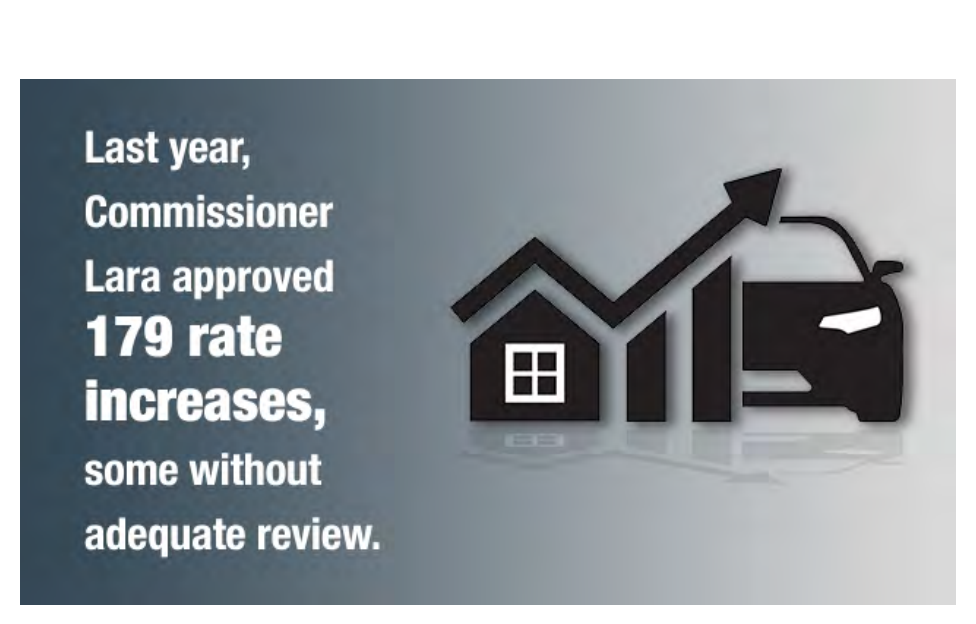
From his 2022 election through last year, Commissioner Lara approved 179 rate increases, some without adequate review. In 2023, the Commissioner has prioritized speed, sometimes over thorough analysis, in his consideration of rate applications. Faced with massive pressure from insurance companies, including widespread shortages in coverage caused by insurance companies, Commissioner Lara approved 61 rate increases for homeowners, averaging 13.4% between December 2022 and December 2023. He also authorized 118 auto insurance rate increases averaging 13.6% during that period.
In several of the 20 rate challenges that Consumer Watchdog resolved this year, its right to adequately review a proposed rate increase was significantly constricted; in two cases, it was eliminated entirely when Commissioner Lara approved rate applications without giving Consumer Watchdog the opportunity to submit its independent analysis. As insurance companies demand more double-digit rate increases, Consumer Watchdog continues its advocacy on behalf of California homeowners and motorists. Home and auto insurance companies continue to request double digit rate increases. In November and December of 2023 alone, Consumer Watchdog resolved six challenges saving Californian homeowners, renters, and drivers another $885 million by reducing the size of the rate increases. As of January 2024, Consumer Watchdog is contesting five additional home and auto applications in which the insurance companies are requesting an average rate increase of 28%.
Background: Public Scrutiny and Participation Under Proposition 103
Over the last year, California insurance companies have created a massive financial crisis for California
One of Prop
homeowners, renters, motorists, and small businesses.
103’s most
They have restricted sales and renewals of home and auto insurance in California and even threatened to leave
important
the state unless they are freed from complying with critical consumer protections of Proposition 103.
safeguards is
At the top of their target list is an especially effective
consumers’ right
provision of that 1988 ballot measure: the right of California consumers to independently review, and
to independently
challenge, excessive or unjustified insurance premiums or any other violation of the voter-approved reforms by an
review rates
insurance company or by the Insurance Commissioner.
History has proven this to be one of the law’s most important safeguards.
Empowering the Public to Enforce the Law They Passed. Proposition 103 regulates auto, home, business and other forms of property/casualty insurance in1 California. Under Proposition 103, “no rate shall be approved or remain in effect which2 is excessive, inadequate, unfairly discriminatory or otherwise in violation of this chapter.” An insurance company must apply to, and get approval from, the Insurance3 Commissioner before it can change its rates, underwriting rules, class plans, and forms. This regulatory system is known as “prior approval.” To obtain approval, insurance companies must open their books and prove that their rates and premiums are reasonable.123 The voters did not leave everything to the Insurance Commissioner, however. They understood that even the strongest reforms could be defeated through indifference or incompetence, neglect or corruption. Elected officials—including the Insurance Commissioner—might undermine the measure’s reforms or prevent the dedicated civil servants who work at the Department of Insurance from doing their jobs. Additionally, as Insurance Commissioner John Garamendi noted in defending Proposition 103’s public participation requirements, there are practical limits on the agency’s ability to enforce the law: The Department goes to great lengths to review the class plan applications that it receives. However, this is no small feat. Like all administrative agencies, the Department must balance its statutory responsibilities with the available resources when exercising its discretion to deploy its prosecutorial authority. In all candor, however, the Department simply lacks sufficient resources to pursue every4 allegation [of insurer misconduct].
For these reasons, the voters gave themselves the power, independent of the Commissioner and the agency he leads, to monitor and enforce Proposition 103, to make sure insurance companies and the Insurance Commissioner obey the law. Here’s what the initiative says: Any person may initiate or intervene in any proceeding permitted or established pursuant to this chapter, challenge any action of the commissioner under this5 article, and enforce any provision of this article.
To enable consumers to exercise these powerful rights, Proposition 103 requires the Commissioner to notify the public when an insurance company requests the Commissioner’s approval. Consumers have 45 days in which to challenge the request,6 which is done by filing a petition for a hearing stating the consumers’ concerns. If the456 insurance company seeks a rate change of 7% or more, a hearing is mandatory unless the7 insurer, CDI, and consumer participant come to an agreement on the rate. Historically, the vast majority of applications have not been subject to a consumer challenge. Of the tiny fraction that were, virtually all of them were resolved prior to a public hearing before an Administrative Law Judge. The last hearing held by the CDI on a rate application concluded in 2016.8 Insurance companies bear the responsibility for thoroughly justifying their requests. Everything that an insurance company submits in support of a rate change must be open9 to public scrutiny. Although insurance companies are required to provide a “complete” rate application, with detailed information required by the CDI, companies often fail to do so. Moreover, the application is only the starting point for the thorough analysis of a request. Both the Department and the consumer representative typically ask the insurance company to provide more detailed information to justify their proposed rate. The timeline for review of a challenged application is frequently dictated by these responses.
With billions of dollars at stake every year, insurance companies employ thousands of skilled lawyers, actuaries, scientists, engineers, lobbying and consulting firms, and even academic institutions to make sure that their interests are protected before the Insurance Commissioner (and the courts).
It takes significant expertise and resources to counter the industry’s army. To enable consumers to go head-to-head with insurance companies, and, if necessary, the Commissioner and his staff, Proposition 103 requires the insurance companies to pay the fees and expenses of attorneys, advocates, actuaries, and other experts who represent consumers in such challenges. No consumer or non-profit consumer advocacy organization could afford to undertake such a mission otherwise. Proposition 103 states: The commissioner or a court shall award reasonable advocacy and witness fees and expenses to any person who demonstrates that (1) the person represents the interests of consumers, and, (2) that he or she has made a substantial contribution7891011 to the adoption of any order, regulation, or decision by the commissioner or a12 court.
Because there is no single “correct” insurance rate—a rate must be within the range bounded by “inadequate” and “excessive”—there is considerable room for judgment. The purpose of Proposition 103’s public participation process is to empower consumers to participate and provide a different analysis than the insurance company, even if the Insurance
Proposition 103
Commissioner ultimately does not agree with the consumer representative’s position.
helps
Once a proceeding has been resolved, the consumer
level the playing
representative who initiated the challenge (sometimes referred to as an “intervenor”) is entitled to compensation for their
field between
expenses so long as they can show they “represented the interests of consumers” and made a “substantial contribution”
13insurance
during the proceeding. In recent years, Administrative Law Judges within the CDI’s Administrative Hearing Bureau have
companies and
been assigned to review and decide compensation requests.
the public.
As the California Supreme Court summarized: “Proposition 103 was enacted to ‘ensure that insurance is fair, available, and affordable for all Californians.’ To achieve this goal, the drafters established a public hearing process for reviewing insurance rate changes. In doing so, the drafters sought to ‘enable consumers to permanently unite14 to fight against insurance abuse . . . .’” The compensation standard is specifically intended to achieve what another court noted was Proposition 103’s “wholly distinct15 purpose”: encouraging “broad consumer participation.”16 Sixteen states allow consumers to intervene in utility rate matters. Indeed, California law permits consumer advocates to intervene in proceedings at the Public Utilities Commission and be compensated by the regulated public utilities if they make a1213141516 “substantial contribution.” But unlike those statutes, Proposition 103 contains none of the restrictions that enable a state agency to deny compensation when the intervenor has made such a contribution.
Proposition 103 helps level the playing field between insurance companies and the public. In a nationwide survey of state insurance laws, the Consumer Federation of America termed Proposition 103 a “unique success,” and expressly recommended its public participation procedures: “In order to achieve the most effective form of a prior approval system, states should construct an intervenor system that provides resources for citizen and organizational watchdogs who can serve as both a resource for and check on state Departments of Insurance and who will help hold insurance rates down to appropriate18 levels.”
Findings and Analysis The data presented here detail the results of Consumer Watchdog’s advocacy on behalf of Californians and illustrate why public participation is crucial to the success of Proposition 103’s reforms.
The report analyzes the financial benefits to Californians of Consumer Watchdog’s challenges to proposed changes in insurance company rates, rules, class plans, forms, and practices since 2002. And it examines in greater detail 42 instances during Commissioner Lara’s administration (January 7, 2019 to December 2023) in which Consumer Watchdog contested an insurance company’s application for such changes in a proceeding that has concluded.1718
I. Rate Challenges Saved Consumers Billions
Between January 2002 and December 2023, Consumer Watchdog reviewed and challenged more than 140 rate applications submitted by insurance companies seeking to unjustifiably increase—or sometimes insufficiently lower—their rates.
Comparing the amount of the rate change that the insurance company originally requested with the final amount approved, the organization’s challenges during that period saved Californians $5.51 billion—$3.16 billion in auto insurance overcharges; $2.25 billion in unjustified increases in homeowners insurance; and $99.08 million in
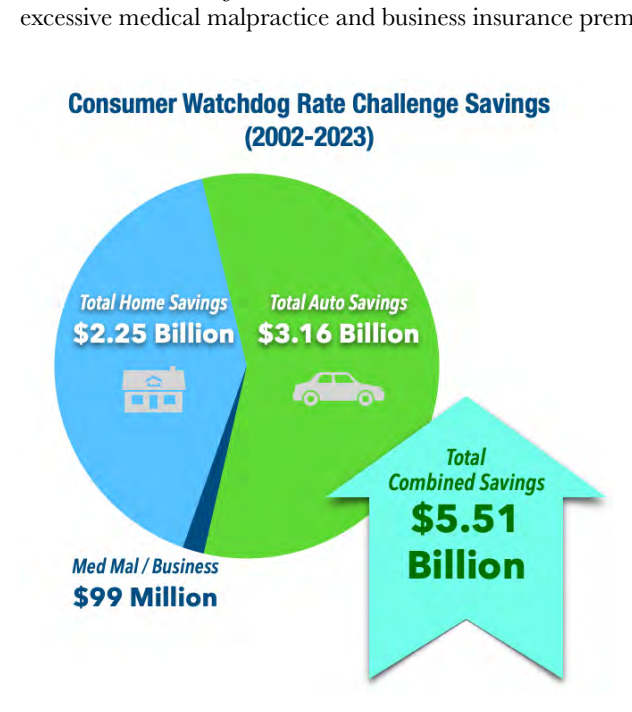
excessive medical malpractice and business insurance premiums.
A spreadsheet providing details on each of Consumer Watchdog’s challenges to insurance company filings since 2002 is downloadable at19 this footnote. Proceedings discussed in this report are cited by their CDI case number, for which the spreadsheet can be searched.
They can also be accessed by searching SERFF, a database available on CDI’s website, by the case number listed in the footnote for that proceeding in20 this report.
The following charts show the twenty home and auto challenges in which Consumer Watchdog saved Californians the most money since 2002.1920
Savings: Top 20 Consumer Watchdog Home Insurance Rate Challenges, Jan. 2002 – Dec. 2023
| Rank | Company | Amount of Savings | Date Approved | File No. |
|---|---|---|---|---|
| 1 | Farmers | $276,000,000 | 2023 | PA-2023-00009 |
| 2 | State Farm | $266,000,000 | 2006 | PA-06092759 |
| 3 | Allstate | $250,000,000 | 2008 | PA-2006-00006 |
| 4 | State Farm | $199,737,857 | 2023 | PA-2023-00007 |
| 5 | Farmers | $171,000,000 | 2006 | PA-06093078 |
| 6 | State Farm | $157,000,000 | 2013 | PA-2011-00010 |
| 7 | State Farm | $156,000,000 | 2016 | PA-2015-00004 |
| 8 | Farmers | $121,000,000 | 2023 | PA-2022-00007 |
| 9 | State Farm | $86,000,000 | 2014 | PA-2013-00012 |
| 10 | CSAA | $52,046,800 | 2012 | PA-2010-00014 |
| 11 | Safeco | $40,500,000 | 2006 | PA-06093080 |
| 12 | USAA | $40,500,000 | 2014 | PA-2013-00008, PA-2013-00009, PA-2013-00010 |
| 13 | USAA | $40,000,000 | 2005 | PA-2010-00008 |
| 14 | State Farm | $35,100,000 | 2016 | PA-2016-00010 |
| 15 | Fireman’s Fund | $35,000,000 | 2008 | PA-2007-00017 |
| 16 | Allstate | $34,200,000 | 2016 | PA 2015-00009 |
| 17 | Farmers | $27,000,000 | 2017 | PA-2016-0008 |
| 18 | Farmers | $24,244,585 | 2008 | PA-2008-00007 |
| 19 | State Farm (Rental) | $21,509,293 | 2023 | PA-2023-00006 |
| 20 | Safeco (Earthquake) | $19,300,000 | 2006 | PA-04041210 |
Savings: Top 20 Consumer Watchdog Auto Insurance Rate Challenges, Jan. 2002 – Dec. 2023
| Rank | Company | Amount of Savings | Date Approved | File No. |
|---|---|---|---|---|
| 1 | Farmers | $535,000,000 | 2023 | PA-2023-00008 |
| 2 | GEICO | $356,008,006 | 2023 | PA-2023-00013 |
| 3 | Allstate | $250,000,000 | 2007 | PA-2007-00004 |
| 4 | CSAA | $192,400,000 | 2023 | PA-2023-00004 |
| 5 | State Farm | $151,709,663 | 2023 | PA-2023-00012 |
| 6 | Allstate | $149,524,857 | 2023 | PA-2023-00014 |
| 7 | Interinsurance Exchange of the Automobile Club | $140,716,762 | 2008 | PA-2008-00026 |
| 8 | State Farm | $131,400,000 | 2009 | PA-2008-00021 |
| 9 | GEICO | $117,946,624 | 2011 | PA-2010-00013 |
| 10 | Mercury | $115,001,845 | 2010 | PA-2008-00037 |
| 11 | State Farm | $100,000,000 | 2004 | File No. 04-4539 |
| 12 | 21st Century Casualty Company | $95,926,605 | 2009 | PA-2008-00034 |
| 13 | Allstate | $95,197,281 | 2012 | PA-2011-00011 and PA-2011-00013 |
| 14 | Farmers | $93,900,000 | 2004 | PA-04039720 |
| 15 | Allstate | $92,991,856 | 2013 | PA-2013-00003 |
| 16 | Farmers | $73,427,908 | 2010 | PA-2008-00032 |
| 17 | Interinsurance Exchange of the Automobile Club | $70,200,000 | 2013 | PA-2012-00009 |
| 18 | State Farm | $69,000,000 | 2013 | PA-2012-00006 |
| 19 | Farmers | $46,000,000 | 2013 | PA-2012-00011 |
| 20 | Allstate | $34,680,358 | 2010 | PA-2008-00038 |
Rate challenges during Insurance Commissioner Lara’s administration.
Commissioner Lara took office in January 2019. Since then, insurance companies have filed more than 24,000 applications seeking the Insurance Commissioner’s approval as required by Proposition 103. Between January 2019 and December 2023, Consumer Watchdog initiated a total of 42 challenges that were resolved during that period. Of those challenges, 33 were to proposed rates. In 19 of those,
Consumer
the proposed rate increase was approved at a lower percentage than the company requested—ranging from 0.6 percentage
Watchdog’s
points to 21.6 percentage points lower. In two of those 19 matters, Consumer Watchdog not only blocked an increase but
advocacy has
secured a decrease in the company’s existing rates. In seven of the 33 rate challenges, the insurance company chose to21
saved consumers
withdraw its application rather than justify its request.
a total of $2.1
Consumer Watchdog’s advocacy has saved consumers a total of $2.1 billion since 2019, including $2.03 billion in 2023 alone.
billion since 2019,
In seven instances where Consumer Watchdog challenged
22including
rates, Commissioner Lara approved the rate as requested. In two of those rate applications, the insurance company
$2.03 billion in
established to Consumer Watchdog’s satisfaction that its request was justified after initial investigations. However, this year the
2023 alone.
Commissioner approved several increases in full without allowing Consumer Watchdog to complete its independent analysis, as discussed below. One additional proceeding concerned an insurance company’s rating rules, not a rate change, and also resulted in savings.
Here are a few noteworthy examples of how Consumer Watchdog’s participation obtained significant savings for Californians since 2019.2122
CSAA Homeowners Insurance: Approved Sept. 2021
Savings: $14.75 million saved + three-year non-renewal moratorium
In November 2020, CSAA—the Northern California DY U T S E AS C affiliate of the Auto Club—filed an application requesting the Commissioner’s approval of an increase to its home23 insurance coverage averaging 20%. Consumer Watchdog reviewed the application and identified multiple concerns, including the following issues: (1) CSAA proposed to use two separate computer models to calculate potential losses from fires that follow earthquakes, but failed to establish that the models’ projections met actuarial and legal standards, particularly because there was a difference of 140% between the results of the two models; and (2) CSAA’s application did not provide adequate support for certain data and actuarial techniques and assumptions, resulting in overstated losses and expenses.
Concluding that the proposed rate was potentially excessive, Consumer Watchdog challenged the application in January 2021. CSAA and Consumer Watchdog discussed the issues raised by Consumer Watchdog and agreed to work collaboratively to expedite the review process. The company’s lawyers promised to provide written responses and documentation requested by Consumer Watchdog.
Between February and August 2021, Consumer Watchdog requested information including the underlying data and calculations concerning the models’ loss projections; the process by which a policyholder can apply and qualify for the 10% individual property and 5% community mitigation discounts then offered by CSAA; and documents, analyses, or studies which evaluated the impact on expected claims payments of the criteria the company used to set those mitigation discounts. CSAA provided most of the information Consumer Watchdog requested. However, it refused to provide the data concerning the models, claiming the information was confidential.
Though CDI staff was kept apprised of the communications between Consumer Watchdog and the company, CDI convened the first formal call with all three parties— Consumer Watchdog, CSAA, and CDI—in May 2021.
In July 2021, Consumer Watchdog provided its actuary’s written analysis of CSAA’s application, and further exchange of information and discussions followed. In early August, CDI proposed that the parties agree to an overall rate increase of 17.3%—23 midway between the rate proposed by Consumer Watchdog and the rate proposed by the Department.
CSAA did not agree to the CDI compromise proposal. However, CSAA informed the Parties that it would agree to a three-year moratorium on non-renewals due to wildfire risk and would also expand access to its wildfire mitigation discounts, if it obtained what it considered a sufficient rate increase.
Subsequently, Consumer Watchdog proposed that the parties agree to the following: an overall rate increase of 18.2%; a three-year moratorium on non-renewals due to wildfire risk; an additional 5% property mitigation discount on top of the company’s existing discounts; a phase-in of any large individual premium increases, which would be capped at 65% for the first renewal term; and CSAA would agree to report to the Department and Consumer Watchdog quarterly for the first two years following the effective date of the filing concerning the implementation of the wildfire mitigation discounts. To this, CDI additionally proposed, among other things, that CSAA provide a longer moratorium on non-renewal for those policyholders who qualified for and maintained the mitigation discounts, and agree to identify and adopt additional mitigation efforts that are most achievable to consumers in order to expand participation in the mitigation programs. Ultimately, Consumer Watchdog, CDI, and CSAA agreed to an overall rate increase of 18.55%, with the following additional savings and protections: the phase-in of large individual premium increases for policy renewals, capping the maximum individual premium change at 65% for the first renewal term; the additional 5% individual property mitigation discount; and quarterly reports to the Commissioner for two years concerning policyholders who qualified, applied for, and obtained the mitigation discounts, which reports would be made available to Consumer Watchdog.
Critically, CSAA also agreed to a three-year moratorium on non-renewals due to wildfire risk for policies with effective dates in years 2021, 2022, or 2023, as well as a five-year moratorium on non-renewals for policyholders who qualify for CSAA’s two original mitigation discounts.
The direct benefits to policyholders of the collaborative review process that characterized this proceeding are significant. The agreed-upon rate increase resulted in a savings of $9.95 million in the first year after implementation over the rates originally proposed by CSAA. Capping the impact of the rate increase on certain policyholders resulted in additional savings of about $4.8 million, for a total savings of $14.75 million. Expansion of CSAA’s property mitigation discounts—well before new mitigation discount regulations took effect—incentivizes policyholders to harden their homes and puts the company at the forefront of this important policy. Protections against non-renewals are also a benefit, since many insurance companies have since withdrawn from selling policies to new customers or are non-renewing existing customers.
Farmers Auto Insurance: Approved August 2023
Savings: $535 million saved
On March 31, 2023, CDI informed the public that Y D U California-based Farmers Insurance Group had requested a T S E S A C $793 million, average 29.9% increase in auto insurance24 premiums. Consumer Watchdog reviewed the request and petitioned for a hearing on the proposed increase on May Consumer Watchdog’s challenge contended that the increase was unjustified because it ignored $215 million in underwriting profits from 2021, that Farmers’ projections of future losses were overstated, and that the company was improperly using motorists’ occupation to set premiums.
Consumer Watchdog also objected to requiring motorists to shoulder the excessive annual “management fees” that Farmers pays to its affiliate Farmers Group Inc., ostensibly to provide administrative services. In 2021, Farmers paid about $2.8 billion in “management fees” to Farmers Group Inc., the affiliated management company owned by Swiss-based25 Zurich Insurance Group. In 2021, Zurich reported a profit of $1.53 billion from the26 management fees it collected from Farmers. Consumer Watchdog concluded that the management fee payments were in violation of a CDI regulation which excludes payments to affiliates from being included in policyholders’ rates to the extent such27 payments exceed the fair market rate or value of services in the open market. Aware of the Commissioner’s pressure to speed up the agency’s review of rate increases, Consumer Watchdog asked Farmers to provide additional information about the applications within days of filing the challenge—even before the agency granted Consumer Watchdog’s petition to participate. On June 23, CDI scheduled a three-way call for July 7.
In response to Consumer Watchdog’s 28 requests for information, Farmers provided over 4,000 pages of data and information to Consumer Watchdog and the Department to24252627 evaluate the need for the company’s massive rate increase request. It contested Consumer Watchdog’s objections to the company’s projections of future losses, however. And it denied that the management fees were excessive but did not provide any documentation to support its claim that the fees did not exceed fair market value. CDI did not contest Farmers’ unsupported argument about the management fees. CDI also insisted that swift approval of the Farmers applications was a number one priority, though Farmers’ financial and actuarial data did not reflect any urgent financial hazard requiring immediate action.
After additional discussions and exchange of information, Consumer Watchdog negotiated a 67% reduction in the rates sought by Farmers, saving Farmers’ customers $535 million. Consumer Watchdog’s analysis and negotiations throughout this proceeding were key to reaching an agreement to rates that were 67% lower than Farmers’ proposed overall rate increases. Commissioner Lara approved that agreement on August 10, 2023, and the new rates took effect on September 26, 2023.
Medical Insurance Exchange of California: Approved Jan. 2023 Savings: $1.4 million premium reduction; $1.44 million refunds Proposition 103’s protections also apply to insurance companies that sell malpractice liability coverage to physicians and other health care providers. In November 2020, Medical Insurance Exchange of California asked the Commissioner for an overall rate increase of 1.4% for over 1100 doctors. After reviewing the application, Consumer Watchdog requested a hearing on the grounds that the proposed rate was excessive.
Specifically, Consumer Watchdog challenged MIEC’s claim that it had an underwriting loss of $3.7 million in 2019; in fact, the company’s own data showed that it had earned $24.4 million in premiums that year, while its losses totaled just $8.1 million. When combined with expenses during 2019 of $12.1 million, the underwriting profit during 2019 was $4.2 million, or about 17% of premium. The rate increase that MIEC proposed was inconsistent with such huge profits, according to Consumer Watchdog’s analysis. Additionally, Consumer Watchdog argued that MIEC’s projections of future claims and losses were inflated.
CDI requested MIEC provide updated data and responses to questions about the filing, including issues raised in Consumer Watchdog’s petition. More than a year after Consumer Watchdog presented its concerns, MIEC revised its application based on updated data to request a rate decrease of 4.4%. Then, in June 2022, MIEC asked to withdraw its application entirely, because Governor Newsom had recently signed legislation—backed by Consumer Watchdog—to increase compensation to victims of28 medical negligence. MIEC claimed that the new law’s reforms would result in significant losses to the company. Consumer Watchdog objected and asked that MIEC provide additional data to support that argument. MIEC provided no specific data or analysis, however, leading both Consumer Watchdog and CDI to maintain that MIEC’s existing rates were excessive and that a rate decrease greater than 4.4% was justified, and for those reasons the application should not be withdrawn.28 In January of 2023, MIEC agreed to reduce its rates going forward by an average of 7.2%. It further agreed to refund 4.4% of the premiums its policyholder members had paid in 2021 and 2022. As a result, over 1,100 doctors and other healthcare provider policyholders saved $1.41 million in annual premiums under the newly reduced rates compared to the rates originally requested by MIEC.About 4,000 MIEC policyholders received an additional $1.44 million in refunds for the overcharges.
When Consumer Watchdog did not intervene, insurance companies got most of the rate increase they requested.
Consumer Watchdog conducted a separate analysis of rate applications that were before Commissioner Lara between January 2022 and October 2023, comparing the outcome of the rate requests which Consumer Watchdog challenged with the ones it did not challenge.
In rate applications for homeowners insurance that Consumer Watchdog did not challenge, the Commissioner approved the applications at an average of 97% of the rate originally requested by the insurance company. In matters in which CWD participated, the approved rate averaged 62% of the rate requested.
A similar gap is evident in approvals of auto insurance rate applications between 2022 and October 2023. In the requests which Consumer Watchdog did not challenge, the Commissioner approved rate increases at an average of 98% of the rate requested. When29 CWD did intervene, CDI approved at an average of 71% the rate requested. Consumer savings from public participation far exceed the costs.
Insurance companies employ an army of lawyers, actuaries, lobbyists, scientists, engineers, and other experts to help them secure the Commissioner’s approval for their rates and practices. CDI regulations allow a portion of those expenses to be passed through to policyholders in the premiums the companies charge. When ordered to compensate a consumer representative that has made a “substantial contribution” in an administrative proceeding concerning Proposition 103, insurance companies are also permitted to pass those costs on to their policyholders.
Insurance companies paid Consumer Watchdog’s lawyers, advocates, and experts a total of $11.6 million for their work in over 140 proceedings that resulted in the $5.51 billion in savings over the last 21 years. Thus, for every $100 that Consumer Watchdog saved policyholders, policyholders paid an average of less than 25 cents. Slightly more than half29 of that compensation went to the outside actuaries and other experts with special knowledge, such as geologists and economists, who Consumer Watchdog hired to counter the insurance industry’s experts.
Rate Filings Approved by California Dept. of Insurance With & Without Public Participation, Jan. 2022 – Oct. 2023 AUTO INSURANCE RATES APPROVED Without Public Participation With Consumer Watchdog Participation HOME INSURANCE RATES APPROVED Without Public Participation With Consumer Watchdog Participation
AVERAGE RATE INCREASE REQUESTED AVERAGE RATE INCREASE APPROVED 13.8% 13.5% Percent of total rate increase requested that was approved: 97.7%
AVERAGE RATE INCREASE REQUESTED AVERAGE RATE INCREASE APPROVED 16.4% 11.7% Percent of total rate increase requested that was approved: 71.0%
AVERAGE RATE INCREASE REQUESTED AVERAGE RATE INCREASE APPROVED 14.4% 14.0% Percent of total rate increase requested that was approved: 97.3%
AVERAGE RATE INCREASE REQUESTED AVERAGE RATE INCREASE APPROVED 16.8% 10.4% Percent of total rate increase requested that was approved: 62.0%
II. Protecting Consumers from Unfair Insurance Practices
Under Proposition 103, insurance companies must be in compliance with all provisions of30 Proposition 103 before the Commissioner may approve a rate application. Nine of the 42 challenges brought by Consumer Watchdog between January 2019 and December 2023 sought to stop illegal conduct by an insurance company. Here are some examples: Forcing Insurance Companies to Disclose Underwriting Guidelines.
“Underwriting guidelines” are the rules insurance companies use to determine whether they will sell a policy to a particular person, and the premium they will charge that policyholder for an insurance policy. Changes to these rules matter because they can dramatically impact what a consumer pays. Insurance companies are required to submit underwriting guidelines whenever they seek to change their rates—or when a change in31 underwriting guidelines would have an impact on the company’s rates. Proposition 103 requires such information be disclosed to the public and approved by the Insurance32 Commissioner. These rules must also comply with California’s anti-discrimination laws. State Farm, California’s largest insurance company, has long contested its obligation to publicly disclose information under Proposition 103. California courts have twice rejected33 State Farm’s challenges to the disclosure mandate. In 2018, State Farm filed an34 application for an increase in its homeowner insurance premiums. However, the company failed to disclose its underwriting guidelines in its request for an increase. Because State Farm refused to comply with the transparency law, Consumer Watchdog filed a petition challenging not the rate requested, but State Farm’s failure to disclose its underwriting guidelines.3031323334 State Farm resisted Consumer Watchdog’s demand that it publicly file its underwriting guidelines for many months. The company even attempted to strike a deal with CDI to avoid disclosure in a separate State Farm rate proceeding in which Consumer Watchdog had not intervened. Four additional months of delay ensued as State Farm provided multiple sets of supposedly complete underwriting guidelines, while refusing to confirm that any one of them was the operative policy. CDI later told Consumer Watchdog that State Farm had put negotiations regarding its homeowners application on hold because the company preferred to prioritize an auto insurance rate application. Further delays by State Farm, followed by extensive negotiations between Consumer Watchdog, State Farm, and CDI, consumed 20 months. In August 2020, the company finally agreed to publicly file its underwriting guidelines in any rate application the company submitted.
Challenging Discriminatory Practices.
Consumer Watchdog also objects to unlawful practices it uncovers in rate applications. Consumer Watchdog discovered that Pacific Specialty Insurance Company’s current underwriting rules permit the company to deny home insurance coverage for “properties located in a neighborhood not showing pride of ownership or condemned dwellings,” a manifestly subjective, unverifiable, and potentially discriminatory basis for denying35 coverage. The company’s 2020 application for a 6.9% increase—which was updated with additional data multiple times and was resolved in December 2023 at 3%—did not address why “neighborhood pride of ownership” is relevant, how it is determined, or who at the company would have the power to make that determination. Consumer Watchdog
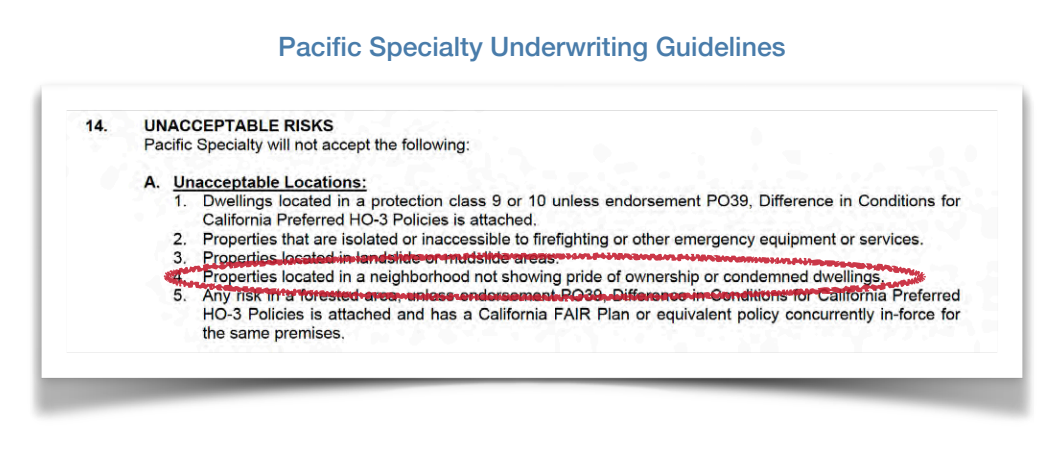
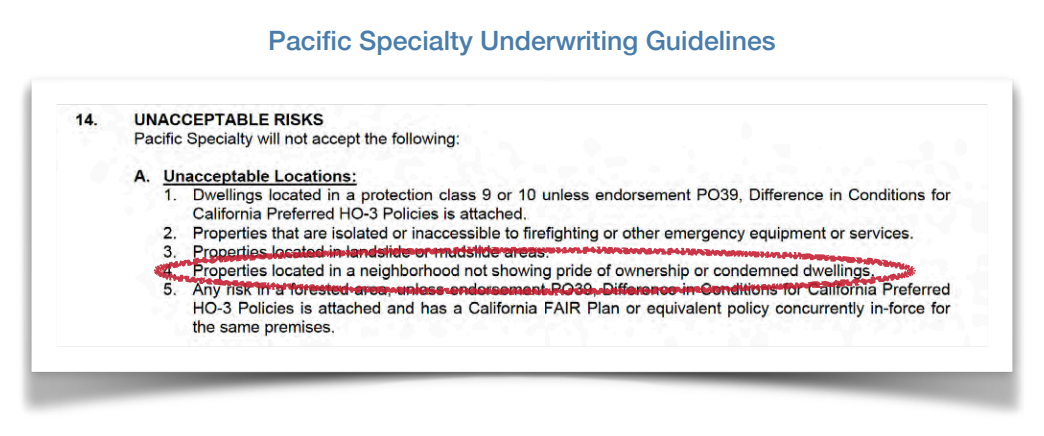
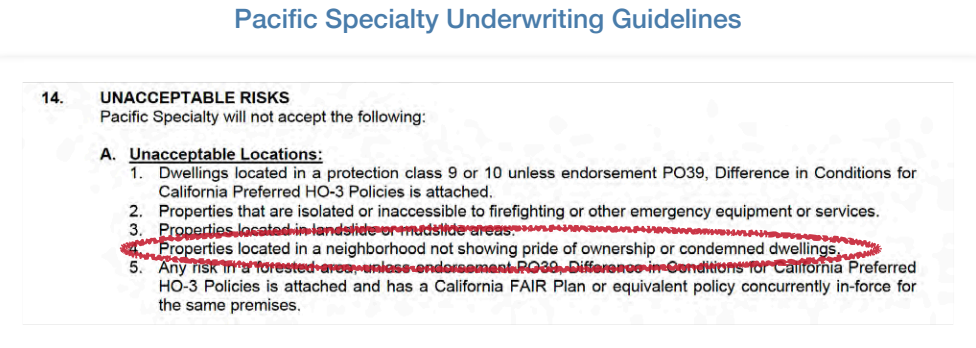
Pacific Specialty Underwriting Guidelines35 successfully advocated to have this and a related eligibility requirement removed from Pacific Specialty’s underwriting guidelines.
Proposition 103 also bars insurance companies from using discriminatory or unauthorized criteria—called “rating factors”—to set auto insurance premiums. Consumer Watchdog has challenged numerous rate applications by insurance companies that use “occupation” and “education” to overcharge motorists who do not have college degrees or white-collar jobs. Doctors, lawyers and accountants pay less than grocery cashiers, janitors, gig-workers, retirees, students, homemakers, and the unemployed. Consumer Watchdog and other citizen groups formally petitioned Commissioner Lara to36 bar the use of occupation and education rating factors in early 2019, but he denied the37 petition. Consumer Watchdog then began challenging their use by individual companies38 through the prior approval process.
Commissioner Lara has acknowledged that basing rates on occupation and education causes “wide socioeconomic disparities,” with the most adverse impact falling on low-363738 income drivers and communities of color. In response to Consumer Watchdog petitions in several individual rate filings, he made a commitment to issue a regulation to address40 the issue. To date, however, Commissioner Lara has yet to issue the promised regulation, and continues to approve the rates of companies that use these discriminatory and illegal rating factors.
Failure to Refund Auto Insurance Overcharges During COVID.
Auto accidents plummeted during the unexpected COVID lockdown that began in March 2020, as Californians’ cars quarantined in driveways across the state. Yet virtually all insurance companies continued to charge the same rates that had been approved well prior to the pandemic.41 Proposition 103 requires insurance companies to maintain reasonable rates at all times. Commissioner Lara issued multiple notices advising insurance companies to provide their customers refunds, but compliance fell far short of the amount drivers were overcharged. Consumer Watchdog estimated that the fifteen largest California auto insurance companies overcharged motorists by $5.5 billion during 2020 alone, of which they42 refunded $1.9 billion, leaving the industry with a windfall of at least $3.6 billion. The organization repeatedly urged the Commissioner to take formal public regulatory actions to enforce Proposition 103: require all auto insurers to submit new rate applications43 reflecting the dramatic drop in claims; issue a binding regulation that would have44 required companies’ compliance; call recalcitrant insurance companies to an394041424344


enforcement hearing as required by Proposition 103; and in the meantime, suspend46 approval of new auto insurance rate increases. Consumer Watchdog also raised the COVID refund issue in the context of applications for rate increases filed by auto47 insurance companies, but Commissioner Lara announced that the refund issue would48 be considered through a separate process. The Commissioner never commenced a public proceeding regarding any company’s failure to provide refunds, however. Rather, Commissioner Lara has negotiated with insurance companies and relieved them of their outstanding refund obligations behind closed doors, as agency communications obtained49 by Consumer Watchdog confirm.4546474849
III. Insurance Company Delays and Department of Insurance Scheduling Drive Rate Challenge Timelines
After a consumer representative challenges an insurance company’s application, the Department and Consumer Watchdog frequently make several rounds of requests for additional financial or underwriting information from the company. There also may be preliminary two-way communications between the insurance company and CDI, between the company and Consumer Watchdog, or between the CDI and Consumer Watchdog. A key milestone in the review process is a conference, scheduled by the CDI, at which Consumer Watchdog, the CDI and the insurance company exchange and discuss their actuarial analyses based on review of the application and additional information obtained from the company. At that meeting, the parties discuss the application, issues raised by Consumer Watchdog’s petition, and outstanding requests for information necessary to evaluate and refine each party’s respective rate calculation.
The time between Consumer Watchdog’s challenge and this initial three-way call is often determined by how much additional financial or underwriting information that was not included in the filing is needed by the Department and Consumer Watchdog to correctly evaluate a company’s request, and how long it takes the company to provide that information.
Consumer Watchdog assessed both metrics in considering the cause of delays. Insurance companies are responsible for delays that add months or even years to the process.
Of the 35 challenges Consumer Watchdog completed between January 2019 and October 2023 during Commissioner Lara’s tenure, at least eight were significantly delayed by the insurance company applicant, by up to 19 months.
There are five common ways that insurance companies cause lengthy delays in the review process. First, they routinely fail to file all the initial data required by CDI regulations as part of a rate application. Second, they frequently refuse to cooperate with requests for additional information that Consumer Watchdog’s or CDI’s actuaries need in order to comprehensively assess the rate application. Third, insurance companies frequently “update” their filings to provide new information, which typically resets the process. Fourth, they often slow walk the entire process when a rate decrease is required, since decreases reduce their revenue. Fifth, insurance companies frequently assign a lower priority to their application. For this analysis, Consumer Watchdog considered any period of more than two months of inaction by the insurance company to be a “significant” delay. Other delays, such as instances in which the insurance company’s responses to CDI or Consumer Watchdog were timely, but incomplete, also occurred but are not quantified here.
Insurance Commissioner Lara testified recently that, in response to his inquiries about the reason for rate review delays, CDI analysts told him that 80% of the time “we’re waiting50 on them [insurance companies] to respond to the information that we need.” Here are examples of matters initiated by Consumer Watchdog during which the insurance company caused lengthy delays. Download a spreadsheet with more examples51 at the link in this footnote.
State Farm Underwriting Guidelines: State Farm’s failure to agree to publicly disclose its underwriting guidelines in an application for a homeowners rate increase— noted above at page 23—delayed approval of a second homeowners insurance rate increase, and an auto class plan filing as well.
Mercury Automobile Class Plans: Under Proposition 103, the rating factors that insurance companies may use to set a motorist’s premium are regulated separately from52 rates. Companies selling auto insurance must submit filings for the Commissioner’s approval known as “class plans” that prove the insurance companies have used lawful rating factors and that they are applied to prioritize rating factors within a motorist’s control, such as driving safety record.
In April 2017, Consumer Watchdog objected to a class plan filing by Mercury Insurance53 and its affiliate, California Auto Insurance Company. The organization noted that Mercury’s rules wrongly treated motorists as if they were at fault in a car accident; the companies used conflicting data; the proposed calculation of the driving safety record rating factor was not in compliance with CDI regulations; Mercury tried to coerce policyholders who were lawyers to submit to arbitration and forfeit their right to sue Mercury in court in exchange for a discount, which is unlawful; and the company improperly set premiums based on a motorist’s education and occupation.50515253 During the summer of 2017, Consumer Watchdog sent Mercury requests for additional information. Mercury agreed to revise its at-fault accident rules so they complied with the law, and agreed to eliminate the arbitration requirement. Then over the course of the rest of 2017 and 2018, Mercury responded to requests by the Department to revise the methodology the company used to determine the discounts/surcharges relating to several of its rating factors. Upon completion of that lengthy revision to its filing, the CDI reached out at the end of February 2019 to schedule a three-way call for the end of March. Only after that lengthy delay, and just prior to that March 2019 call, did Mercury complete its response to several of Consumer Watchdog’s outstanding initial requests. The Commissioner refused to compel Mercury to cease the use of occupation and education, however. After Mercury documented its calculations in connection with the driving safety rating factor and updated its rule manual to conform its at-fault accident rules to the regulations, the matter was resolved in May 2019.
Allstate 2021 Homeowners Increase: In April 2021, Allstate asked the54 Commissioner for an overall +4.6% rate increase to its homeowners rates. Consumer Watchdog challenged the application in June, contending that Allstate had not shown that its computer risk model was properly implemented; had not supported the loss projections it used; had failed to justify its requests for variances from the standard regulatory ratemaking formula; had not properly excluded all expenses for institutional advertising; and had failed to provide data in a spreadsheet format in its rate application, as required by CDI regulations.
Over the course of the next nine months, the CDI and Consumer Watchdog requested additional data and documents to justify Allstate’s proposed rates and underwriting rules. The CDI scheduled a three-way call in May 2022. Eventually, Allstate provided some of the information requested by Consumer Watchdog, but claimed the rest was either proprietary or irrelevant. The parties eventually reached a tentative agreement for an overall rate increase of 2.75%. However, in August 2022, CDI and Consumer Watchdog learned for the first time that Allstate had stopped selling policies in neighborhoods where the company insisted it was still doing business.
After Consumer Watchdog sought detailed information on the change, the company ceased communicating with Consumer Watchdog and CDI—for six months. Negotiations resumed, but in May 2023, Consumer Watchdog discovered that, contrary to Allstate’s assurances that it was still selling new homeowners policies as it had previously agreed, the company had in fact stopped all such sales the previous November. Allstate admitted that it had disengaged in negotiations and confirmed that it had withdrawn from all new business, but contended it was not obligated to publicly notify the Commissioner.54 Insurance Commissioner Lara ultimately agreed to approve a 4.0% rate increase over55 Consumer Watchdog’s objection.
CDI scheduling also drives the timeline for review of rate applications. Of the 35 Consumer Watchdog challenges that were resolved between January 2019 and October 2023, 24 proceeded to the point of at least one conference between all parties. Of those 24, it took CDI an average of 7.2 months to schedule the initial conference. In 18 of the 24 matters that reached the scheduling stage, the first conference was held after three months, in eight of these matters after six months, after a year in five matters, and after 18 months in four of the 24 matters. Once CDI scheduled the first conference, it took an average one month for that conference to occur, and an average 3.7 months from that conference to resolve the matter.
Insurance Company Delays and Department of Insurance Scheduling Drive Rate Challenge Timelines55 The timeline above shows the period from the date Consumer Watchdog filed a challenge to an application, to outreach for the first conference, to the conference, and finally to the resolution of each of the 24 Consumer Watchdog challenges that proceeded to the conference scheduling stage.
Auto Insurance “Moratorium”: According to news reports, Commissioner Lara imposed a de facto moratorium on the review and approval of auto rate increases prior to56 his re-election in November 2022. Just one auto insurance rate increase was approved between January 2021 and November 6, 2022. Several rate decreases were approved in 2021. Although the industry complained it was unable to get the rate increases it needed during that period, and under Proposition 103, insurance companies have a legal right to any rate increase it can prove is necessary, no insurance companies filed suit against the Commissioner challenging the moratorium.56
IV. Not All Rate Increases Are Fully Vetted by Commissioner Lara
Faced with massive pressure from insurance companies to raise home and auto rates and a backlog of unprocessed pre-election applications for auto insurance rate increases, the Commissioner adopted a markedly accelerated approach to his review of rate applications immediately after his re-election in November 2022.
Commissioner Lara approved 61 rate increases for homeowners, condo and renters insurance, averaging 13.4%, between December 2022 and December 2023. He also authorized 118 auto and other vehicle insurance rate increases averaging 13.6% during57 that period.
In 2023, Consumer Watchdog brought and resolved eleven auto insurance, eight homeowners insurance, and one medical malpractice insurance rate increase challenge. In some of those proceedings, the Commissioner prioritized speedy approval of rate increases over the requirement that an insurance company thoroughly justify its requests, at a significant cost to policyholders. In two of the cases, Consumer Watchdog’s right as a consumer representative to thoroughly review an insurance company’s request for a rate increase was abruptly terminated—and rate increases were approved that the insurance58 company had failed to fully justify.
GEICO Auto Insurance. One of those cases was GEICO’s June 2022 request for an59 auto insurance rate increase averaging 6.9%. Consumer Watchdog reviewed the application and determined that GEICO had improperly inflated its projections of future losses by assuming that the sudden increase in driving and claims as the COVID pandemic ended would continue during the year after the requested increase took effect. CDI did not reach out to schedule an initial conference among the three parties until November 18, 2022. Consumer Watchdog requested that GEICO provide further information to justify its application for a rate increase, including data on the impact of COVID-19 on claims and rates, on refunds GEICO provided for overcharges during COVID, as well as on its decision to shut down its sales force in California. GEICO partially responded to the requests, but withheld documents critical to the completion of Consumer Watchdog’s review and analysis of the rate application. For example, GEICO refused to provide data, documents, and/or analysis related to (1) changes in its marketing system, including its decision to close local offices in California and stop selling insurance575859 through telephone agents in the state; (2) the impact of the COVID pandemic on its
private passenger auto insurance costs; and (3) comprehensive trend data for both the frequency and severity of accidents.
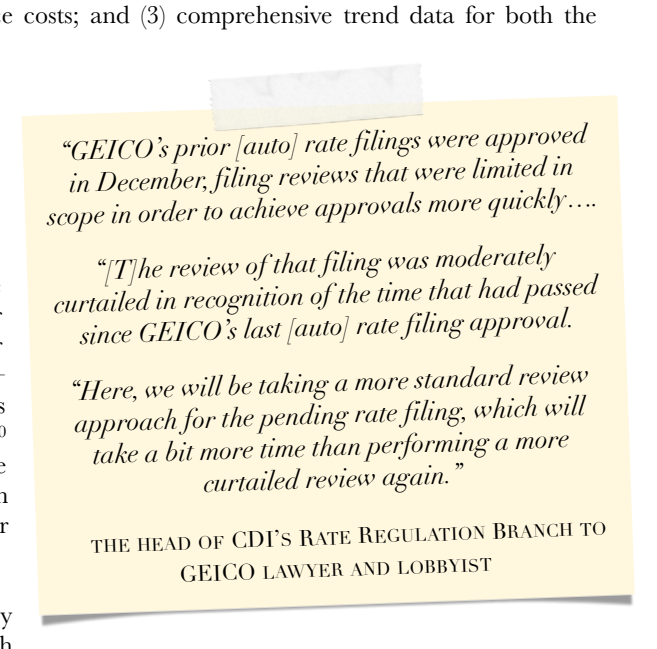
CDI set a December 8, 2022, ved ere appro te filings w or [auto] ra ICO’s pri “GE call with GEICO and in re limited ws that we filing revie December, in Consumer Watchdog to further y….
ore quickl pprovals m o achieve a e in order t scop discuss the application. But on December 6, Commissioner oderately filing was m ew of that “[T]he revi Lara abruptly approved the rate ssed at had pa f the time th ognition o ailed in rec curt increase, ignoring Consumer g approva o] rate filin ’s last [aut nce GEICO si Watchdog’s request for information and objections—ew ndard revi a more sta l be taking ere, we wil “H unlawfully negating its rights ill g, which w g rate filin the pendin proach for 60ap under Proposition 103.
e ing a mor an perform ore time th ake a bit m t GEICO customers’ rates were .”
view again urtailed re c increased by $256 million because of that improper NCH TO LATION BRA ATE REGU OF CDI’S R THE HEAD approval.
YER AND L CO LAW GEI Communications obtained by Consumer Watchdog through public records disclosure requests show that lawyers for GEICO then pressured the agency for hurried approval of a subsequent rate increase. In response, the head of CDI’s Rate Regulation Branch acknowledged that “GEICO’s prior [auto] rate filings were approved in December, filing reviews that were limited in scope in order to achieve approvals more quickly….” As he explained, “[T]he review of that filing was moderately curtailed in recognition of the time that had passed since GEICO’s last [auto] rate filing approval.” But, he warned, “Here, we will be taking a more standard review approach for the pending rate filing, which will take a bit more time than performing a61 more curtailed review again.”6061 Three other challenges initiated by Consumer Watchdog, objecting to proposed increases by Mercury Insurance, Auto Club of Southern California, and Allstate, were64 arbitrarily curtailed, resulting in rates that the company had not fully justified. Information obtained by Consumer Watchdog through official records requests and other public sources show that Commissioner Lara has met repeatedly with insurance companies that have rate applications and other matters pending before him—including65 matters initiated by Consumer Watchdog and discussed in this report. For example, Commissioner Lara met with both Farmers Insurance and GEICO while the companies’ auto insurance rate proceedings, detailed above, were ongoing. Records also reveal that the Chief Deputy Commissioner Michael Martinez—second in command to the Commissioner—has personally intervened in pending rate matters at the urging of insurance companies. Martinez testified before the legislature in March 2023: “We have been working very closely I believe with industry on homeowners and commercial filings – and that is something that hopefully others can attest to in this room – that I personally have been working very closely with trade associations to flag those68 particular filings that can help be able to move the ball forward….” It is improper for the Insurance Commissioner—who is the decider, or judge, in a rate case—or his Chief Deputy to discuss an insurance company’s pending rate case with the insurer and then intervene on that rate case with agency civil servants. Such intervention62636465666768 with agency staff at a minimum places enormous pressure on them to act quickly. At worst, it is a tacit instruction that the Commissioner wants a rate approved immediately, or at a higher level than is justified, regardless of whether it has been carefully vetted or staff finds the company’s requested increase is too high.
Obtained by Consumer Watchdog through
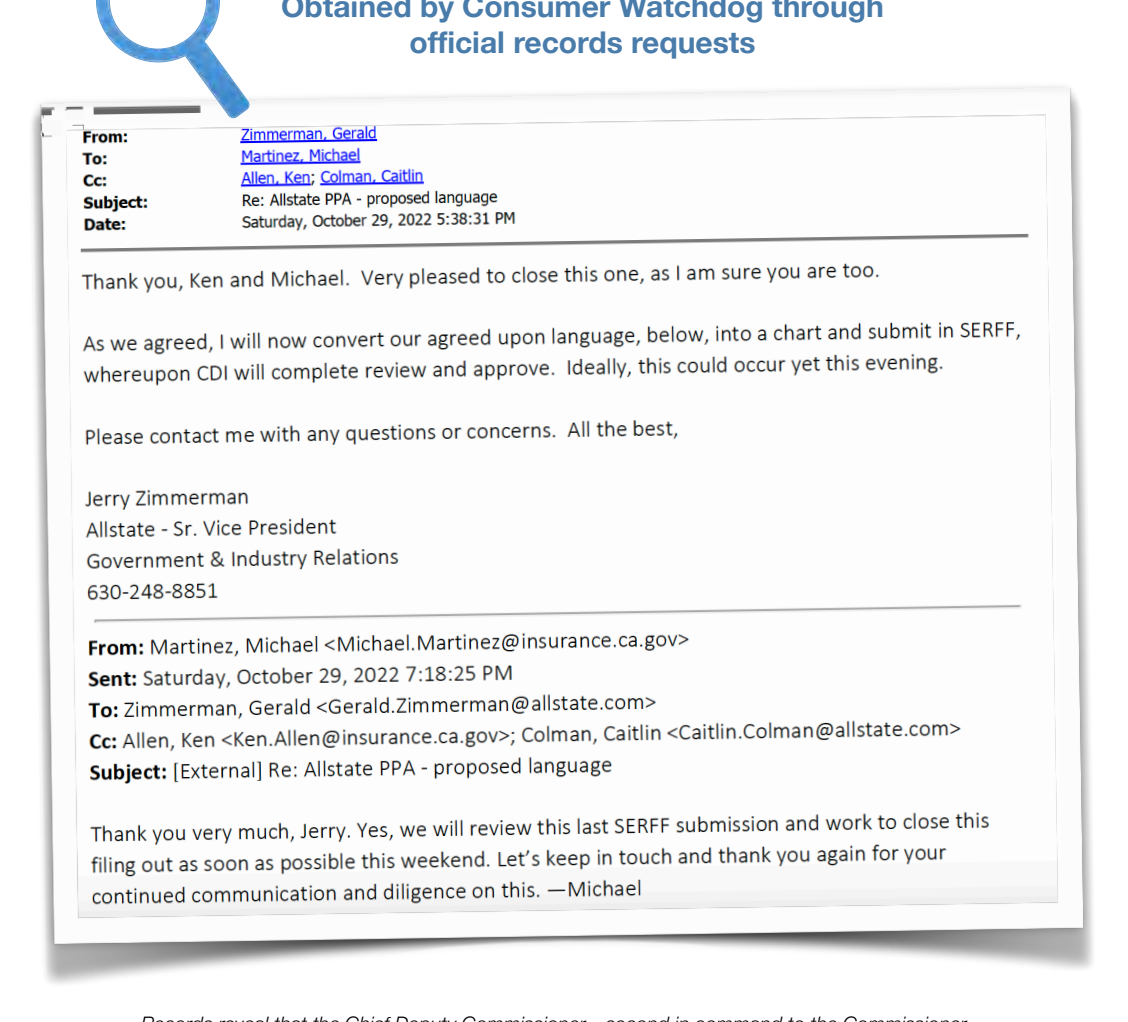
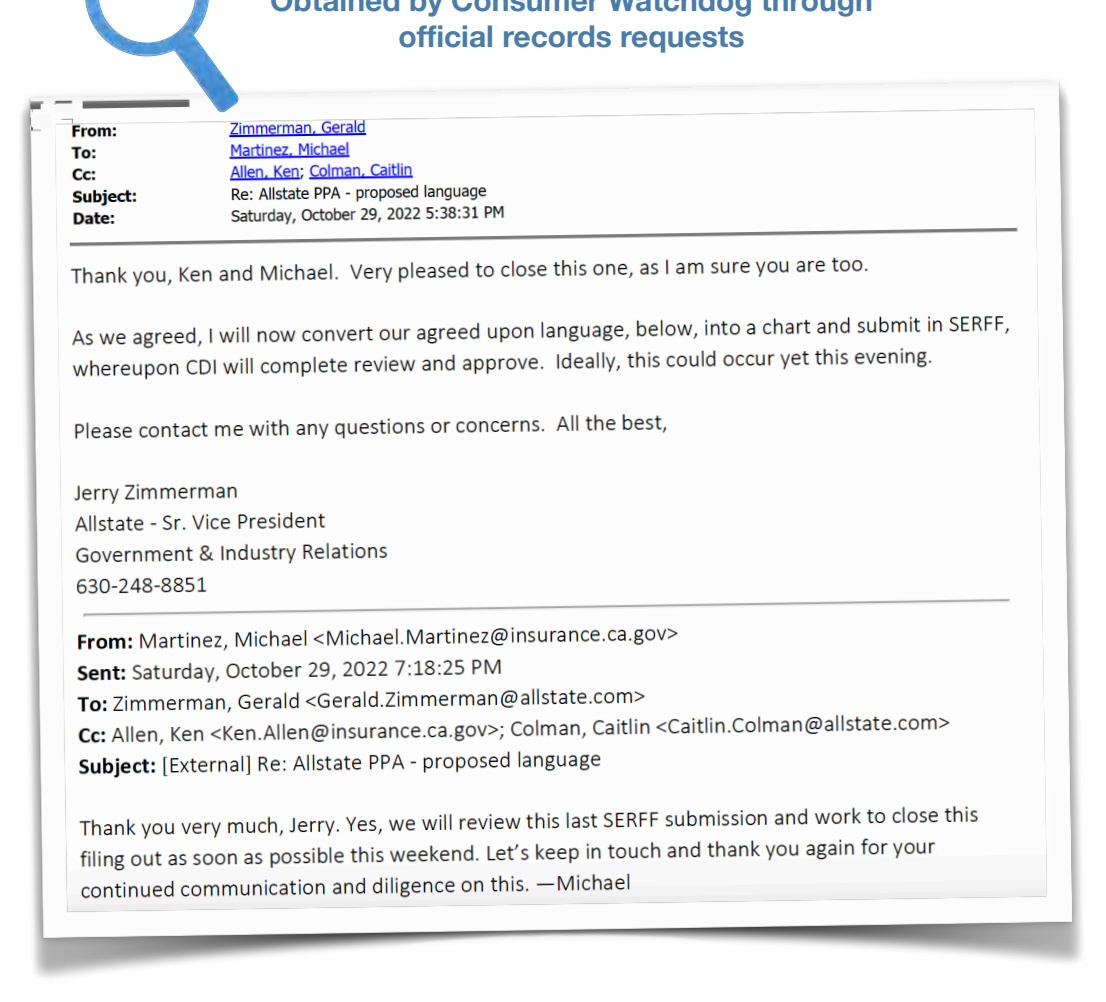
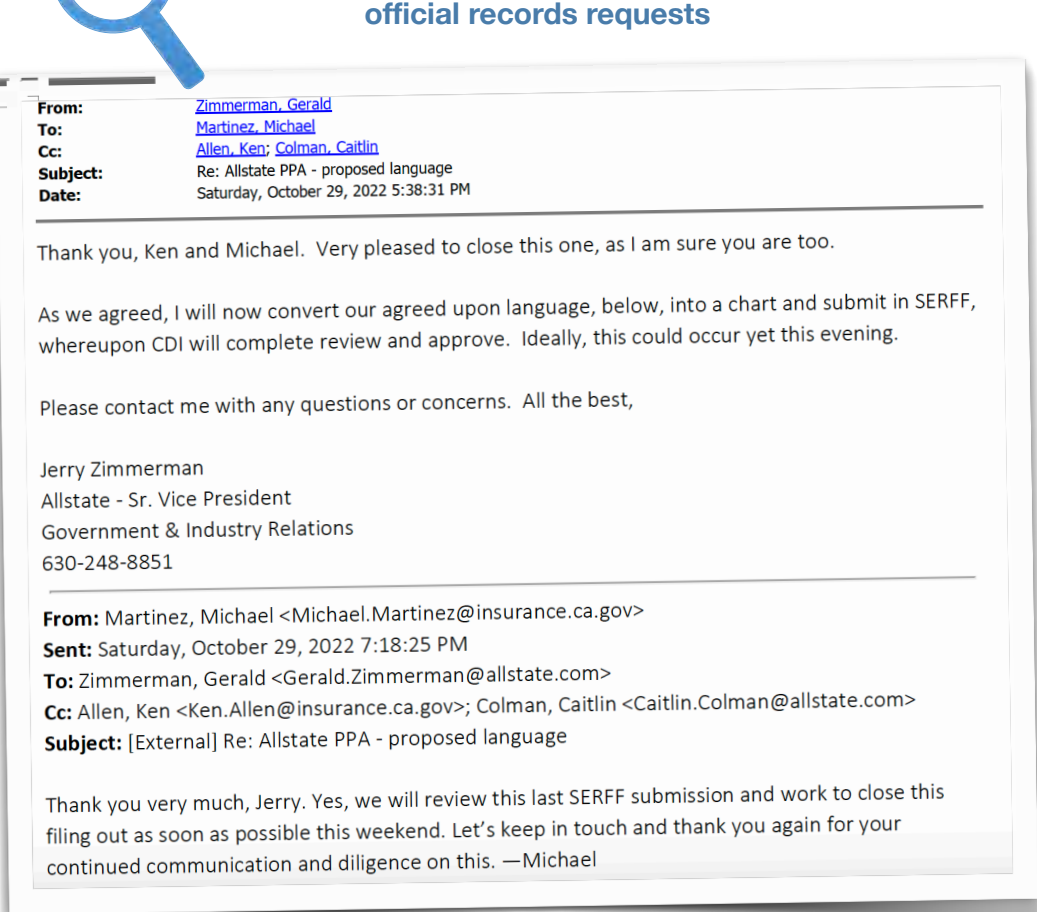
official records requests
V. Ongoing Rate Challenges and Latest Savings
During the months of November and December 2023, six homeowners and auto rate challenges brought by Consumer Watchdog were resolved. The total savings for policyholders from those six proceedings alone is nearly $885 million. Savings from Consumer Watchdog Rate Challenges, Nov. – Dec. 2023 Consumer Watchdog is presently contesting five additional applications for auto and home insurance increases, in which the companies are seeking permission from Insurance Commissioner Lara to increase rates by an average of 28%.
Consumer Watchdog Rate Challenges Pending, Jan. 2024 Advocating for Wildfire Mitigation Discounts. In addition to challenging requests for enormous increases in rates, Consumer Watchdog is closely scrutinizing whether insurance companies are complying with their obligation to offer “mitigation discounts” to homeowners and communities that take proven steps to protect their properties from wildfires. A new regulation adopted in October 2022 by Insurance Commissioner Lara, after years of complaints by consumers, mandates these discounts.
| Company | File No. | Rate Requested | Rate Approved | Total Savings |
|---|---|---|---|---|
| State Farm Rental | PA-2023-00006 | 20% | 11.43% | $21,509,293 |
| Allstate Northbrook Auto | PA-2023-00014 | 35% | 30% | $149,524,857 |
| Pacific Specialty HO | PA-2020-00009 | 6.9% | 3% | $6,334,736 |
| State Farm Auto | PA-2023-00012 | 24.6% | 21% | $151,709,663 |
| State Farm HO | PA-2023-00007 | 28.1% | 20% | $199,737,857 |
| GEICO Auto | PA-2023-00013 | 20.8% | 12.8% | $356,008,006 |
| Total Savings: | $884,824,411 |
| Company | File No. | Rate Requested |
|---|---|---|
| Allstate HO | PA-2023-00011 | 39.60% |
| Liberty Insurance HO | PA-2023-00016 | 29.10% |
| Standard Fire HO | PA-2023-00017 | 21.70% |
| CSAA Auto | PA-2023-00021 | 28% |
| United Services HO | PA-2023-00023 | 20% |
The discounts are meant to incentivize homeowners and communities to invest in fire mitigation that protects homes and property from fire damage, reducing the risk of damage from wildfire up to 75%, and to give consumers a way to lower the cost of home69 insurance coverage. With insurance companies lobbying strenuously to bend the proposal in their favor, Consumer Watchdog extensively participated in the two-year70 regulatory process of drafting those regulations at CDI.
All insurance companies were required to file new rate applications in April of 2023 that disclose the amount of the mitigation discounts they intend to give, along with other critical information, such as disclosures to consumers of their wildfire risk scores, and the computer models that the companies use to assign those scores.
Most of the filings Consumer Watchdog has reviewed do not comply fully with the new regulations. A common problem is the insurance company’s failure to offer a specific discount for each of the ten property-level mitigation steps that homeowners can take to harden their homes, which is required by the regulation. In many filings, insurers have tried to skirt the regulations by lumping several of these property-level factors together and offering an aggregated discount, relying on a private black-box model that they refuse to open to public scrutiny.
As of December 1, 2023, just one of the 100 mitigation applications filed by insurance companies so far has been approved—the FAIR Plan’s. Many of the discounts proposed by insurance companies are insignificant, with at least one, proposed by Farmers, as low6970 as $42 per year, or just 1% of premium. Some companies have requested permission to offer more meaningful mitigation discounts. For example, Allstate’s recent mitigation filing proposes discounts of more than $600 for homes in the highest-risk areas for72 wildfire. Insurance companies also want to require homeowners to pay for certifications73 of the mitigation work, which can dwarf the amount of the discount. And insurance companies are unlawfully refusing to disclose the underlying data and algorithms that their computer models use to determine whether a homeowner is eligible for a mitigation discount. The Commissioner is now asking insurance companies to remove the proposed mitigation discounts from their homeowners rate applications, and re-file them separately, in order to expedite the approval of rate increases for those homeowners, while the wildfire discounts are delayed.717273
VI. The Insurance Industry’s Campaign Against Public Participation
Insurance companies spent $63 million on their unsuccessful campaign to defeat the grassroots-backed Proposition 103 at the ballot box in 1988. The industry’s campaign then proceeded to the courts, the legislature, and the Department of Insurance; insurance companies filed over one hundred lawsuits to block provisions of the law immediately after it passed, and have spent untold amounts seeking legislation and regulations to override its reforms. Using Proposition 103’s authority to defend and enforce Proposition 103, Consumer Watchdog has defeated virtually all of the attacks, in most cases working closely with lawyers for the Insurance Commissioner.
Thirty-five years later, insurance companies across the United States are targeting Proposition 103’s public participation protections as part of their campaign to overturn its reforms—a political crusade that is driven not only by the industry’s desire to reap windfall profits in California, but to eliminate a law that has served as a model for consumer empowerment in other states. What’s different now is that insurance lobby is
holding California hostage with shortages, and using the undisputed impact of climate change to serve its financial and political agenda.
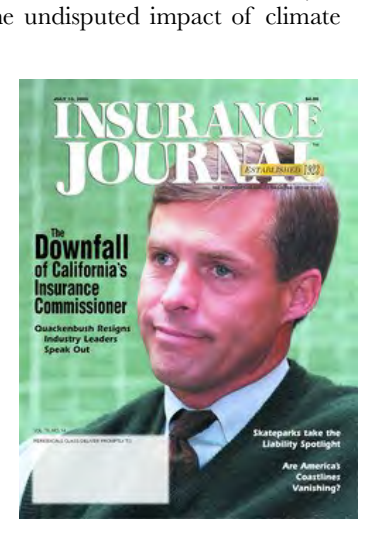
In the past, California Insurance Commissioners have strongly defended the public participation rights established by Proposition 103. The exception was Chuck Quackenbush, who pursued a deregulatory agenda at the behest of insurers and was forced to resign his office in 2000 after he was caught in a financial scandal involving insurance companies. He attacked the public participation process generally and Consumer Watchdog in particular, invoking insurance industry talking points that the industry and its allies employ to this day. As one report put it at the time, “Insurance Commissioner Charles Quackenbush declared bureaucratic war this week on two consumer groups that74 have sharply criticized his record.” Quackenbush said: “While some consumer groups have legitimately and effectively represented consumers in insurance-related issues, others have gotten fat off the public trough.” A7475 newspaper editorial noted that “astonishingly, the new commissioner says that the real76 problem is greed by consumer advocates….”
Unfortunately, Quackenbush’s hostility profoundly impacted public participation just as Proposition 103’s prior approval regulations took full effect. The process requires an initial investment of resources and expertise that are costly to acquire. Consumer organizations such as the Utility Consumer Action Network, San Diego University’s Center for Public Interest Law, Consumers Union, Public Advocates, the Economic Empowerment Foundation, and others that had previously been active in Proposition 103 matters reduced or eliminated their participation. More recently, the Consumer Federation of California has brought public challenges.
The insurance industry has now seized on the climate crisis to claim that insurers can no longer afford to do business in California if they have to comply with the protections of Proposition 103, including the public participation process. The insurance crisis of the 1980s—widespread insurance shortages and skyrocketing rates, coupled with demands from the insurance industry that California limit consumers’ legal rights—was precisely what led voters to pass Proposition 103 in 1988. Its safeguards and public participation provisions are essential to protecting Californians today.
Which explains why the insurance companies want to cripple the public’s ability to hold them accountable. Echoing Quackenbush’s 1995 attack, an insurance industry’s PR organization, the American Property Casualty Insurance Association, recently established a website dedicated entirely to Consumer Watchdog. It says: “Consumer Watchdog cares77 about [its] bank accounts, not California consumers.”
Insurance Commissioner Lara also channeled Quackenbush and the insurance industry when he recently accused Consumer Watchdog of “materially benefitting” from the78 process and his press spokesperson claimed: “Watchdog is turning a blind eye to79 consumers’ needs while defending its own insurance piggy bank.”76777879 At the same time, attorneys for CDI and Consumer Watchdog have been working together to vigorously defend the public participation process against a series of court80 challenges brought by State Farm in 2016 and that continue to this day. Proposition 103’s public participation protections have leveled the regulatory playing field, enabling consumers to defend their interests with the same quality legal representation that insurance companies deploy. As this report has shown, these protections have been remarkably effective. But as part of a backroom deal with the insurance industry, Commissioner Lara recently announced he will “streamline” and81 “diversify” the rate review process. To the extent that this means more efficiency—by hiring new rate staff, requiring insurers to submit all documentation for a rate increase up front, and encouraging more consumer representation—it is fully compatible with the robust public participation system created by California voters. But to the extent that the Commissioner accedes to insurance companies’ demands that consumer participation be limited, or does not require insurers to transparently and thoroughly justify the rate increases they seek, California consumers will pay hundreds or thousands of dollars more for insurance every year.8081