Auto insurance Too Expensive? It Could Be Your ZIP Code

Published on

Can you imagine moving just a few blocks to a new home and seeing as much as a 64 percent difference in your auto insurance premium?

That wasn't a typo. While a number of factors can influence an auto insurance quote, including your age, the make and model of your car, your driving habits and your credit score, where you live — and specifically your ZIP code — may have more of an effect on your insurance rates than you think, a Bankrate survey finds.

You can get vastly different quotes from the same insurance company at two addresses a relatively short distance apart but in different ZIP codes.

Save on your auto insurance — compare quotes from reputable insurers

Quotes sampled in neighboring ZIPs

The results are based on sample six-month auto premiums within the 10 largest U.S. metro areas. Bankrate gathered insurance quotes online from three leading insurers using two sample home addresses — separated by as little as three-tenths of a mile — in neighboring ZIP codes. Three hypothetical profiles were used at each address:

  • A 30-year-old single man driving a 2013 Toyota Camry.
  • A 30-year-old single woman driving a 2013 Toyota Camry.
  • A 45-year-old married couple with two teens at home: an 18-year-old daughter and 19-year-old son. This fictitious family drives a 2014 Nissan Pathfinder and a 2012 Nissan Altima (four-door).

The survey concentrated on ZIP codes in areas the Pew Research Center identified as having a relatively poor area adjacent to a relatively wealthy area. But the sampling found no clear correlation between income levels and auto insurance premiums. In other words, the poorer areas didn't always have the higher rates, for example.

However, the results do suggest that all other things being equal — coverage selections, liability limits, deductibles, etc. — your ZIP code may determine what you pay for auto insurance.

So close, yet so far (in rates)

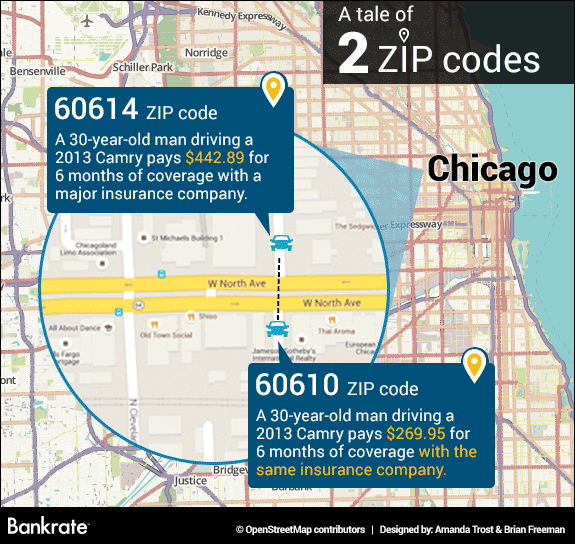
In the most extreme example, a comparison of one company's rates at two Chicago homes shows that a 30-year-old man could pay 64 percent more, depending on which side of a ZIP code boundary line he resides. The distance between the addresses used to obtain the quotes? Three-tenths of a mile — or a five-minute walk from house to house.
A tale of two ZIP codes; savings on auto insurance

The fact that auto premiums can vary so much within a fairly short distance may come as a shock to many consumers, but it isn't news to Carmen Balber.

"In most states, with the exception of California, insurance companies charge drivers more for living in some ZIP codes than others," says Balber, executive director for the advocacy group Consumer Watchdog in Santa Monica, California.

"We don't think that's the right policy," she says. "A ZIP code should not be the determining factor in a person's auto insurance rates. What should matter is how good of a driver you are."

What insurers say

But the insurance industry denies that your ZIP code is a deciding factor in what you pay for car insurance.

"It's not ZIP codes that drive insurance rates," says Robert Hartwig, president of the New York-based trade group the Insurance Information Institute. "It is the frequency and the cost of accidents within certain geographic areas that drive insurance rates."

Certain "location-dependent" variables can also affect auto premiums, he says. For example, fraud, theft and vandalism are issues in some areas that may affect rates.

"It's simply always been the case that you're going to see variation across geographic zones for auto insurance, simply because the risk is not constant as you move through these different territories," he says.

Regulators downplay ZIP code importance

State insurance regulators also say your ZIP code is not the only determinant affecting rates.

Urban population, miles driven per number of highway miles, and disposable income per capita all affect premium costs, according to an email from the National Association of Insurance Commissioners.

"High-premium states tend to also be highly urban, with higher traffic density. High traffic density is found in urban areas. Thus territory or ZIP code (the building block for territories) does matter," the association says.

A 58 percent price difference in Brooklyn

Other key findings from Bankrate's auto insurance survey include:

  • After the Chicago example cited previously, another high variation in premiums between neighboring ZIP codes turned up in New York. At one of the insurers we surveyed, quotes for a 30-year-old man varied by 58 percent between sample addresses in neighboring Brooklyn ZIP codes. The homes were 1.6 miles apart.
  • Boston, Philadelphia and Houston also had big rate differences between sample addresses in neighboring ZIP codes. In Houston, two insurers' auto premiums for each of the hypothetical customers varied by around 13 percent at addresses 0.3 miles apart but in different ZIP codes.
  • Rate variations were not consistent for all customers. In Chicago, the insurance company with the 64 percent difference in rates between sample addresses for a 30-year-old man had no price difference at all between the two ZIP codes for a 30-year-old woman.

A 'way to redline'?

In national surveys, the Consumer Federation of America has found that lower- and moderate-income drivers often face unaffordable auto insurance rates.

Drivers with clean records living in lower-income areas of major cities have been charged annual premiums of $2,000 or more for the minimum amount of coverage required by their respective state, says Robert Hunter, the consumer federation's director of insurance. The group says its research shows that ZIP codes affect auto insurance rates.


It's common to see that the lower-income, higher-minority-population ZIP codes have more costly auto insurance rates, says Consumer Watchdog's Balber. "A ZIP code has been traditionally — and continues to be across the board — used as a proxy for income and a different way to redline," she says.

But Bankrate wasn't able to make any conclusions about incomes and auto insurance rates.

In four of the 10 cities, averages of the sample premiums at the lower-income ZIP code were universally higher than those in the higher-income ZIP by at least 4 percent. But in the other cities, the results were mixed, or the differences were smaller.

Should ZIP code-based insurance be banned?

California has a law that prohibits auto insurance companies from using ZIP codes, and a few other non-driving-related considerations, as primary factors in determining premiums. The Consumer Federation of America says that since 1988, when California enacted Proposition 103, drivers have seen more than $100 billion in premium savings.

Consumer advocates believe laws like California's are a good idea. Some of the underwriting practices insurance companies use are baffling, says Ruth Susswein, deputy director of national priorities for Consumer Action, a group based in San Francisco.

"Factors unrelated to your driving are considered in figuring out what your rate should be, and those things include the type of job you have (and) the education level you have. What that's got to do with your driving record is beyond me," she says.

Beating a high-rate ZIP code

There are many things outside of your control as it relates to auto insurance, but what you can do is shop around.

"The more a consumer shops around, the more likely they are to find an insurance company who favors their particular characteristics and will give them a better deal," Balber says.

Bankrate's survey found that while one insurer's rates for a 30-year-old woman varied by nearly 20 percent between neighboring ZIP codes in New York, another insurer's quotes for the same hypothetical customer differed by less than 1 percent at the two addresses.

At two Philadelphia addresses in adjacent ZIP codes, rates for a 30-year-old man or woman varied by nearly 23 percent at one insurance company but only by 6.5 percent at another.

And if your savings search falls short, take it a step further by complaining to the insurance commissioner in your state, Susswein suggests.

"They're the ones that have the control to do something about this," she says. "And I would copy my state legislators, and I would contact the media."

METHODOLOGY:
Survey was conducted April 6-30, 2015. Online quotes for six-month premiums were gathered from three of the top 10 auto insurance carriers (as identified by the National Association of Insurance Commissioners) in the 10 largest metro areas using sample addresses in neighboring ZIP codes. Addresses were found using Redfin.com. We surveyed using three hypothetical profiles: A 30-year-old single man, a 30-year-old single woman, and 45-year-old married couple with two teens (an 18-year-old woman and 19-year-old man). Lower- and higher-income residential area info came from the Pew Research Center.

OTHER PARAMETERS:

Cars: For the 30-year-old man and woman, a 2013 Toyota Camry. For the 45-year-old married couple with two teens, a 2014 Nissan Pathfinder and 2012 Nissan Altima.

Coverages: For singles: $50,000/$100,000 liability; $50,000 property damage; $500 deductibles on collision and comprehensive; $50,000/$100,000 uninsured and underinsured motorist; $50,000 UM/UIM property damage (when applicable).

Coverages: For family: $100,000/$300,000 liability; $50,000 property damage; $500 deductibles on collision and comprehensive; $100,000/$300,000 uninsured and underinsured motorist; $50,000 UM/UIM property damage (when applicable).

Quotes do not include: Medical payments coverage; personal injury protection; emergency road service/roadside assistance; rental reimbursement and other optional coverages, such as sound-system coverage or mechanical breakdown insurance.

Exceptions: Medical payments coverage was included only when required by the state. Personal injury protection was included only when required by the state. "Compulsory" bodily injury liability was included only when required by the state.

Full survey results can be found here.

 
Latest Insurance Videos
Video thumbnail
Fox 20: Bill Could Lead To California Fair Plan Changes
01:07
Video thumbnail
CBS NEWS: New Wildfire Insurance Report
03:26
Video thumbnail
KRON 4: Mercury and CSAA Insurance Raising Rates
02:28
Video thumbnail
To The Point with Alex Bell: California's Insurance Crisis
01:06
Video thumbnail
KXTV-SAC (ABC): California's Insurance Crisis
04:05
Video thumbnail
Spectrum News 1: Property Insurance Struggles After LA Fires
04:52
Video thumbnail
Eaton Fire Survivors Anniversary Press Conference 1/7/26
01:21:37
Video thumbnail
KTTV-LA (FOX): Harden Your Home To Protect It From Wildfire
01:03
Video thumbnail
KTVU FOX 2: New insurance Laws In 2026
03:27
Video thumbnail
Spectrum News 1: Palisades Fire Rebuild Insurance Concerns
05:53
Video thumbnail
Wildfire Survivors Press Conference 11•06•25
32:31
Video thumbnail
Spectrum News: Eaton Fire Survivors Call For Ricardo Lara To Resign
01:58
Video thumbnail
ABC7 News: New Calls For Insurance Commissioner To Resign
02:40
Video thumbnail
NBC News: Fire Victims Ask State Insurance Commissioner To Resign
01:54
Video thumbnail
Fox 11: Wildfire Survivors Demand State Insurance Commissioner To Resign
03:26
Video thumbnail
KTLA-LA (CW): Ricardo Lara Accused Of Siding With Insurers Over Homeowners
00:58
Video thumbnail
KCRA News: Fire Victims Want Insurance Commissioner To Resign
00:53
Video thumbnail
ABC10 To the Point with Alex Bell: Calls For Ricardo Lara To Resign
03:32
Video thumbnail
ABC10: Calls For Insurance Commissioner To Resign
01:13
Video thumbnail
Wildfire Survivors Call on Insurance Commissioner Lara to Resign
32:31
Video thumbnail
KCAL CBS: Consumer Watchdog President Discusses Problems With California’s Home Insurance Market
06:03
Video thumbnail
KCAL Mornings: CA Homeowners Face Surcharges To Help Recoup Costs From January Wildfires
00:38
Video thumbnail
CBS News Bay Area: CA Fair Plan Proposes Rate Hike For Home Insurance Coverage
03:53
Video thumbnail
KTVU Mornings: CA Fair Plan Proposes 35.8% Insurance Rate Hike
04:44
Video thumbnail
KCAL Mornings: Proposed Insurance Rules Under Criticism
05:33
Video thumbnail
ABC7 News: AI Energy Toll Could Be Passed Onto Consumers
02:08
Video thumbnail
Consumer Alert: Insurers That Newsom Said Were Returning Never Left California
02:49
Video thumbnail
CBS 8: Are Insurance Rates Really Better?
02:51
Video thumbnail
KMPH-FRES (FOX): Major Insurance Companies Returning
01:32
Video thumbnail
KMPH-FRES (FOX): Ballot Measure Takes Aim At Insurers
00:38
Video thumbnail
CBS 13 News: Home Insurance Ballot Initiative
00:24
Video thumbnail
KFMB SD CBS San Diego, CA: Rate Hikes Filed Under Insurance Reform Plan
02:26
Video thumbnail
KFMB SD CBS San Diego, CA: Rate Hikes Filed Under Insurance Reform Plan
02:26
Video thumbnail
KOVR-SAC (CBS) - Sacramento, CA: Proposing An Insurance Change
02:28
Video thumbnail
KXTV-SAC (ABC) - Sacramento, CA: Fair Plan Fee Lawsuit Scaled Down
01:08
Video thumbnail
KTVU-SF (FOX) - San Francisco, CA: State Farm Asks Judge To Seal Documents Justifying Rate Hike
04:31
Video thumbnail
Spectrum News 1 - Green Bay, WI: Grappling With Loss In LA 6 Months After Devastating Wildfires
03:41
Video thumbnail
KTVU (FOX): Tips On Getting Smoke Damage Claims Paid
04:31
Video thumbnail
KTVU-SF (FOX): Pro-Homeowner Bills Moving Through CA Legislature
02:30
Video thumbnail
Spectrum News 1 (San Fernando Valley) - Los Angeles, CA: State Farm In The Hot Seat
03:09
Latest Privacy Report

Support Consumer Watchdog

Subscribe to our newsletter

To be updated with all the latest news, press releases and special reports.