
Mark Burton is the poster child for obscene AAA home insurance premium hikes in recent years. The latest hike came to $14,601 for his home insurance premium covering July 2024 to July 2025. He would have had to pay $22,632 if he didn’t have other insurance policies with the company. That treatment recently forced him onto the CA FAIR Plan and a wrap-around home insurance policy that, though expensive, look cheap in comparison.
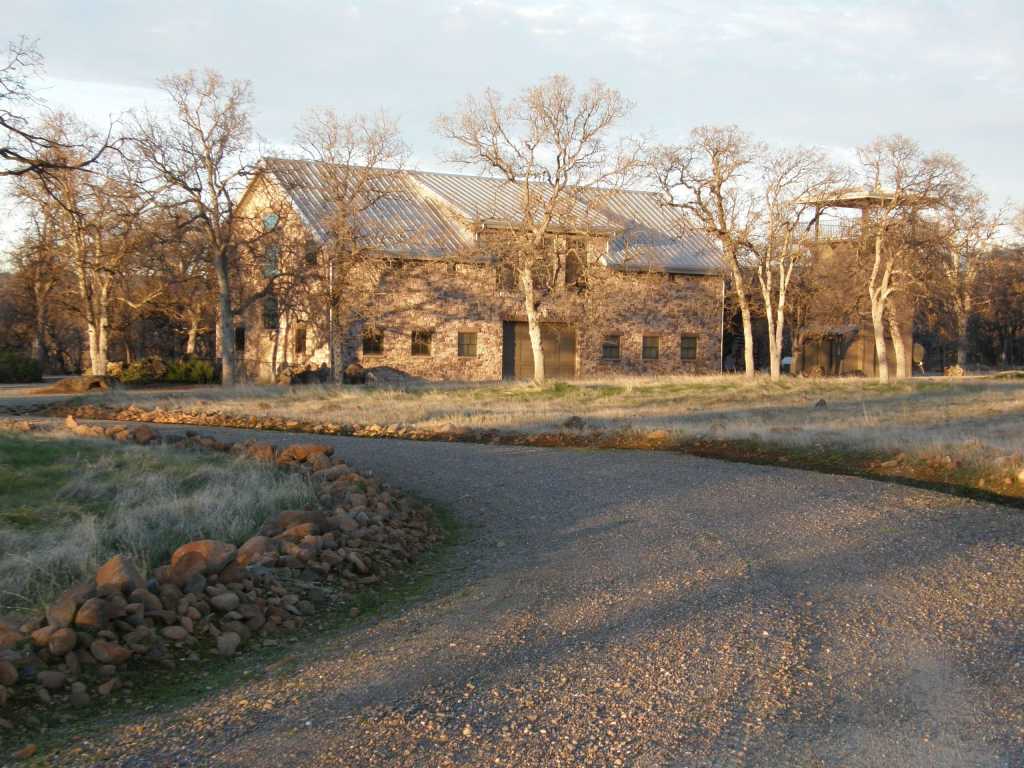
He and his wife live in a tiny town in mountain-ringed Shasta County. Their modern, custom-built 4,200-square-foot retirement home was built in 2010 to literally withstand anything. It’s built on a flat spot with oak trees and grass but no underbrush. Mark keeps plenty of room between the house and any vegetation and keeps lower tree branches trimmed to prevent grass fires from catching on trees. He’s aware of the danger as Shasta County has experienced numerous fires. And he’s aware of how to use construction techniques to protect buildings from them.
For a dozen years before retiring, Mark distributed insulating concrete forms in California and promoted this type of building construction. He used the forms to build his own home. Styrofoam block forms are stacked, rebar is inserted, and concrete is poured to form indestructible walls eight inches thick that are fire and wind resistant. Mark covered the home’s walls in stone. The home also has a commercial steel roof, and closed eaves with concrete board. Every elevated deck is concrete and steel. The railings are steel. The two-story home and the upper floor are also concrete slab supported with a beam frame and engineered structural steel posts.
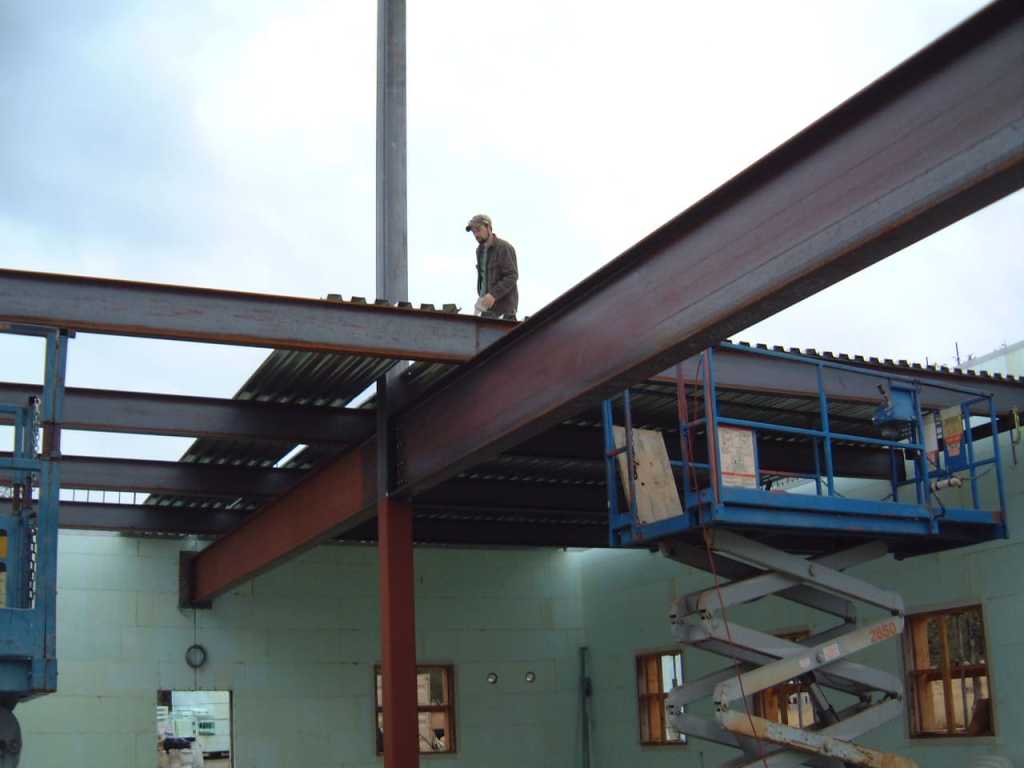
Right after the couple completed the house, they had a surprise inspection from CalFIRE. They got an A+ inspection grade. Later, in 2022, CalFIRE performed a notice of defensible space inspection and noted on the form: “House and property looks great!” The inspection listed all the home-hardening construction features. “The inspector commented this would be a great property to use for CalFIRE example training for their wildfire mitigation inspectors,” Mark said. “There is nothing left to do.”
In 2023, Mark attended a CalFIRE business meeting where fire chiefs from around the state gathered to discuss wildfire mitigation and home hardening. Mark, the only attendee from the general public, was only given three minutes to speak but was so riveting that the Fire Marshall gave him 20 minutes to finish his presentation on how he had built his home. “Afterwards, a battalion chief in charge of California’s wildfire mitigation came over to me and she said, ‘I would love to have digital photos of your property to use in our presentations.’”
But AAA, which continuously ratcheted up Mark’s home insurance premium over the last several years, didn’t care. “After a 48-year uninterrupted AAA insurance relationship from homeowners, auto, umbrella, and earthquake insurance, our home insurance has risen by three and half times over the past few years from approximately $3,400 to $14,601,” said Mark. “It would be $22,632 a year if we did not carry other types of AAA insurance. All without any claims.
“I am finding out after speaking with numerous other property owners insured with AAA that even though my situation is extreme, others are experiencing the same. Now, AAA is creating a situation where we cannot afford to stay in our home,” Mark said.
What he finds most astonishing is the insurer’s complete disregard for how his home was constructed. He got a one-time discount seven or eight years ago only because he was able to personally reach AAA’s head of underwriting and she knew about the type of construction he used. But after the wildfire of 2021, attitudes hardened. “Every year, I have called them and they have not lowered a penny,” Mark said.
Mark persisted by going up the food chain at AAA again, finally reaching a high-level AAA underwriter. “I said, what is the deal, you know what type of construction. I really got into it. She knew the type of construction. She said, ‘Well, Mr. Burton, AAA does not get that granular with their type of construction and things,’ and I said you gotta be kidding me, risk and reward and getting granular is your entire business. You create a policy with X amount of risk involved and you are expected to make a profit and you don’t even take that into consideration?”

In June 2022, Mark wrote AAA’s CEO Tim Condon. He wrote the CEO that all his insurance policies for home, auto and umbrella policies had been with AAA for 45 years and not a single claim had ever been filed. He pointed out all the construction benefits of his home and told Condon, who is Canadian, that the insulated concrete forms he distributed were made in Canada. He sent along a 2022 press release from Insurance Commissioner Ricardo Lara. “This press release addresses the profound concerns of CA residents and business owners regarding some possible answers to the rising risk to insurance companies and in turn the cost burden to policy holders,” Mark wrote. “The reasoning for this is to recognize and reward the efforts of property owners that help in the mitigation of fire risk.”
Mark stated the irony that he chose the type of construction years ago to reduce risk of fire and wind damage and that it was ignored. He suggested that the type of building envelope he used be introduced as an option to help mitigate fire and limit AAA loss exposure. “Mr. Condon, I ask you, please explain to me after our 45-year uninterrupted AAA insured history, why are we being treated in this negative way. We feel that we are being targeted and burdened with extra costs when in fact we should be looked at as a positive in AAA eyes.”
Dead silence from AAA.
In June 2023, Mark filed a complaint about AAA excessive rate hikes with the Department of Insurance. Later that month he received a letter from AAA, copied to the Department of Insurance, in response to the complaint. The four-page single spaced letter essentially told Mark to take a hike.
“We understand your concern regarding the increase in your renewal premium,” the company stated. “The Company takes such concerns into consideration when contemplating a rate increase but also considers many factors such as wildfire risk, inflation and rising costs to rebuild. The Company cannot and does not arbitrarily ask for a rate increase. Rather, the Company must submit a formal request for a rate change to the California Department of Insurance and must provide the Department with reasonable justification, sound actuarial data, and cost information for its review Each of the Company’s submitted requests referenced in this letter were approved by the California Department of Insurance.”
The letter went on to say that in 2022, changes were made to increase the deductible to decrease the premium and that Mark was offered a “Fortify your Residence” discount of 5% to 15% on his premium depending on whether AAA determined that he met the criteria. “You expressed your dissatisfaction that the discount was not more and explained that you felt the Company was not carefully considering all of the things you had done to your property to mitigate the fire risk for your home.” Mark said that a AAA representative had told him by phone that he could get an inspection from an independent company they required him to use for about $1,000 to qualify for a discount. Mark was insulted that AAA would not take the comprehensive CalFIRE inspection that he passed with flying colors to show that he qualified. “I was going to lay out about $1,000 to save about $1,500, it was like a slap in the face, really.”
The letter noted that Mark had informed AAA of the materials he used to build his home, the fire mitigation efforts he completed, and that CalFIRE had given his home an A+ rating. That didn’t matter to AAA because the company uses a black box software system provided by a private company called Verisk to determine fire risk. “It is important to understand that the Company’s current plan…utilizes two specific factors to assess wildfire risk exposure which include a property’s FireLine Score and Public Protection Classification (PPC),” the AAA letter stated.
“As previously explained, both the FireLine Score and PPC are obtained from the Insurance Service Office (ISO) Verisk, a leading provider and source of reliable information regarding property and casualty insurance risk. ISO Verisk’s FireLine score is one rating factor which determines a dwelling’s susceptibility to loss by wildfire based on the fuel load, slope, and road access of a property. ISO Verisk’s PPC is a numerical classification based on the analysis of the structural fire suppression delivery system provided in a community. The Company does not have any part in the calculation of either of these two scores. However, the Company’s use of the scores to measure risk, is an industry standard and not prohibited by the Department nor California law.
“Our review of your policy finds that our policy renewal has been rated in accordance with our filed and approved rate plan with the Department of Insurance.”
“This is a strong arm by AAA,” said Mark. “They had heavy hits with fires up here, so essentially in a nutshell they were insuring properties that obviously they did not inspect and the risk far outweighed their premiums. But they were getting one-way checks and then had big losses. Who is paying for it now? People like myself—retired. They created a $1,500 monthly mortgage for me. Insurance Commissioner Lara and the California Department of Insurance are giving insurance companies a rubber stamp just to keep them in California. It doesn’t pay to own a house anymore, it’s a false sense of security.”
Mark finally threw in the towel on AAA after no other home insurers would write him a policy. He is switching to the CA FAIR Plan with an annual premium of $7,800 and a wrap-around policy from Aegis for $1,450 a year. Between the two policies, he will be paying an annual premium of $9,250. “I am done, I can’t do it anymore. I am saving about 35% by going to the FAIR Plan with a wrap-around plan,” said Mark. An independent company just inspected the property on behalf of the FAIR Plan. “The inspector was pretty enthralled, and he said it’s not gonna burn.” Mark added that the FAIR Plan premium seemed fair to him after consulting other homeowners in his same situation. “They were paying even more than I am.”