EXECUTIVE SUMMARY
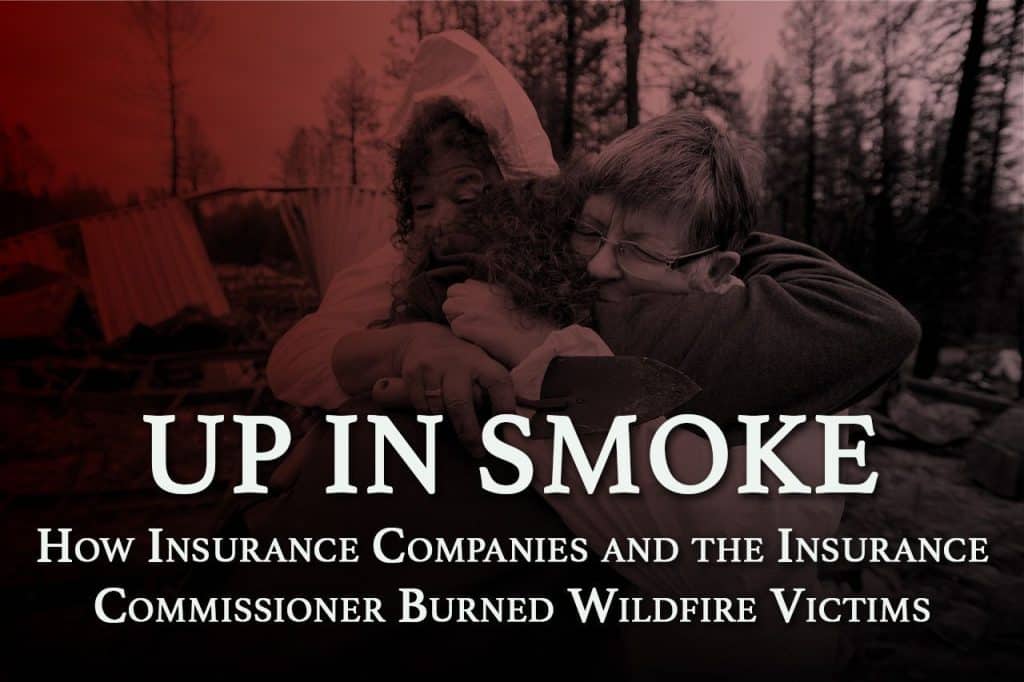
For many years, insurance companies have used illegal coverage limitations in California1 homeowners, condominium, and renters insurance policies to deny or lowball claims after a wildfire disaster. The financial harm—and the trauma—that consumers have suffered as a result, particularly in recent years as wildfires have repeatedly struck the Golden State, is incalculable.
Fire insurance provisions that erode coverage and devalue policies have made their way into the policies of some of the largest insurers in California, including Farmers, Nationwide, and the Automobile Club of Southern California. And the California FAIR Plan (FAIR Plan), a program created by the Legislature to provide homeowners with minimum coverage when private companies won’t do so, has used these unlawful provisions to aggressively curtail coverage for wildfire claims.
Insurance companies have inserted these harmful provisions into policies at the same time that the wildfire season in California has grown longer and much more damaging; homeowners must increasingly turn to their home and fire insurance policies for protection. Over the past decade, the wildfire season in California has been increasing in both length and severity—the three most destructive years on record are 2017, 2018, and2 Insurers have responded to increased wildfire losses not only by massively raising their homeowners insurance rates and refusing to insure many homeowners, but also by modifying insurance policies to restrict investigations into the scope of wildfire damage, narrow the benefits they pay under the policy, and create often insurmountable hurdles for homeowners seeking payment for their legitimate claims.
Based on an examination of public filings required to be made by insurance companies with the CDI, this report identifies six violations of California law by homeowners insurance companies.
Classifying smoke damage as a separate peril/loss from fire damage.
California law requires insurance companies to compensate property owners for “all loss by fire.” (Ins. Code section 2071.) That includes smoke damage—highly toxic fire contaminants and debris—which is one of the most common and costly forms of wildfire loss. But some insurance companies now treat smoke damage as separate from fire damage and restrict coverage for it. Additionally, some policies12 require homeowners to prove “permanent physical changes” before the insurance company will pay for smoke damage, and don’t allow such changes to be proven by a comprehensive site investigation by certified experts, the usual (and recommended) method of assessing smoke damage. These changes, combined with separate and lower limits on recovery for smoke damage, allow insurers to avoid fully compensating property owners, when in many cases most, if not all, of the damage to a residence after a wildfire results from smoke.
2. California Changing the trigger for when a fire loss must be reported.
law requires policyholders to “give written notice to [the insurer] of any loss without unnecessary delay…and within 60 days after the loss…the insured shall render to [the insurer] a proof of loss.” Nevertheless, some policies impose reporting triggers that are difficult, or even impossible, for consumers to meet. For example, in considering whether a loss was timely reported, some policies require the policyholder to notify the insurance company of a loss within a limited time after the “start date of [a] wildfire,” even though the damage to a home from a wildfire can occur long after the wildfire begins. Clearly, a homeowner cannot report a loss before it occurs.
3.Limiting or denying payment of claims for a certain type of covered loss or after a certain amount of time has passed from a specified event. Some policies limit coverage for a particular kind of loss to an amount that is less than the policy’s total coverage: for example, establishing an arbitrary maximum for compensation for smoke damage that is less than the total amount of fire loss covered by the policy. Additionally, some policies impose timelines that allow companies to reduce or deny a claim depending upon when it was submitted.
4.Denying coverage to an insured person if they suffer a loss within a certain time after purchasing the policy. Some insurance policies exclude coverage if a loss occurs within a short period of time after the policy is purchased (usually 72 hours).
5.Barring litigation either before or after an appraisal is completed, even if an insured person disputes the appraisal process/finding.
While California law allows insurance companies or policyholders to obtain a private appraisal in the event of a dispute over a claim, consumers remain able to file a lawsuit challenging certain aspects of the appraisal process either before or after the appraisal occurs. However, some policy provisions prevent a homeowner from going to court to challenge the appraisal process.
6.Failure to communicate consumers’ rights after wildfires. California law requires that insurance policies disclose that, in the case of a “government-declared disaster” or “state of emergency,” an insurance company may not compel an appraisal, and it extends the time that a consumer can sue an insurance company for violating the law to 24 months. Some companies fail to notify policyholders of these important rights.
Recognizing California’s longtime vulnerability to disasters such as earthquakes and wildfires, state law provides powerful protections for policyholders against insurance company abuses, particularly in the aftermath of a catastrophic event. Fire insurance policies are subject to minimum legal standards established by California3 Insurance Code sections 2070 and 2071. (Copies of these statutes are attached as Appendices A and B to this report.) Pursuant to Section 2070, insurance companies may alter the policy provisions contained in Section 2071 only if, in doing so, “coverage with respect to the peril of fire, when viewed in its entirety, is substantially equivalent to or more favorable to the insured” when compared to the standard policy. Put simply: if a provision
“The insurance
appears in Section 2071, it, or a “substantially equivalent” provision, must, by law, appear in every insurance policy covering fire losses. And industry’s emphasis on Section 2071 could not be clearer: in this state,
expanding its profits at
the minimum coverage is for “all loss by fire . . . .”
the expense of its
These laws are enforced by the California
policyholders cannot be
Insurance Commissioner, who heads the state Department of Insurance (CDI). Under Proposition 103, the insurance reform law tolerated.”
enacted by voters in 1988, insurance companies must open their books to public scrutiny and obtain the approval of the Insurance Commissioner for any changes in insurance forms that affect rates such as provisions that restrict or deny coverage. Insurance companies are required by law to submit applications for the Commissioner’s approval when making such changes. The Commissioner, and his 1,400-person consumer protection agency, are charged with preventing illegal policies or practices.
The policy provisions uncovered in this report conflict with California law. They allow insurance companies to deceive and defraud their policyholders at the very moment when insurance coverage becomes essential to restore policyholders’ most valuable assets—their homes and property.3 The internal audit conducted by CDI confirms that, among a litany of legal violations, the FAIR Plan routinely and repeatedly imposed an unlawful limit on compensation for smoke damage on policyholders.
The FAIR Plan is the California insurance industry. It is financed and run by the state’s largest property insurance companies. The audit, known as a Market Conduct Examination, was completed on March 18, 2021, but posted to CDI’s website in June 2022. It makes clear that at least since January 2017, the FAIR Plan has been settling wildfire claims based on illegal policy provisions that should never have been approved by the agency.
The Market Conduct Exam concluded that the FAIR Plan deceived CDI by failing to disclose the true impact on policyholders of the FAIR Plan’s proposed changes to its policy. But as this report reveals, many of the illegal policy provisions were also adopted by private insurance companies, and were required to be disclosed in their applications seeking the agency’s approval. Commissioner Lara has made it a point to visit communities devastated by wildfires, and CDI has an active consumer complaint process.
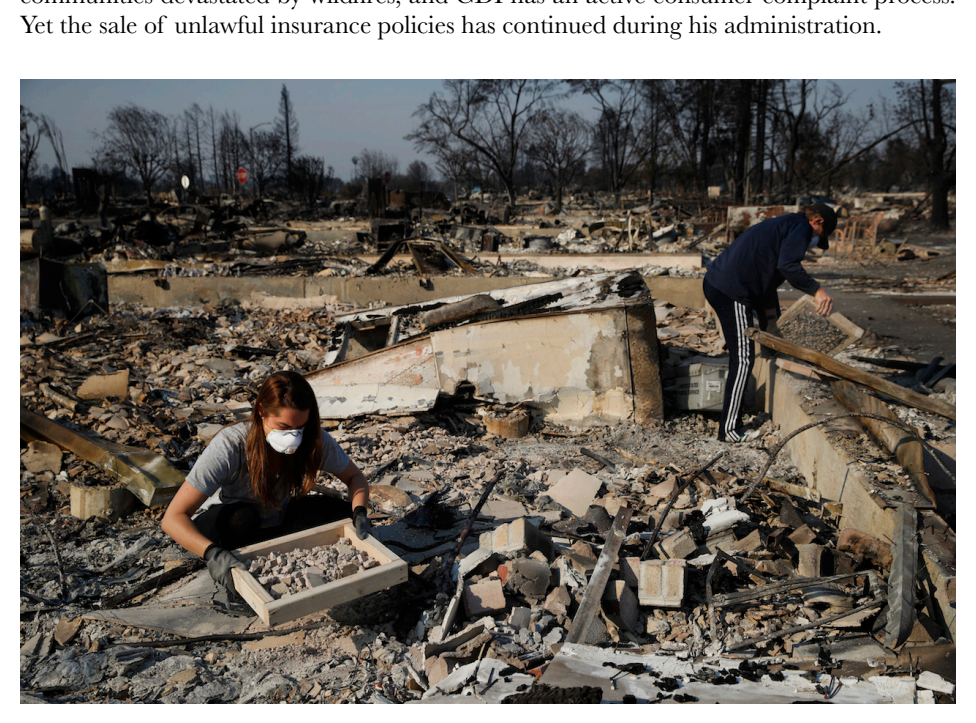
Yet the sale of unlawful insurance policies has continued during his administration. As California enters another fire season, the insurance industry’s emphasis on expanding its profits at the expense of its policyholders cannot be tolerated. Here are five immediate steps that Insurance Commissioner Lara and CDI must take to protect California consumers and prevent further violations of the law: 1.The Commissioner should investigate all claims denied by insurance companies during and after the historic 2017 wildfires to determine whether they were handled lawfully, with special attention paid to claims denied pursuant to unlawful smoke damage provisions. The Commissioner should use the full authority of his office to get insurance companies to reopen any claims that were improperly denied and pay such claims in full.
2.The Commissioner should initiate enforcement actions against insurance companies that systematically violated Californians’ rights to fair claims handling and should seek the maximum statutory penalty of $5,000 per policy per violation, or $10,000 if the violation was willful.
3.When the Commissioner determines that one or more insurers violated California law with respect to a significant number of the claims it handled, as did the FAIR Plan, the Commissioner should refer the matter to the Attorney General or to a local District Attorney for prosecution of the responsible individuals and companies under Section 2083. In addition to criminal penalties for such violations, law enforcement should investigate whether the individual insurance companies that run the FAIR Plan conspired among themselves to limit coverage and raise prices, thereby violating California’s antitrust laws, which apply to the insurance industry under Proposition 103 (Section 1861.03, subd. (a); see also North Carolina State Bd. of Dental Examiners v. F.T.C. (2015) 574 U.S. 494.) 4.The Commissioner should request an investigation and public report, by the California State Auditor or another independent authority, of the failure of CDI to disapprove or otherwise take action against the violations of California law. The report should determine whether the agency devoted sufficient staffing and other resources to its consumer complaint, review, and enforcement procedures, and make recommendations for improvement.
5.The Commissioner should issue a notice or Bulletin reminding insurance companies that it is unlawful to engage in the misconduct identified by this report.
1. LIMITS ON COMPENSATION FOR SMOKE DAMAGE
What is the issue?
Some insurance companies are unlawfully classifying “smoke damage” as a separate peril/loss from “fire damage.” Additionally, some policies (like those sold to over 240,000 Californians in 2020 by the FAIR Plan) contain provisions that limit coverage to “direct physical losses,” which the policies unlawfully define as “any actual loss or physical damage, evidenced by permanent physical changes,” and which then define “permanent physical changes” to further limit coverage caused by smoke damage.
Why is this a problem?
“Smoke damage” is an inseparable aspect of fire damage, as the plain language of Section 2071 (“all loss by fire”) makes clear, and as court decisions in California and other states have determined (see for example the ruling of the Los Angeles Superior Court in Marrufo v. Automobile Club of S. California, No. BC597839 at *11–*12 (May 10, 2018), pp. 8– 11; attached as Appendix C). However, some insurers are treating ‘smoke damage’ as a separate form of coverage, and are restrictively defining that coverage to apply only to patently visible or smellable smoke damage. This can lead to insurers paying out far less than the total cost of repairs after fire damage. This issue will often appear in endorsements to insurance policies adding a new section on “smoke damage” or “wildfire smoke loss.”
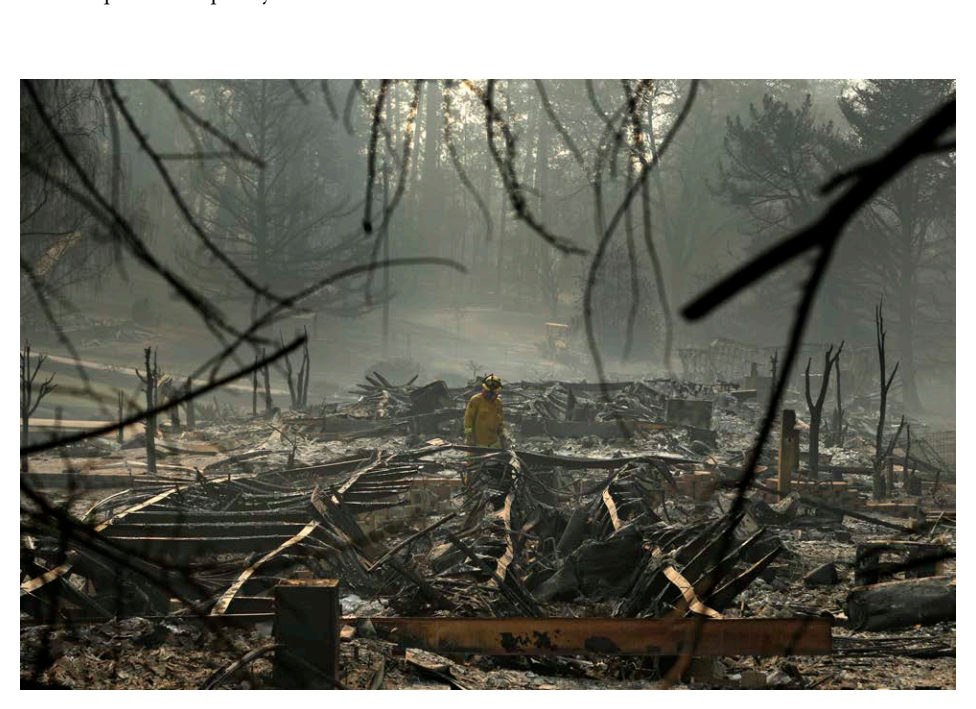
The proliferation of smoke damage limitations in California fire insurance policies constitutes a grave danger to the finances and health of California homeowners. In many instances, most, if not all, of the damage to a residence after a wildfire results from4 smoke. Even routine smoke remediation can cost tens of thousands of dollars, while in the event of extended wildfire exposure, which has become increasingly common, many houses may be rendered uninhabitable.5 Wildfire debris is extremely toxic and harmful to health. Smoke damage can cause significant health problems—in the short term, exposure can lead to sudden cardiac6 arrest, while chronic impacts include diabetic complications and cancer. Wildfire smoke is particularly dangerous because it contains fine particulate matter of 2.5 microns or less (PM2.5). PM2.5 is small enough to cross over into the bloodstream from the lungs, “making456 it capable of reaching every organ in the body.” Even worse, research has shown that8 PM2.5 in wildfire smoke is more harmful to health than PM2.5 in the ambient air. Thus, it is generally very unsafe to inhabit a smoke-damaged home before adequate remediation, which can often require removal of building components like interior wall insulation, carpeting, and ducting.9 Even more troubling, insurers have tended to use endorsements to amend existing policies with the express purpose of restricting coverage for smoke damage to extremely insufficient amounts.
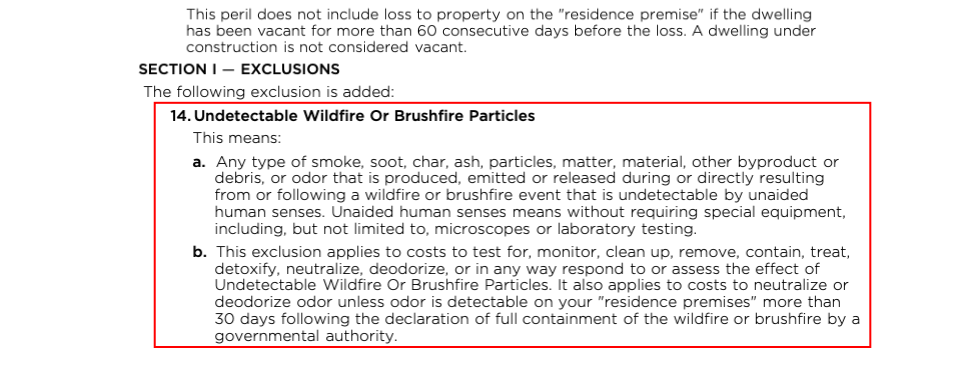
Other policy provisions restrictively define coverage to apply only to patently visible or smellable smoke damage. It is well understood that neither the extent of smoke damage,10 nor any lingering health risks, can be assessed merely by unaided human senses. Seeking to preclude individuals from recovering for losses caused by smoke damage11 therefore threatens both serious financial harm and serious harm to physical health. It should be a matter of public policy in California to seek to maximize the remediation of smoke damaged properties. Without remediation, structures damaged by smoke can emit volatile organic compounds, which “penetrat[e] into porous materials in the building,” for12 “months or even years.”
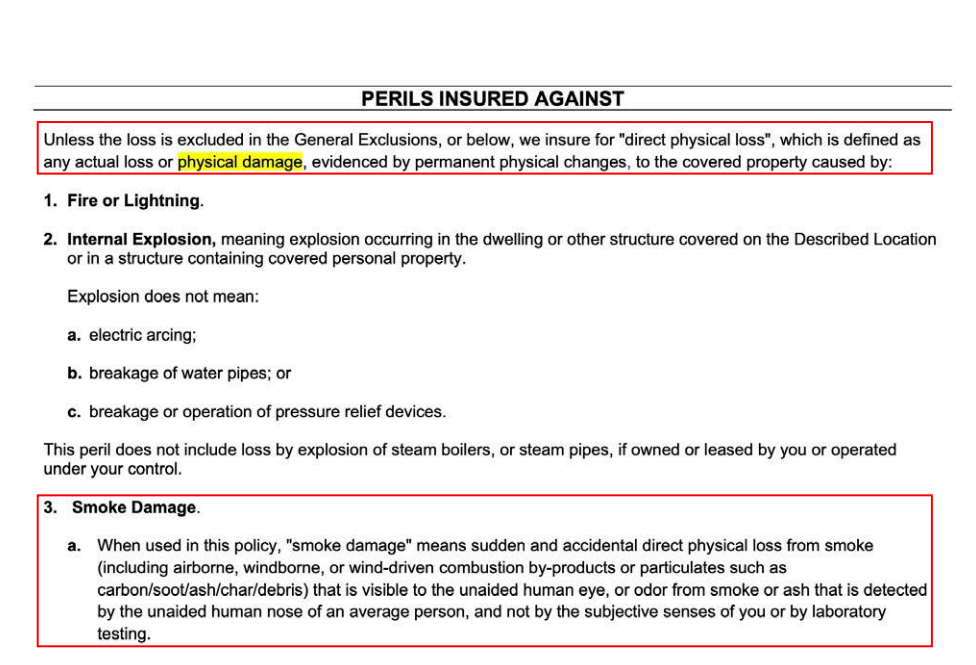
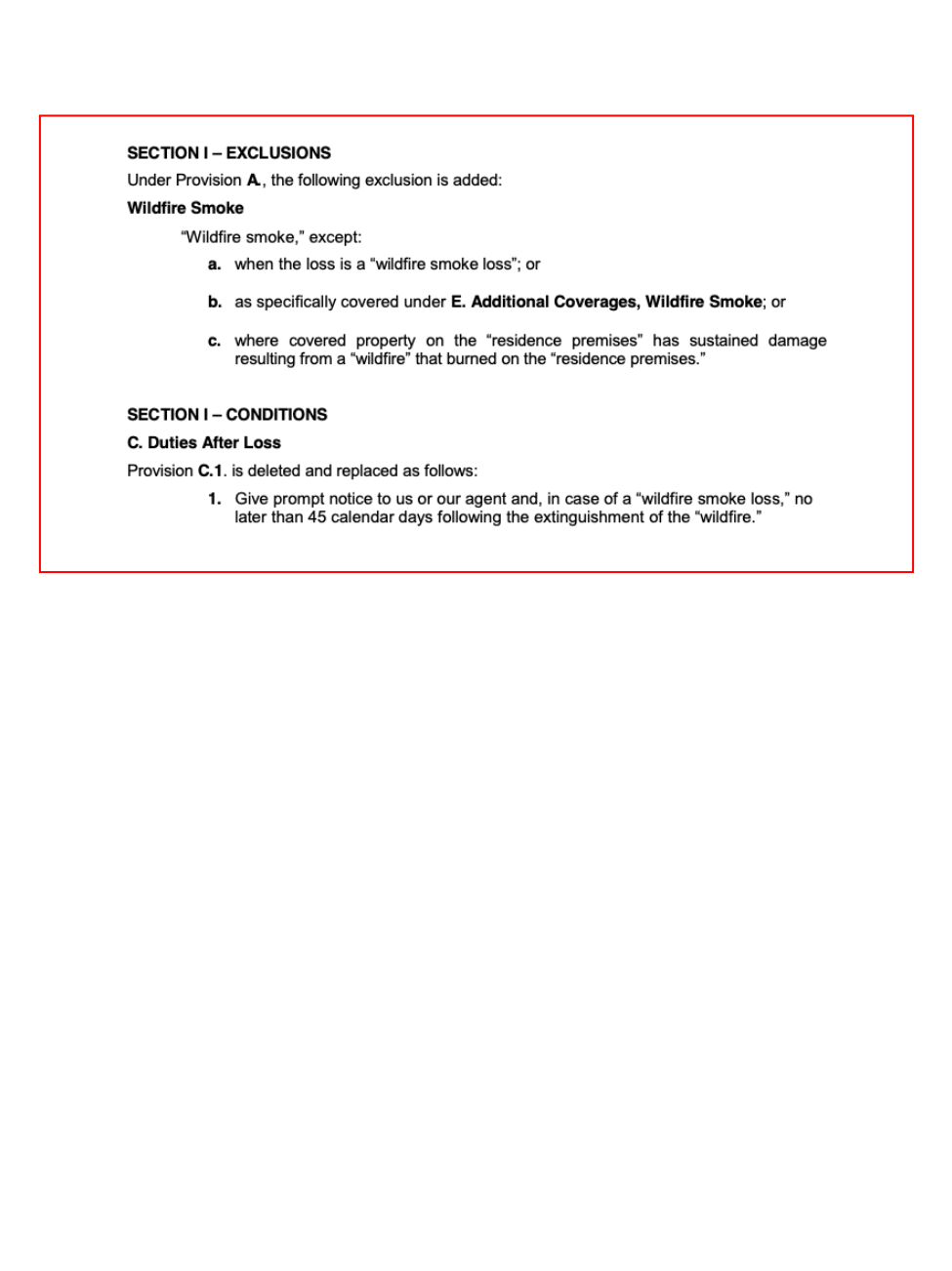
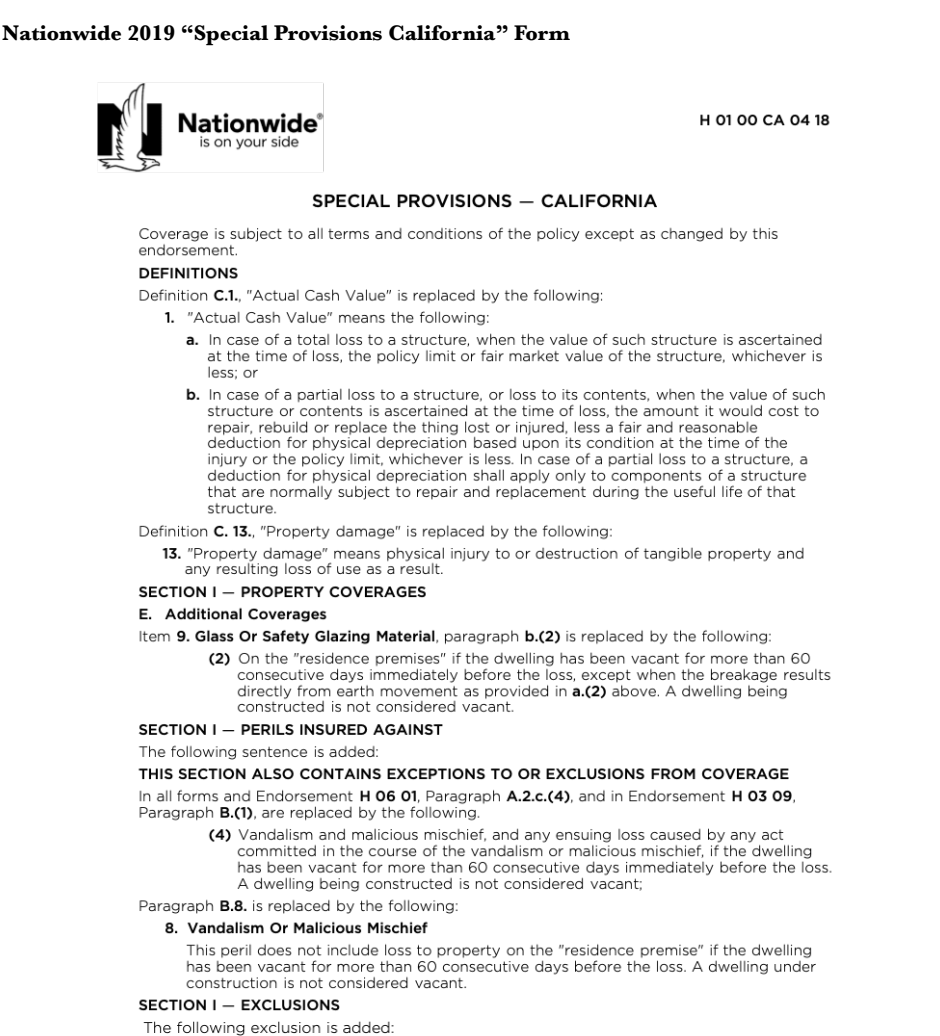
Examples of policy language regarding smoke damage Policies carving out smoke damage coverage from broader coverage of loss by fire are used extensively in California. Such provisions tend to utilize similar language, restricting recovery for losses that are not detected by “unaided human senses,” as in Nationwide’s789101112 2019 “Special Provisions – California” form, or by an “unaided human eye/nose,” as in the FAIR Plan’s 2017 Dwelling Property Policy. Another term used to restrict coverage is the FAIR Plan’s requirement that losses must be “evidenced by permanent physical changes.”
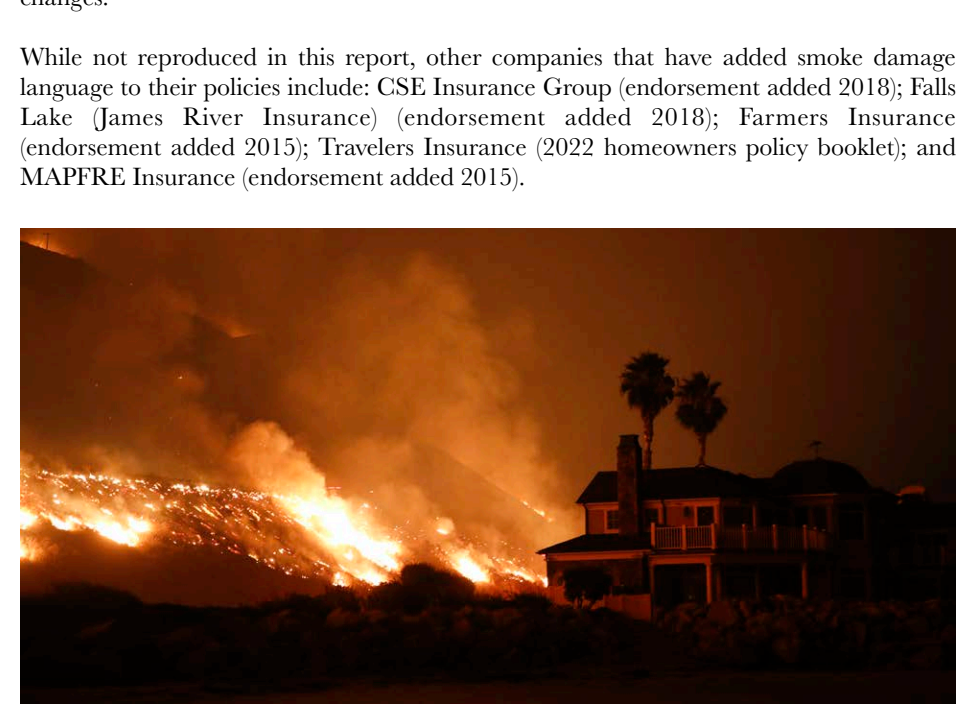
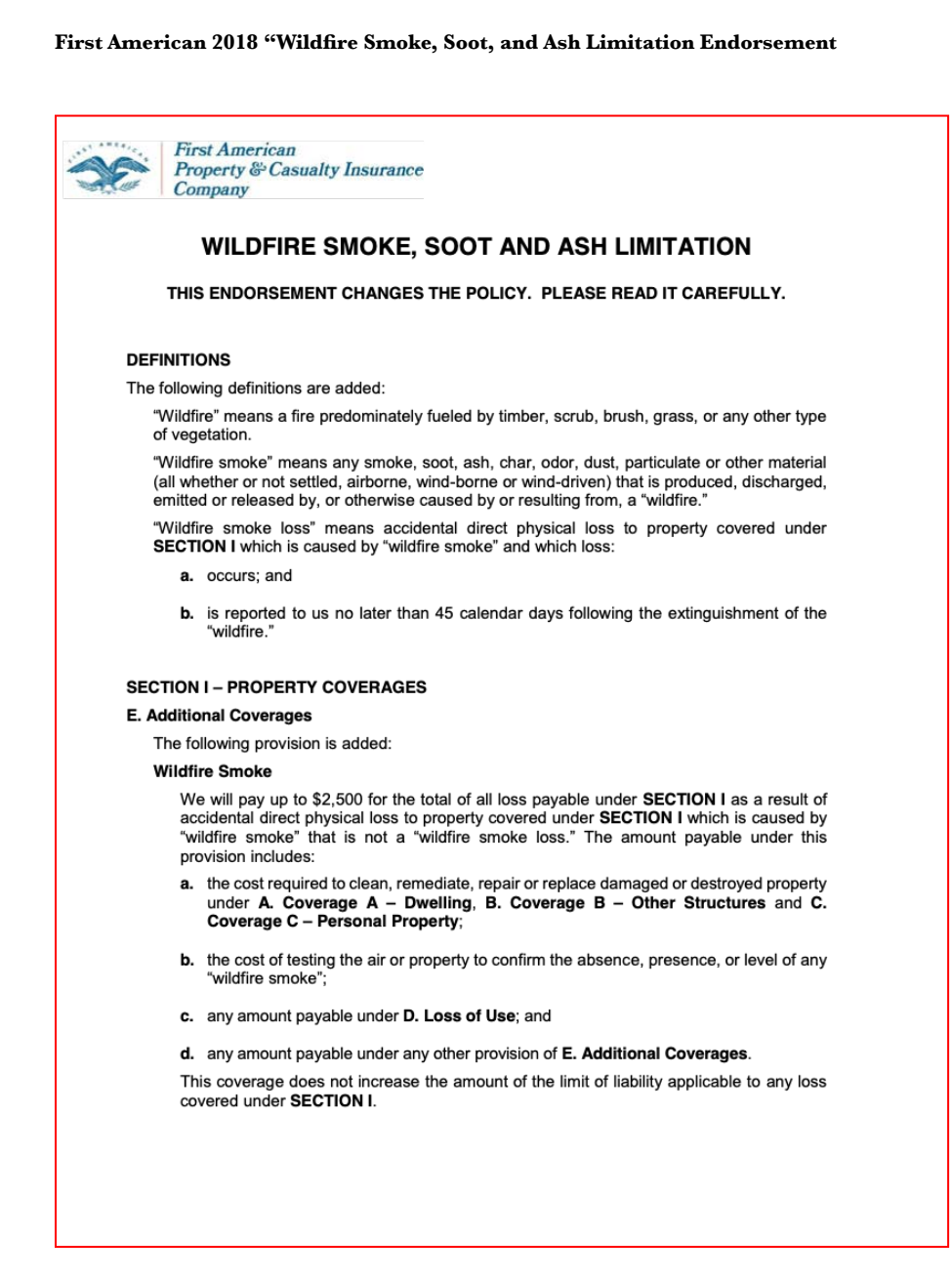
While not reproduced in this report, other companies that have added smoke damage language to their policies include: CSE Insurance Group (endorsement added 2018); Falls Lake (James River Insurance) (endorsement added 2018); Farmers Insurance (endorsement added 2015); Travelers Insurance (2022 homeowners policy booklet); and MAPFRE Insurance (endorsement added 2015).
At least nine major insurance companies have incorporated smoke damage language into their policies within the last decade. This is in addition to FAIR Plan policies, which consumers are increasingly forced to purchase when individual insurance companies refuse to cover their dwelling, and which has seen, and will continue to see, substantial13 growth as the severity of wildfire seasons continue to rise.13 As discussed in more detail below, the Market Conduct Examination of the Fair Plan, conducted by internal CDI auditors and recently posted on the agency’s website, confirms that “[s]moke damage is not a separate occurrence from fire,” and that the FAIR Plan violated California law. (Market Conduct Exam, p. 13.)
Fair Plan 2017 “Dwelling Property Policy”
2. LOSS REPORTING TRIGGER
What is the issue?
The issue here is the trigger (event) that an insurance company uses to determine whether a loss was reported on time by the policyholder. Under California law, and common sense, the requirement to report a loss should begin at the inception of the loss. But some insurance policies start counting from the date of some other event—such as the start date of the wildfire, or the date that the wildfire is 100% contained. Obviously, a loss that is supposed to be covered by the policy can occur at a date later than either of those two events.
Why is this a problem?
Insurance Code Section 2071 requires an insured person to give written notice of “any loss without unnecessary delay.” An insurer can deny a claim on the grounds of delay, but only if the late notice caused “actual and substantial prejudice” to its investigation and14 claims adjustment process. The time to report a loss must logically begin at the time of the loss. Policies that could require insured persons to report losses before they occur do not provide “substantially equivalent coverage” when compared to the standard fire policy form in Section 2071.
In other words, a policy that triggers the loss reporting requirement at the start date of the wildfire could require a person to report a loss before it is even suffered, especially for long-lasting wildfires. This language can also create major obstacles for policyholders trying to recover for a loss. For example, a “100% contained” wildfire may subsequently become less than fully contained—how is the proper date calculated in that situation? For both legal and practical reasons, such language fails to comport with the required standards of Section 2071.
Examples of policy language regarding loss reporting deadlines This is one of the most common issues encountered while surveying fire insurance policies. For example, in 2017, Homesite Insurance added an endorsement to its homeowners policy limiting smoke damage coverage to “$2,500 for losses reported within 46 – 120 days of 100% containment.” The following year, Bamboo Insurance implemented a nearly identical endorsement to its homeowners policy that also limited coverage to $2,500 for losses “not reported to us within forty-five (45) days of the date a14 governmental authority declares the wildfire to be 100% contained.” Also in 2018, the Auto Club of Southern California implemented an endorsement to its homeowners, renters, and condominium policies that required notification of “loss no later than 90 calendar days following the start date of the wildfire.” Copies of these policy provisions are reproduced below.
Insurers applying these arbitrary and improper requirements unlawfully reduce or deny the compensation policyholders are entitled to obtain for losses.
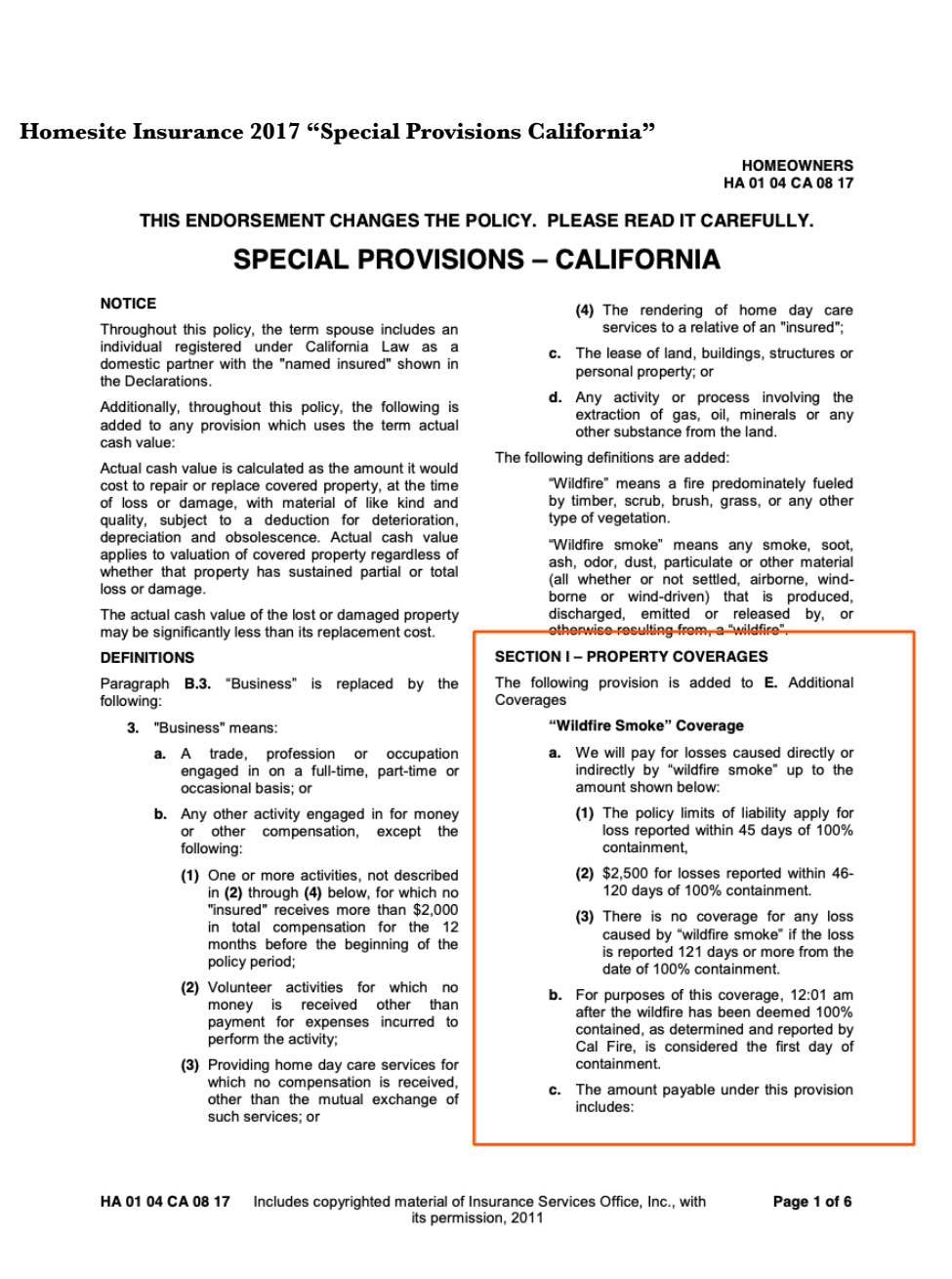
Homesite Insurance 2017 “Special Provisions California” AAA SoCal 2018 Amendatory Endorsement Bamboo 2018 “$2,500 Sublimit for Late Wildfire Claim Reporting for HO-3 Policies”
3. SUBLIMITS ON FIRE LOSSES
What is the issue?
Some insurance companies are imposing sublimits on fire loss coverage that reduce what consumers are paid. Two types of sublimits are at issue here. A reporting deadline sublimit is a provision in an insurance policy limiting or excluding recovery after a certain amount of time has passed from a specified event. For example, a policy may provide for full recovery of loss if the loss is reported within 45 days, but limit recovery to 50% of the total loss or a fixed dollar amount after 45 days—that is a sublimit. A loss-based sublimit is a provision limiting the amount of recovery for certain types of covered losses to less than the total policy limit. For example, a policy may restrict coverage for smoke damage losses to 50% of the total policy limit—this is also a sublimit.
Why is this a problem?
Section 2071 prescribes a single policy limit for loss by fire. For losses by fire, an insurer must pay for either the cost of repairs or the policy coverage maximum, whichever is less. Under the plain language of Section 2071, an insurer has no legal authority to apply sublimits on recovery due to things like reporting a claim after a certain amount of time has passed, or to apply sublimits to different kinds of fire losses, such as smoke damage losses. This was the conclusion reached by the Los Angeles Superior Court on summary judgment in the case Marrufo v. AAA of SoCal, No. BC597839 at *11–*12 (May 10, 2018), which appears to be the only on-point California decision. That court ruled that, “[Section 2071] prescribes a single policy limit for loss by fire. It does not permit a separate limit for some losses by fire (the ‘sublimit’) and a more generous limit for others.” Insurers cannot create separate policy sublimits outside the single policy limit for loss by fire.
Insurers create artificial deadlines limiting recovery in order to avoid having to prove that an insured person “unnecessarily delayed” reporting a loss, in contravention of the statutory requirement that insurers can deny claims for delay only if they show a late notice or proof of loss caused “actual and substantial prejudice” to their investigation and15 claims adjustment processes. Sublimit provisions fail to comport with the minimum coverage established by Section 2071, which prescribes a single policy limit for loss by fire and simply requires an insured person to report a loss “without unnecessary delay”— arbitrary reporting deadlines are not authorized by the statute.
The reasons why insurers would want to apply sublimits to smoke damage losses are manifest—such sublimits are nothing more than brazen attempts to greatly reduce claims payouts to consumers who correctly believed that their fire insurance coverage must cover15 smoke damage caused by a fire. Sublimit provisions can confuse and dissuade policyholders who are seeking compensation for covered losses.
Any damage caused because of fire should be covered under the single policy limit for fire losses. The potential harms to consumers from any kind of sublimits are massive. For example, the costs of remediating a smoke-damaged dwelling can easily cost tens of thousands of dollars, and six- or seven-figure losses are not unheard of. Unilaterally limiting coverage for such damage to, for example, $5,000 total is devastating. Similarly, allowing artificial deadlines to drastically limit an insured’s recovery without meeting the requirement that the company show prejudice permits insurers to deny completely valid16 claims on mere technicalities.
Examples of policy language regarding sublimits Like claim reporting deadlines, sublimits are also a very common issue in fire insurance policies. Indeed, both the Homesite and Bamboo Insurance policies, described previously and reproduced below, also contain “reporting deadline” sublimit provisions. Homesite’s 2017 “Special Provisions – California” form delineated recovery into three periods based on when a loss was reported: the policyholder obtains full recovery of the claim if reported within 45 days, $2,500 if reported within 46–120 days, and no recovery if reported after 120 days. Bamboo’s “$2,500 Sublimit” simply limits all recovery for losses reported after 45 days to $2,500.
An example of a “loss-based” sublimit is found in a 2018 “Limited Wildfire Smoke, Soot, Ash or Particulates Coverage” endorsement added to Civil Service Employees’ Insurance Company homeowners policies. Pursuant to the endorsement, a consumer who fully complies with the terms of the insurance policy can never recover more than $5,000 for smoke damage losses. (This endorsement also includes a reporting deadline sublimit, as recovery for smoke damage losses not reported within 45 days is limited to $1,500.) While not reproduced in screenshots following this page, other companies that have sought to institute recovery deadline sublimits include: California FAIR Plan (2017 Dwelling Property Policy); Farmers’ Insurance (endorsement added 2015); Travelers Insurance (2022 homeowners policy booklet); First American (endorsement added 2018); Falls Lake (James River Insurance) (endorsement added 2018); and MAPFRE Insurance (endorsement added 2015). These policies most commonly set a sublimit for losses reported after, as with the Homesite and Bamboo policies, forty-five days from whenever the insurer decides to run the reporting timer (this is how this issue and the previous issue interrelate).16
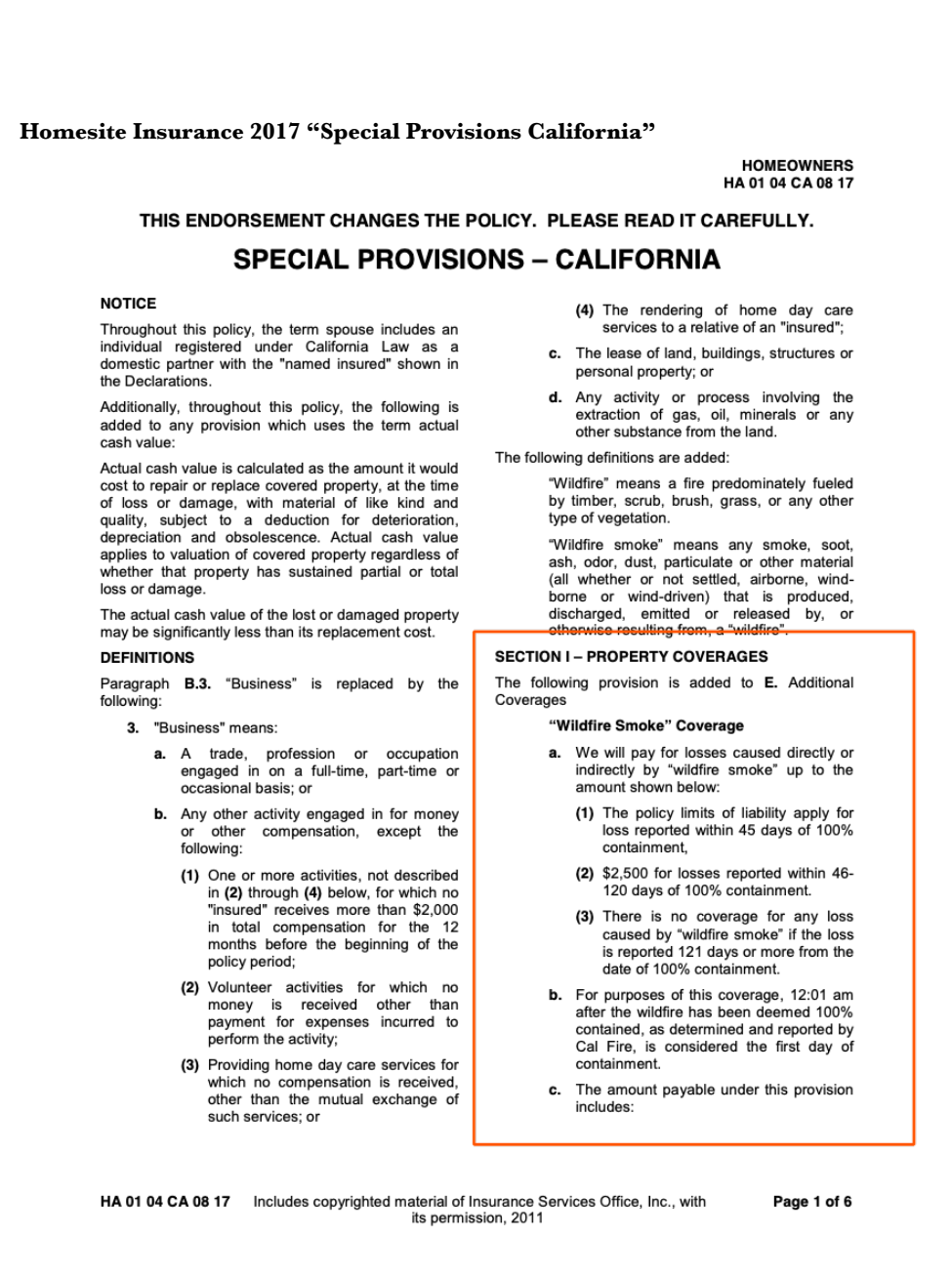
Homesite Insurance 2017 “Special Provisions California” Bamboo 2018 “$2,500 Sublimit for Late Wildfire Claim Reporting for HO-3
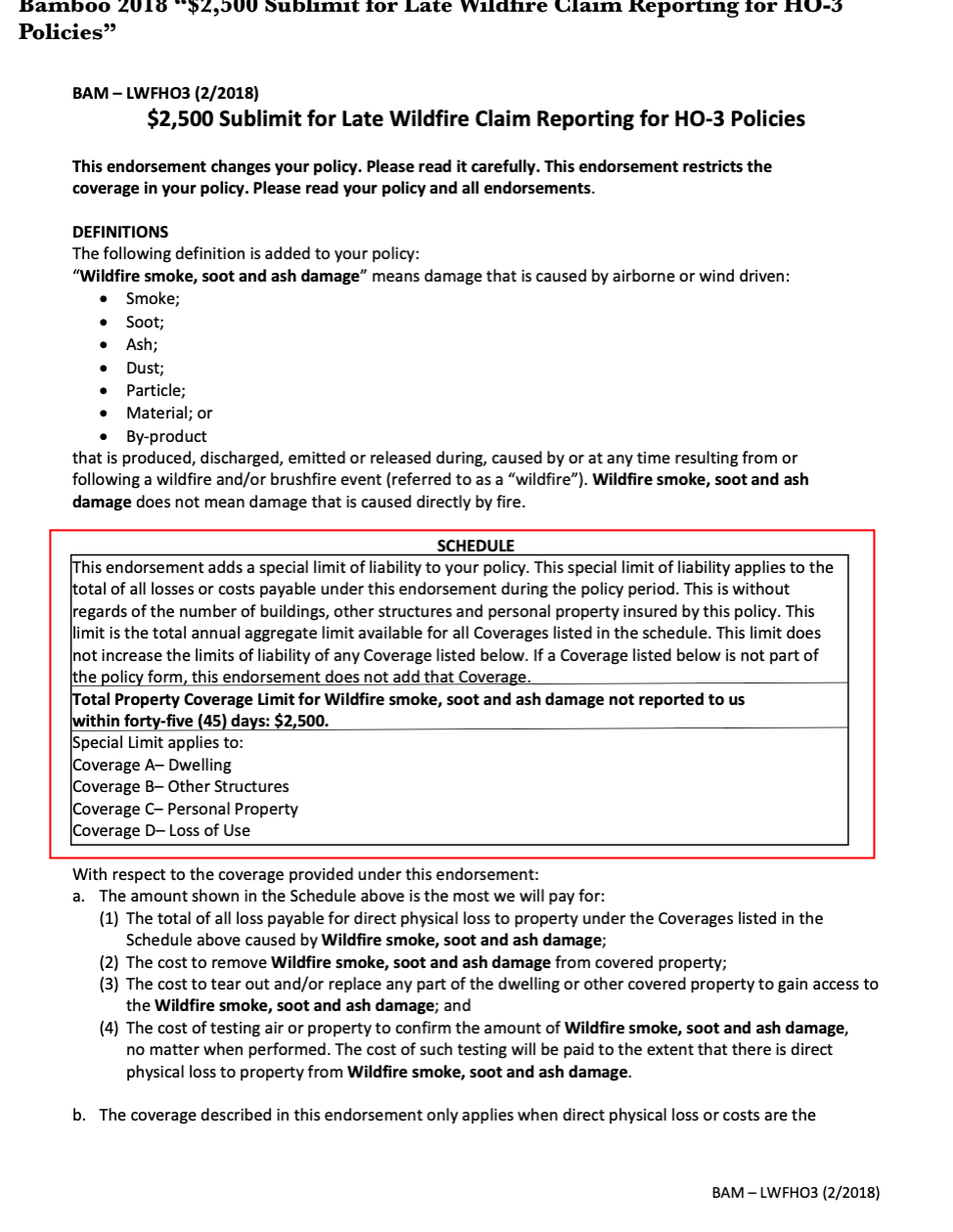
Policies”
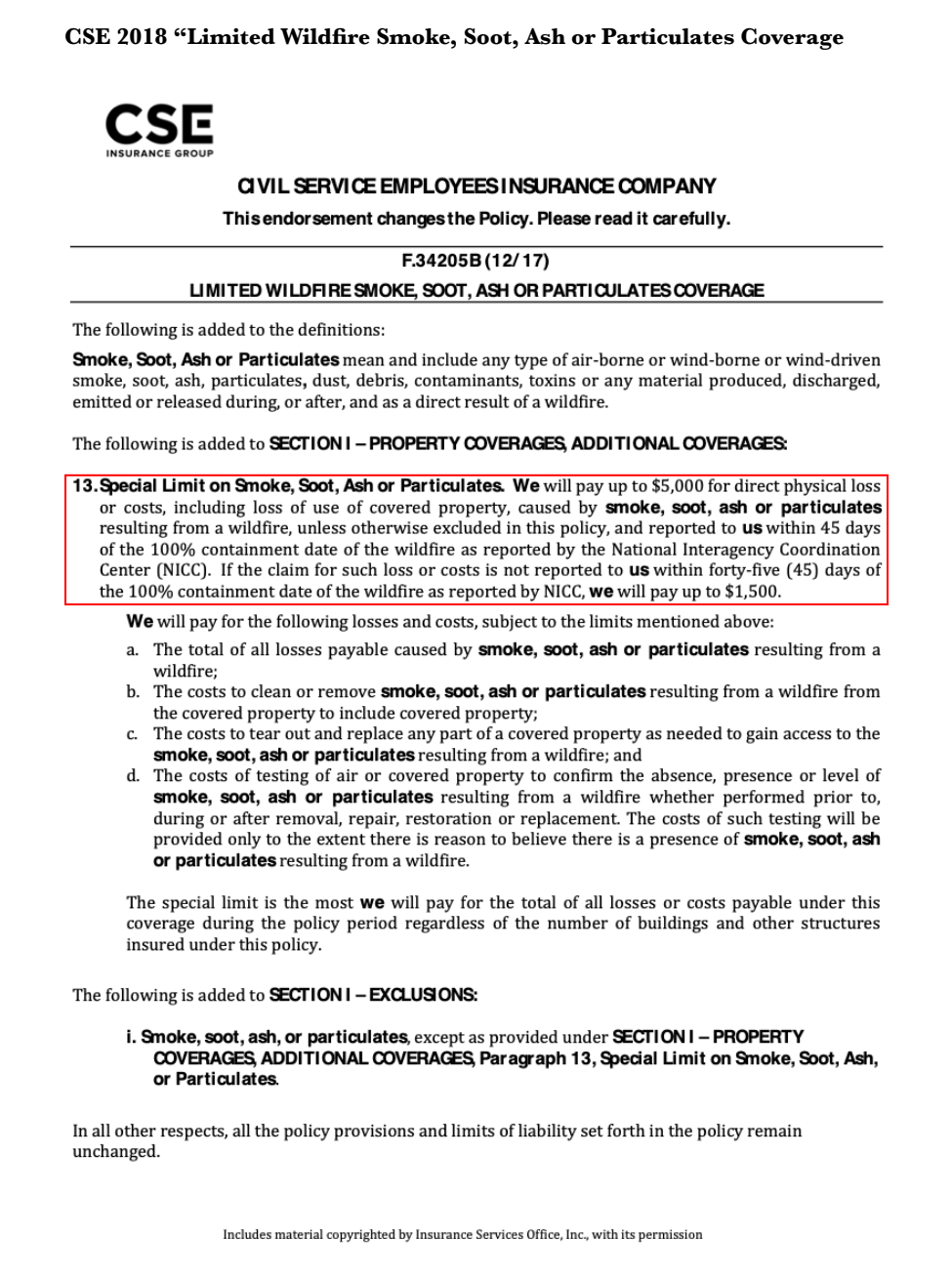
CSE 2018 “Limited Wildfire Smoke, Soot, Ash or Particulates Coverage
4. INCEPTION EXCLUSION
What is the issue?
An inception exclusion is a provision in a policy that denies coverage to an insured person if they suffer a loss within a certain time after purchasing the policy, generally 72 hours. Why is this a problem?
The issue here is similar to that with reporting/recovery deadline sub-limits discussed above. The statute says that a claim can be filed until 60 days after loss. The standard fire insurance form policy, which has been enacted into law as Section 2071, requires only that an insured person file a proof of loss within 60 days of the loss. It does not provide for any delay in the start of coverage. Precluding coverage for 72 hours after purchasing a policy is a demonstrable reduction in coverage compared to the standard policy,
“Someone could be
and therefore unlawful under Section 2071.
denied compensation
The intention of insurance companies that utilize
for damage from the
inception exclusions is no secret. They are seeking to avoid paying claims to homeowners who have purchased
very fire that they
coverage during wildfires that have already begun. It is
purchased the policy
thus possible that someone could be denied compensation for damage from the very fire that they purchased the
to protect themselves
policy to protect themselves against. The inception exclusion allows insurance companies to sell policies and
against.”
reap the profits, but later deny coverage if they can contend the exclusion applies.
Examples of language policies use regarding inception exclusions.
The two examples that follow, from Falls Lake’s (James River Insurance) 2019 “Amendment of Policy Terms California” endorsement and Homesite Insurance’s 2021 “Special Provisions California” endorsement, utilize the exact same operative language, adding to the list of exclusions: “loss occurring within 72 hours of the inception of this policy which is caused directly or indirectly by ‘wildfire’ if the ‘wildfire’ started prior to the inception of this policy.”
Falls Lake (James River Insurance) 2019 “Amendment of Policy Terms California”
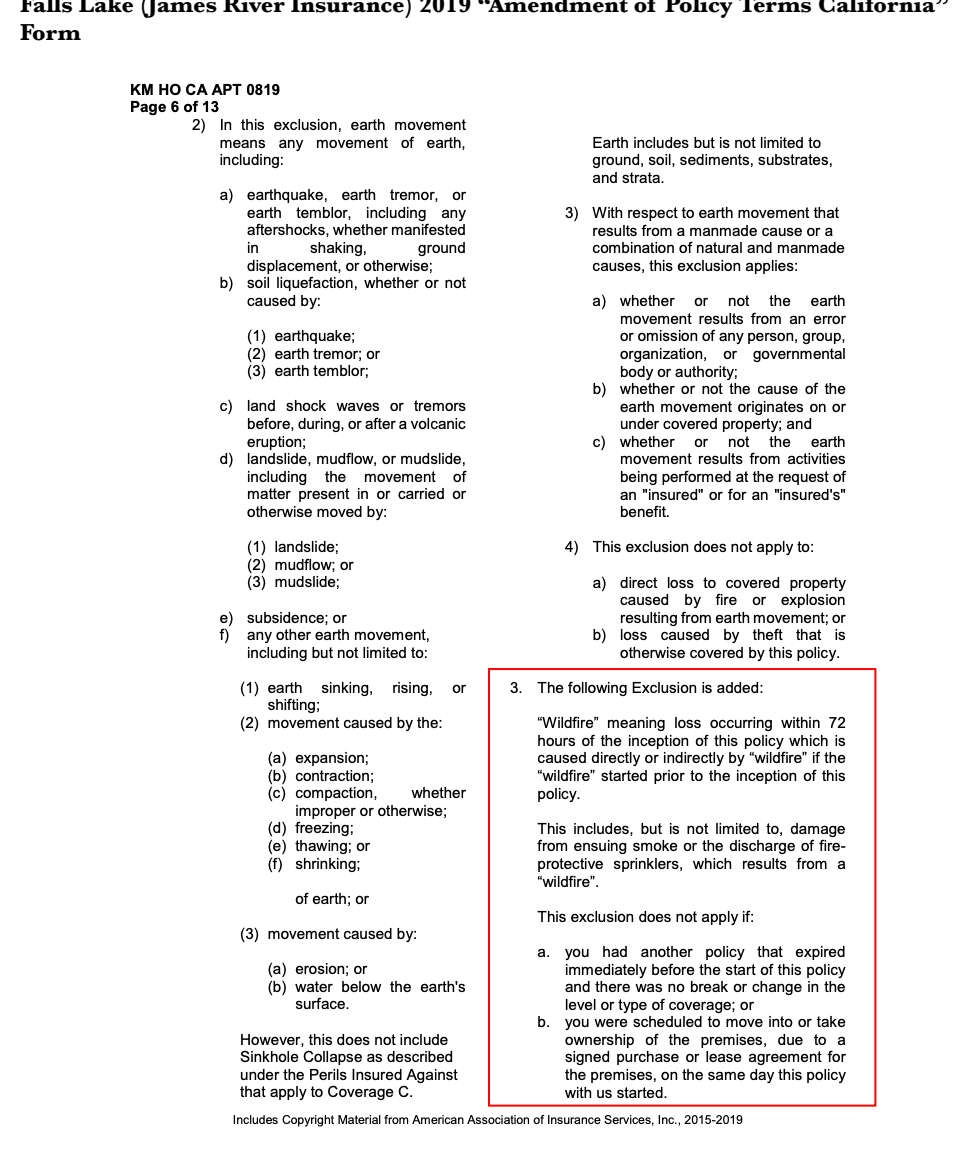
Form
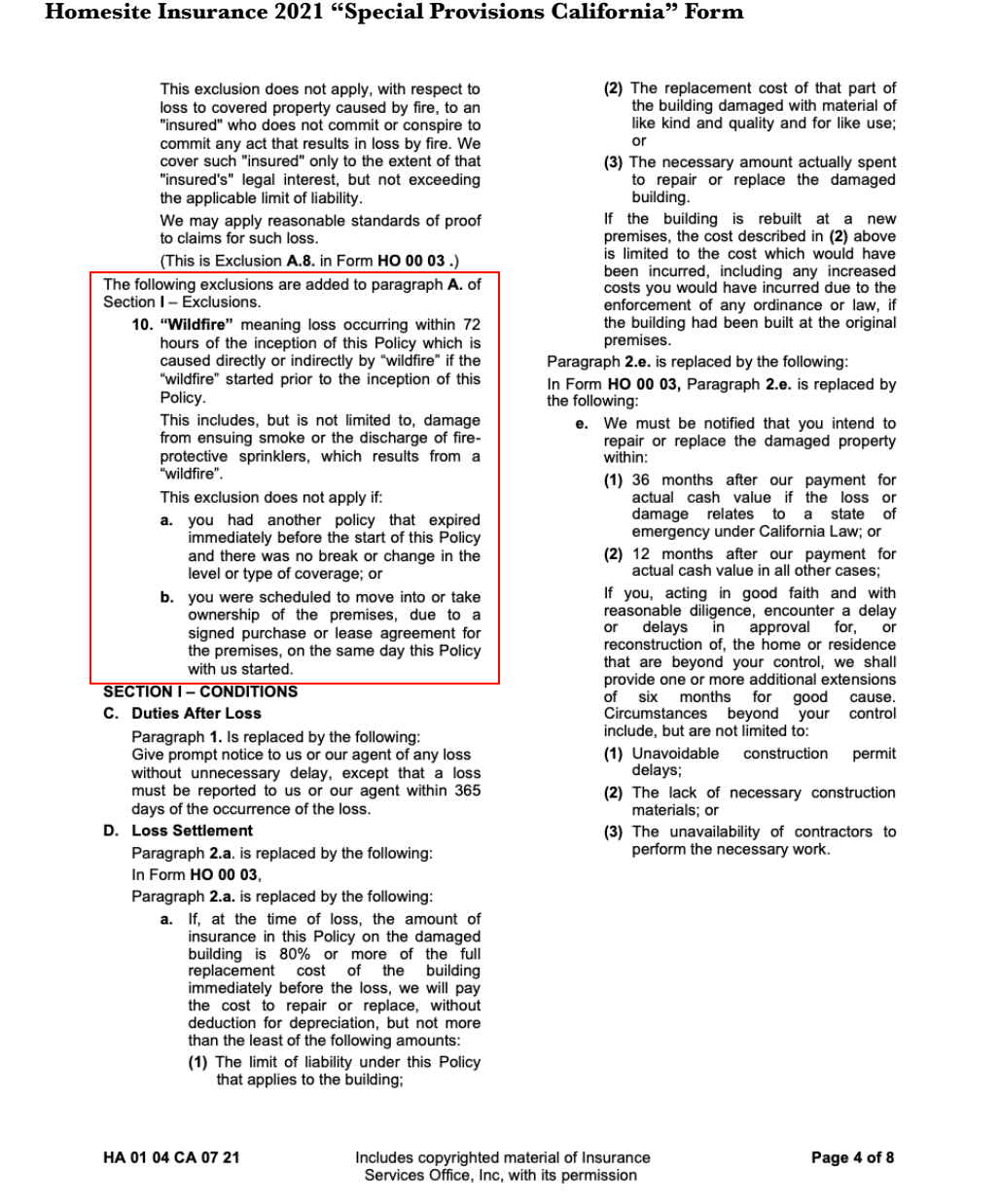
Homesite Insurance 2021 “Special Provisions California” Form
5. BARRING LITIGATION EITHER BEFORE OR AFTER AN APPRAISAL IS COMPLETED
What is the issue?
California law allows insurance companies or policyholders to obtain an appraisal by a third party in the event of a dispute between the policyholder and the insurance company over the amount of a loss. Some insurance companies have inserted provisions in their policies that prevent a homeowner from going to court to challenge the appraisal process, depriving the consumer of their legal rights. There are two main problematic appraisal provisions. Some insurers have included a policy provision that requires the homeowner to submit to an appraisal as a precondition to filing a suit. Other companies have included a policy provision that prevents the policyholder from filing a lawsuit after there has been an appraisal. These problems are essentially two sides of the same coin—both provisions allow the insurance company to use the appraisal process as a shield against a lawsuit by the homeowner, one by barring any litigation in the absence of appraisal, and one by barring all litigation because there was an appraisal. Both these types of provisions are unlawful, and each can harm consumers.
Why are these issues problematic?
Section 2071 does not authorize an insurer to bar litigation over a policy by manipulating the appraisal process. There are valid reasons for a consumer to, depending on their circumstances, either desire to bring a lawsuit before appraisal, or to seek an appraisal before bringing suit. A consumer might not want to be forced into appraisal before bringing suit if the insurance company is applying an incorrect legal basis for establishing the amount of damages the consumer suffered—otherwise, they could be forced to pay for an unlawful appraisal. Or a consumer might want to bring suit after an appraisal was completed if it became clear after the appraisal was completed that the insurance company was applying incorrect legal standards. Appraisals are supposed to provide the policyholder with the opportunity to resolve a dispute. They are not supposed to block, and can in no way substitute for, a homeowner’s right to their day in court. Examples of policy language regarding appraisals.
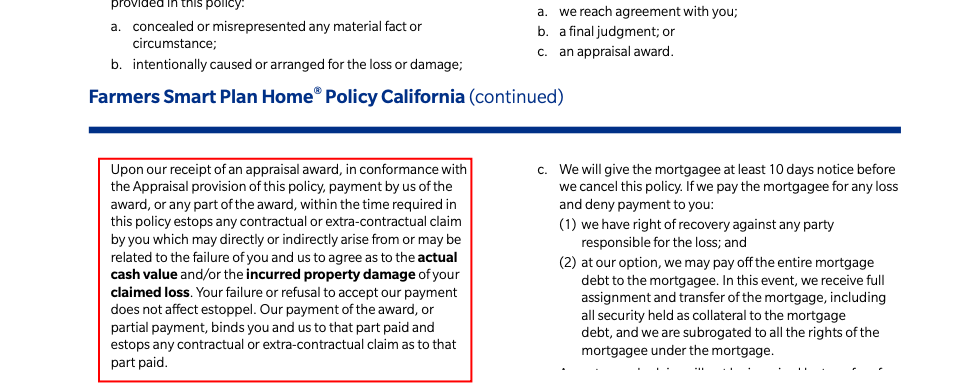
Foremost, a Farmers company, inserted a provision in its 2015 “Condominium Homeowners Policy” that precludes legal action if the insurer and insured fail to agree on the amount of a loss, “until [the insured has] submitted and resolved that dispute through appraisal.” The policy also purports to preclude a homeowner from any legal action concerning the policy unless the insured has “fully complied with all of the policy terms.” Farmers’ 2016 “Smart Plan Home Policy California” is another example. The policy contains a provision that purports to preclude litigation if Farmers pays out “any part of [an appraisal] award.” This policy language appears to be in direct conflict with Code of Civil Procedure sections 1285 and 1286.2, which expressly provide policyholders with a right to bring legal action asking a court to vacate an appraisal.
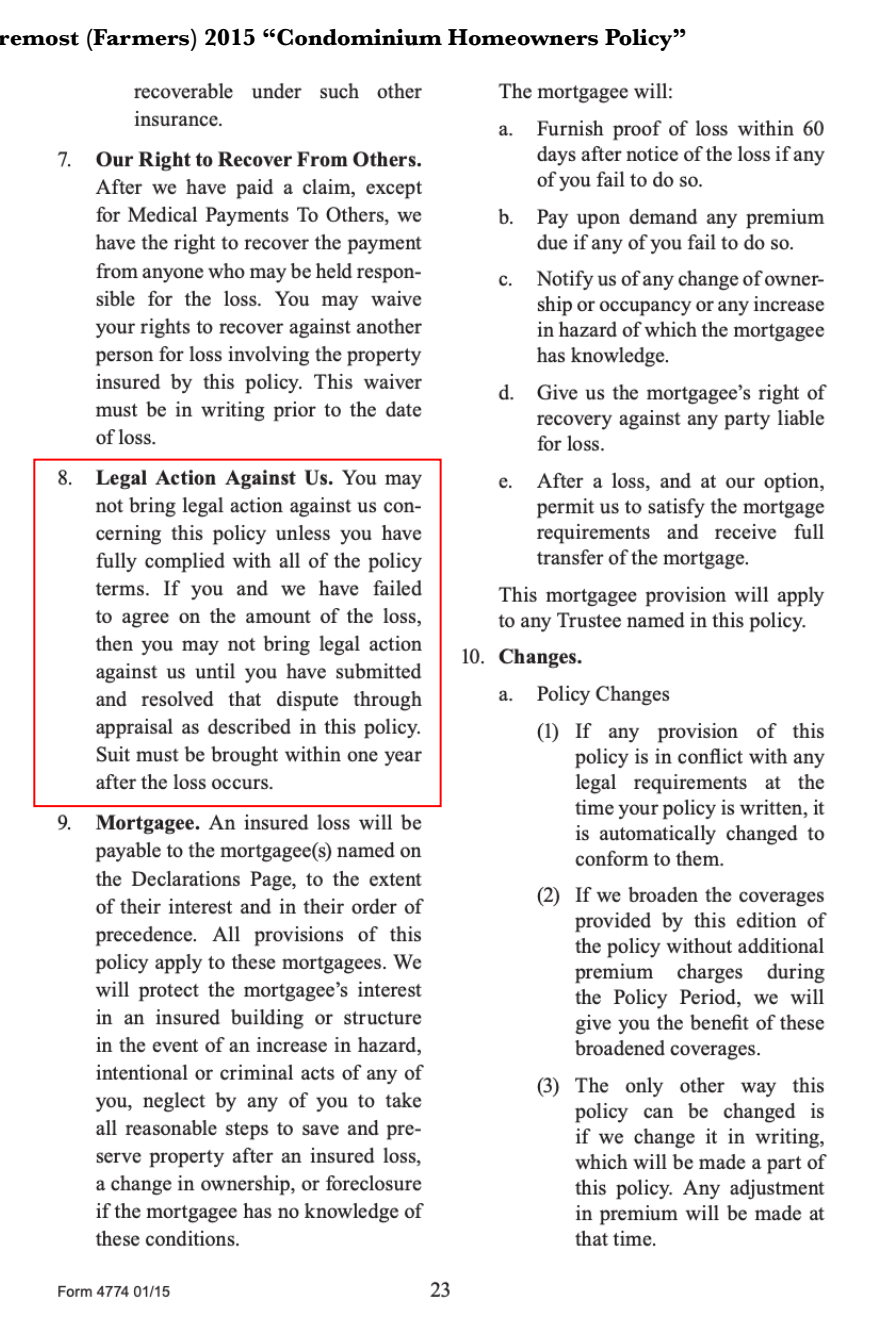
Foremost (Farmers) 2015 “Condominium Homeowners Policy”
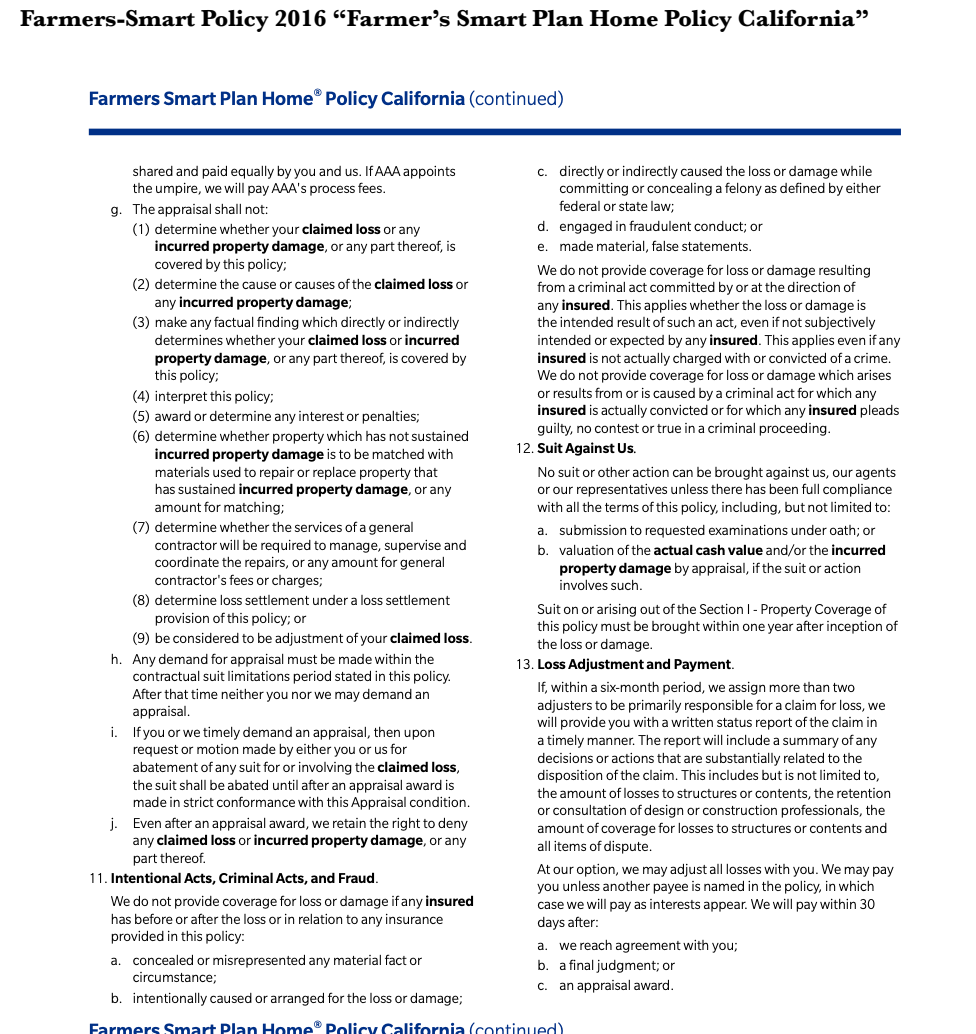
Farmers-Smart Policy 2016 “Farmer’s Smart Plan Home Policy California”
6. FAILURE TO NOTIFY CONSUMERS OF GOVERNMENT-DECLARED DISASTER/STATE OF EMERGENCY EXCEPTIONS
What is the issue?
Section 2071 states that in the case of a (1) “government-declared disaster,” or (2) “state of emergency,” the normal Section 2071 requirements regarding appraisal and the statute of limitations are modified, as described below. Because these exceptions appear in the Section 2071 statutory standard fire insurance form, all insurance policies must include language notifying the homeowner that the normal requirements for appraisal and filing suit are modified in such circumstances. Insurers must also provide policyholders with a separate, additional notice of these exceptions within 15 days after the consumer files a claim during a declared disaster or state of emergency. (Section 14046(b).) Why is this a problem?
Section 2071 generally allows for either party to compel appraisal, but it expressly bars compelled appraisals “in the event of a government-declared disaster.” Similarly, Section 2071 normally has a 12-month statute of limitations to sue over a loss, but this time is extended to 24 months “if the loss is related to a state of emergency.” As noted above, because these exceptions appear in Section 2071, which sets the statutory minimum for fire insurance coverage, all fire insurance policies must include language stating when these exceptions apply. Furthermore, even if these exceptions are stated in a policy, insurers must provide policyholders with notice of these exceptions within 15 days after they file a claim. (Section 14046(b).) These disaster/emergency exceptions are in place in recognition of the potential severe trauma and life disruption that can impact individuals whose property is damaged by wildfire. They give consumers greater flexibility to attend to personal and other urgent matters immediately after a catastrophic wildfire without having to worry about going through complex insurance procedures such as an appraisal or filing a lawsuit against their insurer. However, some insurance companies fail to include this information in their homeowners insurance policies, or fail to notify consumers of these rights after an applicable claim is made.
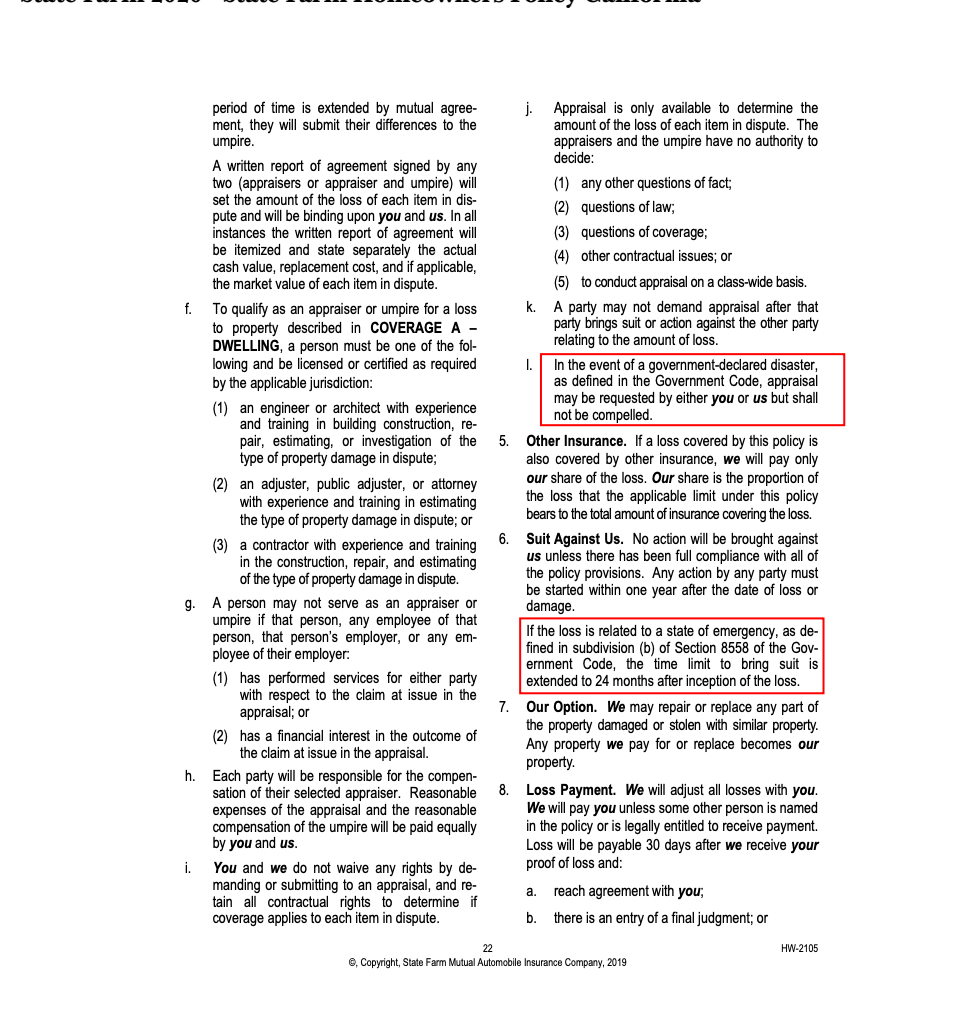
Example of policy language regarding notifying consumers of their rights. In contrast to the previous issues described in this report, this issue does not concern terms improperly included in a policy, but rather the use of terms improperly excluded from a policy. State Farm’s 2020 California Homeowners Policy is an example of the language a policy should contain, properly denoting these exemptions by directly quoting the language of Section 2071 regarding disasters and states of emergency. The policy states that (1) “In the event of a government-declared disaster, as defined in the Government Code, appraisal may be requested by either you or us but shall not be compelled”; and (2) “If the loss is related to a state of emergency, as defined in subdivision (b) of Section 8558 of the Government Code, the time limit to bring suit is extended to 24 months after inception of the loss.”
CDI’s Market Conduct Exam of the FAIR Plan found that the FAIR Plan sometimes failed to provide consumers with the notice of their rights after a disaster, as required by Section 14046(b). (Market Conduct Exam, pp. 10, 42.)
State Farm 2020 “State Farm Homeowners Policy California”
The Audit of the Fair Plan Reveals That It Uses Unlawful Provisions to Violate the Rights of Californians The FAIR Plan, established by the California Legislature in 1971, is known as the “insurer of last resort” in this state. That means that if a private company refuses to sell a homeowner insurance policy to a consumer in California, the FAIR Plan is required by law to do so. The FAIR Plan is the California insurance industry, however. Its governing committee is composed of senior executives from the major insurers. The FAIR Plan keeps its prices high and its coverage low in order to not to compete with its member companies. As more and more private insurance companies have refused to renew or sell homeowners insurance to communities across California—creating a crisis with serious repercussions for homeowners and California’s economy—the FAIR Plan’s market share increased by more 67% from 2018 to 2020 (1.6% to 2.7%—including a 559% increase in17 the “top risk counties”).
An internal, secret audit of claims handling by the FAIR Plan, undertaken by CDI, was completed more than a year ago, on March 18, 2021. It was posted to CDI’s website in June 2022. It makes clear that since at least January 2017, the FAIR Plan has been settling wildfire claims based on illegal policy provisions, including those documented in this report. The Market Conduct Exam, which can be found by searching “Fair Plan” on the18 CDI website, determined that:
- “Contrary to [Ins. Code Section 2070],” the FAIR Plan “failed to issue a fire policy, when viewed in its entirety, that is substantially equivalent to or more favorable to the insured than that contained in the California Standard Form Fire Insurance Policy as reflected in [Ins. Code Section] 2071.” (Market Conduct Exam, p. 5.)
- “[The FAIR Plan] failed to provide coverage for all loss by fire as set forth in the California Standard Form Fire Insurance Policy.” (Ibid.)
- Relying on its invalid policy provisions, the FAIR Plan routinely and improperly denied claims for fire damage across the state. (Id. at pp. 8–10.)1718
- “[The FAIR Plan] failed to conduct and diligently pursue a thorough, fair and objective investigation” of claims. (Id. at p. 5.)
- “[The FAIR Plan] failed to disclose all benefits, coverage, time limits or other provisions of the insurance policy.” (Ibid.)
The Market Conduct Exam places the blame squarely on the FAIR Plan: “in [the FAIR Plan’s] Filing Memorandum in support of its form filing to CDI, [the FAIR Plan] specifically represented to CDI that its proposed revisions, including its new definition of ‘direct physical loss,’ would not reduce or eliminate existing coverages, might even broaden coverage, and would have no rate impact. Specifically, [the FAIR Plan] stated: ‘The changes in the policy will either provide no change in coverage or will provide some broadening of coverage. The FAIR Plan will not revise rates for the additional coverage.’ Despite its representations to CDI, [the FAIR Plan] handled claims for smoke damage based on its policy’s definition of ‘direct physical damage’ as requiring permanent physical changes to covered property. However, loss caused by fire does not require ‘permanent physical changes’ for there to be coverage. Further, a loss from smoke stemming from fire should be adjusted as would a loss caused only by fire. Smoke damage is not a separate occurrence from fire. [The FAIR Plan’s] definition of smoke and/or smoke damage is not at least equivalent to that required under the Standard Form Fire Insurance Policy and is therefore a violation of law.”
CDI’s audit asserts that the FAIR Plan deceived the agency by failing to disclose the true impact on policyholders of the FAIR Plan’s proposed changes to its policy. But the FAIR Plan appears to serve as an industry testing ground for unlawful policy provisions that have appeared in the policies of insurance companies operating in the marketplace. As this report reveals, many of the similarly illegal policy provisions adopted by some of the largest private insurance companies in California were publicly disclosed in their applications requesting the agency’s approval. The question remains why these provisions were not flagged and rejected by the Commissioner’s staff. Moreover, the Commissioner has made it a point to visit communities devastated by wildfires. And the agency has an active consumer complaint process. How could they not be aware of the devastation wrought by insurance companies unlawfully refusing to pay claims based on these unlawful provisions?
CONCLUSION
This report documents unlawful restrictions in the fire insurance policies of major insurance companies doing business in California.
As California enters another fire season, the insurance industry’s emphasis on expanding its profits at the expense of its policyholders cannot be tolerated. Under Section 12921(a), the Commissioner and the Department have a statutory duty to consumers to enforce the law. Here are five immediate steps that Commissioner Lara must take to protect California consumers and prevent further violations of the law: 1.The Commissioner should investigate all claims denied by insurance companies during and after the historic 2017 wildfires to determine whether they were handled lawfully, with special attention paid to claims denied pursuant to unlawful smoke damage provisions. The Commissioner should use the full authority of his office to get insurance companies to reopen any claims that were improperly denied and pay such claims in full.
2.The Commissioner should initiate enforcement actions against insurance companies that systematically violated Californians’ rights to fair claims handling and should seek the maximum statutory penalty of $5,000 per policy per violation, or $10,000 if the violation was willful.
3.When the Commissioner determines that one or more insurers violated California law with respect to a significant number of the claims it handled, as did the FAIR Plan, the Commissioner should refer the matter to the Attorney General or to a local District Attorney for prosecution of the responsible individuals and companies under Section 2083. In addition to criminal penalties for such violations, law enforcement should investigate whether the individual insurance companies that run the FAIR Plan conspired among themselves to limit coverage and raise prices, thereby violating California’s antitrust laws, which apply to the insurance industry under Proposition 103 (Section 1861.03, subd. (a); see also North Carolina State Bd. of Dental Examiners v. F.T.C. (2015) 574 U.S. 494.) 4.The Commissioner should request an investigation and public report, by the California State Auditor or another independent authority, of the failure of CDI to disapprove or otherwise take action against the violations of California law. The report should determine whether the agency devoted sufficient staffing and other resources to its consumer complaint, review, and enforcement procedures, and make recommendations for improvement.
5.The Commissioner should issue a notice or Bulletin reminding insurance companies that it is unlawful to engage in the misconduct identified by this report.
APPENDIX A: CALIFORNIA INSURANCE CODE SECTION 2070
CALIFORNIA INSURANCE CODE SECTION 2070
§2070. Policies to be on standard form
All fire policies on subject matter in California shall be on the standard form, and, except as provided by this article shall not contain additions thereto. No part of the standard form shall be omitted therefrom except that any policy providing coverage against the peril of fire only, or in combination with coverage against other perils, need not comply with the provisions of the standard form of fire insurance policy or Section 2080; provided, that coverage with respect to the peril of fire, when viewed in its entirety, is substantially equivalent to or more favorable to the insured than that contained in such standard form fire insurance policy.
APPENDIX B: CALIFORNIA INSURANCE CODE SECTION 2071 §2071. Form of policy
The following is adopted as the standard form of fire insurance policy for this (a) state: California Standard Form Fire Insurance Policy No.
[Space for insertion of name of company or companies issuing the policy and other matter permitted to be stated at the head of the policy.] [Space for listing amounts of insurance, rates and premiums for the basic coverages insured under the standard form of policy and for additional coverages or perils insured under endorsements attached.] In consideration of the provisions and stipulations herein or added hereto and of ______________ dollars premium this company, for the term of ______________________ from the ______________________day of ______________________, 20____________ } At 12:01 a.m., to the ______________________day of ______________________, 20____________ } standard time, at location of property involved, to an amount not exceeding ______________ dollars, does insure ______________________ and legal representatives, to the extent of the actual cash value of the property at the time of loss, but not exceeding the amount which it would cost to repair or replace the property with material of like kind and quality within a reasonable time after the loss, without allowance for any increased cost of repair or reconstruction by reason of any ordinance or law regulating construction or repair, and without compensation for loss resulting from interruption of business or manufacture, nor in any event for more than the interest of the insured, against all LOSS BY FIRE, LIGHTNING AND BY REMOVAL FROM PREMISES ENDANGERED BY THE PERILS INSURED AGAINST IN THIS POLICY, EXCEPT AS HEREINAFTER PROVIDED, to the property described hereinafter while located or contained as described in this policy, or pro rata for five days at each proper place to which any of the property shall necessarily be removed for preservation from the perils insured against in this policy, but not elsewhere.
Assignment of this policy shall not be valid except with the written consent of this company.
This policy is made and accepted subject to the foregoing provisions and stipulations and those hereinafter stated, which are hereby made a part of this policy, together with any other provisions, stipulations and agreements as may be added hereto, as provided in this policy.
IN WITNESS WHEREOF, this company has executed and attested these presents; but this policy shall not be valid unless countersigned by the duly authorized agent of this company at ______________________ ______________________Secretary. ______________________ ______________________President.
Countersigned this day of ______________________, 20____________ ______________________ Agent CONCEALMENT, FRAUD This entire policy shall be void if, whether before or after a loss, the insured has willfully concealed or misrepresented any material fact or circumstance concerning this insurance or the subject thereof, or the interest of the insured therein, or in case of any fraud or false swearing by the insured relating thereto.
UNINSURABLE AND EXCEPTED PROPERTY This policy shall not cover accounts, bills, currency, deeds, evidences of debt, money or securities; nor, unless specifically named hereon in writing, bullion or manuscripts. PERILS NOT INCLUDED This company shall not be liable for loss by fire or other perils insured against in this policy caused, directly or indirectly, by: (a) enemy attack by armed forces, including action taken by military, naval or air forces in resisting an actual or an immediately impending enemy attack; (b) invasion; (c) insurrection; (d) rebellion; (e) revolution; (f) civil war; (g) usurped power; (h) order of any civil authority except acts of destruction at the time of and for the purpose of preventing the spread of fire, provided that the fire did not originate from any of the perils excluded by this policy; (i) neglect of the insured to use all reasonable means to save and preserve the property at and after a loss, or when the property is endangered by fire in neighboring premises; (j) nor shall this company be liable for loss by theft.
OTHER INSURANCE Other insurance may be prohibited or the amount of insurance may be limited by endorsement attached hereto.
CONDITIONS SUSPENDING OR RESTRICTING INSURANCE Unless otherwise provided in writing added hereto this company shall not be liable for loss occurring (a) while the hazard is increased by any means within the control or knowledge of the insured; or (b) while a described building, whether intended for occupancy by owner or tenant, is vacant or unoccupied beyond a period of 60 consecutive days; or (c) as a result of explosion or riot, unless fire ensues, and in that event for loss by fire only.
OTHER PERILS OR SUBJECTS Any other peril to be insured against or subject of insurance to be covered in this policy shall be by endorsement in writing hereon or added hereto.
ADDED PROVISIONS The extent of the application of insurance under this policy and of the contribution to be made by this company in case of loss, and any other provision or agreement not inconsistent with the provisions of this policy, may be provided for in writing added hereto, but no provision may be waived except such as by the terms of this policy or by statute is subject to change.
WAIVER PROVISIONS No permission affecting this insurance shall exist, or waiver of any provision be valid, unless granted herein or expressed in writing added hereto. No provision, stipulation or forfeiture shall be held to be waived by any requirement or proceeding on the part of this company relating to appraisal or to any examination provided for herein. CANCELLATION OF POLICY This policy shall be canceled at any time at the request of the insured, in which case this company shall, upon demand and surrender of this policy, refund the excess of paid premium above the customary short rates for the expired time. This policy may be canceled at any time by this company by giving to the insured a 20 days’ written notice of cancellation with or without tender of the excess of paid premium above the pro rata premium for the expired time, which excess, if not tendered, shall be refunded on 94 Ch. 397 — 3 — demand. Notice of cancellation shall state that said excess premium (if not tendered) will be refunded on demand. If the reason for cancellation is nonpayment of premium, this policy may be canceled by this company by giving to the insured a 10 days’ written notice of cancellation.
MORTGAGEE INTERESTS AND OBLIGATIONS If loss hereunder is made payable, in whole or in part, to a designated mortgagee not named herein as the insured, the interest in this policy may be canceled by giving to the mortgagee a 10 days’ written notice of cancellation.
If the insured fails to render proof of loss the mortgagee, upon notice, shall render proof of loss in the form herein specified within 60 days thereafter and shall be subject to the provisions hereof relating to appraisal and time of payment and of bringing suit. If this company shall claim that no liability existed as to the mortgagor or owner, it shall, to the extent of payment of loss to the mortgagee, be subrogated to all the mortgagee’s rights of recovery, but without impairing mortgagee’s right to sue; or it may pay off the mortgage debt and require an assignment thereof and of the mortgage. Other provisions relating to the interests and obligations of the mortgagee may be added hereto by agreement in writing.
PRO RATA LIABILITY This company shall not be liable for a greater proportion of any loss than the amount hereby insured shall bear to the whole insurance covering the property against the peril involved, whether collectible or not.
REQUIREMENTS IN CASE LOSS OCCURS The insured shall give written notice to this company of any loss without unnecessary delay, protect the property from further damage, forthwith separate the damaged and undamaged personal property, put it in the best possible order, furnish a complete inventory of the destroyed, damaged and undamaged property, showing in detail quantities, costs, actual cash value and amount of loss claimed; and within 60 days after the loss, unless the time is extended in writing by this company, the insured shall render to this company a proof of loss, signed and sworn to by the insured, stating the knowledge and belief of the insured as to the following: the time and origin of the loss, the interest of the insured and of all others in the property, the actual cash value of each item thereof and the amount of loss thereto, all encumbrances thereon, all other contracts of insurance, whether valid or not, covering any of said property, any changes in the title, use, occupation, location, possession or exposures of said property since the issuing of this policy, by whom and for what purpose any building herein described and the several parts thereof were occupied at the time of loss and whether or not it then stood on leased ground, and shall furnish a copy of all the descriptions and schedules in all policies and, if required and obtainable, verified plans and specifications of any building, fixtures or machinery destroyed or damaged. The insured, as often as may be reasonably required and subject to the provisions of Section 2071.1, shall exhibit to any person designated by this company all that remains of any property herein described, and submit to examinations under oath by any person named by this company, and subscribe the same; and, as often as may be reasonably required, shall produce for examinations all books of account, bills, invoices, and other vouchers, or certified copies thereof if the originals be lost, at any reasonable time and place as may be designated by this company or its representative, and shall permit extracts and copies thereof to be made. The insurer shall inform the insured that tax returns are privileged against disclosure under applicable law but may be necessary to process or determine the claim.
The insurer shall notify every claimant that they may obtain, upon request, copies of claim-related documents. For purposes of this section, “claim-related documents” means all documents that relate to the evaluation of damages, including, but not limited to, repair and replacement estimates and bids, appraisals, scopes of loss, drawings, plans, reports, third-party findings on the amount of loss, covered damages, and cost of repairs, and all other valuation, measurement, and loss adjustment calculations of the amount of loss, covered damage, and cost of repairs. However, attorney work product and attorney-client privileged documents, and documents that indicate fraud by the insured or that contain medically privileged information, are excluded from the documents an insurer is required to provide pursuant to this section to a claimant. Within 15 calendar days after receiving a request from an insured for claim-related documents, the insurer shall provide the insured with copies of all claim-related documents, except those excluded by this section. Nothing in this section shall be construed to affect existing litigation discovery rights.
After a covered loss, the insurer shall provide, free of charge, a complete, current copy of this policy within 30 calendar days of receipt of a request from the insured. The time period for providing this policy may be extended by the Insurance Commissioner. An insured who does not experience a covered loss shall, upon request, be entitled to one free copy of this policy annually. The policy provided to the insured shall include, where applicable, the policy declarations page.
APPRAISAL In case the insured and this company shall fail to agree as to the actual cash value or the amount of loss, then, on the written request of either, each shall select a competent and disinterested appraiser and notify the other of the appraiser selected within 20 days of the request. Where the request is accepted, the appraisers shall first select a competent and disinterested umpire; and failing for 15 days to agree upon the umpire, then, on request of the insured or this company, the umpire shall be selected by a judge of a court of record in the state in which the property covered is located. Appraisal proceedings are informal unless the insured and this company mutually agree otherwise. For purposes of this section, “informal” means that no formal discovery shall be conducted, including depositions, interrogatories, requests for admission, or other forms of formal civil discovery, no formal rules of evidence shall be applied, and no court reporter shall be used for the proceedings. The appraisers shall then appraise the loss, stating separately actual cash value and loss to each item; and, failing to agree, shall submit their differences, only, to the umpire. An award in writing, so itemized, of any two when filed with this company shall determine the amount of actual cash value and loss. Each appraiser shall be paid by the party selecting him or her and the expenses of appraisal and umpire shall be paid by the parties equally. In the event of a government-declared disaster, as defined in the Government Code, appraisal may be requested by either the insured or this company but shall not be compelled.
ADJUSTERS If, within a six-month period, the company assigns a third or subsequent adjuster to be primarily responsible for a claim, the insurer, in a timely manner, shall provide the insured with a written status report. For purposes of this section, a written status report shall include a summary of any decisions or actions that are substantially related to the disposition of a claim, including, but not limited to, the amount of losses to structures or contents, the retention or consultation of design or construction professionals, the amount of coverage for losses to structures or contents and all items of dispute.
COMPANY’S OPTIONS It shall be optional with this company to take all, or any part, of the property at the agreed or appraised value, and also to repair, rebuild or replace the property destroyed or damaged with other of like kind and quality within a reasonable time, on giving notice of its intention so to do within 30 days after the receipt of the proof of loss herein required.
ABANDONMENT There can be no abandonment to this company of any property.
WHEN LOSS PAYABLE The amount of loss for which this company may be liable shall be payable 60 days after proof of loss, as herein provided, is received by this company and ascertainment of the loss is made either by agreement between the insured and this company expressed in writing or by the filing with this company of an award as herein provided. SUIT No suit or action on this policy for the recovery of any claim shall be sustainable in any court of law or equity unless all the requirements of this policy shall have been complied with, and unless commenced within 12 months next after inception of the loss. If the loss is related to a state of emergency, as defined in subdivision (b) of Section 8558 of the Government Code, the time limit to bring suit is extended to 24 months after inception of the loss.
SUBROGATION This company may require from the insured an assignment of all right of recovery against any party for loss to the extent that payment therefor is made by this company. Any amendments to this section by the enactment of Senate Bill 658 of the (b) 2001-02 Regular Session shall govern a policy utilizing the form provided in subdivision (a) when that policy is originated or renewed on or after January 1, 2002. (c) The amendments to this section made by the act adding this subdivision shall govern a policy utilizing the form provided in subdivision (a) when that policy is originated or renewed on or after January 1, 2004.
(d) (1) The amendments to this section made by the act adding this subdivision govern a policy originated or renewed on or after the effective date of this act. Notwithstanding paragraph (1), an insurer shall incorporate the revisions to (2) the standard form of fire insurance policy made by the act adding this subdivision on or before July 1, 2019.
APPENDIX C: MARRUFO V. AUTOMOBILE CLUB OF SOUTHERN CALIFORNIA
[A#ached]