Executive Summary
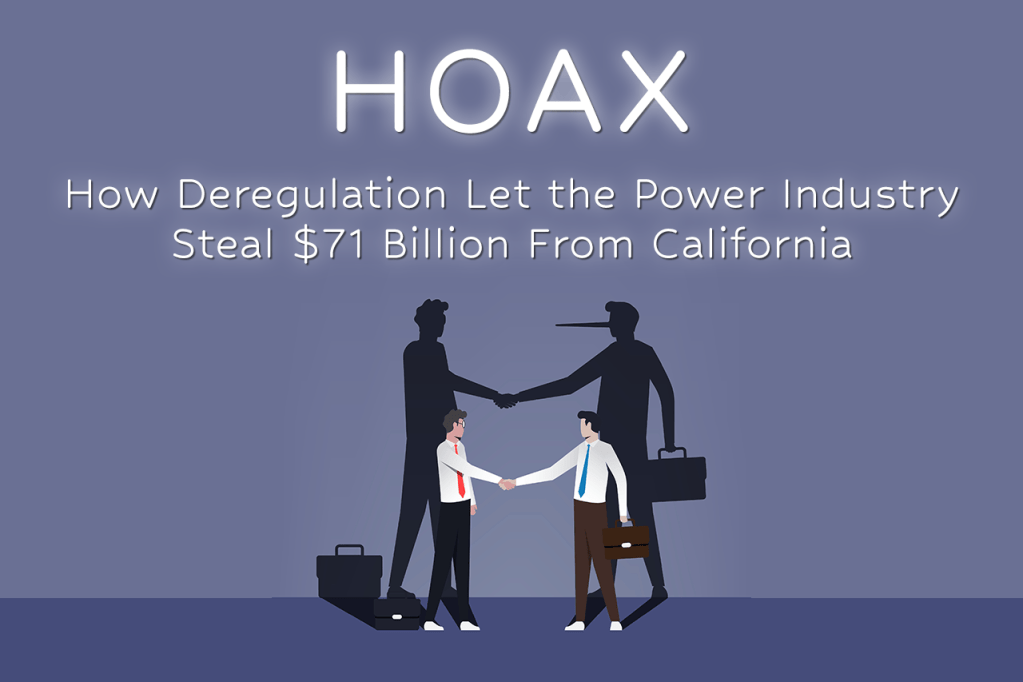
Last year’s electricity crisis has fallen off the front pages for the moment, but the impact on consumers will appear on electric bills for years to come. The crisis has cost taxpayers an extra $8.5 billion to date. Impending bailouts for utility companies, long-term power contracts and other factors will add an estimated $40 billion in excessive costs for residential and small business ratepayers. This is on top of $23 billion the utilities already received through the bailout contained in the initial deregulation legislation. In total, the deregulation law enacted with the unanimous support of politicians in 1996, will cost Californians approximately $71 billion, or $2,100 for every man, woman and child in the state.
This report analyzes the California energy crisis to determine what happened and why. We review the explanations provided by the power industry, deregulation advocates and state officials for why it occurred. Their often perfunctory assertions, rooted in the language and ideology of market economics, are shown to be disconnected from the actual circumstances during the crisis. We use publicly available data and analysis to demonstrate the degree to which the crisis was a combination of myth (shortages) and threat (blackouts) employed to increase profits or decrease liabilities of powerful special interests. We conclude that deregulation itself – the elimination of state controls over electricity rates by 1996 legislation sponsored by energy companies, utilities, large electricity users and other special interests –- enabled these companies to manipulate supplies, manufacture artificial shortages, inflate their stocks and thus reap windfall profits.
We also find that the same special interests which instigated and prospered from the electricity crisis are now lobbying vigorously to shift all of the crisis’s costs on to ratepayers and taxpayers while at the same time promoting a continuation of the deregulation law. We conclude that California may be revisited by electricity crises – both phony and real – in the near future, unless lawmakers and public officials act quickly to protect the public. We list fourteen major policy prescriptions to protect Californians against the impact of last year’s crisis and similar debacles in the future.
The study is broken down into five sections: I.A Chronology of Deregulation in California. This section provides a timeline of important crisis-related events beginning with the signing of the deregulation law in 1996.
I. The Myth of the Energy Shortage. This section focuses on the broadly, but mistakenly, accepted view that the California energy crisis arose out of an imbalance between California’s electricity supply and consumers’ demand for power. The data demonstrates that California was never short on power capacity during the crisis. It shows that blackouts occurred on low-demand days and wholesale prices spiked irrespective of the surplus supply available to private power companies.
I. Turning Off the Juice. This section details what really happened during the first sixth months of the California energy crisis. The data illustrates the means by which power wholesalers created spot shortages on the market to gain political and financial rewards. This section reviews the unprecedented windfall received by the energy industry during the first two quarters of 2001 while the rest of the U.S. economy was slipping into a recession.
I. Turning On the Juice. This section looks at the surprise of the year: a blackout-free summer. The data shows the way by which Governor Davis misled the public with conservation data in his attempt to explain the relative ease with which the state got through the summer. We explain that this summer should not have been a surprise, because, with angry public officials breathing down their necks, the energy industry did not want to kill deregulation by pushing their luck with still more gouging. More importantly, after signing windfall long-term power contracts, they had already locked in the profiteering for years to come prior to the summer.
I.The Legacy of the Deregulation Debacle. This section runs the numbers and addresses the policy concerns that will linger for years to come as a result of the California energy crisis. In summary this includes: (cid:216) Two rate increases since January have imposed an average 40% electricity rate increase on ratepayers – equaling $5 billion per year – with billions more to come.
(cid:216) $11.3 billion of taxpayers’ money from the State Treasury to buy power overpriced by more than $8 billion. With interest the price tag for energy bought from the energy wholesalers will reach $19 billion.
(cid:216) $22 billion in excessive electricity prices for the next twenty years as a result of long-term energy contracts negotiated with the wholesale energy companies worth a total of at least $43 billion.
(cid:216) A $5-13 billion bailout/reorganization plan for PG&E, the state’s largest private utility, which would remove plants operated by PG&E from current state price regulation.
(cid:216) A $3-5 billion bailout of Southern California Edison through an illegal secret deal with the Davis-controlled Public Utilities Commission.
(cid:216) The failure of the Public Utilities Commission to stop big businesses from exiting the public utilities system, which will result in $4.6 billion in losses due to surplus power purchased under contract.
(cid:216) The potential for a future supply crisis as private power companies, still in control of California’s power supplies, scrap plans to build promised power plants in order to limit supply and therefore justify higher prices in the future.
I. The Way Out of the Deregulation Debacle. This section includes thirteen specific recommendations to state and federal policymakers in order to shield the public from the manufactured crisis and avoid future crises: (cid:216) Renegotiate Long-Term Contracts (cid:216) Direct Access Ban Must Be Retroactive (cid:216) Keep Remaining Plants Regulated (cid:216) Remove DWR’s Authority to Procure Electricity or Manage Contracts.
(cid:216) Build Publicly-Owned Plants (cid:216) FERC Regulation (cid:216) Develop an Energy Plan for California’s Future (cid:216) Fight the PG&E Bankruptcy Re-Organization Plan (cid:216) Bar PUC From Implementing Edison Bailout (cid:216) Authorize PUC to Investigate and Penalize Inappropriate Plant Outages (cid:216) Restructure Electricity Rates so Residents and Small Businesses Don’t Pay More Than Big Businesses (cid:216) Windfall Profits Tax (cid:216) Citizen Utility Board VII.Conclusion.
I. A Chronology of the California Deregulation Debacle
September, 1996 – Greased with over $1.8 million in contributions from the big1 three utility companies, California lawmakers unanimously enact deregulation2 law. Legislation promises competition, 20% decreases. Gov. Pete Wilson signs the bill into law, saying that the landmark legislation is a major step in our efforts to guarantee lower rates, provide consumer choice and offer reliable service, so no one literally is left in the dark. We’ve pulled the plug on another outdated monopoly and replaced it with the promise of a new era3 of competition.
1997-1998 – Seeking favorable deals from state regulators, utilities sell most of their electricity power plants to seven out of state energy companies and one California corporation (Calpine) for $3.2 billion. The companies that bought the4 utility plants are: AES, Calpine Corp, Duke Energy, Dynegy, NRG Energy, Reliant Energy, Southern Energy (now known as Mirant) and Thermo Ecotek (which later sold its plants to AES).
March, 1998 – Competition is supposed to begin. California electricity consumers may choose alternative energy providers. Per deregulation law, retail electricity rates are frozen at historically high 1996 level, more than 40% above national average through 2002. California’s three private utilities – Southern California Edison, Pacific Gas & Electric and San Diego Gas & Electric – begin surcharging ratepayers to pay off previous debts incurred through mismanagement, poor regulation and cost overruns on nuclear plants. This is the first utility bailout. Fewer than 3% of residential customers leave their own utility companies.12 “It is the further intent of the Legislature…to provide…an anticipated result through34 November, 1998 – California utility companies spend over $38 million to defeat Proposition 9, initiative sponsored by The Foundation for Taxpayer and Consumer Rights (FTCR) and other consumer groups to block bailout of utilities’ bad debts under deregulation law.
July, 1999 – San Diego Gas & Electric (SDG&E) customers pay off the utility’s past debts. Statutory rate freeze is lifted for customers of SDG&E, making it the first region with both wholesale and retail deregulation. Customers’ electricity prices are no longer limited by state law.
June, 2000 –Instead of going down, as deregulation supporters promised, wholesale electricity rates in California begin to rise exponentially – as much as 300%. SDG&E passes these higher prices for purchasing power through to local customers, pursuant to the lifting of the rate freeze. An estimated $800 million is6 transferred out of the local economy.
August 30, 2000 – State lawmakers, facing revolt at November elections, order temporary rate rollback for SDG&E customers. The legislation, backed by utility lobbyists, requires SDG&E customers to repay balance of higher energy prices, with interest, beginning in 2003.
Fall, 2000 – Deregulation’s rate freeze turns on its own sponsors. Forbidden by the terms of the deregulation law they sponsored from raising retail rates beyond the frozen surcharge level, the state’s larger utilities, Pacific Gas & Electric (PG&E) and Southern California Edison, are now forced to cover the excess cost of deregulated electricity out of their own pockets. They begin to pressure the Public Utilities Commission (PUC) for permission to impose rate increases on utility customers. The California Public Utilities Commission rejects the request, asserting that the PUC does not have the authority to rewrite the deregulation law mid-way through the transition to deregulation.
November, 2000 – Lobbyists for utilities demand that the California Legislature order rate increases to bail out utilities from current losses. FTCR warns Legislature against bailout.
December 7, 2000 – The California grid operator announces the first Stage Three “rolling blackout” alert, signaling that the state is close to exhausting its electricity reserve capacity. At the same time, wholesale power prices average as much $1,000 per megawatt-hour and spiking as high as $1,500/MWh – a 3000%7 increase over 1999 levels. The state’s major utilities threaten imminent bankruptcy if they are not allowed to increase rates by at least 30%.567 December 15, 2000 – FERC rejects price cap on wholesale electricity, even as prices continue to soar above $1,000/MWh.
December 2000-January 2001 – Unbeknownst to elected officials or the public, state employees of the Department of Water Resources (DWR) begin to secretly take over some of the utilities’ power procurement responsibilities, buying8 electricity from the private power generators on the spot market. Meanwhile, utilities threaten to default on payments they owe to wholesale energy suppliers. January 3, 2001 – FTCR calls on Governor to seize, by eminent domain, power plants improperly kept off-line in order to protect the reliability and affordability of electricity.
January 4, 2001 – PUC imposes its first residential rate hike of approximately 10%, reversing its previous decisions that rejected such increases on the grounds that they would be illegal. Governor Davis, who has appointed a majority of PUC, promises there will be no more rate hikes. Utilities say they require more rate increases.
January 16, 2001 – Edison defaults on $596 million worth of payments to power companies and bondholders. Edison and PG&E announce they can no longer afford to pay wholesale energy companies for electricity.
January 17 and 18, 2001 – First rolling blackouts hit Northern California since World War II. Panicked state lawmakers and the Governor draft emergency legislation in which a state agency, DWR, would temporarily take over the utilities’ duty to buy power for all their customers. FTCR testifies against the measure, saying it represents a blank check for wholesale energy companies. The bill (SB 7x) passes the Senate on Thursday night, January 18, and is signed by the Governor on Friday. Rolling blackouts end that day.
February 1,2001 – Legislature enacts new law (AB 1x), pursuant to which the state takes over power procurement for the foreseeable future. The legislation allows the state to purchase electricity on the spot market and to sign long term contracts to meet the shortfall of electricity. Energy supplies remain tight as smaller, California based independent energy companies – many of them providers of renewable resources – demand payment to continue their operations.
March 19, 2001 – Second set of rolling blackouts hit California, affecting southern California for first time. Blackouts end after two days when public officials move to ensure that the smaller power producers are paid by the utilities. During this time, the Davis administration, having hired dozens of energy traders and consultants, begins negotiating long-term power contracts with energy wholesalers.8 March 27, 2001 – Public Utilities Commission enacts the second consumer rate hike since January, bringing the year’s total rate increases to an average of 40% – the largest increase in California history. According to the PUC decision, the rate increase is only to be used to cover the cost of buying power on a “going forward basis” and not to repay the debts incurred by the utilities as a result of high wholesale prices in 2000.
Spring, 2001 – Energy industry, backed by numerous academics who act as consultants to energy companies, predicts energy shortages will lead to a summer of repeated, lengthy and widespread blackouts. However, a report by State Legislative Analyst’s Office concludes that the state should be able to avoid blackouts during the summer of 2001. The Davis administration’s energy team continues to sign energy contracts, but the governor refuses to make the terms of the contracts public.
April 5, 2001 – Concluding weeks of secret discussions with the state’s utilities for a bailout of their deregulation losses, Governor Davis makes a televised speech warning that unless the utilities are saved from bankruptcy, California’s9 lights will go off. He announces support for rate increases. The next day, PG&E files for Chapter 11 bankruptcy protection the next day, claiming that negotiations between the Governor and that company were not progressing. April 9, 2001 – Stunned by the PG&E bankruptcy, Davis announces a hastily crafted “Memorandum of Understanding” with Edison in which ratepayers would bail out Southern California Edison in exchange for the transfer of the company’s transmission lines to the state.
April 25, 2001 – FERC orders price mitigation plan for California electricity market. The plan, which would become effective in late May, sets price controls on power sold into the California market during energy emergencies.
May 2, 2001 – Civil lawsuits for conspiracy, price-fixing filed against wholesale energy companies.
May 7-8, 2001 – The third round of blackouts occurs. Blackouts end after two days when state agrees to finance its power purchases through the largest municipal bond issuance in American history.
May 11, 2001 – Enron executive Ken Lay hosts Los Angeles meeting with L.A. Mayor Richard Riordan, Arnold Schwarzenegger, Michael Milken and others in an effort to shore up support for deregulation in spite of growing catastrophe. May 16, 2001 – Bush Administration decrees national energy shortage and announces results of secret task force: relaxation of environmental rules, more oil drilling in preservation lands and more nuclear power plants.9 June 13, 2001 – California Attorney General announces investigation into price increases.
June 18, 2001 – Under pressure from state officials and US Senate, Federal Energy Regulatory Commission (FERC) expands wholesale price controls that were established by April 25 order.
July 2001 – Governor Davis and Edison continue massive lobbying campaign for utility bailout. Meanwhile, state officials uncover a series of potential conflicts of interest among Governor’s staff and energy consultants hired by the state. State energy buyers own stock in power companies; top state negotiators have long-standing business relationships with power companies.
August 2001 – Governor Davis pushes for “DWR Rate Agreement,” which would imperil public scrutiny over energy system. Consumer groups oppose agreement, lobby for public oversight of state’s energy activities.
Late Summer 2001 – FTCR establishes volunteer “War Room” in Sacramento hotel and dozens of volunteers – “Bailout Watchdogs” – combat Edison’s and Davis’s push for a bailout during last month of legislative session.
September 14, 2001 – Campaign by Edison and Davis to enact bailout legislation fails to pass California Senate.
October 2001 — State has now spent approximately $10 billion of taxpayer money from the General Fund to purchase electricity since January 19 from wholesale energy companies – nearly three times what the companies paid for the power10 plants.
October 2, 2001 – PUC announces secretly negotiated deal for $3-5 billion ratepayer bailout of Edison. Consumer groups sue to overturn deal in federal courts.
October 18, 2001 – Governor Davis announces plan to renegotiate some of the $43 billion in long term energy contracts with wholesale energy suppliers. Many of the contracts contain unlawful provisions. More revelations that state negotiators had conflicts of interest with energy companies.
December 2, 2001 – After disclosure that previous financial statements were massively overstated, and a precipitous decline in stock value, Enron Corporation, a major player in the failed California energy market, files for Chapter 11 bankruptcy protection. It is considered the largest bankruptcy filing in U.S. history.
January 8, 2002 – PUC announces ratepayer bailout plan as alternative to PG&E’s corporate reorganization plan offered in bankruptcy court. The PUC plan closely resembles the secret bailout agreement struck between the PUC and Edison.10 January 17, 2002 – One year anniversary of rolling blackouts. After two rate increases, six days of blackouts, $10 billion plus of taxpayer money spent, two major corporate bankruptcies and one corporate bailout, electricity deregulation still defended by special interests, politicians.
II.The Myth of the Energy Shortage
“The math is pretty simple. There’s not enough supply. Northern California will be looking at rolling blackouts. There’s just no way around it. The situation is dire.”
—Gary Ackerman, executive director of the11 Western Power Trading Forum “A fundamental imbalance between supply and demand defines our nation’s energy crisis…This imbalance, if allowed to continue, will inevitably undermine our economy, our standard of living, and our national security.”
—From President Bush’s National Energy12 Policy Overview “There was no shortage, in other words, no “energy crisis.”
—Wall Street Journal business columnist13 Holman Jenkins, Jr.
As the energy conglomerates and electricity traders took full advantage of deregulation to exponentially increase the wholesale price of electricity, sucking more than a billion dollars out of the state every month, Californians demanded an explanation. For the eighty plus years during which electricity rates had been regulated, there had never been such sudden and devastating rate increases. At a time when the state’s consumers and businesses had been told to expect dramatic rate reductions, just the opposite occurred. Why?
For the power producers and the energy middlemen, their bountiful feast posed a dilemma: a growing chorus of public officials joined consumer advocates in calling for a halt to deregulation, a windfall profits tax and even seizure of the power plants under the rules of eminent domain. Moreover, if the perception grew that the energy industry was simply utilizing deregulation to engage in a spectacular rip-off of California, deregulation efforts in other states would be imperiled. Their greed in California could threaten the goose that laid the golden egg: deregulation. If, as the power industry argued, it wasn’t greed that was responsible for skyrocketing prices, then what was it?
The industry’s explanation was simple: Californians were using too much electricity, and there were not enough power plants to meet that demand. There was a “shortage” of electricity in California, and when demand exceeds supply in a “marketplace,” prices rise.
According to the energy industry, as a result of complex and restrictive plant siting and pollution control regulations, California had built no new power111213 supply in a decade. Therefore, they said, with a stagnant supply and massive increases in consumption in recent years, the state was bound to face price increases and reliability problems. Moreover, said the energy industry, the problem was compounded by the age of many of the natural gas-fired power plants on which California depended. Due to heavy demand, these old plants were overtaxed, causing outages that exacerbated the crisis.
To be sure, the energy conglomerates and their allies offered many other explanations at one point or another: the deregulation law was poorly written, it was poorly executed, incompetent state regulators were failing to deal properly14 with the crisis. But their core justification was “shortage.”
For the energy industry, a “shortage” was the perfect explanation for the massive wholesale price increases, for several reasons: 1.The industry could blame the victims, the people and businesses of California, for their own problems. They were energy pigs, too stupid to build enough power plants to satisfy their insatiable appetite for electricity.
1.It could blame California regulators and regulation for failing to anticipate the shortages.
1. It could rest the wholesalers’ behavior (huge increases in wholesale prices) on the abstract forces of “supply” and “demand” – independent, immutable forces discovered and established by the “science” of market economics.
1.It could scapegoat – and hence undermine – “cumbersome” environmental laws for discouraging construction of new facilities.
1.Perhaps most important, the solution to the shortage – building more power plants – promised even greater riches for the energy industry.
Once freed of regulatory constraints that protect the environment and quality of life, the energy companies would become the heroes as they built the necessary power plants that would replenish California’s electricity supply. Deregulation, rather than being the perpetrator of the crime, would be its savior. The vaunted “free market” would come to the rescue.
Considering the widespread backing for the “shortage” explanation, it is not surprising that many in California began to accept it as fact. The propaganda began with corporate funded academics whose independence and integrity were unchallenged. Economist Paul Joskow, for example, who directs MIT’s Center for Energy and Environmental Policy Research, wrote in the New York Times that “The lesson to be learned from California’s [electricity crisis]…is not, as some14 have suggested, that deregulation is a bad idea,” and contended that “no new15 generating plants were completed” in California due to siting process delays. Joskow’s Center derives its funding in part from Enron Corp., Reliant Energy, Southern Company (now Mirant), Pennsylvania Power and Light Company,16 along with other electricity, oil and gas companies.
According to deregulation advocates, the alleged power shortage and the resultant energy crisis were attributable to the failures of California’s regulatory regime.
“The disaster that squandered the wealth of California was born of regulation by the few, not by markets of the many.”
—Ken Lay, Chairman and CEO, Enron17 Corporation President George W. Bush quickly put his administration behind the policy prescription: more deregulation, competition and power plants were needed to prevent California’s “shortages” from becoming a national problem. This was sure to please one of deregulation’s greatest sponsors, and one of it’s leading beneficiaries, Ken Lay, the Chairman of
Enron CEO Ken Lay or staff met
Enron. Enron had lobbied heavily for
four times with the Cheney
deregulation in California and in other energy team prior to thestates, as well as at the federal level. Lay and his company were the biggest donors to
publication of the National
President Bush in the presidential
Energy Plan.
campaign, and Ken Lay was reputed to have been granted veto authority over who would become energy officials in the new administration.
President Bush asked Vice-President Cheney to convene a task force to address the “shortages.” Cheney’s team, the identities of which remain secret, is rumored to have been selected largely by Lay. The Bush-Cheney plan – issued one month18 after Vice President Cheney met with Lay – called for the reinvigoration of the nuclear energy industry, expansion of domestic oil drilling into the Arctic National Wildlife Refuge and the furtherance of efforts to open energy markets19 by continuing deregulation plans throughout the country.
In California, the Davis administration seemed to accept the “shortage” theory, even as the Governor himself often railed against the wholesale energy suppliers151617 Letter to the Editor, New York Times, August 22, 2001.1819 as “pirates.” New plant construction was taken up aggressively by the Davis administration, which used executive orders to ease rules and regulations governing the building of power plants. The Davis administration later signed power contracts under which the public would pay the pollution penalties levied against power companies that exceed their pollution limits. Davis bragged that 17 new major plants were approved for construction since he took office. No one seemed to mind that virtually all of those plants would be owned by the same cartel of eight wholesale energy companies that had taken over the electricity supply under deregulation, thus guaranteeing that California would be at their mercy for decades to come.
California’s Demand for Power Growth in Demand in California The argument that California’s demand for electricity had skyrocketed and surpassed the state’s capacity to supply power is false. Indeed, a long-term view of consumption patterns in California illustrates that the claims of skyrocketing demand – an alleged result of energy sucking internet server farms and generally wasteful Californians – were false. In fact, Californians already ranked as the second most efficient energy consumers in the nation behind Rhode Island prior to the energy crisis. As Figure 1 indicates, total California electricity consumption (in gigawatt-hours) grew at a very stable average of 1.5% per year between 1990 and 2000. Based on California Energy Commission Data for 2001,21 total consumption in 2001 may be as much as 5% lower than 2000.
Figure 1. Electricity Consumption 1990-2000 Indeed, since July of 2000, California monthly peak demand has been lower than the same month of the previous year in all but three months. (See Figure 2). At no point during the energy crisis has California’s electricity demand neared the all-time peak demand of 45,574 megawatts (MW), which occurred in July of20 U.S. News and World Report21 “Total Conservation in the ISO Area,” California Energy Commission, December 13, 2001. 1999. Prices in that month were steady and there were no threats of imminent blackouts. At no time did the actual demand for electricity exceed the available generation capacity of power plants in California – 47,674 MW – as discussed in the next section.
Figure 2. California Monthly Peak Demand (MW) Demand During Blackout Periods A review of electricity demand during the first wave of rolling blackouts reveals a similar startling fact (see Figure 3). Demand during the mid-winter days of Wednesday and Thursday, January 17 and 18, 2001, when demand is traditionally low, was nearly 10% lower than the January peaks of prior years – years when there were no blackouts. In fact, on the previous, blackout-free Wednesday (January 10, 2001) demand was 9% higher.
The two days with blackouts were among the lowest demand days of the month, with peak demand less than 30,000 megawatts each day.22
| 1999 | 2000* | 2001* | |
|---|---|---|---|
| Jan | 31,352 | 32,675 | 32,450 |
| Feb | 31,218 | 32,071 | 30,414 |
| Mar | 30,951 | 32,340 | 29,567 |
| Apr | 31,073 | 33,013 | 31,430 |
| May | 32,716 | 39,521 | 37,633 |
| Jun | 40,896 | 43,447** | 39,613 |
| Jul | 45,574 | 43,334 | 40,241 |
| Aug | 43,925 | 43,509 | 41,155 |
| Sep | 40,088 | 43,069 | 37,751 |
| Oct | 36,692 | 35,542 | 38,580 |
| Nov | 32,599 | 33,180 | 31,867 |
| Dec | 34,319 | 33,672 | n/a |
Figure 3. Rolling Blackouts January 2001 California again faced rolling blackouts on March 19 and 20. Peak demand was slightly lower than the January blackout days and virtually the same as March 21, the first day of spring, when the lights never flickered. (See Figure 4.) Figure 4. Rolling Blackouts March 2001 In May, when the third and last series of rolling blackouts struck California, the story was a variation on the same theme: peak demand on blackout days, May 7 and 8, though slightly higher than days earlier in the year, was as much as 10% lower than other days of that month. (See Figure 5.)
———————————————— Rolling Figure 5.
Blackouts May 2001 Thus, at the visible height of the “crisis” – the days of rolling blackouts – California’s demand for electricity did not approach the state’s capacity to supply it, or even, for that matter, the peak demand of previous days, weeks or years, when prices were relatively low and supply entirely stable.
California’s Supply of Power Central to the energy industry’s “shortage” theory was that California had insufficient supplies of power available because it had failed to build the necessary power plants to satisfy the demand (which, we have seen, grew modestly). A frequent claim by the industry and its partisans was that no new plants had been built in California for over a decade.
“We have only to look at California, where no new power plants have been built for twelve years, to see where that path can lead.”
—Thomas Kuhn, President of the Edison Electric23 Institute These assertions were false. One hundred seventy new generation plants and cogeneration facilities were built in California in the 1990’s, bringing more than24 3,369 megawatts on-line.
There was plenty of electricity capacity in California by the time the energy crisis slammed into the state. As noted above, during the winter and spring of 2001, California had the capacity to supply more than 47,000 megawatts to customers in ISO territory. That includes about 5,000 megawatts of imported electricity2324 from dependable sources. Figure 5 shows the amount and source of the electricity capacity during the first five months of 2001. The power plants available should have easily met the demand placed upon the system by California consumers, businesses and government.
Figure 6. California Energy Capacity Existing ISO Control Area Resources Thermal19,087 MWLargely owned by merchant generators ISO Control Area Nuclear4,310 MWUtility owned ISO Control Area Hydro11,395 MWUtility owned ISO Muni Non-Hydro Resources1,448 MWPublicly owned Net Imports ISO Control Area5,068 MWFirm contracts Dependable QF Capacity6,366 MWUtility contracts Total Resources Available to ISO Customers47,674 MW26 Even after subtracting a 5% operating reserve to address reliability concerns, the state’s capacity to produce electricity in California far exceeded the peak demand during the periods of high rolling blackouts, especially in the low consumption months of the California winter and late spring when the crisis hit the hardest. Figure 7. California ISO Capacity and Peak Demand 20012526
Existing ISO Control Area Resources Thermal 19,087 MW Largely owned by merchant generators ISO Control Area Nuclear 4,310 MW Utility owned ISO Control Area Hydro 11,395 MW Utility owned ISO Muni Non-Hydro Resources 1,448 MW Publicly owned Net Imports ISO Control Area 5,068 MW Firm contracts Dependable QF Capacity 6,366 MW Utility contracts Total Resources Available to ISO Customers 47,674 MW
Wholesale Power Prices Now, to assess the integrity of the “market,” compare the change in prices between the summer of 1999, when demand was higher, and the summer of27 2000, when electricity prices began to soar. (Figure 8).
Figure 8. Demand – Price Comparison July 15, 1999July 15, 2000 Average28,666.28 MW23,098.46 MW24% less supply demand/hourneeded in 2000 Average hourly$41.30$62.5852% increase in price/MWhprice December 15, 1999December 15, 2000 Average23,083.13 MW19,945.14 MW16% less supply demand/hourneeded in 2000 Average hourly$31.19$493.831483% increase price/MWhin price Figure 9 shows peak prices — the average of the daily peak prices for each month — for 1999 as compared to 2000, highlighting the extraordinary price inflation. In four of the last six months of 2000, with peak prices 432% higher than in 1999, peak demand was down. How, using “economic reasoning,” could the average peak price for December 2000 power be $438/mWh, while the year before, when28 peak demand was 2% higher, the average peak price was only $33/MWh?2728
| July 15, 1999 | July 15, 2000 | ||
|---|---|---|---|
| Average demand/hour | 28,666.28 MW | 23,098.46 MW | 24% less supply needed in 2000 |
| Average hourly price/MWh | $41.30 | $62.58 | 52% increase in price |
| December 15, 1999 December 15, 2000 | |||
| December 15, 1999 | December 15, 2000 | ||
| Average demand/hour | 23,083.13 MW | 19,945.14 MW | 16% less supply needed in 2000 |
| Average hourly price/MWh | $31.19 | $493.83 | 1483% increase in price |
Figure 9. Average Peak Price 1999-2000 The energy industry responds to this economic non sequitur by arguing that price rose because available electricity supplies were lower in the fall of 2000, as a result of plant maintenance outages. Much has been made of the extremely high rate at which power supply was pulled off-line from November 2000 through May 2001 (see below for full discussion), but even the removal of supply from the California grid by plant operators never actually stressed the system to such a degree that prices should have skyrocketed, and remained high for over29 twelve months, as they did.
The month of April 2001 provides a good example of the incongruity. (See Figure 10.) In that month, power plants were taken off-line at an unprecedented rate with plant outages keeping nearly 15,000 MW, of the ISO-controlled 47,674 MW, off the grid. But even with that level of power off-line, the state only faced five days with power alerts and never fell below the 1.5% operating reserve that could trigger forced blackouts. Put another way, even though the power industry took large amounts of generating capacity off-line during April, there was never an actual shortage. In fact there was at least a 5% surplus of energy available (after accounting for the outages) for nearly every hour of the month of April. The “market” rationale is, therefore, incapable of explaining why electricity prices averaged $293/MWh, or 816% higher than the average wholesale price in April 2000 of $32/MWh. Though there were no power alerts in April 2000 (when there were nearly 80% fewer megawatts off-line), actual peak demand and total load were approximately 5% higher than April 2001.29 Nor, it should be noted, could the price increases of July through September 2000 be explained
Months with higher peak prices, lower peak demand in 2000 than in 1999
Figure 10. April 2000 and April 2001 April 2000April 2001Difference Total Energy (MWh) Consumed18,211,76817,255,297-5.3% Peak Demand (MW)33,01331,430-4.8% Average Daily Power Off-line (MW)3,32914,911348% Days with Stage 2 Alerts05 Days with Stage 3 Alerts00 Average Wholesale Market Price/MWh$32*$293^816% The natural gas factor During the crisis, particularly during the winter of 2000-2001, there was another, also market-oriented, explanation for the high electricity prices: high natural gas prices. Natural gas, which was deregulated during the 1980’s, fuels30 approximately 30% of the state’s power plants. In late 2000, natural gas prices began to rise dramatically, remaining high until Spring 2001, and, it was argued, natural gas costs explained the price hikes: [T]he primary culprit is the high price of natural gas. Since November, the spot price of natural gas in Southern California has risen 600 percent over the 1998-99 average. And because 90 percent of the marginal cost of natural gas-fired electricity is fuel cost, the marginal cost of electricity would have to spike from 3 cents per kilowatt hour to above 15 cents per kilowatt hour to cover costs.31 That is what’s happened at the wholesale level.
This argument ignores crucial facts.
- The price of gas, while high, was not 600% above previous levels throughout the crisis. An extreme price spike in December 2000 was short-lived (though devastatingly expensive, particularly on residential customers’ gas bills) and, except for two other smaller spikes, natural gas prices in California were generally two to three times above average through the spring.
- The power generators typically buy some gas supplies under long-term contracts with more stable prices; they did not rely entirely on the spot market to buy their fuel.
- Electricity was rarely 15 cents/kwh; it was generally two to three times that and often more.3031
| April 2000 | April 2001 | Difference | |
|---|---|---|---|
| Total Energy (MWh) Consumed | 18,211,768 | 17,255,297 | -5.3% |
| Peak Demand (MW) | 33,013 | 31,430 | -4.8% |
| Average Daily Power Off-line (MW) | 3,329 | 14,911 | 348% |
| Days with Stage 2 Alerts | 0 | 5 | |
| Days with Stage 3 Alerts | 0 | 0 | |
| Average Wholesale Market Price/MWh | $32* | $293^ | 816% |
Consider what the accountants at wholesaler Reliant Energy told the Securities and Exchange Commission in reporting a 178% increase in 2001 operating income for its energy sales: Our Wholesale Energy segment’s operating income increased $32 million and $270 million, respectively, for the quarter and six months ended June 30, 2001 compared to the same periods in 2000.
The increases were primarily due to increased gross margins (revenues less fuel and cost of gas sold and purchased power).
Gross margins for Wholesale Energy rose by $113 million and $456 million for the quarter and six months ended June 30, 2001 compared to the same periods in 2000, respectively. Gross margins increased primarily due to increased
If natural gas price spikes forced
revenues from energy and ancillary
the companies to increase prices,
services, increased volumes and
then Reliant’s “gross margins”
higher margins from its trading and marketing activities and the addition
would not have increased by $456
of our Mid-Atlantic assets and
million.
strong commercial and operational32 performance in other regions.
Emphasis added.
In this legally-required disclosure – which, if inaccurate, could result in liability for the company – Reliant thus quashes one of the energy industry’s own favorite explanations for the price hikes in California: the increased cost of natural gas. Reliant’s booming “gross margins” mean the company’s revenues far exceeded its costs. If natural gas price spikes forced the companies to increase prices, then the gross margins would not have increased by $456 million.
Conclusion The great myth of the California energy crisis – that the state’s energy capacity was unable to meet business and consumer demand for the electrons – was the silver bullet for the energy industry. This myth enabled the energy industry to blame gluttonous Californians and an archaic regulatory regime that had previously prevented the energy industry from filling the supply-demand gap. It absolved deregulation and price gouging from any responsibility for the crisis. After reviewing the data, however, the myth falls apart. We find no justification for prices that, month after month, topped 1000% higher than previous years on average, with prices skyrocketing as high as 10,000% above the prices of the regulated era.32
III.Turning Off the Juice: What Really Caused the Energy Crisis
“The rolling blackouts in California are more likely intended to soften up the Legislature and the voters to the need for rate increases….The ‘unthinkable’ rarely will be permitted to happen.”
—Credit Suisse First Boston (CSFB), in a January 18, 2001 memo to clients The story of deregulation is not one of supply and demand; it is the story of greed. Power companies, in an unregulated world, no longer observe the standard “obligation to serve” historically incumbent on regulated utilities. The obligation for the unregulated power companies is solely to the shareholder, compelling the companies toward opportunistic actions such as the gouging that devastated the California economy.
State data demonstrate that California’s demand for electricity never exceeded, nor even approached, the state’s capacity to produce power. Throughout the energy “crisis,” there were more than enough power plants to generate the electricity California required. There was no “shortage” of power plants in California. But state data show that the energy companies that control the plants manipulated the supply of electricity to create spot shortages.
The wholesale energy suppliers
Data made available by the California
began shutting down their plants
Independent System Operator (ISO) show
for “maintenance” in October of
that the wholesale energy suppliers began
2000 at a rate unparalleled in prior
shutting down their plants for “maintenance” in October of 2000 at a
years.33
rate unparalleled in prior years. In some critical months –but not all – during the crisis, as much as 30% of the state’s power capacity was rendered unproductive by the unregulated plant owners. (See Figure 11.) November 2000, saw a 246% increase in plant outages over November 1999. By April 2001, outages were up 348% over the previous year.33 Figure 11. California Plant Outages 1999-2001 199920002001 Jan3,0682,4239,940 Feb5,0963,24310,895 Mar5,7403,38913,737 Apr5,7393,32914,911 May3,0324,01213,431 Jun1,2162,6836,794 Jul9632,2335,044 Aug8782,4344,229 Sep1,1953,621n/a compiledOct1,7617,633n/a Nov2,98810,343n/a Dec2,5698,988n/a How did the energy companies explain their actions? By claiming that the power plants they had purchased from the utility companies in recent years were old and tired and breaking down more frequently. “The units have been running very hard all summer,” was the common explanation, presented as a34 simple fact to be taken for granted. This ignores the fact that the plants did not run “very hard,” with Summer 2000 demand off from the 1999 peak.
State rules require the plant operators to notify the California ISO of “scheduled,” also known as “planned,” shutdowns in advance, and allow the ISO to monitor any unexpected, or “unscheduled,” shutdowns. Throughout much of the crisis, the majority of shutdowns were unscheduled, according to ISO data.
It is easy to see how the plant outages dynamically affected electricity prices. Under the deregulation rules concocted by the energy industry, the energy traders have access to crucial real-time data through unregulated internet sites,35 allowing the industry to monitor and manipulate the market. Much of the industry’s profits were being made by the energy companies’ trading divisions, which could orchestrate spot market volatility. According to one energy executive, energy trading companies like Enron, Williams and Duke “don’t make36 money off price (differentials). They make their money off volatility.” With crucial supply and price data available to the traders, power companies knew when to take plants off-line and when to run them in order to maximize profits. In the words of a former energy trader, “[w]hen you can calculate exactly what a market needs and where its surplus is going to come from, then343536
| 1999 | 2000 | 2001 | |||||
|---|---|---|---|---|---|---|---|
| Jan | 3,068 | 2,423 | 9,940 | ||||
| Feb | 5,096 | 3,243 | 10,895 | ||||
| Mar | 5,740 | 3,389 | 13,737 | ||||
| Apr | 5,739 | 3,329 | 14,911 | ||||
| May | 3,032 | 4,012 | 13,431 | ||||
| Jun | 1,216 | 2,683 | 6,794 | ||||
| Jul | 963 | 2,233 | 5,044 | ||||
| Aug | 878 | 2,434 | 4,229 | ||||
| Sep | 1,195 | 3,621 | n/a | ||||
| Oct | 1,761 | 7,633 | n/a | ||||
| Nov | 2,988 | 10,343 | n/a | ||||
| Dec | 2,569 | 8,988 | n/a |
you have the ability to essentially fix prices.” Further aiding the energy companies, the Commodities Futures Trading Commission (CFTC) exempted electricity trading from federal regulation, in the early 1990’s, with Enron lobbying for the ruling. Wendy Gramm, chair of the CFTC at the time, later became an Enron board member.
As plants were taken off-line (See Figure 12), energy companies monitoring the state’s supply and the electronic markets would increase their prices to reflect the spot reduction in supply. With supplies tightened as a result of the outages, traders at Enron and other private energy trading firms would bid prices up, sometimes astronomically. On days like January 16, 2001, prices hit $550/MWh late into the evening, as nearly 6,000 megawatts were pulled off-line without warning by plant owners Duke, AES, Mirant, Reliant and the state’s utilities,38 among others. The next day, with another 500MW forced off-line, all allegedly for maintenance, rolling blackouts hit California.
Percentage Figure 12. c of California’s Electricity Capacity Off-Line The energy companies denied charges by consumer advocates that they were manipulating the generation of electricity in order to reap windfall profits. With billions of dollars in taxpayer money being used to buy the high-priced electricity, lawmakers in Sacramento began to inquire into the charges. Their investigations bore fruit when workers at a power plant owned by Duke reported that plant managers had ordered the rapid ramping up and down of power production and even left units idle during power shortages for reasons of “economics.” “They were running the units like a yo-yo,” said one whistleblower, in sworn testimony before the state Senate committee investigating power company abuses. He also suggested that such spastic production schedules probably contributed to legitimate plant breakdowns: “It’s like bending a coat hanger back and forth – eventually it will break.” In addition, whistleblowers said, they were directed to discard brand new3738 replacement parts, resulting in the plant being shut down for unnecessarily long39 repairs.
Blackout Blackmail In the drama of California’s energy “crisis,” blackouts, and the threat of more blackouts, play a leading role.
Plant outages alone do not explain why three times between January and May, 2001, the state of California experienced rolling blackouts – the first in over fifty40 years. Nor, for that matter, do they explain why the blackouts suddenly ceased in May, never to return, despite dire projections for the summer of 2001. In fact, each series of blackouts coincided with critical energy-related actions by state officials in Sacramento.
As the chronology of events in Section I shows, the utilities’ default in paying the wholesale energy generators for electricity on January 16, 2001 was followed the next day by the first series of rolling blackouts. The Legislature responded by authorizing payment of hundreds of millions of taxpayer dollars to buy electricity from the wholesale energy suppliers on the second day of blackouts. The blackouts then ceased.
In March, after small, independent energy producers [known as qualifying facilities (QF)] were unable to obtain payment for their sales of electricity to the utilities, rolling blackouts ensued. On the second day of the blackouts, the Governor
Each series of blackouts coincided
and legislators promised the QFs payment. Again, the blackouts ceased
with critical energy-related actions
immediately.
by state officials in Sacramento.
Two days of May blackouts ended when the Legislature authorized the Treasurer to sell $13.4 billion in bonds to pay for state purchases of electricity from the wholesale generators, thereby assuaging the concerns of the energy cartel that the state itself might go broke before paying the electricity bills. The bond measure also assured the power generators that the state was prepared to buy high priced power for a long time to come. In short, the power companies that controlled approximately 35% of the state’s electricity – that energy not produced by utility-owned plants or under utility contract – utilized their plants as weapons to effectuate higher prices in the spot3940 “market,” and to achieve financial goals through the political realm. It was the prospect of days and weeks of blackouts and, ultimately, financial failure – the “unthinkable,” as Credit Suisse put it – that pushed frightened politicians to reorganize the energy situation in a manner consistent with Wall Street and the energy industry’s interests.
The Long-Term Contracts “We don’t see any charity in this…This is strictly business. It’s just good business for someone to pay you a good price for a long period of time.” —Gary Ackerman, executive director of the41 Western Power Trading Forum It was also the threat of widespread blackouts, and the ensuing economic catastrophe for the state, that leveraged what ultimately became the greatest rip-off of the “crisis”: the Davis Administration’s negotiation of huge long-term contracts with the energy wholesalers for the purchase of power in coming years. Analyses of the contracts place their cost to taxpayers and consumers at anywhere from $43 billion to $86 billion, depending on the cost of natural gas and other items stipulated by the contracts such as the state’s obligation to pay plant pollution penalties.
As the state’s coffers were drained at the rate of $1 billion per month during the spring of 2001, predictions for the energy situation in the summer of 2001 were nothing short of apocalyptic. For example, Michael Zenker, Director of Cambridge Energy Research Associates, a firm that consults for the energy42 industry, prophesied that rolling blackouts would be “in the hundreds of hours.43 I expect Californians will grow pretty weary of them pretty quickly.” Had they materialized, California’s economy would have sustained damage that would have been irreversible in the short term.
In the face of this mortal threat – to California, and to his political aspirations – California Governor Gray Davis had only two choices: surrender to the demands of the energy industry, or use his power of eminent domain to seize the power plants now owned by the out-of-state energy companies. Davis chose the former. With assurances that they would be guaranteed payment, the energy companies began to enter into long-term contracts for the sale of electricity to the state.
Compared to the skyrocketing spot market prices for electricity, the long-term contracts were viewed by Davis as an offer he could not refuse. By early summer, Davis had signed long-term contracts for more than 526 million4142 From the CERA website: “Cambridge Energy Research Associates is a leading advisor to major43 megawatt-hours of electricity through 2011 at a face value of approximately $4044 billion.
Succumbing to the energy industry’s threat of blackouts and economic ruin was an error of massive proportions, as FTCR pointed out at the time. The contracts were Unwilling to confront the powersigned at the moment when power prices were at all-time high levels. Like refinancing a
companies, Davis moved to
home mortgage when interest rates are high,
stabilize the crisis on terms
these contracts locked California consumers
dictated by the energy industry.
into exorbitant electricity rates for two decades. Unwilling to confront the power companies, Davis moved to stabilize the crisis on terms dictated by the energy industry. The cost to California is profound. Figure 13 compares the contract prices with projected spot-market prices through 2010 to illustrate the way in which the deals struck in the midst of the crisis will extend the crisis-level prices, with Californians paying above-market prices for years to come.140120100 Figure 13.80 Comparison of Long- ( Term Contract Prices P with Projected Spotr Market Prices 2002-40 2010-e—+—i—/-: :—-1■1—-1■—– ——1■~—■ ■ ■20 The actual terms of those contracts negotiated by the Davis administration did not become public until June, after lawsuits by state newspapers and Republican lawmakers forced the Governor to open the books. In addition to locking in excessive power prices, the Governor accepted ludicrous and unlawful contract terms, such as a virtual ban on a state windfall profits tax, state assumption of power plant pollution liabilities, and rules requiring the state to give power companies payment priority even ahead of repayment of loans from the state treasury. This payment provision has effectively barred the state from recouping44 its energy expenditures, by creating a conflict between the provisions necessary for the sale of bonds (namely, payment priority for the bondholders) and the priority given to the power companies in these contracts.
The Energy Industry Reaps the Deregulation Windfall To be sure, the spot market had been exceedingly profitable. The recent fate of Enron notwithstanding, energy companies active in the California wholesale energy market saw record profit increases in the first half of 2001. Press releases screamed their success: “Dynegy Posts Record Earnings for Second Quarter” “It was a great quarter for Calpine” “Mirant More Than Doubles Second Quarter Earnings” “We [Sempra] continue to exceed our financial targets “ While the blackouts sent California reeling, their value was widely acknowledged on Wall Street. The combination of inflated prices and rolling blackouts sent the stock prices of the energy giants soaring in the early part of 2001. Whereas, power company stocks had historically been the holdings of conservative pensioners, the volatility of deregulation turned these formerly stodgy stocks into high flyers defying the broader economy, as Figure 14, charting the movement of three generators’ stock after the first rolling blackouts on January 17, 2001, demonstrates.
Figure 14. StockeDuke: 23% increase Value After Blackouts (2001 Q1) Data provided by Dynegy (its stock rose 17% in the period after the blackouts) to its shareholders in May 2001 shed some light on the particularly high revenues that led to the increased stock value throughout the industry.
Dynegy reported “Average On-peak Market Power Prices” (January through
This energy crisis is better
March) at certain electricity hubs around45 the country (see Figure 15). Each of the
described as a political crisis of
four hubs obtained significantly higher
leadership and a corporate crisis
prices for electricity in Q1 2001 than in Q1
of greed.
2000, possibly attributable to natural gas increases. While spot market price for natural gas in California were generally higher during this period, as we discuss above, it cannot account for the staggering difference between the California increase and that at the other hubs. Dynegy’s 2001 California prices were 583% higher than it charged a year earlier. Figure 15. Average On-Peak Market Power Prices Q1 2000Q1 2001Change Midwest (Cinergy Hub)$24.56$42.3172% Southeast (TVA Hub)$24.78$42.7973% Mid Atlantic (PJM Hub)$28.41$44.2956% California (CALPX SP15)$32.79$224.24583% Price increases like these were sure to spark investor interest. Figure 16 below illustrates the degree to which this industry benefited from California’s misery. During a period pegged by economists as the early part of a recession – U.S. corporate profits were down 12% in the first six months of 2001 compared to the same period in 2000 – major energy companies, availing themselves of opportunities arising from California’s deregulation scheme, recorded unprecedented profits.
D Figure 16. Profit Increasecompany’s Q1 & Q2 200145
| Q1 2000 | Q1 2001 | Change | |
|---|---|---|---|
| Midwest (Cinergy Hub) | $24.56 | $42.31 | 72% |
| Southeast (TVA Hub) | $24.78 | $42.79 | 73% |
| Mid Atlantic (PJM Hub) | $28.41 | $44.29 | 56% |
| California (CALPX SP15) | $32.79 | $224.24 | 583% |
| 21% | ||
|---|---|---|
| 212% | ||||
| 50% | ||
|---|---|---|
To demonstrate the value of spot market trading in the California market during the first half of 2001, we have included the profit increase of Duke energy’s wholesale subsidiary, for which the profitability was extraordinary during this period. The profit data actually greatly understate the positive impact of the California debacle on the energy industry’s balance sheets, as companies do not necessarily report profits separately by state.
Conclusion The California crisis was not, in fact, an energy crisis. As the data shows, the economic pall cast over the state did not result from insufficient capacity to produce energy or an electricity consumption explosion. This crisis is better described as a political crisis of leadership and a corporate crisis of greed.
IV.Turning On the Juice: The Crisis Vanishes
As California entered the summer of 2001, when electricity usage would be at its yearly peak, the state prepared for the worst.
Instead, the energy crisis vanished.
In June, after Davis had signed and finally made public the long-term contracts, spot market prices began to fall. June was the first month in 2001 to see average spot market prices below $200/MWh. Prices were still six-fold greater than pre-deregulation prices, but the trend was clearly downward. As July came and went, the wholesale price for electricity had fallen to $126/MWh. By August, it was averaging $100/MWh.
Figure 17. Spot Market Price for Electricity 2001 Perhaps more surprising, the threatened blackouts never materialized. This was even harder to understand than the sudden collapse of prices. After all, if there truly had been such a shortage of electricity in the state that there were blackouts in the dead of California’s winter, then the summer months of peak usage – when Californians flip on their air conditioners – surely would have led to the predicted blackouts. But none occurred.
For the energy industry, the sudden disappearance of the “crisis” and the collapse of prices posed the same problem it faced when the crisis began: how to explain what looked to most people like a successful scam. For Governor Davis,
Governor Davis had duped the public,
whose long-term contracts specified
or he himself had been duped.
purchase prices far above the current spot market price, polls reflected the public perception that Davis had mishandled what amounted to a multi-billion dollar heist; either the Governor had duped the public, or he himself had been duped.
Together, Davis and the energy industry framed the answer in terms of the immutable laws of supply and demand (as well as another immutable force: the weather).
Conservation In a televised speech on the energy crisis to the people of California on April 5, Governor Davis put it bluntly: “In order to make it through the summer we must cut demand by at least 10 percent.” Davis had earlier announced, by executive46 order, that those who reduced electricity consumption in June through August by 20% over the preceding year would be credited with a 20% reduction on their utility bills.
The conservation effort was presented as necessary to help the state avoid some, if not all, of the rolling blackouts in the face of a severe energy shortage. The real concern, unstated, was whether a reduction of 10% or even 20% would matter in solving the problem the state faced, however it was defined.
If supply was truly insufficient to meet demand in January, when Californians were using 65% of the available capacity of electricity, what difference would a reduction of only 20% make in the peak summer months?
Or, if the crisis were in fact the product of market manipulation by the cartel of energy companies, would a reduction of 20% be sufficient to break the cartel? There is no doubt that Californians did rise to the occasion with a substantial conservation effort. But there is also no doubt that Californians did not reach the 10% statewide goal Governor Davis set. An analysis of demand data show that Davis “cooked the books” by using “adjusted” data when announcing that Californians had met the goal. Indeed, Californians’ conservation efforts last summer had little, and most likely nothing, to do with the disappearance of the crisis.
California consumers, in each and every month of 2001, did reduce electricity use over the same period of the prior year in both peak demand and total load. (See footnote #22 for a discussion of peak demand and total load.)
For the purposes of avoiding blackouts, actual consumption data is the only useful measure of conservation. 2000 – when there were no rolling blackouts – is a good yardstick. Ignoring manipulation of supply for the moment, common sense and logic dictate that California should have been safe from blackouts in 2001 so long as the state didn’t use more actual electrons than the previous year.46 Therefore, the raw data measuring use of electricity is the number that mattered in determining whether or not California would slip into the dark.
When Governor Davis warned Californians in April that it would take a 10% energy usage cut to make it through the summer, he did not say, and did not mean – if he was being honest – “a 10% rate cut in either peak demand or total load, adjusted to account for weather and factoring in the economic growth in California over the previous year.” He meant that if we did not use ten percent fewer electrons than the year before, the lights would go out. After all, the 20% discount provided to consumers for reducing consumption by 20% was compared against raw consumption and was not adjusted.
As Figure 18 shows, actual demand during the spring and summer months dropped an average of 5.3% – roughly half what the Governor had been aiming for. However, month after month, Governor Davis announced nine to twelve percent reductions due to conservation.
Figure 18. Conservation Data MonthGovernor Davis’sActual Total LoadActual Peak AnnouncedReductionDemand Conservation Level Reduction 9% April5.3%4.8% May11 %1.8%4.8% June12%8.4%8.8% July11%4.3%7.1% August8.9%6.5%5.4% Governor Davis achieved his numbers with two statistical devices that compromised the integrity of his announcements.
1.Although it was the raw usage that mattered in terms of reducing the threat of blackouts, the Governor’s numbers were always “adjusted” for weather and projected economic growth. These numbers provided an estimate of “how much more California would have used had the weather been hotter or the economy more productive.” The measure of consumption in 2000 was thereby inflated by virtue of the “adjustments, leaving 2001 consumption to appear relatively lower. Use of these statistical projections exaggerated the conservation rates that Davis publicized.
2.The governor also altered the measuring stick he used to gauge demand each month. In some months he announced conservation levels based on reduction of the monthly peak (April, July and August) – the largest amount of megawatts consumed at any one time – and in other months (May and June) he noted the drop in the total monthly load – the amount of megawatt-hours consumed all month. Each month, except June, Gov.
| Month | Governor Davis’s Announced Conservation Level | Actual Total Load Reduction | Actual Peak Demand Reduction |
|---|---|---|---|
| April | 9% | 5.3% | 4.8% |
| May | 11 % | 1.8% | 4.8% |
| June | 12% | 8.4% | 8.8% |
| July | 11% | 4.3% | 7.1% |
| August | 8.9% | 6.5% | 5.4% |
Davis selected the statistical measurement that demonstrated the more significant reduction.12 ……..10 ‘ 8Davis Press Rtelea se: Figure 19. Davis’sn6 in Conservation Numbersd4 Compared to Raw Data2 % Reduction MwH (Actual Metered Load)% Reduction MW (Actual Peak Usage) _,,. Governor’s Publicized % Reduction = Why was Governor Davis willing to mislead the public concerning conservation? Apparently, he, like the energy industry, saw the “market shortage” theory as the best way to describe the conduct of the industry, even as prices collapsed. He could portray his “conservation program” as having reduced demand and prevented the blackouts, and then claim that he had vanquished the energy47 crisis. And that is exactly what he did.
The alternative would have been to confirm what much of the public suspected: that the crisis was manufactured by the energy industry to boost its profits, that there was never any justification for blackouts in California, that blackouts were used to extort the state, and that the governor had been duped into signing long term contracts that obligated the state to pay excessive prices for up to two decades. Inevitably, Governor Davis would have had to back his conclusion with forceful actions against the energy cartel. To a risk-averse politician, this approach was clearly anathema.
The Weather The energy industry also portrayed California as lucky to have experienced an unusually cool summer, thus obviating shortages. This explanation, however, is refuted by U.S. government data. According to the National Climatic Data Center, a federal agency, the “near normal” temperatures of July were sandwiched between the “above normal” temperatures of June and August. (See Figure 20.) On the whole, Californians faced a warmer than normal summer, and Summer 2001 ranked hotter than the summer of 2000.47 Figure 20. Summer 2001 Average Daily Maximum Temperature* New Power Plants During the spring and summer, Governor Davis made frequent appearances in front of new power plants, hailing each megawatt of power added to the state’s power supply. While they made good press, the new capacity did not make the difference.
A total of 261 megawatts came on-line in June; this did not meet the projected48 shortfall of nearly 6,000MW, projected earlier in the year. A total of 2,500 additional megawatts became available to consumers by the end of the summer. But this additional supply, even in conjunction with conservation, did not provide enough power to fill the purported gap.
Figure 21 compares the winter months of 2001 with the summer months of that year, based on the available supply and the peak demand. “Available supply” is the capacity to produce power (including new power brought on-line) less the amount of power taken off-line for scheduled or unscheduled maintenance. In mathematical terms it can be described as follows: Initial capacity (for the month) + New Supply – Supply Off-Line = Available Supply. By subtracting the peak demand from the available supply we arrive at the monthly surplus relative to the monthly peak. (Note that for most hours of the month, demand is well below the peak demand.)
Figure 21. Comparison of Monthly Surplus of Electricity, Winter vs. Summer 2001 MonthInitialNew MWAverageSupplyPeakSurplusAvg. Spot CapacityMWAvailableDemand(MW)Market Price
+— =
(MW)Off-Line(MW)($/MWh) January47,674–9,94037,73432,4505,284$317 February47,674–10,89536,77930,4146,365$288 March47,674–13,73733,93729,5674,460$245 June47,6742616,79441,14139,6131,789$172 July47,9359905,04443,88140,2413,640$126 August48,9251,2694,22945,96541,1557,330$10048
| JUNE | Actual | Normal | JULY | Actual | Normal | AUGUST | Actual | Normal |
|---|---|---|---|---|---|---|---|---|
| Sacra- mento | 88.7 | 87.3 | Sacra- mento | 89.2 | 92.7 | Sacra- mento | 91.4 | 87.7 |
| San Francisco | 70.5 | 66.1 | San Francisco | 67.3 | 65.7 | San Francisco | 68.8 | 69.7 |
| Los Angeles | 80.2 | 77.1 | Los Angeles | 79.7 | 82.5 | Los Angeles | 81.5 | 81.8 |
| Average | 79.8 | 76.8 | Average | 78.7 | 80.3 | Average | 80.6 | 79.7 |
| Month | Initial New MW Average Supply Capacity MW Available + — = (MW) Off-Line | Peak Demand (MW) | Surplus (MW) | Avg. Spot Market Price ($/MWh) | |||
|---|---|---|---|---|---|---|---|
| January | 47,674 | — | 9,940 | 37,734 | 32,450 | 5,284 | $317 |
| February | 47,674 | — | 10,895 | 36,779 | 30,414 | 6,365 | $288 |
| March | 47,674 | — | 13,737 | 33,937 | 29,567 | 4,460 | $245 |
| June | 47,674 | 261 | 6,794 | 41,141 | 39,613 | 1,789 | $172 |
| July | 47,935 | 990 | 5,044 | 43,881 | 40,241 | 3,640 | $126 |
| August | 48,925 | 1,269 | 4,229 | 45,965 | 41,155 | 7,330 | $100 |
To avoid an energy shortfall in the summer of 2001, the state needed to conserve and build enough megawatts to have a greater surplus than in the winter months, during which there were high prices and blackouts. First, the data demonstrate that there was never a real shortfall of electricity, even when the lights were going out in January and March. Additionally, as the chart shows, after accounting for both new megawatts in the system and fewer megawatts taken off-line as a result of outages, the cheaper summer months generally faced a much tighter available supply of electricity than the expensive winter months. In fact, the state’s energy surplus was as much as 255% greater during the most expensive months of January and February than during the months of June and July, when prices were as much as 60% lower.
Like the explanation for the crisis itself, the explanation advanced by the energy
The state’s energy surplus was as
companies for its disappearance does not
much as 255% greater during
withstand scrutiny. Conservation, the
expensive winter months than
weather and new power resources do not
during the cheaper summer
explain why California’s energy crisis vanished last summer. If the perfunctory
months.
and simplistic explanation for the shrinking crisis during the summer of 2001 offered by the free market ideologues does not sufficiently explain why the crisis evaporated, then what really happened?
Heading for the Hills It was the greed of the industry that manufactured California’s energy crisis, and it was the industry’s greed that ultimately ended it.
Power prices began to decline and reliability concerns washed away for two basic reasons: the energy industry had already accomplished all the profiteering it could hope to do, and further profiteering risked not only a massive backlash in California but threatened the viability of deregulation throughout the nation. Consider what the energy industry had accomplished by the summer of 2001, thanks to the deregulation law: 1. Nearly $10 billion in sales to state government at inflated prices, resulting in massive profits.
2. The long-term energy contracts that locked in inflated prices and profits for two decades. As summer passed, the long-term contracts became the primary avenue by which the companies were raking in the profits. After milking the spot market for billions of dollars in excess profits and locking in above-market long-term contracts, there was, in effect, nobody left to gouge. By August 2001, the energy industry had reduced it’s spot market sales to California by 47% by selling 2.5 million megawatt-hours of electricity through expensive long-term contracts.
Having sucked billions of dollars out of California’s economy since June, 2000, crippled the state’s budget, effectively bankrupted two utility companies, and used its control over the supply of power to extort contracts for twenty-years worth of energy at inflated prices, the energy cartel had amassed a fortune by the summer of 2001. But it had also wreaked havoc upon California, and a serious backlash had begun. Here’s what the energy industry faced as California entered the summer: 1.State investigations. On June 13, 2001 the California Attorney General announced a full-scale grand jury investigation of the energy crisis targeting the energy companies and trading firms. Additionally, a special sub-committee of the California Senate, which began its own investigation on March 14, agreed to subpoena energy company documents on June 4.
2.Lawsuits. On May 2, California Lieutenant Governor Cruz Bustamante, acting as a private citizen, filed suit against the energy cartel and traders. Earlier, (November 29, 2000) private individuals had filed a lawsuit against several electricity wholesalers on behalf of a San Diego resident. The suits alleged price-fixing and other antitrust violations.
3. Windfall profits tax. FTCR’s proposal to impose a windfall profits tax on the energy companies began gaining supporters among state lawmakers.
Two proposals were moving through the Legislature, one having received swift approval in the State Senate on May 7, 2001.
4. State re-regulation. The crisis almost immediately resulted in a move toward re-regulation of the energy system. The decision by California lawmakers in January to insert the state as the principal purchaser of electricity upon the default by the utilities signaled the collapse of deregulation and a dramatic increase in the role of government. To ensure that the state’s coffers would be repaid for the energy purchases made on behalf of the public, lawmakers ordered the PUC to forbid businesses from further purchases of electricity directly from energy suppliers. The hallmark of deregulation – competition (also known as direct access) – was thus terminated (although the PUC waited for months to issue the order and hence allowed hundreds of the state’s largest companies to sign side deals with power companies). As the California Public Utilities Commission began imposing rate increases – in what was supposed to be a “deregulated” market – it became clear that it was wielding (with questionable legal authority) the authority it once exercised prior to the deregulation law.
5. Federal re-regulation. California’s deregulation law purported to transfer authority to regulate the wholesale energy suppliers to the U.S. Federal Energy Regulatory Commission (FERC). An avid proponent of deregulation under both Clinton and Bush, FERC faced conflicting pressures as the crisis in California escalated. Lobbied heavily by Bush- confidante Kenneth Lay, Chairman of Texas-based Enron, FERC’s free market ideologues were anxious to stave off California officials’ assertion of state regulatory authority. The federal regulators hoped to use FERC’s power to preempt the state officials from re-regulating.
However, FERC was under enormous pressure from California officials and the US Senate, in Democrat hands by early June, to use its authority to impose regulations on the out-of-state energy companies that would force prices down to the actual cost of generating the electricity plus a modest profit – a return to traditional regulation. A highly-publicized meeting between California Governor Gray Davis and President Bush was widely seen as a successful effort by Davis to pin the blame on Bush for failing to order FERC to impose price restraints. Indeed, in a series of orders in April and June, FERC imposed a wholesale price cap regime to mitigate prices. While FERC explicitly rejected straightforward cost-based regulation, and its plan would not reduce prices to the more reasonable pre-deregulation levels – wholesale electricity prices generally remained three to four-fold higher than justified after the order – the Commission’s action placed some constraints on prices.
Perhaps equally frightening to the energy industry, FERC appeared prepared to force the companies to give some of their windfall back.
FERC hosted summer negotiations concerning potentially billions of dollars of refunds from energy companies to Californians, and, on July 25, 2001, FERC convened a formal proceeding to determine if the energy companies should be forced to refund money to California’s utilities for overcharges. This order was also fairly circumscribed – it excluded gouging from the previous summer and used fairly high price targets for the determination of what amount might be refunded. But the FERC actions demonstrated that the political heat arising out of California was sufficient to force even the deregulation ideologues to beat a retreat, the lobbying prowess of the energy industry notwithstanding.
6.Deregulation efforts slowing in other states. As California slipped toward an economic abyss, the rest of the nation was watching. Pushed by the energy industry’s lobbying and PR campaign, which extolled California’s “success,” 23 states had deregulatedIn several states, deregulation their electricity systems since
efforts were grinding to a halt
September 1996. Several of those,
as policymakers, aghast,
however, had delayed the
pondered California’s example.
implementation of restructuring49 plans. In these states, deregulation efforts were grinding to a halt as49 policymakers, aghast, pondered California’s example.
7.Seizure of the power plants by the state. In January of 2001, FTCR called for the use of the power of eminent domain to seize the power plants from the out of state energy companies, who, every seven weeks, were reaping from the state what it had cost them to buy all the plants outright. At first, advocating seizure was considered an extreme view. But as California lurched toward a fiscal disaster, a growing number of respected state officials, including Senate President Pro Tem John Burton and Treasurer Phil Angelides, urged Governor Davis to seize the power plants to protect California’s economy and maintain public health and safety. Such a seizure would be an unprecedented indictment not only of the energy industry but of deregulation itself.
8. Creation of the California Consumer Power and Conservation Financing Authority. In November 2000, FTCR proposed the creation of a state public power agency to be responsible for ensuring an adequate and affordable supply of electricity. Senate Bill 6X was signed into law by Governor Davis on May 16, 2001. The legislation, creating what could become the largest public power agency in any state, was provided with $5 billion in bonding capacity to be utilized to build new plants, retrofit old ones and develop energy efficiency and conservation programs.
Nothing represented so great a negation of the ideology of deregulation than the fact that the first state to deregulate had been forced to become the state’s sole electricity purchaser and to create a new public power agency.
In summary, by mid-2001, the energy industry had amassed enormous wealth by pushing California to the brink. Now, however, it faced a potentially devastating backlash. The calculation: how much more could the industry siphon from California without igniting a massive revolt – signified by a threatened ballot initiative in California – that would ultimately end in the collapse of deregulation and return to regulation throughout the nation? With so much money in their pockets now and for the next twenty years, did it make sense to risk everything – kill the goose that laid the golden egg – by instigating blackouts as a way to obtain even higher prices?
The answer, obviously, was no.
Conclusion It was not conservation, nor the weather, nor new power plants that put an end to the twelve-month ordeal of California’s energy crisis. The same companies that created the crisis put an end to it. First, because they had accomplished what they had set out to do – instigate a massive transfer of wealth from the people of California into their pockets. And, second, because they had little to gain, but everything to lose, if the crisis boiled into the summer of 2001. Rent the video Those seeking to understand California’s energy crisis might simply rent the Western classic, “The Magnificent Seven.” In that film, a group of outlaws come to a peaceful Mexican town, and they proceed to plunder the town, which has no law enforcement. Finally, the townspeople recruit and deputize a group of gunslingers to protect them from the outlaws.
The movie ends with the bloody eradication of the outlaws. But in the Wild West of deregulated California, the ending may well be different.
When the utilities, the energy industry and the industrial users of electricity went to Sacramento in 1996, they succeeded in bribing state lawmakers to get rid of the laws that had regulated electricity and protected Californians for eighty years. Then they proceeded to pillage the defenseless state. By mid-2001, a new group of elected officials determined to stop the outlaws. But they did not eradicate the outlaws. They let them get away, head for the hills.
California’s energy crisis has subsided – for now. But unless strong measures are taken, the outlaws will be back for more.
V.The Legacy of the Deregulation Debacle
“The worst of the energy crisis is behind us.”
—Gov. Gray Davis, on November 16, 2001, explaining why he quietly lifted his self-imposed ban on accepting financial contributions from50 energy companies doing business in California Since September 11, energy has largely slipped from its former front-page status, and the crisis – skyrocketing prices, threats of rolling blackouts – has seemingly disappeared. Events that would have drawn banner headlines – the illegal bailout of Edison by the PUC in early October, the initial collapse of Enron a few weeks thereafter – were but mere blips as the nation focused on the war against terrorism.
But the deregulation debacle is far from over. It will cost Californians over $48 billion in unwarranted costs (i.e. above the reasonable price of energy that would be expected) during the next twenty years. That is an additional $4,300 for each utility ratepayer in the state. And, unless new steps are taken by state lawmakers, we will be right back where we started in June of 2000, with additional power crises – including, eventually, true supply shortages. That is the legacy of deregulation.51 Figure 22. Total Cost of Deregulation5051 1. Crisis Power Prices “[Under deregulation, California] would save about $8.9 billion per year….If you had $8.9 billion…you can triple the number of police officers in Los Angeles, San Francisco, Oakland and San Diego…you could double the State of California construction for hospitals…you could double the number of teachers in Los Angeles, San Francisco, Oakland and San Diego… and you’d have enough pin money left over to cover the CPUC’s budget.”
—Jeffrey Skilling, Enron executive, June 14, 1994, explaining to California regulators why electricity52 deregulation will benefit California “Southern California Edison…is committed to a 25% rate reduction effective Jan 1, 2000. As near as we’re able to tell, this is consistent with our goal.”
—John Bryson, Southern California Edison CEO in53 1995 comments about proposed deregulation plans The state legislature, enacting the deregulation plan sponsored by the utility and energy companies, included a statutory promise of a 20% rate reduction by March 2002 in the 1996 deregulation law (see footnote #2).
“Increased competition could drive the price down even further [than 20%] as other energy producers try to expand in California.”
—Sen. Steve Peace, architect of deregulation law,54 during 1996 hearings on the legislation But the conduct of the utility and energy companies has turned the promises of rate reductions into utter lies.
“The Legislature got involved to save jobs. It was never about lowering residential bills.”
—Sen. Steve Peace responding to criticism of55 deregulation in 1998 Californians, as a result of deregulation, now pay the highest electric rates in the nation. As a result of the excessive prices charged by power companies in both the spot market and under long term contracts, Californians were overcharged $8,513,270,000 for power purchased in the first nine months of 2001. (See Figure 23.)52535455 Prior to the price spikes that hit in June of 2000 and carried through 2001, the reasonable price for electricity hovered around (though often below) $30 to $35 per megawatt-hour. Projections for energy costs over the next few years also56 hover around this price window. Crisis prices were astronomically higher. Based on data provided by the California Department of Water Resources, which include monthly totals for megawatt hours purchased by the state on the spot market and under contract, the total MWh sold back into the market by the state and the average, or projected average, price per MWh of spot market power, contract power and re-sold power on a monthly basis, the state spent $10,428,820,000 purchasing electricity between January and October. If a reasonable price for power, reflective of historical costs under regulation (ignoring deregulation advocates’ promises of even cheaper electricity), is set at the high end of the average, $35/MWh, then the state would have spent57 $1,915,550,000 on electricity purchases for the first nine months of the year. Figure 23. Excessive Power Costs 2001 Electricity PurchasedMarket price paid byReasonable priceExcessive amount (January – OctoberCalifornia($35/MWh) 2001) 54,730,000 MWh$10,428,820,000$1,915,550,000$8,513,270,000 Absent action by elected officials, eventually California consumers will pay the full price of the wholesale price gouging unleashed by deregulation. In 2001, the PUC ordered two rate increases resulting in 40% rate hikes, the largest increase in California history. These increases will collect over $5 billion per year, for the purpose of allowing the state to recoup massive expenditures of taxpayer money: (1) The $11.3 billion of taxpayer money, plus interest, spent by order of the Legislature to buy electricity on the spot “market” once the utilities ceased doing so in January, and (2) The $43 billion in long-term contracts signed by Governor Davis, obligating Californians to buy power from the energy cartel at vastly inflated prices through the year 2021.
Were state regulators to order rate increases sufficient to recover these taxpayers funds on a contemporaneous basis, the financial shock to the economy would have been severe; in this scenario residential utility bills would have increased by $300 dollars per month at the height of the price boosts. In order to cushion the shock, the state borrowed short term funds from Wall Street and will float as5657
Electricity Purchased (January – October 2001) Market price paid by California Reasonable price ($35/MWh) Excessive amount 54,730,000 MWh $10,428,820,000 $1,915,550,000 $8,513,270,000
much as $13.4 billion worth of bonds to cover the balance. Ratepayers will repay these off, with interest, for the next 10 to 15 years.
To cover these costs in the future, California families will find power bills58 roughly $288 higher per year than the costs of regulated power. Some will be much higher, as Kate Berry of the Orange County Register reported: Sam Sarem a retired petroleum engineer who owns a 2,450 square foot, four bedroom home in Yorba Linda, is paying $260 a month more for electricity today than he did a year ago – even though he reduced his59 power use by 20 percent and got a rebate for doing so.
In the wake of the direct access debacle (see below) the price for residential and small business consumers could increase even more.
Adding to consumers’ burden, under PUC rules, residential consumers pay a much higher rate than big businesses, many of which joined forces with the power industry to create deregulation in the first place. Worse, California consumers will eventually pay the increased costs of electricity for many of these large businesses and industrial users of electricity, as these firms pass along their higher costs in the form of higher prices for their goods and services.161412106 Figure 24. California4 Electricity Rates2060 2. The First Bailout of the Utilities61 Prior to January 2001, most California consumers were sheltered from the full deregulation disaster by the statutory rate freeze enacted by the 199658596061 deregulation law at the behest of the utility companies. However, contrary to the propaganda of the free market ideologues, the retail rate freeze was not intended62 to shield residential ratepayers from the risks of deregulation. Neither the utilities, nor then-Governor Pete Wilson, nor California lawmakers had the interests of consumers in mind back in 1996 when they ram-rodded the deregulation legislation through a process besotted with millions of dollars from the energy industry.
The rate freeze was designed to keep California rates at pre-deregulation levels that were 40% above the national average. The difference between the frozen rate and the actual cost of electricity was pocketed by the state’s three utilities allegedly in order to pay off previous debts – largely from cost overruns on nuclear plant construction in the 1970s – that would otherwise render the electricity sold by California’s three utilities uncompetitive in a deregulated63 environment. The total cost to ratepayers of the first bailout: $23.6 billion. After collecting the overcharge from ratepayers, more than $4 billion each was removed from the PG&E and Edison utilities by recently-created parent64 companies, and then spent on a global shopping spree.
3. The Proposed Second Bailout Of Edison, PG&E In 2000, the eight wholesale energy companies that purchased a third of California’s power plants after deregulation began apparently decided that they wanted to reap some of the windfall being raked in by the utilities. When wholesale prices soared in 2000, the rate freeze, intended to be a floor, became a ceiling. This was a potentiality that the deregulation law anticipated, but the utilities apparently never expected.
The utilities quickly ran out of money. At that point, the parent companies, which had siphoned off much of the windfall from the earlier bailout, decided to walk away from the utilities’ debts. Instead of fulfilling their legal obligation to65 prioritize the financial health of their utility subsidiaries, the companies demanded that the rate freeze be lifted retroactively and ratepayers be forced to pay the utilities’ losses. Spending $2 million per month in 2001, the utilities, and the energy companies to which the utilities owed money, lobbied for a bailout in Sacramento. FTCR and other consumer groups fought a second round of utility bailouts, noting that the utilities had reaped the benefits of the deregulation law and should be forced to accept its risks.62636465 Pacific Gas and Electric Fearing that consumer groups would prevail, PG&E forced its utility into bankruptcy in May. In a reorganization plan filed in bankruptcy court in September, the parent company, with assets valued at $30 billion, agreed to pay off half the utility’s debts; the balance would come from the utility, which, it was revealed, had more $4 billion in cash in the bank. In exchange, however, the parent company would strip the utility of its remaining power plants and66 valuable gas pipelines. Because they are owned by the utility, the electricity those plants generate is still subject to state price regulation – and sells for much less than the price of power in the unregulated market. When the plants are in the hands of the parent company, however, it will be free to sell the power to Californians at any price the “market” will bear, joining the ranks of the energy profiteers that have sucked billions out of our economy this year. The remnant of a utility would be a useless middleman — the equivalent of an HMO – simply passing through to ratepayers the price the parent company charges for electricity, plus a profit markup for itself. Through future rate increases, PG&E would pay off its creditors – many of which are the wholesale energy generators
- at one hundred cents on the dollar.
In response to the PG&E plan, the PUC has suggested an “alternative” bankruptcy plan, in which ratepayers would be responsible for an estimated $5 billion in PG&E debt, while the utility would be required to remain a regulated entity, as it had been for nearly a century. Total cost of the PG&E reorganization to ratepayers: $5 -$13 billion.
Southern California Edison Edison, the politically-connected co-sponsor of the 1996 deregulation law, eschewed bankruptcy in favor of a legislative bailout. But legislation that would force residential and small business ratepayers to pay off Edison’s losses was going nowhere until Gov. Davis and Assembly Democrats offered to transfer much of the $43 billion price tag on the inflated long term energy contracts from big business to residential and small business ratepayers. Under this proposal, developed in the State Assembly, large energy consumers would be allowed to avoid the long-term power purchases by signing side deals directly with power producers. Big business, thinking it could cut better deals now that electricity prices have dropped, signed on to the bailout deal in exchange. But the State Senate, acknowledging bitter public opposition to the bailout, killed the bill before adjourning for the year in September.
Edison now had only one move: a deal in federal court. Through secret negotiations with the PUC, Edison agreed to drop an outstanding legal claim against the state in exchange for the PUC’s agreement to a massive consumer-funded bailout of the company to be ratified by a federal court.66 “What we did with the Edison settlement was essentially agree to a settlement that federal law trumped state law, but the Commission on its own could not trump state law.”
—PUC President Loretta Lynch, explaining that67 the PUC ordered an illegal bailout of Edison The revenue source for the bailout is the three-cent rate increase in rates imposed by the PUC in March. The PUC’s application of this money to Edison debt repayment flouts the conditions that the legislature and the PUC placed on the rate increase: Revenue generated by the rate increases will be applied only to electric power costs that are incurred after the effective date of this68 order.
Total cost of the Edison bailout settlement to ratepayers: $3.3 – $4.9 billion. This bailout settlement is under legal attack by consumer groups. The settlement has been appealed to the Ninth Circuit Court of Appeals by The Utility Reform Network (TURN). FTCR, TURN and other consumer groups are considering other legal avenues, as well.
4. Deregulation Redux While California taxpayers and ratepayers suffer with the results of a deregulation scheme they never wanted, the proponents of deregulation have been working hard to restore it – so that they may escape the debacle’s financial impact upon themselves.
Deregulation was promoted as a means ofFewer than 3% of residential helping average residential consumers. But
ratepayers ever left their utility for
that was a charade designed to obscure the
an independent energy provider.
true beneficiaries: the large industrial and commercial electricity users – manufacturers, high tech companies, state universities. When competition first began under deregulation, in 1998, the energy companies, particularly Enron, sought their business through a mechanism known as “direct access.”
Direct access – allowing utility customers to buy power directly from energy merchants rather than the local utility company – is a key adjunct to the promise of deregulation. According to the free market proponents, all consumers would benefit from the competitive environment in which the consumer could choose their energy provider. In fact, it was just another item on the bill of goods sold to California politicians. Fewer than 3% of residential ratepayers ever left their6768 utility for an independent energy provider, and they were forced to pay the first bailout tax to the utilities even if they did. Meanwhile, big business and industrial customers quickly negotiated bulk deals to lower their own rates massively, and as much as 35% of electricity for industrial use was purchased through the direct access program.
In winter 2000-2001, the wholesale power companies began to abrogate their direct contracts with big business consumers. Quickly, the big companies went back to the utilities. By March 2000, more than 97% of all electricity load in California was being served by the state purchases of power, using taxpayer money. In effect, California taxpayers had bailed out the large energy users. When the state signed long-term contracts with the generators, it bought enough
- likely too much – power to serve the entire state. The contracts covered
residential consumers and the electricity needs of all the state’s business customers, expecting all customers to use the state-purchased energy. When Legislators authorized the state to buy the electricity they wanted to make sure that the large customers paid their fair share in the future. So the law curbed the69 ability of large users to negotiate separate deals. Indeed, through June there were still virtually no energy customers buying power from private energy merchants.
But the PUC, lobbied hard by big business, delayed. In July, the PUC belatedly announced its intention to formally suspend the direct access program to ensure that companies did not leave the system now that power was already bought for them, reserving its right to make any final decision to suspend retroactive to July 1, 2001. On September 20, the PUC suspended direct access from that point forward (but put off the decision about retroactivity).
It was too late. Thousands of businesses – representing about 30% of the total demand – had already ignored the law and jumped ship, cutting side deals with the power companies to take advantage of the dramatically lower prices. This maneuver, they hope, will enable them to escape responsibility to pay their share of the high priced power contracts. The net effect of this is to place most of the burden for the long-term contracts on the backs of the residential and small business ratepayers. According to an analysis by California State Treasure Phil Angelides: Because of the failure to timely suspend direct access, as required by law, homeowners, small businesses and other enterprises still served by the utilities and the State could have to absorb over $800 million in costs through December 2002. This stampede [of69 businesses signing energy contracts with private firms] could shift70 over $8 billion in costs to these consumers in coming years.71 5. Californians will overpay $20.5 billion for power between 2002 and 2010 The long term power contracts between the state and the wholesale energy generators and marketers will be the most expensive and long-lasting aspect of the California crisis. According to a recent review of the contracts by the California Bureau of State Audits, “[t]he majority of the contracts are not written to ensure a reliable source of power, but instead they convey lucrative financial72 terms upon the suppliers to ensure that energy is delivered.” These financial terms will be felt in the form of excessively high electricity rates for at least a decade.
According to projections by the California Energy Resources Scheduling (CERS) division of the DWR, the average price for spot market power over the next nine years (the bulk of the power contracts expire in 2010) is $34.67. After rounding up to the conservative $35 estimate applied above to 2001 purchases and comparing to the actual price customers will be charged, the overpayment is evident. According to current power contracts and CERS projections for power bought and sold by the state, Californians will purchase a net 638,785,000 MWh through 2010. Based on the $35/MWh projection, the reasonable price of that power would be $22,357,475,000. However the actual net cost for that power is estimated, by the state, to cost $42,928,054,000. Therefore, as a result of the power contracts alone, Californians will spend an additional $20,570,579,000 for electricity over the next ten years.
Figure 25. Excessive Power Costs 2002-2010 ElectricityMarket price paid byReasonable priceExcessive amount Purchased (JanuaryCalifornia($35/MWh)
- October 2001)
638,785,000 MWh$42,928,054,000$22,357,475,000$20,570,579,000707172
Electricity Purchased (January – October 2001) Market price paid by California Reasonable price ($35/MWh) Excessive amount 638,785,000 MWh $42,928,054,000 $22,357,475,000 $20,570,579,000
6. The Next Debacle – A Real Supply Shortage “Talking to investors has us convinced that overbuild concerns will remain until we see another major run-up in power prices.”
—Kit Konolige, ratings analyst with Morgan Stanley, explaining why energy companies aren’t as73 favored on Wall Street as they were last summer The bankruptcies of PG&E and Enron, and the collapse of market prices in California, has worried those on Wall Street who considered deregulation an irrevocable license to steal, and expected prices and profits to soar indefinitely. During the energy crisis, free market ideologues argued that the crisis was one of supply and the high market prices would bring new capital into California to fill the gaps. Spurred on by an easing of the siting process, dozens of new plants were promised. Currently over 29 new plants are either on-line or under construction and an additional 21 plants are under consideration by the74 California Energy Commission. Of the proposed new power plants, 60% of the generating capacity would be controlled by Calpine, Sempra, Enron, Southern, Duke, Reliant and Dynegy – the very same cartel that manufactured the energy crisis of 2000-2001. Moreover, most of these are gas-fired power plants, furthering the state’s dependence on natural gas.
The energy cartel that controls that fuel – El Paso Energy, Sempra and Enron, to name a few – is
Power generators have an
almost indistinguishable from the electricity
economic incentive to keep
cartel.
supplies tight and prevent the
Certainly, the 23,000 MW proposed to bestate from obtaining a sufficient constructed could address the problem of aging
operational surplus.
power plants and growing demand over the next decade. However, many of these plants may never be built. Gary Ackerman, of the Western Power Trading Forum75 (WPTF), noted that “[m]any projects have been canceled, delayed or sold off.” The energy industry and Wall Street are well aware that an abundance of power plants – including some built by the state Power Authority – might force prices down, even in a market dominated by an oligopolistic cartel.
The plans to build plants were offered up by the industry as lip service to their free market promise that if there is a need for supply, the market will fill that need. But as they demonstrated last year, these electricity generators understand that their market power can only be maintained through the appearance, at least,737475 of constant scarcity. They have an economic incentive to keep supplies tight and prevent the state from obtaining a sufficient operational surplus. There are already widespread reports that some companies will withdraw from, or are reconsidering, new plant construction. Using the request by California officials to renegotiate long-term power contracts as justification, Ackerman of WPTF explains: Some of the new power plants that are under construction right now are secured with some of these long-term power contracts, which people are talking about renegotiating…If any of those contracts were to fall apart, then the very instrument which76 guarantees the construction of those power plants would vanish.
Another economic force “tight capital markets” – has been offered as the ostensible reason for the pullback. But so long as control over California’s electricity system remains in the hands of private companies whose sole goal is to maximize profits, Californians will remain at the mercy of energy generators and electricity traders who thrive from volatile, skyrocketing prices and an unstable supply of electricity. The debacle of 2000-2001 is only the first of what will be many similar crises under deregulation.
Those who insisted that California had failed to build new plants in the 1990s “” never explained why, if plants were needed, market forces did not ensure that they were built once California deregulated in 1996. Could it be that the energy companies wished to corner the new market by maintaining their control over limited supplies, rather than build more power plants that would undermine their ability to exact windfall profits? Or was it merely the conclusion that California had sufficient supplies?
In 1995, Southern California Edison successfully appealed to FERC to block the development of 1,400 megawatts of new capacity, claiming that it would not77 need this power until 2005. In addition, a Sacramento Bee study found that the state’s wholesale power generators have intervened and slowed the licensing of78 12 of the 21 power plant proposals since 1997. Neither regulators nor state law prevented the development of new plants; the power industry itself slowed or halted the process.
While the energy crisis of 2000 and 2001 was not the result of a real energy shortage, a true supply crisis looms as California continues to depend on the unregulated energy industry to meet the state’s needs.767778
VI.The Way Out of the Deregulation Debacle
“PG&E was a failure of regulation…Enron went bankrupt because of the way the company operated…It’s just happenstance that both went bankrupt.”79 —Energy company attorney “California backed into this year’s energy crisis because politicians and utility executives pursued short-range goals rather than the state’s long-term interests. It’s even more important now that thoughtful policymakers create a post-crisis energy planning, regulatory and finance system that is workable and equitable.”80 —Dan Walters, Sacramento Bee columnist Even as California deals with the ravages of the crisis of 2001, the still powerful utilities, energy companies, traders and other deregulation co-dependents are lobbying state and federal agencies to plow forward with deregulation. However, as this report has shown, electricity is too important to our economy and public safety to permit it to be controlled by companies whose only goal is to maximize profits.
The deregulation route is no longer an option for the state’s energy system, and political leaders must be prepared to acknowledge that fact. Elected officials must move toward a publicly accountable energy system, governed by rules that restore a reliable and affordable electricity system.
In the short term, the new California energy system should become a hybrid of regulated and publicly owned power. Power produced by private wholesale81 companies should be strictly regulated, per the California Constitution. It is all too clear how dangerous it is to rely on the private companies for our power needs. Our future power needs should be owned and supplied by the state of California, through power plants either built directly by the state, the power produced to be sold on a non-profit basis, or built by private parties under contracts approved by state regulators guaranteeing that the electricity produced will be sold at a fair price.
Here are the key elements of California’s recovery from the deregulation debacle:79 Steve Greenwald, quoted in Jason Leopold, “First PG&E, Now Enron – But Don’t Blame the8081 1.Renegotiate Long-Term Contracts. The long-term energy contracts must be renegotiated. As is described above, the power deals signed by the DWR are not reasonably priced. Nor are the contracts reasonably reflective of California’s long-term energy demand, according to a comprehensive assessment in the aforementioned Bureau of State Audits report.
2.Direct Access Ban Must Be Retroactive. The ban on “direct access,” which prohibits retail energy customers from signing private contracts with non-utility energy service providers, must be made retroactive to July 1, 2001. All direct access contracts signed after July 1, 2001 must be ruled null and void. The average small consumer should not be left holding the bag for the worst economic disaster California has experienced, while large businesses are allowed to avoid the financial pain of the deregulation debacle they promoted.
3. Keep Remaining Plants Regulated. The native generation – that is, power produced at plants still controlled by California’s private utility companies, including the state’s hydro-electric power, must be retained and offered at a regulated price. Losing control of the generating assets in the state by allowing utilities to sell off power plants to the wholesale generators was among the chief reasons that the state could not rein in the energy crisis early on. Currently, state law bars the sale of utility assets for 5 years. That should become an outright ban on the sale or transfer of any power plants to entities that are not subject to full oversight by the state of California or a public entity within the state, such as municipalities or irrigation districts.
4. Remove DWR’s Authority to Procure Electricity Or Manage Contracts.
AB 1x placed the procurement responsibilities in the hands of a largely unaccountable state agency, the Department of Water Resources. Any power procurement not performed by regulated utilities should be the responsibility of a state agency subject to public scrutiny that provides an opportunity for public input and intervention. The most appropriate agency for that task is the California Power Authority. Its actions should be reviewed by the Public Utilities Commission. Additionally, previously negotiated energy contracts should be managed by an accountable state agency. The Power Authority is a reasonable agency to hold that responsibility, though an alternative plan is to transfer the contracts to the state’s utilities to be overseen by the Public Utilities Commission.
5. Build Publicly-Owned Plants. The California Power Authority should begin the process of developing new base load and peaker plants to replace aging plants owned by private generators, while cleaning up and re-powering older plants where possible. With thousands of megawatts pulled off-line over the last year due, allegedly, to the relative disrepair of many of the state’s privately owned power plants, the Power Authority should ensure that Californians have an adequate supply of electricity by building state of the art plants that will provide electricity on a not-for-profit basis to consumers. The Power Authority should not merely provide stop-gap energy for the times when the private generators fail, but a full range of power sources available at all times. Not only will this strengthen the reliability of the system, it will place downward price pressure on the wholesale market.
6. FERC Regulation. The Federal Energy Regulatory Commission oversees the wholesale price of electricity. Currently, its price mitigation rules place limited restrictions on the price of electricity sold by merchant generators. The apparent objective, however, of the FERC and the Bush administration is the continuation and expansion of the deregulation model for electricity generation and, additionally, transmission. This is in spite of the overwhelming failure of the market to deliver reasonably priced power to California consumers. In economic terms, the unregulated energy market place could not compete with the regulated structure of most American utility systems. The deregulated market model should be dismissed and federal regulators should return the82 wholesale market to cost-of-service regulation.
7.Develop an Energy Plan for California’s Future. Just as California pioneered the nation’s movement to high-technology, California should have a plan to become the standard bearer of an efficient energy system. The California agencies responsible for the energy system – the PUC, the Power Authority and the Energy Commission – should develop an integrated resource and procurement plan, which will develop a guide for California’s energy future. This plan will provide a publicly accountable system under which each of the agencies, and the private entities that it regulates or otherwise oversees, will operate. The plan will identify procurement guidelines to be followed by any entity (public or private) that buys power for utility customers. These guidelines will establish, for example, rules by which energy can be purchased under contract. It will identify pricing standards not only for any power procured to meet the net-shortfall, but for any new or upgraded plant licensed by the state. The plan will also be used to assess the energy needs for the state from a public interest perspective to ensure that the state maintains the appropriate mix of peaker and base load plants as well as renewable and non-renewable resource powered plants. Through a combination of tax incentives and regulatory mechanisms, this plan should increase California’s energy efficiency standards and its supply of renewable electricity sources. To ensure, for example, that the state’s electric grid is not dependent on one fuel source, such as natural gas, the plan should require that at least 20% of the electricity sold to retail consumers must be from plants generating electricity using renewable sources.82 8.Fight the PG&E Bankruptcy Re-Organization Plan. The PUC and Attorney General must vigorously oppose the PG&E re-organization plan. So long as Pacific Gas & Electric and its parent PG&E Corp. seek to exit bankruptcy by transferring its assets from the regulated arm of its company to an unregulated arm, the state should actively oppose the plan. PG&E placed itself under federal bankruptcy protection to stave off creditors. But that is no justification for using the federal courts to eviscerate state laws and their efforts to do so should be countered forcefully.
9.Bar PUC From Implementing Edison Bailout. Legislation should stop the PUC from implementing its unlawful bailout agreement with Edison until the issue has been fully decided in the courts. If the federal courts ultimately find that the settlement is illegal, but the PUC has already allowed Edison to take $3 – $5 billion from consumers and disburse that money to creditors, any remedy may be irrelevant.
10.Authorize PUC to Investigate and Penalize Inappropriate Plant Outages. Legislation should give the PUC authority to investigate and oversee the maintenance schedules and outages of all generation plants in the state. By allowing the PUC to enforce maintenance and operation standards for all power plants in the state, including those owned by merchant generators, the state will be able to protect against the withholding of generation that, in 2001, led to rolling blackouts.
11.Restructure Electricity Rates So Residents and Small Businesses Don’t Pay More Than Big Businesses. Legislation should be enacted that directs the PUC to re-allocate electricity rates, such that residential consumers’ rates are not higher than those of businesses. The current rate structure forces residential consumers to pay nearly twice the rate paid by industrial consumers.
12.Windfall Profits Tax. The state should impose a windfall profits tax on wholesale power prices that exceed reasonable prices. After a year of excessive spot market and contracted power prices on wholesale markets, the state should tax companies on sales that exceed a certain threshold price established by the state. This would be the last line of defense against gouging by taxing the actual profiteering by energy companies that refuse to offer reasonably priced power.
13.Citizen Utility Board. The state should create a Citizen Utility Board (CUB) to provide consumers with a means to represent themselves on energy matters. The CUB is a non-profit, public corporation created by the state, but funded solely by its consumer members, with the express purpose of providing independent consumer representation before the Public Utilities Commission, the legislature and other public agencies that make decisions on utility-related matters.
VII.Conclusion
The data analyzed in this report highlight the fallacies of the energy industry’s and public officials’ explanations for the crisis. The report confirms what most of the public recognized intuitively: the electricity crunch in California was83 manufactured. Deregulation allowed a cartel of energy companies to steal billions of dollars from California consumers, businesses and taxpayers. Deregulation was described early on by a lobbyist for the Chamber of Commerce as a masterwork of economic efficiency: California’s deregulated electrical market…has already brought about greater customer choice, free market competition, lower electricity rates and guaranteed rate reductions to millions of84 California’s businesses and consumers.
In fact, it was anything but that. Deregulation of electricity will rank as one of the great public policy disasters of modern American history.
However, for the collection of energy companies, private utilities, commodities traders, and manufacturers who joined together to write the deregulation law and ramrod it through the California Legislature in 1996, it offered the prospect of a massive transfer of wealth from the people and small businesses of California, a thievery cloaked in deceptions and complexity so profound that, they knew, by the time its victims figured it all out, it would be too late. They were pretty much right.
Like the 1982 deregulation of savings and loans, another colossal rip-off pioneered by California lawmakers and quickly replicated around the nation, deregulation of electricity was marketed by its sponsors, and a phalanx of elected officials, academics and think tanks, all on the industry dole, as a way to lower electricity rates for the average residential and small business customer. Their logic was based on the vaunted forces of the free market. The reason, they argued, that rates in California were 40-50% above the national average: government regulation.
But deregulation of electricity never meant getting government out of the energy system: it meant switching government’s role from protecting the public to protecting the energy industry and facilitating its greed.8384 As They Sow, So Shall They Reap Deregulation did not turn out exactly as its sponsors had planned – but not because it was not capable of bestowing riches upon them. It was and it did. Rather, their own greed did them in.
The utility companies that had soaked Californians for billions of dollars in unjust surcharges under the deregulation law became the victims themselves, when the wholesale energy companies, to whom the utilities had sold most of their plants, began increasing electricity prices in 2000. In effect, the muggers themselves got mugged. The utilities’ newly-created, unregulated parent companies, which had siphoned most of the profits out of the utilities in the preceding years, refused to step in to rescue their former cash cows.
Enron, whose proselytizing for deregulation (backed by a huge national lobbying force and massive campaign contributions) got the company in on the ground floor in state after deregulated state, hardly generated a megawatt of electricity. It profited, as a middleman, from buying and then selling electricity as others trade gold or pork bellies. But in their overarching greed, the executives of this HMO of the energy industry cooked the books in order to show greater profits than the company’s operations were actually achieving.
The wholesale energy companies boxed themselves in when their avarice eventually drew the reluctant attention of state and federal officials facing a consumer revolt. After extorting deals that locked the state of California into a two-decade long energy crisis, the companies cut their prices – and left Wall Street wondering whether there wasn’t a bit of Enron in at least two of the wholesalers, Dynegy and Calpine.
But make no mistake about it: as the lawyers and lobbyists for these companies go back to work, their goal is to make the ratepayers of California pay for the greed of these corporations. And, despite the blackouts, bailouts, bankruptcies and the real facts of the California crisis, the deregulation mantra – lower rates and more reliable service – will be presented as a sure-bet again and again in state capitols across the country and in Washington D.C.