
EXECUTIVE SUMMARY—4 The Permitting Universe Map—9 DTSC Active Corrective-action sites map—10 Certified Unified Program Agencies (CUPA) Map—11 HOW WE GOT HERE—12 LOOKING THE OTHER WAY—19 Chevron Richmond Refinery Overview—24 Juggling Jurisdictions Map—25 KEEP THE CLIENT HAPPY—26 Evergreen Oil Overview—40 Chemical Waste Management Overview—41 Phibro-Tech Overview—42 CleanTech Environmental Overview—43 Autumnwood Overview—44

KEPT IN THE DARK—45 Western Environmental Overview—53 STACKING THE DECK—54 WEALTH OVER HEALTH—57 Boeing, Santa Susana Lab Overview—62 RECOMMENDATIONS—63 END NOTES—67

EXECUTIVE SUMMARY
California produces more than four billion pounds of hazardous waste every year. That’s enough to fill 727 Olympic-sized pools. At least one hundred thousand businesses—from aerospace, computer, and chemical companies, to metal shredders, gas stations, plating companies, and dry cleaners—contribute to this toxic stream. It has to go somewhere.
The Department of Toxic Substances Control (DTSC) has the job, according to its mission statement, of protecting people and the environment from the harmful effects of toxic substances. The DTSC, a department of the California Environmental Protection Agency (CAL EPA), oversees 117 authorized facilities that manage hazardous waste, and about 900 registered businesses transporting hazardous waste. It has a division that oversees some 1,000 hazardous substance release site investigations and cleanups, and monitors the long-term maintenance and oversight of about 200 sites where cleanup is complete. The DTSC also supports and oversees 83 local agencies—from fire to public health departments—certified to make sure that businesses properly handle hazardous wastes and materials. DTSC is also supposed to provide comprehensive hazardous waste management information to the public and legislature and involve the public in its decision-making. In short, the DTSC, plays a critical role in protecting soil, water, and air from toxic substances.
But the DTSC is falling down on the job. According to the US Environmental Protection Agency’s yearly Toxic Release Inventory, toxic releases in this state from manufacturing plants and refineries rose in 2011 after steady annual declines since 2007.2 While pollution released into the air fell statewide by 13 percent in 2011, releases to water and soil increased by 10 percent. California has some of the toughest environmental protection laws in the nation, but also some of the weakest enforcement. Among the divisions that enforce those laws, the DTSC does the poorest job. As an example, the DTSC collected far less in fines than the California Air Resources Board between 2007 and 2010, even though it has far broader responsibilities. Over these three years, DTSC’s penalties fell by half, to $2.2 million, while the California Air Resources Board collected between $9 and $20 million each fiscal year in the same time period. e The DTSC lists 655 corrective actions on its Envirostor website. These sites represent e cases where the DTSC was sufficiently concerned to require evaluation of actual or possi- C ble releases from hazardous waste handlers and businesses that generate it. Some of these U cases were completed, but many remain unresolved. Many cases were handed off to other T agencies, and others still appear to be in limbo.4 (See “CUPA Map” on page 11). The DTSC is the only division under CAL EPA that has an office of criminal investiga- e tions with sworn peace officers on staff. Its team of investigators, scientists and auditors has extensive authority to perform surprise inspections, to demand documents, to take s air, water and soil samples, and to sanction companies by suspending, revoking or deny- U ing them permits. This office can develop cases against violators of environmental laws M and settle out of court or refer the cases to public prosecutors.
M But the number of cases that the DTSC develops and refers for criminal or civil prose- a cution to the Attorney General or City and District Attorneys has dropped from 55 cases in 2007 to just a single one in this fiscal year. The money that companies can choose to R channel into communities harmed by their activities as part of out-of-court settlements Y with the DTSC has shrunk from a paltry $93,000 in fiscal year 2009-2010 to zero in the fiscal year that ended in June 2012.5 Communities are not getting what they deserve, either in monetary restitution from companies for poisoning people or contaminating property, or in DTSC protection against what they say are instances of cancer and other diseases caused by toxic pollution. Although many lower income minority communities are disproportionately home to toxic waste dumps, refineries, and chemical companies, poisons are equal opportunity killers. They can travel silently, in the form of contaminated soil bought and sold by unscrupulous contractors or contaminated water running through streams that crisscross the backyards of wealthier communities. Poisoned air, water, or soil affect minority, working class communities like Richmond and Newark in the East Bay and Santa Fe Springs in the industrial heartland of greater Los Angeles. But poison has also seeped into richer bedroom communities from Simi Valley to Wildomar, halfway between San Diego and Los Angeles.
This study of the DTSC is based on interviews with members of these communities, environmental advocates, legislative experts, private attorneys, and prosecutors. DTSC staff (present, and former) interviewed for this project ranged from scientists and engineers to geologists, policy analysts, prosecutors, inspectors, and investigators. DTSC staffers asked that their names not be used. The reasons were many. Many sources for this report are still employed at DTSC and came forward—even at the risk of losing their jobs—because they were so concerned about the failings of the department. Others who e have left the DTSC fear that future work—from consulting to new environmental start-up projects—could be jeopardized.
e All of them believe that the DTSC puts vulnerable communities last. They say that the C DTSC does not use the tools it possesses to protect Californians from toxic harm. Some U top managers, they claim, appear more committed to their own career building than T beefing up resources—from criminal investigators to refinery inspectors—for the department’s core mission. They report that the department consistently fails to effectively deter repeat offenders or to develop and refer cases for prosecution. Indeed, as cases from e around California show, this department accommodates industry at the expense of the s people and environment that it is mandated to protect.
U AMONG THE REPORT’S FINDINGS ARE: M
- DTSC’s bureaucratic culture is timid and risk-averse, and its officials
M hide behind a weak and fractured system of environmental regulation a and enforcement.
R
- The DTSC either does not fully understand its own powers or Y intentionally refuses to apply them.
- DTSC relies on out-of-court settlements, levying wrist-slap fines,
instead of suspending the permits of serial violators of environmental laws. It tolerates serial violators operating on expired permits for years at a time without firm deadlines for permit renewals.
- DTSC grants exceptions to the rules without public input, and has
issued emergency regulations that save companies money but endanger public health.
- Top DTSC administrators play favorites and hamper the staff from
performing their environmental duties, including within its Office of Criminal Investigations.
- DTSC suffers from a bias toward industry encouraged by a revolving
door between regulators, lobbyists, and lawyers.
Our findings, based on interviews and specific cases, show that the DTSC is a troubled agency with a long-standing culture of mission fatigue, pro-business bias, and fear of political criticism. Reform at the department is long overdue. The replacement of some top staffers who have been with the agency for decades and shaped what some employees report as a corrosive and spineless culture would be a good first step for DTSC’s director, Debbie Raphael. California Governor, Jerry Brown, together with the State Controller’s e Office and legislative policy and budget committees, should take immediate steps to reform the DTSC and ensure that its core mission of timely and effective oversight of toxins in our soil, water, and air remain uppermost at the department. Specifically, enforcement e must be beefed up, transparency enforced, community policing expanded, and the de- C partment’s finances and spending reviewed: U T ENFORCEMENT:
- Stop negotiating with companies on the size of fines and apply e maximum existing penalties for non-compliance.
s
- Reform the permit process so that companies cannot operate on an U expired permit for more than two years. New or expanded permits may M not be granted to companies that have pending corrective actions.
M
- Shift to a “Three Strikes and You’re Out” policy: more than three out of court administrative settlements for violations, and the company loses a its permit.
R Y TRANSPARENCY:
- Make the Chief Deputy Director a position confirmable by the Senate.
- Require all top managers to post a Financial Integrity and State Managers Accountability performance bond.
- Post inspection reports and draft enforcement orders online, and link company pages to all enforcement actions by the DTSC and other environmental departments, boards, and offices.
- Establish a DTSC ethics committee of independent outsiders.
- Include communities in identifying wrongdoers and in negotiating out- of-court settlements.
INDEPENDENCE:
- Endow the California Environmental Protection Agency with power over its boards, departments, and offices.
- Strengthen the powers of the Office of Criminal Investigations (OCI) so it can pursue cases involving hazardous substances in soil, water, and air with cooperation from other agencies. Elevate it to a core DTSC e program.
- Shift OCI from DTSC to the California Environmental Protection e Agency through appropriate legislation.
C U
- Create an Office of Inspector General for the Environment as an T independent body with oversight capabilities that reports to the legislature.
e s U M M a R Y
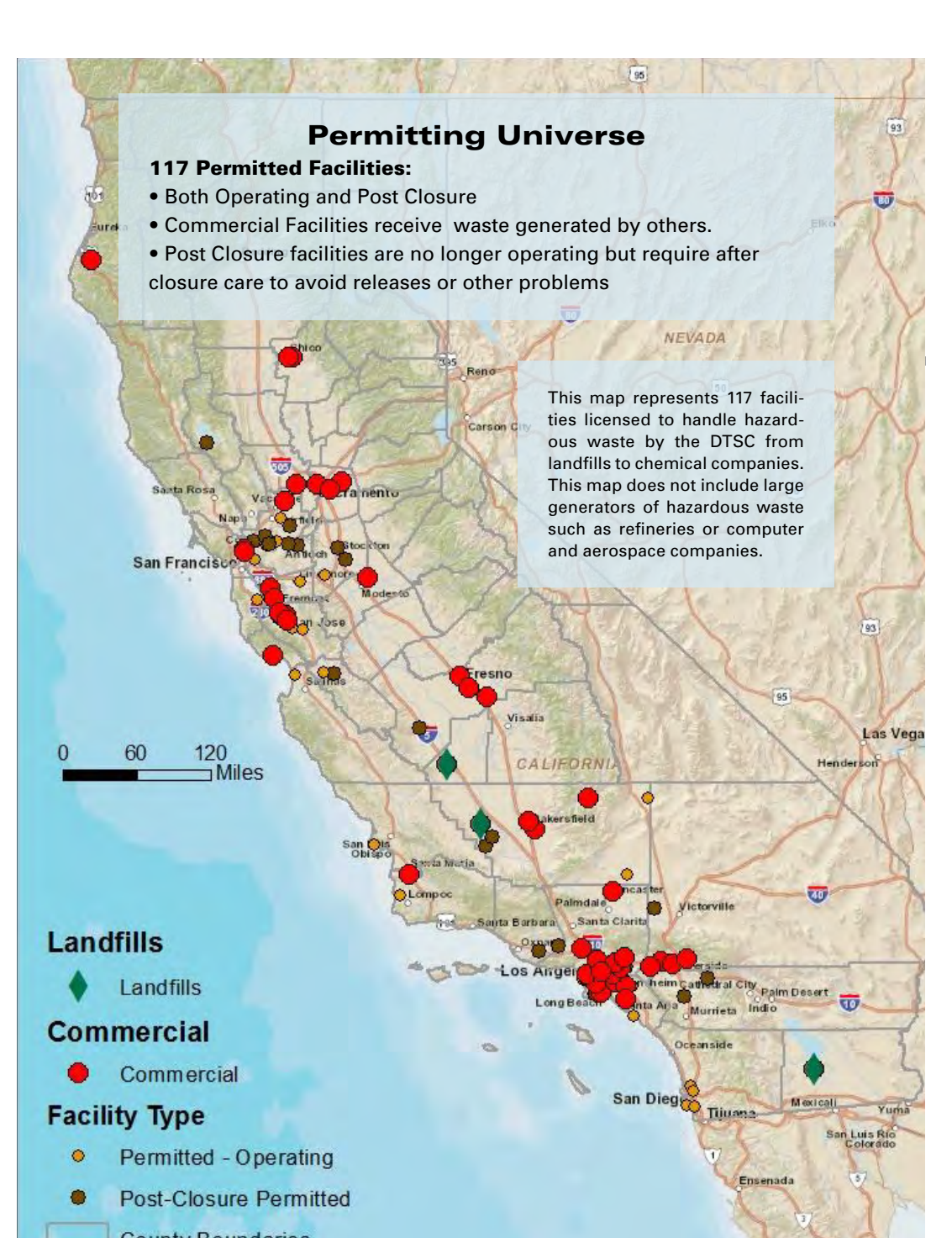
Permitting
Permitting Universe
ThE PERMITTIng
117 Permitted Facilities: UnIVE
- BRothS OEperating and Post Closure
- Commercial Facilities receive waste generated by others.
- Post Closure facilities are no longer operating but require after
Universe
closure care to avoid releases or other problems This map does not include large 117 Permitted Facilities: Both Operating and Post Closure Commercial Facilities —=====:i receive waste generated by Miles others.
Post Closure facilities are
Landfills
no longer operating but ♦
- Landfills
Commercial
require after closure care to
e
♦ Commercial avoid releases or other .}.,.n)1 1-1
Facility Type
0 problems.
Permitted -0 perating
- Post-Closure Permitted
County Boundaries Corrective-Action Sites
DTSC ACTIVE CoR-
Map of former treatment, storage and RECTIVE-ACTIon disposal facilities that are undergoing SITES MAP some form of corrective action.
Federal Superfund sites, state lead sites and other active hazardous waste facilities that either handle or generate hazards waste and have corrective actions pending against them are not included on this map.
Corrective Action Statewide Q County Boundaries Map created December 20th, 2012 Southern California
DTSC Active Corrective Action Sites DTSC Active Corrective-Action Site Map of former treatment, storage an disposal facilities that are undergoing some form of corrective action. Federal Superfund sites, state lead sites and other active hazardous was facilities that either handle or generat hazards waste and have corrective actions pending against them are not included on this map. 0 Corrective Action Q County Boundaries 0 10 20 40Miles Map created December 20th, 2012 Data Sources: DTSC Envirostor and Basemap ESRI ArcGIS online 2012 DTSC Active Corrective Action Sites DTSC ACTIVE CoR- RECTIVE-ACTIon SITES MAP Corrective Action County Boundaries 0 37.5 75 150Miles Statewide Map created December 20th, 2012 Data Sources: DTSC Envirostor and Basemap ESRI ArcGIS online 2012 DTSC Active Corrective-Action Site Map of former treatment, storage an disposal facilities that are undergoing some form of corrective action. Federal Superfund sites, state lead sites and other active hazardous was facilities that either handle or generat hazards waste and have corrective actions pending against them are not included on this map. 0 Corrective Action Q County Boundaries s d te e DTSC ACTIVE CoR- RECTIVE-ACTIon SITES MAP Statewide Data Sources: DTSC Envir 0 10 20 40Miles ap created December 20th, 2012 tor and Basemap ESRI ArcGIS online 2012 10 20 40Miles p created December 20th, 2012 or and Basemap ESRI ArcGIS online 2012 M os
CAL EPA certifies local agencies to coordinate requirements, permits, inspections and enforcement for six different environmental and emergency response programs on behalf of state agencies, including the DTSC. This is CAL EPA’s
CUPA’s in CALIFORNIA
evaluation of the job they’re doing as of August 2012.
CUPA stands for “Certified Unified Program Agencies.”
CUSPiskiyouA’s in CALIFORNIA LiveCrmoreE/PleaRsantoTn FDI- fIED BerkeleyUnI-San Joaquin SutterOaklandfIED
Gilroy.
and enforcement for six different environmental and emergency response programs on behalf of state agencies, including the DTSC. This is CAL EPA’s C U P A ‘ s i n C A L I F O R N I A evaluation of the job they’re doing as of August 2012. T h e E v a l u a t i o n S t a t u s a s o f A u g u s t , 2 0 1 2 CUPA stands for “Certified Unified Program Agencies.” rograms on behalf of state agencies, including the DTSC. This is CAL EPA’s C U P A ‘ s i n C A L I F O R N I A valuation of the job they’re doing as of August 2012. T h e E v a l u a t i o n S t a t u s a s o f A u g u s t , 2 0 1 2 CUPA stands for “Certified Unified Program Agencies.” C U P A ‘ s i n C A L I F O R N I A Del Norte Sonoma Napa Siskiyou Solano T h e E v a l u a tMioodocn S t a t u s a s o f A u g u s t , 2 0 1 2 Sacramento Marin Humboldt Shasta Trinity Lassen BNerakpealey Contra Costa San Joaquin Del Norte Sonoma Siskiyou Solano Modoc Oakland CERTSacraImen-to Tehama San Francisco Plumas San Leandro LivefrmoIre/PEleasaDnton F D Marin Hayward Alameda Glenn Butte Sierra Union City UnI- HumbMoeldntdocTinroinity Shasta Yuba Neva L d a a ssen Berkeley FCroefnmtroan ItCosEta D San Joaquin Colusa Lake Sutter Placer San MateOoakland Stanislaus Tehama San Francisco Sunnyvale Santa Clara County Healds bu r g /S S e b S o a n a s o n t m t o a p a R o l o J s P a N a p a Y o l o BSu R attce o r s a e m vi e ll n eP t o luE A m l m Da a os d r o a r d o Alpine San Lea H n a d y r S w o a a n r t d a L Ci v learrma oCriety/Pleasant A o l n a m FD eda M e n d o ci n o P e ta l u m G l a e n n So l a n o C a l a v e r a S s ie rra U n i o n C i t y Marin Fremont San Fran L c a i k s e co C O Co a n k ot l l a ura n s d aCo S s u ta tt S e Y r a u n b J a oa N q e u v i a n da Placer Tuolumne Mono San Mateo Ventura Los Ange S le t s a n C is o l u a n u t s y Healdsburg/S S eb o a n s o t m op a ol S J a P H n a M yw a a te rd oY S F A o r a l l e o a n m m ta o e R C n d t a o la s r e S a v t C a ill n i e t i y slaEul sDorado Ma A rip lp o in sa e S S u a n n n t y a v C al l e ara City Sa L n o t s a A C n l g a e raG le Cl s e on C ud it na y tlye Santa RosaNSaapnata ClaraS CaocuranmtyentoMAemrcaeddor Madera Santa Monica Vernon Petalum S a an S ta o C la r n u o z Gilroy Calaveras El Segundo Santa Fe Springs M a r in TuolumFnreesno Los Ange le s C o u n t y Evalua M t e io et n s p S ro t g a r t a u m s reqSuairne mFerannt sc is c o C O o a n k t la ra n d CostaSan S J a o n a q B u e i n n ito Mono Inyo Ventura L L o o s n A g n B g e e l a e c s h C O o ra u n n g ty e HaywardAlameda S U a n t s is a f t a is c f t a o c r t y o w ry / improvements n S ee a d n e M d ateo S Fr a e n m ta o C n M t laorn S at t eC a r n iet i yy slaus Marip K o in s g a s Tulare Los Ange G le l s e n C d it a y le Santa Clara County Merced Madera Santa Monica Vernon Santa Cruz Gilroy El Segundo Santa Fe Springs Los Angeles County Evaluation Status San BeSniaton Luis Obispo Fresno Bakersfield Kern Long BeachOrange OaMkelaentsd program reCqouinretrmae Cntossta Inyo SanS aLtiesafancdtorroy wLi/v imerpmroovreem/Penletsa nseaendteodn FD Tulare San Bernardino Monterey UnsaHtiasfyawctaorryd Alameda Santa BaKribnagrsa Union City Victorville Fremont VenturaLos Angeles County Glendale Oxnard San Luis Obispo BakersfiLeolds AngKeleersn City San OMaaktleaondSunnyvaCleontra Costa Los Angeles CountySanta Fe Springs San Lean S d a ro nt L a i v C e l r a m ra o r C e i / t P y leasanton FD El S L e o g n u g n B d e o a A c n h a O h r e a im nge San B R er iv n e a r r s d id in e o Santa Clara County Hayward Alameda Santa Barbara Union City Victorville Fremont VenturaLos Angeles County Imperial Santa Cruz Glendale San Diego Oxnard Gilroy Los Angeles City San Mateo Sunnyvale Los Angeles CountySanta Fe Springs Santa Clara City El SegundoAnaheim Riverside Long BeachOrange Santa Clara County . Date: August, 2012 Contact: Farida Islam Imperial Santa Cruz San Diego Gilroy Note: Map is not official, for presentations purposes only. 0 15 30 60 90 12 M 0 iles California S E a n c vU r i ( r a9 no 1m1 in 0f 6 im e e0 )n d 1 e 3t n o P 2 I t ,3 Sra o C t l 2 eg A P 5 er ra 19t om 45 te 8 c 1 t 4 ion Agency . Date: August, 2012 Contact: Farida Islam Note: Map is not official, for presentations purposes only. 0 15 30 60 90 12 M 0 iles California S E a n c vU r i ( r a9 no 1m1 in 0f 6 im e e0 )n d 1 e 3t n o P 2 I t ,3 Sra o C t l 2 eg A P 5 er ra 19t om 45 te 8 c 1 t 4 ion Agency . Date: August, 2012 Contact: Farida Islam Note: Map is not official, for presentations purposes only. 0 15 30 60 90 12 M 0 iles California S E a n c vU r i ( r a9 no 1m1 in 0f 6 im e e0 )n d 1 e 3t n o P 2 I t ,3 Sra o C t l 2 eg A P 5 er ra 19t om 45 te 8 c 1 t 4 ion Agency
El Segundo Los Angeles County Los Angeles County Ventura Long BeachOrange Glendale Los Angeles City Santa Monica Vernon Santa Fe Springs El Segundo Los Angeles County Long BeachOrange

hoW WE goT hERE
FINDING: The DTSC’s bureaucratic culture is timid and risk-averse, and its officials hide behind a weak and fractured system of environmental regulation and enforcement Observation: “This regulatory system reminds me of Italy, little provinces that have their own authority.” — Former DTSC Investigator WEAK ENFORCEMENT According to many sources interviewed and studies conducted on California’s Environmental Protection Agency and its branches, the Department of Toxic Substances Control (DTSC) is a problem child within a larger, dysfunctional family.
The DTSC became a stand-alone agency under the freshly created California Environmental Protection Agency (CAL EPA) in 1991. Today, it employs almost a thousand scientists, engineers, sworn peace officers, inspectors and support staff with a budget of $234 million. CAL EPA was also assigned the Air Resources Board, the Department of Pesticide Regulation, the Office of Environmental Health Hazard Assessment, the State Water Resources Control Board, and Cal Recycle.
CAL EPA was chiefly supposed to “coordinate” environmental programs to avoid overlap and duplication, increase communication and coordination, and allow for “one-stop” shopping for environmental permitting. It was also supposed to draw a bright line between divisions assessing risk and managing that environmental risk. Unfortunately, a review of CAL EPA in 2000 by the consulting group R&G Associates found there was essentially no one in charge. Some argue the CAL EPA was never supposed to be in charge, as autonomy for various environmental regulatory bodies is set out in the state constitution and codified in air and water statutes. It is time to rethink this. CAL EPA is led by a secretary whose powers are equal to those of the heads of other state environmental agencies. Further, he or she has “no authority” to compel seamless and consistent regulation or enforcement, let alone cooperation, said the critical report. Each board, department, or office acts as if its own regulatory system is best. Rules on H which agency takes the regulatory lead on cases are fuzzy, which allows agencies to work in compartmentalized “silos.” In fact, the legislature never codified CAL EPA or its di- O visions. No one ever set out clear lines of authority, systematized rules, regulations, or W procedures. And nothing has changed substantially since the report was issued. “In reality, virtually nothing was consolidated,” says one former DTSC enforcer. “The Boards, Offices, and Departments still operate more like autonomous little kingdoms than coor- W dinated parts of a single agency.” Combine the turf wars with budget cuts and financial ineptitude, and “we have a crappy system of enforcement,” he said.
e G LACK OF COOPERATION O Most environmental violations aren’t confined to one medium—soil, water, or air. The T DTSC is empowered to look at the deposition of hazardous waste and substances in all three simultaneously. In fact, it is directed by state law to build a strike force to enforce H state laws and regulations on hazardous waste. Government regulations direct CAL EPA e to establish an enforcement unit to coordinate compliance and enforcement actions R across media of soil, water, and air to protect public health and the environment. Since, as one DTSC policy expert puts it, CAL EPA “entirely ignores” cross-media analysis, the e DTSC’s Office of Criminal Investigations could be the vehicle for this effort. “CAL EPA should drive the car and they don’t,” said the former DTSC enforcer. “They let six agencies drive the car. The Office of Criminal Investigations would entitle and allow the opportunity to do cross-media enforcement.”
But without a central enforcement mechanism to ensure cooperation between divisions of the CAL EPA, one environmental lawyer sums it up this way: “The alphabet soup of regulatory agencies are interested only in protecting their own specialized enforcement universe.” That can hurt the environment as a company might burn a waste to avoid water pollution, only to have toxic particulates land on soil. DTSC investigators can’t force other air and water regulators to donate their expertise. Regulators at other agencies are already overworked and jealously guard their own resources. “No one has authority over multi-media investigations and, if you don’t want to play, you can tell them to go pound sand,” says the former DTSC enforcer. Another issue is the question of will, or lack thereof, on the part of the DTSC.
PASSING THE BUCK The DTSC is fearful of, and highly sensitive to, criticism from CAL EPA, lawmakers and the Governor—especially when large businesses can command attention by threatening to leave the state during a fragile economic recovery.
During the 1990s, in the face of intense business lobbying, the state’s Republican H governor Pete Wilson weakened the enforcement of environmental laws. In many cases, “shall” language that requires an agency to act, was changed to “may,” making enforce- O ment discretionary. That dovetailed with a choking off of additional funding for envi- W ronmental enforcement. “A common practice by the administration with the support of industry was to insist that bills passed by the legislature would use only existing resources for enforcement,” said Bruce Jennings, former adviser to the California Legislature W on environmental law and policy. Agency directors who had never possessed adequate enforcement budgets were forced to practice a kind of triage, he said. “It was little wonder e that skilled corporate lobbyists found ample opportunity to avoid enforcement actions, G especially in communities confronting influential polluting industries and lacking aggressive political leaders.”8 O TLawmakers who had to campaign for re-election confronted a choice similar to that of agency heads. Many novice legislators feared being labeled as too aggressive when it came Hto enforcement, opting instead to support laws having only vague and ambiguous en- eforcement provisions. “The message for politicians was clear: don’t push too hard against R industry, or you may have a big target on your chest in your next election and be defeated e by an industry-sponsored ‘moderate,’” said one veteran political consultant. Today, “enforcement looks like a slinky and not like a titanium spine,” said one DTSC scientist. The DTSC will never pull the trigger. Instead, the department resorts to “begging companies to change their ways,” as the DTSC has abandoned existing enforcement tools such as tough fines or permit revocations. “They fold like a wet paper bag before industry,” he said. “They forget who they work for, and that’s the public.” Corporations will always argue that if the DTSC holds polluters responsible, then businesses will fold. Governor Brown’s senior advisor for jobs and business development, Mike Rossi, believes this, according to one long-time environmentalist. “Rossi is reflexively ideological in opposing strong regulation as being bad for jobs, without giving any evidence that that would be the case.”
Jobs aren’t the only thing on the minds of regulators like DTSC Director Debbie Raphael. She worries, for example, that if the Kettleman Hills hazardous waste landfill is not allowed to expand, then Chemical Waste Management, which owns the landfill, will just leave the state and go to Arizona or Nevada where laws are laxer, while charging companies more to remove waste. “I can’t live with that,” she says.
But that’s an argument that not everyone buys. “I am not concerned about their threats to leave,” said Bill Magavern, now senior advocate for Coalition for Clean Air, and formerly director of the Sierra Club California. California is the ninth-largest economy in the world and it makes sense for hazardous waste companies to be close to the source of their revenues. Further, “The notion that economic growth is hindered by enforcement is H a specious one,” said Jennings. “Many California companies dealing with hazardous waste have not only sunk costs, but a continuing liability and responsibility for their activities, O cradle-to-grave,” he said. “The real issue is what kind of economy the people of this state W want to foster.”
But instead of pushing back against corporations that can certainly afford to run their W hazardous waste operations safely, the DTSC habitually crumbles under industry pressure. The whole name of the game is cutting corners to save a buck, and the DTSC helps e them do it. “There’s a culture here and it’s to be user friendly,” said the former DTSC G enforcer. “It makes the world go around if you get along with business.” O One way of avoiding responsibility is to hide behind other state regulators such as air T districts and water boards, or local fire and health departments. Officially the DTSC says that it does not regulate hazardous waste generators that fall under local jurisdiction. Ac- H cording to Odette Madriago, chief deputy director of the DTSC, local authorities are put e in charge. “You have to be careful [how] to define who generators are, [and] which facili- R ties are regulated by the DTSC.”10 But other DTSC top managers admit the DTSC can step in if it chooses to do so.
e Regulatory smoke and mirrors and evading enforcement are intimately connected. In one sense, local agencies are an extension of the DTSC. “We really are the DTSC,” says one hazardous materials supervisor for an environmental health department in a rural county. “Anything we have the right to do, they have the right to do. They oversee us. And they are allowed to do their own inspections of companies if they want.” Certified county or city fire and public health departments, together with DTSC, enforce the Hazardous Waste Control Act, Title 20, Chapter 6.5 of the Health and Safety Code. The DTSC gives local authorities the “opportunity” to take the lead on any needed enforcement. But the DTSC maintains independent inspection and enforcement responsibilities, according to general principles set out by the director of the DTSC in 2002. “We absolutely have the responsibility to regulate generators,” said one DTSC enforcer. “The DTSC retains the authority to step in if a certified local agency isn’t performing and DTSC is in no way prohibited from taking enforcement action against a generator just because a local agency hasn’t.”
Notwithstanding this authority, the DTSC prefers to leave as much regulation as possible to local agencies certified to regulate hazardous waste generators. But most local agencies, excluding some in the largest jurisdictions, can’t hold a candle to the DTSC in terms of expertise or powers. For example, the “consolidated permits” that local agencies issue for half a dozen environmental programs, on behalf of several agencies, are really not permits that can be revoked or used to bring companies into compliance with the rules, the local agency supervisor said. “It’s not a permit. It’s here are the conditions and here are the programs you have to comply with.’” Taking serious enforcement action H beyond fining companies is daunting. And local agencies are often constrained by local politics that dictate tax revenues are more important than environmental health. “We O don’t formally enforce, unless it’s egregious,” he said.
W The Natural Resources Defense Council confirmed local regulatory weaknesses in its 2005 report, An Uneven Shield.11 The probability that a violator would be inspected and W sanctioned depended entirely on where the violator was located and what law enforcement authority was in charge, the report said. Public data on compliance was spotty. An e Uneven Shield further found that adequate funding for enforcement at all levels under G CAL EPA was lacking; without complete, accurate and timely data on violations and enforcement, it was difficult to pinpoint “hotspots” that needed correction; institutional O barriers prevented timely and effective enforcement; and penalties were too low to deter Tunlawful conduct or prevent violators from profiting from their misconduct. Bureaucrats would not allow the very people most directly harmed by pollution to help them police Hthe communities they live in. The situation remains the same today. “They have been eshort on action to address the problem of enforcement across the CAL EPA and to ad- R dress the recommendations of our report, quite honestly,” said NRDC’s Miriam Rotkin- e Ellman, a co-author of An Uneven Shield.
BUSINESS MANIPULATION In this climate, businesses uninterested in environmental compliance can thrive by playing regulators off against each other. “It doesn’t take much to derail an investigation,” said one environmental investigator. “I am looking at hazardous waste emissions into water, and the company will say ‘but the Water Board gave us a permit.’ That’s their defense.” A veteran political consultant says that well-heeled companies “hire lobbyists who are more sophisticated than regulators to shop for the weakest regulators, and file appeals on regulations before they are adopted to give themselves as much latitude as possible. They run to the Air Board to do a settlement for $50,000, instead of face criminal enforcement from another agency like the DTSC. Then they can say, ‘we took care of that.’” Situations involving more than one medium are a regulatory minefield and companies prefer it that way. For example, if soil and water are both contaminated, in some cases the DTSC will tell the company to clean up the soil, but leave the water to state water regulators. Companies find it cheaper to pay lawyers to fend off a more comprehensive cleanup of both soil and water, though the two are inter-related. “It’s a big mess,” said one DTSC inspector. “This is happening in almost every project where the responsible party doesn’t want to clean up. They will throw lawyer money at it instead.” Meantime, upper management at the DTSC allows corporate lawyers to treat employees asking tough questions like the hired help. “One lawyer yelled at me like he was my boss,” the inspector said. H “Like he owns the department or something.”
Some companies figure that because of myriad requirements and multiple agency per-O W mits, they’ll never be caught. “Seven agencies have oversight over auto dismantlers, and none of them know what the others are doing,” said one environmental investigator. “The chances of getting caught are such that half the auto recyclers in Los Angeles County W aren’t licensed.” Companies profitably bet they’ll simply be overlooked in the shuffle. And the wealthier and more politically powerful the company, the more cavalier they can af- e ford to be about environmental regulation. According to the investigator, huge corpora- G tions, like Chevron, don’t ever intend to be in full compliance with environmental laws. “The reality is they’re not going to throw money at it,” he said. It’s simply cheaper and O easier to pay the fines than it is to upgrade and outfit the refinery with better equipment. T Of course well-heeled companies have more financial resources to defend themselves H than regulators do to police them. But that is not the only problem. “We have about a e thousand people at DTSC, but we have almost no real field presence as far as enforcement R is concerned,” said one scientist. “Our enforcement numbers are in the toilet. Legal and administrative shops are huge, and we employ more former on-air TV talent than inspec- e tors doing truck stops.” In fact, the DTSC currently has some 50 people handling public information and participation. It employs about 100 people for environmental enforcement, while 300 people work on cleaning up sites, sources say. “Does it follow that if there were more enforcement and less PR and site mitigation, there would be fewer cleanup sites?” asked one former environmental prosecutor. As it stands now, the DTSC has only around ten criminal investigators—with none for all of Southern California—and only two refinery inspectors for the whole state, one DTSC investigator noted. Another DTSC policy expert says, “DTSC costs too much, takes too long, and doesn’t have any bang for the buck. DTSC hasn’t seen a permitted facility that it doesn’t consider tomorrow’s illegal cleanup.”
DROPPING THE BALL Even when the DTSC successfully enforces environmental protections, it frequently drops the ball on follow up. Pacific Steel is a classic example. In 2002, the DTSC discovered open piles of toxic debris at this metal recycler in National City outside San Diego. It fined the company $235,000 for unlawful storage and treatment of hazardous waste and unlawful treatment and disposal of contaminated soil. It approved a waste hauling plan Pacific Steel would follow after getting necessary local permits. Then the DTSC walked away. And Pacific Steel’s actual “solution” was throwing blue tarps over the piles and forgetting about them. It took a TV news crew’s investigation at the end of 2011, nearly a decade later, to uncover that no cleanup had been done.
Jill Witkowski runs the San Diego Coastkeeper’s legal clinic. She said the community H worried that they were breathing in toxic dust filled with copper, zinc, and lead that could also migrate into waterways. But the interagency cooperation and follow up necessary to O ensure that cleanup happened, was absent. “The regional water board gave up authority W to the DTSC” and washed its hands of the case, Witkowski said. “But the DTSC didn’t do a good job on water and air violations,” and then simply didn’t “bother to check” after its settlement with the company to see if the company had done what was required, she said. W e G O T H e R e

LooKIng ThE oThER WAY
FINDING: The DTSC either does not fully understand its own powers or intentionally refuses to apply them.
“The agency has sweeping powers but seldom uses them.
Observation: They don’t read the language of their own Health and Safety Code.”
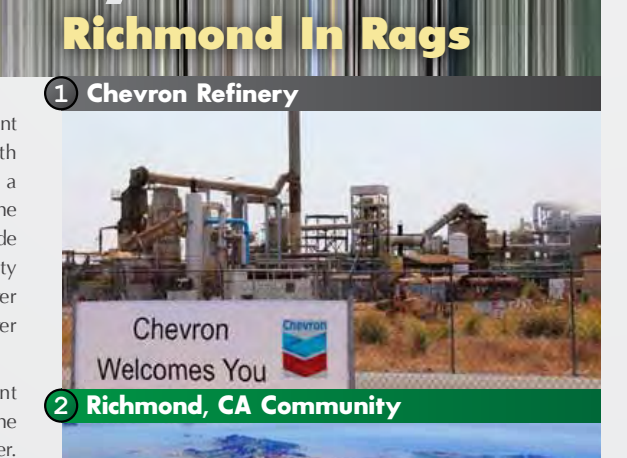
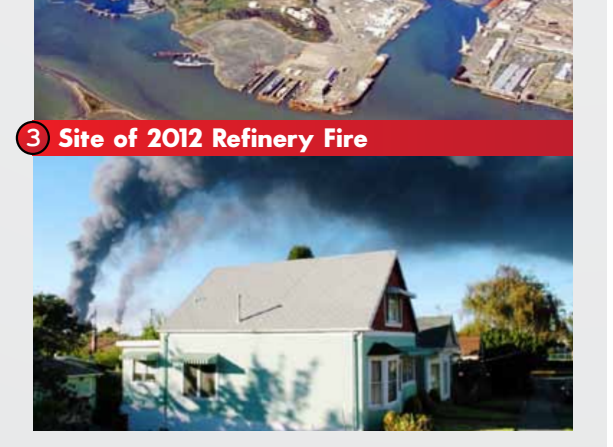
–Private Attorney LACK OF WILL: CHEVRON Last summer, the Chevron refinery in Richmond burst into flames. (See “Chevron Richmond Refinery Overview” on page 25). The conflagration emitted a vast toxic cloud of sulfur dioxide, sulfuric acid, nitrogen oxide and other chemicals that sent thousands to the hospital with eye, skin and lung irritations. The DTSC staunchly resisted calls to step in. The excuse was that any airborne hazardous emissions don’t fall under DTSC’s jurisdiction. “Anything that goes up in the air, folks have always said that that is an air issue,” said Brian Johnson, head of DTSC enforcement, in an interview. But in a DTSC promotional video, Brian Johnson states the opposite: “I’ve got about a hundred people throughout the state who get up and go to work every day thinking about how they can improve the quality of life in communities by making sure that toxic harms are not occurring… We’re the hazardous waste folks, but we also have some of the broadest authority so we can take care of things in the air, in water…”
According to the DTSC’s chief counsel, Reed Sato, action is entirely discretionary. “We could respond to a release but sometimes we don’t.” Instead, the DTSC left Chevron to other, local and state agencies like Contra Costa Health Services and the Bay Area Air Quality Management District that have been largely ineffectual in regulating Chevron. (See “Juggling Jurisdictions” on page 25).
The DTSC should lead environmental regulation of toxic substances in the air, water and soil in California. The DTSC’s mission statement plainly says that it exists “to protect California’s people and environment from the harmful effects of toxic substances through the restoration of contaminated resources, enforcement, regulation, and pollution prevention.” The evidence is overwhelming that the department either does not want to fulfill its mission, or is simply ignorant of it. Rather than protecting local communities by acting as O a vigilant regulator of toxics, the DTSC is turning into a toxic regulator that is a boon to dirty business.
O K “The department suffers from a long-standing culture of mission fatigue and laziness,” Isays one environmental attorney in private practice. “The penalties are light. They are the n Willy Lomans of the regulatory world. They have figured out their thresholds and are extremely risk averse. They are career bureaucrats keeping their heads down, afraid of their G own shadows.” At the confirmation hearing last April of the DTSC’s current director, Debbie Raphael, Consumer Watchdog expressed serious concern that the department is T
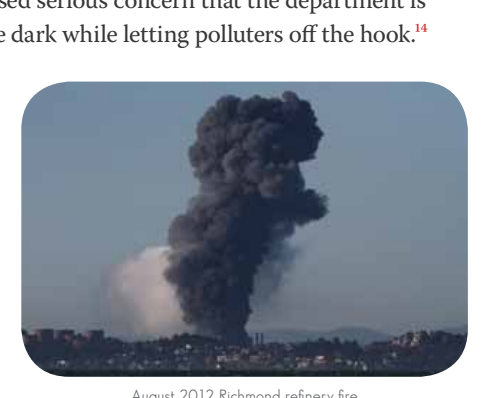
allowing polluters to keep communities in the dark while letting polluters off the hook. H e The day of the Chevron fire, Contra Costa Health Services turned to the DTSC Ofor help, according to one of the county’s T hazardous waste officers. Clearly, this H county agency was out of its league with a e disaster so large. But the officer said that no R help was forthcoming. “I had a lot of discussions with DTSC and they didn’t really vol- Wmight send a refinery inspector.” Contra unteer anything,” he said. “They said they a Costa County Health Services has noted that the largely low-income minority residents Y of Richmond exposed to the release are one of the “most at-risk groups” for poor health nationally.15 Chevron is the eighth biggest oil company in the world, and the biggest in California. It earns billions in profits but apparently hasn’t put much of it into vigilant plant maintenance and upgrades.
According to an environmental justice case study compiled for the nonprofit West County Toxics Coalition in Richmond by environmental expert Scott Sherman, Chevron had 304 accidents between 1989 and 1995, including major fires, spills, leaks, explosions, toxic gas releases, flaring, and air contamination. As of the mid-1990s, Chevron stored over 11 million pounds of toxic, explosive and corrosive chemicals at this refinery. Local activists have battled the company since at least 1986, winning some partial victories in the mid-1990s such as $5 million for a community development fund in exchange for a land use permit to expand Chevron’s operations. But activists had originally demanded $50 million. Wrote Sherman: “Chevron had a history of giving local politicians large campaign contributions, and it always threatened to leave town if the citizens became too disruptive.”
Henry Clark, a long time resident of Richmond, and director of the West County Toxics Coalition, says Chevron is continuing in the same vein. In the November election, O the company worked hard to elect a friendly pro-Chevron banker to the city council and to maintain another member who is “basically in Chevron’s pocket.” The company is O largely unregulated, he said, with a “cozy” relationship between Chevron and state air K regulators that levy only wrist-slap fines, if any, for air pollution violations. “Today, they’ll be working for the air district, and tomorrow they may be working for Chevron.” Mean- n time, the community suffers. “I was sick from the last fire, from almost all of them,” he G said. Clark said he had a breathing problem for a week in the wake of the 2012 Richmond
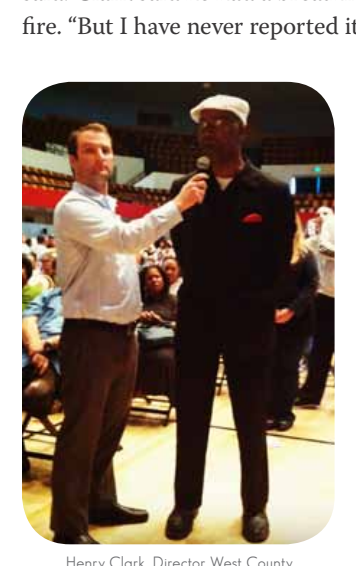
fire. “But I have never reported it and filed a claim. I probably should have.” T In this scenario, where regulation is myopic, fragment- H ed, and largely ineffective, and major corporations wield e outsized financial and political clout, the DTSC persists in ignoring its own jurisdiction over toxic releases like O this one. But DTSC’s refusal to regulate refineries di- T rectly contradicts other air-related cases that the DTSC led with help from other agencies. One victory, in 2011, H involved the giant auto shredder, S.A. Recycling. Regula-e R tors charged the company’s Terminal Island shredder with emitting tons of ultra-fine lead particulates onto W the air of nearby Los Angeles County neighborhoods.
DTSC—with the authority to penalize the illegal dis- a posal of hazardous waste outside of permitted facilities— Y headed up the investigation with other state regulators.
The case was settled for $2.9 million.
Chevron has a long record of air, water, hazardous waste, and worker-safety violations. More than a decade ago, the DTSC created air, water, and waste profiles of all the refineries in the state, including their compliance history, working with other agencies, in a first-step effort to take the lead in regulating refineries. The initiative was “deep-sixed” when the Western States Petroleum Association objected to public access to the information, said one DTSC scientist. “They used the 9-11 attacks as the justification for their objections. DTSC caved instantly, and has never done anything like it again.” At the very least, this could have been an opportunity for the DTSC to bring out its “Golden Galleon,” a federally-financed mobile environmental lab on wheels that is part of their “rapid response” capability. But this high-tech lab, shown off at the capitol to visiting dignitaries, is virtually never deployed. “Last I heard, we don’t even have anyone designated to drive it,” the scientist said.
O In fact, the DTSC is obligated to step in when incidents like Chevron’s fire occur. The department is granted sweeping powers under California’s Health and Safety Code Sec- Otion 25186 over the management of hazardous waste, hazardous materials, and hazardous K substances—biological, chemical, or physical agents that can cause harm to humans, animals or the environment. It is regulatory obfuscation on the part of the DTSC to suggest n that hazardous waste is a distinctly separate subset of hazardous materials. In fact, hazard- G ous wastes and materials share virtually the same characteristics. California Health and Safety Code section 25501 defines a hazardous material as “any material that, because of its quantity, concentration, or physical or chemical characteristics, poses a significant present T H or potential hazard to human health and safety or to the environment if released into the workplace or the environment…(which) include but are not limited to, hazardous substanc- e es, hazardous waste, and any material which a handler or the administering agency has a O reasonable basis for believing that it would be injurious to the health and safety of persons or harmful to the environment if released into the workplace or the environment….” In T section 25141(b), hazardous wastes are defined as wastes that “because of their quantity, Hconcentration, or physical chemical, or infectious characteristics (may either) cause, or sig- e nificantly contribute to an increase in mortality or an increase in serious illness (or) pose a R substantial present or potential hazard to human health or the environment when improperly treated, stored, transported, disposed of or otherwise managed.”
WYet, DTSC Director Debbie Raphael maintains that “the DTSC’s enforcement authority a is expressly limited to hazardous waste,” not hazardous materials or substances. Haz- Y ardous wastes are hazardous materials, as even she acknowledges in the strategic plan for 2013-2015. It states that, “DTSC investigates and oversees the cleanup of sites where releases of hazardous materials to soil, soil gas, ground water, and surface water have occurred. This includes thousands of California properties, including former industrial plants, military bases, small and large businesses, school sites, and landfills.”17 Section 25186 of the California Health and Safety Code gives the DTSC the right to deny, suspend, or revoke any permit, registration or certificate in situations where a generator’s violation or noncompliance shows a repeating or recurring pattern or may pose a threat to public health, safety, or the environment.18 Section 25316 says the DTSC also oversees federally defined toxic pollutants, and any imminently hazardous chemical substance or mixture. Moreover, under section 25189.5(a), it is illegal to dispose of hazardous wastes outside of permitted facilities, or to cause such disposal, and therefore the DTSC can bring charges against companies, like Chevron, for doing so. The byproducts of burning oil are by definition hazardous wastes. Section 25358.3(a) authorizes the DTSC to issue an imminent or substantial endangerment order when there may be a major immediate threat to public health or welfare, or to the environment, because of a release or a threatened release of a hazardous substance.
These powers are not a matter of interpretation or debate. But DTSC top staffers repeatedly refuse to use these powers to protect California communities from the poisons O that engulf them. Situations like Chevron’s Richmond fire cry out for a lead regulator. The DTSC should be that regulator given its extensive statutory authority over toxic emis- O sions in a situation where fragmented oversight of California refineries has left residents K unprotected.
n The DTSC could have issued an imminent and substantial endangerment determination and order against Chevron when the fire occurred and called for remedial action, G such as Chevron using some of its billions in profits to upgrade pipes at the 110-year-old plant. But, it didn’t. It should prosecute Chevron for allowing hazardous particles to land T far away, on water or land not permitted by the DTSC for hazardous waste disposal. The H DTSC should make Chevron pay for this dangerous toxic emission. But it has done none e of these things.
O T H e R W a Y
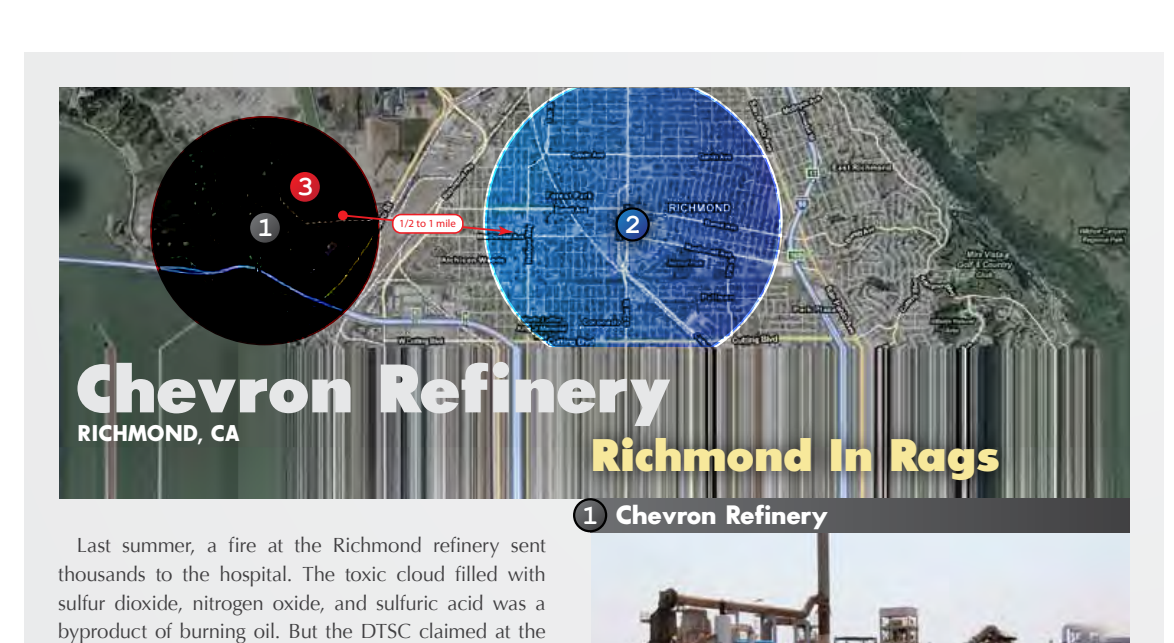
ChEVRon RIChMonD REfInERY oVERVIEW 3 2 1
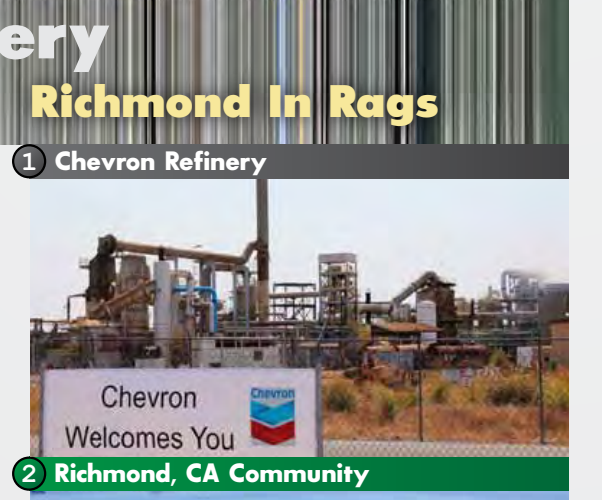
Chevron Refinery
RICHMOND, CA Richmond In Rags Chevron Refinery
1
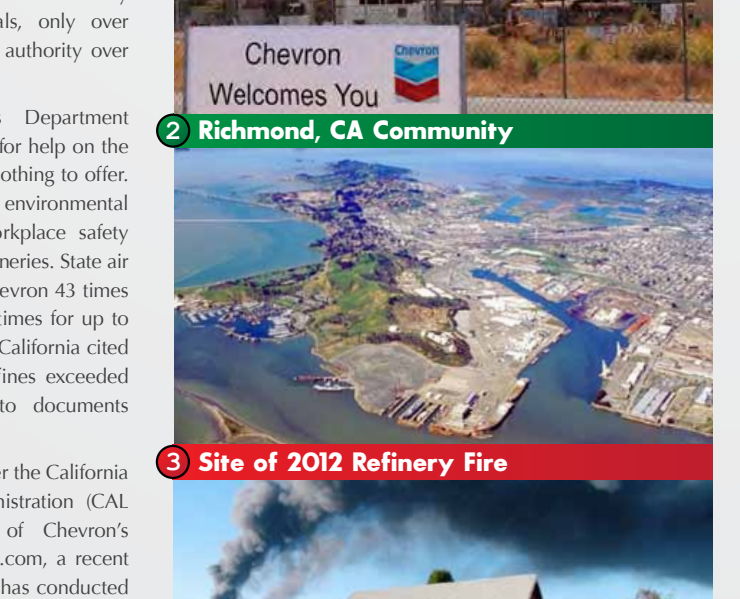
Richmond, CA Community
hazardous waste officer turned to DTSC for help on the 2
Site of 2012 Refinery Fire
3 JUggLIng JURISDIC- TIonS

KEEP ThE CLIEnT hAPPY
FINDING: DTSC relies on out-of-court settlements and levies wrist-slap fines, instead of suspending the permits of serial violators of environmental laws. It tolerates serial violators operating on expired permits for years at a time without firm deadlines for permit renewals. “I object that companies make money and don’t clean up Observation: the mess they’ve made.” — DTSC Cleanup Manager EVERGREEN OIL Another example of foot dragging is the case of motor oil recycler, Evergreen Oil, in Newark. Evergreen takes used motor oil from gas stations and re-refines it into new products. It also treats and disposes of hazardous waste such as used anti-freeze and oily water. It portrays itself as environmentally friendly. In its quarterly company newsletter of March 2012, the company touted its ability to convert “every drop” of used oil back into its original state and into other products such as fuel gas, fuel oil, or asphalt. “We were green before it became fashionable and we’re continuing to get better,” the company wrote. If only this were true.
Evergreen Oil is a private company, founded by a chemical engineer, and featuring such board members as former administrators of George H.W. Bush’s EPA, the Small Business Administration, and a former Defense Secretary. It employs about 200 people and generates some $36 million in revenue annually. It is also a serial violator of environmental laws. In 2000, the DTSC fined the company $825,000 for burning used oil with either excessive halogen content or PCBs. Between 2006 and 2012, the DTSC signed seven consent orders—administrative actions taken outside of court—with Evergreen and levied only wrist-slap fines. Infractions included cracks and gaps in waste container storage and transfer areas, failing to track contaminated petroleum waste coming in and out of the facility, careless soil contamination, and omissions in its own inspection system. Fines between 2005 and 2011 for a serial violator of environmental laws totaled just $86,000 (See “Evergreen Oil Overview” on page 40).
K One private environmental attorney says that the California legislature never intended e for the DTSC to allow serial violators like Evergreen Oil to stay in business. “The legisla- e ture has said, ‘We want to clean out bad actors, you can let the chronic and recalcitrant P have it.’” Instead, it is possible for serial toxic polluters to sign endless consent orders T with the DTSC, with no public input, in which the DTSC lets the violators negotiate their H penalty.
e The department routinely reduces the original number of violations cited and does not charge for each day of non-compliance with DTSC orders – even though companies C can be fined as much as $25,000 a day for unauthorized intentional or negligent hazardous waste disposal. “We calculate the fines and then ‘discount’ them,” said one disgusted I e DTSC geologist. “There are hefty fines in the thousands that can be levied for each day of n non-compliance. We should levy them.” In addition, responsible company personnel can receive prison sentences of up to two years and fines of up to $50,000 for repeat offenses. T “They put away the Bernie Madoffs,” said one environmental prosecutor familiar with the H DTSC. “But that never happens with environmental crimes. Most environmental crimes a should be prosecuted criminally.”
P Instead, the DTSC negotiates punishments with companies before making them public, a tactic that typically results in paltry fines. The DTSC maintains that a “draft” order P Y is subject to a secrecy privilege. Only when it becomes “final” does the public see it. This secrecy means the public has no idea what the full fines could or should have been. Endless negotiations also happen on permits that include corrective actions to clean up toxic releases. “Stop negotiating fines and stop negotiating on permits,” the geologist said. “If it takes five years, it’s ridiculous.”
By law, the DTSC must consider ability to pay when it fines companies. But sources say the department lacks the necessary accounting expertise to really review a company’s ability to pay and doesn’t go after parent companies. The DTSC should use an independent CPA firm to do the estimates on ability to pay, said one scientist. “Someone with professional integrity, expertise, reputation, and dollars on the line is needed to ensure the public gets a fair shake.”
Combine that with political pressure from the governor’s office anxious to calm a big company under the gun, and you get a toxic brew. “It’s easy to get your way when you have friends in government,” says one prosecutor intimately familiar with the DTSC. In just one example, during the tenure of Governor Arnold Schwarzenegger, the DTSC rounded fines in a consent order down from well over $100,000 to $90,000 for Abbott Vascular, a division of Abbott Laboratories, at the request of the governor’s then-chief of staff, so the company would not have to report the fine to the Securities and Exchange K Commission publicly, the prosecutor said. In its 2010 consent order, the DTSC alleged that Abbott Vascular had failed to maintain all required spill-control equipment in its hazard- e ous waste storage area, had failed to maintain the facility to prevent spills, and had failed e to properly label containers holding waste alcohol wipes and adhesives, among other haz- P ardous waste violations.19 DTSC officials claim not to know how many such out-of-court T administrative orders it signed with any one company. But these agreements keep the pol- H luters working, keep them out of court, and have become merely a cost of doing business. The price is unsafe plants that are making communities sick.
e ECONOMY TRUMPS COMMUNITY C IIn March 2011, a huge explosion at the Evergreen facility in Newark involving a hy- edrochloric acid tank and waste oil sent flames hundreds of feet into the air and nearly n required an evacuation of surrounding areas. The fire closed down a portion of the plant. Last July, Evergreen reported a leak of hazardous heat transfer fluid and evacu- T ated the plant. Seventy frightened workers fled even before the evacuation order. Worried H residents watched helicopters with news cameras hover overhead. One resident, a realtor named Lori Lowe, called Evergreen’s community hotline only to be “blown off” by the a man who answered the phone. She said he told her “the leak is of no concern.” P PVictor and Rose Waddel have lived in Newark for 34 years. They say regulators have let Y Evergreen off with wrist-slap fines for emissions that have sickened them for years. When President George H.W. Bush and his entourage toured the plant in 1992, “They thought it was great,” said Victor. “The crowd was so thick you couldn’t get through to tell him it wasn’t true.” He said, “Personally, I think Evergreen should be shut down.” The Waddels say that the odors have caused headaches for years. “We are just not feeling well,” said his wife Rose. “We don’t know what illnesses are triggered by it. They are saying it is a non-toxic odor but they will never tell you what’s in it.” Their three children, now in their twenties and thirties, grew up with asthma problems, they say. “All of our children had learning disabilities that were never in either side of our family before and we never knew if that was from Evergreen,” said Victor Waddel.
In mid-October 2012, Lowe said odors from the plant led teachers at nearby Bunker Elementary to lock students in at lunchtime. She says the community has lived with leaks and noxious odors for years, and no amount of complaining to the fire department or air regulators seems to work. Lowe says when Evergreen has a leak, it doesn’t notify the city. And when she notifies the city or the Bay Area Air Quality Management District herself “nothing ever happens.” She says no one cares about the city’s residents. “Evergreen sent me to the hospital 15 years ago. On a scale of one to ten, the odor was a 13.” At a public meeting in August 2012, plant manager Bob Gwaltney said the odors resulted from high-sulfur content in the gas they use and leaks in the piping system that permitted vapors to escape during truck and rail car loading. Gwaltney also blamed other “upsets in the K operation of the plant.”21 e Regulators at the DTSC may be worried about what they think would be bigger up- e sets. According to one DTSC prosecutor, Evergreen is one of the few oil re-refiners in the P West. “If you shut down a company like Evergreen, they do provide a service,” he said. “Not many companies can do that.” Local concerns also complicate the picture. Terrence T Grindall, community development director for Newark, says the city views Evergreen “as H a business in town that has invested quite a bit in a process that’s good for the environ- e ment, but we want them to operate safely.” Translation: the city wants to retain jobs and tax revenues. But preserving recycling should not come at the expense of people’s health. C The DTSC has tried not to take broad oversight responsibility for Evergreen, which I holds a DTSC permit. On August 16, 2012 DTSC Director Debbie Raphael wrote Con-e n sumer Watchdog that the leak of a heat transfer fluid was not the DTSC’s responsibility because it took place in a portion of the plant treating certified recycled oil, a product T exempted by law from regulation. Moreover, “Because DTSC’s enforcement authority is H expressly limited to hazardous waste, and not to other hazardous materials oversight, our hazardous waste generator standards cannot reasonably be invoked by this incident,” Ra- a phael wrote. But one DTSC scientist says that once the heat transfer fluid is released, “it is P by definition a hazardous waste” and thus falls under the DTSC’s purview. P Y In a subsequent letter to Consumer Watchdog, on December 12, 2012, Director Raphael wrote that the DTSCs determination not to suspend Evergreen’s hazardous waste facilities permit “at this time is not based on any perceived lack of authority.” Instead, she wrote, “The nature, severity and history of violations, including those incidents at the entire facility did not rise to the level of harm that would justify a suspension.”22 In fact, the law does not require a specific level of harm to be determined before revoking or denying permits. The only requirement is that a generator’s violation or non-compliance shows a repeating or recurring pattern or where such actions may pose a threat to public health, safety, or the environment. Thus, DTSC has every right – indeed a duty – to shut down this serial environmental polluter.
SHOW ME THE MONEY: FINANCIAL ASSURANCE THAT YOU CAN CLEAN UP Evergreen also epitomizes another big problem. As part of the permitting process, the DTSC is supposed to receive financial assurance from companies—in the form of a bond, insurance policy, escrow account, or other financial proof—that they have the ability to pay for any cleanup that the DTSC orders as a condition of a new permit. They also have to prove they can pay for closing their facility safely, if that becomes necessary. The DTSC demands assurance for plant closure, but often doesn’t demand financial assurance when it issues a new permit with clean up requirements. Instead, companies get new permits K and then routinely negotiate with the DTSC over the right fixes to save themselves money and delay action for as long as possible.
e e In 2004, a DTSC cleanup specialist based in Chatsworth, Phil Chandler, chided a P DTSC deputy director for awarding a permit to Evergreen Oil without any financial assurance that the company could pay for ordered fixes. “The Assurance of Financial Re- T sponsibility is required by statute to be included in permits issued by the DTSC,” Chan- H dler wrote. “Why isn’t this addressed?”23 Years later, he tried to obtain a list from the e agency of the number of waivers from this requirement granted by the DTSC and regional boards, the total number of businesses or other entities required by law to demonstrate C and maintain financial assurance, the number able to comply, and the number unable to comply. Chandler says he has never received it.24 e n One DTSC scientist said that the DTSC also underestimates what it would cost to close a facility so that companies are not putting up enough financial assurance for that con- T tingency. “These are time bombs for dollars and cents,” he said. “Any one of these facilities H could be leaking. And if they went out of business, somebody would have to pay for cleaning that up. If you had to report to the state every year what the actual liabilities were on a 117 hazardous waste management facilities and only two have financial assurances, what P is the liability to the state?” In fact, he said, that many facilities have pollution in need of P cleanup that predates the 1976 Resource Conservation and Recovery Act governing fed- Yeral hazardous waste management. “If a company is getting a permit and hasn’t finished cleaning up, they need to put the financial assurance up,” the scientist said. “Most facilities have not completed their corrective action and the department is not requiring them to put up financial assurance. The actual liability to the state could be many times the $2.2 billion dollars that the department has on hand (in the form of financial assurance) to cover closure costs, let alone to cover cleanups required in permits.” Besides underestimating closure costs, the DTSC doesn’t always bill companies the full cost of cleanup afterwards, said another DTSC scientist. “Some of it is just simple incompetence. We are preparing cost estimates on complex, multi-year projects, with proponents who have attorneys and CPAs representing their interests. The state’s project managers and engineers cannot be expected to be experts in cost accounting. No wonder the expected and actual costs diverge.” But another part of the problem stems from choosing not to bill companies for cleanups—potentially to the tune of millions of dollars—because the DTSC is afraid of lawsuits from the industry it regulates, the scientist said. So afraid that, “historically, a branch chief who wasn’t authorized to spend $300 could call the accounting department and say ‘hold the bills.’ And they would put them on hold.” Even collecting past-due fines from permitted facilities can be a challenge for this department. Internal records show a balance due of roughly $1.7 million in administrative fines, civil or criminal penalties, and cost reimbursements to the DTSC for its work. K Activist and head of the non-profit Greenaction for Health and Environmental Justice e Bradley Angel says he’s never seen the DTSC deny a permit. For the last five years, he’s e been helping residents of the Central Valley town of Kettleman City battle DTSC plans to P grant a new permit to Chemical Waste Management to expand one of only three hazard- T ous waste landfills in the state (See “Chemical Waste Management Overview” on page H 41). The DTSC recently cited the company for 72 spills of hazardous waste. Kettleman, like the other two California hazardous waste dumps, is located in a low-income minority e community. Bradley says that the community took up the fight after evidence of miscar- C riages and birth defects began surfacing several years ago. The state determined there was nothing unusual about the rate of defects. But Angel says regulators tested soil only after the rate of dumping had slowed significantly (because the dump was running out e of space). And he says that the state withheld the true number of birth defects from the n public. Since then, the DTSC has been on a five-year US EPA probation for its poor com- T munication with the public.
H “DTSC in their history, how many permits have they issued and how many have they a denied?” Angel asked. “It doesn’t matter how many years you have illegally disposed of toxic waste, no matter how many years a company fails to do required monitoring, no P matter how tainted the permit process is in terms of environmental racism, including P [corporate] use of police dogs and intimidation at public meetings, no matter how many cases of child cancer, birth defects, and infant deaths. In 99 percent of cases, the DTSC Y and other environmental agencies favor polluters over people.” He continued, “Pro-polluter bias and favoritism is the result of our government valuing corporate wealth over people’s health. I truly believe it’s that simple.” One DTSC scientist says Mr. Angel isn’t far off the mark. “The DTSC consistently refuses to deny permits because politically that is ‘the third rail.’ A no-no, jobs are on the line,” says one DTSC investigator. Unfortunately, this philosophy can easily translate into the maxim, “Don’t kill jobs, kill people.” DTSC officials report that the number of permits they have denied in the last 25 years total 23. They suspended the permit of one facility for non-payment of fines, and ordered another to stop operating, said Rizgar Ghazi, branch chief in the DTSC Office of Permitting. That former hazardous waste facility in East Palo Alto—Romic—closed in 2007. Ghazi said that he had revoked three permits prior to 1997. But none have been revoked since then. And once a permit is obtained, it’s awfully hard for a company to lose it. “The permits of serial violators of environmental laws don’t seem to be at risk of suspension, and they know it,” says one DTSC scientist. Ghazi said that the department is currently working on re-permitting 22 facilities with permits that have been expired anywhere from two to 15 years. It is the tail end of a groundswell of permits that came up for renewal at the same time, said Ghazi. There is no time limit to approve or deny a permit, according to Jim Marxen, deputy director for the Office of External Affairs. In fact, as the story of a company called Phibro-Tech illustrates, it’s okay to operate on an expired K permit for years at a time, while thumbing your nose at state requirements to clean up contamination. “That’s the million dollar question,” said one permitting official. “When e you say, ‘enough is enough.’” e P PHIBRO-TECH T Chemical company Phibro-Tech, located in the working class Latino community of H Santa Fe Springs, makes specialty chemicals for industry from the hazardous waste it e accepts from the computer, chemical and aerospace industries. It’s a division of Phibro Animal Health Corporation, a multi-national corporation that employs 900 people and C has sales of more than half a billion dollars a year. (See “Phibro-Tech Overview” on page I42). The company began operating in 1981. The DTSC has allowed Phibro-Tech – which esits a stone’s throw from a federal Superfund Site that created a four-mile long plume of n contaminated ground water stretching from Norwalk to Whittier – to operate on an expired permit for 16 years. Phibro-Tech now wants to expand in order to process oily water T and the DTSC has already drafted a permit to approve it.
H Phibro-Tech is a serial environmental violator. The DTSC ordered Phibro-Tech to fix a problems in 1999, 2000, 2003, 2007 and 2010. Problems identified in 2000 included ex- Pceeding permitted storage capacity by three times, storing hazardous waste in unauthor- Pized areas, and allowing hazardous wastes to overflow in unauthorized areas that typi- Y cally had no containment and could soak into soil and ground water. The DTSC noted cracked and corroded floors and berms. In 2003, Phibro-Tech was found not to have corrected some earlier violations. In 2007, the company had similar violations. In 2010, the company was cited for cracks and gaps in secondary containment systems and eroded sections in acidic waste storage areas, and for failing to minimize releases of hazardous wastes, including copper chromium, nickel and zinc. Fines over the years totaled little more than half a million dollars—a pittance to a division of a company making hundreds of millions in revenue every year.
Even more troubling is the company’s connection to ground water contamination. In 1988, the US EPA identified a toxic soup of heavy metals including chromium and cadmium, halogenated volatile organic compounds such as TCE, and aromatic volatile organic compounds such as benzene and toluene, and chlorides, in ground water under the site. PCBs and other contaminants were found in soil. In 1995, the US EPA and the DTSC determined remedies for the contamination and modified the company’s permit to incorporate these new requirements for pumping and treating ground water and soil vapor testing. Phibro-Tech maintains any contamination is “historical,” and that its operations do not pollute soil, water, or air.
In 1996, the company’s DTSC permit expired. But Phibro-Tech was allowed to keep K operating because it submitted a renewal application to DTSC just before its expiration. That maneuver serves as a legal placeholder for a new permit, according to the DTSC. e But in 1997, the US EPA traced hexavalent chromium, a potent carcinogen in the ground e water contamination, directly back to Phibro-Tech. The concentrations as high as 59,000 P parts per billion were nearly three million times the state public health goal of a maxi- T mum of 0.02 ppb in drinking water. Phibro-Tech is only some 500 feet from a municipal H water supply well, within 600 feet of residences, and within a mile of three schools and two churches. The US EPA wrote that the contaminated water under Phibro-Tech could e be in contact with one public water supply aquifer used for drinking water. C Sixteen years after its permit expired, Phibro-Tech is still operating and DTSC sources say the company has not cleaned up the ground water. “We believe that the ground water e could feed into the drinking water,” says one Southern California DTSC geologist. “Some n say it is isolated from drinking water because it is shallow. Drinking water is typically T deeper. But the investigations are up at the top of the water table, so we don’t know if it’s in the drinking water.” He said that Phibro-Tech “has not proved that hexavalent chro- H mium is not in the drinking water.”
a Further, he said, “I would probably not drink the tap water and I would not trust DTSC P to analyze it properly.” He said that the contaminated ground water is moving South and P that it could be slowly diluting, but that “letting Mother Nature take care of it was not what we told the public we were doing.” The DTSC has also only lethargically enforced its Y cleanup orders. “They need to fix this, permit or no permit,” he said. “This is not supposed to be a sweetheart deal with the DTSC. The permit is supposed to provide protection while these guys operate.”
According to an internal 13-page DTSC chronology of the Phibro-Tech case, the DTSC is doing a terrible job of protecting the public from Phibro-Tech.27 In fact, the story of Phibro-Tech’s stalling on cleanup is Kafkaesque. The company rebuffed requests by the DTSC for proof of financial assurance to perform required corrective actions. Phibro-Tech appealed a DTSC permit modification in 1995 that incorporated a remedy for ground water and a requirement for corrective action financial assurance. When the DTSC requested more than $10 million for financial assurance for implementation of the selected ground water remedy, Phibro-Tech objected. The company submitted what the DTSC called a “grossly inadequate” and “purely speculative” alternative ground water remedy. In 2005, a full decade after it was ordered to clean up the contamination, the company modified its request to add a new waste stream to the permit. That delayed the renewal still more. Phibro-Tech pleaded economic hardship three times during the last decade, complaining that a downturn in the printed circuit board industry meant that it didn’t have the money for the permit renewal and corrective action requirements. Nonsense, says one DTSC scientist. “Ten million dollars is budget dust to them. This firm could eas- K ily post a bond, self-fund, or get a secure line of credit for upwards of $50 million without suffering.”
e e A DTSC engineer familiar with Phibro-Tech says that, “Companies regularly cry that P they are bankrupt to avoid being held to account. And all too often it works.” He said that the DTSC should issue any new permit with remaining deficiencies listed as specific T permit conditions, and slap the company with additional fees each time its operations are H modified to address the deficiencies. The DTSC should assess $25,000 a day for every day e of non-compliance with either specific DTSC permit conditions or applicable regulations. But one DTSC scientist says Phibro-Tech should not get a new permit under any circum- C stances. “They should deny the permit and tell them they can’t get one because they can’t control the pollution.”
e n Instead, in a serious lapse of public transparency, the DTSC signed a corrective action consent order with Phibro-Tech in February, 2012 that essentially switched the remedy T for cleaning the water of hexavalent chromium without letting the public know. “The H DTSC did a major change to the (old) permit, and did no California Environmental Quality Act (CEQA) compliance,” said the DTSC geologist. “It didn’t allow the public a chance a to comment. That’s illegal.” After 20 years of delay on cleaning up the site, it simply resets P the clock again. The consent order states that there are 68 public drinking water wells P within a three mile radius of the plant. But it does not indicate that Phibro-Tech installed Yany downgradient monitoring wells to assure that contaminant migration is not dropping vertically into drinking water, he said. “Shame on DTSC.”
SKIPPING ENVIRONMENTAL REPORTS The DTSC is considering a new permit for Phibro-Tech based on a flawed and now expired “negative declaration” by the City of Santa Fe Springs—essentially rubberstamp- ing Phibro-Tech’s expansion plans as safe. This clean bill of health for Phibro-Tech did not mention that the company was a serial violator of environmental laws. The city did not order an in-depth and independent Environmental Impact Report (EIR) that is required under the terms of CEQA, and did not request an independent Health Risk Assessment, according to members of the community.
The DTSC could take over in this case, and have the EIR performed. But it claims it can’t “override” a local jurisdiction’s decision, despite the fact that the city violated its own laws in locating a hazardous waste facility over a public water supply aquifer and so close to residential areas. According to a 1998 fact sheet issued by the DTSC and CAL EPA on hazardous waste facility permits, DTSC is responsible for the preparation of the appropriate environmental documents required under the California Environmental Quality Act, whether or not it is the lead agency. “When the DTSC is not the lead agency, it must still conduct a CEQA evaluation for its discretionary action before it issues a draft permit or K permit denial.”
e But one regulator who worked in the CEQA division at the DTSC says that the depart- e ment routinely comes under pressure from businesses and its own permitting unit to P hurry up and issue a permit, skipping required EIRs. This regulator is extremely troubled by the recent award of a new permit to a company called CleanTech to build a motor oil T recycling facility in Irwindale based on a shoddy initial environmental study. (See “Clean- H Tech Environmental Overview” on page 43). In this case, the DTSC set a limit on the e facility’s monthly output so as to count the facility as “small-scale.” That was the justification not to do a full-blown EIR that would show many more minuses than pluses in locat- C ing the facility right next to a recreational dam and in a location that already has a dozen other EPA-regulated facilities in the hazardous waste business. In fact, the CleanTech e facility will eventually be large-scale – as revealed by its own projected physical capacity n
- which the company would never plan to build if it wasn’t going to use it. “There is tre-
T mendous pressure not to do EIRs,” the regulator said. “We reviled business owners calling us and pressuring us, but there are too many businesses to regulate and money talks. In H hard economic times that is the way that it is.”
a RESIDENTS ABANDONED P At an evening meeting in the community of Los Nietos, P Y so closely intertwined with Santa Fe Springs that it is really part of the same city, a group of residents hand me a list. It is the list of the dead and dying. It lists the names of whole families struck down by cancer: Familia Sepulveda (4 per- sonas), Familia Flores (2 personas)…So far, 26 people have died. The list also names seven people battling cancer now.
The DTSC maintains that its testing shows the Los Nietos community’s drinking water is safe, though the community believes that Phibro-Tech has been poisoning the environment for 20 years.
“The DTSC is derelict in its duties,” said Jim Sanchez, spokesman for Neighbors Against Phibro-Tech, a community group against Phibro-Tech’s new permit and expansion. Community members say regulators—they think it was the San Gabriel Basin Water Quality Authority—dropped off a plastic test tube at one person’s house so a water sample could be taken. They show me the test tube now stored in a clear plastic bag since the beginning of 2012. No one ever came to pick it up. According to Esther Rojos, an older woman in a white blouse, about a year and a half ago, the water in her bathroom began to smell and turned yellow, making her body sticky after a shower. “Our dogs got cancer,” she said. And for years, mainly during the dead of night, odors from Phibro-Tech would overwhelm the community. “We had no air-conditioning and so we suffered.” She re- K members a neighbor running into her house, slapping a wet towel over her face very early one morning, and pulling her out of the house to safer ground.
e e “Unless Phibro-Tech cleans up its act, we don’t want the city or DTSC to give them per- P mits,” said Sanchez. “This is historical neglect of a particular socioeconomic group. There has been no independent analysis. The ground water is polluted and Phibro-Tech has T contributed to that contamination.” He said the DTSC has done a terrible job of answer- H ing questions. A “workshop” held by the DTSC in Santa Fe Springs in January was not the e format the community wanted. “We wanted to be able to ask questions and hear the answers as a group,” he said. Instead, some DTSC regulators say the DTSC uses “workshops” C to defuse controversial situations and avoid answering questions. In these workshops, the DTSC mans stations in public auditoriums featuring charts and graphs. Residents are e forced to break up into twos and threes to ask their questions at different stations, and n the DTSC gets to answer individuals instead of facing the community as a whole. Sanchez T still has not seen the quarterly reports that Phibro-Tech is supposed to provide on soil, water and air sampling. He says that government agencies also must conduct a health H study, and that Phibro-Tech should not get permits from regulators until all the contami- a nation is cleaned up. Margarita Montelungo, a vibrant woman with her dark hair pulled back, wryly comments that “the DTSC will test the water after they do the permit.” Com- P munities routinely get the brushoff from the DTSC in favor of companies, says one DTSC P regulator. “Communities can squawk all they want, but what matters is the companies Y that write big checks, putting heat on the governor,” says one DTSC scientist.

WILDOMAR In November, a resident of Wildomar in Temecula Valley, Xonia Villanueva, and an environmental activist named Penny Newman held a conference call with a few DTSC officials. They called to ask for the DTSC to test soil for contamination that has driven people in the Autumnwood development out of their homes, sickened many, and likely even killed some. (See “Autumnwood Overview” on page 44). Villanueva says Dried Sewage Soil that on her cul-de-sac alone, eleven houses are contaminated and two women in their thirties have died of chemical poisoning. The Riverside County coroner performed an autopsy on one of the women—Fatima Ciccarrelli—and the December 2012 report shows that she had almost three times the highest normal level of the heavy metal barium in her system.28 This heavy metal is found in electronics and paints and in high doses it can lead to cardiac irregularities, difficulty breathing, and paralysis.29 Villanueva says that her development of 61 homes, completed in 2006, was built on K toxic soil. In 2004, the Rancho California Water District, which owns a sewage treatment plant, paid a trucking company to remove soil from the plant. The company delivered it e to the subdivision for use as fill in grading the complex. Critically, other contamination e from illegal dumping of industrial waste may also be in the soil, according to records P obtained from one subcontractor on the development’s construction job.31 In 2010, the T Villanuevas discovered that their home’s foundation was cracked and something was H seeping in. “We had toxic chemicals vaporizing into our home, methylene chloride, benzene, toluene, xylene, chloroform, TCE, and 1, 2-dicholoroethane,” she said. “Our e family suffered tremendous illness. We were the first ones out of our home, we were
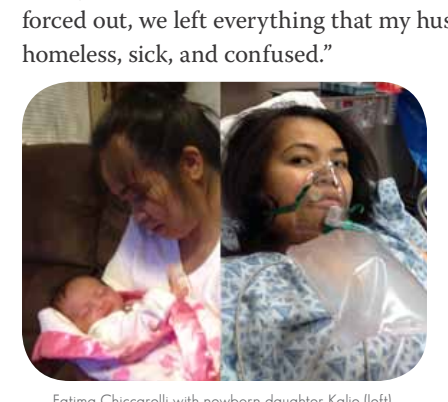
C forced out, we left everything that my husband and I built over 20 years, we were left homeless, sick, and confused.”
e She said adults and children are suffering n from chemically-induced pneumonia, and her T family has suffered from it. Her husband, “the epitome of health,” fell ill in 2008. That same H year, her neighbor, a woman in her thirties, a died not long after gardening. Another neighbor Fatima Ciccarelli, also in her thirties, died P two days after gardening in 2012. Her lungs P Fatima Chiccarelli with newborn daughter Kalie (left) filled with fluid and she suffered cardiac arrest. Y She left behind a two-week old newborn, Kalie, and her husband, Thom. The Villaneuva’s dog developed seizures,a bloody cough, and soon died. Another friend’s five-year-old child has had two bouts of pneumonia, had his adenoids removed, and is now undergoing immunotherapy. Villanueva, 43, came down with pneumonia in 2010. As she leaned over to retrieve a kitchen appliance, she felt as if a lung was collapsing. “The next day I went to urgent care and had pneumonia in one of my lobes. I had trouble breathing, chest tightness, shortness of breath. I imagine a fire fighter’s lungs would feel like mine, my lungs hurt so bad.”
When her daughter Alexandra was five, “Her lips would turn purple, and her eyes would bulge and you could see this desperation, and she’d start coughing and cough-ing. Her lungs sounded like there was a flapping inside. The nurse practitioner diagnosed COPD. “I said, ‘What do you mean? That’s a smoker’s disease.’” The illness was officially listed as “asthma.” Her two older daughters suffered severe bronchitis, chronic sinusitis, nose bleeds for two weeks at a time, pleurisy, and gastrointestinal problems. Villanueva says she provided chemical test results of her home, performed by an industrial hygienist, to the DTSC in September, 2012. She said that in the conference call with the DTSC, the department questioned the validity of the chemical testing. “They said, ‘We are not denying this, we just think the chemical levels are too low.’ Our argument was that our levels exceeded the thresholds that CAL EPA set.” Then the officials said the K EPA’s threshold was just a “tool, a guide, not set in stone, we aren’t saying those are the limits.” Villanueva pressed the DTSC to test for chemicals in her home. e e “We were on the phone for four hours,” Villanueva said. She asked if the DTSC could P ask the US EPA for help. One DTSC official asked the other one on the line and said he didn’t know how to do that, said Villanueva. “We were astonished and shocked. You work T at the DTSC and never put in a request for an investigation?” Villanueva said the officials H argued that under “normal” circumstances there is a clear responsible party, but here they e didn’t see one. “Is that it?” she said. “That means you are not going to investigate because there is no [responsible party] immediately visible? What about the safety of the public C and the lives that are at risk? It’s just unbelievable.” DTSC officials told Villanueva they would think about testing and let her know by the end of November. They didn’t. In the e meantime, 700 people signed a petition demanding that the department investigate. “We n need help,” she said. “DTSC is not doing their job.“ T They still aren’t. On February 5, 2013, the DTSC held a public meeting in Wildomar to- H gether with the South Coast Air Quality Management District (SCAQMD), and Riverside County Department of Public Health. According to Villanueva, DTSC regulators main- a tained that soil and air tests by the air district show nothing unusual that would warrant P an investigation. But, she said, test results by the air district showed 40 contaminants in P both indoor and outdoor air, and 30 compounds in the soil, including heavy metals such Yas aluminum and magnesium at high levels. “The uranium was 77 times higher than you would see in the western United States,” she said. “They are trying to pull the wool over our eyes.”
Villanueva said that one medical doctor in private practice, James Dahlgren, said at the meeting that barium carbonate can turn into highly soluble and cardio-toxic barium chloride in the body. If a person is also exposed to volatile organic compounds, they can react and become one hundred times more toxic than being exposed to barium alone, she said. “I believe that Thom’s wife could have died of a barium overdose. They refuse to admit that contaminants seeping into our homes are above safe limits.” Dahlgren maintains that soil and air tests by the SCAQMD show levels of the heavy metal barium and other volatile organic compounds well above levels considered safe by the California Office of Health Hazard Assessment. “If values are above those levels, then further investigation is necessary because this is very dangerous.” Dahlgren said that the DTSC should be in charge of this investigation, and not the SCAQMD since the source of the problem is soil in which DTSC specializes.
One DTSC scientist said there’s no doubt that the so-called “clean” fill, the soil used by the developer in 2006 to grade the development, was “anything but clean.” He said that the shipment of contaminated soil to the developer should be immediately investigated. “The Villanuevas paid close to $600,000 for their property. They represent those in the K middle class who aren’t used to being treated this way and expect the system to work for them.” Anybody can be poisoned, not just working class communities of color. “It’s heart- e breaking,” the scientist said. “These people are coming here for our help and they get the e usual runaround. ‘No, we can’t test the soil; we’ll have to do that with other agencies, even P though soil is squarely in our purview. People ask me, ‘why are you here?’ And I honestly T can’t give them an answer. Why should they pay taxes if we can’t protect them?” H It isn’t as if the DTSC does not have some money in its hazardous waste control ac- e count. In fact, $26 million dollars has not been spent, according to the governor’s new budget.34 This account is used for various purposes, including enforcement and cleanup C of sites where there is no clearly identified responsible party. This case clearly calls for an investigation of the soil in Wildomar, including tests for heavy metals, volatile organic e compounds, and other toxins. In fact, this $26 million sum, DTSC sources say, could have n funded everything that the DTSC should be doing, but hasn’t. “They could have tested T the soil in Wildomar, hired criminal investigators and oil refinery inspectors, and done something about the whole Central Valley on the East side where poor rural communities H routinely drink contaminated ground water,” said one DTSC policy specialist. a P P Y
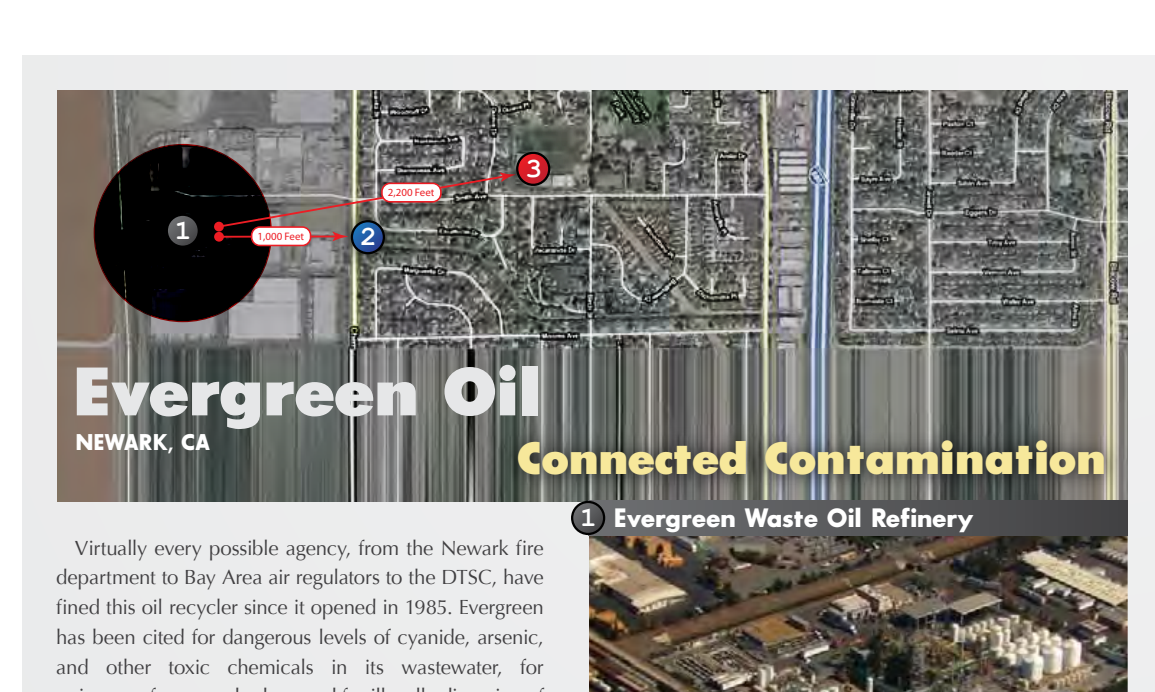
EVERgREEn oIL oVERVIEW2,200 Feet 3 1 2
Evergreen Oil NEWARK, CA Connected Contamination
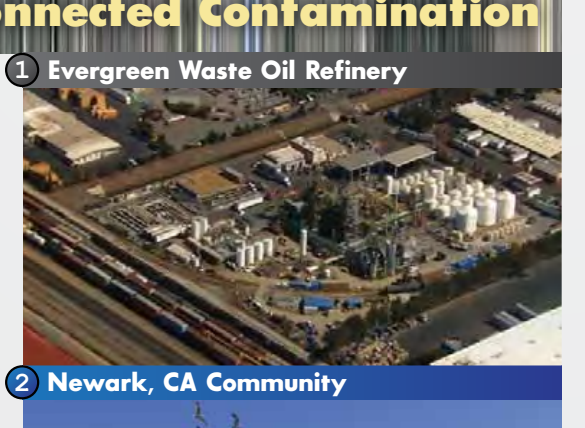
Evergreen Waste Oil Refinery
1
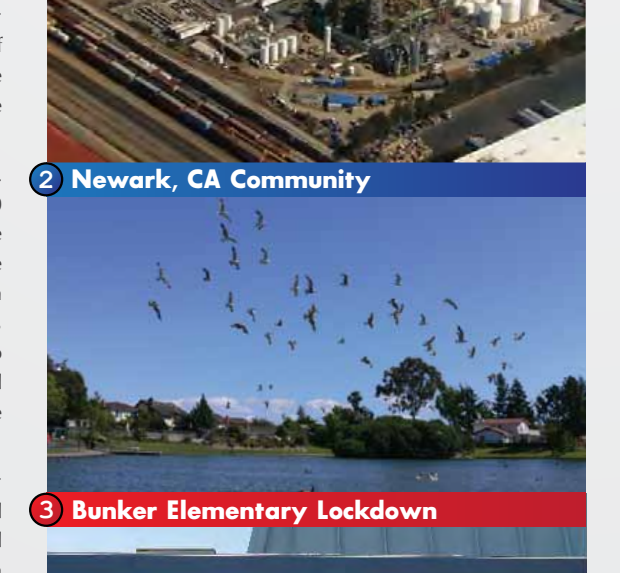
Newark, CA Community
2
‘ -( :l r . ‘
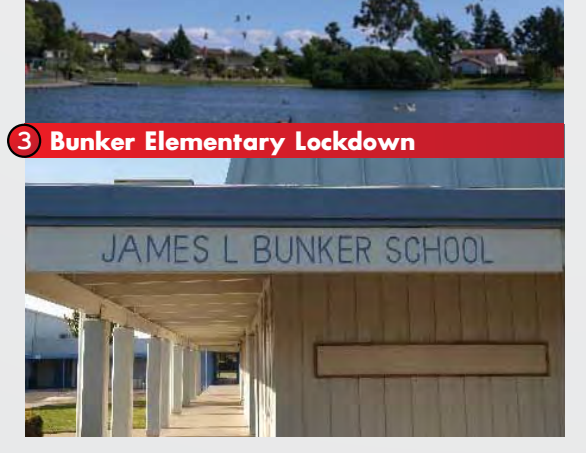
agent, took place last July. The DTSC first said it could Bunker Elementary Lockdown
3
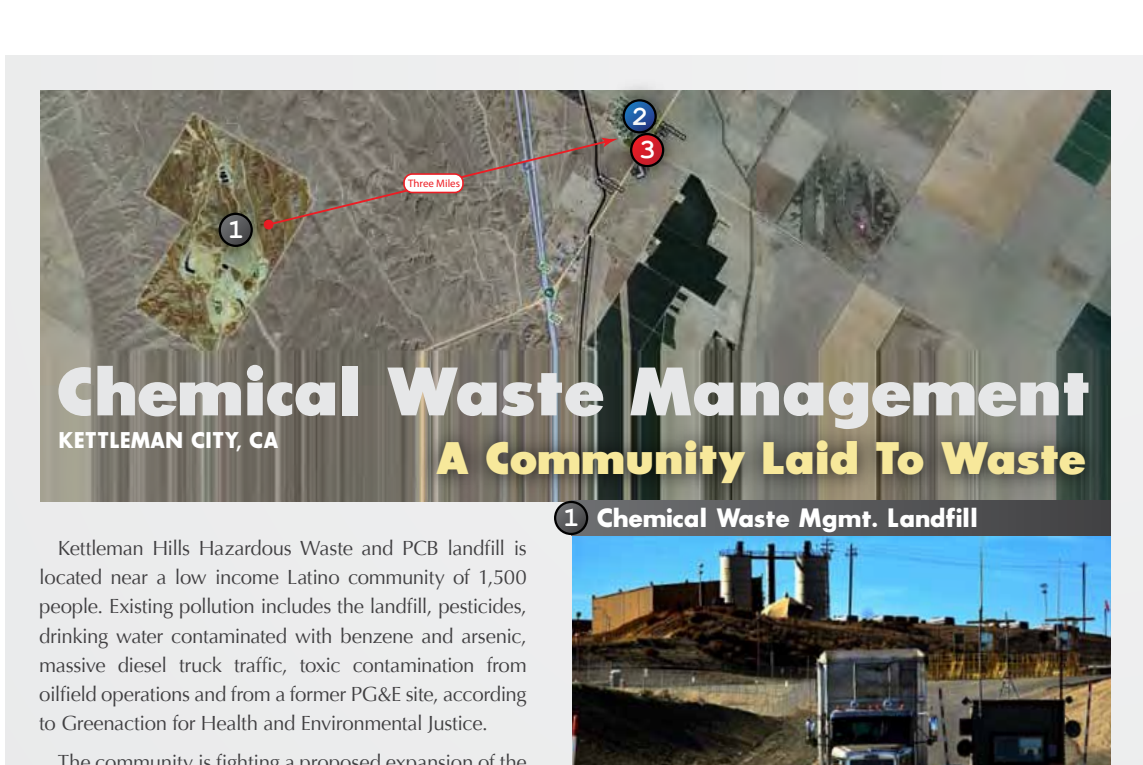
ChEMICAL WASTE 2 MAnAgEMEnT oVER- 3 VIEW 1
Chemical Waste Management
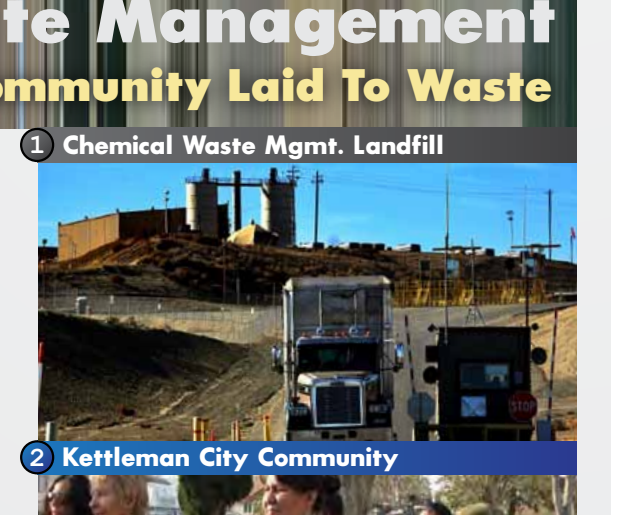
KETTLEMAN CITY, CA A Community Laid To Waste Chemical Waste Mgmt. Landfill
1

Kettleman City Community
2

Families Call For Justice & Accountability
3
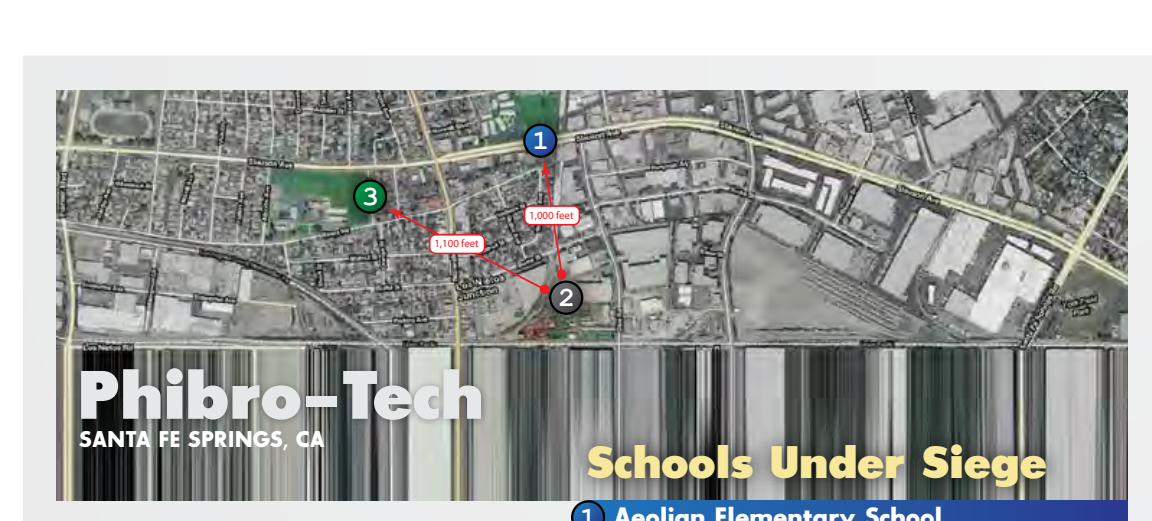
PhIbRo-TECh oVER1- VIEW 3 2
Phibro-Tech


SANTA FE SPRINGS, CA Schools Under Siege Aeolian Elementary School
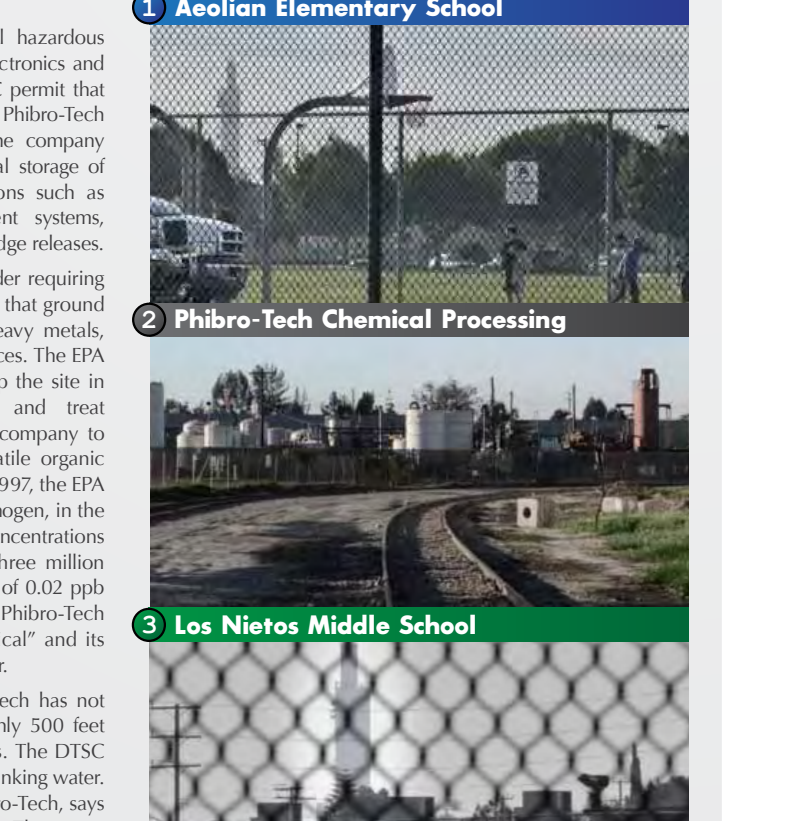
1
Phibro-Tech Chemical Processing
2
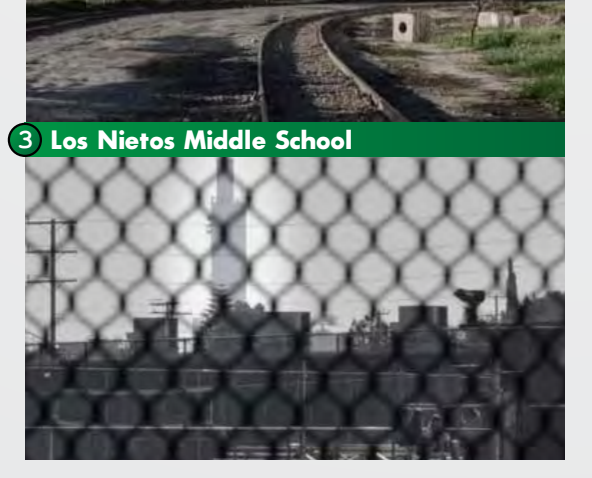
Los Nietos Middle School
3
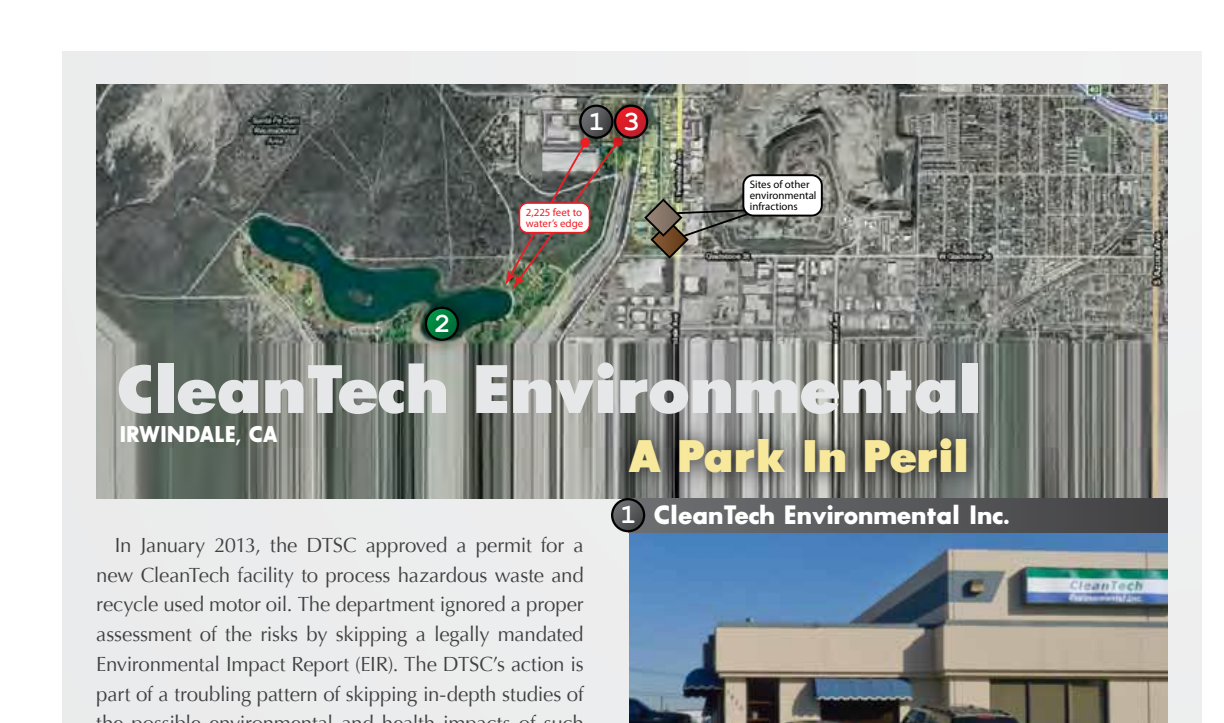
CLEAnTECh EnVI-13 RonMEnTAL oVER-
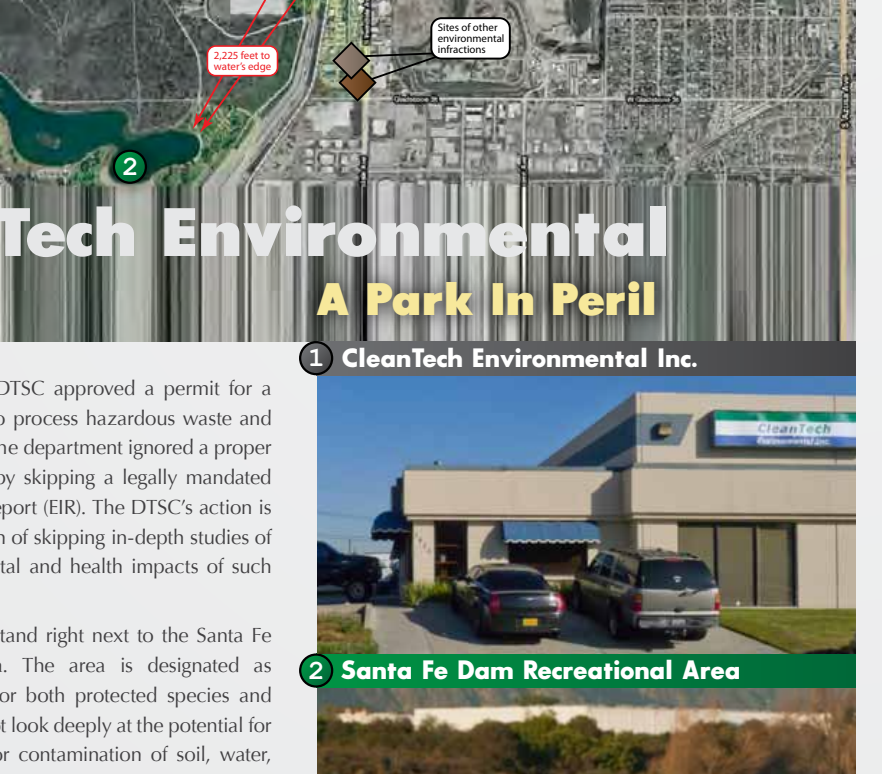
VIEW 2
CleanTech Environmental
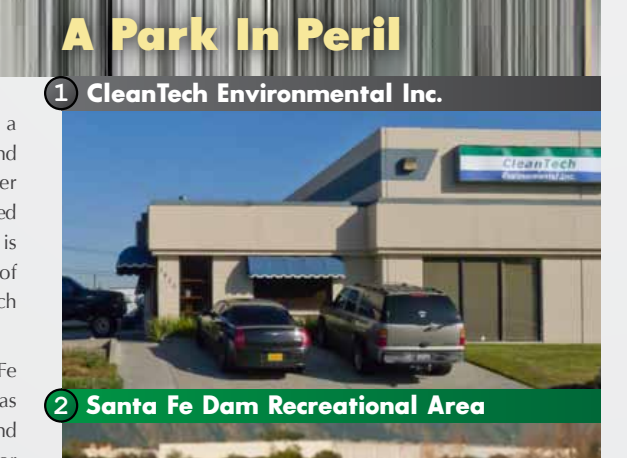
IRWINDALE, CA A Park In Peril CleanTech Environmental Inc.
1
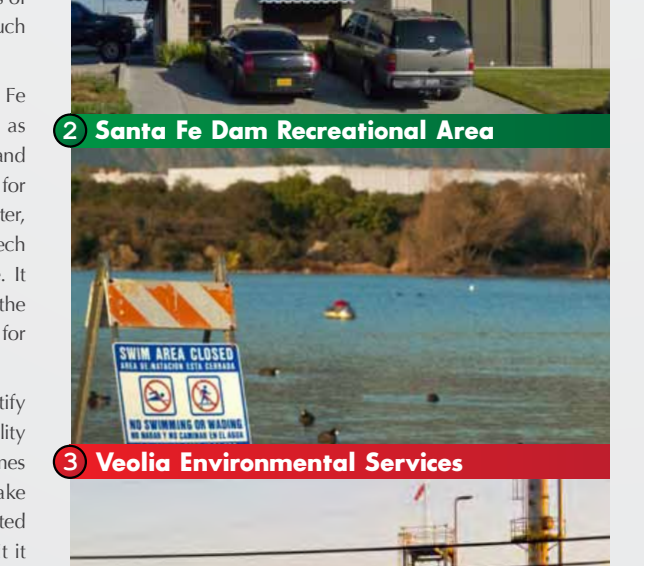
Santa Fe Dam Recreational Area
2
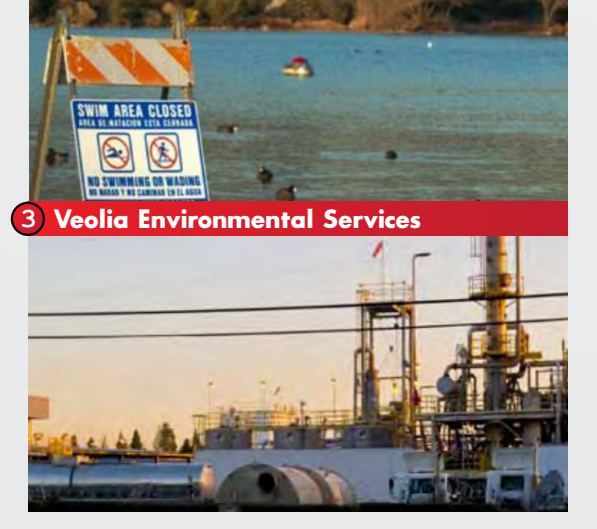
“small-scale” when its final capacity will be eight times Veolia Environmental Services
3

AUTUMnWooD oVERVIEW 1 2 3

AUTUMNWOOD COMPLEX

WILDOMAR, CA HOME, TOXIC HOME Amaryllis Court, Wildomar
1
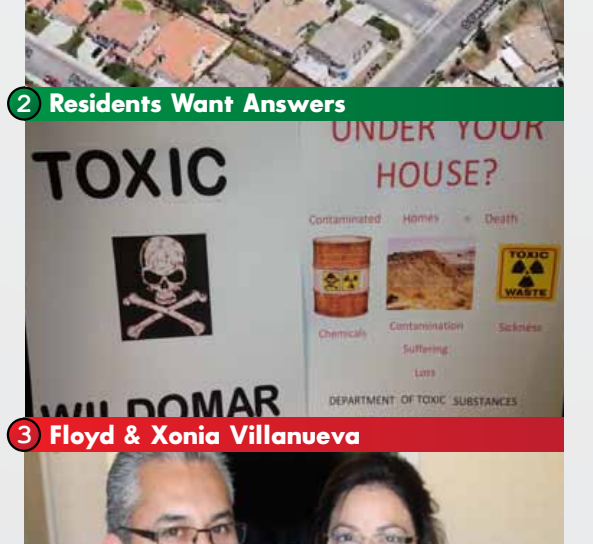
Residents Want Answers
two women revealed unusually high levels of barium, a 2 OXIC
HOUSE?
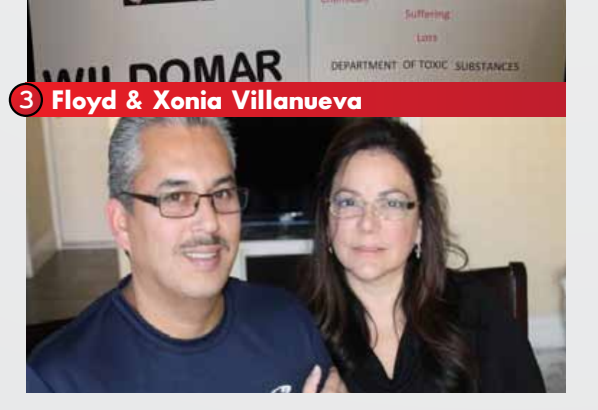
the air district are normal and refuses to do more Floyd & Xonia Villanueva
3
KEPT In ThE DARK
FINDING: DTSC grants exceptions to the rules without public input and has issued emergency regulations saving companies money but endangering public health.
Observation: “All of these things the DTSC did helped save industry a hell of a lot of money.”— DTSC Scientist CRT GLASS Under California law, the DTSC is supposed to encourage new hazardous waste treatment technologies that reduce or eliminate the hazards to human health and the environment to improve California’s economic and environmental well-being. In at least one case, they’re not. Market forces are changing the economics of recycling the cathode ray tubes from old, clunky TVs and computer monitors. The DTSC has done exactly the wrong thing in response. Electronics makers used to take the old tubes back and recycle them. Because the technology has shifted away from these tubes, the electronics makers don’t want to pay the recyclers for them anymore, and recyclers don’t want to pay companies with the new technology capable of recycling the tubes to take them off their hands. They’d rather just throw them away.
Rather than insist that recyclers follow the law, the DTSC gave in to the recyclers’ pressure and issued an “emergency rule” to overturn the state requirement that recyclers sell the CRT tubes back to companies that recycle them. The emergency rule, issued with no public opportunity to comment, allows them to dispose of the tubes in hazardous waste landfills. The decision displeased Sheila Davis, executive director of the advocacy group Silicon Valley Toxics Coalition. She said consumers in California pay an extra fee embedded in the cost of the electronics they buy that is used by the state to subsidize recyclers. “It is the consumer who pays the recyclers to have our electronics properly recycled and then we find out that they are going to dump this into hazardous waste landfills that are located in really poor communities. We think that the HPs, Apples, and Dells should… take it back and recycle it responsibly. We want them to design (electronics) properly so this is preventable, or to pay for it.”
The redesign of products to reduce hazardous waste is a longer term goal. In the mean- K time, technology exists to profitably recycle CRT glass, said Jim Taggart, head of ECS Refining, the second-largest recycler in the country based in Stockton. “This is knocking the e legs out from under the industry that is developing the recycling technologies and mak- P ing the capital investment.” The state should simply have kept its rules in place, he said. T “It’s done by just not encouraging landfill. You require recycling and the system takes care of it.”
n ECS Refining is concentrating lead from CRT glass and selling it back to smelters for Tnew batteries. It’s selling decontaminated glass to new customers, from insulation to ce- H ment makers, in other states. The impetus for the emergency rule most likely came from e owners of landfills who stand to make money or recyclers who stand to save it this way, said Taggart, who adds that this was a dangerous decision. Taggart says that unscrupu- D lous recyclers could end up throwing contaminated glass into cheaper unlined municipal a landfills that charge much less to take waste and lead could leach out. So much for the DTSC protecting Californians’ health and the environment.
R KMETAL SHREDDERS Companies don’t need emergency regulations when the DTSC is willing to grant exceptions that become rules. That’s what happened with the lucrative metal shredder industry that extracts ferrous and non-ferrous metals from scrapped cars and appliances and sells
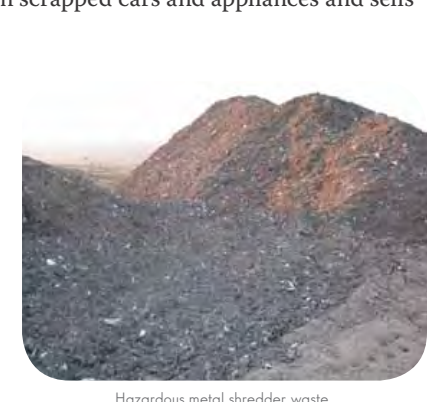
them to Asia.
Once auto dismantlers divest cars of re-usable parts, shredders reduce the metal hulks into fist-sized pieces in a matter of seconds.
These metals are further separated. The residue left over, deceptively called “fluff,” is coated with industrial lime and trucked to local landfills where it is used as a “non-hazardous” soil substitute to cover municipal waste.
This fluff contains plastics, fire-retardants, glass, rubber gaskets, wires, and dirt impregnat- ed with toxic heavy metals that include lead, copper, zinc, and cadmium, metallic paint, plus polychlorinated biphenyls (PCBs). In the mid-1980s, the State of California classified the fluff as hazardous. “Auto shredders didn’t want to spend the money on putting it into hazardous waste landfills,” says one DTSC scientist. The DTSC planned on giving shredders a “variance,” or exception to the rule, to keep using municipal landfills as a much cheaper disposal option. But lots of landfills had no impermeable liners to contain toxic leachate, a byproduct of fluff exposed to acidic wastes and liquids that form in landfills. Owners of municipal landfills rebelled at the legal ramifications of liability for accepting K hazardous waste, even if the DTSC was choosing to pretend that it wasn’t. e In the late 1980s and early 1990s, the DTSC changed the rules. It issued seven of the P big metal shredders in the state exemptions in the form of so-called “F” letters granting T non-hazardous waste status to the fluff, provided the shredders would treat it specifically the way that the DTSC prescribed before going to municipal landfills. “They essentially I n told the big guys if you sprinkle Pixie Dust on this stuff, you’re golden,” said one DTSC scientist. The idea was to get the fluff out of sight and out of mind, not to regulate its toxic properties. The exception allowed shredders to dump the supposedly treated toxic waste T H at low-cost local landfills. In a strange twist, another agency, now called CalRecycle, clas- e sified the toxic waste as an “alternative daily cover,” meaning landfill operators were allowed to spread tons of this stuff, like a blanket, over household garbage at the end of each D day to control rats, fires, odors, blowing litter, and scavenging. No fees were collected to a dump this waste, now actually considered beneficial.
R There was just one hitch. “Years after the letters were issued, it turned out that the self- K regulated shredder industry was not treating the waste as the DTSC specified it should,” said the DTSC scientist. The waste could leach and also crumble and blow into the air. In 2002, a DTSC scientist, Peter Wood, concluded that the industry’s coating method wasn’t preventing lead, zinc, and other hazardous minerals from leaching into landfills at hazardous waste levels.
In a draft report for the agency, he recommended a series of steps to regulate and mitigate this hazardous waste. He recommended that shredders pay hazardous waste generation fees, that the department rescinds all F letters, that shredders get authorization to treat their waste on site, and that the internal DTSC policy allowing shredders to treat their waste also be rescinded. “That’s when the department went into paralysis by analysis,” the DTSC scientist said. That is also when shredder industry lawyers and lobbyists descended on the DTSC and the legislature in full force. Not a thing has changed since the draft report was published a decade ago, except for the cars themselves, and not for the better. According to a report in the San Francisco Weekly by Matt Smith four years ago, titled “Car Alarm,”36 today’s cars contain even more toxins thanks to new technologies like built-in video and touchscreens. Modern appliances have more galvanized steel that is treated with zinc. If exposure is high, that can prevent the human body from absorbing essential minerals. Levels of copper, cadmium and zinc are only growing as technology advances. “This fluff is unequivocally a hazardous waste,” says one environmental prosecutor. “It is a hazardous waste under federal law due to toxic metals over the limits. The DTSC is way out of reality on this one. But who is going to raise the resources to fight? US EPA doesn’t give a s**t either.”
Companies that manage hazardous waste pay the DTSC fees for permitting and for K waste disposal, among other fees. Between 1998 and 2012 alone, California landfills, including Simi Valley Landfill in Ventura County, accepted six million tons of toxic auto e fluff. Just a modest fee of a dollar a ton could have generated $6 million for state coffers P and funded meaningful studies on how to safely control, treat and dispose of this poison- T ous waste.
n Alice Sterling, a former senior project manager for sustainability for the city of Pasadena, lives near the Simi Valley Landfill. For the past two years, she’s been trying to get Tthe DTSC to prove that treated shredder waste is safe. Responsiveness is not one of H DTSC’s strong suits. Sterling waited exactly 118 days for a response to a Public Informa- e tion Request concerning the DTSC’s progress in managing the health and safety issues associated with auto shredder waste. In an email to the DTSC in February, 2012, she D wrote: “In my community, Simi Valley, over two billion pounds of a (treated) auto shredder waste has been buried, and as of this time, the DTSC has not been able to scientifically prove that it is not R harmful… Moreover the DTSC has yet to prove that it has a plan for K addressing the myriad problems associated with auto shredder waste.” By now, she says, the DTSC should have developed a project framework for managing auto shredder waste, completed an analysis of all the state and federal codes controlling auto shredder waste, provided a thorough definition for effective treatment, provided protocols for independent sample collecting and testing of the treat- Alice Sterlinged waste product, among a long list of other to-dos.
Sterling says that the self-monitoring by auto shredders means that the laboratory tests of waste they pay for cannot be trusted. “I’m nothing but a gnat to this elephant,” she said. “Industry has put a ring in the nose of the DTSC, and doesn’t have to pull hard to lead the DTSC down the path of their choosing.” She said the DTSC has capitulated its responsibilities to properly authorize the treatment of a hazardous waste and lets the industry run amok at the taxpayers’ and the environment’s expense. To this day, the DTSC has not told a single metal shredder that it must hold a permit to treat what every single source interviewed for this report agrees is hazardous waste under California law. Instead, the fact that metal shredders are treating hazardous waste on site without any DTSC authorization is ignored.
MECCA Soil recycling and disposal company Western Environmental began operating a contaminated soil dump in 2003 on land owned by the Cabazon Band of Mission Indians. The company began accepting contaminated soil for recycling at the tribe’s 640-acre “resource recovery park” near the Salton Sea on a permit issued by the tribe, not the state. K It was a snap to get it.
e By December of 2010, odors were sickening children at the Saul Martinez Elemen- P tary School in Mecca (See “Western Environmental Overview” on page 53), giving them T nausea, stomach pain, and breathing problems. Recess was brought indoors. Residents complained bitterly. “Those smells…you feel like you don’t have worth,” resident Ange-I n lina Guillen told The Desert Sun, which produced a multi-part series on the story. “My friends would tell me, ‘We don’t have any other options besides what’s here.’ And I would say, ‘Sure we’re in Mecca but we’re not animals. We’re human beings.”T H The Press-Enterprise in Riverside also took a close look. Reporter David Danelski found e that the Los Angeles Unified School District, the US Marine Corps and Caltrans were D among dozens of agencies and companies that illegally shipped more than 160,000 tons of hazardous waste to the Western facility. It is illegal to ship hazardous waste to facilities a that do not hold permits issued by the state of California. Former workers told The Desert R Sun that the plant couldn’t process all it took in. By 2009, a pile of putrid soil had grown K to four stories high. The facility accepted untreated sewage sludge in 2010 and 2011, intensifying the smell. Workers felt nauseous and suffered diarrhea and lightheadedness. Some quit to protect their health.
Meantime, the Los Angeles Unified School District cut its hazardous waste cleanup bill by two million dollars, according to The Desert Sun, as it added to that four-story pile. And Western Environmental did very well indeed, undercutting the prices of other regulated dumps in the state. In 2009 and 2010, Western accepted more than 10,000 shipments—about 160,000 tons of dirt laced with gasoline, pesticides, and other chemicals, according to public records that Danelski examined. His investigation finally prompted the DTSC to order hazardous waste shipments to Mecca stopped. The US EPA also stopped all shipments to the plant and ordered a cleanup.
The district’s dangerous dumping began around 2008, when the LAUSD developed a plan to remove soils polluted with lead and pesticides from 15 acres in Los Angeles so it could build new schools. Light industry, from furniture makers to machine shops, had previously occupied the site. The DTSC said in a fact sheet that it would “oversee” the cleanup and “ensure that it is performed in a manner that does not harm people or the environment.”
The school district originally planned to send the toxic soil to permitted landfills in the San Joaquin Valley. But then something changed. The DTSC gave the LAUSD an exemption to send the waste to Mecca, according to school documents unearthed by Danelski. Based on Danelski’s work, it turned out that the agency itself had approved shipments of waste considered hazardous in California to a dump unlicensed by California. The DTSC listed the Mecca plant as a disposal option on its website, a San Bernardino K County public works manager, Brendan Biggs, told Danelski. DTSC Deputy Director for brownfields and environmental restoration, Stewart Black, later acknowledged that the e waste should not have gone to Mecca and said that there was a widespread misunder- P standing about the plant’s status inside and outside the agency. But some environmental T enforcers don’t buy it. “The school property evaluation and cleanup division at DTSC allowed contaminated soil to go from the school sites to Mecca,” said one former DTSC n enforcer. Hazardous waste landfills are running out of room, and this was one convenient solution. “It is a criminal violation if you knew or reasonably should have known that the T materials were being stored or transported to an unpermitted facility. You’re in the frick- Hin’ business. It’s your job to know.”
e A sanitized report prepared on Mecca by the DTSC in August of 2011 shows that, in D the most charitable light, the DTSC badly fumbled the ball. The department first be- a came aware of plans to transport contaminated soil to Mecca in 2003 and 2004 through manifests in its Hazardous Waste Tracking System (HWTS) that indicated delivery. In R 2004, its criminal division got a complaint that Western Environmental was treating haz- K ardous waste on Indian land without a permit. DTSC initiated an investigation, and was shown a permit issued by the Cabazon tribe. In 2005, the tribe had tried to negotiate a cooperative agreement on such a plant with CAL EPA. The DTSC explained the tribe had to meet certain legal provisions that were not negotiable and heard nothing more from them.
Between 2007 and the fall of 2010 (the DTSC inexplicably closed its investigation earlier that year) various parties contacted the DTSC asking whether hazardous waste generators had to pay California land disposal fees for hazardous waste sent to an Indian reservation, requests for confirmation that the Mecca facility could receive lead and pesticide contaminated soil, and requests to see if the facility was DTSC authorized. Throughout, the DTSC never clarified what its regulatory authority was over the facility. In 2009, a staffer analyzing the Hazardous Waste Tracking System noticed the Mecca facility was receiving “large volumes of hazardous waste” and went to see if it had been permitted. It hadn’t. The staffer turned to the legal counsel at the agency.
DATA DISASTER It was the staffer’s instincts, and not the DTSC’s own Hazardous Waste Tracking System, that finally got the agency to pay attention. According to the DTSC report, “The HWTS data system does not have automatic alerts that would flag potential violators of hazardous waste laws such as potentially unauthorized facilities accepting hazardous waste.” One DTSC regulator said that so many incomplete, incorrect, or illegible manifests were flooding the system that filters prevented computer loading and automatic alerts were actually turned off.
In general, DTSC sources say that the hazardous waste tracking system inside the K DTSC is a disaster. An internal 2011 executive report on the system says that the current business process is “inadequate, understaffed, vulnerable, and does not adequately e support core DTSC hazardous waste and fee activities.”39 Each year, the system is track- P ing more than 450,000 hazardous waste shipments including data and images from over T 900,000 manifests that companies at both ends of a transaction are supposed to sign and supply to the DTSC. The system does not flag manifests indicating that waste is be- n ing sent to an un-permitted California facility, and its data quality is poor with up to 40 percent of the manifest records containing at least one error. Data is also not mined to T identify violations and patterns.
H e The tracking system is such a disaster, that, according to one DTSC scientist, “If I shipped Methyl Ethyl Death on Bin Laden Trucking Company to Disneyland, nothing D would happen. If you look on our system and ask what are the largest facilities accept- a ing hazardous waste, it comes up unknown, what the waste is comes up unknown, who is shipping it comes up unknown.” In the early 1990s, before the DTSC stopped applying R penalties for shoddy paperwork filed by hazardous waste haulers, the DTSC took hun- K dreds of administrative actions against registered waste haulers for violations related to hazardous waste manifests, hauler applications, and disclosure statements, such as omissions of violations if they were applying to be haulers, the scientist said. Now, in the 21st century, “We only review disclosure statements for administrative completeness. Companies can lie on these things.” Time was that the California Highway Patrol would pull over a truck hauling hazardous waste and if it found bad brakes, it would refer the trucker to the DTSC for penalties or revocation of the permit. But then the DTSC stopped doing anything about it. “The highway patrol stopped sending over the paperwork. They got sick of it.”
COMMUNITIES WANT JUSTICE Luis Olmedo wants someone held responsible for the Mecca debacle. He’s executive director of the advocacy group Comite Civico del Valle, based in Brawley, California some 50 miles from Mecca. “We still haven’t seen anyone held accountable for Mecca. How much did the DTSC know about Mecca?” He says the facility still isn’t entirely cleaned up and wind is still blowing toxic dirt around. “The bad actors end up in environmental justice communities where people don’t have education or are monolingual.”
Eduardo Guevara Sr. has lived in Mecca for the past five Eduardo Guevara Sr. at public years. He says the Western Environmental operation gave his wife asthma and she took two trips to the hospital because of “severe chest pain and K lack of breath.” His eleven year old was regularly kept indoors and soccer games were canceled. “He was like, grounded,” he said. At a public meeting with hundreds of Mecca e residents, his son Eduardo Junior handed an official from the Air Quality Management P District a letter begging that regulators protect his mother from getting another asthma T attack. Running noses and eye irritation were something the family just lived with. Others who lived closer to the facility had severe headaches.
n Guevara said the poisoning occurred because of greed. “They started receiving more Tthan they could process,” he said. “If they had kept a low profile maybe they would have H been under the radar up to this day, like the seven years before they got caught. But they e tried to grasp more than they could handle and the odors triggered all the community upset.” He says that the community should always be included in identifying wrongdoers D and environmental violators should be made to pay in a court of law, not by cutting deals a with regulators in out-of-court settlements.
R Luis Olmedo says he is working hard with regulators from the DTSC, the local health K department, and many others to “be the eyes and ears” of government. His group has developed online tools that allow community members to lodge complaints on everything from dumping to vandalism. The aim is to help regulators while complementing government complaint systems and databases that lack transparency and are hard to navigate. The model, which also used bus tours for community members and regulators to investigate environmental problems, evolved under the former director of the DTSC’s enforcement division, Gale Filter, in 2009. He served as the chief regulator in Imperial County, which had no local agency to implement environmental programs. But the effort has flagged since he left in 2011, said Olmedo. “It’s a great model,” said Olmedo. “Why not embrace it?” He said some DTSC officials are dedicated to making it work. “But regulators are trying to work with sticks and wire,” he said. “What we have is a government that is not investing significantly in environmental justice. Jobs are a priority. Creating jobs and investment.”
Olmedo says that not enough money is being invested in communities where enforcement actions occurred. “The fines will never equal the benefits to the polluters,” he said. “The fines ought to be invested 100 percent into the communities.”
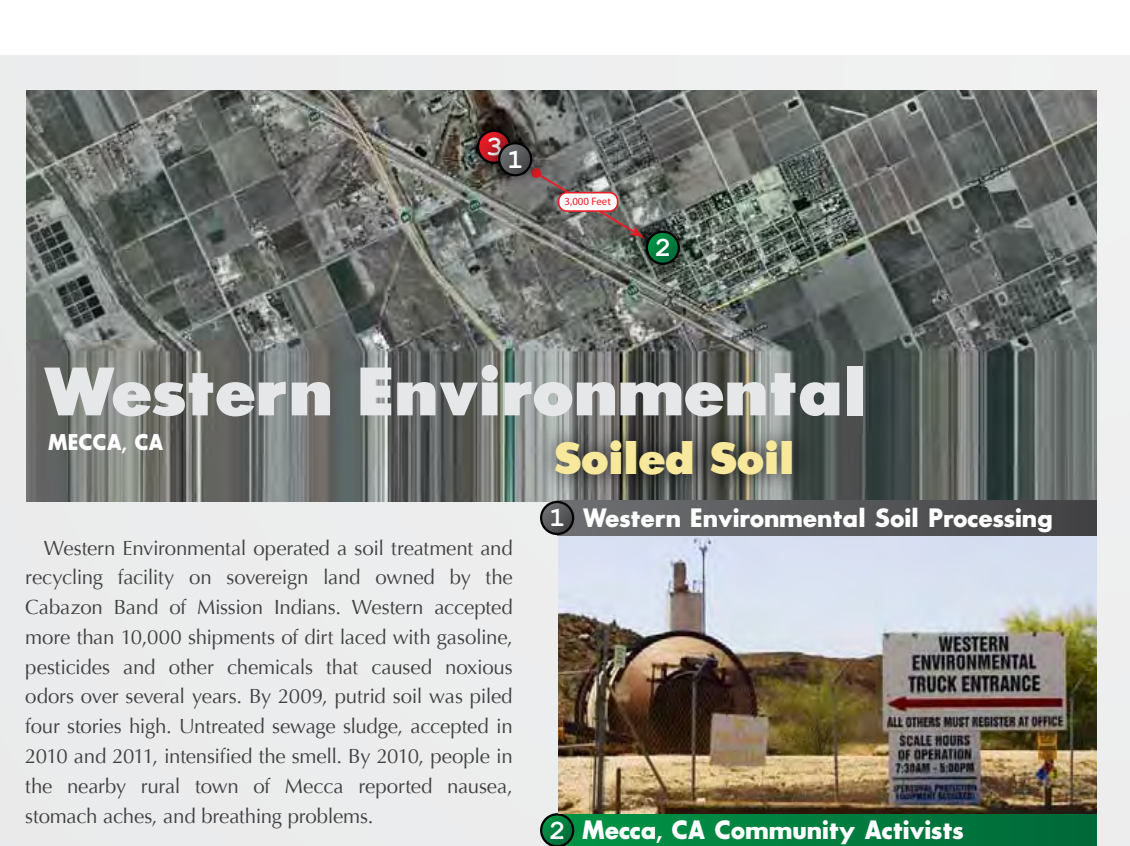
WESTERn EnVIRon- 3 MEnTAL oVERVIEW 1 2

Western Environmental

MECCA, CA Soiled Soil Western Environmental Soil Processing
1
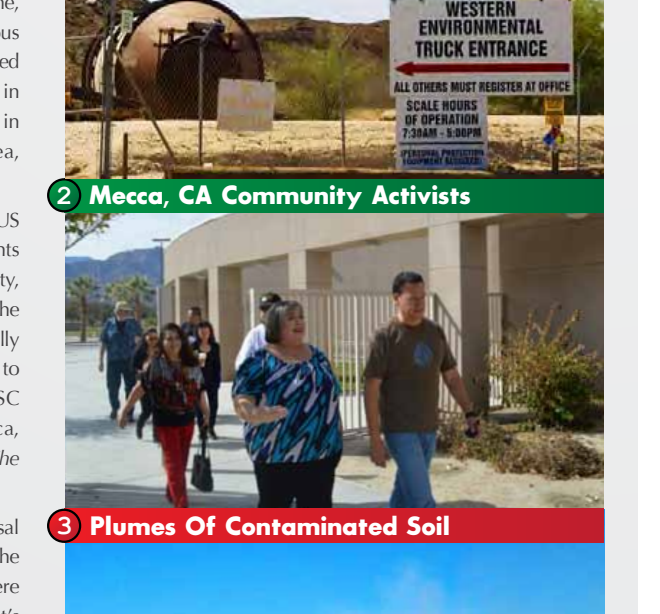
Mecca, CA Community Activists
2
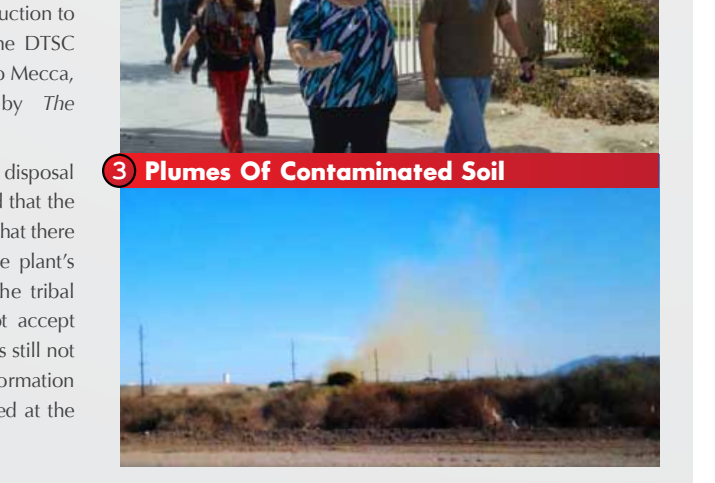
The DTSC had listed the Mecca plant as a disposal Plumes Of Contaminated Soil
3

STACKIng ThE DECK
FINDING: Top DTSC administrators play favorites and hamper staff from performing their environmental duties, including within its office of Criminal Investigations.
Observation: “This department is all about fiefdoms and self-promotion. They have been reclassifying positions and moving them around like chess pieces.” — Source familiar with DTSC personnel practices
CRONYISM TRUMPS QUALIFICATIONS Last August, the California Department of CalifoDrneipaa rtmofeH nut mRane sources Human Resources —Governor Jerry Brown’s HumRane souQrcueliasty R eview newly formed personnel management department—reviewed DTSC’s allocation of positions
REDS TATUTSA G;
between 2010 and 2012. The purpose of the review was to verify that higher-level personnel appointed by the DTSC were actually qualified to perform their assigned duties, that their work ______ matched the job specifications, and that the department was following the rules in awarding ____ ———
- —~ ___ —
- —
- —
- – . .. .. ..
—..- ———— civil service jobs according to merit. . ._. ,.
–
- ——
- –
- ——– The cover page of the resulting report has a giant headline: RED STATUS TAG: Action Required. Beneath it a big, oval red dot contains the words “Exceeds 20% Allocation Error Rate.”
The report suggests that the DTSC has a practice of putting people who aren’t fully qualified into jobs they don’t belong in. The human resources department found that the DTSC has “an unacceptable misallocation rate of 59 percent,” meaning that more than half of the jobs reviewed were not filled with properly qualified people. Written justification to support appointments was missing from numerous personnel files. In some instances, the DTSC requested authority to appoint someone under-qualified to a position, had the request denied, and actually made the s appointment anyway.
T a “The ultimate findings suggest a pervasive and flagrant practice of ignoring civil service laws and rules, of blatant favoritism to candidates otherwise not qualified for the C high-paying supervisory and managerial positions they were awarded, and abject failure K to correct these appointments when the error was pointed out to them,” said one source intimately familiar with the DTSC personnel practices. “There is the distinct possibility, n perhaps probability, that these appointments were directed by those in high-level man- G agement positions and that personnel staff had no choice but to ‘go along to get along.’” What’s most troubling is what’s missing: “An explanation of why these appointments T were made and who specifically authorized them.”
H WHO WIELDS POWER e D A number of sources close to the DTSC say the single most powerful person at the department is not its director, Debbie Raphael. It is Odette Madriago, chief deputy direc- e tor, who has been with the DTSC since the days of Governor Pete Wilson. “Odette runs C the place and nobody messes with Odette if they can help it,” says one scientist. “You are K either someone Odette views as helping her, or you go on the pile.”
Madriago earned the title “Little Dick Cheney” during the Schwarzenegger administration, for controlling key decisions and appointments. DTSC insiders say that Madriago places people in positions that make them beholden to her. They say she has re-hired top people who formally retired into annuitant positions where they are free to double-dip their state pension and a salary.
She is very close to industry, say several DTSC sources. “From the big picture standpoint, the DTSC has been especially responsive to the regulated community,” said one. “That wasn’t supposed to be the case in the Brown Administration, but the trend continues. Odette gets a lot of the blame for this, and properly so.”
DTSC sources describe Madriago and Brian Johnson, Deputy Director of Enforcement and Emergency Response, as meddling in the Office of Criminal Investigations. They report that this department has now been moved under the Office of Legal Affairs in an effort to insulate it. “They tried to get confidential information by saying that we are subordinate. But we won’t give it to them,” said one DTSC investigator. “That information would get out there. They would give it to their industry contacts. Information leaks like a sieve.” Criminal investigators don’t want to tip off the objects of their attention and don’t trust staffers close to industry to keep the information confidential. Madriago in particular does not like cases referred to public attorneys because “it makes the department look bad.” Sources say she has been trying to reassign scientists away from the office, but investigators would be left without the scientific expertise to generate more cases for refer- s ral. “The culture of fear here is worse than I have ever seen,” the investigator said. T a The investigator said that Madriago cut off funding to develop a technology that can detect several sizes of particulate matter and trace the pollution back to its source—criti- C cal to expanding DTSC’s enforcement authority to regulate toxic particles. The DTSC had K contracted with a top scientist and professor emeritus at UC Davis, Dr. Thomas Cahill, to support the work. The new technology measures more minute amounts of materials more n cheaply. If applied to air polluters, such as refineries, the technology would show that G refiners are out of compliance with air emissions rules.
TThe new technology could also be applied to the toxic particles that accumulate on the H ground. This is an area that the DTSC has largely ignored, arguing that air emissions, e even if their hazardous byproducts settle on soil, isn’t their problem. “The DTSC appears to be biased against looking at new technologies to enforce the laws,” said one DTSC sci- D entist. “If you use the new technology then you will find violations and that pushes them e towards enforcement.” Exactly what they don’t want. Madriago has used what the sci- C entist says are “reports by third-rate consulting firms hired by the shredder industry” to K refute the UC Davis scientist’s competence. Blocking adoption of new enforcement technology means no new enforcement.
Some observers say the only way to ensure an effective Office of Criminal Investigations is to remove it entirely from the DTSC. “Whatever you do with this puppy, it has to be independent,” says one former DTSC enforcer. Some inside the department have long advocated for an “expedited response team” under CAL EPA that would address cases from the point of view of air, water, and soil simultaneously and would be composed of experts and investigators from various boards, offices and departments. “There is a critical need for an environmental enforcement program that is responsible, accountable, and increasingly transparent,” wrote one DTSC scientist in such a proposal in 2007. “At a time when funding is shrinking, existing resources must be restructured to promptly detect and vigorously deter unlawful conduct in those areas within the state where California’s environmental laws are being ignored.” The plea has fallen on deaf ears.

WEALTh oVER hEALTh
FINDING: DTSC suffers from bias toward industry helped along by a revolving door between regulators, lobbyists, and lawyers.
“You are up against a regulator who isn’t working for the Observation: state really, for the public in any fashion, but is owned by, employed by, the very polluter that they are in fact supposed to be controlling and victims of these toxics don’t have a chance.” — Dan Hirsch, head of Committee to Bridge the Gap SOME THINGS NEVER CHANGE A dozen years ago, the nonprofit Public Employees for Environmental Responsibility (PEER) interviewed some 80 DTSC employees about the department. The report found that then-Governor Gray Davis wasn’t living up to expectations that he would significantly improve environmental protection. The overt hostility to environmental enforcement that prevailed under his predecessor Pete Wilson had disappeared, but reforms hadn’t followed.
The report found that Davis didn’t clean out the Wilson appointees and regulated industries knew they could keep going over the heads of project managers and inspectors to avoid compliance. Employees told PEER that they were still waiting for DTSC to crack down on facilities that failed to meet cleanup schedules or use their attorneys or lobbyists to delay or avoid expensive cleanup projects. They said that they had observed incidents where DTSC project managers were replaced at the request of regulated industry representatives and where politics continued to override science-based recommendations. And they reported that Peter Weiner, an attorney representing hazardous waste generators and responsible parties in a number of DTSC cleanup projects, had influenced several projects. Simply change a few names, and the report accurately describes the state of the DTSC today.
W One of the most politically influential polluters in California is Boeing. “For years, e regulators at the DTSC have been too cozy with Boeing,” said one long-time environmen- a talist. “They hire consultants and Boeing has the most insiderish track.” Boeing is resisting cleanup of its portion of the highly contaminated Santa Susana Field T Lab site once owned by Rocketdyne and used to build and test rocket engines and nuclear H reactors. In 1959, the site suffered a partial nuclear meltdown that has been described as the worst in US history, releasing more nuclear contamination than the Three Mile Island O disaster in 1979. (See Boeing, Santa Susana Lab Overview, on page 62). In 1996, Boeing became primary owner and operator and later closed the site.
e R The DTSC is the lead regulatory agency overseeing the investigation and cleanup of nuclear and chemical contamination at the site. And it is very sensitive to Boeing’s fi- H nancial interests. “Boeing is the number one Big Gorilla with the California Chamber of Commerce that is always threatening to leave California if the ‘job killers’ don’t leave e them alone,” says one DTSC regulator. “The governor’s key special advisor for jobs and the a economy, Mike Rossi, is very close to the Chamber and Boeing.”
T The Rocketdyne Cleanup Coalition advocacy group wrote DTSC Director Debbie HRaphael in September 2012 about what they view as the department’s abandonment of nearby residents sickened by the site.41 “Boeing has purchased very powerful lobbyists and public relations consultants, including Winston Hickox, Peter Weiner, Bob Hoffman, Charlie Stringer, and Gary Polakovic, several of whom are close to the governor,” wrote the members. “We recognize that we represent merely the ‘little people,’ everyday folks who live near this polluted facility whose families face the risk of cancer and other ailments from the decades during which Boeing and its predecessors have succeeded in avoiding cleanup obligations. Your actions indicate to us that in your eyes we don’t count, that it is only the powerful like Boeing that matter, that you will do what they want you to, no matter who among the unpowerful gets hurt by it.”
The lobbyists and spin doctors Boeing has hired to resist cleanup are a partial who’s who of former regulators and political advisors. Dan Hirsch heads the nonprofit group Bridge the Gap and has battled to clean up the site for more than 30 years. He said that lawyer Charlie Stringer works for the Renewable Resources Group, which Boeing hired to create an “astroturf” campaign to support the company and oppose cleanup. Stringer served on the Los Angeles Regional Water Quality Control Board under Arnold Schwarzenegger. Boeing hired Gary Polakovic, a former Los Angeles Times reporter who now runs a PR firm called Make Over Earth, for a massive Boeing green-washing campaign, Hirsch said.
Many former environmental regulators work for companies involved in the hazardous W waste business or who generate hazardous waste and want to resist regulation. Winston Hickox was the Secretary of the California EPA from 1999 to 2003. He works at the public e affairs company California Strategies. One of its PR specialties is the shredder industry. a His former Chief of Staff was Bob Hoffman, who served as Chief Counsel at the DTSC from 1994-1998, before joining CAL EPA. Sources say that Odette Madriago, who began T as a staffer and worked her way up to chief deputy director of the DTSC, rose under Hoff- H man. “She is a creature of Hoffman,” said one long-time DTSC insider.
Hoffman now works in the real estate environmental practice of the Paul Hastings O law firm together with Peter Weiner, who worked as assistant to Governor Jerry Brown for toxic substances control during Brown’s first administration. Weiner drafted more V than 25 of the state’s basic environmental laws, according to his biography on the law e R firm’s site. Weiner notes in his biography that he specializes in obtaining and modifying permits, enforcement activities, and Environmental Impact Reports, including “success- H ful defense in litigation.” The firm works in various capacities for major hazardous waste e recycling and disposal facilities, hazardous waste transfer facilities, used oil recyclers, and a metal shredders, as well as many others. It has worked on behalf of Phibro-Tech and S.A. Recycling.
T Regulators at the DTSC have become captive to the industry they oversee through H these personal relationships and the ability companies have to go over the heads of regulators and straight to the governor’s office.
“DTSC seems to now be a wholly owned subsidiary of the polluter it is supposed to be regulating,” the Rocketdyne Cleanup Coalition wrote in its DTSC letter. “Rather than control toxic material, DTSC seems to be intent only on protecting the polluter.” The group pointed out that the DTSC dissolved a long-standing interagency working group that included members of the public, government regulators and experts to update the community on the state of the cleanup in favor of a “sham” community advisory group that opposes the cleanup, backed by Boeing.
The DTSC removed its project director on the lab cleanup, legislative and policy director Rick Brausch, who the coalition says was a “consistent force pushing for full cleanup” and replaced him with a more sympathetic DTSC official, Stewart Black, the deputy director in charge during the Mecca debacle. “Boeing is very pleased,” the group wrote. “The community that wants the cleanup is furious. You have betrayed us.” One of the people who battled for cleanup is Dawn Kowalski. She lives in Santa Susana Knolls, a community on the east end of Simi Valley. She formed the Rocketdyne Cleanup Coalition in 1989 with three other women. “My husband was a musician, and I was a Mom, and gardened and wrote poetry and raised chickens and got involved in the community and didn’t realize how much my life would be devoured by Boeing and meltdowns W and things that didn’t enter my vocabulary.”
e Kowalski had a friend who lived below the facility at the time and her baby girl was a drinking formula mixed with well water. The friend tried getting answers from regulators when the story broke about the Rocketdyne site’s pollution. “Twenty years later, her daughter had leukemia, radiation treatments, and now she needs a lung transplant,” said T Kowalski. She says the community wants to know that the site is clean, and not affecting H some other unsuspecting neighborhood. “We have streams running through our properties and we just want to know we are safe from the half million gallons of TCE that went O into the soil and is heading toward the ground water.”
e Kowalski and another one of the women in her group were diagnosed with breast can- R cer in the 1990s. A third was diagnosed with a form of leukemia two years ago. “Whether it has anything to do with the facility, who knows?” says Kowalski. She said about five H years ago, mothers in the Woodland and West Hills areas settled with Boeing over nine cases of retinal blastoma in children. “There were shockingly beautiful pictures of these e angelic children and then pictures where you see them without eyes. They had been a removed.” The women met as they converged on the same children’s hospital, said Kowalski. “The mothers started to realize that they were a group in the same area.” There are T only 288 cases of retinal blastoma in children throughout the US each year, so a cluster of H nine cases was highly unusual, said Kowalski. “You can see why Boeing moved so quickly to silence them,” she said. “We’re facing a very, very clever Boeing, the Goliath out there who knows how to divide the community, they know how to grass root and manipulate egos.”
According to Hirsch, Boeing has litigated to overturn a state lab site cleanup law passed for health reasons. A few weeks after Governor Brown took office, lawyers for the state entered into a stipulation with Boeing in which the state committed itself not to oppose any asserted material fact that Boeing might put forward, he said. Boeing asserted that the law had no health basis and that it would bar Boeing from selling the land, or transferring it for 50,000 years. These arguments were false, said Hirsch. “The state had said so in earlier pleadings, earlier depositions.” But now the state couldn’t contest it. “The judge ruled for Boeing. Now there’s an appeal the state can’t win.”
Peter Weiner and Bob Hoffman have long had virtually unrestricted access to the “top floors” of the California EPA and DTSC to lobby on behalf of clients, said Hirsch. “All the DTSC officials now face people who used to be their bosses,” he said. Over the years, the trajectory of government officials taking jobs in the private sector and then coming back to government again have resulted in meetings where the public interest doesn’t stand a chance. Hirsch says lawyer Maureen Gorsen, a former DTSC director, had previously represented Boeing and then recused herself when she became director. “But she didn’t,” he said. Hirsch said that Gorsen met with a developer that had a stake in the cleanup and W then argued that the contamination at the site didn’t come from Boeing. Maureen Gorsen is now back in private practice with the law firm of Alston & Bird in Sacramento and lob- e bying against the green chemistry rules that DTSC recently put forth.
a Hirsch recalls one earlier meeting with Boeing representatives and state regulators from CAL EPA and DTSC who had recently worked with those very representatives. “You T could just go down the table that way,” said Hirsch. “The people representing the state H were in essence representing Boeing and it was a one-sided negotiation.” One former environmental expert in the California Legislature says the revolving door between gov- O ernment and business should be jammed. “All of us who have had access to the revolving door think there should be a five-year prohibition” against government employees work-V ing on behalf of companies they regulated. “Five years and you become obsolete.”e R H e a T H
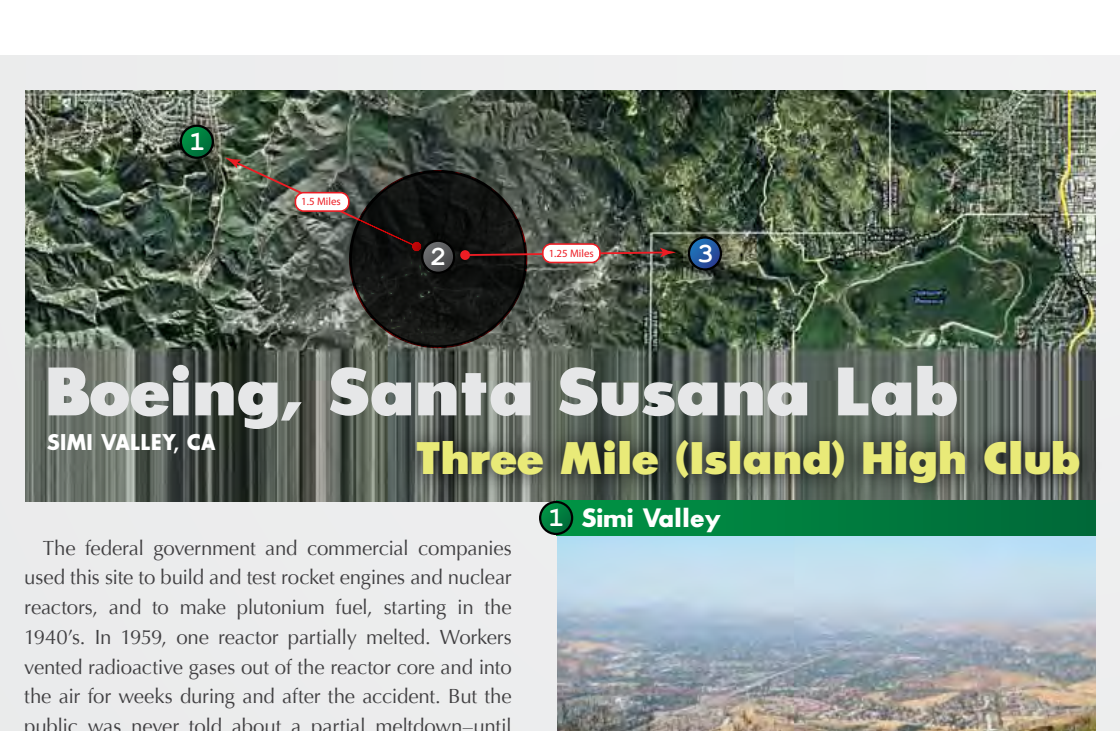
boEIng1, SAnTA SUSA- nA LAb oVERVIEW 3 2
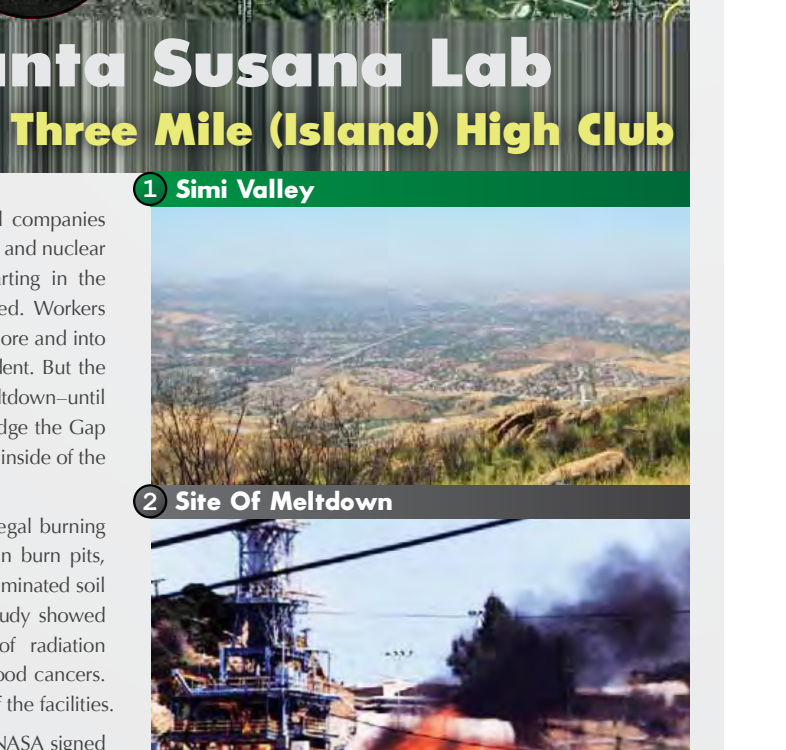
Boeing, Santa Susana Lab
SIMI VALLEY, CA Three Mile (Island) High Club Simi Valley
1
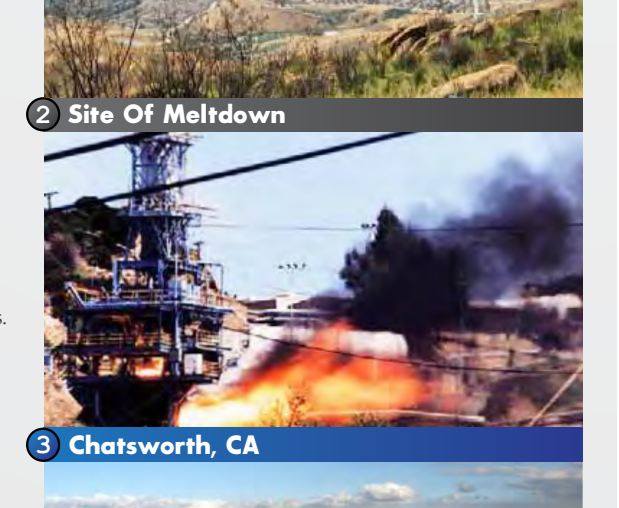
Site Of Meltdown
2
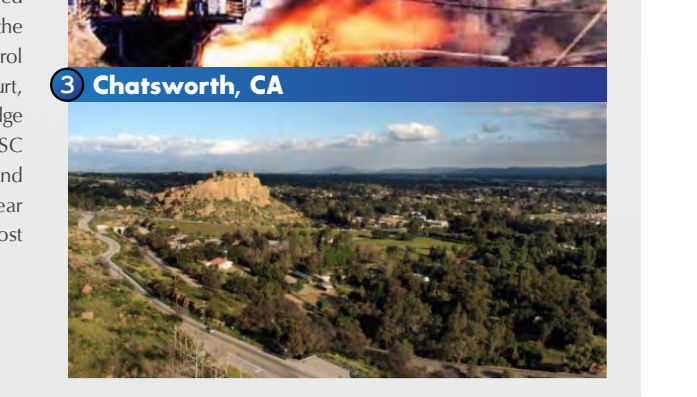
(DTSC). But Boeing has fought the cleanup in court, Chatsworth, CA
3

RECoMMEnDATIonS
Based on our extensive research, interviews, and analysis, Consumer Watchdog makes the following recommendations to the DTSC, the governor’s office, and the State Legislature: Financial Oversight and Reform:
- Have the Auditor General or State Controller perform a complete and independent audit of DTSC.
- Add serial environmental violators to the debarred contracts list for state and federal funds and contracts. Deny favorable tax treatment for any fines and penalties.
- Specify DTSC Enforcement as a budgetary program and tie specific dollars and funds to it in the annual budget act.
- Require DTSC quarterly performance reporting to the Legislature as a condition of expenditure (or liquidation) of any appropriated funds.
- Restructure system of financial assurances and billing of responsible parties so that front and back-end financial assurances are both in place and realistic, and cleanup costs are properly assessed, billed, and collected.
- Remove DTSC and Department of Justice discretion on penalties. In statute, set “mandatory minimum penalties” and prescribe the fund/ account into which those penalties must be deposited. Grow fines in specific steps if companies do not comply with consent agreements/ orders on schedule.
R
- Elevate the DTSC’s Office of Criminal Investigations (OCI) into a core e program with more investigators, scientists and support staff.
C O
- Enable peace officers to serve at CAL EPA and move OCI to CAL EPA.
M Endow OCI with the right to request and receive mandatory help from other agencies so it can lead in coordinating cases involving multiple M media of soil, water, air.
e
- Create independent office of Environmental Inspector General with noversight capabilities that reports to legislature.
D Permitting: a T
- Set explicit timeframes with default action (approval or disapproval) in statutes for permits, applications, renewals, revocations, etc. Pass O legislation to forfeit a portion of DTSC federal funding if the DTSC fails n to act.
s
- Issue no new permits or expanded permits if companies have not completed previously required corrective actions.
- Refuse to issue, renew or modify any permit if applicant is identified as a “significant non-complier.”
- Post all permits, applications, renewals, revocations etc. at the facility, in the community, in the California Regulatory Notice Register and online.
- End the practice of signing repeated consent agreements/orders out of court. Shift to a three strikes and you are out policy.
- Pass legislation to specifically direct DTSC to regulate and include in the permit process suspended and deposited airborne waste constituents.
- Require metal shredders and lead battery recyclers to get full DTSC permits or close their operations with a hard deadline.
Transparency
- Include community members in the process of negotiating consent decrees. Gather their views on appropriate action, publicly defend any compromises and invite public comment before they are incorporated.
R Add citizen suit authority tied to parameters associated with specific issues and standards to be determined.
e C
- Develop a media strategy that amplifies findings and enforcement O actions to deter other bad actors, including signage in front of facilities M that are identified as polluters.
M
- Ban making “underground” regulations away from public scrutiny.
e
- Revamp the DTSC website to make access to public information about companies simple and in real time, without requiring travel to distant n D offices to examine documents or hunt through multiple databases.
a
- Create a comprehensive California EPA database that lists companies T with links to all corrective and enforcement actions taken by all oversight agencies against a company. Direct the California Office of Technology O Services to do this.
n
- At DTSC, create a Hazardous Waste facility website that lists the status s of all hazardous waste facility applications AND lists all DTSC Class I violations issued in past 10 years and whether the violations have been satisfactorily corrected. Link to inspection reports, draft orders, final orders, and other agencies’ enforcement data.
- Highlight “significant non-compliers” on the DTSC website, defined as a facility or company that has had three separate DTSC Class 1 violations noticed by the DTSC in the past decade and/or has substantially deviated from the terms of a DTSC permit, order, settlement document, corrective action or decree by not meeting the requirements in a timely manner, or by failing to perform the work as required by the DTSC.
- Link any and all other enforcement orders, consent agreements, and public correspondence between other regulators and the company to the company’s page on the DTSC website. Pass this information to appropriate government agencies so that other discretionary government actions can be reviewed or revoked for bad actors.
Conclusion: The DTSC houses some top scientific and investigative talent, and it employs many individuals dedicated to public service. These people care deeply about the department’s mission. They are interested in pushing the agency forward to regulate more thoroughly and effectively and to cooperate closely with counterparts at other agencies to protect R Californians from toxic harm. Based on this investigation, the DTSC is not living up to its central mission. In order to do this, the department must be overhauled. DTSC Director e Debbie Raphael needs to replace top managers, enforce existing laws, direct staff to apply C maximum fines and penalties, and exercise the department’s existing authority to deny O or revoke the permits of serial violators of environmental laws. The Office of Criminal M Investigations should become a core program. Californians are beginning to make the connection between illness and toxic chemicals. The DTSC exists to protect them. And if M it chooses not to, it risks becoming obsolete.
e n D a T O n s

EnD noTES81316
e21 n D n25 O T e s333538