Report Findings
- Uber has committed $10 billion to purchasing robotaxis, according to recent reporting (opens in new tab) from the Financial Times, as it has socked away $12 billion via a complex, dark money insurance structure that allows it to hoard billions in self-funded insurance reserves. The company’s goal appears to be to strictly limit its own liability for car crashes, via tort reform efforts nationwide, so that it can use the reserves to finance a dangerous robocar future, instead of paying people hurt or killed by its drivers and operations.
- While Uber claims its insurance premiums are excessive, the company self-funds nearly 95% of its risk, according to public documents. Toward that end, Uber executives formed a captive insurer in Hawaii— Aleka Insurance Inc. Aleka is run by Uber executives, and is a wholly-owned Uber subsidiary exclusively handling Uber’s self-insurance. Uber has accumulated $12.46 billion in insurance reserves in 2025, a 27% increase from the $9.8 billion in reserves in 2024, and nearly doubling its $6.7 billion reserves in 2023. By internalizing nearly 95% of its insurance risk, Uber maintains control over premium flows generated from rides, rather than relying on traditional third-party insurers. Since the money is reserved for claims payout, it is not taxed as profits would be.
- The company’s insurance reserves grew nearly twice as much as trips made by drivers between 2023 and 2025, according to Uber’s own financial statements, indicating that Uber may be over-reserving. More evidence of over-reserving is the fact that commercial insurance, as well as insurance for taxis, is charged at about 6 cents per mile, according to a review by Consumer Watchdog. A healthy auto insurance company in California keeps 100-120% of premiums as a reserve. By our estimation that means Uber should be holding between $4.5 and $5.5 billion in reserves, not $12.46 billion. Demonstrating how the company considers its insurance reserves fungible, Uber transferred about $4.1 billion from its insurance reserves to cash on its balance sheet, according to its financial disclosures, during 2024 and 2025. (2025 annual report, pg. 122; 2024 annual report, pg. 128)
- Aleka Insurance’s entire board and executive committee are or have been executives at the parent company Uber. Since Aleka is a privately-held, wholly owned subsidiary, Uber is under no obligation to disclose any information on the company’s finances and can instead fold Aleka’s financials into their own—allowing Uber executives to obfuscate what would otherwise be public information.
- Uber’s legislative and ballot measure efforts, such as lowering mandated insurance coverage requirements in California and restricting legal recovery in states across America, will decrease the amount paid out to victims, allowing excess reserves to accumulate. These retained funds can be redirected toward Uber’s $10 billion robotaxi expansion and be accounted for as costs in the year they are spent, rather than profits in the year the dollars were made—creating a tax shelter for the company. That cash could be taxed in a year when Uber made a big investment and would have less profit to tax.
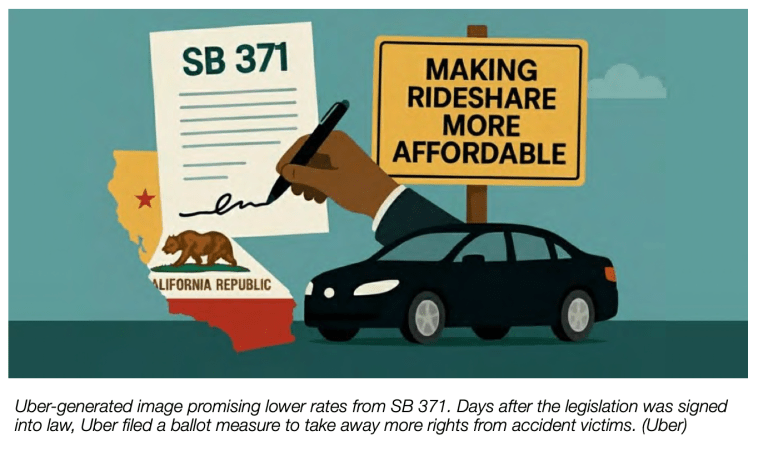
- Uber’s top public policy executive misrepresented the company’s insurance structure to the California legislature in 2025 when securing a reduction in uninsured motorists coverage through SB 371. “In LA County, 45% of every fare is a straight pass-through to government-mandated insurance,” Ramona Prieto, Uber’s head of public policy, told the Assembly Standing Committee on Communications and Conveyance (opens in new tab) on July 16, 2025. In fact, the company was paying itself for insurance and at a rate that it set and allowed its reserves to grow by nearly 100% from 2023 to 2025. In other words, Uber appears to be overcharging itself for insurance premiums that it claimed was bleeding its riders dry in order to secure a reprieve from a state legislative mandate.
- Unbeknownst to the California legislature, Uber made its executives’ compensation contingent on passing SB 371 and other “insurance reform” efforts. SB 371 was specifically named in its proxy, (opens in new tab) as was insurance reform advocacy. Insurance reform was a specific performance goal for Jill Hazelbaker, Uber’s Chief Marketing Officer and SVP, Public Affairs; Chief Legal Officer Tony West; President and COO Andrew Macdonald and CFO Prashanth Mahendra-Rajah. The bonus payment added roughly $516,000 to Hazelbaker’s pay. Uber promoted Hazelbaker on May 11th to President and Chief Corporate Affairs Officer. The promotion came with a $5,000,000 equity grant — $3,750,000 in Restricted Stock Units plus a $1,250,000 stock option award, per Uber’s 8-K filing (opens in new tab). Ramona Prieto has a “shadow” executive bonus strategy not disclosed to shareholders. Her fiancé Juan Rodriguez is a principal in the campaign consulting firm Bearstar and the media buying firm Polaris, which were paid a total of $9.2 million, thus far, in 2026 for consulting and advertising related to Uber’s ballot measure to limit liability for accident victims.
- Uber’s investment in a 2026 California ballot measure restricting victims’ medical recovery and access to contingency fee attorneys will allow it to free itself from liability and open up its “piggy bank” of insurance reserves for investing in its rollout of robotaxis. Those robotaxis, freed from full liability for injuries or death, could give Uber a “license to kill.”
- Uber’s record with robotaxis is disastrous, as outlined in Consumer Watchdog’s previous report “ License To Kill: How Uber’s Rush To Close the Courthouse Doors and Roll Out Robocars Threatens Public Safety. (opens in new tab) ” Uber’s robocar rollout in Arizona was the first and only known instance of a robocar killing a human being. Uber has failed to test its robocars to the degree that Waymo has, and its cars are more cheaply made with fewer sensors. There can be no more dangerous a situation than giving a company whose philosophy is “move fast and break things” the keys to $10 billion worth of robocars with little liability or legal accountability for the injuries they cause.
That cash could be taxed in a year when Uber made a big investment and would have less profit to tax.
Uber Appears To be Over-Reserving And Has Transferred Insurance Reserves To Cash
Uber’s push to reduce insurance liability and legal access in California and nationwide comes as it has been quietly growing $12.46 billion in self-funded insurance money, according to financial documents and regulatory filings obtained by Consumer Watchdog. This creates an opportunity to allow the company to unlock capital and finance its big robotaxi expansion if its liability is reduced by various public policy changes it is promoting across the nation and in California.
Uber’s insurance reserves have grown by 27% from 2024 to 2025, from $9.8 billion to $12.46 billion, and nearly doubling its $6.7 billion reserves in 2023, according to its 2023 annual report (opens in new tab). (Pg. 74)
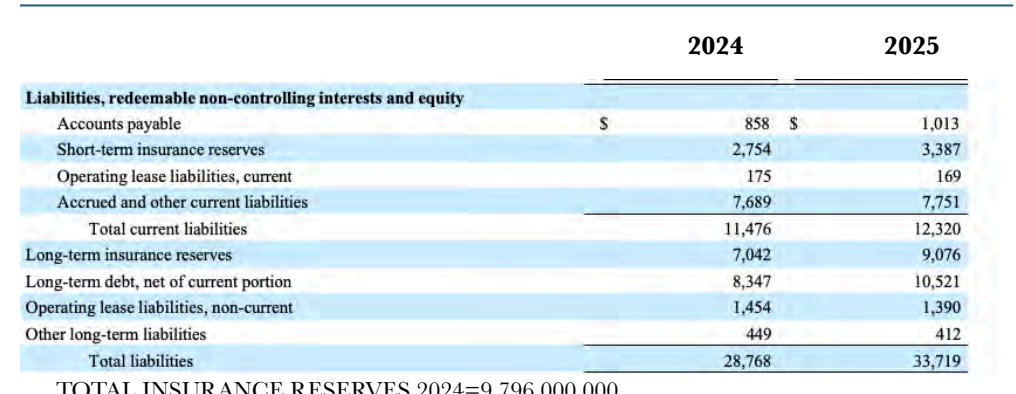
2024 2025 TOTAL INSURANCE RESERVES 2024=9,796,000,000 TOTAL INSURANCE RESERVES 2025=12,463,000,000 (Up 27%.) ( Annual Report (opens in new tab) P. 73) The accumulation of a significant insurance reserve creates tax advantages for the company. The principal in the insurance reserve is not taxed as profit because it is set aside as a liability. (IRC 846: 26 U.S.C.A. § 846, I.R.C. § 846) If the company can reduce its liability through new public policy initiatives such as its California ballot measure, and convert the funds into unrestricted cash, it would free up significant capital to invest in its robotaxi rollout. Moreover, that cash could be taxed in a year when Uber made a big investment and would have less profit to tax.
Showing how Uber’s reserves can operate like a slush fund, Uber has already transferred about $4.1 billion of its reserves to cash, according to financial disclosures, during 2024 and 2025. (2025 annual report, pg. 122; 2024 annual report, pg. 128) It’s unclear from Uber’s financial statements what that cash was used for.
The accumulation of a significant insurance reserve creates tax advantages for the company. The principal in the insurance reserve is not taxed as profit because it is set aside as a liability. ( IRC 846: 26 U.S.C.A. § 846, I.R.C. § 846) If the company can reduce its liability through new public policy initiatives such as its California ballot measure, and convert the funds into unrestricted cash, it would free up significant capital to invest in its robotaxi rollout. Moreover, that cash could be taxed in a year when Uber made a big investment and would have less profit to tax. Showing how Uber’s reserves can operate like a slush fund, Uber has already transferred about $4.1 billion of its reserves to cash, according to financial disclosures, during 2024 and 2025. (2025 annual report, pg. 122; 2024 annual report, pg. 128) It’s unclear from Uber’s financial statements what that cash was used for.
The company’s insurance reserves also grew nearly twice as much as trips made by drivers between 2023 and 2025, indicating that Uber may be over-reserving.
Uber’s Insurance Reserves Grew Nearly Twice As Much As Trips between 2023-25* *Trip totals are on page 2 on each of Uber’s 2023 quarterly reports: 20232025Growth Trips9.45 billion13.57 billion+ 44 % Insurance reserves$6.7 billion$12.5 billion+ 81 % https://investor.uber.com/financials/default.aspx (opens in new tab) | Q1 (opens in new tab) Q2 (opens in new tab) Q3 (opens in new tab) Q4 (opens in new tab) Another potential measure of over-reserving is the cost per mile for insurance. Commercial auto insurance is priced at about 6 cents per mile in California, according to estimates by Consumer Watchdog, and taxi insurance is priced similarly. Uber does not publish miles driven but an estimation can be made based on the number of trips and the average miles per trip. An estimate of Uber’s appropriate reserve level by Consumer Watchdog is between $4.5 billion and $5.4 billion.
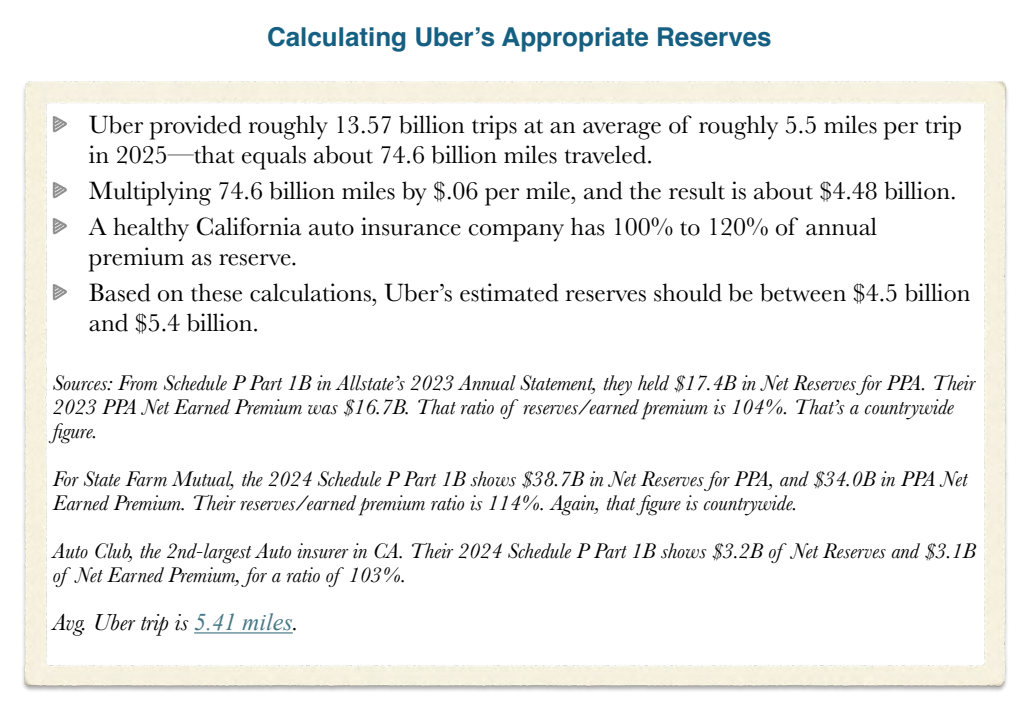
Calculating Uber’s Appropriate Reserves Uber provided roughly 13.57 billion trips at an average of roughly 5.5 miles per trip in 2025—that equals about 74.6 billion miles traveled.
Multiplying 74.6 billion miles by $.06 per mile, and the result is about $4.48 billion. A healthy California auto insurance company has 100% to 120% of annual premium as reserve.
Based on these calculations, Uber’s estimated reserves should be between $4.5 billion and $5.4 billion.
Avg. Uber trip is 5.41 miles (opens in new tab).
| 2023 | 2025 | Growth | |
|---|---|---|---|
| Trips | 9.45 billion | 13.57 billion | + 44 % |
| Insurance reserves | $6.7 billion | $12.5 billion | + 81 % |
In its annual report, Uber states its need for financing its robotaxis. “If we fail to offer autonomous vehicle technologies on our platform at competitive scale or fail to offer such technologies or scale on our platform before our competitors, or if such technologies fail to perform as expected, are inferior to those offered by our competitors, or are perceived as less safe than those offered by competitors or non-autonomous vehicles, our financial performance and prospects would be adversely impacted.”
“In particular, we may need to incur additional debt to finance the purchase of autonomous vehicles or infrastructure to support autonomous vehicles, and such financing may not be available to us on attractive terms or at all.” (P. 30) “In July 2025, we agreed to purchase, or have our designated fleet operators purchase, a minimum of 20,000 Lucid vehicles equipped with Nuro’s Level 4 autonomous driving systems over a six-year period following the start of production, which is targeted for 2026.” (P. 63) Through equity stakes and partnerships, Uber is investing roughly $10 billion in robotaxis, according to the Financial Times. It has committed $300 million (opens in new tab) to purchase 20,000 Lucid-Gravity AVs over a 6-year period, and $250 million into robocar company Waabi for 25,000 robocars. (opens in new tab) Uber also said it will invest over $1 billion in Rivian to deploy its robotaxis beginning in 2028 (opens in new tab).
Overall, Uber has partnered with over 20 car companies and self-driving companies and wants to offer rides in 15 cities by the end of 2026, including San Francisco and Los Angeles. By the end of the decade, it wants to be the main facilitator of rides.
Uber’s Hidden War Chest
Uber doesn’t just carry traditional insurance like many corporate entities. It carries automobile insurance in order to meet state requirements, but only about 5% of its insurance obligations are held by third-parties like AIG, according to the company’s 2025 filings (opens in new tab) with the Securities & Exchange Commission. “$264 million and $473 million of the insurance reserve is covered by third-party insurance,” according to an Uber 10-K filing (opens in new tab). (P.122) And according to documents obtained by Consumer Watchdog, Uber executives formed what is called a captive insurance company—Aleka Insurance Inc.—which appears to hold about 95% of the risk. Incorporating in Hawaii allows Uber to assert more control and work within a more pro-corporate tax structure. It raises questions about corporate transparency and the motivations hiding behind the company’s moves at tort reform.
How the Scheme Works
Start with something Uber will never say out loud: It’s really an insurance company, but one that only serves itself.
Uber’s captive insurance structure allows Uber to do this by not paying premiums to an outside carrier.
Every ride generates insurance premiums baked into the fare. Instead of those premiums flowing primarily to outside insurers, they accumulate inside Uber’s captive structure. Because Aleka holds the majority of the risk, Uber retains control over a growing pool of capital, money that is supposed to be reserved for future claims but does not immediately leave the company’s financial orbit.
Erwin Chemerinsky, dean and professor of law at the UC Berkeley School of Law, wrote (opens in new tab): “Uber has submitted a ballot initiative that would help the company at the expense of the rest of us… Automobile accident victims are the losers if they can’t get to court; the winners are businesses like Uber and insurance companies that will be able to avoid liability more often despite being at fault… Without legal representation, accident victims would more often receive little or no recovery. Uber’s interest, of course, is not really about helping automobile accident victims—no one should think that for an instant. Quite the contrary, Uber wants to make it harder for those injured in its vehicles to have their day in court and recover.”
Pulitzer Prize-winning Los Angeles Times business columnist Mike Hiltzik (opens in new tab): “Uber is trying to snow voters with a supposedly pro-consumer ballot measure. Don’t buy it… Capping contingency fees makes many lawsuits uneconomical for attorneys, who must shoulder litigation costs such as expert testimony until a final judgment is achieved, and are left holding the bag if there is no recovery or the judgment doesn’t cover their costs. So this initiative, if passed, almost inevitably would reduce the tide of lawsuits filed against Uber. Indeed, what gives this effort the stench of cynicism and hypocrisy is that we have plenty of experience about what happens when contingency fees are capped: Plaintiffs who have suffered grievous injury (or if they’ve died, their survivors) have trouble even getting through the courtroom door.”
The irony is that while Uber claims it was driven to the ballot
Uber’s stock
One of the reasons cited for Uber’s push to limit liability is its failure to do appropriate and comprehensive background checks of its drivers. This has led to deaths and injuries caused by drivers with DUIs and other safety issues getting Uber status. In addition, the tens of thousands of sexual assaults reported in Ubers stems from a failure of Uber to do adequate background checks. In its annual report, Uber cites the impact of having to do more expensive and better background checks on its operations: “If we are unable to attract or maintain a sufficient number of Drivers, consumers, merchants, Shippers, and Carriers, whether as a result of competition or other factors, our platform will become less appealing to platform users, and our financial results would be adversely impacted.” (P. 10) “In addition, changes in Driver qualification and background-check requirements may increase our costs and reduce our ability to onboard additional Drivers to our platform.” (Emphasis added, P.15) “Legislators and regulators may pass laws or adopt regulations in the future requiring Drivers to undergo a materially different type of qualification, screening, or background check process, or that limit our ability to access information used in the background check process in an efficient manner, which could be costly and time-consuming. Required changes in the qualification, screening, and background check process (including any changes to such processes of Careem, Postmates or other acquired companies) could also reduce the number of Drivers in those markets or extend the time required to recruit new Drivers to our platform, which would adversely impact our business and growth….. The failure of this provider to provide background checks on a timely basis would result in our inability to onboard new Drivers or retain existing Drivers undergoing periodic background checks that are required to continue using our platform.” (P.15) In other words, Uber’s resistance to better background checks is based on cost and its ability to field enough drivers. Its push for limited liability will allow it to continue its failed background check system as it transitions to a robotaxi future that could be even more dangerous for consumers.
However, Uber’s California ballot measure has prompted a countermeasure requiring strict background checks for Uber drivers and Uber’s strict liability for sexual assaults that occur in Ubers. Both ballot measures appear likely to qualify for the November 2026 ballot. In addition, Uber’s epidemic of sexual assaults has been the subject of multiple New York Times investigative articles, highlighting the counter measure for the public and shareholders. Not surprisingly, Uber’s stock price has fallen by more than 25% since the filing of its ballot measure in October. Meanwhile, Uber’s CEO Dara Khosrowshahi was compensated nearly $36 million in 2025.
Uber Misled California Legislature And Unions
During the 2025 California legislative session, Uber leveraged its political power for a change in the uninsured motorist coverage it must buy under state law. Now, if you are a Californian hit by an uninsured motorist while in an Uber, Uber no longer has to have coverage for $1 million in damages, but $60,000 per person and $300,000 per accident. For seriously injured consumers that’s a big problem.
Uber argued that the change would cut its insurance cost.
“In LA County, 45% of every fare is a straight pass-through to government-mandated insurance,” said Ramona Prieto, Uber’s head of public policy. “Let’s use a trip to LAX and let’s use a round number. It’s $100 and you or I individually are deciding if we can afford to do that. $45 of that $100 today goes to government mandated insurance,” Prieto told the Assembly Standing Committee on Insurance (opens in new tab). What Uber didn’t tell the legislature is that Uber wasn’t paying for about 95% of its insurance. Uber was paying itself and over-reserving.
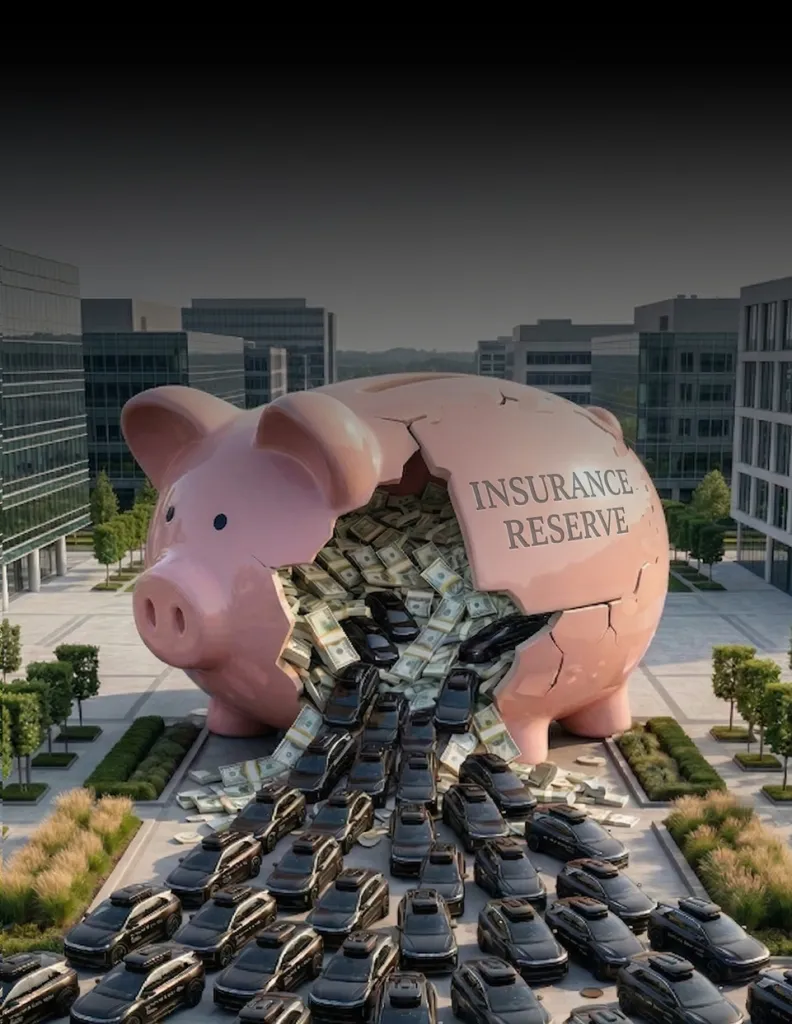
Uber’s 2025 revenue was $52 billion, up from 2024, according to financial disclosures. Its $12.5 billion self-funded insurance reserve, which nearly doubled from 2023, appears to be a giant “piggy bank.”
Uber may well have reason to want to over-reserve, given its safety history, but the fact is by setting its own reserve amount it is setting the price of its own insurance premiums. The vast majority of those premiums are set by Aleka.
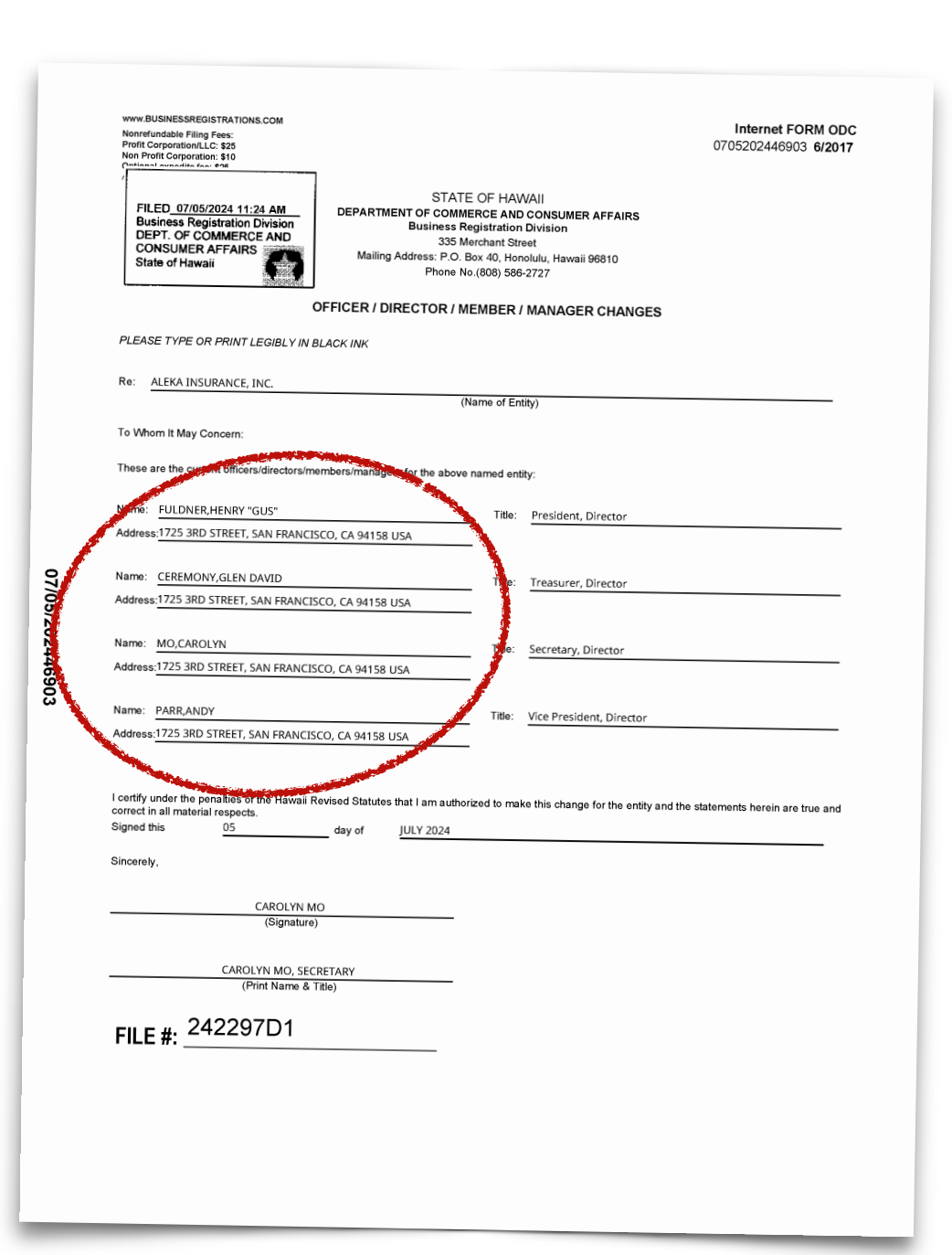
Filings from Hawaii show Aleka Insurance’s board has five directors, all of whom are current or former Uber executives. Carolyn Mo is Uber’s Senior Director and Assistant Corporate Secretary since February 2014. Glen David Ceremony is Uber’s Vice President, Chief Accounting Officer and Global Corporate Controller. Andy Parr is Uber’s Vice President of Insurance. Henry Gus Fuldner left Uber on March 10, 2026 to be Global Head of Operations for Airbnb. He was Senior VP of Core Services and had been with Uber since headquarters in Honolulu, Hawaii.
To get the Sacramento change done in record time, Uber also offered the carrot of allowing its drivers to unionize as a way of inducing union-backed Democrats into rushing through SB 371 within the last weeks of session. The companion bill, AB 1340, allowing ride share employees to unionize, moved through the legislature, as soon as the deal on SB 371 was done. SEIU, the union behind AB 1340, supported the lobbying effort, which is why SB 371 didn’t have a single “no” vote.
Days after Governor Newsom signed SB 371 into law, Uber filed its ballot to limit accident victims’ rights to medical recovery and contingency fee attorneys. A few weeks later, Uber announced a deal to bring 20,000 robot taxis to dozens of markets all over the world over the next six years, which would displace drivers and the need to unionize them.
Unbeknownst to the legislature, Uber aligned its 2025 pay to bonuses for executives who helped pass SB 371 and other “insurance reform” advocacy efforts in other states, according to SEC disclosures (opens in new tab) in March 2026. Insurance reform was a specific performance goal for Jill Hazelbaker, Uber’s Chief Marketing Officer and SVP, Public Affairs; Chief Legal Officer Tony West; President and COO Andrew Macdonald and CFO Prashanth Mahendra-Rajah.
Hazelbaker’s listed 2025 individual goals include “Progress on insurance reform strategy. Generated hundreds of millions of dollars in annualized savings… including the passage of SB 371 in California… and through tort reform efforts at the state-level to combat legal system abuse, including the passage of two bills in Georgia.”
The bonus payment added roughly $516,000 to Hazelbaker’s pay. Uber promoted Hazelbaker on May 11th to President and Chief Corporate Affairs Officer. The promotion came with a $5,000,000 equity grant—$3,750,000 in Restricted Stock Units plus a $1,250,000 stock option award, per Uber’s 8-K filing (opens in new tab). Ramona Prieto has a shadow executive bonus strategy not disclosed to shareholders. Her fiancé Juan Rodriguez is a principal in the campaign consulting firm Bearstar and the media buying firm Polaris. In 2026, Uber paid (opens in new tab) Bearstar $508,818 and Polaris (opens in new tab) $8,691,114 for consulting and advertising related to Uber’s ballot measure to limit liability for accident victims.
If the initiative goes to the ballot, Prieto’s household will likely make tens of millions from a percentage of the advertising buys and consulting fees. Consumer Watchdog wrote (opens in new tab) Uber’s board of directors to argue that such incentives need to be disclosed to shareholders, but it has not responded.
Prieto and other Uber executives misrepresented its insurance payment system to the California legislature. If the legislature knew Uber self-funded its insurance, and the savings from limiting coverage for uninsured motorists would accrue in its own bank accounts for a potential investment in robocars, would SB 371 have passed? Uber’s corporate strategy is clear: limit liability, over-reserve, and re-invest the savings in robocars. Meanwhile innocent accident victims are being asked to give up their rights to recover for their injuries in all auto accidents so Uber and its executives can profit from its cynical strategy.
What’s at Stake
What’s at stake isn’t really about insurance. It’s about what happens after a motor vehicle crash.
Right now, if an Uber driver, or eventually one of its robotaxis, hits and injures someone, there is at least a system in place that is aimed to force accountability. People can sue. They can recover medical costs. They can hire a lawyer and try to prove what went wrong.
But Uber is trying to change that. Across California and a growing list of states, the company is backing laws and sponsoring ballot measures that would narrow what victims can recover and, in some cases, how they can even bring a case at all. The reality is people do get hurt. Passengers, pedestrians, other drivers. As we laid out in a recent report, (opens in new tab) many Uber cases involve drivers who had prior criminal or traffic records but were still approved to drive on the platform.
The impact of Uber’s California ballot measure on people injured in a motor vehicle accident is profound: Medical Cost Caps Limit Access To Care: The California proposal would also cap recoverable medical expenses at levels tied closely to Medicare reimbursement rates. These limits could prevent accidents victims from getting care and healthcare providers from treating crash victims because the capped reimbursements would not cover the actual cost of care.
Proposed CA Law Would Block Seriously Injured Victims From Finding Lawyers: Under Uber’s proposed California law, seriously injured accident victims would not be able to get contingency lawyers because the proposal makes it economically unviable for an attorney to take a case on a contingency basis. The proposal requires that, for the purposes of an attorney fees contract, medical expenses and contingency fees come out of the same 25% pot that attorneys would receive. If, for example, medical expenses total more than $250,000 on a $1 million accident policy, the attorney would receive nothing.
Product Liability Cases Would Be Eviscerated: The initiative would also apply to product defect claims related to vehicle crashes. This would make it significantly harder to pursue cases involving defective airbags, braking systems, steering failures, battery problems, or faulty software. Such lawsuits have historically played a critical role in forcing manufacturers to improve vehicle safety. Weakening these legal tools would reduce incentives for companies to address dangerous defects, including those in autonomous driving systems.
Liability Limits Will Normalize Robotaxis Before They Are Ready For The Road: Uber has announced plans to deploy up to 20,000 robotaxis in partnership with autonomous vehicle developer Nuro over the next six years. However, its partner Nuro’s testing record in California lags far behind competitors. Nuro could not go 700 miles without a human intervention when Waymo could go nearly 20,000 miles, according to California DMV records. In 2025, Nuro vehicles reportedly logged fewer than 160,000 autonomous miles in California, compared with more than 3 million miles driven by Waymo. The Nuro cars are cheaply made and without the sensor capacity of Waymo’s. Experts interviewed by Consumer Watchdog say little is publicly known about Uber’s testing protocols, safety standards, or vehicle specifications. “There are a lot of unknowns,” said Bryant Walker-Smith, an associate professor in the School of Law and the College of Engineering and Computing at the University of South Carolina, in January. “Uber is running a prototype that it started testing last month. We don’t know what safety standards, if any, Uber is adhering to. We don’t know the specs of the car. We don’t know about their internal testing. We don’t know cost of production.” At recent U.S. Senate hearings, lawmakers also raised concerns about autonomous vehicles being monitored by remote operators overseas, so-called “trans-Atlantic backseat drivers,” who are not covered by existing regulatory frameworks.
Uber’s attempt to strictly limit its liability in crashes, free its insurance reserves to fund its robotaxis, and avoid liability for the safety impact of its robotaxi rollout is a strategy that lurks behind its tort reform proposals in California and multiple states.