
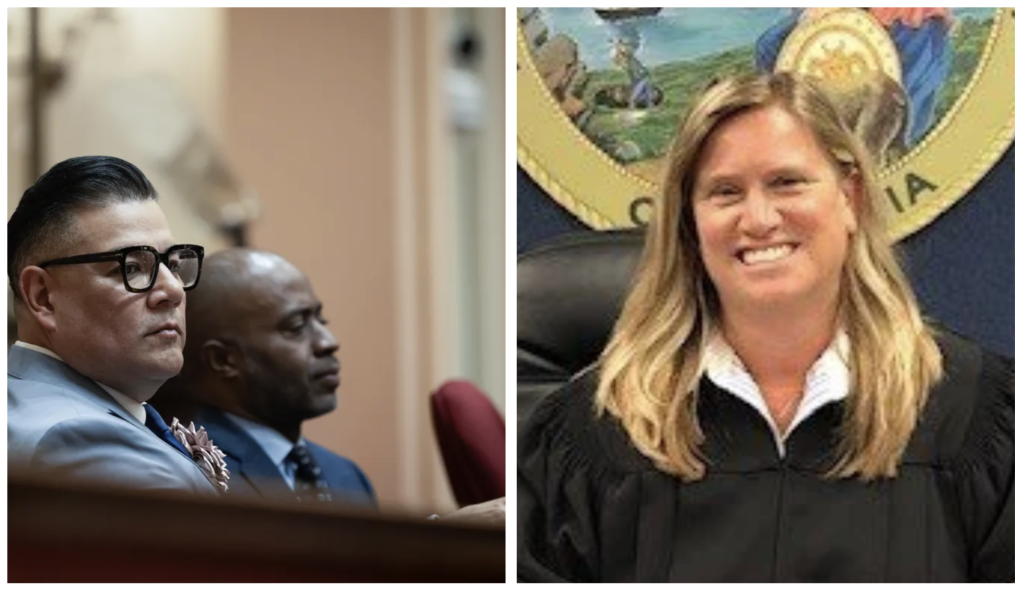
A lawsuit filed on September 18, 2026 by former Chief Administrative Law Judge Kristin Rosi, the California Department of Insurance’s most seasoned Administrative Law Judge with nineteen years of experience, identifies serious misconduct by top Department of Insurance lawyers in interfering with her independent decisions.
Judge Rosi alleges that the highest-ranking officials at the California Department of Insurance (CDI) secretly helped write instructions telling Chief Judge Rosi to change her rulings on rate increase cases pending before her, breached legal fire walls at the Department to meet privately with the agency’s prosecutors while those cases were being decided, and then discussed punishing Judge Rosi when she refused to go along. Judge Rosi was later terminated.
The lawsuit names former Deputy Commissioner/Special Counsel Lucy Wang and mentions other top agency lawyers, including General Counsel Teresa Campbell and Rate Enforcement Bureau Chief Nikki Kennedy, for illegally violating the strict separation of agency functions and trying to usurp the Administrative Hearing Bureau’s (AHB) independent powers.
The AHB is the judicial department of the CDI; it is composed of trained judges. After disgraced Commissioner Quackenbush was caught meddling with ALJs, the legislature passed Ins. Code § 21.5, which maintains the independence of ALJs by forbidding the Commissioner, his deputies or other employees from directing their work. Rosi’s lawsuit alleges violations of that firewall.
The lawsuit also notes that the Chief Judge “submitted complaints to the California State Bar regarding Defendants’ improper actions” and says that she was fired in retaliation. (Complaint, ¶¶81-82.)
Consumer Watchdog has sought to depose Rosi in a separate lawsuit against the Commissioner for his refusal to compensate the organization and Consumer Federation of California for their representation of consumers before the agency. The Department has written, through its lawyers in the Attorney General office, that it seeks to quash the subpoena in the case.
Among the misconduct Rosi alleges in her lawsuit:
• Top CDI staff demanded her “acquiescence to directives from the Commissioner that would have deprived parties appearing before her of due process and jeopardized her continued appointment. Among other things, the Commissioner requested that Plaintiff [Rosi] issue specific orders to conceal Defendants prohibited communications within her pending public proceedings. These actions were intended to undermine the statutory authority vested in Chief Judge Rosi while serving the private interests of individuals inside the Department. By unlawfully exercising supervisory control over Plaintiff, the State acted contrary to the Insurance Code, elevated internal interests over the rights of parties appearing before the Department and sought to compel Plaintiff to violate fundamental principles of due process, judicial canon of ethics and regulatory fairness. When Plaintiff refused to comply, the State retaliated through further improper ex parte communications and later stripped her of her appointment and replaced her with Deputy Commissioner and Special Counsel Wang.” (Complaint ¶2)
• Agency staff were using “procedures that are neither codified by insurance law, nor found in the regulations” to authorize “unprecedented rate increases,” according to Chief Judge Rosi’s lawsuit. That “circumvents the voter-approved statutory language and ignores regulatory requirements, put in place to facilitate the hearing scheme in order to privately facilitate non-reviewable rate increases.” Judge Rosi describes the agency staff’s actions as a “wholesale disregard of the hearing process that constitutes the backbone of the Insurance Code as required by Proposition 103.” (Complaint, ¶¶17-18, 20.) A series of rulings she issued in October 2024 called out the agency for its failure to comply with the law.
• After she issued those decisions, the Department’s Legal Branch and members of the Commissioner’s executive team, including Deputy Commissioner Wang, and Chief Deputy Commissioner Michael Martinez “began meeting to discuss a response to the decisions,” in violation of state laws barring meetings between agency decisionmakers and prosecutors on pending proceedings. (Complaint, ¶¶24-25.) Those undisclosed meetings also violated Consumer Watchdog’s constitutional rights as a party to the cases.
• The agency staff then hatched “an orchestrated endeavor to gut Chief Judge Rosi’s Decisions.” (Complaint, ¶25.) In a series of secret communications to Judge Rosi, the agency staff ordered her to revoke or revise her rulings and other pronouncements, telling her to “get on board” with their demands. These instructions were accompanied by a “thinly veiled threat of discipline” against Chief Judge Rosi and even her removal. (Complaint, ¶28.)
• As required by California law, Chief Judge Rosi notified Consumer Watchdog and the insurance companies of these unlawful communications from the agency. Agency staff then ordered Chief Judge Rosi to withdraw the public notices. In effect, the agency staff was “act[ing] as their own judge, issuing orders in which [the agency] is a party.” (Complaint, ¶34.)
• After Consumer Watchdog emailed Judge Rosi a request for a public hearing on the agency’s improper attempts to control the AHB, Deputy Commissioner Wang “responded to the email addressed to Chief Judge Rosi, indicating the hearing had been” cancelled. “Wang had no legal authority to rule upon matters as an administrative judge in place of Chief Judge Rosi, nor to communicate to other parties as if she had such legal authority,” Judge Rosi’s lawsuit points out. (Complaint, ¶35.)
• Ultimately, Chief Judge Rosi “was suspended after repeatedly refusing to comply with an unlawful directive or otherwise act in violation of governing law and the judicial code of ethics” shortly thereafter. (Complaint, ¶50.)
• Wang then began an extraordinary effort to seize control over AHB’s work. She rewrote Chief Judge Rosi’s rulings to eliminate their criticism of the agency’s failure to obey the law. Wang also began directing the remaining ALJ and staff of the AHB – stating that the AHB was not independent from the rest of the agency. And “she challenged the ALJ’s reasoning in disputed matters in pending cases, notwithstanding a request that she recuse herself for bias, even as she acted on behalf of the sitting Commissioner in those matters.” (Complaint, ¶¶56-58.)
Complaints to State Bar Provide Further Details of Interference
Allegations in four State Bar complaints, presumably lodged by Rosi and obtained anonymously by Consumer Watchdog, reflect that members of the Commissioner’s executive office and/or the Rate Enforcement Bureau chief somehow obtained access to CALJ Rosi’s draft rulings before their issuance, and began meeting to discuss how to respond. They drafted a document instructing Chief Judge Rosi what her ruling should say. Those meetings raise serious legal and ethical issues. The meetings breached the required separation of the agency staff from the executive staff, violated the integrity of AHB, and denied Consumer Watchdog due process: as a consumer representative organization that was a party in the cases, Consumer Watchdog was required to be notified of such meetings.
Background on CDI Structure
In legal matters, the strict separation of agency functions is recognized by law.
- Executive. CDI’s Executive Branch consists of Commissioner Lara, the Chief Deputy Commissioner (Michael Martinez), and other advisors, including the Special Counsel.
- The Special Counsel. The Special Counsel is Lucy Wang. She was appointed by Lara in 2022 and advises the Commissioner and his executive staff. She also appears to direct the work of other Department employees. In the spring of 2026, Wang left CDI to work for the insurance industry’s principal California law firm, Hinshaw & Culbertson.
- General Counsel. The General Counsel is Teresa Campbell. The GC is appointed by, and advises, the Commissioner and his staff.
- Legal Branch. The Legal Branch is CDI’s prosecutorial division. The Rate Enforcement Bureau, which CDI attorney Nikki McKennedy directs, is responsible for enforcement of Proposition 103. It therefore must be kept separate from the Commissioner, his executive staff, and from the judges in the Administrative Hearing Bureau when it is involved in legal matters that are decided by AHB and the Commissioner.
- Administrative Hearing Bureau (AHB). The AHB is the judicial department of the agency; it is composed of trained judges. After disgraced Commissioner Quackenbush was caught meddling with ALJs, the legislature passed Ins. Code § 21.5, which maintains the independence of ALJs by forbidding the Commissioner, his deputies or other employees from directing their work.
Consumer Watchdog · November 11, 2026
https://consumerwatchdog.org/insurance/lawsuit-by-former-chief-administrative-law-judge-alleges-illegal-interference-in-decisions-department-wants-to-quash-testimony-in-consumer-grou/
© 2026 Consumer Watchdog. Printed November 11, 2026.