Rideshare platforms want Washington to reduce their exposure to lawsuits.
By Aaron Short, STREETSBLOG USA
https://usa.streetsblog.org/2026/06/24/uber-and-lyft-want-congress-to-let-them-off-the-hook
Uber and Lyft are lobbying Capitol Hill to include sweeping immunity language in the next federal transportation spending bill — while nearly 1,900 sexual assault survivors are demanding (opens in new tab) that congressional leaders pull it.
The rideshare companies support an amendment to the $580 billion surface transportation reauthorization proposal that would shield them from liability in cases involving car crashes, assaults and sexual harassment.
The legislation would classify (opens in new tab) firms like Uber and Lyft as operators of digital networks instead of common carriers like bus companies, who currently bear responsibility for their drivers’ conduct. The same legislation preempts state-level regulations that would define rideshare companies as carriers.
If the amendment survives, insurance firms would begin holding rideshare drivers personally responsible for passenger injuries, unless a court decides that rideshare companies engaged in criminal activity or deems them “grossly negligent” — a much higher bar (opens in new tab) than current law.
Victims are very skeptical
Survivor advocates said U.S. law should hold rideshare companies responsible for such injuries, since passengers book rides based on their familiarity with the companies. More than 1800 survivors of sexual assault or abuse committed by Uber drivers signed a critical letter addressed to Speaker Mike Johnson (R-Louisiana) and House Minority Leader Hakeem Jeffries (D-Brooklyn).
“No court case can take away the pain and trauma we have endured — that will stay with us forever,” their letter read (opens in new tab). “But we are worthy of the right to try and hold these rideshare platforms legally accountable for failing to protect us when they told us to trust them to get home safely.” Neither Johnson nor Jeffries responded to a request for comment.
The proposal has gained steam since Memorial Day, when House Republican Vincent Fong (R-California) added the immunity amendment to the mammoth BUILD 250 Act, which will fund the nation’s roads, bridges and transit infrastructure for the next five years. Fong did not respond to a request for comment.
Fong’s amendment passed (opens in new tab) the House Transportation and Infrastructure Committee, 35-30, in an early morning vote on May 22. Then the House committee signed off on the entire surface reauthorization package of 160 amendments after a 15-hour marathon markup session that ended in a 62-2 vote (opens in new tab).
But on June 10, 128 members of the Democratic Women’s Caucus publicly protested Fong’s amendment. In a letter (opens in new tab) to House Speaker Michael Johnson, the members warned the amendment would “disproportionately harm women and girls” and argued it would diminish the recourse of rideshare passengers harmed by car crashes and other incidents.
“Rideshare companies, who claim to provide a tool that enhances safety and convenience, must take this seriously,” the letter read. “Every person deserves to arrive at their destination safely and to know that there is a meaningful path forward for justice when that does not happen.”
The next step is for the House Rules Committee to take up the surface transportation authorization bill, which includes the Fong amendment. Its vote has not yet been scheduled. On Monday, Senate Environment and Public Works Chair Shelley Moore Capito (R-West Virginia) told Politico (opens in new tab) that she wants voting completed before Sept. 30, when the current surface transportation act expires.
Uber pushes back on the pushback
Lyft did not respond to questions about the bill. But Uber spokesperson Ryan Thorton said the liability amendment was necessary to combat frivolous cases, whose associated costs inflate the price of ridesharing.
“Rideshare companies like Uber are too often sued simply because of their high insurance coverage, even when the company is not alleged to be at fault,” Thorton told Streetsblog. “This is a commonsense reform to help stop these unnecessary and abusive auto accident lawsuits, which drive up rideshare prices for consumers nationwide.”
But survivor advocates and consumer watchdogs point out that rideshare companies are facing increased litigation because the underlying number of legally actionable events, like sexual assault, has risen over the past several years. Between 2017 and 2022, Uber received (opens in new tab) a report of sexual assault or misconduct once every eight minutes.
Joanne Doroshow, executive director of the Center for Justice & Democracy at New York Law School, said the liability provision would effectively prevent passengers from holding rideshare companies accountable for their drivers’ actions.
“Of course they’re at fault,” she said. “It’s their platform. They are the ones connecting drivers to passengers. They bear some responsibility for the conduct of those drivers, who take passengers somewhere in an inherently dangerous instrument — a car.”
Trial lawyers hammered the legislation, too. “Affordable transportation and public safety are not mutually exclusive, and Congress should reject any effort to force Americans to choose between the two,” said Andrew Finkelstein, the president of the New York State Trial Lawyers Association.
Rideshare companies spend millions on political influence
Fong’s amendment constitutes the latest victory in rideshare companies’ organized effort to lower their insurance costs and settlements paid out to survivors. Uber spent (opens in new tab) almost $1 million while Lyft kicked in about $250,000 to lobby Congress on the surface transportation bill, including the liability amendment. Uber’s political action committee also spent (opens in new tab) $14,500 to assist the re-election campaigns of seven members of the House transportation committee.
In New York, a political action committee backed by Uber spent $8 million (opens in new tab) to assist Gov. Hochul’s quest to reduce auto insurance rates. The gambit succeeded: On May 28, Hochul signed a state budget that narrows New York’s definition of a serious injury, caps personal injury compensation at $100,000 (opens in new tab) if the driver is uninsured or committing a felony, and cracks down on staged auto accidents (opens in new tab).
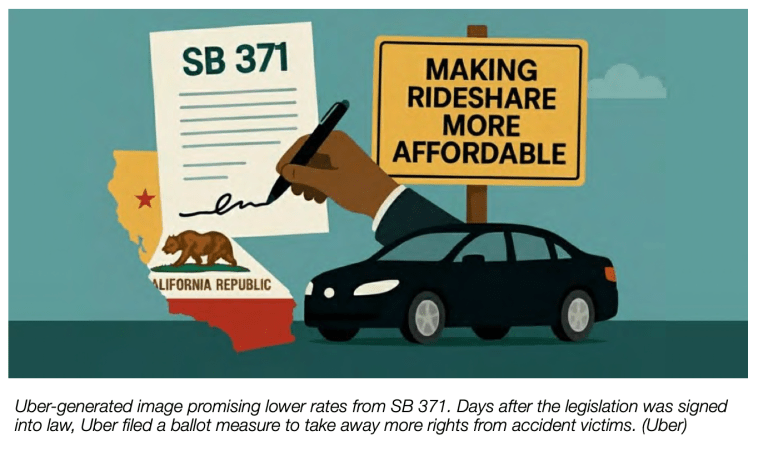
And in California, Uber supported a ballot initiative (opens in new tab) that would cap the fees attorneys can collect in crashes at 25 percent and limit damages for all car crashes in the state, even ones that do not involve a rideshare vehicle, based on 125 percent to 170 percent of Medicare rates. The company spent $42 million (opens in new tab) on ads criticizing personal injury attorneys for taking advantage of crash survivors.
In response, the Consumer Attorneys of California, a trade association of attorneys who represent consumer legal rights, fought for a competing ballot measure (opens in new tab) that would hold rideshare companies liable for drivers’ misconduct, sexual harassment, and assault and impose new standards on background checks and safety reporting.
Supporters of both ballot initiatives submitted enough signatures (opens in new tab) to qualify for the November ballot, the California Secretary of State announced (opens in new tab) on June 17. The next day, however, Uber and CAC struck a deal to pull their initiatives before the June 25 deadline. Uber agreed to improve safety measures while CAC agreed to cap medical claims to 70 percent of the benchmark rate set by a national database called Fair Health, which tracks payments for different medical procedures.
“Both sides agree: Californians deserve a system that’s safe, fair, and accountable,” Uber and CAC said in a joint statement. “This agreement protects patients from unnecessary treatment or getting overcharged, ensures access to medical care and legal representation, and strengthens safety measures.”
Jamie Court, president of Consumer Watchdog, a nonprofit public interest group, believes Uber pushed its California ballot initiative to obtain leverage over CAC and persuade the group to abandon its own ballot initiative.
“I don’t know where this leaves federal legislation,” he said. “Would it be pulled as part of legislative compromise or do we have to fight this out?”