By Jamie Court and Will Pletcher
If President Trump signs Uber-backed legislation to prevent state and federal lawsuits against the company for its drivers’ misconduct, he will likely be creating a big payday for President Obama’s former Associate Attorney General, Uber’s Chief Legal Officer Tony West, who was also a senior advisor and fundraiser for Kamala Harris’s 2024 presidential campaign, and happens to be her brother-in-law.
West’s pay as an Uber executive is explicitly tied to public policy goals such as “combatting legal system abuse through tort reform” and whether he “successfully advocated for reform in the U.S,” according to Uber’s 2026 disclosure to shareholders.
The Uber-backed bill just passed its first House committee and is a long way from Trump’s desk, but it brings into focus the problems of paying executives more for successful public policy results. Would President Trump think twice about signing Uber’s bill if he knew Harris’s family would benefit financially?
Such dangers have prevented the vast majority of publicly traded companies from financially incentivizing their executives for successful public policy changes.
California already recognizes the danger of paying people for legislative outcomes. Government Code section 86205(f) prohibits a lobbyist or lobbying firm from accepting compensation “in any way contingent upon the defeat, enactment, or outcome” of proposed legislative or administrative action. FPPC Regulation 18626 clarifies that contingent compensation includes fees, salaries, bonuses, commissions, or other payments tied “to any degree” to the governmental result.
Uber’s executives may not be lobbyists under that statute. That is not the point. The point is the policy judgment behind the rule. California bans contingency-fee lobbying because personal financial stakes in legislative outcomes distort public lawmaking. They turn the passage of laws into a private bounty system.
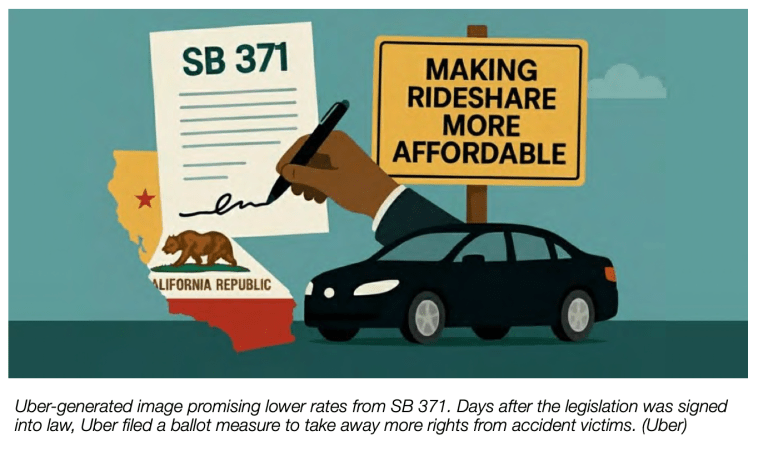
Uber’s 2026 proxy statement ties executive compensation to insurance-reform advocacy, including explicitly SB 371 in California. SB 371 reduced mandatory uninsured and underinsured motorist coverage during rideshare trips from $1 million to $60,000 per person and $300,000 per incident during the period from passenger entry to exit.
To win passage of SB 371, Uber’s top public policy executive misrepresented the company’s insurance structure to the California Legislature in 2025. “In L.A. County, 45% of every fare is a straight pass-through to government-mandated insurance,” Ramona Prieto, Uber’s head of public policy, told the Assembly Standing Committee on Communications and Conveyance on July 16, 2025.
Uber didn’t disclose the fact that the vast majority of its insurance payments are self-funded and it has amassed a huge reserve of $12.5 billion. In fact, the company was paying itself for insurance, at a rate that it set and allowed its reserves to grow by nearly 100% from 2023 to 2025. Uber set up a captive insurance company, Aleka, staffed by Uber employees, to manage its self-funded reserve. Disclosures to the SEC show about 5% of the insurance payments collected go to third party insurers. The information is documented in a new report from Consumer Watchdog.
Uber appears to have overcharged itself for insurance premiums that it claimed was bleeding its riders dry in order to secure a reprieve from a state legislative mandate. Uber is now using the same false argument about insurance costs to pass the federal legislation limiting its liability, which passed its first committee in the early hours on the Friday of Memorial Day weekend.
How much did the financial bonuses for executives play into the incentive to misrepresent the company’s insurance structure?
SB 371 was specifically named in its proxy, as was insurance reform advocacy. Insurance reform was a specific performance goal for Jill Hazelbaker, Uber’s Chief Marketing Officer and SVP, Public Affairs; Chief Legal Officer Tony West; President and COO Andrew Macdonald and CFO Prashanth Mahendra-Rajah. The bonus payment added roughly $516,000 to Hazelbaker’s pay. Uber promoted Hazelbaker on May 11 to president and chief corporate affairs officer. The promotion came with a $5,000,000 equity grant — $3,750,000 in Restricted Stock Units plus a $1,250,000 stock option award, per Uber’s 8-K filing.
Ramona Prieto has a “shadow” executive bonus strategy not disclosed to shareholders. Her fiancé Juan Rodriguez is a principal in the campaign consulting firm Bearstar and the media buying firm Polaris. The companies were paid a total of $9.2 million, thus far, in 2026 for consulting and advertising payments for Uber’s California ballot measure to limit accident victims’ right to medical recovery and contingency fee attorneys.
Uber’s ballot measure would sharply limit medical recovery and contingency fees, preventing most seriously injured accident victims from obtaining legal representation. The irony is that Uber executives would likely receive contingency-based bonuses for dismantling California’s contingency-fee system.
Personal financial incentives skew judgement about what is right and what is wrong, and even whether to pursue proposals based on their viability. Private polling shows the Uber ballot measure doesn’t have 50% support based on a first reading of the measure. If Uber pushes forward with the measure, will it be because the executives will make a killing or because Uber has a real shot at success?
Meanwhile, the 2026 Axios Harris Top 100 Poll of reputational rankings shows Uber’s standing slipping to No. 72, down 14% from last year, and below Exxon and State Farm. Uber’s stock has fallen 30% since its ballot initiative was first filed. Shareholders might soon start to question whether the company’s strategy is paying off for more than its executives.
Jamie Court is the president of the nonprofit group Consumer Watchdog, and Will Pletcher is the group’s litigation director.