The rideshare giant’s ballot proposition could upend the legal industry. Critics call it an “inhumane” attempt at corporate greed.
By Anya Schultz, THE SAN FRANCISCO STANDARD
https://sfstandard.com/2026/05/07/uber-accident-ballot-measure-california
On a Monday afternoon in May 2020, a corporate shuttle bus carrying Genentech employees in South San Francisco changed lanes without warning and crashed into a Toyota Camry.
The woman driving the Camry worked as a janitor. She barely spoke English, and she was six months pregnant. She gave birth to a girl 17 days later. The mother was hospitalized for three weeks; her premature baby spent nearly three months in the NICU. Both survived, but at a cost — their medical bills totaled more than $1.6 million.
The family hired a personal injury attorney — the kind seen on highway billboards — on contingency; they paid nothing upfront but promised him a healthy portion of any settlement they won. The case took four years and garnered $3.4 million: $2.2 million for the family and $1.2 million for the lawyer.
This is the usual course of personal injury claims in California, beginning with lawyers who gamble from case to case, taking nothing if they lose and potentially seeing big paydays if they win. But with its new sponsored ballot measure that would rewrite California’s constitution, Uber is trying to change the legal calculus for all car crash victims and the attorneys who represent them.
The measure backed by the $162 billion rideshare company would cap attorneys’ fees in auto crash cases at 25% and put restrictions on the way medical claims are valued. As a constitutional amendment rather than a statute, it would be much harder to reverse if passed. The strategy mirrors a recent national dark-money push supported by Uber to make it harder for consumers to sue corporations(opens in new tab) (opens in new tab).
Uber has contributed more than $77.5 million as the sole donor to its own California campaign committee.
The campaign’s ads claim the current system is rife with abuse: ambulance-chasing “billboard lawyers” inflating medical bills, pressuring clients into unnecessary surgeries, and taking up to half of what victims win. The measure could protect Uber from liability stemming from car crashes, whether those cars are driven by humans or autonomous tech.
“Californians deserve a system that prioritizes victims over billboard lawyers, and that’s exactly what this measure does,” said campaign spokesperson Nathan Click. “We’re confident voters will agree.”
Opponents of Uber’s measure — plaintiff attorneys and medical professionals — disagree. They say what looks like attorney regulation is actually a sweeping restructuring of legislation that dictates who can access the civil justice system after a crash. Should Uber’s proposal succeed, they say, it would be nearly impossible for a victim like the pregnant woman in the Camry to find a lawyer willing to take her case. Only well-heeled victims with the ability to pay for an attorney out of pocket would get the chance at justice and compensation.
Attorneys are also concerned about reducing the pressure on companies to make their products safer, saying product liability cases often stem from auto crashes — a reading that Uber’s campaign disputes.
“There are some lawyers that aren’t doing things the right way, and they should be held accountable,” said personal injury attorney Rahul Ravipudi, partner at Panish Shea Ravipudi LLP. “But that shouldn’t mean the destruction of the entire justice system.”
The attorneys have mounted their own Uber-targeted proposition that would require stronger rideshare driver background checks, in response to thousands of pending cases alleging sexual assault against the rideshare giant. They are matching Uber’s spending nearly dollar-for-dollar.
With six months until the election, it’s shaping up to be one of the priciest ballot fights in California history — a confusing, multi-disciplinary clash over who bears the cost of car crashes in the state with the most cars on the road.
‘The lawsuit is often the only mechanism’
Uber’s measure(opens in new tab) (opens in new tab), “Limits Automobile Accident Victims’ Recovery of Medical Expenses and Fees Their Attorneys May Receive,” really comes down to contingency fees.
An attorney who takes a case on contingency is betting on a future payday. They pay out of pocket for expert witnesses, depositions, records, and months to years of overhead. In the case of the injured mother in South San Francisco, her attorney took more than 30 depositions, fought more than 30 motions filed by the defense, organized translators, prepared for trial, and negotiated the hospital’s medical claim down to $300,000.
If they win, attorneys working on contingency get to keep the agreed-upon fees. In California, those generally fall between 33% and 40% of a total award but are usually capped at 25% for injured minors.
Plaintiff attorney Deepak Gupta said the arrangement is uniquely American.
“In most wealthy democracies, a person catastrophically injured in a crash can rely on some combination of universal healthcare, robust disability insurance, and wage replacement,” Gupta said. “In the United States, the lawsuit is often the only mechanism available.”
In the current system, medical debt typically comes out of the plaintiff’s share, not the attorney’s. In a case with massive bills, the lawyer can walk away with their contingency fee while their injured client ends up with nothing, or even in debt.
In some cases, as Uber’s campaign points out, personal injury firms pressure clients into unnecessary surgeries to inflate settlement values and increase attorney fees. In an investigation(opens in new tab) (opens in new tab) of alleged predatory practices, the Los Angeles Times found a woman who spent $500,000 on medical fees on the referral of her attorney but received a settlement of only $350,000, leaving her in debt and with ongoing pain.
Uber’s measure would require that victims keep 75% of settlements, capping plaintiff attorney fees at 25%. Defense attorneys could take as much as they and their clients agree on.
The measure would also limit what injured people can recover for medical expenses, placing fee caps and requiring plaintiffs to prove their damages. And it would ban financial arrangements between attorneys and the doctors to whom they refer their clients. Uber says this would leave more of the payout with victims.
Uber says the language mirrors California’s existing medical malpractice fee-cap law and does not dictate who pays medical bills — only how attorney fees are calculated.
Critics(opens in new tab) (opens in new tab) (opens in new tab) (opens in new tab)interpret the measure differently. They say that it creates another problem — the economics of catastrophic injury cases would be infeasible. If medical liens cannot be deducted before calculating the victim’s 75%, they argue, a seriously injured victim could end up with far less. Expecting smaller paydays, attorneys say they would be less inclined to take those cases. Ironically, this could make the most gravely injured the least likely to find a lawyer willing to gamble on their case.
“The goal of this is not an altruistic attempt by Uber to make sure that people who sue Uber get more of the money,” said Gupta. “It’s to prevent people from being able to bring cases in the first place.”
Dr. Topher Stephenson, a Sacramento traumatic brain injury specialist, regularly treats patients on attorney-arranged medical liens, meaning that if the legal case is resolved, the clinic is reimbursed.
“This ballot initiative is just inhumane,” Stephenson said. When his patients cannot access lien-based specialists, he said, they go to emergency rooms, and the cost falls on California taxpayers. When Medi-Cal recipients are injured in crashes, the state is required to recover costs from the eventual settlement. If attorneys decline those cases because they’re economically unviable, there is no settlement to recover from. Medi-Cal pays the price instead.
The state’s legislative analyst estimates(opens in new tab) (opens in new tab) that if Uber’s measure passes, fewer lawsuits will be filed, meaning trial courts could save tens of millions of dollars annually. In turn, according to the analysis, the state’s Medi-Cal costs would likely increase by tens of millions of dollars annually.
‘A very large war chest’
This is not the first time California has seen this fight. Voters rejected nearly identical ballot measures twice, in 1988 and 1996.
Uber tried a version of this in Nevada in 2024. The Nevada Supreme Court threw it out unanimously, calling the ballot language misleading. Rather than abandon the strategy, Uber drafted a tighter version and brought it one state over.
Gupta argued the case that got Nevada’s initiative cut from the ballot. California would be a far bigger prize, and Gupta does not believe it will be the last one Uber tries to win. “Uber has a lot of money to spend on these kinds of fights,” he said. “They have a very large war chest.”
What’s different this time is the moment for the company.
“Uber is so hell-bent on protecting its profits that it is trying to amend the California constitution to give itself a free pass,” said attorney Micha Star Liberty, owner of Oakland-based Liberty Law. “They’re not doing this out of the goodness of their heart.”
Uber faces an avalanche of litigation across the country that is gaining traction. More than 3,300 plaintiffs have sued the company in federal court for sexual assaults they allege against drivers. Two bellwether cases have gone to trial, and both were decided in favor of the victims, one with an $8.5 million verdict.
In response to these cases and to Uber targeting their livelihoods, Consumer Attorneys of California — including the billboard attorneys whom Uber loves to hate — have filed their own ballot measure, “Sexual Assault Against Rideshare Passengers and Drivers Prevention and Accountability Act.” It would mandate more stringent annual background checks, require monthly public reporting of sexual misconduct incidents, and compel rideshare companies to disclose internal driver risk scores to passengers before a ride begins.
The stakes are as high on both sides as the pockets are deep — the billboard lawyers and their allies have raised around $75 million from more than 1,000 contributors for their measure. Together, the two measures have made this one of the most expensive ballot fights of the year. And that doesn’t include potential dark money from larger organizations pushing tort reform across the country.
In a letter to shareholders(opens in new tab) (opens in new tab) filed with the Securities and Exchange Commission in March 2026, Uber’s Compensation Committee disclosed that executive cash bonuses for 2025 were tied in part to “insurance reform advocacy efforts” as a named performance metric.
Uber’s insurance reserves grew from $9.8 billion to $12.5 billion in 2025. If the ballot measure passes and expected claim values fall, Uber would potentially free billions in capital.
Uber did not mention the ballot initiative in its annual report to the SEC. But the filing describes those reserves as subject to “changes in the economic, legal, and social environments.”
Gupta has been watching the company’s legal strategy for long enough to see a pattern.
“Uber from the very beginning has been a company that has always tried to change the legal rules,” he said. “The very genesis of the company was just: break the rules and then force people to change them.”
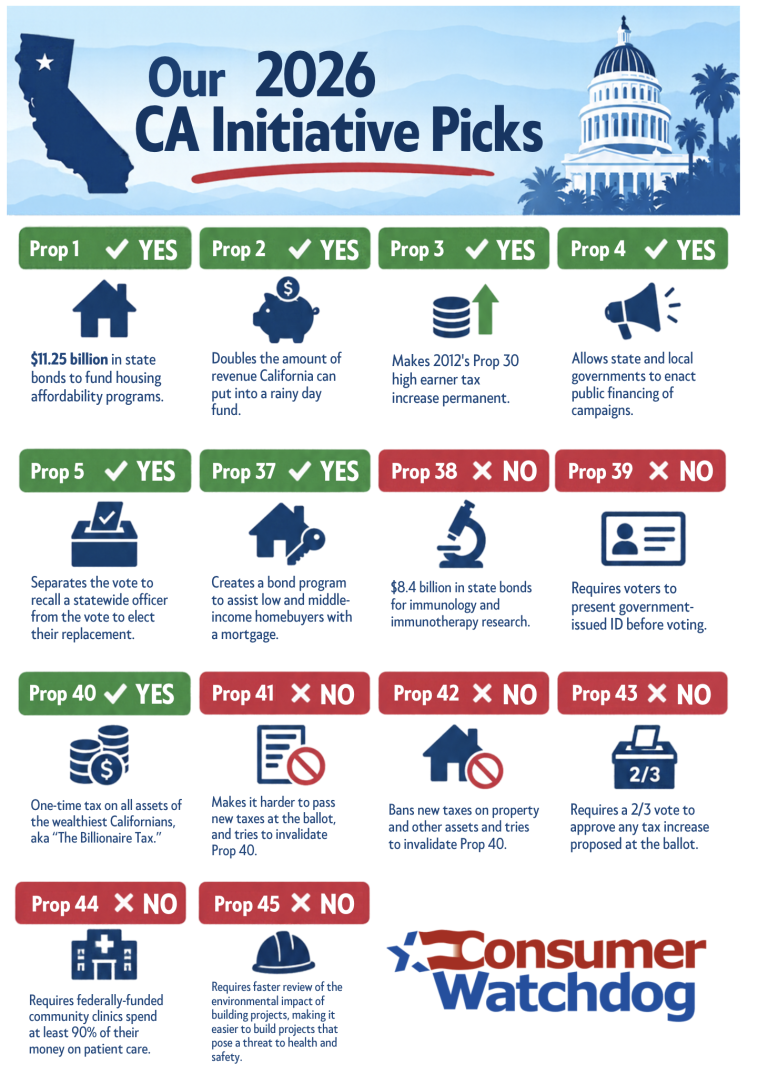
Some critics, including Consumer Watchdog(opens in new tab) (opens in new tab), say a potential longer-term benefit to Uber of its proposed amendment is tied to the apparent strategy to move away from human to autonomous driving(opens in new tab) (opens in new tab), while the company’s version of that technology is reportedly becoming less reliable.
According to data from the California DMV, safety metrics for Nuro, Uber’s autonomous vehicle partner, deteriorated sharply in 2025. Its reliability rate dropped 68%, even as it drove 25% fewer miles. Over the same period, Waymo drove 40% more miles and nearly doubled its reliability.
Uber’s campaign disputes that the ballot measure is aimed at minimizing robotaxi liability. A spokesperson said that the company reviews each autonomous vehicle partner’s safety approach before deployment and that its internal safety program has been recognized as an industry best practice.
“What I want is to keep up pressure on the companies to make this technology safer,” said Matthew Wansley, a professor at Cardozo School of Law and expert on legal issues around autonomous vehicles. “Tort liability serves an important function for society. It gets compensation to victims, and it creates a deterrent. When companies have to pay out settlements or damages, they start to rethink their practices and think: How can we reduce the risk in the future?”
He was unambiguous about Uber’s ballot initiative. “I wouldn’t vote for this, and I don’t think California voters should. I think it will reduce liability across the board.”
Whether voters agree will depend on whose story they find more convincing: the rideshare giant or the billboard lawyer.