By and
https://www.sacbee.com/news/politics-government/capitol-alert/article317008779.html
A California Senate plan that would change how the state handles utility-caused wildfires differs from an earlier proposal put out by Gov. Gavin Newsom, but aligns itself more with one recently put forward by the Assembly.
That now sets up a high-stakes negotiation between the Democratic leaders of both legislative chambers and the governor over an issue of far-reaching importance to Californians: Who pays for people’s losses in the wake of devastating wildfires caused by electrical utility companies. TOP VIDEOS The video player is currently playing an ad.
And yet still, with just days to go in the legislative session, the majority of lawmakers, as well as the public, do not have any draft legislative language to work with, leaving all but the negotiators in the dark about key details of the proposal.
Notably, state Senate leaders appear to be joining the Assembly in rejecting Newsom’s proposal to prevent insurance companies from suing an electrical utility to recoup their losses after paying out massive wildfire claims, according to an outline obtained by The Sacramento Bee.
Insurance companies received money from Pacific Gas and Electric Co. before many survivors of the 2018 Camp Fire that burned through Paradise and the 2017 North Bay fires, which sparked outrage. But insurance industry representatives said banning their ability to recoup money from utilities when their electrical equipment starts fires would destabilize California’s troubled market and lead to higher premiums for coverage, particularly in fire prone areas.
The Senate plan calls for placing some limits on insurance companies, saying they can’t sell their rights to sue utilities after a fire to hedge funds, unless they receive approval by the state’s insurance commissioner.
The Senate proposal, like one from the Assembly, did not include detailed bill language that many lawmakers want to see before determining how they will vote. The Legislature’s last day to pass bills this year is currently Aug. 31.
Legislative leaders and the governor will also have to rectify differences over who can receive money after a utility-caused fire. Newsom’s proposal called for preventing compensation for people who were not present or harmed in a fire’s perimeter and also placing limits on others who feared for their safety.
The Assembly plan calls for rejecting the governor’s cap on certain damages that people can receive. The Senate said it would allow damages to be collected by people outside the immediate wildfire area, but that lawsuits must clear a higher standard of evidence in court to win.
The Senate plan also would place limits on attorneys fees for claims and calls for limiting the ability of lawyers to advertise after a disaster.
‘I’m furious’
Lawmakers have been hit with an outpouring of concern from wildfire survivors and a large swath of organizations representing municipal and county governments, insurance companies and others. Those groups sprang into action in recent weeks, after Newsom indicated he would try to push through a major reform to how the state handles utility-caused wildfires in the remaining moments of his final legislative session as governor.
“We’ve watched the Legislature, both from the Assembly and the Senate, respond to the feedback that all of the advocates here have been providing,” said state Sen. Sasha Renée Pérez, D-Alhambra, whose district includes the community of Altadena which was ravaged by the Eaton Fire in 2025. State and Los Angeles County fire investigators this month concluded Southern California Edison’s equipment started that blaze. Utility representatives have said the company is reviewing the findings.
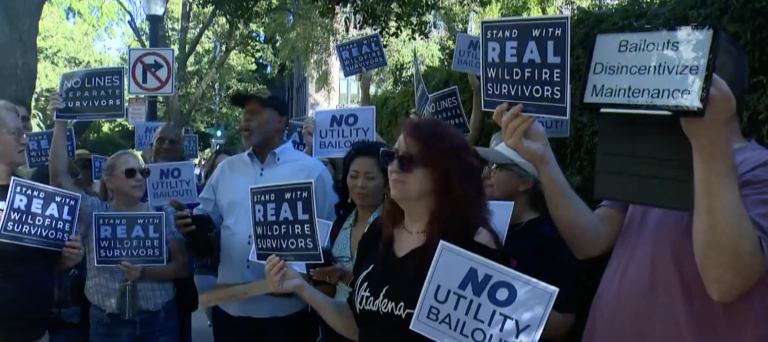
Pérez spoke Tuesday morning to a group of Eaton Fire survivors who rallied on the Capitol grounds to protest what they’ve characterized as a utility company bailout driven by the governor.
“I’m furious that Southern California Edison and the other for-profit utilities are driving Governor Newsom to limit our rights and compensation, whether now or for future Californians,” said Ellen Snortland at the rally. She and her husband lost their home to the Eaton Fire.
“We’re both in our mid 70s, and it’s excruciating and daunting to start our lives over again at this age,” Snortland said. “Our insurance is not enough to cover our rebuild. Southern California Edison’s fire destroyed half of our income and our well-being and our ability to ever retire, ever.”
Eaton Fire survivors also protested outside a reception Monday evening that Newsom hosted for legislators at the historic Governor’s Mansion.
‘Still gaps’
Despite the differences, there are areas of overlap among the proposals. Like Assembly leaders and the governor, the Senate plan also suggests docking CEO bonuses to incentivize utilities to maintain safer practices. While the Assembly proposal would eliminate bonuses for all a company’s top executives in a year in which its equipment sparks a wildfire, the Senate’s plan only mentions CEOs.
It remains unclear, without specific language, just how easily regulators would be able to stop CEOs from receiving bonuses — a clear picture has yet to emerge about how catastrophic a wildfire would need to be and what level of fault the utility would need to be found culpable of. In Newsom’s plan, the fire would be required to cause a fatality. But some wildfires have been immensely costly and burned through homes and communities without killing anyone.
The Senate proposal also includes measures to try and lighten the loads on Californians’ utility bills, though again, details remain vague. It predicts it could save households and small businesses between $20 million and $40 million a year, by “ensuring utility regulators take a closer look at utility profits.”
The Senate plan also requires the California Public Utilities Commission to consider tying electricity rates to inflation, a major change chamber lawmakers predict could save more than $2 billion a year. Carmen Balber, executive director for the advocacy organization Consumer Watchdog, said the Senate’s plan still has elements that concern her. For example, setting restrictions on what compensation people can receive after a wildfire and limits on attorneys fees could mean that some survivors aren’t able to find a lawyer to take their case.
That said, she was overall pleased by other key parts of the plan.
“We appreciate that both houses are pushing back against the governor,” Balber said, “and refusing to take a fait accompli.”