Los Angeles, CA—California oil regulators issued 95% fewer permits to drill new wells and 25% fewer to fix or redrill existing wells during 2023 in a cratering of permit approvals over 2022, Consumer Watchdog and FracTracker Alliance said today.
While Chevron has complained that state regulatory policies, such as limiting permitting, have resulted in financial losses, new research by FracTracker shows that California oil production is no longer profitable. See the new FracTracker analysis here: https://www.fractracker.org/2024/01/index-of-oil-and-gas-operator-health-in-california-january-2024/. Chevron, one of the biggest oil producers in California, is currently producing an average of just 3 barrels of oil a day per well, enough to fuel the tanks of only 10 Camry Hybrids or 5 Ford F-150s. 88% of all oil producers in the state are producing average per-well volumes of under 4 barrels per day as they scrape the bottom of California reserves.
Meanwhile, drillers have spent tens of millions of dollars to overturn a legislatively authorized ban on community drilling that is designed to protect communities from being poisoned. A referendum of SB 1137 is on the November ballot, despite the fact that wells near communities are yielding very little oil (opens in new tab) and idle wells near communities are being plugged at much slower rates.
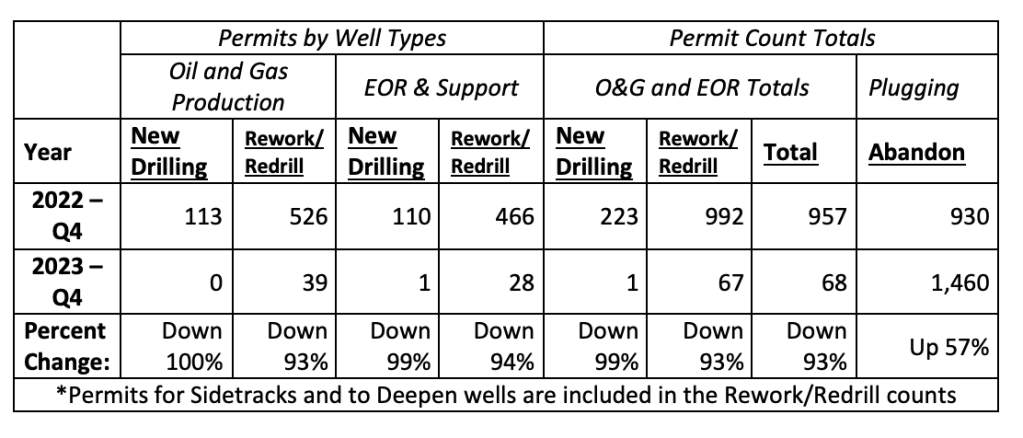
Oil regulators issued no new well drilling permits in the fourth quarter compared to 113 in the fourth quarter of 2022. The issuance of all permits, including redrilling and reworking existing wells, plunged 93%. Permit approvals to plug wells rose 57% in the fourth quarter of 2023, though overall they fell during 2023 by 22% over the year before. See Table 1.
Table 1. CalGEM Oil and Gas Well Permitting Counts for 2023, Quarter 4.
But the catch, according to FracTracker Alliance, is that oil companies are not using nearly 20 percent of the plugging permits issued between 2018 and 2022 to plug thousands of non-producing idle wells as the state’s remaining active wells yield less and less oil. The state allows idle wells to stay open for decades in exchange for industry fees that are far lower than it would cost oil companies to plug the wells.
More than 101,000 unplugged wells exist in the state, according to state data. About 40,000 of them are idle and 62,000 of them are operational. Chevron, for one, owns the most unplugged wells in the state and is the second largest holder of idle wells after Aera Energy. Chevron is currently producing only three barrels of oil per day per unplugged well in California, when more productive operators in the state produce an average of up to 55 barrels a day per well. For comparison, any well producing less than 15 barrels per day is considered a barely profitable “stripper” well. In other states such as Colorado, Chevron has already divested from operations producing just 14 barrels per day, according to FracTrackerAlliance.
Half of the country’s oil and gas production between 2012 and 2022 came from wells that produced between 100 and 3,200 barrels per day, according to the Energy Information Administration.(https://www.eia.gov/petroleum/wells/)
An onshore well that produces between 1,000 and 3,000 barrels of oil a day is considered a good production range.
(https://undervaluedequity.com/oil-and-gas-flow-rates-how-to-determine-if-a-wells-daily-production-range-is-fair/)
“Chevron’s big lie is that it is drilling for oil in California, when in fact it is drilling for a very little bit of oil to avoid the costs of plugging unproductive wells,” said Liza Tucker, consumer advocate with Consumer Watchdog. “California needs to plug policy loopholes allowing wells no longer operational to stay unplugged forever via low fees paid by oil companies to keep them open. The state is facing big deficits. If Governor Newsom ordered the plugging of unproductive wells, he would create a massive jobs program for Californians funded by the companies responsible for plugging wells.”
In addition, 15% of Chevron unplugged wells are within the state’s public health protective zone of 3,200 feet of communities, FracTracker reports. “Idle wells should be plugged immediately to reduce current environmental health risks from their toxic emissions,” said Kyle Ferrar, Western Coordinator for FracTracker Alliance. “California regulators are failing to manage California’s backlog of idle wells using the existing idle well system. Regulators and policymakers must look to model legislation in other states, such as North Dakota, that require the plugging and reclamation of non-producing oil and gas wells after one year of ceasing production.”
To see the number of drilling permits approved and locations, visit Consumer Watchdog and FracTrackerAlliance’s joint site: https://newsomwellwatch.com
“Chevron is already writing off billions of dollars of these California assets in its latest SEC filings and it’s because it’s just plain not profitable to run barely producing wells as California runs out of oil reserves,” said Tucker. (https://chevroncorp.gcs-web.com/static-files/2dfd7336-f466-4269-a2b4-7c13c8d044df)
“FracTracker research and research from Carbon Tracker shows that the remaining operational oil and gas wells in the state will not likely produce enough oil to cover the costs of plugging, reclamation, and remediation,” said Ferrar. “Companies such as Chevron would rather blame California regulatory policies for major profit write downs, but the real story is that they are putting CA taxpayers in the cross hairs of covering the growing costs when operators divest or turn to bankruptcy if the state does not make them plug unproductive wells.”