Table of Contents
Executive Summary2 CalRecycle’s Obligation to Make Consumer Deposit Refunds Easy5 Less Convenience Equals Lower Redemption Rates7 Principles of Successful Direct Deposit-Return Systems11 Modern Technology and Labeling11 California’s Challenges12 CalRecycle’s Pilot Program Dead End14 How Other Deposit-Return Systems Have Evolved16 California’s Bottle Deposit System Today26 Building On What Exists In California29 Formula For Success31 Conclusion33 Citations34
Executive Summary
After decades of consumer and media criticism of California’s failed bottle deposit return program, Governor Newsom and the California Legislature last year finally passed a substantive reform of the program.
They placed the ultimate responsibility for recycling onto grocery stores selling deposit beverages. Starting January 1, 2025, supermarkets, big box and drug store chains have a choice. They must either take back empty containers and refund consumers their deposits or form beverage dealer cooperatives to do that in two-thirds of the state’s designated “convenience zones” that lack a single recycling center.
In tandem with the reform, SB 1013 (Atkins) that also expanded the program to include wine and liquor, the state budget also allocated $73.3 million to CalRecycle for grocer and recycler grants. These grants are for giving consumers access to easy
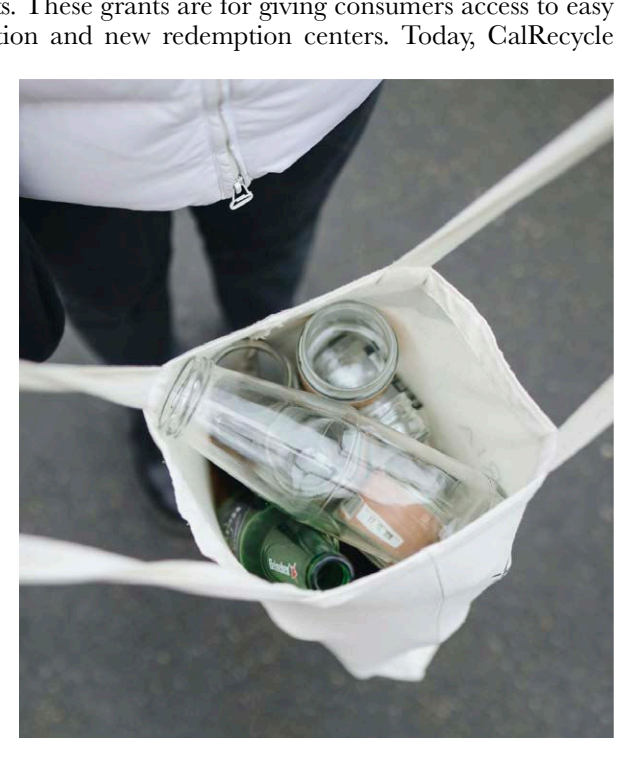
deposit refunds via automation and new redemption centers. Today, CalRecycle has a legal obligation to make the system convenient and easy for consumers to use.
Consumers with no easy access to recycling centers that instantly refund deposits must instead use inconveniently located recycling centers and scrap yards in industrial areas. In rural areas, some residents must drive up to 50 miles to get their California Refund1 Value (CRV) deposits back.
This has led to a massive surplus of unredeemed deposits totaling more than $500 million and put California in nearly last place among the ten US bottle deposit states. The consumer redemption rate2 sank to 60% last year.
Today, only one recycling center exists for every 31,600 consumers in California compared to return locations serving several hundred consumers in states and countries with far more successful programs. (See Convenience Chart, page 9 below.) To make its bottle deposit return system a success, CalRecycle must write regulations implementing the state’s newly reformed bottle law under SB 1013 to guarantee that retailers provide consumers with convenient access to redemption. Simply put, the more visible and conveniently located, automated redemption points are offered to consumers, the higher the rate of beverage container returns. The higher the rate of returns, the more hundreds of millions of dollars in deposits are refunded back to consumers, the more energy is saved and the more litter is reduced. More greenhouse gases and toxic emissions are cut, and more jobs are created by recycling hundreds of millions of additional containers every year. This report reviews three bottle deposit return systems in the United States and Canada that have or are in the process of modernizing for standards of convenience that CalRecycle should embrace. These modernizedsystems put consumer convenience first by employing easy-to-use and cost-efficient technologies. These include reverse vending machines (RVMs) at grocery stores that refund cash on the spot and/or supermarket bag drop receptacles as well as off-site community redemption depots. These depots feature bag drop technology and RVMs that pay consumers their deposits back immediately.
Recommendations
- By the end of May, CalRecycle should announce the application process for deposit beverage retailers and recyclers to apply for $73.3 million in grants to invest in proven automated redemption technologies such as bag drop machines and RVMs. This should include automation of existing redemption centers and money to open new ones in low-income communities depending on such centers for immediate cash refunds. By June 30, 2023, CalRecycle should award the money.
- In awarding the $73.3 million, CalRecycle must not fund any more so-called “mobile pilot programs.” No other bottle deposit return programs waste money on this highly inefficient and carbon-intensive collection method involving trucks that has proven to be a logistical and financial debacle in California.
- CalRecycle should adopt regulations that require at least 4,500 new points of redemption in all unserved zones to be in operation no later than January 1, 2025. That standard would provide one redemption point per roughly 9,000 Californians and enable the state to lift its redemption rate to and past its low statutory goal of 70%. These regulations must include the option of immediate payment of the CRV to the consumer as well as requiring that consumers are actually paid the CRV for every container returned for recycling.
- CalRecycle should adopt a regulation to deem aconvenience zone as “served” if at least 3 automated points of redemption at 3 different supermarkets exist within the previously unserved zone.Alternatively, CalRecycle can allow for a single full-service, automated community redemption depot at a nearby location to serve a convenience zone.
- Every big box style store selling CRV beverages must offer consumers at least 2 automated recycling machines on their premises. Redemption locations should be clearly marked to be visible.
- Based on requirements in other deposit-return states and countries, CalRecycle should ensure that machines and receptacles for bag drop offs installed at supermarkets should offer at least 70 hours a week of redemption service to be deemed “open for business.” Redemption depots should be open for at least the same number of hours.
- CalRecycle should implement a process to ensure transparent and accurate reporting by operators of dealer cooperative redemption plans on the number of containers collected for processing to ensure a significant improvement in the consumer takeback rate reaching and exceeding 70% redemption.
- CalRecycle should require that redemption locations in unserved zones be based on population density and not on political considerations.
- CalRecycle should ensure that dealer cooperative redemption plan proposals are subject to written public review and are also hold public hearings with right of verbal comment prior to approving any proposals.
- CalRecycle should make approval of dealer cooperative proposals involving the hiring of a third party to offer redemption service contingent on that third party’s proven qualifications and prior experience running deposit return systems.
- CalRecycle should conduct public opinion polling to hear directly from consumers on what constitutes redemption convenience and then convene focus groups comprised of both urban and rural residents on the same.
- Using public opinion polling results to inform CalRecycle, the department should proactively provide menus of possible models of convenience in unserved zones to retailers by January 1, 2024.
- CalRecycle must strictly adhere to the deadlines SB 1013 sets out. That includes the adoption of emergency regulations by January 1, 2024, that provide access and convenience for consumers comparable to what was promised but not delivered over the last decade. It should provide “other regulations necessary for the implementation and enforcement” of the new law. CalRecycle must hold at least 2 public hearings with the right of written and oral comments on the emergency regulations prior to adoption.
CalRecycle’s Obligation to Make Consumer Deposit Refunds Easy
Prior to reform, lawmakers, regulators, waste haulers protecting curbside programs, and grocers that reneged on pledges to be recyclers of last resort where recycling centers closed, created the most inconvenient deposit-return system in the world. It consists of manual processing of containers and their frequent purchase by weight3 that deprives consumers of full deposit refunds and opens the system up to fraud. In 2021, California’s redemption rate (direct consumer returns of CRV containers for deposit refunds) sank to 61%, the third worst redemption rate among ten bottle deposit states. Today, it stands at 60%. The reasons include widespread flouting of retailer responsibilities to take back containers, retailer “opt-out” payments to CalRecycle in lieu of recycling, and chronic state underfunding of redemption centers. CalRecycle also suffered gross mismanagement by previous CalRecycle senior staff who were replaced by Governor Newsom.
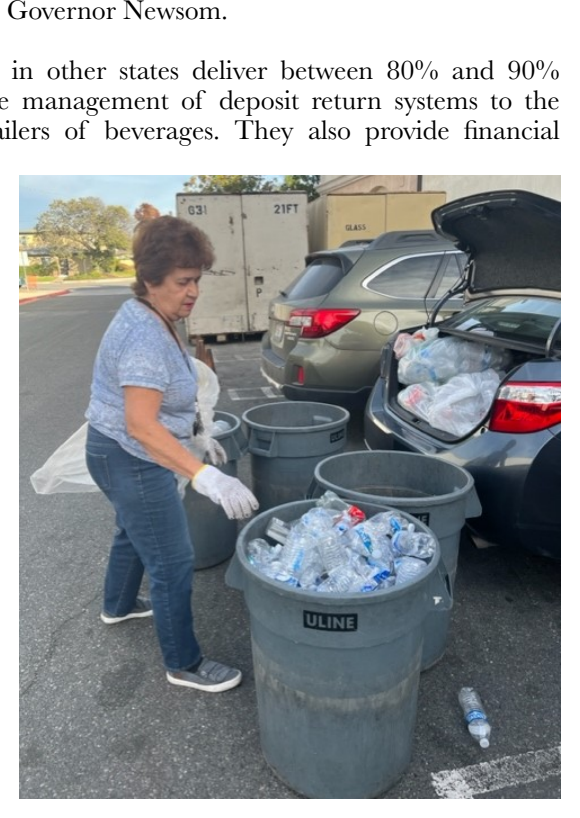
In contrast, successful programs in other states deliver between 80% and 90% redemption rates by handing the management of deposit return systems to the producers, distributors, and retailers of beverages. They also provide financial incentives to install automation to take back empty containers either on premises or at beverage industry funded modern redemption depots. This makes relying on scrap yards in industrial zones far from where consumers live obsolete.
The reform legislation passed last year, SB 1013 (Atkins), gives CalRecycle the power to design and enforce a standard of convenience that works for California consumers and ensures that CRV beverage containers are in fact recycled.
The legal standard under the new law is the following: “Redemption programs shall include sufficient redemption opportunities for consumers that have comparable consumer convenience” to the current requirements under the law. Those requirements were insufficient to begin with and were not met for a decade over which more than half of the state’s recycling centers closed. The provision of convenience includes requirements that “at least one certified recycling center or location” within each convenience zone take deposit containers and issue refunds.” In addition, locations must “be open at least 30 hours per week with a minimum of five hours of operation occurring during periods other than from Monday to Friday, from 9 a.m. to 5 p.m.” At the same time, “the department may require a certified recycling center to operate up to 50 percent of its hours of4 operation other than during 9 a.m. to 5 p.m.”
In other words, CalRecycle has great latitude to design “convenience” that will lead to the stated California goal of 70% redemption and beyond. The legislative remedy contained in SB 1013 will now require large stores selling CRV beverages to provide redemption service, as of January 1, 2025, in state-drawn consumer “convenience zones” that lack a recycling center. Or they can form “dealer5 cooperatives” by that date to serve those zones.
Under SB 1013, convenience zones consisting of geographic radiuses, each anchored by a major supermarket, may now be combined to create even larger zones with radiuses of up to 78 square miles in rural locations and 10 miles in urban locations. That makes it imperative for CalRecycle to write rules requiring more redemption options, not less, in those zones. Under no circumstances must CalRecycle consider one redemption point in overlapping zones to fulfill the requirement of providing sufficient redemption. It must take charge and mandate more redemption points.
To make redemption easy and convenient for all consumers, the approach CalRecycle takes should be a mix of technologies and refund options. That should include the provision of cash refunds and credit in settings addressing the unique circumstances of densely populated urban areas, less densely populated suburban areas, and lightly populated rural areas. In addition, it must be recognized that low-income communities without major grocery stores refunding bottle deposits rely on the existing redemption centers that the state has left. To maintain them, California will have to pay adequate fees to both these centers and to retailers participating in the new system.
“at least one certified recycling center or location” within each convenience zone take deposit containers and issue refunds.” In addition,
Less Convenience Equals Lower Redemption Rates
əˈːəy Convenienceoun The qualit [knvi.ni.ns]. n aves ty. Anything that s nvenient (opens in new tab); suitabili of being co (opens in new tab) ort, ne’s ease or comf s work, adds to o or simplifie ke.
ensil, or the li appliance, ut etc., as an e.
:at your convenienc t (opens in new tab) situation or time A convenien (opens in new tab) onary.com) (Source: dicti The single most important feature of a successful bottle deposit-return system is consumer convenience. In other bottle deposit states and countries with successful systems, modern technology makes it very convenient for shoppers to bring back containers and get deposit refunds on the spot in cash or store credit. Or consumers can take containers to depots with RVMs that enable cash refunds or use bag drop technology that issues credit onto an account within several days. Increasing the number of consumers who use a modernized deposit-return system built into a consumer’s daily lifestyle makes deposit refunds easy while amplifying environmental benefits.
The world’s best performing bottle deposit systems employ return-to-retail technology. Such “pure” return-to-retail systems exist in nine European countries,6 in one U.S. state—Michigan—and in three Canadian provinces. Ten more markets feature a combination of models that include retailer participation and employ modern technology from RVMs to bag drop sorting technology. The more available points of redemption, the higher the redemption rate.
In comparison to California’s dismal ratio of 1 recycling center to every 31,600 people, every Michigander has access to 739 different points of return at retail stores selling deposit beverages. In 2019, prior to the pandemic, Michigan’s high number of redemption points—solely at supermarkets—produced a redemption rate of 89% due to consumer convenience. Oregon, with fewer redemption points per person, and a mix of retail store and redemption depot returns, delivered a redemption rate of 86% that same year. These rates are climbing back again7 today.
The most convenient way for consumers to return empty beverage containers is to bring them to the store where they shop for their groceries. In fact, a review by the international nonprofit Reloop of direct deposit return systems around the world shows that hybrid systems using a mix of direct return to retail and return to offsite locations that require a separate stop produces a median redemption rate of 69%8 versus return to retail systems only that produce a redemption rate of 90%. The relationship between retail revenues and
“The most
consumer convenience is symbiotic. Consumers can take smaller amounts of containers on frequent
convenient way for
shopping trips. That saves time, fuel, and lines at
consumers to
redemption centers. And consumers who redeem containers at the store tend to boost store revenues.
return empty
“A number of studies have…found that when retailers
beverage
provide a convenient return location for used containers, they benefit from increased sales and
containers is to
consumer foot traffic,” according to Reloop. A survey
bring them to the
of more than 1,100 people by the New York Public Interest Research Group found that 68 percent of people were shopping where they returned their store where they bottles and cans at supermarkets, and 81% said that
shop for their
they shopped there more often. The survey also found that as many as 57% of shoppers had chosen the store
groceries.”
because of the site’s convenient bottle return system.
According to Reloop, the technology boosts sales. “The equipment allows retailers to offer in-store promotions to their customers using videos, images, and websites to advertise and add coupons to deposit receipts. This encourages customers who may have only intended to return their empties to shop as well.”
The technologies in use today have their pros and cons and are appropriate for consumers who want choice as well as convenience.
RVMs at stores and depots can compact containers, thus saving space and requiring fewer trips to processing facilities. They can also issue vouchers for cash payment, issue cash immediately or make an immediate electronic payment. Vouchers show the number of containers redeemed and the total amount of the refund. One plus—one stop shopping and container redemption. One drawback— consumers using RVMs at stores issuing only vouchers may have to wait in checkout lines to cash in their vouchers.
Convenience Chart (2021 Data)
SystemCAMIOregonNorwayGermany
System CA MI Oregon Norway Germany Refund Rate 61% 75% 81% 92% 98% Return Locations 1,265 Redemption Centers, 2,328 retailers 13,500 2,091 15,000 130,000 Population 40M 10M 4.2M 5.4M 83M Refund Points Per Person 1:31,600 for RCs, 10,921 counting retail stores 1:914 1:2,008 1:360 1:638 Model For Collection *Hybrid (On Paper Only) Return-to- Retail Hybrid Return-to- Retail Return-to- Retail Return Method Manual Mostly Automated Mostly Automated Mostly Automated Mostly Automated Hours Redemption Centers 30 Hours Per Week, No rules for retail stores All Store Hours All Store Hours, Up to 16 hours 7 days a week at RCs and bag drop express depots All Store Hours All Store Hours
Bag drop receptacles in grocery store parking lots can take in tagged bags of containers but do not compact them on the spot, thus requiring more storage space at stores and more frequent trips to processing facilities. The pluses include convenience in quick consumer drop-offs at grocery stores with no waiting. Consumers can also use offsite community redemption depots featuring bag drop receptacles and bag sorting technology as well as RVMs. But the digital system issues credit on an app such as PayPal and can take up to a week to be reflected. This works well for those who do not need immediate cash but is a drawback for those who do. Thus, immediate cash options must also be provided. In addition, there is no way to verify how accurate the credited refunds are in terms of the
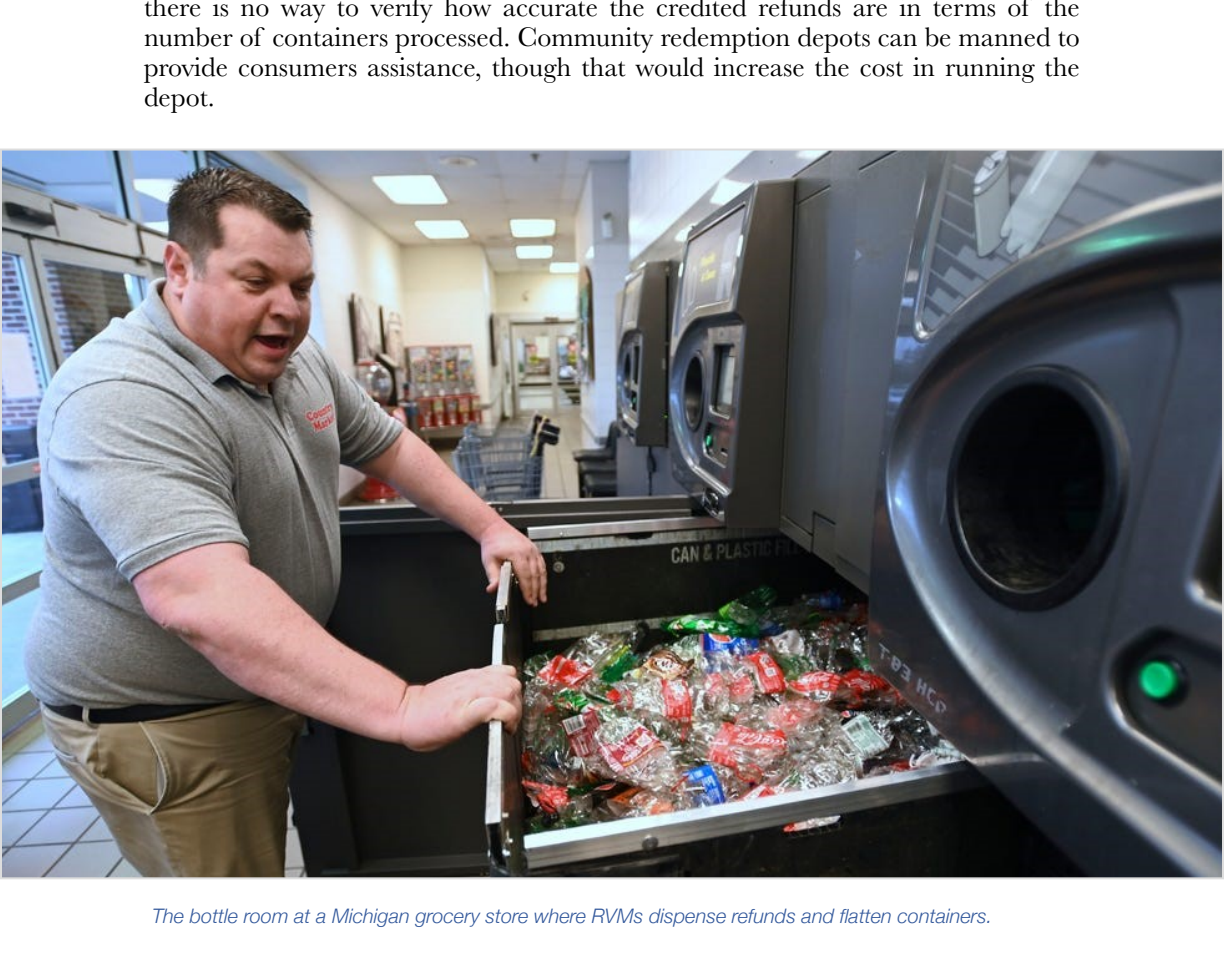
number of containers processed. Community redemption depots can be manned to provide consumers assistance, though that would increase the cost in running the depot.
Principles of Successful Direct Deposit-Return Systems
The most successful direct deposit-return systems include the following key features: Convenience The redemption system ensures widely accessible, easy, and convenient access that does not overburden grocery stores. Deposit programs should offer a variety of ways and locations for consumer redemption and fairly compensate operators10 hosting the infrastructure.
Producer Responsibility A single beverage industry entity runs and finances the system. State oversight and enforcement ensures transparency in operations and achievement of performance standards. Unredeemed deposits are used only to add infrastructure, fund a transition for existing recyclers, and conduct consumer education.
High Performance The system sets a high collection target of 90% and a fully refundable deposit large enough to incentivize consumer redemption. Deposits should be at least 10 cents per container, though they can vary based on container size, and should include all possible beverage types and containers.
Modern Technology and Labeling Beverage containers should display harmonized marks so that machines and consumers can easily recognize refund eligibility. Containers should also carry bar codes for accurate allocation of costs, accurate reporting of redemption rates, and fraud reduction.
California’s Challenges
The California bottle deposit return program has several challenges to successful reform. It has created no enforceable target for a redemption rate. There should be a statutory target of at least 80% redemption, but within the confines of the current law, the state should aim to hit the statutory goal of at least 70% and beat it.
The state has only a statutory “recycling goal” of 80%. Waste haulers do not redeem consumer deposits, but instead charge the state for them as though they had redeemed consumer deposits. This is a system design failure that is found in no other deposit-return system in the world. This practice makes up about 10% of the recycling rate that the CalRecycle reports. Consumer Watchdog subtracts that fudged number to arrive at an accurate redemption rate of direct consumer container takebacks.
SB 1013 aims to increase that direct consumer redemption rate by requiring beverage retailers to choose between accepting containers at stores or forming dealer cooperatives to do that. CalRecycle will have to approve dealer cooperative redemption plans. But then it should not sit back and expect dealers to come up with plans that will offer enough convenience on their own. CalRecycle must set specific rules on what dealers must provide—in fact, SB 1013 requires CalRecyle to adopt these regulations.
CalRecycle must not only approve dealer cooperative redemption plans that meet specific state requirements, but also enforce them. They must write rules that allow CalRecycle to review dealer cooperative redemption plan results within a set period and mandate changes if sufficient convenience—and thus the redemption goal—is not attained.
In addition, SB 1013 allows beverage retailers forming dealer redemption cooperatives to contract privately to third parties to provide consumer redemption services. CalRecycle has an obligation to ensure that the contracted parties have the demonstrated expertise required to do this job before approving any dealer cooperative redemption plans.
System protection is lacking. Anywhere between $40 million to $200 million a year is stolen from unredeemed deposits, based on past estimates from investigations by11 the State Auditor and the Los Angeles Times. California’s deposit system is based largely on sales of CRV containers by weight.
Using a weight-based formula to calculate state reimbursements of CRV and other recycling subsidies, instead of using advanced technology to count containers, allows unethical recyclers to manipulate the system by using easily altered hand-
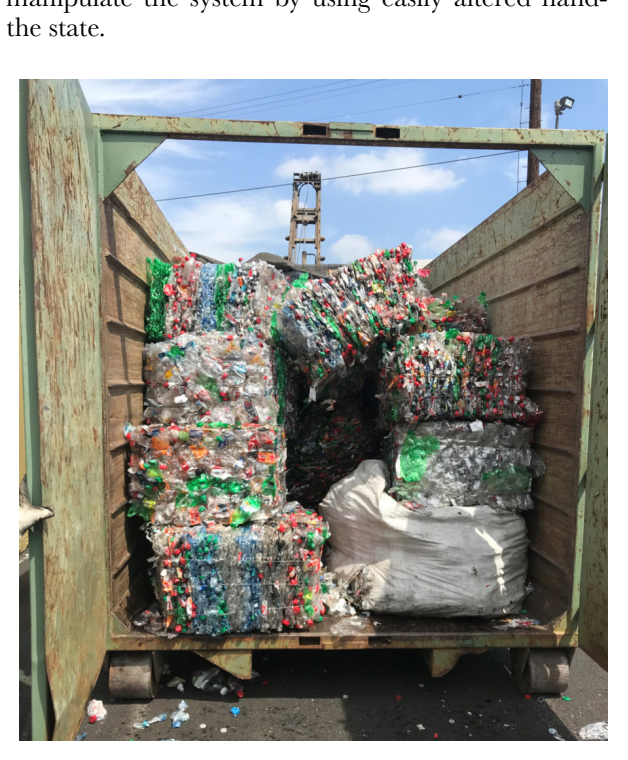
written documentation to bill the state.
Fraud against the California bottle bill program is particularly extreme compared to bottle bill programs in other states and provinces in North America.
It is virtually unheard of in European and Australian deposit return programs.
The state’s CRV label is not always digitally readable.
However, both RVMs and bag drop sorting technology can recognize unique bar codes or infrared markings as empty containers are fed into them to verify that they are eligible for a deposit refund as CRV containers.
Beverage companies participating in Extended Producer Responsibility deposit return systems recognize that readable deposit bar codes or other marks are an intelligent and easily implemented fraud mitigation solution. It saves the system money and ensures that consumers are paid deposits for eligible empty containers. A decade ago, Nestlé Waters North America notified redemption centers in five Northeastern states that it would use separate bar codes in bottle deposit versus non-bottle deposit states.
In Connecticut, as of January 1, 2024, every deposit beverage container sold in the state must include a Universal Product Code and barcode to be read by RVM system administrators and other system operators.
CalRecycle’s Pilot Program Dead End
Lastly, CalRecycle must stop going down pilot program dead ends. This year’s state budget allocated $73.3 million for CalRecycle to modernize the system and open new redemption centers. According to the budget language, these monies are available to support start-up costs for recycling programs that are limited to recycling centers, mobile recycling, RVMs, and bag drop programs. No more than 50% of the funds can be used to fund either mobile recycling, RVMs or bag drops. Under no circumstances should additional so-called mobile recycling programs be funded out of this money because initial mobile pilots funded with $5 million12 authorized by lawmakers in 2019 are crashing and burning. No other state or country wastes money on such “mobile” programs. Yet CalRecycle persists in funding existing pilots and in awarding new grants to new mobile pilot programs13 with an additional $10 million allocated in the state budget last year. No other state or country wastes money on “mobile” programs involving trucks to pick up CRV containers.
“No other state or country wastes money on such ‘mobile’ programs.”
In California’s most egregious example, the BottleBank pilot in San Francisco, the estimated cost to return a nickel per container to a consumer was as high as $1.25 last year. Today, industry sources estimate that it is costing anywhere from a quarter to 40 cents per container to do so. Extremely inconvenient days and hours of service ensure that too few containers are taken in for the pilot to remotely pay for itself, let alone continue without support.
In fact, the BottleBank pilot was conceived by consultants to the grocery industry who enriched themselves by more than $700,000 in grant money between 201714 and 2021. Their goal was not to provide convenient redemption service but to exempt all retailers in San Francisco from redemption responsibilities. Under the terms of CalRecycle grants, pilots approved exempt all retailers in a jurisdiction from in-store redemption obligations or paying state fines to get out of recycling. As soon as the San Francisco pilot was deemed operational, more than 400 stores immediately stopped redeeming bottles and cans. That left hundreds of thousands of San Francisco residents without any convenient access to redemption whatsoever. But the pilot never delivered service sufficient and comparable to what one single recycling center open at least 30 hours a week in one convenience zone would have under the original bottle law.
The BottleBank program currently uses three trucks to pick up CRV containers at15 19 supermarket locations. Called “mobile redemption centers,” the trucks go between closely located supermarket parking lots to provide stationary redemption service. Virtually all these locations only offer the service one weekday a week for three or four hours when most people are working. Only a few enable consumers to drop off containers between 4 pm and 7 pm, and only one is open on a Saturday. None are open on Sundays. Yet, weekends are an ideal time for consumers to recycle as they shop and run errands.
The San Francisco mobile pilot originally was awarded $1 million, but CalRecycle just allocated another $500,000 to extend the program that will not be able to make ends meet when the money runs out. In fact, CalRecycle is dispensing a total of an additional $5 million to fund ill-advised new mobile pilots. It is also extending funding to existing pilots, including mobile pilots in Irvine and Culver City that are16 either a bust or not going to make it without state help.
How Other Deposit-Return Systems Have Evolved
Oregon, Quebec, and Connecticut have all grappled with how best to provide redemption service at supermarkets while encouraging modernization. Oregon’s system has evolved into a hybrid system of direct return to retail and offsite returns at modernized full-service redemption depots. Quebec and Connecticut are evolving in that direction but with a greater emphasis on store redemption via modern technology.
Oregon In Oregon, beverage distributors and retailers work together via the Oregon Beverage Recycling Cooperative (OBRC) to provide consumer convenience17 through container returns at both stores and full-service redemption depots. Consumers can return empty containers to over 2,000 supermarkets, over 300 of which offer RVMs to process up to 24 containers per person per visit, according to OBRC. Store RVMs are accessible during virtually all store hours except for18
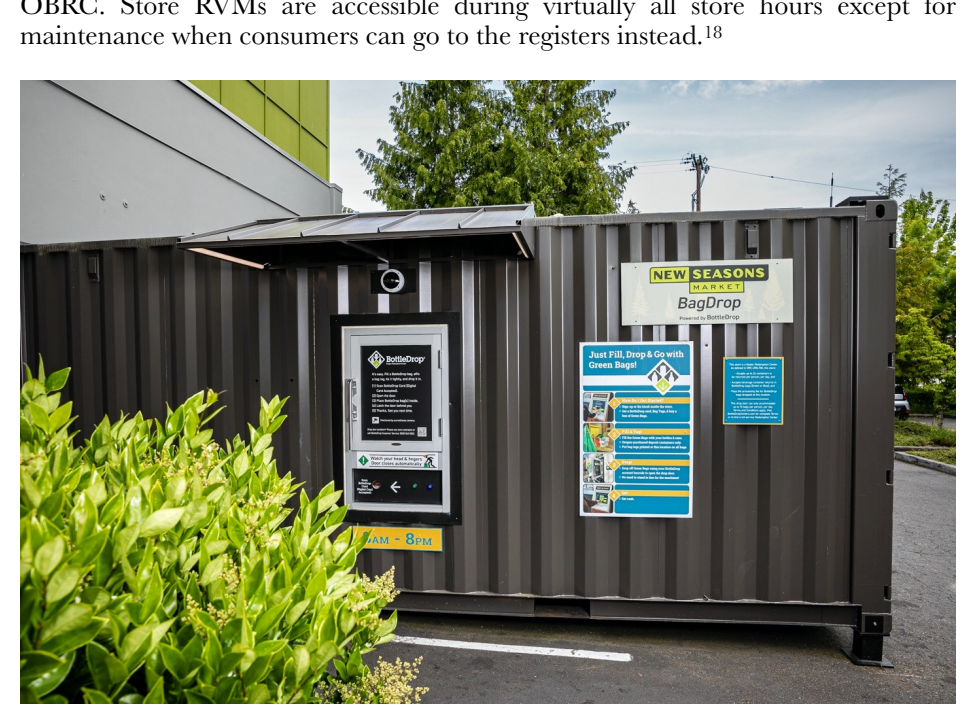
maintenance when consumers can go to the registers instead.
In addition to retail takeback, Oregonians can return containers at 26 full service BottleDrop redemption depots across the state with higher daily limits (up to 350 containers per person, per day). Full-service depots are manned and featureRVMs for cash refunds. They are open seven days a week up to 11 hours a day. Bagged
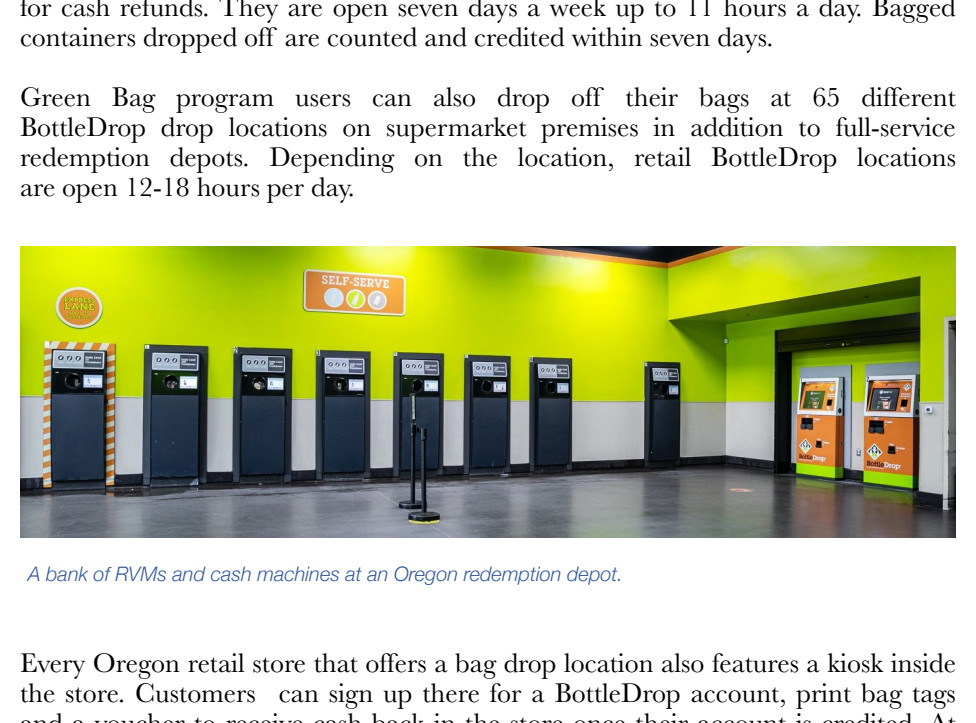
containers dropped off are counted and credited within seven days.
Green Bag programusers can also drop off their bags at65 different BottleDropdroplocations on supermarket premises in addition to full-service redemption depots.Depending on the location,retail BottleDrop locations areopen 12-18 hours per day.
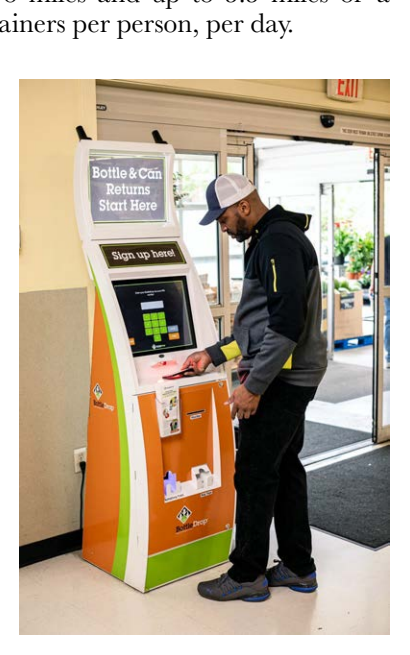
Every Oregon retail store that offers a bag drop location also features a kiosk inside the store. Customers can sign up there for a BottleDrop account, print bag tags and a voucher to receive cash back in the store once their account is credited. At some participating retail locations, consumers can print a BottleDrop Plus voucher and get 20% more money added so long as they shop with store credit. Refunds can also be donated to more than 5,000 participating nonprofits and be linked to19 an Oregon College Savings Plan.
Oregon’s modern technology enables OBRC to count every single container to ascertain how many containers are processed at what cost. This enables OBRC to closely track the state’s consumer redemption rate and the costs of the provision of service.
Beverage industry resistance to in-store container redemption has led to a law that gives retailers a break provided that full service-redemption centers locate nearby. Oregon’s full-service redemption centers create a “convenience zone” whereby retailers located within two miles of a redemption depot are no longer required to accept containers. Retailers located between two miles and up to 3.5 miles of a
redemption depot are required to accept 24 containers per person, per day. Retailers over 5,000 square feet that are not located within a convenience zone are required to accept at least 144 containers per person, per day during all hours they are open. If one of these retailers chooses to become a Green Bag drop location, its individual container takeback requirement decreases from 144 containers in-store to 24 containers per person, per day.
Today, supermarket take back represents more than 18% of the state’s return volume. The rest of the containers arereturned through the BottleDrop network at redemption depots and supermarket bag drops. More than half of the state’s 1.4 million households hold a BottleDrop20 account.
The beverage industry supported and set the terms of a recent effort in Washington State to create its first bottle deposit return system.
OBRC testified in favor of it. The bill would have required producers of certain beverages to take responsibility for beverage containers by forming a beverage distributor responsibility organization and to establish a deposit21 return system.
The bill failed in the face of opposition from waste haulers battling over container collection. The legislation would have set a 10-cent deposit to incentivize returns but would have initially mandated only 270 bag drop depots to serve nearly 8 million people. That would leave a ratio of 30,000 people using just one drop off point.
The legislation explicitly stated that no supermarkets or publicly owned facilities would be required to accept returns of qualifying beverage containers or allow a bag-drop site on the premises.Anyone wanting an immediate cash refund would get a credit on an account and would have to wait for it. Had it passed, the bill would have offered consumers only bag drop depots not located on supermarket premises with only an option for credit, not cash—a minus for consumer choice and convenience.
Oregon Takeaways
- Oregon maintains a mandate for supermarkets to take back containers. RVMs provide vouchers for cash out at stores. Stores with indoor bag drop kiosks also provide vouchers, though consumers must wait to be credited after drop off.
- Oregon ensured that consumers have maximum access to redemption service by mandating that stores not in convenience zones take back large amounts of containers during virtually all open hours. Full-service depots are open seven days a week up to 11 hours a day. Bag drops and kiosks at supermarkets are open 12-18 hours per day.
- Oregon’s system funnels consumers to redemption depots because the system allows supermarkets to turn away consumers if a redemption center is located nearby.
Quebec In Quebec, every beverage retailer must take back deposit containers and refund deposits. Containers are returned to 5,500 stores. Of those sites, 82% of containers are currently returned to 1,200 stores offering RVMs. Three quarters of all transactions include less than 48 containers. Yet, its 67% redemption rate is currently the lowest among nine return-to-retail systems in Europe and two Canadian provinces because deposit amounts are too low to incentivize consumers to return containers.
Quebec’s government funded seven pilot projects in six cities to test out various container return options. Quebec tested manual and automated systems at retail locations and offsite depots before expanding the deposit system to include more beverages and raising deposits.
Pilot reviewer Houston Consulting had one key recommendation. “Automation is critical to good performance and must be considered in the design and deployment of the new system,” the report said. The advantages are reduced labor and handling costs; on the spot container compaction that shaves storage, and transportation costs; fraud control via barcodes and optical scanners; and electronic22 reimbursement, which simplifies refunds. Off-site redemption locations cost more to install and operate than technology inside stores and require permits from municipalities to be constructed, while offering automation at stores costs less and requires no permits.
As of November 2023, Quebec is expanding its deposit system, raising deposits, and shifting to a hybrid redemption model. The model consists of a mix of RVMs at stores, small, enclosed structures on their premises, and larger offsite redemption
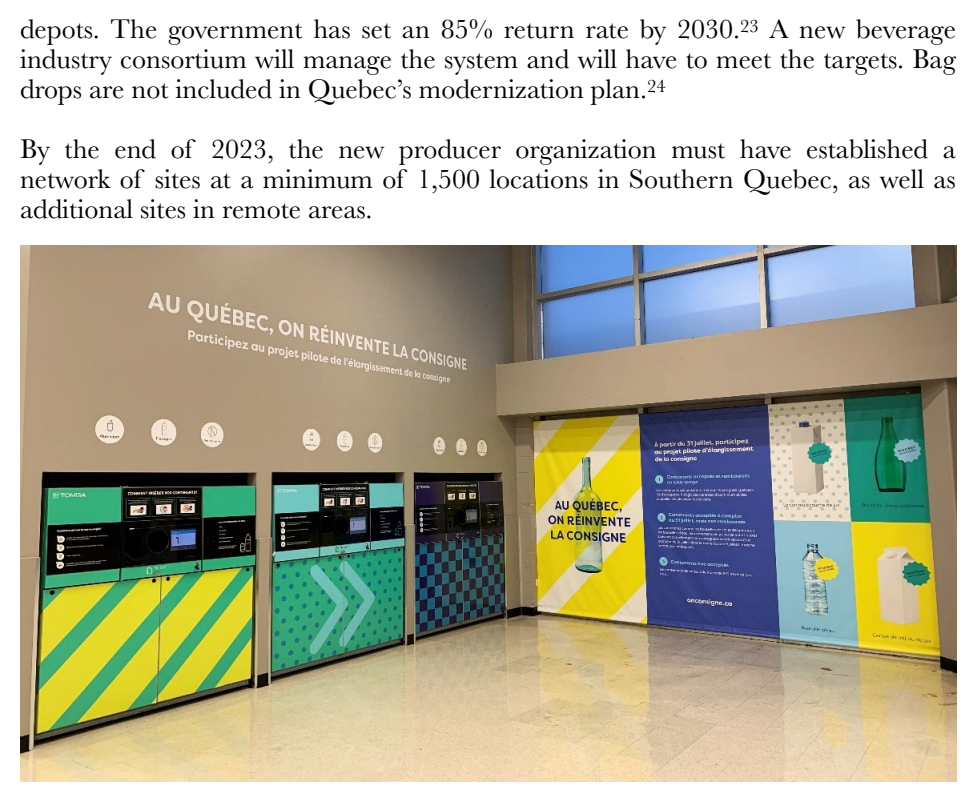
depots. The government has set an 85% return rate by 2030. A new beverage industry consortium will manage the system and will have to meet the targets. Bag24 drops are not included in Quebec’s modernization plan.
By the end of 2023, the new producer organization must have established a network of sites at a minimum of 1,500 locations in Southern Quebec, as well as additional sites in remote areas.
Under the reform law, Quebec makes distinctions between types of redemption sites—dividing them into “return points” designed to accept small quantities of redeemable containers of up to 50 and offering cash deposit refunds at stores and at off-site “return centers” that can accept both small and large quantities of redeemable containers at each visit. These larger sites can refund deposits via credit issued within two days of the transaction offered on site.
In addition, every beverage producer must also ensure that at least two bulk return sites are made available in each regional municipality. There, consumers can return an unlimited number of containers per visit and site managers can refund deposits any way they see fit. Electronic refunds must be completed within seven days of container returns.
In Quebec, all redemption points offered—from manual takebacks at counters and
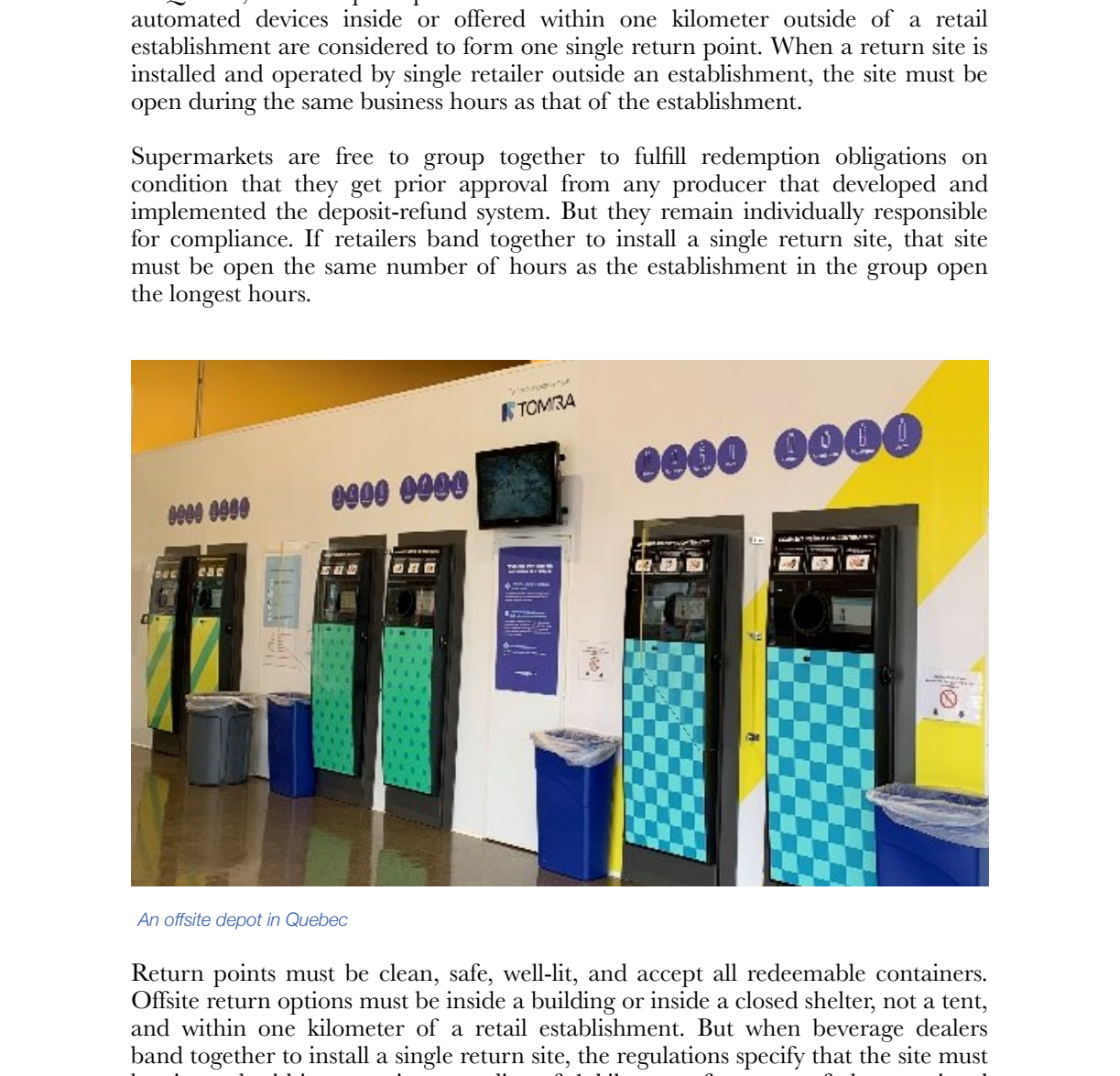
automated devices inside or offered within one kilometer outside of a retail establishment are considered to form one single return point. When a return site is installed and operated by single retailer outside an establishment, the site must be open during the same business hours as that of the establishment.
Supermarkets are free to group together to fulfill redemption obligations on condition that they get prior approval from any producer that developed and implemented the deposit-refund system. But they remain individually responsible for compliance. If retailers band together to install a single return site, that site must be open the same number of hours as the establishment in the group open the longest hours.
Return points must be clean, safe, well-lit, and accept all redeemable containers. Offsite return optionsmust be inside a building or inside a closed shelter, not a tent, and within one kilometer of a retail establishment. But when beverage dealers band together to install a single return site, the regulations specify that the site must be situated within a maximum radius of 1 kilometer from one of the associated establishments.
Quebec requires beverage producers and dealers to install return points based on
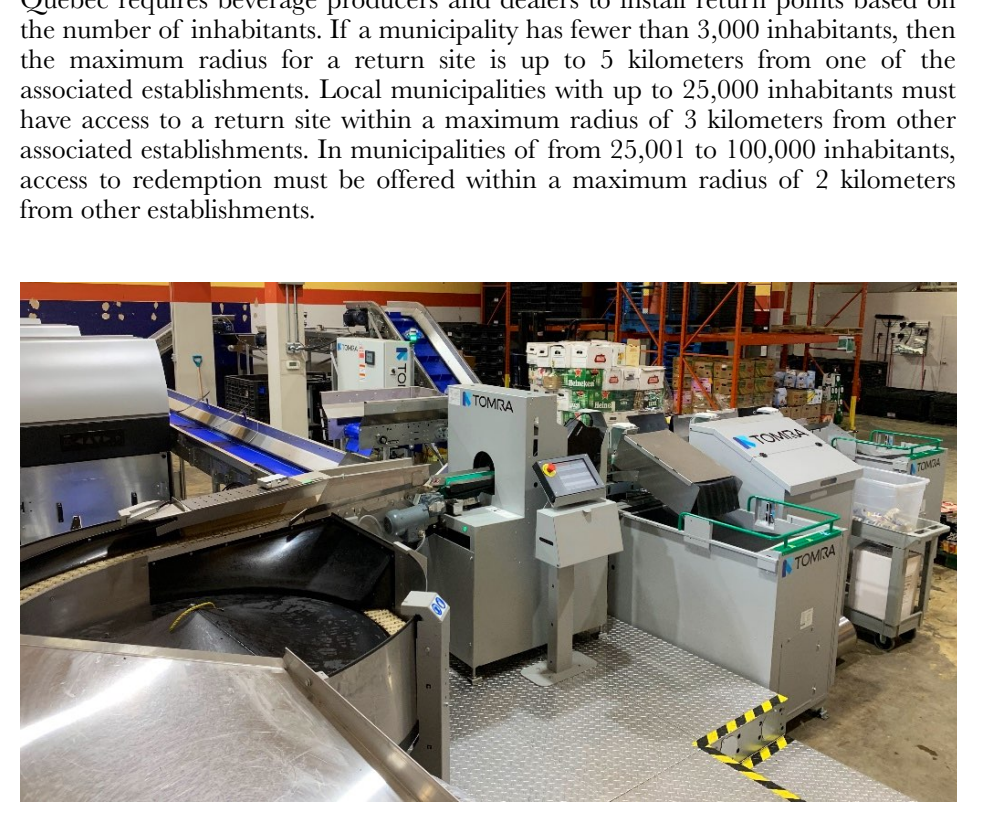
the number of inhabitants. If a municipality has fewer than 3,000 inhabitants, then the maximum radius for a return site is up to 5 kilometers from one of the associated establishments.Local municipalities with up to 25,000 inhabitants must have access to a return site within a maximum radius of 3 kilometers from other associated establishments. In municipalities of from 25,001 to 100,000 inhabitants, access to redemption must be offered within a maximum radius of 2 kilometers from other establishments.
On-site return location hours must match those of the supermarket.Return sites operated by a group of retailers must be open for business during the same hours as the supermarket staying open the longest.
Producers must submit a plan on how they will implement the return system. That includes the locations, the types of devices and other equipment to be installed, who will operate, maintain, and replace the equipment and how.Producers must make maps of all return sites publicly accessible and they are responsible for installing return sites in retail establishments.The direct return systems must be adapted to meet the needs of residents in remote or isolated territories. Quebec Takeaways
- Quebec emphasizes RVM cash refunds at stores but is moving towards a hybrid system of on-site and off-site redemption. Quebec’s goal is to automate the system while still providing maximum consumer convenience.
- Quebec bases the location and number of redemption points on population density.
- Quebec defines one redemption site as the total number of devices inside a store and on its premises as one redemption site. It does not count one piece of machinery on its own at a store as one redemption site.
Connecticut Connecticut’s hybrid model of takebacks at stores and redemption centers delivered a dismal 46% redemption rate in 2021. The nickel deposit just wasn’t enough to incentivize consumers to redeem container deposits. (California should also raise the CRV to 10 cents for every container, but only after CalRecycle has enforced regulations to make sure that every Californian has access to redemption.) In addition, state underfunding of redemption centers that also faced rising costs forced many to close.
In 2021, the state modernized the program to lift the redemption rate. At the time, 81% of voters backed the modernization of the deposit return system. The state turned responsibility over to beverage producers, expanded beverages included in the program, and raised the fees paid by beverage distributors to support the25 improved redemption network, according to Reloop. The deposit will be doubled to 10 cents from a nickel starting January 2024.
The new law incrementally decreases the unredeemed deposits that the state retains from 100% in favor of giving beverage distributors responsible for the26 program 55% of the deposits consumers leave behind by 2026. It also mandates that redemption plans submitted by a producer responsibility organization meet an 80% redemption target.
Its redemption centers are run by private businesses that work with distributors of carbonated beverages to redeem deposit carrying bottles and cans. Consumers can redeem containers at retail outlets but the outlets can limit redemption only to those brands, sizes, and types of beverages they sell. Consumers can also bring27 large quantities of containers to redemption centers.
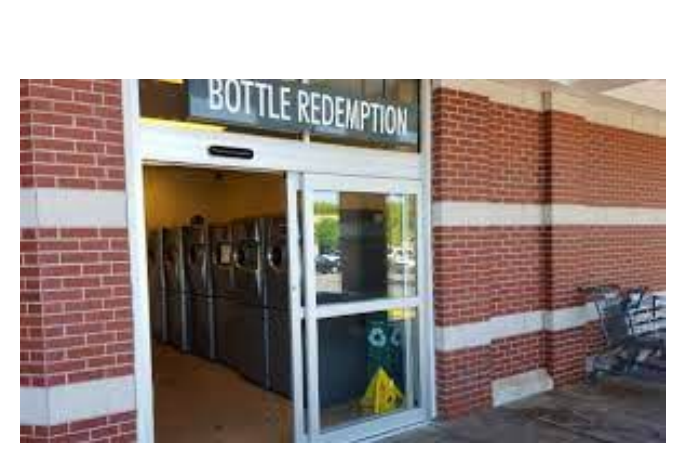
Connecticut’s system has a strong retailer takeback mandate. But retailers can opt out of redemption service if they are within one mile of a redemption center. Redemption centers can choose what deposit containers they take back but any affiliated with grocery stores may not redeem brands that the stores do not sell.
Under the new law, in addition to some major grocery store chains already required to have RVMs, large chain drugstores such as CVS and Walgreens and other chains such as Dollar General and Target must install RVMs to take back at least the deposit containers of the brands that they sell. The state is requiring any chain with ten or more stores in the state and whose business features 7,000 square feet or more to install and maintain at least two RVMs.
Large stores that do not install RVMs and are not exempt from the rules must provide a staffed, dedicated area inside the store to redeem containers. Conspicuous signs must be posted at each public entrance to the business describing where containers can be redeemed.
According to the Container Recycling Institute, RVM makers surveyed say RVMs are being installed in 300 more stores. The state also is making available $5 million in grants to open redemption centers in environmental justice communities. This will divert more materials away from incineration, cut toxic emissions that especially impact low-income communities. An increase in the deposits amounts28 will allow low-income consumers to double their deposit refunds.
The new measures are leading to the opening of more redemption centers in underserved areas and more redemption points at stores where consumers shop. One downside so far is that the reform did not mandate a public education component. So, word of mouth is how consumers are finding out about new redemption locations and hours.
Connecticut Takeaways
- Connecticut is mandating that beverage retailers with stores of more than 7,000 square feet install at least two RVMS for consumer use.
- Connecticut recognized that it had to increase the deposit to incentivize returns. California can do this too, but not until redemption infrastructure is in place to accept additional containers, including millions of wine and liquor containers that will be entering the system.
- Connecticut allows retailers to opt out of redemption service if they are within one mile of a redemption center and to limit refunds to brands that they sell.
- Connecticut is investing in opening redemption centers in environmental justice communities most impacted by plastic pollution and toxic emissions. These communities often lack supermarkets to take back containers and many residents depend on cash refunds.
California’s Bottle Deposit System Today
California’s deposit return system today favors those who gather containers in high volume. They then take them to CRV authorized scrapyards and dwindling29 redemption centers where consumers mainly choose to be paid in cash by weight. California’s deposit system is so broken that many consumers must brave the redemption experience at inconveniently located and often unsafe redemption centers. One such redemption center, Ming’s Recycling, recently closed in Sacramento County because angry consumers started fighting with recycling center staff over their checking of containers for lack of labels disqualifying deposit refunds.
CalRecycle has been conducting “secret shopper” style inspections of recycling centers to check that their workers are inspecting each bottle for a valid label and30 slapping centers with hefty fines if they are missed, according to Ming’s. This enforcement is not efficient, instead penalizing recycling centers and consumers for small, unintentional infractions that do not rob the state of meaningful amounts of deposits. In fact, the extensive fraud problem happens at the back end when bundled pallets contain non-CRV bottles but are presented as CRV loads, and31
other forms of far more costly fraud are committed.
On top of that, public education by CalRecycle about the bottle deposit system is so poor that a 2020 YouGov opinion poll found that more than a third of Californians have no clue at all that they pay deposits on specific beverages.
According to the Story of Stuff, less than one in four Californians redeem containers while more than three quarters simply toss their empty containers—with the CRV—32 into curbside bins. Waste haulers are paid by municipalities to landfill empty beverage containers. Roughly one third of those curbside recycling bin containers are landfilled while waste haulers collect a second revenue stream by billing the state for the CRV. This billing the state for CRV happens nowhere else and SB 1013 did not33 eliminate it.
At the same time, 60% of Californians say they would be willing to return empty containers for their deposits if they could at34 their grocery store or someplace very near. Using existing depots and scrapyards in California is no picnic—even the use of navigation apps won’t necessarily get a consumer to one if it is small and well-hidden enough. These centers are often
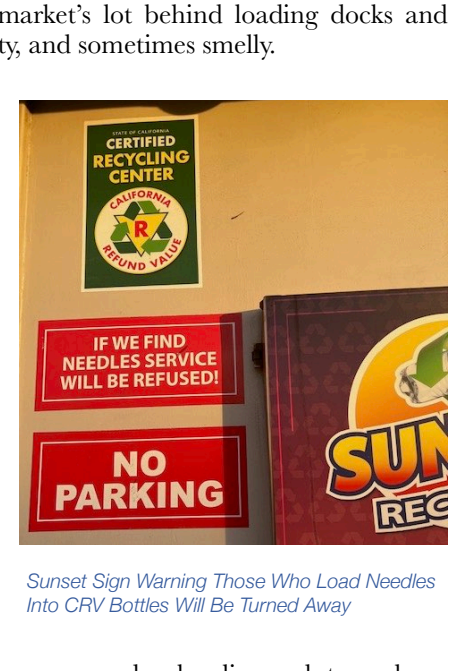
located in the far corners of a big supermarket’s lot behind loading docks and dumpsters. They are unappealing, often dirty, and sometimes smelly.
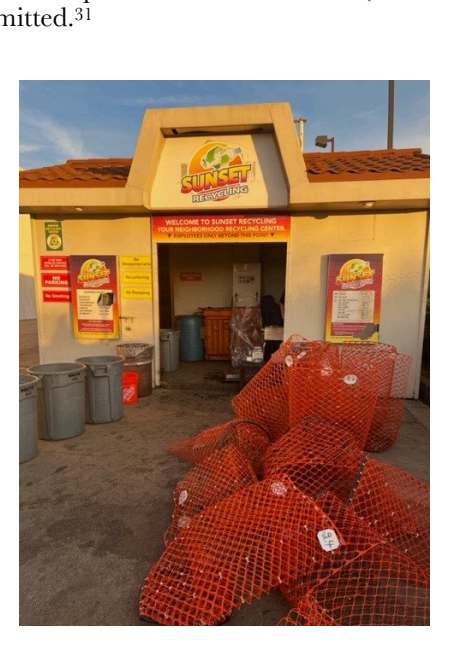
This investigator almost gave up on finding a Sunset depot (above) in Baldwin Park because the navigation app used was at a loss to give correct directions. The depot was located far behind a Food4Less that required making turns on unnamed streets, maneuvering between giant storage bins and loading docks. All California redemption centers follow the same model of payment of full CRV for limited amounts of containers or payment by weight for larger quantities.
The Sunset depot attendant noted that drug users in need of cash will occasionally turn in plastic bottles filled
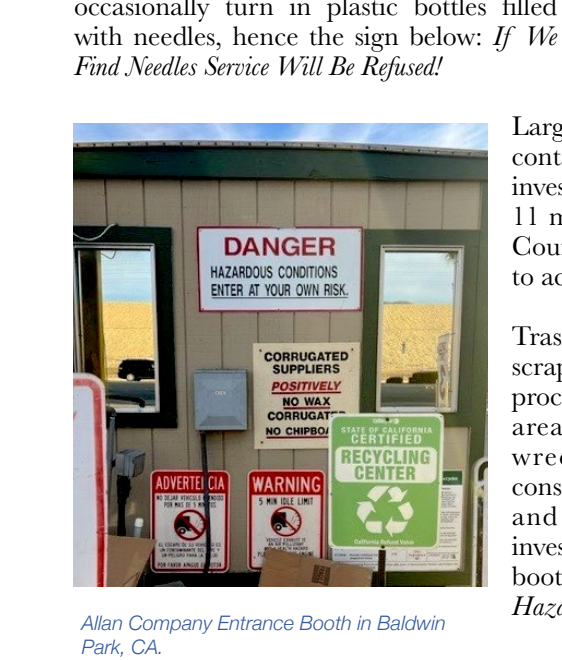
with needles, hence the sign below: If We Find Needles Service Will Be Refused!
Large scrapyards also licensed to redeem containers can be dangerous places. This investigator visited four centers within 4 to 11 miles of South Pasadena in Los Angeles County and found none of them convenient to access.
Trash hauler Allan Company operates a scrap yard, redemption center and curbside processing operation in a heavily industrial area of Baldwin Park featuring auto wreckers, equipment manufacturers, construction companies, and auto repair and tire shops. The first thing this investigator encountered was an entrance booth with a warning sign saying: DANGER, Hazardous Conditions, Enter At Your Own Risk.
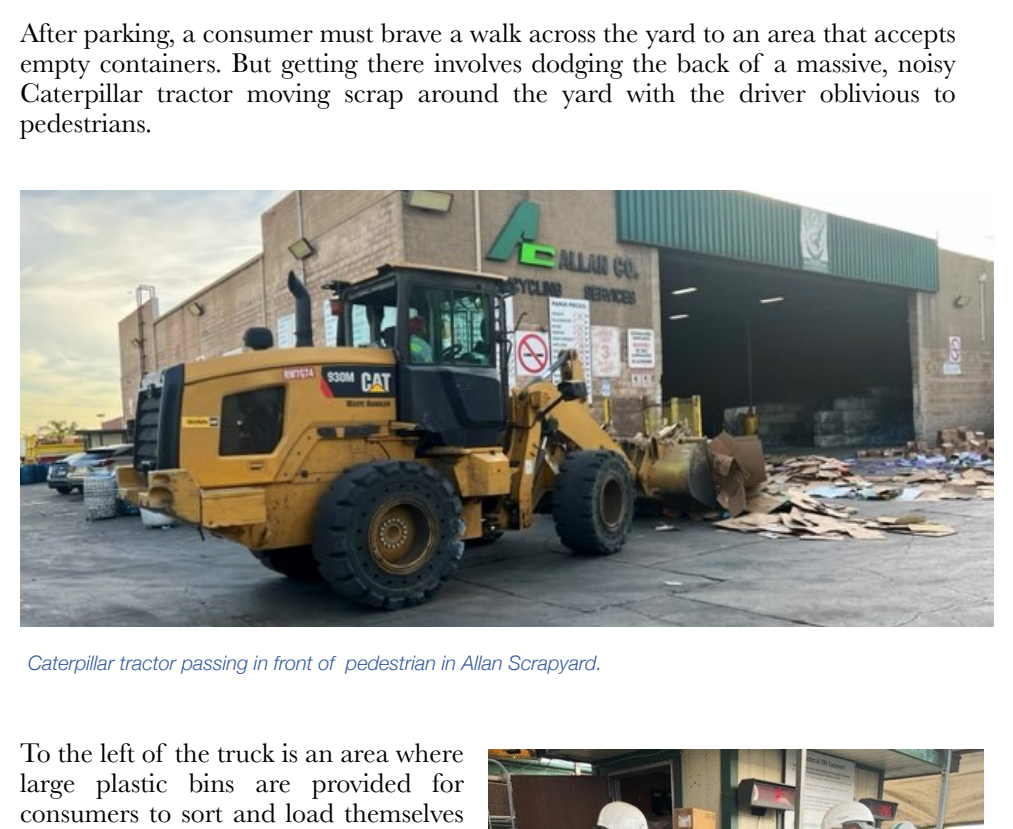
After parking, a consumer must brave a walk across the yard to an area that accepts empty containers. But getting there involves dodging the back of a massive, noisy Caterpillar tractor moving scrap around the yard with the driver oblivious to pedestrians.
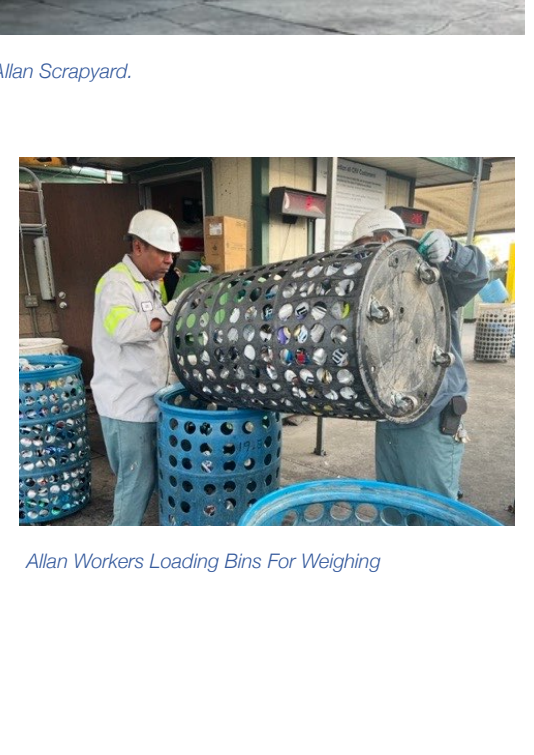
To the left of the truck is an area where large plastic bins are provided for consumers to sort and load themselves with empty CRV containers. Workers then weigh the bins. Consumers have the right to redemption for the full CRV value of a nickel or dime per container, depending on its size, in quantities of up to 50 containers of each material (plastic, glass, aluminum). Most consumers bringing in larger quantities paid by weight.
Consumers then go to a small cashier booth to collect their cash payment.
Building On What Exists In California
Driving miles out of the way and risking bodily harm is not convenient. Nor should it be what consumers regularly have to do to obtain their bottle deposit refunds automatically charged in supermarket checkout lines. Instead, California can build on some of its existing infrastructure and add to it by having retailers fund modern redemption options at their stores and on their parking lots.
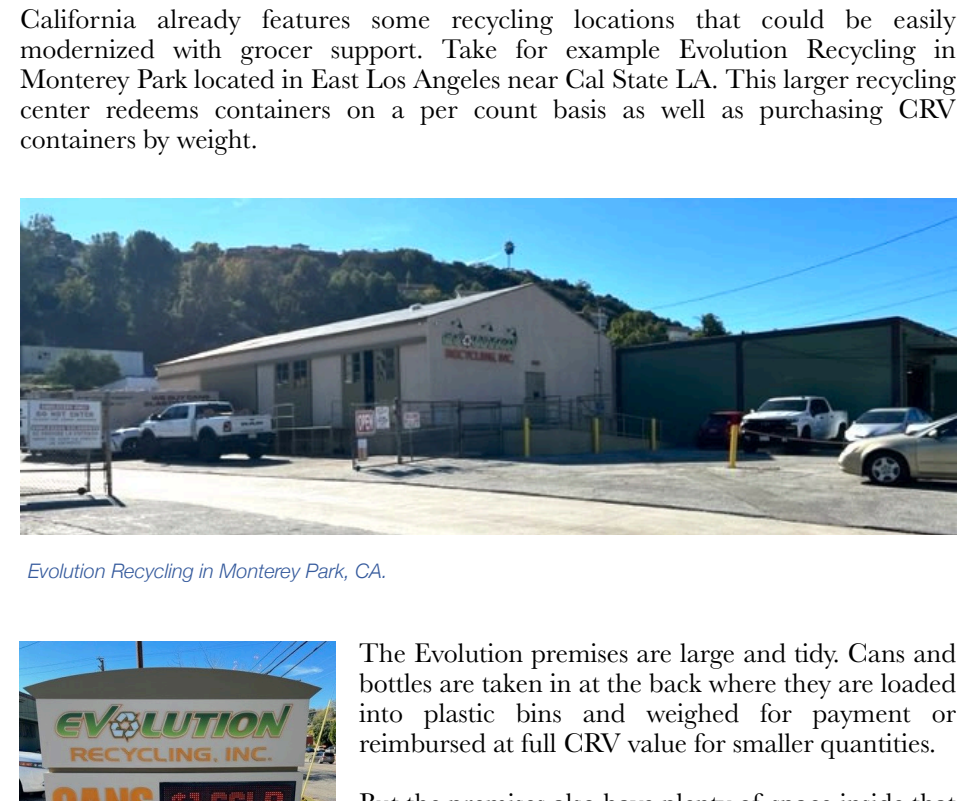
California already features some recycling locations that could be easily modernized with grocer support. Take for example Evolution Recycling in Monterey Park located in East Los Angeles near Cal State LA. This larger recycling center redeems containers on a per count basis as well as purchasing CRV containers by weight.
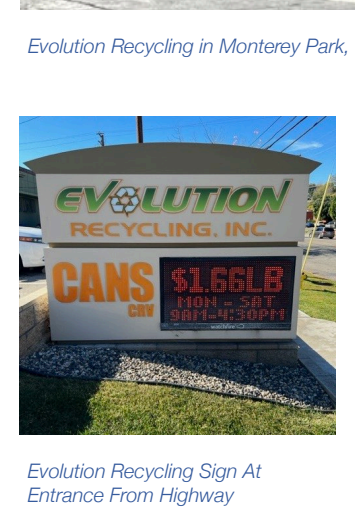
The Evolution premises are large and tidy. Cans and bottles are taken in at the back where they are loaded into plastic bins and weighed for payment or reimbursed at full CRV value for smaller quantities.
But the premises also have plenty of space inside that could be used to create a modern, full-service redemption center with RVMs and bag drop sorting technology. Beverage dealer cooperatives could finance the installation of RVMs and bag drop technology as in Oregon. They could also employ Evolution to service bag drop locations and RVMs on supermarket premises.
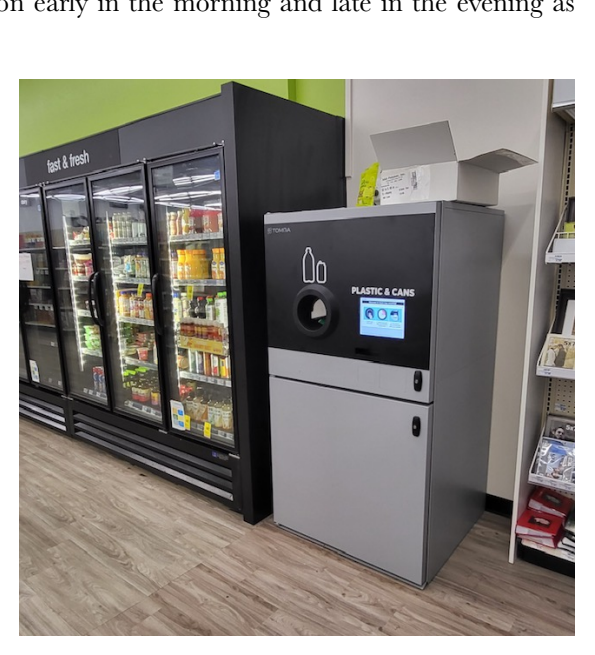
Progressive state beverage retailers in Northern California are already offering convenient RVM service in their stores. Bag drop service could also be added. For example, a reach-in fridge at a Northern California CVS could be switched out for a bag drop kiosk. A bag drop receptacle could easily be installed on its parking lot. RVMs are open during all store hours, providing major convenience to consumers who don’t have time during their workday to redeem containers for deposits. In addition, RVMs can also provide retail stores with extensive information about the beverage buying habits of their customers, giving them a leg up on what to stock. PepsiCo has partnered with RVM maker Olyn’s to install RVMs in seven Safeways and two independent locations in San Mateo and Alameda Counties. The machines crush and separate container materials using artificial intelligence image recognition and provide consumers with an app that enables instant crediting to35 PayPal accounts.
This technology and other technologies, such as bag drop points at retail stores, can
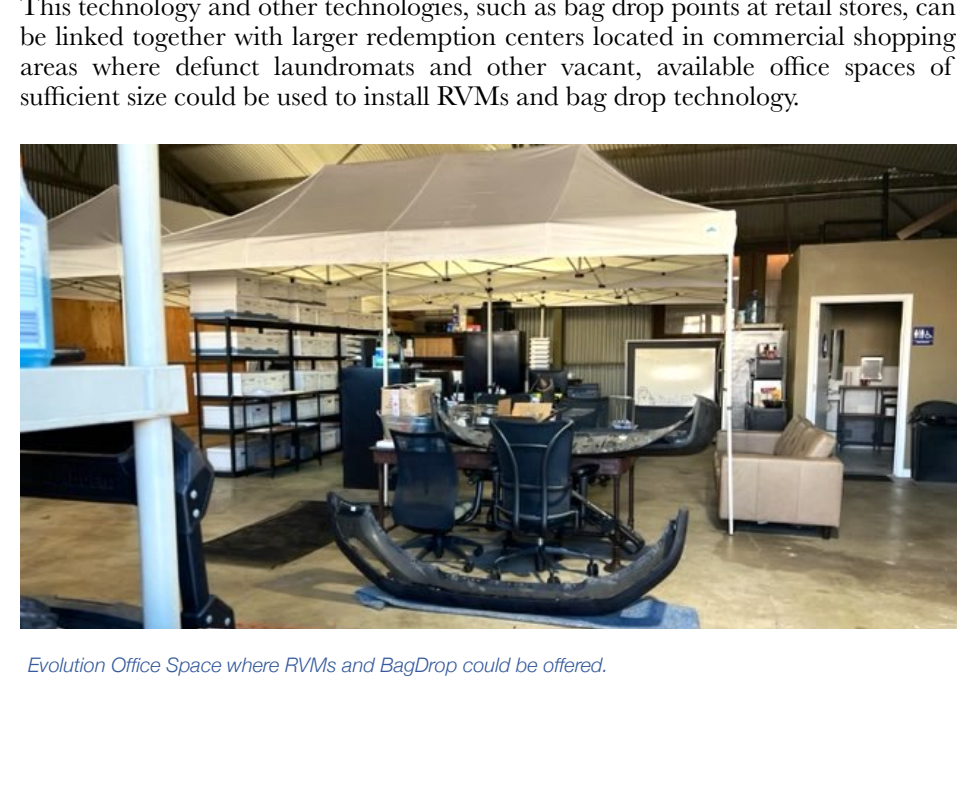
be linked together with larger redemption centers located in commercial shopping areas where defunct laundromats and other vacant, available office spaces of sufficient size could be used to install RVMs and bag drop technology.
Formula For Success
CalRecycle should take several steps to adopt new regulations on redemption, as required by SB 1013. CalRecycle can hire independent firms to conduct public opinion polling and run focus groups to determine what the public considers convenient redemption service. CalRecycle should also seek public input from stakeholders, including recyclers, makers of RVMs and bag processing equipment, and retailers. The beverage industry and retailers should not be writing the rules. Currently required hours of operation for state-certified redemption centers areat least 30 hours per week with a minimum of five hours of operation occurring during periods other than from Monday to Friday, from 9 am to 5 pm. CalRecycle already has the right to require a certified center to operate up to half of its hours outside of the 9-5 timeframe.
Since hours of operation have failed to provide access and convenience, CalRecycle should craft new regulations mandating that both retailers and full-service redemption centers offer 70 hours a week of redemption service. Redemption centers should be required to serve the public the same hours as stores. Working people need access to redemption early in the morning and late in the evening as
well as on both weekend days.
California law currently requires retailers to register as stand-alone redemption centers to participate in the program.
An RVM or one bag drop door at a grocery store is considered a recycling center all on its36 own. According to California law, “If a recycling center consists of reverse vending machines or other automated equipment, or is a bag drop recycling center, the recycling center is ‘open for business’ if the equipment or bag drop is properly functioning and accepting all types of empty beverage containers at one physical recycling location within the recycling location.”
at least 30 hours per week with a minimum of five hours of operation occurring during periods other than from Monday to Friday, from 9 am to 5 pm. CalRecycle already has the right to
If a recycling center consists of reverse vending machines or other automated equipment, or is a bag drop recycling center, the recycling center is ‘open for business’ if the equipment or bag drop is properly functioning and accepting all types of empty beverage containers at one physical recycling location within the recycling location.”
CalRecycle should not count a convenience zone as “served” with only one RVM or one retail bag drop location because their capabilities are not equal to a full-service, modern community redemption depot. Instead, CalRecycle can adopt regulations allowing different modes of automated redemption to define what constitutes a served zone. Further, CalRecycle must adopt regulations specifically allowing proven technologies, such as RVMs and bag drop machines, to constitute a point of redemption to serve currently unserved convenience zones.
This regulation would eliminate the requirement that an attendant be present for ten hours a week for each machine as dealer cooperatives would likely strike maintenance contracts with third parties. In addition, regulations should be reformed so that machines are not required to take containers of all sizes, a minute amount of super large containers carrying deposits can be accepted by CRV beverage retailers for recycling. This regulation would be consistent with the letter and the spirit of existing bottle law even prior to the enactment of SB 1013. It would also enable supermarkets to collect the same subsidies from CalRecycle that current redemption centers serving a convenience zone receive for the provision of redemption service.
As in Quebec, the guidelines should allow for adjustment in areas with higher density requiring fewer redemption locations and less populated areas requiring more points of redemption to raise the redemption rate.
CalRecycle will need to establish regulations for grocer co-ops by relying on industry determinations of the ability of RVMs and Bag Drop depots to collect containers as opposed to full-service redemption centers.
Overall, CalRecycle must define minimum standards of access to redemption, including geographic coverage, and the roles and obligations of retailers. In addition, CalRecycle must define technologies that must be provided for system management and convenient customer experience, minimum criteria for the establishment and operation of community redemption depots and review handling fees paid to dealer cooperatives for providing redemption services.
Conclusion
California’s expansion of the bottle deposit system to include wine and liquor will not work if there is no place for consumers to bring back empty containers for deposit refunds. Improving consumer convenience will substantially increase the redemption rate for clean, recyclable material needed to build a truly circular economy. This simultaneously enables consumers to get back hundreds of millions of dollars in deposit money that they can’t access now. It also presents new opportunities for retailers to expand their ability to gather data about consumer product preferences via the use of smart technology while being paid by the state for redemption service.
CalRecycle should seize the moment to implement extraordinarily visionary legislation enacted in 2022, SB 1013 (Atkins), to finally realize the vision of the original bottle bill legislation by then-Assemblymember Burt Margolin, AB 2020, in 1986. Though beverage dealers are responsible for creating a working redemption system, it is up to CalRecycle to ensure that consumer convenience is finally delivered by adopting tough but fair regulations for beverage dealers and for dealer redemption cooperatives to meet. Then CalRecycle must ensure that the dealer cooperative proposals that they approve actually deliver the convenience promised. Otherwise, the state will let consumers down once again.
Citations
For how broken California’s deposit system is, see: https:// www.consumerwatchdog.org/energy/consumer-watchdog-unveils-top-10-signs-californias-shattered-bottle-deposit-system-urges (opens in new tab)2 California’s statutory goal for recycling deposit-carrying bottles and cans is 80%. Waste haulers that collect CRV containers in recycling bins account for about 10% of that official recycling rate. These waste haulers do not redeem deposits, rather they bill the state for them while contaminating containers at a high rate. Thus, Consumer Watchdog does not include them in the redemption rate of direct consumer returns for deposit refunds.3 For a comprehensive report on bottle deposit fraud in California, see: https:// consumerwatchdog.org/sites/default/files/2022-01/ CASH%20FOR%20TRASH%202022.pdf (opens in new tab)4 See: https://casetext.com/statute/california-codes/california-public-resources-code/ division-121-california-beverage-container-recycling-and-litter-reduction-act/ chapter-65-dealer-cooperatives/section-145785-model-dealer-cooperative-redemption-plans-emergency-regulations-duties-of-dealer-cooperatives (opens in new tab) Specifically, SB 1013’s Section 14578.5. states: (c)A dealer cooperative shall do all of the following: (1)Submit a redemption plan to the department to provide redemption in one or more unserved convenience zones. Redemption programs shall include sufficient redemption opportunities for consumers that have comparable consumer convenience to the requirements of Section 14571…”
(3)(A)Redeem all material types and offer one or more redemption locations within the dealer cooperative zone.5 For analysis of the status of convenience zones in 2019, see: https:// www.container-recycling.org/images/stories/PDF/ BackgroundonCaliforniasConvenienceZoneStructureandCurrentStatus.pdf (opens in new tab) For more on the return-to-retail model, see: https:// www.openaccessgovernment.org/deposit-return-systems/52221/ (opens in new tab)7 For more on recycling rates during and after the pandemic, see: https:// www.recyclingproductnews.com/article/38856/us-beverage-container-redemption-rates-in-bottle-bill-states-remain-below-pre-covid-levels (opens in new tab)8 See Reloop’s Global Deposit Book survey, page 15, here: https:// www.reloopplatform.org/wp-content/uploads/2022/11/ RELOOP_Global_Deposit_Book_11I2022_P1.pdf (opens in new tab)9 For the Reloop article on supermarkets, botte returns and foot traffic, see: https:// www.reloopplatform.org/wp-content/uploads/2018/09/In-Our-Opinion-Why-deposits-make-sense-for-retailers-Resource-Recycling-News.pdf (opens in new tab)10 For more on the principles of successful return systems, see: https://www.cancentral.com/GuidanceDocumentForNationalDepositSystem (opens in new tab)11 For Consumer Watchdog’s comprehensive report on bottle deposit fraud in California, see: https://consumerwatchdog.org/sites/default/files/2022-01/ CASH%20FOR%20TRASH%202022.pdf (opens in new tab)12 For a comprehensive Consumer Watchdog report on California pilot redemption programs, see: https://consumerwatchdog.org/wp-content/uploads/ 2022/06/2022-06_PILOT-ERROR-report.pdf (opens in new tab)13 For more on pilot funding, see: https://calrecycle.ca.gov/bevcontainer/ recyclers/pilot2018/ (opens in new tab)14 For a review of CalRecycle funded pilot programs, including the SF BottleBank program, see: https://consumerwatchdog.org/energy/pilot-error-how-calrecycles- new-crv-refund-pilots-are-crashing-and-burning/ (opens in new tab) For more on BottleBank, see their website at: https://sfbottlebank.org/ locations/ (opens in new tab)16 For the specifics on new and existing pilots that CalRecycle is funding, see: https://consumerwatchdog.org/wp-content/uploads/2023/03/RPP2-Award- RFA-3.21.23-signed.pdf (opens in new tab)17 For more on Oregon’s bottle bill, see: https://www.oregon.gov/deq/recycling/pages/bottle-bill.aspx (opens in new tab)18 For Oregon’s redemption rules, see: https://www.oregon.gov/olcc/Docs/ bottle_bill/Bottle-Bill-Retailer-Guidelines.pdf (opens in new tab)19 For more on OBRC, see: https://obrc.com/about-obrc/who-we-are-and-what- we-do/ (opens in new tab)20 See interview with OBRC CEO Jules Bailey here: https://www.wastedive.com/ news/jules-bailey-oregon-bottle-bill-refillable-epr/641705/ (opens in new tab)21 For a Washington State analysis of the waste bill, see: https:// lawfilesext.leg.wa.gov/biennium/2023-24/Pdf/Bill%20Reports/House/ 1131%20HBA%20ENVI%2023.pdf?q=20230309133423 (opens in new tab)22 For Quebec’s pilot study, see: https://consumerwatchdog.org/wp-content/ uploads/2023/03/Houston-Consulting-rapport-interimaire-projets-pilotes-mod-consigne-May-2022-translated-ENG.pdf (opens in new tab) For a schedule of redemption targets in Quebec, see: https:// www.environnement.gouv.qc.ca/matieres/consigne-collecte/modernisation- consigne-en.htm#changes (opens in new tab) For a review of the new convenience standards in Quebec, see: https:// consumerwatchdog.org/wp-content/uploads/2023/03/Convenience-Standards- Quebec.pdf (opens in new tab) For Quebec’s statute on the bottle deposit system, see: https://consumerwatchdog.org/wp-content/uploads/2023/03/Division- III_Regulation-retailers.pdf (opens in new tab)24 For a schedule of redemption targets in Quebec, see: https:// www.environnement.gouv.qc.ca/matieres/consigne-collecte/modernisation- consigne-en.htm#changes (opens in new tab) For a review of the new convenience standards in Quebec, see: https:// consumerwatchdog.org/wp-content/uploads/2023/03/Convenience-Standards- Quebec.pdf (opens in new tab) For Quebec’s statute on the bottle deposit system, see: https://consumerwatchdog.org/wp-content/uploads/2023/03/Division- III_Regulation-retailers.pdf (opens in new tab)25 For more on Connecticut and deposit return systems in the Northeast, see: https://bottlebillreimagined.org/wp-content/uploads/2022/06/Reimagining-the- Bottle-Bill-FINAL-JUNE-2022.pdf (opens in new tab) And https://nerc.org/news-and-updates/blog/nerc-blog/2022/04/26/reloop- reimagines-the-bottle-bill-for-northeastern-states (opens in new tab) For the text of the Connecticut solid waste management bill that includes bottle recycling, see: https://www.cga.ct.gov/2021/ACT/PA/PDF/2021PA-00058-R00SB-01037- PA.PDF (opens in new tab) For more on the Connecticut Bottle Law, see: https://consumerwatchdog.org/wp-content/uploads/2023/03/ CRI_Factsheet.pdf (opens in new tab) And https://portal.ct.gov/-/media/DEEP/reduce_reuse_recycle/bottles/Bottle-Bill- Communication-122022-FINAL.pdf (opens in new tab) And https://portal.ct.gov/DEEP/Reduce-Reuse-Recycle/Bottles/Bottle-Bill-FAQ (opens in new tab)27 For more on Connecticut’s bottle deposit system, see: https://portal.ct.gov/ DEEP/Reduce-Reuse-Recycle/Bottles/Connecticut-Redemption-Centers (opens in new tab)28 See: https://ctmirror.org/2023/02/09/ct-bottle-bill-can-5-cent-deposit-law-change/ (opens in new tab)29 CA and Hawaii have the only two bottle-return systems in the world that allow payment by weight for bottle deposit containers.30 For a Sacramento Bee story about the closure of a Ming’s recycling center in Sacramento, see: https://consumerwatchdog.org/in-the-news/the-sacramento-bee-sacramento-recycle-center-shutters-blames-california-agency-for-irate-customers/ (opens in new tab)31 For more on fraud scams in California, see: https://consumerwatchdog.org/ sites/default/files/2022-01/CASH%20FOR%20TRASH%202022.pdf (opens in new tab)32 See Story of Stuff report here: https://www.storyofstuff.org/wp-content/ uploads/2022/02/Californias-Bottle-Bill-The-Path-to-Redemption.pdf (opens in new tab) See: https://www.consumerwatchdog.org/sites/default/files/2019-02/ Half%20a%20Nickel_0.pdf (opens in new tab)34 For more on consumer convenience, see: http://changingmarkets.org/wp-content/uploads/2020/05/GENIE-IN-A-BOTTLE-UNLOCKING- CALIFORNIAS-BOTTLE-BILL-web.pdf (opens in new tab)35 For more on Olyn’s RVMs, see: https://www.recyclingtoday.com/article/reverse-vending-machines-are-a-matter-of-convenience/ (opens in new tab)36 On what technology currently counts as a “recycling center,” see California Public Resources Code Division 12.1, Section 14571 here: https://law.justia.com/ codes/california/2021/code-prc/division-12-1/chapter-6/section-14571/ (opens in new tab)