There’s no question that the medical malpractice insurers are making more money than they should, and what’s really interesting is several of these companies which are dominant in the market are owned and operated by doctors themselves. And so doctors are charging other doctors excessive rates. I thought it was outrageous, and that’s why I intervened, ordered those companies in, we adjusted their rates, we’ve saved doctors $52 million. California Insurance Commissioner Dave Jones KNBC “News Conference” August 5, 2013 For nearly 25 years, California doctors, hospitals and other healthcare providers have reaped the benefits of the most protective insurance company accountability laws in the nation. Under the voter-enacted Proposition 103, insurance companies have been forced to return hundreds of millions of premium dollars to healthcare professionals through refunds and rate reductions. Policyholders have saved millions more simply because strong insurance rate regulation makes it difficult for insurance companies to overcharge their customers in California.
While hospitals and doctors have benefited from this oversight of the insurance industry, patients who are injured by medical negligence are unprotected. Another California law, the 1975 Medical Injury Compensation Reform Act (MICRA), limits the legal rights of patients injured by medical negligence. A $250,000 cap on damages has stayed the same for nearly 38 years, because the medical industry argues any increase would lead to premium hikes for health providers.
This report reviews the data related to medical malpractice premiums paid in California in the wake of both changes in California law. The report’s key findings include:
- Real* medical malpractice insurance premiums rose substantially during the pe-
riod after MICRA and before rate regulation was enacted.
- Real medical malpractice premiums have fallen in California since voters enacted
rate regulation.
- In response to Proposition 103’s rollback requirement, medical malpractice
providers refunded more than $73 million to doctors and other health service providers.
- Premiums are falling again since Insurance Commissioner Jones ordered $52 mil-
lion in decreases by every major carrier over the past year.
- Public challenges to excessive malpractice rates on behalf of physicians, nurses
and dentists have resulted in $77 million in premium savings.
After seeing insurance rates increase dramatically in the first 13 years after MICRA was enacted, California health care providers have been systematically protected by the insurance reform rules that have guided insurance rates in the state for 25 years. This report details the premium data that lead us to that conclusion. *Throughout this report, when adjusting to real dollars, we use the Bureau of Labor Statistics Consumer Price Index All Urban Consumers.
Limits on Patients’ Legal Rights Did Not Lower Malpractice Premiums For Doctors In California
In 1975, the insurance companies that provided coverage for acts of medical negligence in California threatened California physicians, hospitals and other healthcare providers with massive rate hikes. In response to political pressure brought by the rate hikes, and physician threats to leave the state, Governor Jerry Brown signed the Medical Injury Compensation Reform Act (MICRA), which placed a series of limits on injured patients’ legal rights. Most prominent among the restrictions was a $250,000 cap on noneconomic damages. The medical-insurance coalition presented the $250,000 cap, along with the other rules of MICRA, as a force for lower insurance rates. In fact, doctors and hospitals found themselves paying substantially more for medi-cal malpractice insurance during the thirteen years following the law’s enactment. As Table 1 below illustrates, medical malpractice premiums were 450% higher in nominal dollars in 1988 than in 1975 when MICRA was enacted. Even after adjusting for inflation, doctors and hospitals paid 150% more for medical malpractice insurance 13 years after the law’s enactment than in 1975. On average, doctors and hospitals spent 70% more on premiums during the MICRA years, after adjusting for inflation, than immediately prior to enactment.
Table 1
California Medical Malpractice Insurance Premiums
Table 1
During the MICRA Years In Nominal and Real Dollars Increase Premium Increase over Premium (Nominal over 1975 (Adjusted to 1988 1975 Premium Dollars) (Adjusted) PremiumDollars) Year 1975 $120,650,000 — $265,295,446 — 1976 $228,451,000 89% $474,969,302 79% 1977 $227,077,000 88% $443,287,279 67% 1978 $248,724,000 106% $451,289,098 70% 1979 $238,932,000 98% $389,334,099 47% 1980 $230,230,000 91% $330,536,517 25% 1981 $203,825,000 69% $265,263,999 0% 1982 $210,652,000 75% $258,239,706 -3% 1983 $287,256,000 138% $341,188,602 29% 1984 $374,661,000 211% $426,587,067 61% 1985 $449,727,000 273% $494,448,923 86% 1986 $629,448,000 422% $679,413,307 156% 1987 $633,903,000 425% $660,129,621 149% 1988$663,155,000450%$663,155,000150% Average Adjusted Average Increase Increase Over 1975 Over 1975 Premium 195%70% Premium (1976-1988) (1976-1988) Sources: Report on Profitability By Line By State, 1976-2011, National Association of Insurance Commissioners (Nov. 2012); Bureau of Labor Statistics Consumer Price Index All Urban Consumers
California Medical Malpractice Insurance Premiums During the MICRA Years In Nominal and Real Dollars Premium (Nominal Dollars) Increase over 1975 Premium Premium (Adjusted to 1988 Dollars) Increase over 1975 Premium (Adjusted)
Insurance Reform Proposition 103 Lowered Malpractice Premiums For Doctors and Hospitals In California
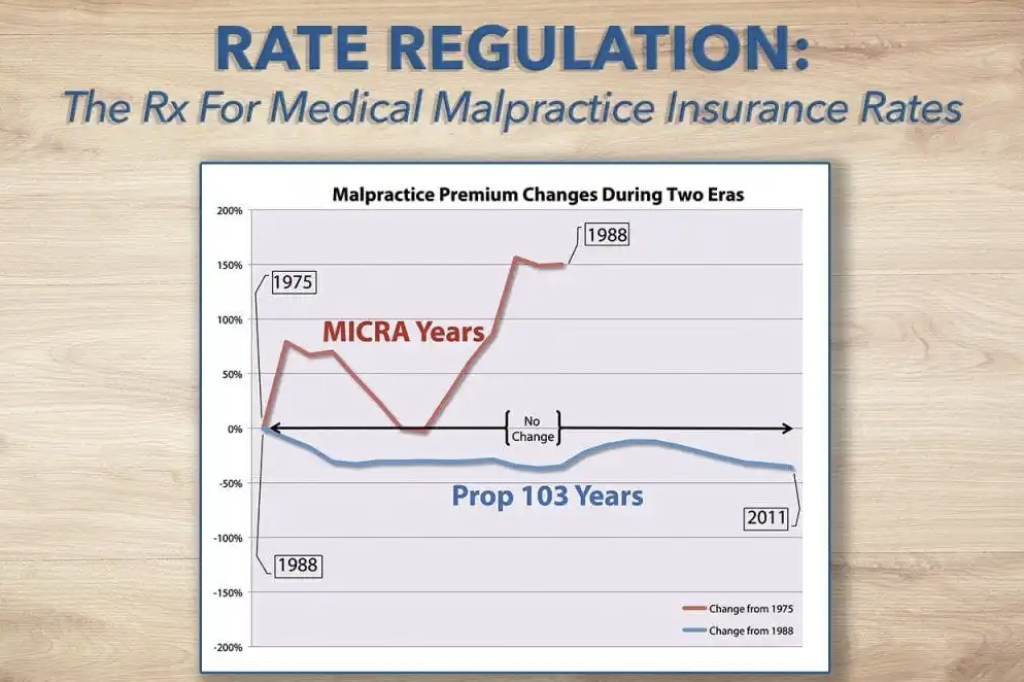
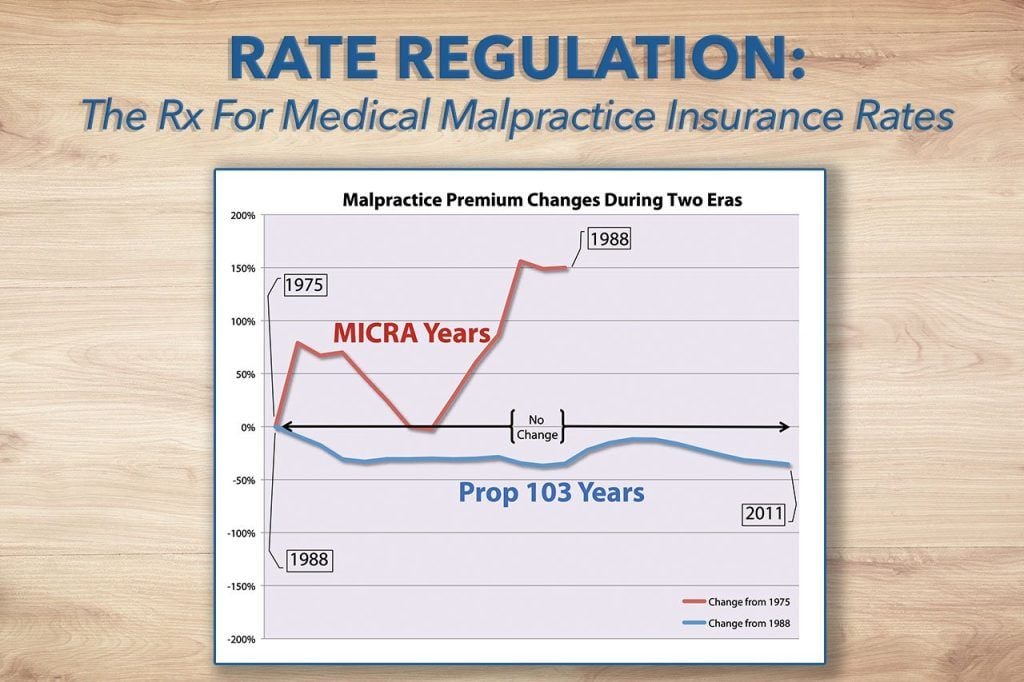
Unlike the damage caps, which failed to have much long-term impact on the premiums paid by medical professionals and institutions, data show that the stringent regulatory formula created by the voter-approved Proposition 103 in 1988 had a significant impact on premiums. In fact, Proposition 103 pushed inflation-adjusted premiums below the 1988 figure for every single year of this survey. Figure 1 shows that between 1975 and 1988 – the MICRA Years – inflation-adjusted premiums are almost exclusively higher than the pre-MICRA level and trend upward, while after 1988 – the Prop 103 Years – inflation-adjusted premiums are exclusively lower than 1988’s premium total and trend slightly downward.
Figure 1 Malpractice Premium Changes During Two Eras Figure 1
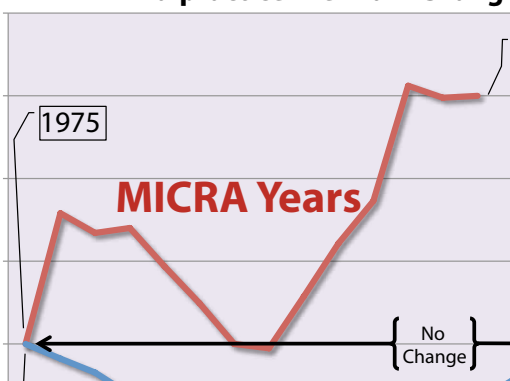
MICRA Years Prop 103 Years
While MICRA caps the claims payments of insurance companies by limiting what patients could receive for their injuries, the 1975 law did nothing to limit the premiums insurance companies could charge. As a result, insurers’ claims costs fell but, as the table and graph above illustrate, premiums generally continued to escalate. Proposition 103, on the other hand, requires insurers to publicly justify any rate changes and prohibits excessive rates. Malpractice insurance companies must submit rates for review and approval before they take effect. The contrast of this approach with the claims-side approach of MICRA could not be more stark: instead
| 1988 | ||
|---|---|---|
| 1975 | ||
| MICRA Years | ||
| No | ||
| Change | ||
| Prop 103 Years 2011 | ||
| 1988 | ||
| Change from 1975 Change from 1988 |
of paying 70% more on average for medical malpractice insurance in the wake of MICRA, doctors and hospitals pay 26% less on average than they did immediately prior to the enactment of Proposition 103. As Table 2 shows, the nominal cost of medical malpractice insurance in California in 2011 is only 23% higher than premiums were 23 years prior in 1988. Recall that 13 years after MICRA, nominal premiums had risen 450%. The inflation-adjusted range of total premium paid after MICRA was between 2% lower than 1975 (1982) and 156% higher (1986). In contrast, real malpractice premiums after Prop 103 ranged from 9% lower than 1988 levels (1989) to 37% lower (2000) and, in 2011, were 36% lower than health professionals and hospitals paid before Proposition 103. In fact, since Proposition 103’s enactment, real premiums have never been as high in California as they were in 1988, after 13 years of MICRA.
Table 2
Table 2California Premiums Earned: Medical Malpractice Insurance Premium Increase Premium Increase (Nominal over 1988 (Adjusted to over 1988 Year Dollars) Premium 1988 Dollars) Premium 1988 $663,155 – $663,155 – 1989 $633,424 -4% $604,307 -9% 1990 $605,762 -9% $548,291 -17% 1991 $529,056 -20% $459,525 -31% 1992 $526,496 -21% $443,938 -33% 1993 $563,004 -15% $460,923 -30% 1994 $576,771 -13% $460,405 -31% 1995 $597,660 -10% $463,932 -30% 1996 $610,003 -8% $459,932 -31% 1997 $628,858 -5% $463,513 -30% 1998 $652,601 -2% $473,636 -29% 1999 $611,785 -8% $434,419 -34% 2000 $609,712 -8% $418,867 -37% 2001 $647,198 -2% $432,318 -35% 2002 $787,182 19% $517,641 -22% 2003 $873,789 32% $561,789 -15% 2004 $933,757 41% $584,772 -12% 2005 $963,059 45% $583,358 -12% 2006 $949,011 43% $556,885 -16% 2007 $913,780 38% $521,362 -21% 2008 $884,663 33% $486,085 -27% 2009 $824,207 24% $454,484 -31% 2010 $816,768 23% $443,114 -33% 2011 $813,264 23% $427,712 -36% Average Average Increase Adjusted Increase over 1988 9%over 1988 -26% Premium (1989- Premium (1989- 2011) 2011) Sources: Report on Profitability By Line By State, 1976-2011, National Association of Insurance Commissioners (Nov. 2012); Bureau of Labor Statistics Consumer Price Index All Urban Consumers
| TaTabblele 22 | ||||
|---|---|---|---|---|
| California Premiums Earned: Medical Malpractice Insurance | ||||
| Premium (Nominal Dollars) | Increase over 1988 Premium | Premium (Adjusted to 1988 Dollars) | Increase over 1988 Premium |
| Average Increase over 1988 Premium (1989- 2011) | 9% | Average | -26% | ||
|---|---|---|---|---|---|
| Adjusted Increase | |||||
| over 1988 | |||||
| Premium (1989- | |||||
| 2011) |
Proposition 103-Mandated Refunds Returned Tens of Millions of Dollars To Doctors And Hospitals And Stabilized The Marketplace
One of the ways that Proposition 103 provided relief for doctors and other providers was through an explicit rate rollback of up to 20%. The relevant portion of California Insurance Code Section 1861.01 provides: For any coverage for a policy . . . of insurance subject to this chapter . . . every insurer shall reduce its charges to levels which are at least 20% less than the charges for the same coverage which were in effect on November 8, 1987.
Medical malpractice insurers were among the first insurance companies in California to comply with Proposition 103’s mandatory rate rollback. Four of the state’s largest malpractice insurers – Norcal Mutual, SCPIE, The Doctors Company and MIEC – refunded $69.1 million to doctors by 1992. Proposition 103 Mandated Refunds Paid by Major Medical Malpractice Insurer s
Table 3 Table 3
Malpractice Insurer Total Refund** Date Paid Norcal Mutual Insurance Co. $19,875,172 10/6/91 SCPIE $30,730,384 10/15/91 Doctors Insurance Co. $18,519,217 2/20/92 Medical Insurance Exchange of CA Group $4,725,452 10/8/93 $73,850,225.00 Total Paid by Major Malpractice Insurers Source: California Department of Insurance ** Includes interest.
Source: California Department of Insurance ** Includes interest.
| Malpractice Insurer | Total Refund** | Date Paid |
|---|---|---|
| Norcal Mutual Insurance Co. | $19,875,172 | 10/6/91 |
| SCPIE | $30,730,384 | 10/15/91 |
| Doctors Insurance Co. | $18,519,217 | 2/20/92 |
| Medical Insurance Exchange of CA Group | $4,725,452 | 10/8/93 |
| Total Paid by Major Malpractice Insurers | $73,850,225.00 | |
| Source: California Department of Insurance ** Includes interest. |
In addition to these direct refunds paid to policyholders as a result of Proposition 103, the law has required insurers to abide by a regulatory system that has meant substantially less premium volatility for policyholders. By requiring insurers to justify changes prior to imposing any rate hikes and by opening the rate approval process up to public scrutiny, insurers’ pricing has been much more predictable since Prop 103 took effect. Figure 2 shows that doctors and hospitals saw annual adjusted premium changes of more than 10% (five increases and three decreases) during more than half of the MICRA years (1975-1988), while there have only been two years in the 23 years since Prop 103 in which doctors encountered premiums increasing by more than ±10% (one increase, one decrease). Put differently, Proposition 103 imposed rules on insurance companies that stabilized premiums for policyholders. MICRA resulted in no new scrutiny of insurance company rates so premiums swung dramatically.
Figure 2 Figure 2 Annual Malpractice Premium Volatility rMICRA Years Prop 103 Years
MICRA Years
Recent Regulatory Action and Public Challenges Have Pushed Rates Even Lower
The success of rate regulation under Proposition 103 has been amplified by proactive efforts by the California Department of Insurance over the past two years. Proposition 103 requires the Department of Insurance to review and approve every medical malpractice rate increase before it takes effect. It also prohibits an excessive rate from remaining in effect.
As Insurance Commissioner Dave Jones told KNBC’s “News Conference” in August 2013: “These MICRA caps, as they’re called, … haven’t actually worked to keep rates down. What helps keep rates down is rate regulation, which is an authority I have and have used successfully on behalf of medical providers to try to reject excessive rates.” In a March 2011 news release, Insurance Commissioner Dave Jones announced a comprehensive review of medical malpractice insurance rates: “Unlike health insurance, where I do not have the authority to reject excessive rates, the Insurance Commissioner does have the authority to regulate the rates of medical malpractice insurance paid for by doctors, surgeons, clinics and other health providers… “We have found that recent loss ratios – the percentage of every premium dollar the insurer spends on claims – of many medical malpractice insurers are low, and that’s why I have directed my staff to carefully examine the rates of medical malpractice insurers. Low loss ratios are one indication that premiums may be too high…
The review uncovered that malpractice insurers were paying out in claims just a fraction of the amount they were collecting in premiums from doctors, including one insurer that was paying just 10 cents in claims for every dollar in premium. Commissioner Jones ordered the five largest California medical malpractice insurers, representing about 86% of the market, and one smaller company, to lower excessive rates by $52 million. The rate decreases in Table 4 took effect in 2012.
Table 42012 Medical Malpractice Insurance Rate Reductions Table 4 Insurer Savings in Millions
NORCAL Mutual Insurance Company (Aug) $8.5 NORCAL Mutual Insurance Company (Mar) $9.65 Medical Protective Company $3 Doctors Company, An Inter-Insurance Exchange $21 The Dentists Insurance Company $4 The Medical Insurance Exchange of California $5.3 NCMIC Insurance Company $500,000
Total rate reductions $51.95 million
Source: California Department of Insurance
2012 Medical Malpractice Insurance Rate Reductions Insurer Savings in Millions NORCAL Mutual Insurance Company (Aug) $8.5 NORCAL Mutual Insurance Company (Mar) $9.65 Medical Protective Company $3 Doctors Company, An Inter-Insurance Exchange $21 The Dentists Insurance Company $4 The Medical Insurance Exchange of California $5.3 NCMIC Insurance Company $500,000 Total rate reductions $51.95 million
“There’s no question that the medical malpractice insurers are making more money than they should, and what’s really interesting is several of these companies which are dominant in the market are owned and operated by doctors themselves. And so doctors are charging other doctors excessive rates. I thought it was outrageous, and that’s why I intervened, ordered those companies in, we adjusted their rates, we’ve saved doctors $52 million.” Proposition 103’s insurance reforms also allow any member of the public to participate in the regulatory process by challenging an excessive rate. Consumer Watchdog has used this public intervention system to challenge excessive medical malpractice insurance rates and save physicians, nurses and dentists $77 million since
CA Prop. 103 (2003-2013)
Consumer Watchdog rate challenge savings
Medical Malpractice
$80 Million Amer. Casualty of Reading, PA 1.7m Medical Protective Co. 8.9m $70 Million National Union 0.9m $60 Million Norcal Mutual 19.3m $50 Million $40 Million $30 Million SCPIE 34.0m $20 Million $10 Million The Doctors Co. 12.3m
Total: $77.1 million
In the course of one of these rate challenges, an insurance executive admitted under oath that MICRA didn’t impact the price of malpractice insurance in California. SCPIE Assistant Vice President and Associate Actuary James Robertson testified that: “While MICRA was the legislature’s attempt at remedying the medical malpractice crisis in California in 1975, it did not substantially reduce the relative risk of medical malpractice insurance in California.”
Medical malpractice insurance rates spiked 450% in the thirteen years after the Medical Injury Compensation and Reform Act’s cap on damages in cases of medical negligence was enacted in 1975. Physicians’ malpractice insurance rates fell, and then stabilized, only when the voters approved Proposition 103’s strong insurance rate regulation in 1988. Annual variations in rates from year to year are now significantly less drastic and, as a result of the regulatory process, far more predictable than ever before. Since 1988, doctors have saved hundreds of millions of dollars from reductions and rebates on excessive insurance premiums. Insurance regulation, not limits on patients’ legal rights, is responsible for lowering medical malpractice insurance premiums for medical professionals in California. Proposals to index for inflation MICRA’s cap on non-economic damages will therefore have no impact on physicians’ malpractice premiums in California. Threats that physicians will flee the state, resulting in less access to health care providers for Californians because of higher medical malpractice insurance rates, are also unfounded.