
By John S Kiernan, WALLET HUB
Google is the portal to the internet for millions of people, serving not just as the bridge between searchers and information but also increasingly positioning itself as the final destination, pushing owned and operated properties and features on users. In recent years, however, a growing number of people – including journalists, SEO industry insiders, folks in related businesses, and normal people perusing the web – have been voicing concerns about noticeable cracks in the foundation and wondering whether Google search is broken.
To help further the discussion, this report examines the quality of Google search results as well as the impact on consumers and how people feel about the current situation. It also provides evidence for potential motives for the status quo as well as commentary from WalletHub CEO Odysseas Papadimitriou. WalletHub reached out to Google for comment on this report, but they declined.
Table of Contents
Evidence of Declining Google Search QualityProof That Deteriorating Search Quality Is a Deliberate StrategyCommentary From WalletHub CEOIn-Depth ExamplesAsk the Experts
Evidence of Declining Google Search Quality
It can sometimes prove difficult to see the forest for the trees when dealing with something as expansive and complex as Google search results. But when you combine academic research and news coverage with independent analysis on social media, you can get a much clearer picture of how things work – or don’t work, as the case may be.
Below, we have assembled key statistics and other evidence from a variety of sources that illustrate Google’s decline. Of course, Google will contend that everything is better than ever and people love what search has become. However, there are some clear issues, as you can see below.
Most Searches Don’t Get Past Google: Just 36% of Google searches in the U.S. make it to the open web (i.e. a site that isn’t owned by Google or paying Google ad revenue).
Google Search Drives Alphabet Revenue: Search ads accounted for more than half of Alphabet’s revenue and nearly three-quarters of the company’s advertising revenue in 2023, according to company filings.
International Results Are Invading: Websites with information intended for people in the UK, Canada and India routinely show up in U.S. search results for finance queries.
Ads Are Becoming Harder to Avoid: Google’s efforts to make its ads less obvious and to push organic results farther down on the search results page are well documented. For example, a 2020 Moz report found that the first organic result went from an average of 375 pixels down the page in 2013 to 976 pixels down in 2020.
Ads Are Taking Over New Real Estate: Google is now putting advertisements in the middle of the search results page, making it harder to differentiate ads from organic results.
Users Notice the Results Going Downhill: 63% of people think that Google search results were better the previous year, according to a nationally representative WalletHub survey.
Too Many Ads & Irrelevant Results: 66% of people think Google shows too many ads, while 35% think it shows too many irrelevant results.
Low-Quality Results Are Widely Discussed: Lots of examples of poor-quality results have been documented in recent years.
Top Results Lack Relevance: Only 41% of the top 10 search results meet the user’s intent, according to WalletHub’s study on credit card and banking queries.
Biased Results Lack Transparency: 34% of the relevant pages appearing in the top 10 results show only advertiser products to consumers, and 58% of them are not transparent about doing so.
Preference for Big Brands: 72% of people think Google has a bias toward big brands because rather than providing the best information, Google is simply returning whatever the most popular brands give them. Name recognition, not quality content, is really what’s being rewarded.
Going Overboard With Forums: 55% of people think Google emphasizes Reddit too much in search results. After all, it’s common to see old, archived, and outdated Reddit pages that people can’t interact with or get up-to-date information from and forums supposedly about something very different from the topic of the query.
Bad Recommendations: Google can’t identify the most thoroughly-researched, unbiased information, and search results are skewed toward big brands. The top product recommended by the first five relevant search results for banking and credit card queries could cost consumers an average of $202 (and up to $1,347).
Searches per Person Are Rising: The number of Google searches per person is at an all-time high, and given that Google’s market share has not changed, this suggests that people either search more or can’t find information as efficiently. Based on the information above, we believe the latter is true.
You can see some in-depth examples of these issues at the bottom of this report.
Proof That Deteriorating Search Quality Is a Deliberate Strategy
Internal documents and emails revealed as part of United States v. Google LLC (2020), the lawsuit in which Google was ruled to be a monopoly, provide insight into how the company operates and what may be driving the quality of search results downward. Below, we’ll take you through some examples from the trial’s public exhibits that show how advertising interests overtook product quality and consumer satisfaction over time.
Google has known for years that significantly reducing quality would not hurt the business in a significant way.
Example 1 (source):
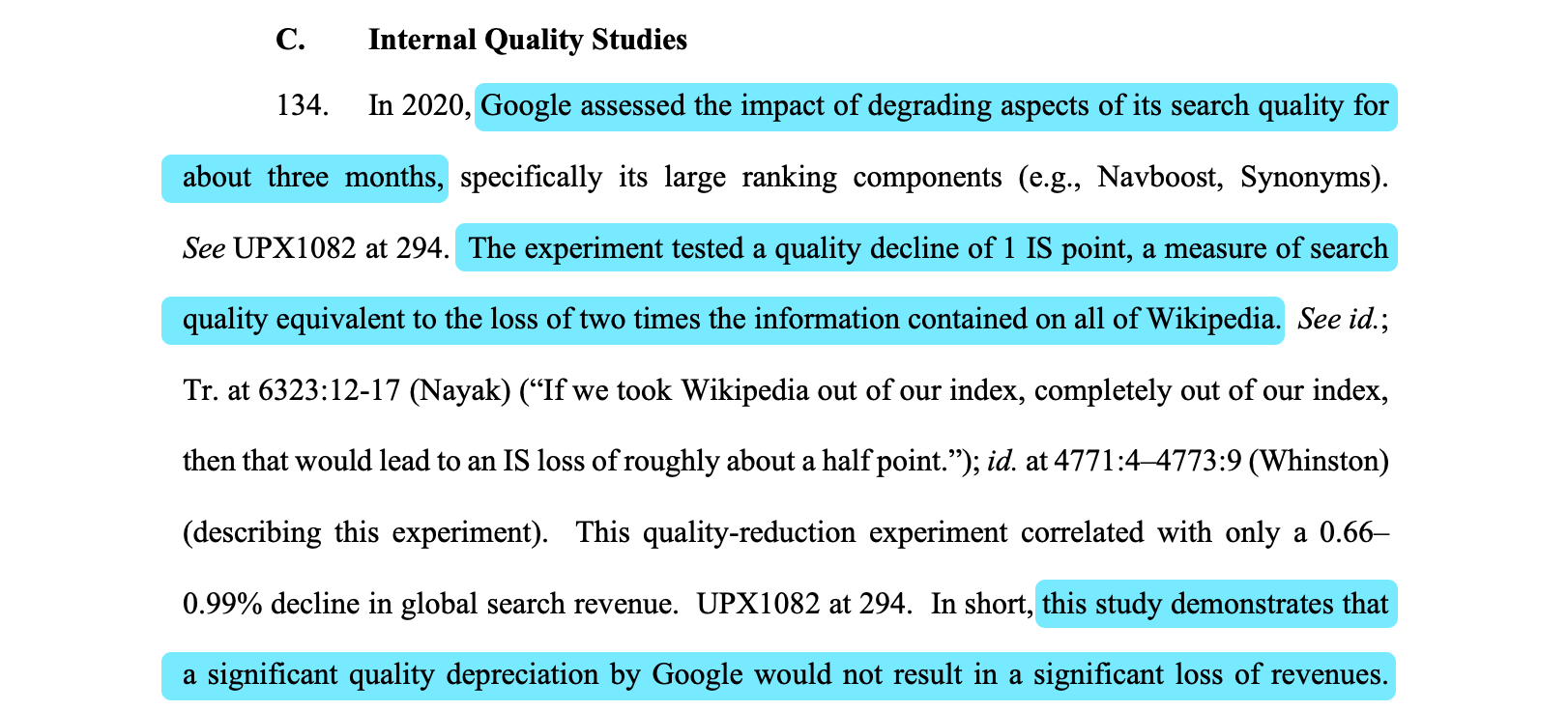
The advertising and search teams previously butted heads about growth efforts that would be negative for consumers.
Example 2 (source):

Example 3 (source):

Example 4 (source):

Despite the company’s long track record of separating the search and advertising teams (and most likely after seeing internal data on the limited impact of lower quality search results on revenue), Alphabet CEO Sundar Pichai decided to change things in June 2020 and appoint the head of the ads business to lead the search business.
Example 5 (source):

Google executives know that query growth drives revenue, which drives Wall Street sentiment, Alphabet’s stock price, and their compensation.
Example 6 (source):

Example 7 (source):

Example 8 (source):

Example 9 (source):

Example 10 (source):

Example 11 (source):

Google executives clearly knew that the more people have to search in order to find the information they want, the more ads they would see and the worse the quality of search would be.
Example 12 (source):

Example 13 (source):

Example 14 (source):

Alphabet’s stock price increased by roughly 160% since they put the head of the ads business to lead search, while the S&P 500 increased by ~100%.
Example 15:

Some Google insiders warned of being overly incentivized by the stock market. The voices that now lead Google drowned them out.
Example 16 (source):

Commentary From WalletHub CEO
 “The quality of Google search results in the personal finance vertical has been declining for years, according to WalletHub data. And, just from anecdotal evidence, this deterioration is across the board – it is not confined to personal finance.
The decline in Google search quality could be the result of poor execution or honest mistakes, but I believe it’s actually an intentional strategy designed to boost advertising revenue. Google didn’t just go from being one of the most sophisticated tech companies in the world to a broken bureaucracy that can’t understand how its own algorithm works overnight. Smart people still work there. They’re just working to maximize ad revenue rather than organizing the world’s information, as was once their claim to fame.
Since Google doesn’t have any real competition, it can make the best information hard to find, forcing users to stay on Google for longer and interact with more ads. This is dangerous for consumers, most of whom think the best results appear first.”
–
“It’s fair to wonder how it makes any sense for a business to worsen its product on purpose. Well, it’s important to remember that Google is a monopoly, according to the recent antitrust verdict, and not a normal business that is affected by the rules governing healthy and competitive free markets.
Like any monopoly that knows its customers don’t have better alternatives, Google appears to have seized on the opportunity to boost profits. You see, the worse the organic search results are, the more useful the ads become. In addition, the worse the results, the more people have to refine their queries to find the information they need, which again leads to more ads.
Still not convinced that inferior results are good for a search monopoly? Just consider the polar opposite scenario. Imagine Google was able to truly serve the absolute best result right below the ads. In such a scenario, users would quickly learn that the first result is the absolute best and would never find a need to click on any of the ads.”
–
“It’s hard to argue with the results if you own stock in Alphabet. The company’s share price has gone up more than 160% since Google’s CEO decided to put the search business under the command of the head of the advertising team and sideline any voices that were against growth-at-all-costs efforts. The status quo is not working for consumers, however.
Google seems to only care about the bottom line, so I encourage people to start using other search engines, such as DuckDuckGo, Bing, Kagi and Brave.”
In-Depth Examples of Google Search Deterioration
We have provided a lot of evidence above showing that Google is engaged in a deliberate strategy to make search results worse in order to make revenue growth look better. Below, you can see an even deeper dive into a couple of the underlying issues, which should further illustrate how flawed Google currently is.
Example 1: Google results prioritize brand recognition over helpful content
Google seems to reward big brands with top placement in search results for queries well outside their wheelhouse. Rather than providing the best information, Google is simply returning whatever the most popular brands give them. Name recognition, not quality content, is really what’s being rewarded.
Consider how Mastercard’s page compares to WalletHub’s page for “best credit cards for bad credit.”
| Mastercard | WalletHub |
| SERP Position: 1 | SERP Position: Not on the first page (used to be #1 before Google started weighing brand so heavily) |
| Only shows advertiser cards | Shows the best cards regardless of advertiser status |
| Ignores 60% of the cards on the market (i.e. Visa, Discover, & Amex) | Shows cards from all companies and networks |
| Hides key terms from a number of cards | Shows all key terms, rates, and fees |
| Lacks any editorial content or user reviews The page literally has only the content provided by advertisers | Incorporates editorial content, user reviews, pros and cons, market comparison across 1,500 cards via the WalletHub Rating, etc |
| Includes some of the worst cards on the market for people with bad credit | Shows the best cards for bad credit |
Brands like Visa and Experian also rank very high for “best credit cards for bad credit.” Visa shows a business credit card first. Both show only advertiser cards. They are joined by Bank of America, which naturally shows only its own offers.
Furthermore, this is not an isolated incident affecting a small number of queries. Mastercard’s organic traffic for “best” KWs has gone up more than 10X since October 2023.

Example 2: Google results are littered with unhelpful forums
Helpful results from Reddit and other forums are one thing, but what we’re seeing on SERPs is quite another. Old, archived, and outdated Reddit pages that people can’t interact with or get up-to-date information from and forums supposedly about something very different from the topic of the query are common.
This whole issue stems from Google paying to train its AI using Reddit’s content. The more traffic Google sends to Reddit, the more it gets out of this investment. Unfortunately, consumers are left to deal with the resulting mess. Readers don’t actually want to comb through hundreds of forum responses looking for a needle in the haystack.
EXAMPLES:
Old, archived Reddit posts ranking for huge credit card terms:
- Best Credit Cards:
https://www.reddit.com/r/CreditCards/comments/1bto4oq/best_overall_credit_cards_today/ - Best Rewards Credit Cards: https://www.reddit.com/r/HENRYfinance/comments/18nyteh/what_are_the_best_credit_cards_for_rewards/
- Best Cash Back Credit Cards:
https://www.reddit.com/r/CreditCards/comments/1b5mgce/best_cash_back_card_in_2024/ - Best Credit Cards for Bad Credit:
https://www.reddit.com/r/CreditCards/comments/1befm8l/best_credit_card_for_bad_credit/
Random forums keep popping up for credit card queries. For instance:
- River Boating Forum: https://www.riverdavesplace.com/forums/threads/best-credit-card-for-travel-rewards-on-daily-purchases-school-me.289821/
- Red Flag Deals:
https://forums.redflagdeals.com/applying-2-credit-cards-same-time-2640224/
Example 3: Google results are full of bad product recommendations
Google can’t identify the most thoroughly-researched, unbiased information, and search results are skewed toward site reputation abusers simply because they are big brands. This is costing consumers actual money. The top Google results for “best” terms in the credit card and banking verticals are costing people an average of $202, based on WalletHub’s study.
EXAMPLES:
WalletHub compares 1,500+ credit cards to make recommendations based on what will save cardholders the most money. Higher-ranking competitors that have more name recognition limit their options in order to promote advertisers.
- WalletHub: 1,500+ cards
- Nerdwallet: 400+ cards (mainly shows cards from advertisers on best pages)
- Bankrate: 150+ cards (mainly shows cards from advertisers on best pages)
- US News: 200+ cards
- Credit Karma: 100+ cards (only shows cards from advertisers on best pages)
- Forbes: ~210 cards (mainly shows cards from advertisers)
Ask the Experts
For additional perspectives on the quality of Google search results, WalletHub posed the following questions to a panel of experts. You can read each expert’s commentary by clicking “Read More” under their name and title.
- Have Google search results gotten noticeably worse in the past few years?
- Do you think Google is prioritizing revenue over quality?
- Can we expect the quality of Google search results to improve or deteriorate in the coming years?

Justin Kloczko
Journalist and Author at Consumer Watchdog
Google search has been getting worse for a while now. It’s spammed with ads and junk reviews, making it harder to find reliable information. This is what happens when a company becomes a monopoly. Monopolies become lazy because there is no incentive to improve their product. And since search engines are being replaced by generative AI such as ChatGPT and Gemini, search will likely further deteriorate in quality.