
Atlantic Legal Foundation
ALF · since the 1970s§ 1 · Origins and Fossil Fuel Ties
The nonprofit group is a little less cagey about who it supports, stating that it seeks “fairness for corporate defendants” and “issues affecting the business community.” Growing out of the public interest movement of the 1970s, the Atlantic Legal Foundation’s (ALF) mission was to be big business’ answer to Ralph Nader and Public Citizen. Since inception, ALF has mostly operated in the legal space, filing amicus briefs in support of the oil and gas industry.
ExxonMobil’s role is not simply that of a company whose positions ALF supports. Exxon contributes capital to ALF, participates in ALF’s governance, and receives awards from ALF.
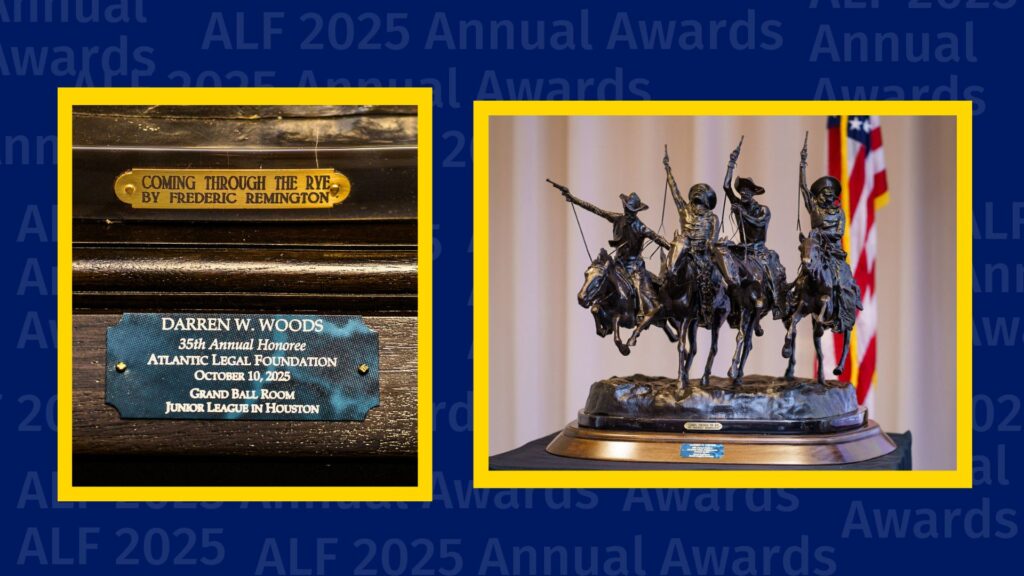
The group is open in its support for ExxonMobil. In the Fall of 2025, ALF hosted a dinner and gave an award to Exxon’s Chairman and Chief Executive Officer, Darren W. Woods. The Exxon head was gifted with a reproduction of Frederic Remington’s sculpture Coming Through the Rye, which depicts a group of drunk cowboys shooting pistols. It begs the question: Is this how they see themselves?
But aside from lauding the largest investor-owned oil and gas company in America, ALF also appointed ExxonMobil employees to its governing and advisory structure. One of ALF’s board of directors is Jeffrey A. Taylor, the Vice President, General Counsel and Secretary of ExxonMobil. Prior to joining Exxon, Taylor worked for Fox, General Motors and Raytheon. And on its advisory council sits Robert L. Levy, a longtime Exxon lawyer who is now a lawyer at the Department of Justice. Throughout the years, ALF has also accepted Exxon funding. Given the cross-pollination, it’s often hard to tell who is whom.
In addition, ALF listed Chevron as a corporate supporter and as a platinum sponsor of its annual dinner host committee in 2025.
ALF’s biggest funder historically is the Mellon-Scaife fortune, which was built through oil, metals, and banking. According to Desmog, the Sarah Scaife Foundation has donated at least $2.5 million to ALF over the years. ALF has also taken money from funds linked to the fossil fuel billionaire Charles Koch.
§ 2 · History of Fronting for the Fossil Fuel Industry
If ExxonMobil is involved in a legal case, you can be sure ALF is never too far behind. The nonprofit was there to file amicus briefs in recent landmark climate liability suits originating in the cities of Baltimore, Honolulu, and Boulder, pushing the oil and gas industry’s federal preemption argument. There, industry defendants believe they are more likely to win their argument that federal law precludes state law for damages against fossil fuel companies for the effects of climate change. In 2025, ALF filed an amicus brief in support of ExxonMobil in Pennsylvania, seeking to overturn a verdict against the firm and in favor of a man who said he developed leukemia from breathing in benzene at a Mobil gas station over a period of years.
ALF has also supported other major fossil-fuel companies. In Chevron U.S.A. Inc. v. Plaquemines Parish, ALF joined the Washington Legal Foundation in urging the Supreme Court to reverse a decision in a case arising from legacy coastal damage litigation against Chevron.
§ 3 · Debunking Phony Fossil Fuel Claims
“The scope of the Clean Air Act is not a vehicle for EPA to address climate change.”
ALF made this false argument before the Supreme Court 20 years ago, essentially adding that all the EPA could do was raise vehicle emission standards. The Supreme Court, which was conservative even then, rejected ALF’s position, ruling that greenhouse gases qualify as “air pollutants” under the Clean Air Act.
“Boulder’s and every other climate-change tort suit also has a transparent political, as well as pecuniary, purpose: destroying the highly regulated oil and gas industry, or at least severely curtailing the entirely legal production, sale, and use of fossil fuels in the United States and abroad.”
That’s not what the lawsuit is about. The purpose of the Boulder case is clearly spelled out, and it’s the central question the court will consider right now: Does federal law preclude state-law claims seeking relief for injuries allegedly caused by the effects of interstate and international greenhouse-gas emissions on the global climate?
Climate change is global and knows no boundaries, therefore states cannot seek redress in the courts for it.
Such as with the tobacco or opioid litigation, states have for a long time used state tort law to seek damages for harms within their borders, even when the conduct happens in multiple state or national jurisdictions.