
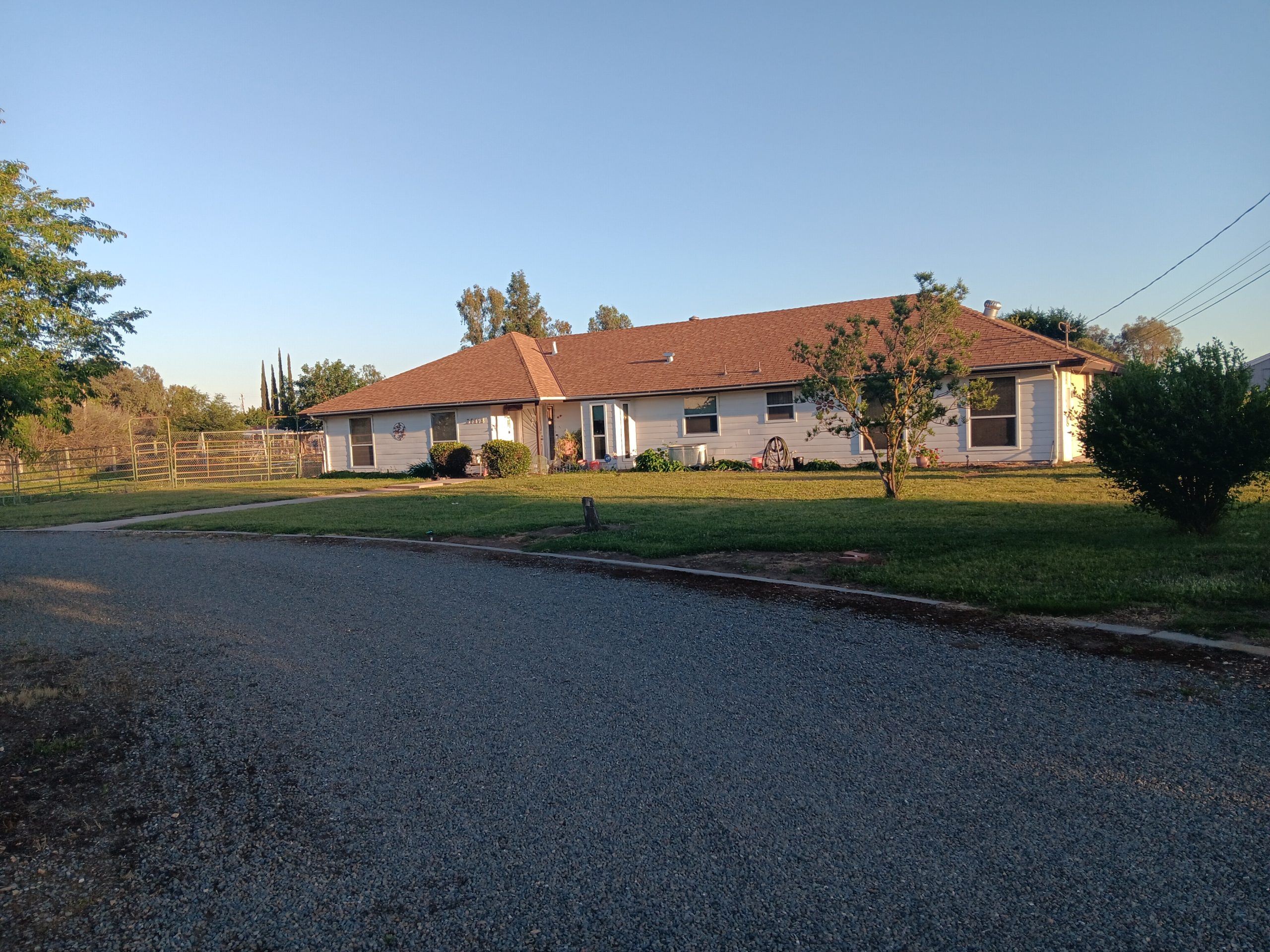
Sharon is a 69-year-old retiree who lives on a two-acre property in Madera. For more than 50 years, Sharon was insured with AAA, carrying homeowners coverage on three main homes and two rental properties. During that time, she never filed a single insurance claim. Yet in August 2024, she received a notice informing her that the company would not renew her policy.
The notice came with a vague explanation stating, “Substantial increase in Hazard.” Sharon immediately contacted the insurer directly to understand why a policy that had remained in good standing for half a century was suddenly being terminated. During that conversation, a company representative told her the issue involved “debris” on her property. To support the claim, AAA later sent a grainy aerial photograph of Sharon’s home without any clear direction as to what she needed to fix.
Sharon lives on rural acreage where she keeps livestock, fosters dogs, and maintains structures typical of small agricultural properties. According to her account, the items the AAA identified as debris were materials she uses regularly for property maintenance and animal care. These included metal roofing panels intended for livestock shelter sheds, large water totes she used during a period when her property temporarily lacked a water supply so she could transport water and keep her trees alive, and livestock panels used to contain animals.
They also questioned stacks of brick pavers that she had been storing on the property.
In her spare time, Sharon frequently fosters dogs and builds kennel areas so she keeps pavers available for those enclosures. The company required her to reduce the stacks from ten pavers high to a single layer. She was also instructed to secure livestock panels to stationary structures despite explaining that the panels were designed with clevis-and-pin connections that prevent them from collapsing or falling.
In Sharon’s view, the items cited by AAA were largely nonflammable materials like metal panels and brick pavers. The only combustible material on the property, firewood, was stored approximately 80 feet away from the home at the opposite end of the property.
Despite her confusion over the company’s assessment, Sharon complied with the requested changes.
“Within a couple of hours, I had it cleaned up and sent them pictures,” she said.
She rearranged materials in the side yard, reduced the height of stacked pavers, and submitted updated photographs to demonstrate the adjustments. What followed was a months-long exchange in which she continued providing images and clarifications until AAA ultimately agreed to renew the policy.
However, the situation resurfaced the following year.
In August 2025, Sharon received another notice of non-renewal. The nonrenewal letter in question appeared identical to the one she had received the previous year. The language was the same, with the only noticeable difference being the change in the calendar year.
The puzzling part was that she had not altered the property since they had approved her renewal in 2024. The layout of the yard, the materials stored on the property, and the structures present were unchanged. After receiving the second notice, she contacted the insurer again seeking clarification. Two weeks later, she received a response indicating the issue had been reviewed and that the property was no longer considered a problem. Her policy was ultimately allowed to continue.
Although coverage remained in place, the annual premium increased significantly from approximately $1,800 to roughly $2,500. Because her homeowners insurance is included in her mortgage escrow account, the increase also affected her monthly housing costs. Her mortgage payment rose from about $857 to roughly $1,200 per month.
As a retiree living on Social Security and a pension from her years working for the State of California, Sharon carefully manages her finances. While the pension provides a measure of stability, she remains concerned about the broader impact of rising insurance costs on homeowners with fewer resources, particularly those living on fixed incomes.
“These kinds of increases matter when you’re on a fixed income. Most people don’t have a pension,” she said. “And that makes me really angry for them.”
The threat of losing coverage forced her to explore alternatives. The only response she received came from an insurance broker who suggested a policy through California’s last-resort insurer, the FAIR Plan. Although the quoted rate appeared somewhat lower, the proposal raised concerns for Sharon because she was told that claim payments were not always guaranteed in the same way as standard policies. The experience led Sharon to contemplate more drastic possibilities.
“I thought, if push comes to shove, if I lose my house, I’ll live in a mobile or an RV on the property.”
At the same time, she has taken steps to ensure that her property presents minimal wildfire risk. Trees are trimmed regularly, and she keeps potentially flammable materials well away from the home. Most trees on the property stand between twenty and forty feet from her home, and the surrounding vegetation is largely ornamental shrubbery. Her roof, which is approximately thirteen years old, remains within its expected service life.
Sharon’s property is also located roughly three miles from the nearest fire station and less than a mile from the closest fire hydrant; factors she believes should be taken into account when insurers evaluate wildfire risk.
The experience has left Sharon deeply frustrated, particularly after sharing her story online and hearing from numerous other homeowners who reported receiving similar non-renewal notices. Some of those individuals, she said, had also maintained coverage with AAA for decades.
After fifty years of coverage without a claim, she expected that her long-standing relationship with AAA would carry some weight. Instead, the process left her feeling that decades of loyalty counted for little when confronted with a form letter and a sixty-day deadline to secure alternative coverage. She acknowledges that she is one of the lucky ones that was able to keep her coverage but that doesn’t lessen the strain of the continuous looming threat of nonerenewal.