
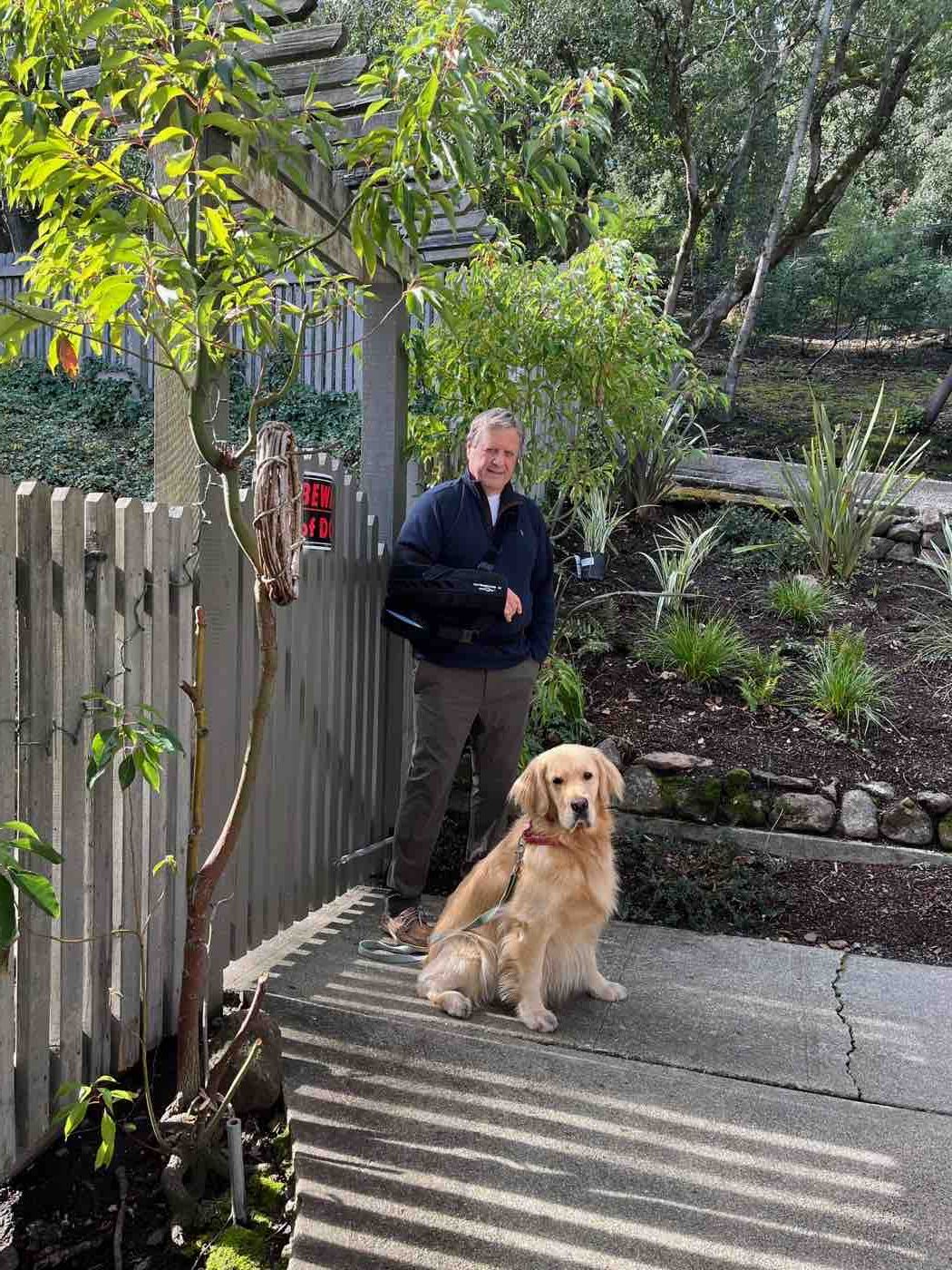
Getting basic information about how insurers arrive at wildfire risk ratings that can send premiums to stratospheric levels has been impossible for homeowner George Braue. George lives in Orinda, a small town in the East Bay Hills.
Braue’s 2,500-square foot home used to be insured for wildfire and liability by a Berkshire Hathaway subsidiary called AmGUARD for under $2,000 a year. Then, about ten months before his coverage was up in August 2024, the company told George they were getting out of California because of the “volatility” of the insurance market.
At that point, he couldn’t find an alternative home insurer and in July 2024 signed up with the California FAIR Plan (CFP). “I went to paying an exorbitant wildfire premium of $8,500 overnight,” George said. CFP requires people to buy additional insurance beyond wildfire called a Difference in Conditions, or “wraparound” policy that pushed the premium to $10,000. Many neighbors have been forced into the same situation, he said.
He quickly ascertained that the premium had something to do with CFP’s wildfire risk rating for his property. The FAIR Plan used a black box software company called Zesty.ai to come up with George’s wildfire risk, according to George’s policy. Zesty assigned him a Level 1 risk score of “moderate,” or 4 out of 10, for the probability of exposure to wildfire. His property’s vulnerability to wildfire—what they call Level 2—was deemed very high or 9 out of 10.
CFP claimed to have used satellite imagery to assess wildfire risk at the property, but no imagery date was provided so it was unclear whether CFP’s imagery was produced before or after the extensive and costly brush clearing that George and his neighbors had already done at the direction of the local fire department. It was also unclear whether the risk assessment was targeting vegetation located on George’s property or vegetation located on neighboring properties, or even whether Zesty AI had looked at the correct property.
George sent CFP an email in August 2024 asking for the data supporting the Zesty AI-supplied risk scores for his property. The response came in December in the form of a CFP “Appeal Receipt Notice” letting him know that his “appeal” would be decided within 30 days of his August 4 email. A few days later he got another notice denying his “appeal,” and confirming Zesty AI’s risk scores for a property located in Valley Springs that George did not own.
“The problem was that I never filed an appeal of my property’s wildfire risk rating. I only asked for info about it,” George said. “And I don’t own any property in Valley Springs, CA. When I called to find out what was going on, the person answering my call at CFP could not even verify that I had an active policy. Is this what the future looks like for all California homeowners who may soon be forced to face the use of catastrophe models by home insurers to rate risk and determine appeals?”
At the beginning of 2025, George found another insurance company, SafePort Insurance, to provide homeowners insurance for about $6,000 a year. The carrier is non-admitted, meaning its rates are unregulated in California though it must meet certain financial standards. If the company, which currently has an A credit rating, becomes insolvent, then no state safety net exists to cover claims.
“That’s still a long way from what I was paying last year at $2,000,” said George. “I am carrying more risk going with them, considering that the state will likely take action to bail out CFP in the event of some cataclysmic event, where the state wouldn’t likely lift a finger to help me collect from SafePort in the same circumstances. That’s why I am focused on reducing local catastrophe risk overall.”
For example, George got conflicting answers on the direction of any catastrophic wildfire coming towards Orinda. The local fire department says the worst-case risk comes from a more northerly direction, while the East Bay municipal district overseeing nearby wildlands says the risk will come from the east. George believes an appropriate state agency, such as the California Office of the Fire Marshall, should make the determination. Then, the Department of Insurance should require that data be incorporated into risk models to adjust premiums. “These wildfire safety issues can’t be left to the myriad agencies that control the wildlands that produce catastrophic events like the Palisades Fire,” he said. The state has to take charge.”
As it is now, “the Insurance Commissioner is proposing to basically give insurance companies blank checks,” said George. “There are no cost estimates or affordability analyses from the Department of Insurance in support of its recent proposals allowing insurers to use catastrophe models or to allow them to pass on reinsurance costs in setting their homeowners premiums. They are just closing their eyes and saying this will bring more insurers into the state. Well maybe. But there is no analysis showing that affordable rates will result from these efforts.”
George put together another complaint to the California Department of Insurance against the FAIR Plan about how his first complaint was mishandled and recently got another denial. “Still no response to my initial request for information,” he said. “If CFP and other insurers using catastrophe models don’t reveal the facts underlying their risk scores, homeowners will not have any effective right to appeal, and the modeling process will remain opaque, at best.”