Los Angeles, CA—California’s bill regulating surveillance pricing, AB 446 (Ward), moves to the Senate after passing an Assembly floor vote this afternoon, 44-16. The bill is now expected to be heard by the Senate Judiciary Committee.
“Companies are using personal data against us to charge people different prices for the same exact product,” said Justin Kloczko, tech and privacy advocate at Consumer Watchdog. “They want to know how bad you want that hat and charge you as much as possible. AB 446 will stop this.”
The bill was introduced by Assemblymember Chris Ward and is co-sponsored by Consumer Watchdog and the United Food and Commercial Workers Western States Council. Assemblymembers Rebecca Bauer-Kahan (D-Orinda) and Rick Chavez Zbur (D-Hollywood) supported the bill during its floor vote.
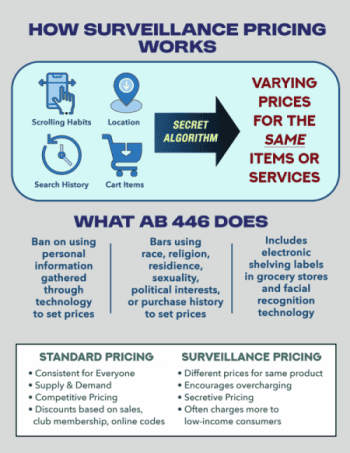
In an era of mass surveillance and rapidly accelerating AI, AB 446 prohibits businesses from using personal information of a consumer to adjust the price of goods, said Consumer Watchdog. Despite California having the strongest data privacy laws in America, there is nothing stopping companies from using personal data to set prices, said the nonprofit.
The bill proposes an outright ban on surveillance pricing, defining it as “offering or setting a customized price for a good or service for a specific consumer or group of consumers, based, in whole or in part, on covered information collected through electronic surveillance technology.”
This include data on a “consumer’s behavior, characteristics, location, or other personal attributes, whether in physical or digital environments.”
The bill has been amended to clarify exemptions. Examples of when surveillance pricing doesn’t happen include when:
- The difference in price is based solely on the costs of providing the service to different consumers.
- A discounted price is offered based on publicly disclosed eligibility criteria, like signing up for a mailing list.
- A discounted price is offered to members of a group, like teachers, veterans, senior citizens, or students.
- A discounted price is offered through a loyalty program that consumers enroll in.
Bill supporters include the American Economic Liberties Project, Consumer Federation of America, EPIC, Consumer Reports, TechEquity, and Privacy Rights Clearinghouse. Those opposed to the bill include the California Chamber of Commerce, the American Advertising Federation, and the California Retailers Association.
Last year, Consumer Watchdog outlined examples of pricing algorithms in a report titled “Surveillance Price Gouging.” (opens in new tab) Companies are trying to read people’s minds and anticipate how bad they want a product and how much they are willing to pay for it, based on data such as scrolling habits and geolocation, said the nonprofit. Orbitz deployed a pricing algorithm assuming that Mac users were wealthier than non-Mac users, and charged them more for hotel rooms. And despite Consumer Watchdog requesting identical rides with the same origin and destination, and the same distance and route traveled, one rider was charged $5 more on Lyft than the other person using Lyft. There shouldn’t be a reason for that, and it’s unclear why, said the nonprofit.
The Federal Trade Commission in the final days of the Biden Administrations said surveillance pricing does happen, (opens in new tab) but the FTC appears to have now bailed on the issue under the Trump FTC, said Consumer Watchdog. California legislators now have an opportunity to address surveillance pricing, said Consumer Watchdog.
“A law regulating surveillance pricing is especially important during a time when grocery prices have increased, the data collected on us is incredibly detailed, and the unprecedented nature of corporate algorithms and AI,” said Kloczko. “This idea that every person has an individual price is a bad one.”View a short Consumer Alert video on surveillance practice here. (opens in new tab)