By Dylan Moroses, LAW360
Law360 (October 8, 2025, 11:47 PM EDT) — Either President Donald Trump doesn’t have authority to impose tariffs under the International Emergency Economic Powers Act Image, or the law is unconstitutional, the nonprofit group Consumer Watchdog told the U.S. Supreme Court Wednesday, urging the justices to affirm lower court rulings deeming those measures unlawful.
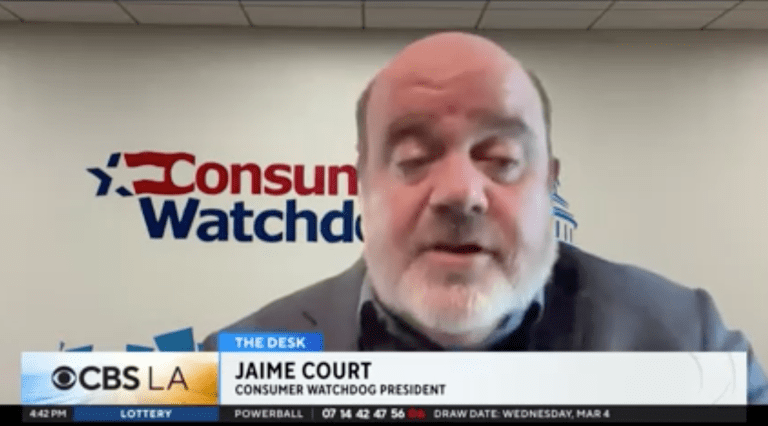
If IEEPA prescribed Trump the power to impose tariffs, the measures under review should be deemed unlawful because they would stand in violation of the nondelegation doctrine, which prevents Congress from delegating its legislative authorities to the executive branch, according to the group’s amicus brief. Consumer Watchdog is a California-based nonpartisan nonprofit representing consumer interests, according to its website.
“This serious constitutional question triggers the canon of constitutional avoidance, which the Government never mentions,” the group said.
The group said that based on the government’s interpretation of IEEPA, imposition of tariffs under the law are absent of statutory procedures laid out for other tariff authorities delegated to the president by Congress, allowing Trump to increase, decrease, delay or extend these IEEPA actions under his seemingly sole discretion.
“That is not law in our constitutional system,” the brief said.
At the Supreme Court, the government is looking to reverse an August Federal Circuit ruling that largely affirmed a CIT judgment that Trump’s tariffs under the IEEPA are unlawful. The government is also arguing that the CIT is the proper venue in a jurisdictional dispute over whether the CIT or district courts should handle IEEPA tariff suits.
The Supreme Court said last month that it would fast-track review of Trump’s appeal of the Federal Circuit ruling, and consolidated it with an accepted petition for review before judgment submitted by a pair of toymakers that challenged the tariffs. The toymakers were awaiting oral arguments at the D.C. Circuit in the government’s appeal of a D.C. federal court ruling that IEEPA doesn’t allow any tariffs.
The parties are challenging tariffs Trump imposed on Mexican, Canadian and Chinese goods in February under IEEPA, declaring a national emergency with respect to illegal fentanyl entering the country. Trump also tapped IEEPA in April to declare a national emergency for persistent U.S. trading deficits and impose the so-called reciprocal tariff regime, which includes a 10% baseline tariff on most imports plus higher rates for many trading partners.
IEEPA, enacted in 1977, authorizes the president to regulate imports “to deal with any unusual and extraordinary threat” to national security, foreign policy or the economy.
The government told the justices in its opening brief last month that IEEPA prescribes the executive broad authority to regulate imports, a power that includes imposing tariffs.
The group said Wednesday that the justices’ ruling in FCC v. Consumer Research, decided in June, should support the idea that IEEPA doesn’t authorize tariffs.
In the FCC case, the majority for the Supreme Court upheld Congress’ delegation to FCC to create a funding mechanism for the Federal Communications Commission’s $9 billion Universal Service Fund, used to subsidize low-income phone service, rural broadband, and school, library and healthcare telecommunications connectivity.
To reach their judgment, the justices examined the extent of FCC’s discretion under the law, whether the delegation itself included sufficient guardrails, and criteria for courts and the public to determine whether the law has been followed.
Consumer Watchdog said IEEPA would plainly fail the assessments laid out in the FCC case.
“The statute’s silence on rate, base, duration, and discrimination is total,” the group said.
The group and U.S. Department of Justice didn’t immediately respond to requests for comment.
Consumer Watchdog is represented by Alan B. Morrison of George Washington University, R. Will Planert and Donald B. Cameron of Morris Manning & Martin LLP, and in-house by Harvey Rosenfield, William Pletcher and Benjamin Powell.
The toymakers are represented by Pratik Shah, James Tysse, Matthew Nicely, Daniel Witkowski and Kristen Loveland of Akin Gump Strauss Hauer & Feld LLP.
The businesses are represented by Neal Katyal, Colleen E. Roh Sinzdak and Samantha K. Ilagan of Milbank LLP, Michael W. McConnell, Steffen N. Johnson and Paul N. Harold of Wilson Sonsini Goodrich & Rosati PC, Jeffrey M. Schwab, Reilly Stephens and James McQuaid of the Liberty Justice Center, and Ilya Somin of George Mason University’s Antonin Scalia Law School.
The states are represented by their respective attorneys general.
The federal government is represented by D. John Sauer, Brett A. Shumate, Sarah M. Harris, Sopan Joshi, Mark R. Freeman, Michael S. Raab, Brad Hinshelwood, Daniel Winik and Sophia Shams of the DOJ’s Civil Division.
The cases are Learning Resources Inc. et al. v. Trump et al., case number 24-1287, and Trump et al. v. V.O.S. Selections Inc. et al., case number 25-250, in the Supreme Court of the United States.