During the signing of the reauthorization bill for cap-and-trade this year, AB 1207 (Irwin), Governor Newsom claimed the bill would result in $60 billion saved in rebates for consumers over 20 years. He has since repeated the claim to suggest his Administration was making energy more affordable.
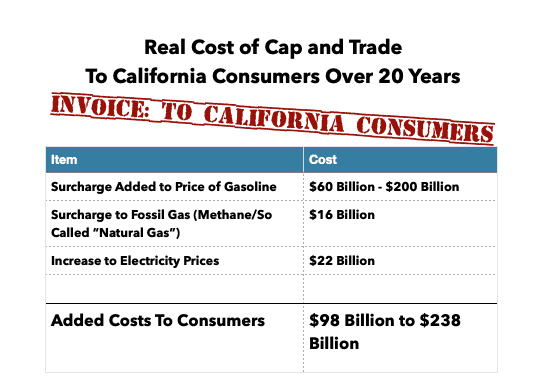
What Newsom didn’t say is that the program will cost consumers between $98 billion and $238 billion over the same time-period as the rebates he touts.
The $60 billion rebate figure is based on roughly $3 billion per year in rebates to utility ratepayers over the next two decades. Customers have been getting those rebates in semi-annual credits on their utility bills for 12 years now. Utilities raise the money for rebates by getting free carbon allowances from the California Air Resources Board (CARB) that they sell at auction. The proviso is they return this money to consumers. But nothing is being “saved.”
Here’s the math: Every time they fuel up, consumers currently pay 22 cents per gallon at the pump to fund the cap-and-trade program. The 22 cents per gallon adds up to $2.95 billion per year (with California consumers buying 13.4 billion gallons of gas annually). Over 20 years, that adds up to roughly $59 billion.
But the prices for cap-and-trade are unlikely to stay that way over 20 years. The price that consumers pay is tied to the price of pollution allowances traded in auctions every year. The California Air Resources Board (CARB) sets a “floor” and “ceiling” on carbon allowance prices. Right now, prices for traded allowances are near their floor, hence the 22 cents per gallon that consumers are paying at the pump.
If prices rise to their ceiling, consumers could face paying 74 cents per gallon, according to the LAO that has done the calculation. That would cost drivers nearly $10 billion per year. That could come to nearly $200 billion over 20 years. A far cry from the $60 billion in “rebates” over the same period.

But on top of that, Californians pay for the cap-and-trade program both in their fossil gas (methane, so-called “natural” gas) and in their electric bills. Cap-and-trade adds 18 cents per therm to fossil gas bills. The average customer in California uses about 400 therms of gas per year. The added cost for cap-and-trade comes to about $72 annually per customer. The state has 11.35 million fossil gas customers, so the cost for cap-and-trade comes to roughly $817.2 million per year. The state has not publicly estimated how much that price could rise over the next 20 years, so that’s anyone’s guess. But, most conservatively, if you multiply $817.2 million over 20 years that comes to $16.3 billion.
Customers pay for cap-and-trade in their power bills. In 2023, cap-and-trade increased residential electricity prices by an average of 1.3 cents per kWh. California’s average residential usage in 2024 was 503 kWh per month which came to 6,036 kWh/year per household. So, the average electricity customer paid $78.47 annually for cap-and-trade. California has 14.2 million electricity customers. So, every year Californians are paying about $1.1 billion for the cap-and-trade program in their power bills. Over 20 years, that comes to $22.3 billion dollars extra out of consumers’ pockets.
Another thing that Newsom didn’t say is that this could happen. Prices depend on CARB and economic factors we can’t control. One question is how fast CARB cuts the number of carbon allowances to make prices rise so industry does more to cut pollution. As it is, the LAO reports that the program consumers support has done little to slash emissions.
Under current rules, allowance prices are likely to rise. The cap that CARB sets on emissions declines by about 4% a year. The allowance price floor also increases annually by 5% plus inflation. If the economy does well, demand for allowances from industry due to increased output would also rise, increasing allowance prices. If summers grow hotter, that will boost fossil fuel use, leading to more demand for allowances. Delays in electrification of buildings—which fossil gas utilities are fighting—would also affect allowance demand and prices.
The cap-and-trade program could incentivize reductions in emissions. That’s a noble goal.
However, to say cap-and-trade saves consumers $60 billion over 20 years when its cost to consumers is between $98 Billion and $238 Billion is a sham. The fact is that cap-and-trade will cost California consumers between one and a half to four times more than it saves them.