Two bills are moving through the California legislature that would lift a state moratorium on building carbon dioxide pipelines. The 2022 moratorium was imposed in the first place because the pipelines are very dangerous and underregulated. AB 881 (Petrie-Norris) and SB 614 (Stern) made it through their houses of origin and are being heard in the opposite house. AB 881 will be heard tomorrow in the Senate Environmental Quality Committee.
AB 881 and SB 614 require the State Fire Marshall to adopt hazardous liquid substances regulations for the transportation of carbon dioxide in pipelines that meet, at a minimum, proposed federal standards. Updated standards have not been finalized by the Pipeline and Hazardous Materials Safety Administration. Passage of the bills would preempt that proceeding now stalled under Trump instead of waiting for its completion, after which California could still impose tougher standards.
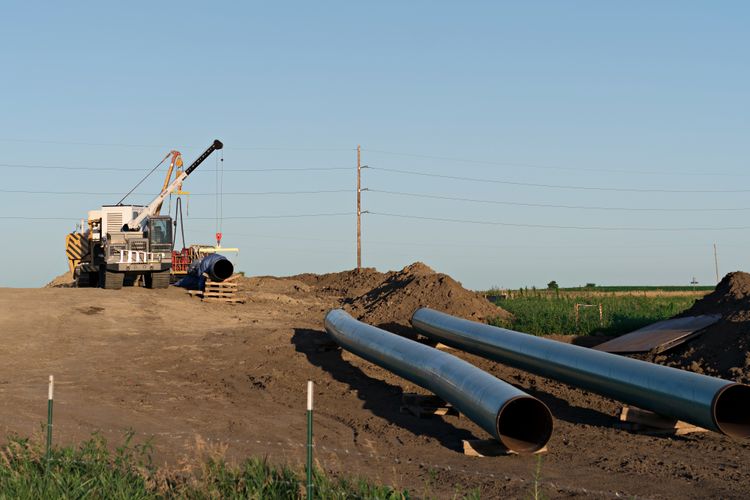
The bills would help accelerate about 13 carbon capture and storage (CCS) projects in California. Big oil and gas companies such as California Resources Corp. (CRC) have such CCS projects in the works. CCS projects will require pipelines to transport compressed carbon dioxide captured at the smokestack to burial via injection wells in geological reservoirs.
The trouble is that pipelines turbocharging the projects and the CCS technology itself are both insidious. Carbon dioxide has unique properties that make ruptures and leaks extremely dangerous to surrounding communties.
“CO2 is a potentially lethal asphyxiant,” according to the Pipeline Safety Trust, a nonprofit public charity. “When released from a pipeline, CO2 will be heavier than air and high-rate releases will form clouds of cold dense gas fog. Upon warming, CO2 plumes flow considerable distances from the pipeline unobserved, traveling over terrain, displacing oxygen while settling or filling in low areas. Oxygen displacement by CO2 gas can cause asphyxiation and lead to death. Oxygen displacement also starves equipment that burns fuel causing it to shut off, potentially including first responder equipment, evacuating cars caught in the expanding release plume, and pilot lights on gas fired equipment.”
That’s exactly what happened in the hamlet of Sartaria, Mississippi, in 2020 when a pipeline carrying compressed carbon dioxide ruptured and released an explosion of carbon dioxide that displaced oxygen. More than 200 people were evacuated and at least 45 people were hospitalized, according to NPR. Symptoms included convulsions and unconsciousness. Luckily, no one died. But cars stalled and an emergency response was hobbled. “In one 911 call, a mother pleaded for help because her daughter couldn’t breathe, her hacking audible in the background,” NPR reported. “Another 911 caller stranded on the highway described what was happening to her friend: ‘She’s laying on the ground and she’s shaking. She’s kind of drooling out of the mouth. I don’t know if she’s having a seizure or not. Can you send somebody quick!’”
But two bills moving now don’t require the addition of an odorant —typically mercaptans—to give it an unpleasant “rotten egg” smell easy for people to detect. Instead, the bills direct the Fire Marshall to consider the addition of an odorant and require the use of an odorant if the Fire Marshall determines it is feasible, safe, and effective. Mandating an odorant by law is critical.
Moreover, pipeline-reliant CCS technology is far from what it’s cracked up to be by the oil industry. Some 76% of 13 “flagship” CCS projects around the world have failed, according to the Institute for Energy Economics and Financial Analysis (IEEFA). Out of the 13 projects, seven underperformed, two failed outright and one was mothballed.
Data show that CCS carbon capture efficiency is significantly lower than advertised due to fossil fuel energy use to power the projects, transportation, leaks, and the use of the carbon dioxide to push more oil out of the ground (though California bans that practice). In addition, the technology contributes pollutants dangerous to nearby communities. “In practice, CCS at best captures only a fraction of carbon emissions and fails to address other harmful pollution from fossil fuel operations, such as nitrogen oxides, fine particulate matter (PM 2.5), as well as other contaminants,” a group of more than 50 health professionals and other experts wrote to Kern County and US EPA officials opposing a California Resources Corp. project slated for Kern County.
A fresh study from Stanford University’s Doerr School of Sustainability shows that carbon capture is more expensive than switching to renewables. “If you spend $1 on carbon capture instead of on wind, water, and solar, you are increasing CO2, air pollution, energy requirements, energy costs, pipelines, and total social costs,” said lead study author Mark Jacobson, a professor of civil and environmental engineering in the Stanford Doerr School of Sustainability and Stanford School of Engineering. “It’s much cheaper and more efficient just to replace the fossil source with electricity or heat provided by a renewable source…The only way to eliminate all air-pollutant and climate-warming gases and particles from energy is to eliminate combustion.”
In the 1950s, as tobacco companies faced mounting evidence that smoking was bad for your health, they invented filters as a way to “capture” harmful smoke and create a “healthy cigarette,” according to s a Harvard Public Health opinion piece by a practicing doctor at the University of Minnesota. In fact, filters did not make smoking safe, but the oil industry is using the same playbook though it’s clear its products hurt people.
“Today, the fossil fuel industry faces incontrovertible science showing its products harm the climate and our health,” the physician wrote. “So, it’s adopting the tobacco industry’s tactics—offering to make fossil fuels ‘healthy’ through their own version of a filter: carbon capture…We know that despite the millions of dollars spent marketing filtered cigarettes, nothing saves lives like quitting smoking. Similarly, no climate change solution will save lives like quitting fossil fuels…Current CCS operations do nothing to reduce the negative heath impacts of fossil fuel pollution because they do nothing to reduce fossil fuel production.”
The state legislature should block these dangerous pipeline bills from advancing until California creates its own regulations that protect communities from the dangers of dedicated carbon dioxide pipelines crisscrossing the state, and only after the federal rulemaking is complete. Governor Newsom and his regulators should understand that CCS only perpetuates the production of oil and gas at a higher cost than a switch to renewables. Oil and gas companies detest that fact, but that doesn’t mean that policymakers should eagerly enable their continued destruction of the environment and climate.