By Megan Fan Munce, Susie Neilson, SAN FRANCISCO CHRONICLE
https://www.sfchronicle.com/california-wildfires/article/underinsurance-legislation-21280891.php
A year after fires razed entire neighborhoods in Los Angeles, California lawmakers unveiled a slate of proposed legislation aimed at protecting wildfire survivors from insurance industry practices that can stall rebuilding and recovery — including at least three bills informed by a Chronicle investigative series that exposed insurers’ hidden cost-cutting practices in L.A. and other fire-ravaged communities across the state.
Last year’s Eaton and Palisades fires collectively destroyed 16,000 structures and killed 31 people, making them two of the deadliest and most destructive wildfires in state history. In the wake of these fires, many survivors complained that dealing with insurance companies was an obstacle to recovery, rather than a source of relief.
The Chronicle’s series found that the state’s largest insurers — including State Farm General and Farmers Insurance Group — have used faulty algorithms and hidden cost-cutting methods in ways that drastically limit payouts to policyholders after wildfires. These practices, some of which operate in regulatory blind spots, have exposed fire survivors to prolonged displacement and financial crisis, the Chronicle found.
The bills aim to close loopholes, improving survivors’ chances at a full recovery by targeting multiple phases of the claims process.
Offering better coverage
Senate Bill 876, a sweeping reform package authored by Padilla and sponsored by California Insurance Commissioner Ricardo Lara, includes three provisions aimed at reducing widespread underinsurance, an issue highlighted in the Chronicle’s investigation.
Under SB 876, residential insurance companies would be required to offer a minimum of 50% extended replacement cost to all policyholders, which many companies already do.
The bill would also require insurance companies to offer the option of a guaranteed replacement cost policy, in which the insurer agrees to replace a policyholder’s property regardless of the cost, albeit for a higher premium. The proposed legislation would also require insurers to automatically increase a home’s coverage limits by an additional 50% if a policyholder lost the home due to a declared emergency. When hundreds or even thousands of homes are destroyed at once in a disaster, such as a wildfire, demand for materials and contractors surges, driving up rebuilding costs.
The issue was the subject of a hearing last May by the California Board of Equalization, which oversees property tax administration in the state; it looked into how the algorithms investigated by the Chronicle could be leading to widespread underinsurance. The board had proposed a number of solutions, including requiring insurers to offer 50% extended replacement cost.
Sally Lieber, chair of the Board of Equalization, said she was looking forward to supporting the legislation in “any way” she could.
Underinsurance “really does destabilize a whole community,” Lieber said. “I know from speaking to fire survivors that no one is where they thought they’d be, in terms of recovery, even after a few years. It’s something that’s going to be even more of a pressing issue in the future, and we’ve got to get it right now.”
Amy Bach, executive director of the consumer advocacy group United Policyholders, told the Chronicle that her group has backed several attempts to solve underinsurance over the years, including through consumer education and regulations that place requirements on how insurance companies are allowed to calculate replacement costs.
“We think requiring 50% extended replacement cost endorsements that kick in after declared disasters is what has to happen,” Bach said by email.
SB 876 would also implement a number of changes meant to aid fire survivors during the claims process, including by requiring insurers to provide “recovery plans” to the Insurance Department for review ahead of disasters and doubling penalties for insurers that violate state law during declared emergencies.
Increasing transparency
SB 877, co-authored by state Sens. Sasha Renée Pérez, D-Pasadena, and Ben Allen, D-Santa Monica, would require insurers to disclose to policyholders how they calculated their repair estimates, plus all of the steps they took to edit those estimates — including who made changes to each estimate, and when and why those changes were made.
“What’s happening is insurers are altering, reducing or entirely rewriting the original estimate to lower the insurance payout that the homeowner receives,” Pérez said in a press conference held on the anniversary of the fires. “This tactic delays payments, exhausts survivors and pressures families to settle for less than they are owed.”
Pérez told the Chronicle that existing state law requires insurers to keep records of claims-related documents, but her legislation strengthens requirements for insurers to share those documents with their customers. She took inspiration from similar laws in Florida and other states.
“These are straightforward policies that other states have enacted, and I think we need to do the same and think about how to be even more forward-thinking in the future,” she said.
The bill follows a Chronicle investigation that found insurers used hidden in-house manuals to edit down fire survivors’ claims, to the point where they were unable to get their homes repaired or remediated for the prices insurers were initially willing to pay on paper.
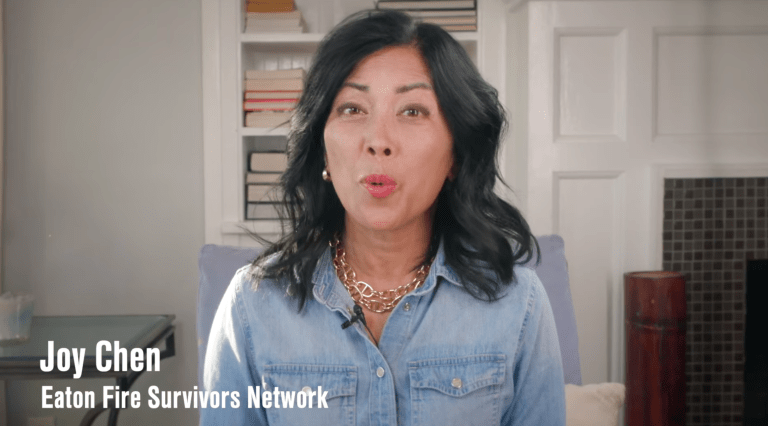
Pérez said the issue was one that came up frequently in her work with constituents following the fires and her conversations with the Eaton Fire Survivors Network, a coalition of wildfire survivors. The legislation was also supported by Consumer Watchdog, a consumer advocacy group.
Penalizing insurers for delayed payments
SB 878, also co-authored by Pérez and Allen, would penalize insurance companies for delaying payments to policyholders by charging them interest penalties. The bill, which would take effect next January, would charge interest rates of 20% on payments delayed without explanation. It would also require insurers to provide data on how well they were complying with existing regulations around prompt payments. Current state law requires insurers in most cases to pay claims no more than 30 days after they have determined the claim is covered. Pérez said a similar law already exists in Texas and other states.
In the press conference, Pérez called systematic delays of claims payments “a common tactic used by the industry,” adding: “Eaton and Palisades wildfire survivors have learned that insurance companies do not have to deny a claim to devastate a family, they only have to delay it.”
In their press release, Consumer Watchdog cited the Chronicle’s series as having informed both of Pérez’s and Allen’s bills.
The newspaper’s reporting, the group said, “exposed” insurers’ hidden claims-cutting practices and found that delays in payments “are often driven by internal insurer adjuster guidance to avoid written decisions and prolong claims — effectively bypassing prompt-payment rules.” Industry representatives have said these practices are necessary to prevent contractors from committing fraud to maximize their payouts.
For Malibu homeowner Chad Peters, the news that in the future insurers could be penalized for the kind of treatment he experienced brought mixed feelings: excitement at the fact that possible reforms were on the horizon, and frustration at how many had faced similar challenges.
The Chronicle detailed Peter’s case in its December investigation into insurers’ hidden claims-cutting rules, including ones that instruct adjusters to avoid putting denials down in writing, prolonging policyholders’ claims processes. By the time the Chronicle’s article ran, nearly a year after the Palisades fire, he had still not received a comprehensive insurance estimate for the potentially $1 million of damage to his home. Yet after the Chronicle’s article ran, Peters said his insurer, State Farm, finally said they would be sending a higher estimate his way.
“I don’t want this to happen to anyone ever again in a million years,” he said. “I wish they just did the right thing from the beginning.”
What comes next?
California’s legislature reconvened on Jan. 5, and legislators have until Feb. 20 to introduce new legislation.
At the Wednesday press conference, Assembly Member John Harabedian, D-Pasadena, promised to address the most pressing issues survivors had faced in L.A. with more legislation.
“Many of you didn’t know that you were underinsured; we are going to fix that. We are going to make sure that no one is denied smoke damage claims. It is unbelievable what we’re seeing,” Harabedian said.
Pérez told the Chronicle she was also researching additional bills she might introduce later in the session.
Denni Ritter, vice president of state government relations for the American Property and Casualty Insurance Association, an industry group, told the Chronicle in a statement that her group was closely reviewing the newly proposed legislation.
As of November, insurers have paid more than $22.4 billion back to wildfire survivors, according to data from the Department of Insurance. Of the more than 42,000 claims submitted in the wake of the fires, about 94% have been at least partially paid, the data shows.
“Insurers are deeply committed to paying claims fairly, promptly, and transparently,” Ritter said. “Any reforms must strike the right balance — strengthening consumer protections while preserving access to affordable, reliable coverage and avoiding unintended consequences that could further destabilize the market.”
Asked if Lara anticipated insurance industry pushback to the bill he sponsored with Padilla, Deputy Insurance Commissioner Michael Soller told the Chronicle, “Yes, and that’s never stopped him before.”